13 Mar 13:30
by Shixiong She, Gangping Su, Bo Wang, Quan Lei, Yan Yang, Li Gong, Beibei Liu
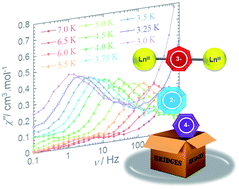
Two Dy compounds, [Dy2(Phen)2(CH3COO)6] (1; Phen = 1,10-phenanthroline) and [Dy(Phen)2(NO3)3] (2), were obtained by the reactions of Phen with different dysprosium salts containing different anions, which act as bridging groups and greatly affect the coordination polyhedra of the metal ions. In the former complex, the DyIII ions are bridged by acetate anions and adopt a spherical capped square antiprismatic (C4v) coordination environment, whereas a bicapped square antiprism (D4d) was observed for 2, in which the DyIII ions are bridged by nitrate anions. Static and dynamic magnetic measurements revealed that both compounds display slow magnetic relaxation but with fast quantum tunneling of magnetization (QTM). In an applied direct-current (dc) field, the QTM was suppressed, and two slow magnetic relaxation processes occurred for both compounds. Comparative studies on the magnetic properties indicate how the ligand field and the local geometric symmetry of the magnetic anisotropy of the DyIII center leads to differing magnetic behavior.

Two Dy compounds, [Dy2(Phen)2(CH3COO)6] (1, Phen = 1,10-phenanthroline) and [Dy(Phen)2(NO3)3] (2), are obtained. The coordination geometries of the DyIII ions in 1 and 2 are C4v and D4d, respectively. Static and dynamic magnetic measurements reveal that both of them display two-step thermal magnetic relaxation under an external direct-current (dc) field and show single-molecule magnetism.
13 Mar 13:18
by Pei-Pei Cen, Sheng Zhang, Xiang-Yu Liu, Wei-Ming Song, Yi-Quan Zhang, Gang Xie and San-Ping Chen

Inorganic Chemistry
DOI: 10.1021/acs.inorgchem.7b00057

13 Mar 13:13
Chem. Sci., 2017, 8,3419-3426
DOI: 10.1039/C7SC00739F, Edge Article

Open Access
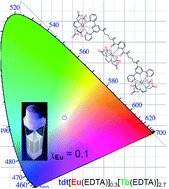
Oxana Kotova, Steve Comby, Christophe Lincheneau, Thorfinnur Gunnlaugsson
Herein, we have developed a white-light-emitting system based on the formation of discrete lanthanide-based self-assembled complexes using a newly-designed ligand. We demonstrate that fine tuning of the lanthanide ions molar ratio in the self-assemblies combined with the intrinsic blue fluorescence of the ligand allows for the successful emission of pure white light with CIE coordinates of (0.33, 0.34).
The content of this RSS Feed (c) The Royal Society of Chemistry

02 Mar 09:35
by Yan-Cong Chen, Jun-Liang Liu, Yanhua Lan, Zhi-Qiang Zhong, Akseli Mansikkamäki, Liviu Ungur, Quan-Wen Li, Jian-Hua Jia, Liviu F. Chibotaru, Jun-Bo Han, Wolfgang Wernsdorfer, Xiao-Ming Chen, Ming-Liang Tong
Abstract
Invited for the cover of this issue is the group of Ming-Liang Tong at the Sun Yat-Sen University and collaborators in France, China, and Belgium. The image depicts the magnetic hysteresis and the fluorescence of a pentagonal bipyramidal DyIII single-ion magnet. Read the full text of the article at 10.1002/chem.201606029.

“We are most excited about the discovery of the fluorescence fine structure in this system.” Read more about the story behind the cover in the Cover Profile and about the research itself on page ▪▪ ff. (DOI: 10.1002/chem.201606029).
02 Mar 09:35
by Takefumi Yoshida, Goulven Cosquer, David Chukwuma Izuogu, Hiroyoshi Ohtsu, Masaki Kawano, Yanhua Lan, Wolfgang Wernsdorfer, Hiroyuki Nojiri, Brian K. Breedlove, Masahiro Yamashita
Abstract
Heterometallic Gd−Pt complexes ([Gd2Pt3(H2O)2(SAc)12] (SAc=thioacetate), [Y1.4Gd0.6Pt3(H2O)2(SAc)12], and [Gd2Pt3(H2O)6(SAc)12]⋅7 H2O have been synthesized. The crystal structures and DFT calculations indicated a Gd−Pt heretometallic bond. Single-crystal ESR spectra determined the direction of magnetic anisotropy as direction of the Gd−Pt bond. In other words, the Gd−Pt bond dictates the direction of magnetic anisotropy. The heterometallic Gd−Pt bond lowers the symmetry of the Gd ion, splitting the Kramers doublet in a dc field. Thus, we observed clear field-induced slow magnetic relaxation of [Y1.4Gd0.6Pt3(H2O)2(SAc)12] up to 36 K. The relaxation process was determined to be a direct process.

Relax and go slow! A new strategy is reported in which a diamagnetic Pt ion was used as a ligand on a Gd ion to bring about SMM-like behavior in a Gd complex. The heterometallic Gd−Pt bond lowers the symmetry of the Gd ion, splitting the Kramers doublet in a dc field. Thus, the complexes should undergo slow magnetic relaxation.
01 Mar 12:56
by Yan-Cong Chen, Jun-Liang Liu, Yanhua Lan, Zhi-Qiang Zhong, Akseli Mansikkamäki, Liviu Ungur, Quan-Wen Li, Jian-Hua Jia, Liviu F. Chibotaru, Jun-Bo Han, Wolfgang Wernsdorfer, Xiao-Ming Chen, Ming-Liang Tong

The pentagonal bipyramidal single-ion magnets (SIMs) are among the most attractive prototypes of high performance single-molecule magnets (SMMs). A fluorescence-active phosphine oxide ligand is introduced, and by combining dynamic magnetic measurements, optical characterization, and ab initio calculations, the magneto-optical correlation of a high-performance pseudo-D5h DyIII SIM with large Ueff = 508(2) K and high magnetic hysteresis temperature of 19 K, [Dy(CyPh2PO)2(H2O)5]Br3⋅2 (CyPh2PO)⋅EtOH⋅3 H2O (CyPh2PO= cyclohexyl(diphenyl)phosphine oxide) was studied. This work provides a deeper insight into the rational design of promising molecular magnets. More information can be found in the Full Paper by M.-L. Tong, J.-L. Liu, et al. (DOI: 10.1002/chem.201606029).
28 Feb 08:36
by Arkadiusz Kornowicz, Michał Terlecki, Daniel Prochowicz, Céline Pichon, Iwona Justyniak, Wojciech Bury, Zbigniew Wróbel, Jean-Pascal Sutter, Janusz Lewinski
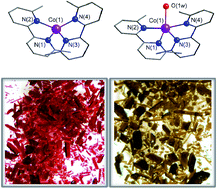
A new synthetic procedure was developed to obtain a novel mononuclear chiral square-pyramidal (acetato)bis(aminoalkoxido)MnIII complex from a heterometallic ZnII/MnII system with a crucial role for O2 in the process. The resulting compound was characterized spectroscopically and crystallographically, and its magnetic properties were determined. The MnIII ion exhibits magnetic anisotropy with a zero-field splitting D parameter equal to –2.95 cm–1.

A new synthetic procedure is developed to obtain a novel mononuclear chiral square-pyramidal (acetato)bis(aminoalkoxideo)MnIII complex. The resulting compound is characterized spectroscopically and crystallographically, and its magnetic properties are determined.
27 Feb 09:03
by Anatoly Buchachenko and Ronald G. Lawler

Accounts of Chemical Research
DOI: 10.1021/acs.accounts.6b00608

14 Feb 11:27
Phys. Chem. Chem. Phys., 2017, 19,7326-7332
DOI: 10.1039/C7CP00048K, Paper
Youngho Cho, Si Won Song, Soo Yeong Lim, Jae Hun Kim, Chan Ryang Park, Hyung Min Kim
Although upconversion phosphors have been widely used in nanomedicine, laser engineering, bioimaging, and solar cell technology, the upconversion luminescence mechanism of the phosphors has been fiercely debated.
The content of this RSS Feed (c) The Royal Society of Chemistry

14 Feb 11:22
Chem. Sci., 2017, 8,3694-3702
DOI: 10.1039/C6SC05188J, Edge Article
Open Access
J. Vallejo, E. Pardo, M. Viciano-Chumillas, I. Castro, P. Amoros, M. Deniz, C. Ruiz-Perez, C. Yuste-Vivas, J. Krzystek, M. Julve, F. Lloret, J. Cano
We have developed a new strategy for the design and synthesis of multifunctional molecular materials showing reversible magnetic and optical switching.
The content of this RSS Feed (c) The Royal Society of Chemistry

06 Feb 10:24
by Colin A. Gould, Lucy E. Darago, Miguel I. Gonzalez, Selvan Demir, Jeffrey R. Long
Abstract
Assembly of the triangular, organic radical-bridged complexes Cp*6Ln3(μ3-HAN) (Cp*=pentamethylcyclopentadienyl; Ln=Gd, Tb, Dy; HAN=hexaazatrinaphthylene) proceeds through the reaction of Cp*2Ln(BPh4) with HAN under strongly reducing conditions. Significantly, magnetic susceptibility measurements of these complexes support effective magnetic coupling of all three LnIII centers through the HAN3−. radical ligand. Thorough investigation of the DyIII congener through both ac susceptibility and dc magnetic relaxation measurements reveals slow relaxation of the magnetization, with an effective thermal relaxation barrier of Ueff=51 cm−1. Magnetic coupling in the DyIII complex enables a large remnant magnetization at temperatures up to 3.0 K in the magnetic hysteresis measurements and hysteresis loops that are open at zero-field up to 3.5 K.

A DyIII HAT Trick: Magnetic coupling between three lanthanide ions is established through a central organic radical bridging ligand in Cp*6Ln3(μ3-HAN) (Cp*=pentamethylcyclopentadienyl; Ln=Gd, Tb, Dy; HAN=hexaazatrinaphthylene). Coupling in the DyIII congener enables a large remnant magnetization up to 3.0 K in the magnetic hysteresis measurements and hysteresis loops that are open at zero-field up to 3.5 K.
06 Feb 09:35
by Albert Escuer, Julia Mayans, Merce Font-Bardia, Lorenzo Di Bari, Marcin Górecki

The cover picture shows space-filling plots of two enantiomeric MnIII triangles and their electronic circular dichroism (ECD) spectra against a background featuring an enantiomeric image from the macroscopic world. Details are discussed in the article by A. Escuer et al. on page 991 ff (DOI: 10.1002/ejic.201601138). For more on the story behind the cover research, see the Cover Profile (DOI: 10.1002/ejic.201700078).
06 Feb 09:34
by Thomas Just Sørensen, Manuel Tropiano, Alan M Kenwright, Stephen Faulkner
Three molecular structures, each containing three different lanthanide(III) centres, have been prepared by coupling three kinetically inert lanthanide(III) complexes in an Ugi reaction. These 2 kDa molecules were purified by dialysis and characterised by NMR and luminescence techniques. The photophysical properties of these heterotrimetallic complexes were investigated and are discussed by comparison with simpler, but related, heterodimetallic compounds. It was found that an aminonaphthalene unit inhibits the sensitisation of terbium, and that the spatial arrangement of the chromophores and lanthanide(III) centres in these molecules inhibits the efficient sensitisation of europium. We conclude that the intramolecular collisions required for efficient Dexter energy transfer from the sensitiser to the lanthanide(III) centre can be prevented by steric congestion.

We have prepared large distinct heteronuclear lanthanide architectures from kinetically inert building blocks. By combining optical and magnetic resonance spectroscopy, we are able to conclude that conformational freedom allowing for intramolecular collision is more important than apparent proximity for efficient energy transfer.
09 Jan 12:46
by Haolin Yin, Patrick J. Carroll, Brian C. Manor, Jessica M. Anna and Eric J. Schelter

Journal of the American Chemical Society
DOI: 10.1021/jacs.6b02248

09 Jan 12:19
by Hisami Wada, Sayaka Ooka, Tomoo Yamamura and Takashi Kajiwara

Inorganic Chemistry
DOI: 10.1021/acs.inorgchem.6b01764

09 Jan 12:18
by Michele Vonci, Marcus J. Giansiracusa, Willem Van den Heuvel, Robert W. Gable, Boujemaa Moubaraki, Keith S. Murray, Dehong Yu, Richard A. Mole, Alessandro Soncini and Colette Boskovic

Inorganic Chemistry
DOI: 10.1021/acs.inorgchem.6b02312

09 Jan 12:18
by Jing-Yuan Ge, Long Cui, Jing Li, Fei Yu, You Song, Yi-Quan Zhang, Jing-Lin Zuo and Mohamedally Kurmoo

Inorganic Chemistry
DOI: 10.1021/acs.inorgchem.6b02243

09 Jan 12:01
by Julia Gutiérrez Seijas, Jesús Prado-Gonjal, David Ávila Brande, Ian Terry, Emilio Morán and Rainer Schmidt

Inorganic Chemistry
DOI: 10.1021/acs.inorgchem.6b02557

09 Jan 11:39
Chem. Sci., 2017, 8,2073-2080
DOI: 10.1039/C6SC04465D, Edge Article
Open Access
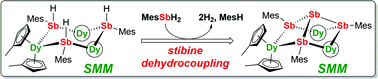
Thomas Pugh, Nicholas F. Chilton, Richard A. Layfield
The synthesis of antimony-ligated dysprosium SMMs is described in addition to the unexpected reactivity of the SMMs in stibine dehydrocoupling catalysis.
The content of this RSS Feed (c) The Royal Society of Chemistry

09 Jan 11:04
Chem. Sci., 2017, 8,231-240
DOI: 10.1039/C6SC01224H, Edge Article
Open Access
Katie L. M. Harriman, Jennifer J. Le Roy, Liviu Ungur, Rebecca J. Holmberg, Ilia Korobkov, Muralee Murugesu
Lanthanide inverse sandwich compounds of the cycloheptatrienyl trianion give rise to ferromagnetic exchange and slow relaxation of the magnetisation.
The content of this RSS Feed (c) The Royal Society of Chemistry

No more posts. Check out what's trending.