Shared posts

06 Oct 23:18

When I'm Gone

by Jason Kottke

In this story by Rafael Zoehler, a father who dies at 27 wrote his son a series of letters to be opened at several of life's milestones, including WHEN YOU HAVE YOUR FIRST KISS, WHEN YOU BECOME A FATHER, and WHEN YOUR MOTHER IS GONE. This letter was entitled "WHEN I'M GONE":

Son,

If you're reading this, I'm dead. I'm sorry. I knew I was going to die.

I didn't want to tell you what was going to happen, I didn't want to see you crying. Well, it looks like I've made it. I think that a man who's about to die has the right to act a little bit selfish.

Well, as you can see, I still have a lot to teach you. After all, you don't know crap about anything. So I wrote these letters for you. You must not open them before the right moment, OK? This is our deal.

I love you. Take care of your mom. You're the man of the house now.

Love, dad.

PS: I didn't write letters to your mom. She's got my car.

(via @Atul_Gawande)

Tags: crying at work   death   Rafael Zoehler
06 Oct 22:59

Two Years with The Old Reader!

I am admittedly a little late to the game to celebrate our two year anniversary running The Old Reader.  Regardless, I’ve been wanting to take the opportunity to look back on these two years and reflect upon how much we’ve enjoyed the process. As many of you remember, we took over The Old Reader during a time when Google Reader was in the process of shutting down. The Old Reader was getting flooded with new users and the original development team was planning to close its doors as well. Performance in The Old Reader was really poor during that time and we spent the first year fixing performance (we’ve now been running at 99% up-time for two solid years) and rolling out our premium offering. We’re grateful for all users in The Old Reader community, but our premium users have kept us afloat and given us the much needed resources we need to maintain and improve this valuable service. Thank you premium users!

As we’ve said repeatedly, we believe in RSS to its core. We look at RSS not as a dying technology, but as a stable and established foundation and protocol that is essential to the internet. We also continue to believe that it will grow over the years to come. Why? Because the internet at its best and most secure is a distributed model. There shouldn’t be a single network (like Facebook) that controls what we read and see on the internet. That’s way too risky for all of us. What good is net neutrality legislation if we’re all willingly submitting to a single private network? Or a single video service? RSS gives us a mechanism to pull from multiple distributed publishers. You can change your RSS reader, you can change your subscriptions. There’s no single party that can change an algorithm to disrupt the way you get information. There’s no single point of failure.

In year two with The Old Reader we made some controversial changes. And we’ve learned a lot. We are continuing to try to find ways to increase our operating revenue so that we can improve our platform and help to grow RSS as a whole. We have lots of plans, but plans cost money to implement. So we tried rolling out some ads to a subset of our users. The vast majority of our users were accepting of that experiment but we did lose some users and some good faith along the way. And we understand why, we’d love to operate without ads. We also rolled out a sponsored posts program which has been very well accepted by our users. In fact, most sponsored posts result in significant numbers of new RSS subscribers for sponsors and tens of thousands of engagements. So we likely won’t be getting rid of our sponsored posts program, but are seriously considering completely getting out of the ad game again. In fact, we’ve had it turned off entirely for the past two months. We look forward to getting your input and will take it to heart. That’s a promise.

It’s been a great two years and we’re very excited for year three. Thanks for using The Old Reader and being a part of our community. You guys mean the world us!

06 Oct 22:40

Don’t base your business on a paid app

by David
Ben Wolf

That link to Tweetbot is interesting.

The App and Play stores have turned out to be exceptionally poor places to run a software product business for most developers. They’re great distribution channels for service makers, like Facebook or Lyft or Basecamp, but they’re terrible places to try to make a living (or better) selling software products.

At a buck or few per app, how could it be otherwise? That type of pricing will work for Angry Birds and a handful of other games, but very poorly for most other types of software products. The scale you need, the sustained influx of new customers, well, it’s a place for mega stars, and people who think they can beat the odds at becoming just that.

That’s why I’ve been discouraging people from chasing dreams of a successful, sustainable software product business by pursuing paid apps. Far better be your odds at succeeding with a service where the app is simply a gateway, not the destination.

Watching users of Tweetbot heckle the team for daring to charge $5 for a 8-month upgrade only reaffirms that belief. It’s a sad sight of entitlement, but at this point also entirely predictable.

Apple and Google both benefit from having apps be as cheap as possible. For Apple, that means people will buy an iPhone more readily when the cost to fill it with software is near nil. For Google, it means app makers have to shove ads into products to make them pay. Win-win-lose.

What’s good for platform makers is often not good for those who build upon it. That’s where the whole picking up pennies in front of a steamroller comes from. Yes, a few may be quick enough to pickup enough pennies to fill a jar, but for most, it’s not a wise trade of risk vs reward.

Forget the paid app.

04 Oct 00:40

Watkins Family Hour: Tiny Desk Concert

by Bob Boilen
Ben Wolf

This is the best.

With help from Fiona Apple, two Nickel Creek alums gather a band to perform old and new material. Watch the Watkins Family Hour perform three charming, country-flavored songs at the NPR Music offices.

01 Oct 13:48

Whistleblower Edward Scissorhands

by Jason Kottke

HLN (which used to be CNN Headline News) needed someone to talk about Edward Snowden, US government whistleblower. They meant to invite a gentleman named John Hendren, a journalist for Al Jazeera, onto the show but instead invited funnyman Jon Hendren, who goes by the username of @fart on Twitter. Hendren, Jon used the opportunity to defend both Edward Snowden, briefly, and then sexy-but-misunderstood barber Edward Scissorhands.

Well, you know, to say he couldn't harm someone, well, absolutely he could. But I think to cast him out, to make him invalid in society, simply because he has scissors for hands, I mean, that's strange. People didn't get scared until he started sculpting shrubs into dinosaur shapes and whatnot.

The best part is that anchor Yasmin Vossoughian just keeps on plowing right through her script like they're not talking suddenly about a man with scissors for hands, deftly demonstrating what a farce these TV news "conversations" are. (via nymag)

Tags: Edward Scissorhands   Edward Snowden   John Hendren   Jon Hendren   journalism   movies   TV   video   Yasmin Vossoughian
29 Sep 13:40

Is productivity software making us less productive?

by Ezra Klein

I'm Ezra Klein, and I'm addicted to productivity software. Evernote, Google Drive, Momentum (particularly the Chrome extension aimed at to-do lists, but I also use the habit-tracking iOS app), Fantastical, Slack, Dropbox ... I use it all.

But I'm particularly addicted to Trello, which is a visual task board where I organize everything from pieces I want to write to movies I want to see to meetings I need to attend. And I'm not alone. The company recently announced it's hit 10 million users, and it launched a new, more powerful product for enterprise users.

Michael Pryor is Trello's CEO, and so he has an unusually clear vantage point into the habits of, well, productivity app addicts like me. So when I got a chance to sit down with him recently, I asked him whether he thinks people using all these productivity applications are actually making themselves any more productive — or whether we've just found a new and more socially acceptable way to waste time.

Pryor, happily, was willing to entertain the question. A transcript of our conversation, edited for length and clarity, follows.

Ezra Klein

I use Trello and I use Evernote, and now I have Slack and Momentum and Google's suite of services, and simply keeping them all updated and current takes a lot of time. Do you think there's a point of severely diminishing returns? Is there a point where people get too into all this productivity software and it all becomes a drag on their productivity?

Michael Pryor

Absolutely. One of our first products was a bug tracking application for software developers called FogBugz. When we built it — this was a decade ago — the bug tracking app that everyone used was a thing called Bugzilla, and, basically, when you went to make a new bug, you had to fill in, like, 40 fields. It was things like, "What computer version is it, which operating system, what was the priority, what was the severity," and developers hated it because it took 20 minutes to enter a bug. So they just wouldn't use it. So in our product, you basically make a bug with just a title. That's the only thing you need to supply. If people need the other information, they'll be able to get it.

With Trello, the idea was to make a collaboration app that was visually restricted. Essentially, how much stuff you can put on a board is limited because it just gets overwhelmingly difficult to put more than what you see on the board itself.

There are people who get a lot of enjoyment out of spending all this organizational time keeping their life in perfect order, but that's not how I operate. For me, it's a matter of just prioritizing. There's way too much stuff, so I have to pick out what's important right now for me to focus on.

Ezra Klein

I have this theory that people overestimate the hassle of how hard it is to fix things when they go wrong and underestimate the hassle of the buildup of small things we do every day to keep them from going wrong. I feel this way about a lot of zero-inbox efforts. I think people overestimate the difficulty of just searching to find things in your email, and they underestimate the hassle of constantly, continually, killing or sorting every piece of email they get. When you add all that up, it's a really big cost.

Michael Pryor

I think you told me before that you just never clear your inbox.

Ezra Klein

Absolutely never. I use Gmail, and it's got that priority inbox function. It's actually pretty good. I find there's very little that slips through that I wanted to see. But the problem for me is it's become good enough that I really don't check the non-priority inbox, so I have no idea what's slipping through at this point.

Michael Pryor

Right. I'm exactly the same way.

Ezra Klein

But I think that's a good example. The work of checking the non-priority inbox to make sure I never miss an email I wanted to see is much more than the work of apologizing if somebody sends me an email that I didn't get. Related to this, you use Slack, right?

Michael Pryor

Yes.

Ezra Klein

What is your confidence level that Slack is productivity-enhancing rather than productivity-depressing for your employees?

Michael Pryor

This is tricky. One thing I notice is that most of the chat activity is actually direct messaging in our organization. Like, 70 percent. You could sort of read that either way. Are people just chatting and gossiping and talking? Or are they just actually getting work done and it's perfect because now it's not interrupting anybody else? So there's that.

In our particular case, our company is half-remote. If everyone were in the same office, I think the way we use chat would be a lot different. For now, there's a certain element of talking about not-work stuff that's appropriate and part of building a relationship with the people you work with. We would need that a lot less if people were all in the same space.

So I think Slack has allowed us to be a remote company and be more connected than we would be otherwise. If we didn't have chat, I don't know if we would be able to be completely remote. We'd have Trello, where we would be doing our actual work, but it would be much harder to have a sense of culture and community in the company.

Ezra Klein

We're 95 percent in the same office, and it's I think a real testament to what a usable, delightful product Slack is that it has almost entirely overtaken vocal communication. We joke that meetings are just live Slacks. The reason I worry about Slack is I think it's created a weird third category of work-like goofing off. It's created this thing that you have to pay attention to, and it feels like it's part of your job to pay attention to it, but primarily what's happening in it is not that relevant to your work.

You look in your Slack sidebar and there are all these messages you haven't read. It gets under your skin. People really feel like they need to be following it. They're working on something and then they click quickly back to Slack to make sure they're keeping up, because it feels like if you don't keep clicking back, you're going to fall irretrievably behind and come back and have a million messages to read. That's work they're doing, and it's work they're feeling tired from doing, but it's not helping the organization or them very much.

Michael Pryor

Yeah. I agree 100 percent. It's not really Slack, it's chat, right?

Ezra Klein

Yeah, it's all chat.

Michael Pryor

Since we both use Slack, that's why we're saying Slack. I think a lot of the software developers have gotten very good at quitting out of chat and setting aside large amounts of time to not be distracted by that. It's like, don't just read about work, go make work — go make stuff that's going to make people buy more of our stuff.

Ezra Klein

One of the things I think about with all this software is the tyranny of the to-do list. There's a bias toward highly structured things that can be broken down into a task versus more unstructured work that doesn't easily break down into tasks but might be more important.

So, for instance, if I have a piece to edit, that's very easy to put on my to-do list, and very easy to keep in front of me until I get it done. Spending two and a half hours just reading things that catch my eye isn't really a task in the same way — there's no deadline, no one is making me do it — but it's important for long-term creativity. But because I have this huge to-do list of discrete tasks, I worry my time is biased against more unstructured kinds of work and learning.

Michael Pryor

I think part of the trick to getting stuff done is having the right perspective. At Trello, we have a board for the whole company that describes our current goals, basically, and how the projects we're working on are accomplishing those goals. But there's not a lot of meat in that board; if you wanted to actually know what was going on with any one of those particular projects, you'd have to drill down to a different board. So that allows me to look at the company from a broader perspective and not be inundated with all this information that's coming across at too low a level of detail.

But I've gone in my career from being a developer where I was writing code and producing things to now being in a position with a lot more interruption. My calendar is just full, people have questions, problems come up, etc. I don't have those big blocks of time to get creative work done, so that part of my job just suffers. I don't get to write code anymore, because I'll just never be able to cordon off enough time to do it.

In your particular case, you're talking about reading stuff on the internet. Even if you don't block off time for that, I'm sure that you would start to feel if you were losing touch with what was going on. It would be very apparent to you. You wouldn't have to schedule it.

Ezra Klein

I'm not sure that's right. There's a superficial level of knowing what people are talking about on Twitter; that's easy to keep up with. But I think the cost of not having that unstructured research time is that I don't find an insight I would have discovered a couple of years ago, and I never know I didn't have it. I think it's very hard to come up with new ideas if you're just pulling the exact same information everyone else is pulling.

But this is one of the problems I have with services like Twitter. I think one thing the computer age has done is give us these really powerfully habit-forming information services that trigger this feeling that if you don't check in every couple of hours you're going to miss things forever. And I think that biases our information consumption in pretty bad ways.

I have a stack of books on my table, and I know they're going to be there tomorrow and next week and next month, so it's easier for me to put off reading them than it is to put off reading Twitter or Facebook or these things that feel more ephemeral. And I wonder if I'm doing a good job getting the best kind of information or if my informational consumption has become just way too oriented toward things that have that ephemerality to it.

Michael Pryor

Yeah, I find myself taking in information in a lot smaller chunks. Now you get a copy of Harper's and if you want to read one of the articles, it's like, "Oh, now it's going to be a 10-page thing," but after you do it, it feels so different and so much more tangible than the enjoyment I get through my Twitter stream.

But here's a good thing that came out of this. I look at my daughter, and she has this iPad in front of her. And I think back to when I was a kid and we had the TV in front of us, essentially. And at least with the iPad, it's actually much more active. The iPad feels like a better interaction than if she were just watching TV.

That said, reading a book is very similar to TV in the sense that reading is a very solitary activity. But we have this nostalgia for reading. I don't know what it is about that that we've elevated that experience over watching television.

Ezra Klein

It sounds to me that there are two kinds of distinctions here. There is fast versus slow kinds of information, and then different levels of interactivity. With the iPad versus the television, you might be dealing with very similar kinds of information, but the iPad has a higher level of interactivity. Reading a book versus reading Twitter is about a harder, slower kind of information as opposed to a faster kind of information, and that's where I think you're probably having more cost right now.

I think that interactivity of media is rising, but the difficulty of that media is probably going down. I feel it in myself. I feel less able to read a hard book that requires many, many hours of serious engagement to process than I did seven or eight years ago, and I wonder what it's going to be like to grow up in a world where you may never really need to do that because the dominant approach to being informed will just never require that.

Michael Pryor

Yeah, there's something about the creative emptiness that you're given when you read a book — the fact that you need to fill in so many different things in your head and your brain is sort of exercised in a way that TV doesn't do or even the iPad doesn't do. It does feel a little bit like exercise.

It seems like there's something in human nature that's drawing us to this shorter dopamine hit of the Twitter feed or the Facebook post or the interactions that are very short and not very deep.

Ezra Klein

Let me ask you one more question and then you can get on with your day. What do you believe about being happy at work that other people don't believe?

Michael Pryor

This is really evident in New York when you go into any office space, but I think that to be both happy and productive as a knowledge worker, people should have an office with a door that closes. These offices with open desk plans are really disruptive — I think there's so much energy being spent to avoid being interrupted, and that energy could be better spent on producing things and being creative.

24 Sep 20:13

The banality of the magazine rack

by Seth Godin

Stop for a minute to consider those magazines that stack up like firewood at the doctor's office, or that beckon you from the high-priced newsstand before you get on the airplane. The celebrity/gossip/self-improvement category.

All the airbrushed pretty people, the replaceable celebrities and near celebrities. The mass-market fad diets, the conventional stories, the sameness tailored for a mass audience.

It's pretty seductive. If you can just fit in the way all these magazines are pushing you to fit in, then you'll be okay, alright, and beyond criticism. Boys and girls should act like this, dress like this, talk like this. Even the outliers are outliers in tried and true, conventional ways.

The headlines are interchangeable. So are the photos and the celebrities, the stories and the escapades and the promises.

Magazines believe they have to produce this cultural lighthouse in order to sell ads--there are advertisers that want average readers in order to sell them their average products. But this doesn't have to be you. These aren't cultural norms, they're merely a odd sub-universe, a costume party for people unwilling to find their own voice.

       
23 Sep 22:07

Deerhoof vs. the Large Hadron ColliderThis is so cool. They are...


Deerhoof vs. the Large Hadron Collider

This is so cool. They are one of my favorite bands — if you ever get the chance to see them live, do it.

Oh, and the Ex/Noise/CERN team has a tumblr if you want to follow along with other stuff they’re up to, click here: exnoisecern

Filed under: Deerhoof

21 Sep 15:00

What if the world's best goalkeeper...was a cat?

by Jason Kottke

(via @dens)

Tags: soccer   sports   video
14 Sep 21:07

Bob Dylan’s parents

In 1963, the Duluth News Tribune caught up with Abe and Beatty Zimmerman, and asked them a couple questions about their son, Robert. Abe didn’t mince words: “My son is a corporation and his public image is strictly an act.”

So what do you do when your son wants to become Bob Dylan? You give him a chance:

His parents say they “always knew that Bobby had a real streak of talent, but we didn’t know what kind. We just could not corral it.” […] "He wanted to have free rein,“ says Zimmerman. "He wanted to be a folk singer, an entertainer. We couldn’t see it, but we felt he was entitled to the chance. It’s his life, after all, and we didn’t want to stand in the way. So we made an agreement that he could have one year to do as he pleased, and if at the end of that year we were not satisfied with his progress he’d go back to school.”

Filed under: parenting, Bob Dylan

11 Sep 17:37

Serious Seinfeld

by Jason Kottke

If you recut the scenes from seasons seven & eight of Seinfeld to emphasize certain aspects of Susan's death-by-envelope, you get a feel-good TV movie about George Costanza, a man who finds triumph in the midst of tragedy.

Her death takes place in the shadow of new life; she's not really dead if we find a way to remember her.

Tags: remix   Seinfeld   TV   video
11 Sep 17:20

Bagel pluralism

by Tim Carmody

Murray's Bagels in New York will now toast customers' bagels on request, doubtlessly reviving a debate about the appropriateness thereof that rivals the oxford comma, shorts on men, and the pronunciation of GIF in its ferocity over the smallest things.

To this I say, let a million flowers bloom, à chacun son goût, de gustibus non est disputandum, whatever blows your hair back. Judge not your fellow citizens' bagel choices, whether in flavor, condiment, or the preparation thereof. But customers, you too should not judge your bagelry too harshly if they are not able to toast your bagel to your specifications. Your indignation is as unwelcome as the prejudice against you.

After all, those machines take up a lot of counter space. And you're holding up the line.

Tags: bagels
10 Sep 22:04

Buy: Folding Bike Lock

by Nara Shin
Folding Bike Lock
Different than your typical U-Lock or chain, the Foldylock (designed in Tel Aviv) opens up when in use and, when you're riding, folds into a compact package that you can easily mount on your bike-frame or toss into a backpack. The lock is easy to transport......
Continue Reading...
08 Sep 13:23

The internet is full of distractions. Here are 7 tips to help you focus.

by Joseph Stromberg

Upon opening this article, you might quickly scroll down, see that it's longer than 500 words, and then leave it open as a tab to read later. After a few hours, you'll return, read a few paragraphs, then impulsively check your email. You might read a bit more, then succumb to the urge to look at Twitter or Facebook. Eventually the day is over, and the tab is left unread.

This, at least, is what often happens to me when I try to read a long article — or immerse myself in many other tasks that require sustained concentration when I'm online. And it seems to be happening to more and more of us.

"We are reading in a dramatically different way than we did just 15 years ago," says Maryanne Wolf, a Tufts University cognitive neuroscientist who uses the term "spasmodic reading" to describe the habit of switching back and forth between tabs and devices. "There's one survey that showed young people, on average, are now switching their attention 27 times per hour."

This impulse makes it hard to actually finish a long article. There's also evidence that this sort of switching and skimming affects your ability to remember material you've read and think critically about it. But all is not lost: There are a number of specific steps you can take to help yourself focus.

1) Treat your attention like money: Spend it wisely

(Shutterstock)

Most researchers start by pointing out an underappreciated fact about attention: It's finite. "Over time, your ability to focus your attention gets depleted and fatigued," says Jason Duvall, who studies the effect of different environments on people's attention at the University of Michigan. "For instance, experiments show that the last 10 minutes of doing a task are much harder than the first 10 minutes." Your attention is gradually depleted throughout the day, though particularly taxing tasks can do so over the course of hours or even minutes.

This means you shouldn't treat your attention like, say, electricity — something you can switch on and off easily whenever you want. It's more like money: an asset you need to conserve, use wisely, and replenish when you're out.

2) Strip all distractions out of your environment

(Shutterstock)

"Everyone suffers some deficit in performance when they're exposed to irrelevant information, even if they're aware they should avoid it and are trying to do so," says Adam Gazzaley, a UC San Francisco neuroscientist who studies attention. Distractions are a problem, he says, because your brain has to work constantly to fend them off. Every time you have to force your attention back to the task at hand, it drains a bit of the reserves you could be applying toward the real goal.

This means that every time an email notification pops up on your screen, your brain involuntarily takes it in, then has to convince itself to get back to work. This may seem minor, but over time it adds up, exhausting your ability to focus.

But there are all sorts of external tools you can use to shut distractions out for you instead. If possible, you can print out an article and step away from your computer, or read it while shutting off your internet connection. If you need to be online, you can use apps like Freedom and Focus to lock your computer out of specific websites for a set period of time. If you have articles you want to read later, use OneTab or TabManager to save them without keeping a distracting tab open. Turn off your phone and desktop notifications to prevent every new email from disrupting your workflow.

3) Treat the most difficult tasks with special respect

Spending your attention wisely also requires you to identify the things that are especially hard to concentrate on — whether reading a long article or writing a report. This will let you attempt them at the right time, and in the right setting, to give yourself the best chance of completing them.

Prioritize them when you're freshest. For many people, this is the start of the day, but it can also be after an afternoon coffee break. Regardless, trying to read a long article when you're drowsy or restless is setting yourself up for failure.

It's also important to put yourself in an environment that will make focusing easier. "If I know I'm doing a particular task — like writing a proposal or reading an important article — that needs my full attention, then I change my mode," says Wolf. "I physically go to a different room, if possible, that has fewer distractions."

4) Don't try to multitask

(Shutterstock)

The research on this one is clear:  When we try to complete several tasks at once, we do them all more slowly — and commit more errors.

The reason, says Duvall, is that "multitasking is a bit of a misnomer. You can't actually work on two things simultaneously." Instead, when you multitask, your brain is constantly switching between different tasks, trying to keep multiple trains of thought active.

This drains your attention way more quickly than if you just did one thing at a time. Some work even suggests that chronic multitasking makes people more susceptible to distractions in general.

5) Get enough sleep — and take naps

(Shutterstock)

All the tips above deal with spending your attention carefully. But there are also ways to replenish it — and the main one, Duvall says, is sleeping.

Getting enough sleep at night is crucial for being able to maintain attention during the day. Experiments on people who have been sleep-deprived show that they're significantly more prone to errors and lapses in attention on a test that measures focus.

But shorter naps during the day can also provide an attentional boost. This has been found in lab experiments that measure people's ability to pay attention to stimuli on a computer screen, but also in real-world experiments. Police officers who nap before a night shift are less likely to get into a car crash, and nurses who do so score better on tests of attention, and made fewer errors in a virtual catheter insertion test.

If you work during the day, the ideal time for a nap is probably the afternoon, when most people feel a dip in energy and focus. Nap for 30 minutes or less if you don't want to feel groggy afterward.

6) Take breaks — by doing things that engage you

(Shutterstock)

Duvall's research concerns how exposure to nature can improve people's attention, part of a broader field called attention restoration theory. Over decades of research, all sorts of evidence has been found for this surprising idea: An hour-long walk in a park, for instance, improves people's performance on a test that measures focus.

The reason, researchers believe, is that we actually have two systems that direct attention. There's the one used to focus on things that are important but not especially exciting (this is the one discussed in all the tips above). But there's also a separate, more evolutionarily primitive system we don't actively control.

"This system automatically draws our focus to stimuli that are inherently fascinating," Duvall says. "Environments that use this system let your directed attention system rest."

This is why exposure to nature seems to boost attention: A walk in the woods pulls our attention to the rich, varied environment surrounding us. But if you don't have easy access to nature, there are all sorts of other activities that could accomplish the same goal.

Activities like cooking or exercising — depending on your interests — can also work. "It should be an activity that has enough to it to hold you," Duvall says. "There's got to be some richness to it."

7) Try meditation

(Shutterstock)

A long-term strategy that might boost your ability to concentrate is mindfulness meditation: a practice that encourages you to focus on your thoughts and sensations in the present moment.

Research into meditation is still ongoing, but so far there's evidence that it can improve people's ability to focus even when they're not meditating. One review of 23 different studies found that in general, people who've been meditating for just a few months perform better on tasks that test their ability to shut out distractions, while longer-term meditators show a markedly improved ability to maintain focus for especially long periods of time.

Additionally, in most people, the ability to control attention declines significantly as they age. But research suggests that long-term meditation can slow down this decline.

07 Sep 12:39

How a Retro Camcorder App Became a Huge iPhone Hit

by David Pierce
How a Retro Camcorder App Became a Huge iPhone Hit

VHS Camcorder makes your video look terrible---and everyone loves it.

The post How a Retro Camcorder App Became a Huge iPhone Hit appeared first on WIRED.

04 Sep 19:33

Animated Recipe: Baked Tofu: Our simple GIF guide to making a restaurant-quality snack

by CH Contributor
Animated Recipe: Baked Tofu
Here’s an easy-to-follow recipe that results in restaurant-quality, crispy tofu—without breaking out the frying pan. Serve it with your favorite sauce or on top of your favorite noodles, salad or rice. Also, feel free to get creative and marinate your......
Continue Reading...
26 Aug 19:36

Google Identifies Hiring Prospects Via Search Queries

by John Gruber

Max Rosett:

I was in the midst of a career transition. I had spent three years working as a management consultant and then at a startup, but I wanted to become a computer engineer. I was earning a Master’s in computer science through Georgia Tech’s online program. I knew that I was slowly developing the skills that I would need in an engineering role, but I still lacked the confidence to apply for a full-time software role.

One morning, while working on a project, I Googled “python lambda function list comprehension.” The familiar blue links appeared, and I started to look for the most relevant one.

But then something unusual happened.

The search results split and folded back to reveal a box that said “You’re speaking our language. Up for a challenge?”

Like much of what Google does, this is both incredibly clever and incredibly creepy.

It makes me wonder how much Google knows and tracks about queries from programmers at competing companies. Do companies like Apple have policies or recommended practices regarding what employees do with Google services?

26 Aug 19:35

Delete your tweets, rewrite history? The Politwoops controversy, explained

by Margarita Noriega

Why did Twitter kill a beloved tool, Politwoops, that kept track of deleted tweets from politicians? Twitter's inspiration was unsatisfactorily simple: because it could. But when the social media platform decided to enforce a technical rule about its developer tools against a popular transparency project, it opened up a very nasty can of worms. As Philip Bump of the Washington Post remarked on the matter, "Twitter's internal logic is flawless. The result is ridiculous."

Twitter's shutdown of Politwoops was motivated by an interest in flushing hackers and bad actors out of its developer community, but the consequences are likely to create more problems than they solved —both for Twitter and for us.

Politwoops tracked politicians' deleted tweets

Here's how Politwoops and 30 similar projects worked, all of which were shut off from Twitter API (application program interface) access between May and August of this year. Using Twitter's API can be summarized as having the privilege to access all sorts of data (records) about any changes to Twitter accounts. The data is a record of change; the API is access to the library of that data.

Politwoops used Twitter's API access to monitor every time a tweet was deleted from specific accounts, such as, for example, a Twitter account run by a governor or senator's office. You could use this record to track any sort of account; it just happens to be that projects like Politwoops tracked politicians.

Politwoops

A sample of four deleted tweets from Muriel Bowser, mayor of Washington, DC.

When tweets were deleted, Twitter would send a "flag" or alert to third-party API users as an implied instruction to take down that tweet from wherever they used that tweet's information. But Politwoops was cleverly using the alerts as, essentially, a to-do list. Twitter should have been monitoring how third parties use its data to make sure its rules were being followed. It seems the company forgot to enforce its API rules the entire time Politwoops operated; Twitter declined to comment on the reason why.

Politwoops was violating Twitter's rule about deleted tweets

Twitter's deleted tweets rule is very simple: When the platform flagged deleted tweets, third parties with API access were supposed take the tweet down from their sites. Politwoops used its access in the opposite way Twitter intended, by using the alerts as a way to keep track of and share deleted tweets. So it was only a matter of time before Twitter had to make a decision about enforcing, or changing, its own rules.

In May, Twitter decided to stick to its guns with Politwoops, enraging many political reporters and offending government transparency advocates, who never expected the decision from Twitter, a company otherwise known for supporting transparency. The decision to cut off API access, however, wasn't broadly applied to international groups doing similar work until August. We don't know why Twitter took so long to enforce its decision between Politwoops and the similar international projects, nor why it decided to let them flourish in breach of developer usage terms in the first place.

This isn't the first time Twitter has had issues with transparency and third-party developers; as Matt Yglesias noted in June, "Twitter began to go astray when it began limiting third-party developers' access to the Twitter API in order to more fully dominate the advertising experience." Last year's Twitter's developer conference, Flight, was the second such conference the company has held since 2010.

How do we solve a problem like Maria('s content)?

Dear @Jack, OK for journalists to tweet & publish screenshots of deleted tweets by @verified officials & politicians? http://t.co/CMYFu6okZY

— Alex Howard (@digiphile) August 26, 2015

The challenge that Twitter faced with Politwoops was one of how developers abide by the terms and conditions Twitter puts forth. A Twitter spokesperson defended the right to enforce these terms against services like Politwoops:

The ability to delete one's Tweets – for whatever reason – has been a long-standing feature of Twitter for all users. We built into our Developer Policy provisions a requirement that those accessing our APIs delete content that Twitter reports as deleted or expired.

From time to time, we come upon apps or solutions that violate that policy. Recently, we identified several services that used the feature we built to allow for the deletion of tweets to instead archive and highlight them. We subsequently informed these services of their noncompliance and suspended their access to our APIs.

We take our commitment to our users seriously and will continue to defend and respect our users’ voices in our product and platform.

The decision, however, opened the door for future content takedown policies regarding all deleted tweets displayed in any form, like, most simply, a screenshot. A screenshot taken on a laptop, in terms of recording content, the same thing as another similar screenshot accessible via API. If Twitter revokes access to developers who record deleted content, it could someday expand that thinking to rules that govern regular users on laptops or phones. Like you.

Let's play out this scenario a bit. Could your account be suspended for sharing a screenshot of a deleted tweet from a local government official? Maybe. Tweets are used everywhere: websites, Facebook pages, as images in Tumblr posts — the platform is so popular it's often found in pop culture references. Will Twitter ask Nicki Minaj to revoke mentions in songs about deleted tweets from, say, Meek Mill? Would Facebook threaten to delete your account if your profile picture displayed an embarrassing tweet from Hillary Clinton? How is the internet supposed to keep a Twitter code of honor when tweets have infused every other popular social media platform and website available today? This all gets messy very quickly, and a can-of-worms metaphor is quite apt here.

Twitter's laziness and vagueness in its application of its own rules is water under the bridge at this point. But Politwoops' shutdown points to a bigger question on the horizon: Who gets to regulate and change the record of online speech? Should the internet accurately reflect modern society, or should the internet be a revised record of our past? For insight on this, we must look across the Atlantic. These kinds of discussions are already happening in Europe, due to the "right to be forgotten" ruling.

Erasing internet flotsam is a foolish attempt to rewrite history

The internet, as fragmented as it is, is still an incredibly powerful machine of cultural influence and information. How we use the internet changes as our legal system evolves. One such evolution regarding online speech is last year's "right to be forgotten" decision by the European Union. If someone posts something about you that you find objectionable, a citizen of an EU member country (say, France) has the right to request that the objectionable content be forever hidden from Google's search results. And if you can't find it, it might as well not exist.

The "right to be forgotten" is the equivalent of having Google delete stuff off of the searchable internet on your behalf, which sounds concerningly similar to Twitter hiding deleted tweets on your behalf. We're slowly rewriting the internet's record of our activity by sweeping content under the rug one piece at a time. Twitter is a private company and can limit access to its service as it chooses; that doesn't mean it is not responsible for the incredible influence it has on online speech.

As Kanye West once remarked on the consequences of power, by deleting our past, we are at risk of becoming "lost in translation with a whole fucking nation." And that nation we risk losing touch with by photoshopping the record of our lives is ourselves. For a few brilliant months, the Sunlight Foundation hacked a loophole in Twitter and showed us things where nothing now exists. The internet's next challenge is to evolve beyond the right to be forgotten and secure for itself the right to be remembered.

11 Aug 21:33

Climate change: we're past the point of no return

by Jason Kottke

In Rolling Stone, Eric Holthaus writes that as far as climate change is concerned, we are already past the point of no return. The things climate scientists have warned against are already beginning to happen...and faster than predicted.

Hansen's new study also shows how complicated and unpredictable climate change can be. Even as global ocean temperatures rise to their highest levels in recorded history, some parts of the ocean, near where ice is melting exceptionally fast, are actually cooling, slowing ocean circulation currents and sending weather patterns into a frenzy. Sure enough, a persistently cold patch of ocean is starting to show up just south of Greenland, exactly where previous experimental predictions of a sudden surge of freshwater from melting ice expected it to be. Michael Mann, another prominent climate scientist, recently said of the unexpectedly sudden Atlantic slowdown, "This is yet another example of where observations suggest that climate model predictions may be too conservative when it comes to the pace at which certain aspects of climate change are proceeding."

Since storm systems and jet streams in the United States and Europe partially draw their energy from the difference in ocean temperatures, the implication of one patch of ocean cooling while the rest of the ocean warms is profound. Storms will get stronger, and sea-level rise will accelerate. Scientists like Hansen only expect extreme weather to get worse in the years to come, though Mann said it was still "unclear" whether recent severe winters on the East Coast are connected to the phenomenon.

You might also like to read Adam Sobel's reaction to this piece. As I wrote in reaction to James Hansen's recent paper: "That's the thing about nonlinear systems like the Earth's climate: things happen gradually, then suddenly."

Update: A group of climate scientists at Climate Feedback analyzed Holthaus' piece at his request for accuracy.

While the information within the article is mostly accurate, the main issue for scientists is the article's framing of the information. More specifically, the article implicitly attributes many weather events to human-induced climate change, while the influence of human activity on these events is not always supported by science, or is at the frontier of scientific knowledge and still debated.

Tags: Eric Holthaus   global warming   James Hansen
11 Aug 21:28

What’s the biggest feature you’re missing in Basecamp?

by Shaun
Ben Wolf

Times do change.

Do you want to assign a task to more than one person? How about folders or real-time chat? If there’s something missing for you in Basecamp, I’d like to hear about it.

We’ve set up a page to collect feature requests and maybe I’ll use your answer in future marketing videos. Head over to basecamp.com/feature-request and let me know what that one feature is that would make your life way better.

29 Jul 14:09

Rappin' to the Beat

by Jason Kottke

In 1981, ABC's news program 20/20 aired a segment on the rising phenomenon of rap music called Rappin' to the Beat. It is painful to watch in parts, but ultimately worth it for the footage of street scenes and artist performances.

Here is part 2. (via open culture)

Tags: music   video
24 Jul 15:15

Opposition

by Seth Godin

The opposite of creativity is fear.

And fear's enemy is creativity.

The opposite of yes is maybe.

Because maybe is non-definitive, and both yes and no give us closure and the chance to move ahead.

Perfect is the enemy of good.

Us is not the enemy of them. Us is the opposite of alone.

They can become us as soon as we permit it.

Everything is the opposite of okay. Everything can never be okay. Except when we permit it.

The right is not the opposite of the left. Each side has the chance to go up, which is precisely the opposite of down.

Dreams are not the opposite of reality. Dreams inform reality.

       
23 Jul 20:54

First ‘Full View’ Of Earth Since Apollo In 1972

by Stephen Regenold
Ben Wolf

Wow

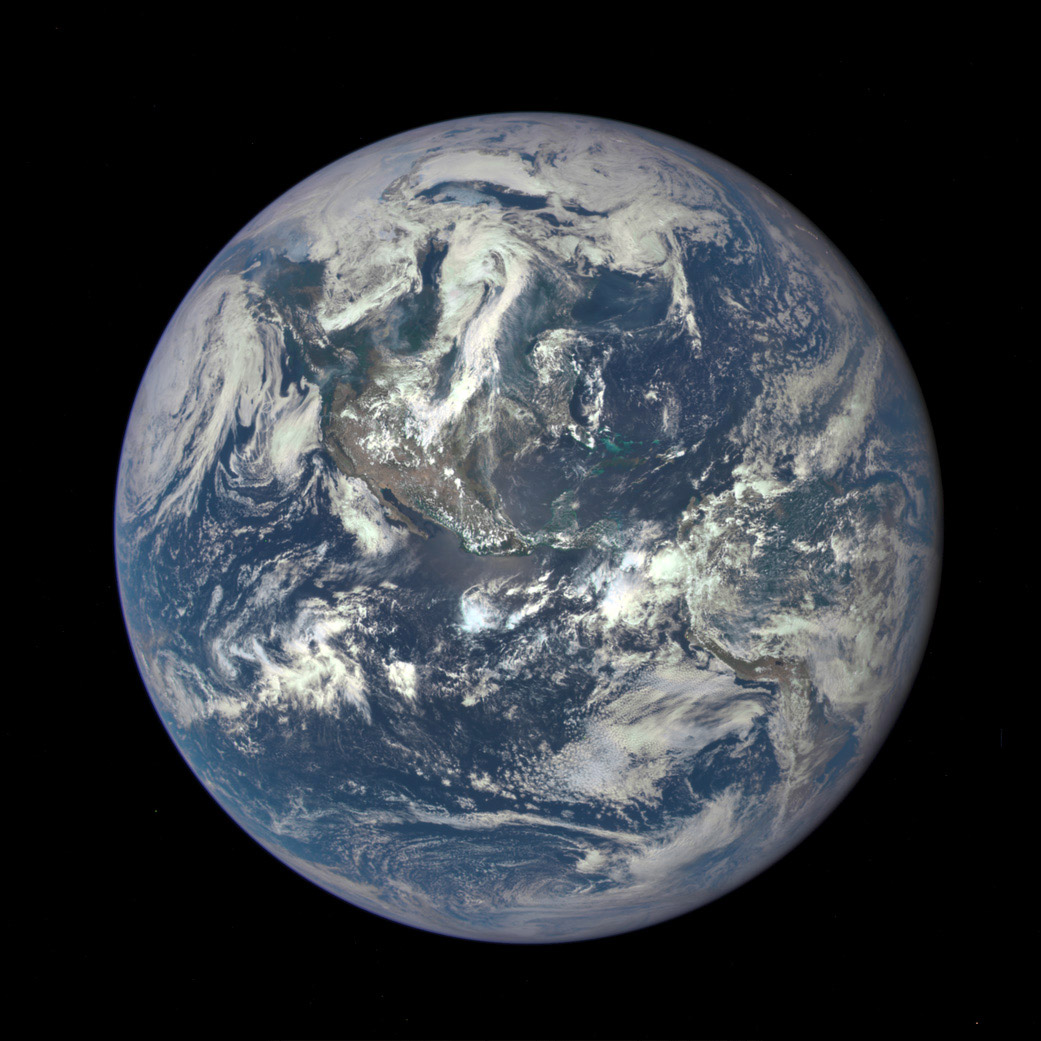
Not since 1972 and the Apollo 17 mission has NASA released a full shot of the sunlit Earth. This month a roaming satellite called DSCOVR sent back the photo below, which shows our planet from about 1 million miles away.

the-earth
Click to enlarge/zoom

NASA notes “it has not been possible to capture images of the entire sunlit side of Earth at once since Apollo 17″ though there have been images over the years composed of mosaics stitched together.

This shot is of Earth “taken at one moment in time,” as NASA poetically puts it.

Earth Studies

Beyond photos, the DSCOVR satellite will be used to measure ozone and aerosol levels in Earth’s atmosphere, cloud height, vegetation properties, and the ultraviolet reflectivity of Earth, NASA cites.

Learn more about the Deep Space Climate Observatory (DSCOVR) satellite and its mission on NASA’s site. The entity hopes to release more (and even better) whole-Earth photos beginning this fall.

22 Jul 17:10

Sea level may rise much faster than previously predicted

by Jason Kottke

James Hansen, NASA's former top climate scientist, is joined by 16 other leading climate scientists in a paper with some alarming conclusions. The gist is that the glaciers in Antartica and Greenland are melting so much faster than previously predicted that the global sea level will rise more than 10 feet in as little as 50 years, rendering many coastal cities uninhabitable. From Eric Holthaus in Slate:

The study -- written by James Hansen, NASA's former lead climate scientist, and 16 co-authors, many of whom are considered among the top in their fields -- concludes that glaciers in Greenland and Antarctica will melt 10 times faster than previous consensus estimates, resulting in sea level rise of at least 10 feet in as little as 50 years. The study, which has not yet been peer reviewed, brings new importance to a feedback loop in the ocean near Antarctica that results in cooler freshwater from melting glaciers forcing warmer, saltier water underneath the ice sheets, speeding up the melting rate. Hansen, who is known for being alarmist and also right, acknowledges that his study implies change far beyond previous consensus estimates. In a conference call with reporters, he said he hoped the new findings would be "substantially more persuasive than anything previously published." I certainly find them to be.

That's the thing about nonlinear systems like the Earth's climate: things happen gradually, then suddenly. This is much more terrifying to me than the Pacific Northwest earthquake. BTW, as a reminder, here's what NYC and the surrounding area looks like with 10 more feet of water. Goodbye JFK Airport.

Update: The paper is now available online.

Update: In the New Yorker, Elizabeth Kolbert provides a bit more explanation and context about Hansen's paper.

What the new paper does is look back at a previous relatively warm period, known as the Eemian, or, even less melodically, as Marine Isotope Stage 5e, which took place before the last ice age, about a hundred and twenty thousand years ago. During the Eemian, average global temperatures seem to have been only about one degree Celsius above today's, but sea levels were several metres higher. The explanation for this, the new paper suggests, is that melt from Antarctica is a non-linear process. Its rate accelerates as fresh water spills off the ice sheet, producing a sort of "lid" that keeps heat locked in the ocean and helps to melt more ice from below. From this, the authors conclude that "rapid sea level rise may begin sooner than is generally assumed," and also that a temperature increase of two degrees Celsius would put the world well beyond "danger."

"We conclude that the 2°C global warming 'guardrail,' affirmed in the Copenhagen Accord, does not provide safety, as such warming would likely yield sea level rise of several metres along with numerous other severely disruptive consequences for human society and ecosystems," Hansen and his colleagues wrote.

Tags: Eric Holthaus   global warming   James Hansen
22 Jul 16:26

The Disapproval Matrix

by Jason Kottke

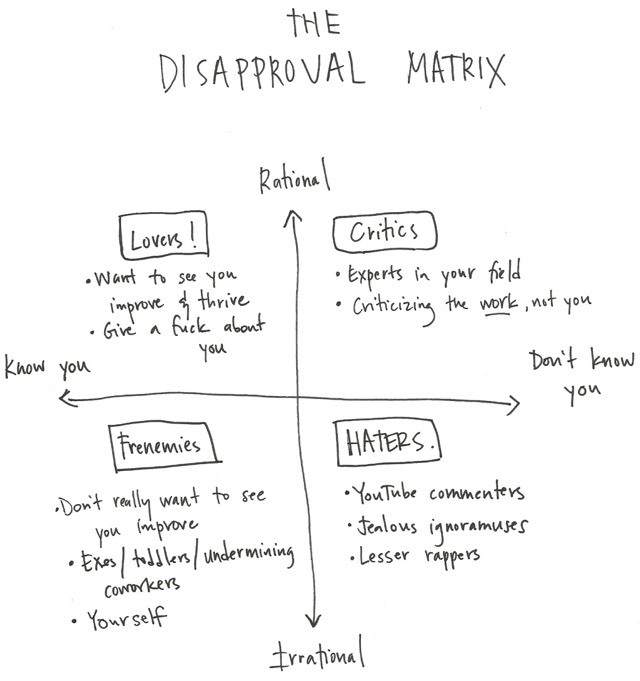
Ann Friedman recently created The Disapproval Matrix to better understand where criticism comes from and how to deal with it.

Disapproval Matrix

Frenemies: Ooooh, this quadrant is tricky. These people really know how to hurt you, because they know you personally or know your work pretty well. But at the end of the day, their criticism is not actually about your work-it's about you personally. And they aren't actually interested in a productive conversation that will result in you becoming better at what you do. They just wanna undermine you. Dishonorable mention goes to The Hater Within, aka the irrational voice inside you that says you suck, which usually falls into this quadrant. Tell all of these fools to sit down and shut up.

See also Friedman's Hierarchy of Haters.

Tags: Ann Friedman
21 Jul 14:02

The Power of Empathy

by Jason Kottke

A nice short animated video on the power of empathy and how it differs from sympathy.

Rarely can a response make something better. What makes something better is connection.

Related: Empathy is a Choice.

Some kinds of people seem generally less likely to feel empathy for others -- for instance, powerful people. An experiment conducted by one of us, Michael Inzlicht, along with the researchers Jeremy Hogeveen and Sukhvinder Obhi, found that even people temporarily assigned to high-power roles showed brain activity consistent with lower empathy.

But such experimental manipulations surely cannot change a person's underlying empathic capacity; something else must be to blame. And other research suggests that the blame lies with a simple change in motivation: People with a higher sense of power exhibit less empathy because they have less incentive to interact with others.

Tags: video
13 Jul 19:41

A Low-Tech Solution to a Hi-Tech Problem: Trains That Generate Electricity

by Daina Beth Solomon
(Photo: ARES)

A rail car the size of a go-kart creeps 850 feet up a steel track through the Tehachapi foothills near Death Valley. Its passenger is a four-ton concrete block, but the real delivery is electricity.

The train is a low-tech attempt to solve a hi-tech problem. California is now generating so much renewable electricity at certain times during the day that the state can't use it all. The three biggest utilities now draw more than 20 percent of their energy from renewable sources. That number should climb higher as falling technology costs spur more investment in solar and wind power.

But the boom has drawbacks: A cloudy day can turn a flood of solar power into a drip. And a sunny day can generate more power than the grid can use.

Faced with the demand to ensure a stable supply of electricity, utilities are under pressure to develop cost-effective ways to store renewable power. The Public Utilities Commission has mandated that California’s three biggest electricity retailers find ways to store 1,300 megawatts of their total power production—about half the generating capacity of the old San Onofre Nuclear Generating Station—in the next five years.

Numerous companies are vying to break into the market, many of them relying on cutting-edge technology. One company is stacking batteries into massive hubs two stories tall. Another is compressing air in vast storage tanks, which can be released through turbines to generate electricity. A product called “Ice Bear” latches onto rooftop air conditioners to store electricity by creating and melting ice.

The "train" car. (Photo: ARES)

Jim Kelly is putting his money on trains. His company, Advanced Rail Energy Solutions, or ARES, bills his upcoming project—a $40 million plan to deliver 50 megawatts of storage in Nevada—as a simpler solution, delivering the same effect without all the flashy technology.

“We don’t need any new physics, we don’t need super conductivity or miracle batteries,” Kelly says. They just need gravity.

A pilot site in the hills some two dozen miles outside Bakersfield suggests how the operation will work. At Victory Springs Ranch in Tehachapi, a railway climbs 60 feet above its starting point, snaking through a hilly field dotted with wind turbines. Here, an ARES rail car climbs a gentle incline at 10mph. It carries concrete formed into a sleek trapezoid atop a steel carriage with four sets of wheels. The unit, stretching 16 feet long and nearly four feet tall, runs on a track set into the dusty Earth, spurred uphill by excess electricity coming off the grid.

The system would kick into gear any time renewable energy production overloads the grid. Grid operators would call ARES, which would use the excess power to drive the train. As soon as renewable production flags, an engineer can send the car downhill by striking a computer key. As the car rolls with gravity, motors inside a metal box latched to the concrete spin to generate electricity. Power goes back on the grid.

The ARES founders didn’t set out to make trains. William Peitzke, a veteran of the energy business, came to scientist John Robinson with ideas to build a hydro-electric pump near the Sea of Cortez. This system, introduced in the early 1900s and used around the world, uses excess power to pump water uphill, and then generates power when it is released back down.

But Robinson, a former National Oceanic and Atmospheric Administration scientist who was working at NASA when humans first stepped onto the moon, deemed this system too demanding on the West’s water supply.

Instead, Peitzke and Robinson turned to Matt Brown, a ship and plane engineer, for a solution that would not rely on scarce water resources. His answer: rail. He knew trains had long excelled at moving mass over distance and height.

It's days like these ARES was made for. (Photo: ARES)

The trio launched ARES in 2009. In 2013, ARES secured a patent and constructed its pilot project at Victory Springs Ranch.

The company plans to break ground on its first commercial project next year in Nevada, 60 miles west of Las Vegas on the California border. Here, the scale will dramatically increase: ARES plans to install a six-mile track climbing 2,000 feet. Seven “shuttle trains”—each equipped with two locomotives hauling seven cars—will ascend at 18mph. Each shuttle train will carry 1,300 tons, the weight of 650 automobiles. They will stretch nearly 500 feet long.

When gravity spurs the trains downhill, they will collectively generate 12.5 megawatt hours of energy. This is enough to power a city of 50,000 homes for 15 minutes.

That size is substantial compared with batteries that can hold only five or 10 megawatts. Still, it represents just a fraction of the capacity ARES envisions. The company’s original plan was to run 800 cars on multiple tracks, storing up to 1,000 megawatts, which could power more than half a million homes. But the financing proved too difficult for the fledgling business, says Francesca Cava, vice president for operations.

Just connecting storage to the transmission grid can cost $10 to $15 million, according to Cava. Securing a land permit can cost another million. And that’s before building and operation costs. The ARES Nevada project will suck up a total of $40 million as-is, but the bigger version would have required $1 billion.

“That’s a huge barrier to any Tom, Dick, or Harry coming along,” Cava says, adding that banks are wary of giving newbie storage companies the same funds they dole out for housing and railroad construction. ARES turned to investors instead, and has raised $25 million so far.

The train track. (Photo: ARES)

“This is not a market that you dilly-dally in,” Cava says. “They believed this would work and they would make money.”

For its next phase, ARES is gearing up to tackle more financial hurdles. Snagging utility contracts could help ARES secure loans. But setting a fair price is complicated. While utilities know how to charge for energy production, calculating the costs for storage is new.

ARES will need to compete against technologies that boast diverse merits. Hydro-electric pumps, moving at slow speeds, can shift large amounts of energy. Batteries and flywheels, on the other hand, offer flexibility by transferring energy within seconds—even if they can only hold small volumes.

ARES says it operates at 60 percent of the costs of traditional hydro pumps, and is less expensive than most batteries. For example, a battery under construction by Southern California Edison, billed as one of the biggest in North America, is slated to store 32 megawatts at a cost of $50 million. By ARES’s own measurements, its rail project will generate nearly twice as much for about the same amount.

To Mark Higgins of the California Energy Storage Alliance, the diversity of storage technology attests to the growing strength of the market. “It’s absolutely healthy, and really shows the competitive nature of the industry,” he says.

The competition is forcing a time crunch. ARES estimates that batteries won’t catch up with its own storage capacity for another two decades. But the company is still under pressure to be the first of its kind to penetrate the market, Cava says.

“If we are able to be the first grid-scale, non-polluting, not-water-using, profit-making energy storage system, obviously that's a very important milestone,” she says.

This story is part of our week-long special report on energy issues in California produced in collaboration with the University of Southern California's Annenberg School for Communication and Journalism. For more, visit the project's landing page.

10 Jul 18:40

Protect Ya Tech

The five best cases for your phone and the brand new one that made a case convert out of me.

09 Jul 00:24

panda bank

09 Jul 00:23

This Guy Turned a Tortilla Into a Record That Actually Plays Music

by Clint Rainey
Ben Wolf

Sometimes I feel like my efforts are just as futile.


After seeing that funny video go viral of a tortilla fake-playing music on a record player, a Redditor decided to see if he could really turn a tortilla into a disc that plays music. He says it took half an hour to laser-etch the grooves on, and he had to experiment with various tortillas (pro tip: cooked ones aren't flat enough). He cautions they're going to get pretty inedible ("rather burnt"), but he succeeded in getting music to come out of an actual tortilla. The tune of choice is "Jarabe Tapatío," of course, better known as "The Mexican Hat Dance," and, okay, it sounds awful.

[Rapture Records/YouTube]

Read more posts by Clint Rainey

Filed Under: video feed, time wasters, tortilla record