Shared posts

29 Jan 19:43

Quote For The Night

by Andrew Sullivan
Brian Stouffer

Great I'm screwed.

“Nothing in the world can take the place of persistence. Talent will not; nothing is more common than unsuccessful men with talent. Genius will not; unrewarded genius is almost a proverb. Education will not; the world is full of educated derelicts. Persistence and determination alone are omnipotent. The slogan Press On! has solved and always will solve the problems of the human race,” – Calvin Coolidge.

28 Jan 16:41

Unionize the NCAA

by Erik Loomis
Brian Stouffer

Go! You Northwestern!

Wow.

For the first time in the history of college sports, athletes are asking to be represented by a labor union, taking formal steps on Tuesday to begin the process of being recognized as employees, ESPN’s “Outside The Lines” has learned.

Ramogi Huma, president of the National College Players Association, filed a petition in Chicago on behalf of football players at Northwestern University, submitting the form at the regional office of the National Labor Relations Board.

Backed by the United Steelworkers union, Huma also filed union cards signed by an undisclosed number of Northwestern players with the NLRB — the federal statutory body that recognizes groups that seek collective bargaining rights.

“This is about finally giving college athletes a seat at the table,” said Huma, a former UCLA linebacker, who created the NCPA as an advocacy group in 2001. “Athletes deserve an equal voice when it comes to their physical, academic and financial protections.”

Huma told “Outside The Lines” that the move to unionize players at Northwestern started with quarterback Kain Colter, who reached out to him last spring and asked for help in giving athletes representation in their effort to improve the conditions under which they play NCAA sports. Colter became a leading voice in regular NCPA-organized conference calls among players from around the country.

Now this is a story worth following. Given the difficulty graduate student unions have had in getting universities to admit they are employees, I think this is going to be an even harder struggle for athletes since they aren’t even paid, but I wish them the best of luck.


28 Jan 15:51

Money and Class

by By PAUL KRUGMAN

My post on Americans starting to recognize class realities has brought some predictable reactions, which I’d place under two headings: (1) “But they have cell phones!” and (2) it’s about how you behave, not how much money you have.

My answer to both of these would be to say that when we talk about being middle class, I’d argue that we have two crucial attributes of that status in mind: security and opportunity.

By security, I mean that you have enough resources and backup that the ordinary emergencies of life won’t plunge you into the abyss. This means having decent health insurance, reasonably stable employment, and enough financial assets that having to replace your car or your boiler isn’t a crisis.

By opportunity I mainly mean being able to get your children a good education and access to job prospects, not feeling that doors are shut because you just can’t afford to do the right thing.

If you don’t have these things, I would say that you don’t lead a middle-class life, even if you have a car and a few electronic gadgets that weren’t around during the era when most Americans really were middle class, and no matter how clean, sober, and prudent your behavior may be.

Now, according to that Pew survey (pdf), in early 2008 only 6 percent of Americans considered themselves lower class — far below the official poverty rate! — only 2 percent upper class, and 1 percent didn’t know. So 91 percent of Americans — roughly speaking, people with incomes between $15,000 and $250,000 — considered themselves middle class. And a large portion of these people were wrong.

Consider health insurance: many Americans with incomes significantly above the poverty line are, or were until very recently uninsured, and many more were at risk of losing coverage. That, to me, says that they weren’t middle class on that basis alone. Many, probably most, low-wage workers have hardly any financial assets, no retirement plan, etc.

What about opportunity? Public schools in America vary widely in quality, and lower-income families can’t afford to live in good districts. College education has become far less accessible as aid to public institutions falls. The chance of finishing college varies drastically with family income (pdf).

I could go on, but surely it’s obvious when you think about it (and if you have any sense of the realities of life). A lot of Americans — quite arguably a majority — just don’t have the prerequisites for middle-class life as we’ve always understood it.

What about the upper end? In 2008 19 percent of Americans considered themselves upper-middle class. Here I think we have problems with defining what the class means. Pretty clearly, life at $250,000 is significantly, qualitatively different from life at $100,000. Yet Americans making 250K don’t feel rich, because above them loom the steep slopes of the upper tail of the income distribution (mixed metaphor, but whatever). So I won’t try to sort this one out.

But back to the lower end: the point is that we could, if we chose, guarantee the essentials of middle-class existence for almost all Americans; other advanced countries do it. Universal health care is the norm; we’re finally making a partial move toward that norm, but the right is fighting that move hysterically. Universal good basic education and free or cheap college education are available in other advanced countries.

The sad thing is that our fetishization of the middle class, our pretense that we’re almost all members of that class, is a major reason so many of us actually aren’t. That’s why the growing appreciation of class realities on the part of the public is a good thing; it raises the chances that we’ll actually start creating the kind of society we only pretend to have.

This entry passed through the Full-Text RSS service — if this is your content and you're reading it on someone else's site, please read the FAQ at fivefilters.org/content-only/faq.php#publishers.

27 Jan 20:26

What If We Threw An Olympics And Nobody Came? Ctd

by Andrew Sullivan
Brian Stouffer

The "first Olympics to be held in an area of mass expulsion of an indigenous people"? Um... you have heard about this country called the United States of America, yes?

Putin Warns Gays Against Flamboyant Displays at Olympics. http://t.co/DQtkfUVupx pic.twitter.com/fBo0kl0mZq

— Ray Kwong (@raykwong) January 23, 2014

A reader builds on Leon Aron’s analysis to consider Putin’s geopolitical motives for holding the Games in Sochi:

Aron writes, “[This will be] the first Olympics to be held in an area of mass expulsion of an indigenous people, whose descendants accuse Russia of genocide. Perhaps most hazardously of all, it is the first (and almost certainly the last) Olympiad to be held within a few hundred miles of a low-intensity but deadly jihad.”

Russia has committed military assets to this region to varying degrees since the early ’90s. The proximity to the disputed territory of Abkhazia strikes me as a feature of Putin’s strategy, rather than a bug. Russia has supported Abkhazia and South Ossetia’s independence from Georgia since the dissolution of the Soviet Union. Access to warm-water ports and the ability to transport troops through the Caucasus Mountains have always been security interests of the Russian state. The Olympic games give Putin an opportunity to build up reconnaissance and logistical infrastructure in a way that previously would have required a hot war. In one stroke, he’s able to build up security presence in the region and preemptively kill any number of jihadists, all while presenting himself as a peaceful world player.

Another reader notes:

One thing that’s going unsaid amid the lead-up to Sochi is that this is something of a rehearsal for the much larger World Cup that Russia is hosting in 2018. If Sochi is a security nightmare, I can only imagine how difficult it’s going to be to secure 11 cities, from Sochi to Moscow to Kaliningrad. If I were FIFA, I’d be crapping myself.

21 Jan 05:20

Calvin and Hobbes for January 17, 2014

21 Jan 05:17

But We Have Our Love to Pay the Bills

by Scott Lemieux
Brian Stouffer

It seems like the Republican argument for marriage as wealth-builder could also be made in support of forming 20-person polyamorous communes.

Speaking of conservatives who want to pretend to talk about inequality while not actually talking about it, Edroso finds this gem from Kathleen Parker:

Obviously, marriage won’t cure all ills. A single mother could marry tomorrow and she still wouldn’t have a job. But in the War on Poverty, rebuilding a culture that encourages marriage should be part of the arsenal.

See, if you want to make it to the real big leagues, it’s better to let snarky critics refute your smarm than just doing it yourself.  I’ll leave the rest to Roy:

I guess all conservatives will get with this program soon enough, even though, in correlation-is-causation terms, marriage is as likely to make you white as it is to make you rich. Poor people who don’t want to get married, here’s your only hope: When the Republicans come for you, tell them you’re gay.


21 Jan 04:35

“No, you’re working at Initech because that question is bullshit to begin with.”

by Scott Lemieux
Brian Stouffer

Shouldn't the saying be "Do what you love (right up until the day everyone on earth dies of cholera because nobody cleaned the toilets.)"

Beth recently noted this terrific article about the “Do What You Love” slogan, which has created a totally proactive, in-your-face new paradigm. Miya Tokumitsu offers further arguments for why DWYL is not merely useless but actively pernicious:

But by portraying Apple as a labor of his individual love, Jobs elided the labor of untold thousands in Apple’s factories, hidden from sight on the other side of the planet—the very labor that allowed Jobs to actualize his love.

[...]

One consequence of this isolation is the division that DWYL creates among workers, largely along class lines. Work becomes divided into two opposing classes: that which is lovable (creative, intellectual, socially prestigious) and that which is not (repetitive, unintellectual, undistinguished). Those in the lovable-work camp are vastly more privileged in terms of wealth, social status, education, society’s racial biases, and political clout, while comprising a small minority of the workforce.

For those forced into unlovable work, it’s a different story. Under the DWYL credo, labor that is done out of motives or needs other than love—which is, in fact, most labor—is erased. As in Jobs’ Stanford speech, unlovable but socially necessary work is banished from our consciousness.

I will start listening to powerful executives saying “DWYL!” just as soon as they commit to personally cleaning all of the restrooms at their firm’s head office and put in a few shifts a month doing the same simple task ten hours a day on an assembly line.


20 Jan 21:24

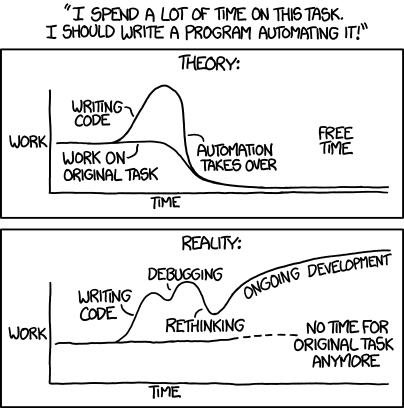
Automation

'Automating' comes from the roots 'auto-' meaning 'self-', and 'mating', meaning 'screwing'.
17 Jan 05:04

Wisconsin Taking Another Step to the New Gilded Age

by Erik Loomis
Brian Stouffer

Arbeit macht frei.

Conservatives’ vision of the future of American work

Scott Walker’s Wisconsin really is vanguard of the New Gilded Age. Republicans have introduced a new bill, almost certain to become law, that will get rid of a state law requiring employers to give workers 24 hours in a row off at least once every 7 days. I know, quite the imposition upon the freedom of workers to work whenever they are compelled upon risk of termination want! But hey, workers have the option to opt out, by which conservatives mean the same as Gilded Age conservatives did in 1895 that workers had real options–do what we say or find another job. But no one is compelling them!

Conservatives say that workers will only have to forego their rest days if they volunteer, but the law’s opponents argue that businesses could create environments that are hostile to workers who insist on their rights. Workers who take their mandated rest days could be skipped over for promotion, denied privileges allowed to workers who work a 7-day week or could see sharp reductions in their schedules until they no longer have enough hours to make ends meet, financially.

Wisconsin Manufacturers and Commerce said that it conceived of the law when it noted that the federal government does not have a rule mandating that workers receive a certain number of hours off per work cycle.

Lawmakers Grothman and Born told reporters from the Journal that they had heard from a diverse array of businesses that support the 7-day work week, but when asked to provide examples, they were only able to provide the names of groups belonging to the Wisconsin Manufacturers and Commerce network.

“Here’s an opportunity for folks to work together to get things done in a positive way for the employer and the employee,” Born said. “It just seems like a win all the way around.”

All the way around. Indeed. All the way around to the conditions of 1895.


17 Jan 04:52

16 Reasons Matt Yglesias is Wrong about the Job Guarantee vs. Basic Income

by Devin Smith

16 Reasons Matt Yglesias is Wrong about the Job Guarantee vs. Basic Income

By Pavlina Tcherneva

Slate’s Matt Yglesias is out with another caricature of post on the Job Guarantee (JG) and, guess what?  He still doesn’t like what he sees. He’s all for guaranteeing income to people who can’t find jobs, but he’s opposed to making receipt of that money “conditional on performing make-work labor for the government.”  As one of the leading proponents of the JG, let me say this for the nth time: THE JOB GUARANTEE IS NOT ‘MAKE-WORK.’  This is not a reaction to Yglesias but a core principle of the earliest literature on the Job Guarantee (e.g., here, here and here).  There is no way that anyone familiar with even a sliver of the vast collection of books, articles, essays, working papers, policy briefs and blog posts on the JG could, in good faith, continue to claim that the JG is “make-work.”

After straw manning the JG, Yglesias expresses his enthusiasm for a Basic Income Guarantee (BIG). He prefers simply handing out money to the jobless because it’s not as “messy” as the JG.  (I’ve already argued why such objections should not be taken seriously). But more importantly, like many BIG advocates, he assumes that the BIG will magically solve the fundamental problem of economic insecurity.

Here are sixteen reasons why this assumption is wrong.

MACRO ISSUES

1. Yglesias may not realize it, but all serious academic support for BIG is based on the idea that many people will quit working (this is considered desirable in order to eliminate bad jobs and ultimately ‘decommodify’ labor; e.g. here and here ). So the goal is to reduce the supply of labor and reduce production.

2. JG provides a “good job” alternative to people who work in “bad jobs”. When private employers want them back, they have to provide at least the same or better living wage-benefit package and work conditions offered in the JG.  JG sets the labor standard.

3. Under BIG, production drops, consumption rises, and so do prices. Suddenly, the value of the BIG grant has been eroded. Great success: the poor are still poor.

4. Under JG, employment rises, socially useful production rises, and (as we have argued many times) some of that production is dedicated to the benefit of the poor, providing goods and services at the local level that the private sector has not provided, and thus it absorbs part of the wage. In other words, both supply and demand rise.

5. Coupled with its countercyclical mechanism, JG is an inflation stabilizer (not an inflation generator, like BIG). We’ve modeled this many times (see here, here, here). Inflation from other sources is, of course, possible (runaway bank lending, speculation, oil shocks etc.—all are separate issues.)

6. BIG is not countercyclical. It’s universal, unconditional, but does not fluctuate with the business cycle. JG is a direct response to recessions and expansions.

7. There is no mechanism by which BIG can ensure full employment over the short or long run. Only the JG can.

8. In short, BIG doesn’t deal with price (or currency) stability, useful output, or any of the negative externalities from unemployment.

POVERTY

9. As Amartya Sen taught us, poverty is not just a function of lack of adequate income.  Providing income alone does not eliminate poverty.

10. The poor and the unemployed want to work (here, here). And as my work on Argentina showed (9m14s), receiving income is the fifth reason why the poor wanted to work! Why do BIG advocates presume to know what’s better for the poor than the poor themselves?  BIG does little for those who want to work.

11. There is almost a ‘neoclassical market equilibrating assumption’ behind most BIG analysis that says: “as long as people have cash, the market will magically provide the goods for them, allow them to acquire assets, provide them with the freedom to do what they please, etc. etc.” If the market hasn’t solved these problems now, why would it do so just because people get cash? All structures that marginalize, reduce opportunities, and discriminate remain. JG is not a panacea for all these problems, but it deals with one crucial and systemic aspect of marginalization – the absence of guaranteed decent work.

12. Amartya Sen also taught us that what matters is not just freedom, but substantive freedom. That is, policy has to 1) recognize what individuals themselves want and value; 2) it must provide these opportunities; and 3) it must remove obstacles from taking advantage of these opportunities.

13. The JG does precisely that: recognizes many people want paid work, provides the job opportunity, and removes obstacles from taking the opportunity by targeting the jobs to the communities, and providing the very services that one might need in order to take care of these opportunities (education, transportation, care etc., etc.).

14. BIG may lull the recipients into a false sense of security. Once the BIG grant proves inadequate to liberate the poor from their poverty, and the poor decide to search for better paying jobs and opportunities, they will not be there. Just like they aren’t now.  As research has shown the mark of unemployment is devastating and unemployment breeds unemployability.

15. Again, many BIG bloggers are not familiar with even the basic BIG literature. There is such a thing called ‘participation income’ and ‘civic minimum’ in serious scholarly work (Atkison 1995 and White 2003, respectively)—an idea that society is built on the principle of reciprocation.  Society provides you with a basic income; you reciprocate by participating in socially-productive activities. This is exactly what the JG does. No matter what Yglesias says, it is not based on the coercion principle of workfare, but rather on the principle of participation.

16. I find it ironic that we have to debate each other. BIG and JG stand on much the same principles. Let policy provide an opportunity to all to perform socially useful activities on the ‘participation principle’ through the JG, while supporting those who cannot (the young, retired, disabled, with onerous care burden) and we have a stronger, more stable economy that creates socially useful activities that serve the public purpose.

Yes, sending a check to people is not as “messy,” but let’s stop pretending that its a panacea for the fundamental problem of economic insecurity.

16 Reasons Matt Yglesias is Wrong about the Job Guarantee vs. Basic Income

17 Jan 04:49

Faces Of The Day

by Andrew Sullivan

UKRAINE-POLITICS-PARLIAMENT

Pro-Russian majority MPs argue with pro-EU opposition MPs during a parliament session to debate the 2014 state budget in Kiev on January 16, 2014. The Ukrainian government approved a programme of cooperation with former Soviet states that have joined the Customs Union, although rapprochement with the Russia-led bloc has fuelled continuing pro-Europe protests in Kiev. By Sergei Supinsky/AFP/Getty Images.

15 Jan 22:57

Chart Of The Day

by Andrew Sullivan

Climate Pie Chart

James Powell updates his chart on global warming research:

I have brought my previous study (see here and here) up-to-date by reviewing peer-reviewed articles in scientific journals over the period from Nov. 12, 2012 through December 31, 2013. I found 2,258 articles, written by a total of 9,136 authors. (Download the chart above here.) Only one article, by a single author in the Herald of the Russian Academy of Sciences, rejected man-made global warming. I discuss that article here.

Holly Richmond passed along the chart:

[I]f a year-long sample isn’t good enough for you, Powell previously examined 21 years of peer-reviewed literature and found that only 24 out of 13,950 articles — or two-tenths of a percent — came out and rejected human-caused climate change.

The fact that one major political party in the US rejects outright this massive preponderance of scientific research is now so familiar to us that we forget just how obscene it is. It is not a position or an argument. It is a transparent lie in defense of short-term material interest against the long-term interests of everyone. There can and should be plenty of debate about what to do about human-caused climate change; but there should simply be no serious debate about its causes. It’s impossible to take the GOP seriously until they recant their knownothingness on this subject. At this point, it is simply an affront to reason.

15 Jan 20:27

Dazed and Confused: Matt Yglesias on the Job Guarantee

by Devin Smith
Brian Stouffer

Good work here.

Dazed and Confused: Matt Yglesias on the Job Guarantee

By Pavlina Tcherneva

Matt Yglesias has written a post that has the words ‘Job Guarantee’ (JG) in the title but has nothing to do with the actual JG proposal.

He begins by asking readers to imagine that:

“…instead of handing out welfare checks and food stamps to these bums, we should make everyone who wants public assistance show up daily at a rally-point to be contracted out to do street-cleaning work. Think parolees sentenced to community service…”

Unfortunately for him, that’s not the Job Guarantee and we have debunked such silly caricatures many times (e.g., here, here and here). Unfortunately for his readers, he is either unfamiliar with the most basic literature on the JG, or is deliberately misleading them. Let’s give him the benefit of the doubt and assume it’s the former.

Yglesias proceeds to tell us that solving the unemployment problem for these “bums” this way is undesirable, because that would empower the Fed too much to focus on avoiding stock market crashes! With unemployment, however, the Fed will just have to keep pushing hard on that string, and sooner or later unemployment would magically disappear. You don’t even need to read Keynes to know that such a thing does not happen.  Just read Bernanke (also here). The Fed cannot do it. We need fiscal policy. Even stranger is his implication that the Fed should not primarily focus its attention on regulations and financial instability!

But back to the Job Guarantee. Lest there is any doubt about our claims, let me reiterate some of them here:

  • The Job Guarantee is not workfare. It is a voluntary program. It is a guarantee of a job opportunity at a base wage, not a requirement to work for one’s current benefits.
  • The JG does not eliminate current programs or take away anyone’s benefits–unemployment insurance, food stamps, etc., all remain. Expenditures on these decline automatically.
  • The JG is not a replacement or substitute for much needed conventional public sector work. Our position has always been that they should be adequately funded. The JG is a buffer stock employment program.
  • It is not run by the federal government (only funder by it). States, localities, non-profits, and nonprofit social entrepreneurial ventures propose, organize, run, and manage the projects.
  • The JG is perfectly compatible with some forms of unconditional basic income—e.g., more generous social security and veteran benefits. I would add universal child allowance.   
  • The JG fluctuates with private sector activity. The JG wage becomes the effective minimum wage. The program maintains and enhances human capital and produces useful output (no ditch digging). It is not a panacea for all labor market problems.
  • No matter how generous the welfare policy, it does little for the person who wants a job and cannot find it.  As I recently explained, the mark of ‘unemployment’ is devastating to the jobless. It’s their scarlet letter.
  • The unemployed are already ‘part of the government sector’.  The public and private sectors, and society at large already bear the enormous real costs of unemployment. 
  • And while the unemployed want to work, the government has chosen to focus on policies that support unemployment. The JG is a policy that supports employment.
  • And as we have long emphasized, there is an important difference between using the unemployed as a buffer stock and having an employment buffer stock policy.  There is a vast body of literature explaining why the JG offers a superior macroeconomic stabilizer to the economy, the currency, and inflationary/deflationary tendencies.

What exactly is novel or progressive about the proposals by Yglesias? He prefers the following: 1) some income support for the needy, 2) some in-kind support; 3) balanced monetary policy; and 4) wage subsidies. All four are policies of the status quo (though I would debate the meaning of #3). All four have been in place for a long time without ever securing true full employment.  They are not enough. The missing piece is the JG.

A new progressive movement is shaping precisely around the idea of the Job Guarantee.  MMT had advocated for a JG even during the Clinton goldilocks economy (e.g., here and here). Sandy Darity has also developed a similar proposal. Bernstein and Baker have recently called for the government to act as an employer of last resort.  Robert Reich has been advocating for WPA renewal for years.

The JG proposal is also not new: Dr. Martin Luther King Jr. called for it in his March on Washington speech;  long-time U.S. Department of Labor economist John H.G. Pierson, who helped draft the Employment Act of 1946, had articulated a Job Guarantee proposal as early as 1941 (Full Employment: Why we need it; How to Guarantee it). Starting in the late 60s, Minsky worked to demonstrate why welfare cannot fully succeed in eradicating poverty (Ending poverty: Jobs not Welfare). And as Matt Bruenig from Demos reported this week, the 1967 report by the Presidential National Advisory Commission on Rural Poverty had proposed a Job Guarantee as a center-stage strategy for the eradication of poverty and unemployment.

In truth, there is nothing of substance in the Yglesias piece that represents an actual critique of the JG. The only thing one could surmise is that he objects to it because it’s “messy”.

He’s essentially echoing the oft-heard objection to the JG that “It’s a good idea; until you start thinking about implementation”.

Let me put it another way:

“Securing the right to food for every person in the world is a good idea, until you start thinking about implementation”
“Securing the right to vote is a good idea until you start thinking about implementation”
“Securing clean water for all is a good idea until…
“Guaranteeing access to public education to all is a good idea until…

You get the idea.  Yes, securing a basic human right is ‘messy’.  Implementing good macroeconomic policies is also ‘messy’:

“Regulating Wall Street is a good idea until…
“Protecting the consumers is a good idea until…
“Building modern infrastructure is a good idea until…

If “problems with implementation” is the pundits’ core objection to a program that provides voluntary employment to those who want to work, secures a basic human right, and provides a better and stronger stabilizer to the economy than anything we have had so far, they cannot be taken seriously. Before speaking from a position of authority, it’s best to become familiar with the literature on the JG. Until then, posts like that by Yglesias would seem like a thinly-veiled strategy to sling mud before the idea gets a fair hearing.

The HuffPo results are loud and clear: the Job Guarantee is by far the most popular program among Americans of all 5 reforms discussed in Myerson’s Rolling Stone piece. Imagine the support the JG would receive, if it got that fair hearing. Until then, cynics uninterested in examining the basic merits of the JG should be ignored.

Dazed and Confused: Matt Yglesias on the Job Guarantee

13 Jan 16:12

Inexplicable

'It has a ghost in it. Take it back.' 'No.'
13 Jan 16:12

Calvin and Hobbes for January 13, 2014

09 Jan 04:41

What you need you have to borrow

by Paul Campos

The DOE’s proposed budget for FY2014 extends the benefits of the Pay As You Earn (PAYE) plan to everyone’s eligible Income-Based Repayment (IBR) loans. As of now only people who hadn’t taken out any federal educational loans prior to October 2007 are eligible for PAYE.

These plans work like this: if the federal government (or, prior to 2010, private lenders participating in the FFEL program, but not other private loans) lends you money to go to school, and you suffer a “partial financial hardship,” you can pay a reduced amount on your loans as long as the hardship exists. The definition of a partial financial hardship is that the portion of someone’s adjusted gross income that doesn’t exceed 150% of the federal poverty line isn’t subject to debt repayment as long as the hardship exists. So if you don’t make more than 150% of the federal poverty line you don’t have to make any payments on your eligible educational loans. As for AGI 150% above the poverty line, you have to pay 15% of that under IBR, and 10% under PAYE, toward your loans as long as you’re eligible (eligibility gradually decreases and can eventually disappear to the extent that someone’s AGI increases faster than inflation).

Here’s a concrete example, using the more generous PAYE provisions, rather than the original IBR system. Suppose Bill takes out $100,000 in federal educational loans while going to undergrad and law school, and graduates with $100,000 in principal debt (Bill’s total debt will be higher, since interest will have already accrued on all of the loans that are unsubsidized, which at the post-graduate level is now all of them, but let’s stipulate that Bill paid the interest on the loans while in school to keep this simple). Bill gets a job that gives him an AGI of $40,000 (this is probably about the median for current law school graduates), and he gets raises that outstrip inflation by 25% each year for 20 years. At the end of that period, Bill will have made $74,000 in payments — an amount which will have covered just slightly over half of the interest that accumulated on the loans over this time (interest on federal government loans in income contingent repayment plans does not capitalize, but it does accrue).

Bill will at this point still owe $100,000 in principal and $73,000 in unpaid interest. This combined amount is then forgiven, and the sum of $173,000 is imputed to Bill as income.

Now one one level this is a “good” deal for Bill, who has not been tossed in debtor’s prison, or had his wages garnished (technically speaking anyway), or had liens placed on his property should he have acquired some, etc. In addition, using a standard discount rate Bill has made $44,000 in payments, reduced to net present value, so in terms of NPV he only paid back 44% of a $100K interest-free loan, which is certainly a better deal than he would have gotten from Tony Soprano or Chase. (Depending on his current economic circumstances he may have a big tax bill though. The good news is that if he and his loved ones are still broke he won’t).

On the other hand, what this “deal” adds up to is, under current tax law, a 23% annual hike in what would otherwise be Bill’s effective tax rate, for each year over the next two decades.

IBR and PAYE, in other words, constitute a gigantic functional backdoor tax hike on (primarily) the middle class and striving working class and poor youth of America, by a political establishment that would rather allow higher education to feed unmolested at the trough of government loans, while passing the costs of doing so onto college attenders and taxpayers via the kind of massively regressive and grotesquely generationally-skewed tax hike that could lead to actual social unrest in even this sleepy republic, if it were not so cleverly disguised.

Is it better than nothing? Absolutely. Is it in anyway an acceptable alternative to returning to a system of higher education that allows those who had the poor judgment not to be born to the Quality to pursue that education at a price that won’t require them to indenture themselves to the government? Absolutely not.


09 Jan 04:29

On Fighting the Last War (On Poverty)

by By PAUL KRUGMAN

Sorry about radio silence — I’ve been on the road, and busy. And I still am.

I wanted, however, to say something about the 50th anniversary of Lyndon Johnson’s War on Poverty.

By 1980 or so, as the linked CBPP piece says, there was widespread consensus that the WoP had failed. As CBPP also says, that conclusion doesn’t stand up once you do the numbers right: poverty measures that take into account government aid — aid of the kind provided by the war on poverty! — do show a significant decline since the 1960s. There’s more sheer misery in America than there should be, but less than there was.

Even so, progress against poverty has obviously been disappointing. But why? Here’s where it’s important to realize that conservatives are stuck with a fossil narrative — a story about persistent poverty that may have had something to it three decades ago, but is all wrong now.

The narrative in the 1970s was that the war on poverty had failed because of social disintegration: government attempts to help the poor were outpaced by the collapse of the family, rising crime, and so on. And on the right, and to some extent in the center, it was often argued that government aid was if anything promoting this social disintegration. Poverty was therefore a problem of values and social cohesion, not money.

That was always much less true than the elite wanted to believe; as William Julius Wilson showed long ago, the decline of urban employment opportunities actually had a lot do with the social disintegration. Still, there was something to it.

But that was a long time ago. These days crime is way down, so is teenage pregnancy, and so on; society did not collapse. What collapsed instead is economic opportunity. If progress against poverty has been disappointing over the past half century, the reason is not the decline of the family but the rise of extreme inequality. We’re a much richer nation than we were in 1964, but little if any of that increased wealth has trickled down to workers in the bottom half of the income distribution.

The trouble is that the American right is still living in the 1970s, or actually a Reaganite fantasy of the 1970s; its notion of an anti-poverty agenda is still all about getting those layabouts to go to work and stop living off welfare. The reality that lower-end jobs, even if you can get one, don’t pay enough to lift you out of poverty just hasn’t sunk in. And the idea of helping the poor by actually helping them remains anathema.

Will it ever be possible to move this debate away from welfare queens and all that? I don’t know. But for now, the key to understanding poverty arguments is that the main cause of persistent poverty now is high inequality of market income — but that the right can’t bring itself to acknowledge that reality.

This entry passed through the Full-Text RSS service — if this is your content and you're reading it on someone else's site, please read the FAQ at fivefilters.org/content-only/faq.php#publishers.

09 Jan 04:26

War on Poverty

by Erik Loomis

The greatest war in American history turns 50 today. That’s the War on Poverty.

Mr. Speaker, Mr. President, Members of the House and Senate, my fellow Americans:

I will be brief, for our time is necessarily short and our agenda is already long.

Last year’s congressional session was the longest in peacetime history. With that foundation, let us work together to make this year’s session the best in the Nation’s history.

Let this session of Congress be known as the session which did more for civil rights than the last hundred sessions combined; as the session which enacted the most far-reaching tax cut of our time; as the session which declared all-out war on human poverty and unemployment in these United States; as the session which finally recognized the health needs of all our older citizens; as the session which reformed our tangled transportation and transit policies; as the session which achieved the most effective, efficient foreign aid program ever; and as the session which helped to build more homes, more schools, more libraries, and more hospitals than any single session of Congress in the history of our Republic.

All this and more can and must be done. It can be done by this summer, and it can be done without any increase in spending. In fact, under the budget that I shall shortly submit, it can be done with an actual reduction in Federal expenditures and Federal employment.

We have in 1964 a unique opportunity and obligation–to prove the success of our system; to disprove those cynics and critics at home and abroad who question our purpose and our competence.

If we fail, if we fritter and fumble away our opportunity in needless, senseless quarrels between Democrats and Republicans, or between the House and the Senate, or between the South and North, or between the Congress and the administration, then history will rightfully judge us harshly. But if we succeed, if we can achieve these goals by forging in this country a greater sense of union, then, and only then, can we take full satisfaction in the State of the Union.

While Johnson’s Great Society was not perfect, it was a brave and noble attempt to fight entrenched poverty in the world’s largest economic power. But largely today, we’d have to call this war lost. The New Gilded Age is by definition a resounding defeat of the War on Poverty by the plutocrats and the shareholders, with quarterly reports meaning more than childhood nutrition and end of the year Wall Street bonuses a higher priority than homelessness, racial equality, or education. Capital mobility is the weapon of the rich, undermining the job security necessary for people to make demands on corporations and making politicians desperate for the good will of corporate leaders for both campaign donations and jobs for their constituents.

But that doesn’t mean we can’t take LBJ as an inspiration and fight a new war on poverty, one that is increasingly needed a nation defined by enormous income inequality, long-term unemployment, and devastating debt loads.


05 Jan 05:06

Leave David Aloonnnnnnnnnnnnne!

by Scott Lemieux

It ain’t easy defending a column as bad as David Brooks’s yesterday. Reihan Salam tries, and his entry is squarely in that odd category of contrarianism, “if we imagine the column being criticized was making a much different argument than it actually was, it would be much better:”

The column has prompted an ungenerous and largely uncomprehending response from people who are attacking David as a hypocrite, and worse. But you’ll notice, if you know how to read, that Brooks isn’t endorsing draconian legal penalties for marijuana use. Rather, he is suggesting that legalization as such might not be the best way forward. Though I imagine I don’t agree with Brooks in every respect on this issue, I think his bottom line is correct. The goal of marijuana regulation, and the goal of alcohol regulation and casino regulation and the regulation various other vices, ought to be striking a balance between protecting individual freedom while also protecting vulnerable people from making choices that can irreparably damage their lives and the lives of those closest to them.

[...]

It should hardly be surprising that Brooks’ column has become the object of the latest two minutes hate. Last I checked, 65 percent of Americans born after 1981 favor marijuana legalization, which makes favoring it an entirely unremarkable and uncontroversial position, and a good way for those of us born before 1981 to seem “down with the youth.” So we lecture him about his thoughtlessness, and the human consequences of marijuana prohibition, as if Brooks had never considered the ways in which the enforcement of drug laws interacts with racial and other inequalities.

Well, I can read perfectly well, and this doesn’t make any sense as a defense of what Brooks actually wrote:

  • The core argument of the first paragraph is just a flat non-sequitur.  Contrary to the implication, “legalization” doesn’t require that marijuana be unregulated or untaxed, and more to the point that’s not how actual decriminalization regimes have proceeded.  In arguing against decriminalization, Brooks must be defending criminal penalties, not regulations or taxes that deter or constrain use.  He wasn’t arguing about how a legalization regime should be properly executed; he was arguing against legalization.
  • So, considering Salam’s assertion that “Brooks isn’t endorsing draconian legal penalties for marijuana use,” the word “draconian” must be doing a lot of work.  The problem is that for an offense this trivial, any criminal punishment constitutes an effectively “draconian” penalty.  A 30-day prison sentence and a criminal record is enough to very substantially affect the life prospects of a young person.  In arguing against legalization, Brooks is ipso facto arguing for legal penalties that exceed the crime.  (And while he might not favor, say, arbitrary civil forfeiture, as long as criminal penalties remain on the books it’s going to happen whether Brooks likes it or not, and this something that really has to be taken into account.)
  • Has Brooks spent a significant amount of time pondering “the ways in which the enforcement of drug laws interacts with racial and other inequalities”?  I have no idea.  I can only judge him on what he writes.  And what he’s written is a not-very-tightly-argued 800 words defending the maintenance of criminal penalties against users of marijuana without a moment’s consideration of the massive racial inequities inherent in the way these sanctions will be enforced.  Even worse, the defense of this arbitrary and racially inegalitarian regime of sanctions involves not a concrete public purpose but some poor-man’s-Allan Bloom (if such a thing is even possible) hand-waving about how people need to be nudged in the direction of actions Brooks considers more noble uses of one’s leisure time.   For Brooks to publicly oppose decriminalizing marijuana, for these reasons, without even bothering to engage with the fact that his criminal-law-backed aesthetic gestures will result in destroyed lives only for people much less privileged than he is appalling, however carefully he’s considered these issues in his private life.


04 Jan 06:14

The Plight of the Employed

by By PAUL KRUGMAN

Mike Konczal writes about how Washington has lost interest in the unemployed, and what a scandal that is. He also, however, makes an important point that I suspect plays a significant role in the political economy of this scandal: these are lousy times for the employed, too.

Why? Because they have so little bargaining power. Leave or lose your job, and the chances of getting another comparable job, or any job at all, are definitely not good. And workers know it: quit rates, the percentage of workers voluntarily leaving jobs, remain far below pre-crisis levels, and very very far below what they were in the true boom economy of the late 90s:

Now, you may believe that employment is a market relationship like any other — there’s a buyer and a seller, and it’s just a matter of mutual consent. You may also believe in Santa Claus. The truth is that employment is, in many though not all cases, a power relationship. In good economic times, or where workers’ position is protected by legal restraints and/or strong unions, that relationship may be relatively symmetric. In times like these, it’s hugely asymmetric: employers and employees alike know that workers are easy to replace, lost jobs very hard to replace.

And may I suggest that employers, although they’ll never say so in public, like this situation? That is, there’s a significant upside to them from the still-weak economy. I don’t think I’d go so far as to say that there’s a deliberate effort to keep the economy weak; but corporate America certainly isn’t feeling much pain, and the plight of workers is actually a plus from their point of view.

This entry passed through the Full-Text RSS service — if this is your content and you're reading it on someone else's site, please read the FAQ at fivefilters.org/content-only/faq.php#publishers.

04 Jan 03:05

The Pope Speaks; The GOP Flails

by Andrew Sullivan
Brian Stouffer

"And perhaps the biggest impact of the new Pope on American politics will be more forthrightly denying the denialist, ideological right any Catholic crutch to peddle their snake-oil with."

VATICAN-RELIGION-CHRISTIANITY-POPE-AUDIENCE

The new line, deployed against Pope Francis’ dismay at the materialism and ideological fixity of global market capitalism, is that the Pope was only referring to Argentina. Global capitalism in Argentina, according to the theocons and neocons, is so different than in the United States that Pope Francis’s critique is simply a regional one. In Argentina, he’s only referring to crony capitalism, entwined with government, combined with an entrenched lack of social mobility. If the Pope were to understand American capitalism better, he’d realize it was a truly free market, empowering social mobility, creating wealth and disseminating it on a massive scale. On CNN last week, that was essentially Newt Gingrich’s argument against the Pope’s Apostolic Exhortation (which I explore in considerable detail here).

A mega-rich donor to the American Catholic church is so offended by the Pope’s words on the importance of poverty that he is allegedly hesitant to pay for a large amount of the restoration of Saint Patrick’s Cathedral. Cardinal Dolan, the reactionary now left stranded by the new papacy, has struggled to rebut the implications of the Pope’s somewhat unequivocal words. Arthur Brooks, a Catholic running the American Enterprise Institute that favors torture, unfettered global capitalism, and pre-emptive war, makes the case as succinctly as he can:

Arthur Brooks … said he agrees that the pope’s beliefs are likely informed by his Argentine heritage. “In places like Argentina, what they call free enterprise is a combination of socialism and crony capitalism,” he said. Brooks, also a practicing Catholic who has read the pope’s exhortation in its original Spanish, said that “taken as a whole, the exhortation is good and right and beautiful. But it’s limited in its understanding of economics from the American context.” He noted that Francis “is not an economist and not an American.”

So America is so unlike Argentina that the Pope should not be taken seriously. The trouble with this assessment is that the Pope clearly was not restricting himself to Argentina in his Exhortation. His remit was much wider. Here’s a critical passage and it’s quite clear that the Pope is referring not to a single country but to the ideology of a global system, rooted in the economy of the United States and its unipolar power since the end of the Cold War:

The current financial crisis can make us overlook the fact that it originated in a profound human crisis: the denial of the primacy of the human person! We have created new idols. The worship of the ancient golden calf (cf. Ex 32:1-35) has returned in a new and ruthless guise in the idolatry of money and the dictatorship of an impersonal economy lacking a truly human purpose. The worldwide crisis affecting finance and the economy lays bare their imbalances and, above all, their lack of real concern for human beings; man is reduced to one of his needs alone: consumption. While the earnings of a minority are growing exponentially, so too is the gap separating the majority from the prosperity enjoyed by those happy few.

The question is: is this only true of Argentina and not of the US, as Arthur Brooks and Newt Gingrich claim? Let’s take a look at each countries’ one percent, and then the top 0.1 percent, and see how much of a country’s wealth they each represent. Here’s a graph from 2005 that shows where various countries fit on that scale:

Screen Shot 2014-01-02 at 10.27.20 AM

Funny, isn’t it, how utterly similar the US and Argentina are in terms of inequality? Since that date, the US’s top one percent have moved from earning around 17 percent to more than 20 percent.

On the core question of social mobility, Argentina and the US are also very close together as the following chart shows:

590px-The_Great_Gatsby_Curve

So in terms of both income inequality and social mobility, the US and Argentina are basically the same country. So why does the Pope’s arguments apply only to Argentina and not to the US? I’m not an economist, so maybe there’s another dimension here that I’ve overlooked. As always, I’d be more than happy to post any correctives or clarifications to this basic reality. But right now, it seems to me that the Catholic right is simply wrong. Their American exceptionalism has morphed from a thoroughly admirable national pride at America’s achievements to a fixed and rigid idolization of a single country along with an idolization of wealth. Both, to put it mildly, are heresies. And perhaps the biggest impact of the new Pope on American politics will be more forthrightly denying the denialist, ideological right any Catholic crutch to peddle their snake-oil with.

(Photo: Vincenzo Pinto/AFP/Getty)

04 Jan 02:39

What is college (and professional school) for?

by Paul Campos
Brian Stouffer

The quoted text in point 3 nails it.

This post isn’t making an argument. Instead it presents some thoughts and questions regarding higher education, in the context of various recent internet items.

(1) Today’s New York Times features a piece about the arguably predatory tactics of the private agency the federal government employs to help collect student loan debt. Unlike almost any other debt, student loans aren’t dischargeable in bankruptcy except under very narrow circumstances (circumstances that the agency featured in the article has fought successfully to have narrowed even further).

Supporters of the agency’s tactics say they are necessary to hold borrowers accountable. “For every dollar that the aggressive debt-collection firm fails to recoup, that’s a dollar that someone else is going to have to pay,” said G. Marcus Cole, a law professor at Stanford University.

Professor Cole added that if it were easy to discharge student loans in bankruptcy, lenders would simply not lend money to students without clear assets or prospects. “We need a standard like that to be able to allow students who can’t afford an education to be able to borrow,” he said.

This is an odd position to take, given that, after the Obama administration’s 2010 reforms, the overwhelming majority of educational lending in America is now done by the federal government, rather than private lenders. Taxpayers should not be expected to subsidize bad loans, but neither should the government be using student lending as a revenue generator. As a practical matter, egalitarian-sounding arguments about “access” end up being arguments for letting schools charge prices that don’t bear a reasonable relation to whatever return students and their families can expect to get from attending those schools, and then sticking somebody other than those schools, namely students, their families, and taxpayers, with the bill.

(2) On the other hand, higher education is to some extent a public, rather than a merely private, good. As such, arguments for a certain amount of public subsidy make sense. But that subsidy should be direct, rather than channeled through a massively inefficient system of public lending. Speaking of which, I was looking at tuition prices for universities in the 1970s, and was struck by the extent to which the cost of going to even the best public universities at that time was almost purely opportunity cost (which of course is itself always significant).

For example, here’s 1975 undergraduate resident tuition at the flagship university of a state whose government at the time was apparently under the control of communists:

Nominal: $390
2013 Dollars: $1,690

That state is (or rather was) Texas.

(3) Last week the Wall Street Journal published an interesting book review, decrying how in America today undergraduate students and professors (the piece was clearly written from the perspective of a tenure-track professor, rather than that of the precariat of contract instructors/adjuncts who do more and more of the actual classroom teaching at our universities) are locked in what the reviewer termed an invidious mutually assured non-destruction pact:

Education thus has degenerated into a game of “trap the rat,” whereby the student and instructor view each other as adversaries. Winning or losing is determined by how much the students can be forced to study. This will never be a formula for excellence, which requires intense focus, discipline and diligence that are utterly lacking among our distracted, indifferent students. Such diligence requires emotional engagement. Engagement could be with the material, the professors, or even a competitive goal, but the idea that students can obtain a serious education even with their disengaged, credentialist attitudes is a delusion.

The professoriate plays along because teachers know they have a good racket going. They would rather be refining their research or their backhand than attending to tedious undergraduates. The result is an implicit mutually assured nondestruction pact in which the students and faculty ignore each other to the best of their abilities. This disengagement guarantees poor outcomes, as well as the eventual replacement of the professoriate by technology. When professors don’t even know your name, they become remote figures of ridicule and tedium and are viewed as part of a system to be played rather than a useful resource.

To be fair, cadres of indefatigable souls labor tirelessly in thankless ignominy in the bowels of sundry ivory dungeons. Jokers in a deck stacked against them, they are ensnared in a classic reward system from hell.

All parties are strongly incentivized to maintain low standards. It is well known that friendly, entertaining professors make for a pleasant classroom, good reviews and minimal complaints. Contrarily, faculty have no incentives to punish plagiarism and cheating, to flunk students or to write negative letters of reference, to assiduously mark up illiterate prose in lieu of merely adding a grade and a few comments, or to enforce standards generally. Indeed, these acts are rarely rewarded but frequently punished, even litigated. Mass failure, always a temptation, is not an option. Under this regimen, it is a testament to the faculty that any standards remain at all.

As tuition has skyrocketed, education has shifted from being a public good to a private, consumer product. Students are induced into debt because they are repeatedly bludgeoned with news about the average-income increments that accrue to additional education. This is exacerbated by the ready availability of student loans, obligations that cannot be discharged in bankruptcy.

In parallel, successive generations of students have become increasingly consumerist in their attitudes, and all but the most well-heeled institutions readily give the consumers what they want in order to generate tuition revenue. Competition for students forces universities to invest in and promote their recreational value. Perhaps the largest scam is that these institutions have an incentive to retain paying students who have little chance of graduating. This is presented as a kindness under the guise of “student retention.” The student, or the taxpayer in the case of default, ends up holding the bag, whereas the institution gets off scot free. Withholding government funding from institutions with low graduation rates would only encourage the further abandonment of standards.

So students get what they want: a “five year party” eventuating in painlessly achieved “Wizard of Oz” diplomas. This creates a classic tragedy of the commons in which individuals overuse a shared resource—in this case the market value of the sheepskin. Students, implicitly following the screening theory that credentials are little more than signals of intelligence and personal qualities, follow a mini-max strategy: minimize the effort, maximize the probability of obtaining a degree. The decrement in the value of the sheepskin inflicted by each student is small, but the cumulative effect is that the resource will become valueless.

Of course faculty complaints about student apathy and fecklessness are as old as the university itself, but that cautionary historical fact doesn’t mean that structural criticisms of this sort are mistaken.

A friend who teaches undergraduates at a research university told me recently that he is finding it increasingly difficult to resist the enormous pressures pushing in the direction of simply not caring about teaching. Chief among these is that he’s well aware he will never be rewarded by either his administrative superiors (who only care about research, or rather publications) or his students (most of whom only care about receiving the maximum grade for the minimum effort) for the effort he puts into trying to make sure somebody learns something worth learning.

(4) Then we have this curious plea from a law professor, who asks whether we want to treat the education of lawyers like that of hairdressers and people who repair televisions:

Most schools of hair dressing, television repair and the like are free-standing, and not located in universities. The instructors are not called professors, and they do not receive either the pay or the prestige associated with being a professor. There are few, if any distributional requirements. Rather, instruction is devoted almost entirely to the skills necessary to find employment as a hair dresser, television repair person and the like.

One hundred years ago, law schools made a self-conscious decision to be a part of the universities. . . law professors began to teach such subjects as constitutional law because they wanted to be part of the university and not be considered employees of a trade school. Persons teaching law wanted to be professors. They wanted the pay and prestige associated with being professors. Most important, they came to believe that a university rather than a trade school education was necessary for a well-trained lawyer, even if that entailed significant time teaching subjects and skills that might not immediately help the student find employment and writing articles that were not of immediate use for judges. Both lawyers and those who trained lawyers, the founders of modern legal education believed, needed to be aware of developments in the humanities and social sciences, and that such knowledge could be gained only if law schools were vital parts of universities.

What’s curious about this is that the relevant parallel for law schools (post-graduate institutions training people to join a profession) would seem to be medical and dental and veterinary schools, which as far as I’m aware spend almost no time teaching their students about “developments in the humanities and the social sciences” (that is, on liberal education in classic sense). Also, humanities and social science professors may be amused by the notion of law professors wanting “the pay associated with” their particular vocations.


11 Dec 15:17

Socialism: Converting Hysterical Misery into Ordinary Unhappiness

by Corey Robin
Brian Stouffer

"I think that’s the goal of the neoliberals: not just ... that we’re more responsible with our money, but also ... that we’re more consumed by it: so that we don’t have time for anything else. Especially anything, like politics, that would upset the social order as it is."

The Left wants to give people the chance to do something with their lives, by giving them time and space away from the market.

mueller

(Maxwell Holyoke-Hirsch / Jacobin)

In yesterday’s New York Times, Robert Pear reports on a little known fact about Obamacare: the insurance packages available on the federal exchange have very high deductibles. Enticed by the low premiums, people find out that they’re screwed on the deductibles, and the co-pays, the out-of-network charges, and all the different words and ways the insurance companies have come up with to hide the fact that you’re paying through the nose.

For policies offered in the federal exchange, as in many states, the annual deductible often tops $5,000 for an individual and $10,000 for a couple.

Insurers devised the new policies on the assumption that consumers would pick a plan based mainly on price, as reflected in the premium. But insurance plans with lower premiums generally have higher deductibles.

In El Paso, Tex., for example, for a husband and wife both age 35, one of the cheapest plans on the federal exchange, offered by Blue Cross and Blue Shield, has a premium less than $300 a month, but the annual deductible is more than $12,000. For a 45-year-old couple seeking insurance on the federal exchange in Saginaw, Mich., a policy with a premium of $515 a month has a deductible of $10,000.

In Santa Cruz, Calif., where the exchange is run by the state, Robert Aaron, a self-employed 56-year-old engineer, said he was looking for a low-cost plan. The best one he could find had a premium of $488 a month. But the annual deductible was $5,000, and that, he said, “sounds really high.”

By contrast, according to the Kaiser Family Foundation, the average deductible in employer-sponsored health plans is $1,135.

It’s true that if you’re a family of three, making up to $48,825 (or, if you’re an individual, making up to $28,725), you’ll be eligible for the subsidies. Those can be quite substantive at the lower ends of the income ladder. But as you start nearing those upper limits (which really aren’t that high; below the median family income, in fact), the subsidies start dwindling. Leaving individuals and families with quite a bill, as even this post, which is generally bullish on Obamacare, acknowledges.

Aside from the numbers, what I’m always struck by in these discussions is just how complicated Obamacare is. Even if we accept all the premises of its defenders, the number of steps, details, caveats, and qualifications that are required to defend it, is in itself a massive political problem. As we’re now seeing.

More important than the politics, that byzantine complexity is a symptom of what the ordinary citizen has to confront when she tries to get health insurance for herself or her family. As anyone who has even good insurance knows, navigating that world of numbers and forms and phone calls can be a daunting proposition. It requires inordinate time, doggedness, savvy, intelligence, and manipulative charm (lest you find yourself on the wrong end of a disgruntled telephone operator). Obamacare fits right in with that world and multiplies it.

I’m not interested in arguing here over what was possible with health care reform and what wasn’t; we’ve had that debate a thousand times. But I thought it might be useful to re-up part of this post I did, when I first started blogging, on how much time and energy our capitalist world requires us to waste, and what a left approach to the economy might have to say about all that. It is this world of everyday experience — what it’s like to try and get basic goods for yourself and/or your family — that I wish both liberals and leftists were more in touch with.

The post is in keeping with an idea I’ve had about socialism and the welfare state for several years now. Cribbing from Freud, and drawing from my own anti-utopian utopianism, I think the point of socialism is to convert hysterical misery into ordinary unhappiness. God, that would be so great.


There is a deeper, more substantive, case to be made for a left approach to the economy. In the neoliberal utopia, all of us are forced to spend an inordinate amount of time keeping track of each and every facet of our economic lives. That, in fact, is the openly declared goal: once we are made more cognizant of our money, where it comes from and where it goes, neoliberals believe we’ll be more responsible in spending and investing it. Of course, rich people have accountants, lawyers, personal assistants, and others to do this for them, so the argument doesn’t apply to them, but that’s another story for another day.

The dream is that we’d all have our gazillion individual accounts — one for retirement, one for sickness, one for unemployment, one for the kids, and so on, each connected to our employment, so that we understand that everything good in life depends upon our boss (and not the government) — and every day we’d check in to see how they’re doing, what needs attending to, what can be better invested elsewhere. It’s as if, in the neoliberal dream, we’re all retirees in Boca, with nothing better to do than to check in with our broker, except of course that we’re not. Indeed, if Republicans (and some Democrats) had their way, we’d never retire at all.

In real (or at least our preferred) life, we do have other, better things to do. We have books to read, children to raise, friends to meet, loved ones to care for, amusements to enjoy, drinks to drink, walks to take, webs to surf, couches to lie on, games to play, movies to see, protests to make, movements to build, marches to march, and more. Most days, we don’t have time to do any of that. We’re working way too many hours for too little pay, and in the remaining few hours (minutes) we have, after the kids are asleep, the dishes are washed, and the laundry is done, we have to haggle with insurance companies about doctor’s bills, deal with school officials needing forms signed, and more.

What’s so astounding about Romney’s proposal — and the neoliberal worldview more generally — is that it would just add to this immense, and incredibly shitty, hassle of everyday life. One more account to keep track of, one more bell to answer. Why would anyone want to live like that? I sure as hell don’t know, but I think that’s the goal of the neoliberals: not just so that we’re more responsible with our money, but also so that we’re more consumed by it: so that we don’t have time for anything else. Especially anything, like politics, that would upset the social order as it is.

We saw a version of it during the debate on Obama’s healthcare plan. I distinctly remember, though now I can’t find it, one of those healthcare whiz kids—maybe it was Ezra Klein—tittering on about the nifty economics and cool visuals of Obama’s plan: how you could go to the web, check out the exchange, compare this little interstice of one plan with that little interstice of another, and how great it all was because it was just so fucking complicated.

I thought to myself: you’re either very young or an academic. And since I’m an academic, and could only experience vertigo upon looking at all those blasted graphs and charts, I decided whoever it was, was very young. Only someone in their 20s—whipsmart enough to master an inordinately complicated law without having to make real use of it—could look up at that Everest of words and numbers and say: Yes! There’s freedom!

That’s what the neoliberal view reduces us to: men and women so confronted by the hassle of everyday life that we’re either forced to master it, like the wunderkinder of the blogosphere, or become its slaves. We’re either athletes of the market or the support staff who tend to the race.

That’s not what the Left wants. We want to give people the chance to do something else with their lives, something besides merely tending to it, without having to take a 30-year detour on Wall Street to get there. The way to do that is not to immerse people even more in the ways and means of the market, but to give them time and space to get out of it. That’s what a good welfare state, real social democracy, does: rather than being consumed by life, it allows you to make your life. Freely. One less bell to answer, not one more.

10 Dec 16:06

December 10, 2013

10 Dec 16:03

BREAKING! The American Political System Does Not Inherently Gravitate Towards Optimal Policy

by Scott Lemieux
Brian Stouffer

Ahyup. All together now, my lefty comrades: 1.) Single Payer is the optimal health policy. 2.) Passing Single Payer into law in 2008 was impossible. 3.) There is no 3.

And we have yet another article wondering why Prime Minister Obama didn’t just eliminate the American health insurance industry:

So what would be the costs if we had a president willing to nationalize health care now that Obamacare is the law of the land? Since 2009, when single-payer was taken off the table, the stock market has been lifted by the Federal Reserve’s desperate attempts to compensate for fiscal austerity and public and private disinvestment. The Treasury check would have to be bigger today, perhaps on the order of $500 billion – much less if the payoff to shareholders went from colossal to merely enormous, for instance. The public’s return on investment would still be over 30 percent.

The answer, of course, is that Obama didn’t take single payer “off the table.” It was never on the table. The idea that there were 60 — hell, that there were 30 — votes for single payer in the Senate is sheer fantasy. Diaz-Alvarez doesn’t even try to explain how “a president willing to nationalize health care” could have actually gotten the relevant legislation enacted. (Again, given that the answers tend to be self-refuting things like “threaten to primary legislators who aren’t running for anything” or “offer to campaign for candidates in states where you’re enormously unpopular” this is probably for the best.) Rather, this is a teleological argument. Single payer is more efficient, therefore policy outcomes should naturally gravitate in that direction and if they don’t the only explanation must be that the president — the sole meaningful inhabitant of the American political universe — must be obstructing it. I’ve already said enough about this line of argument, but wow.

One final point:

So what would make a self-described market-lover like Obama take such an obvious solution off the table before the discussions even began? As it turns out, Obama is a fan of a very specific kind of market – the kind of complicated, opaque market full of rules, moving parts, variables, exceptions, and complexities that generate lots of opportunities for rent extraction.

Right, it’s Barack Obama who created a high-veto point system that provides lots of opportunities for rentiers to extract payoffs. If he had just made an empty threat to nationalize health care all of the vested interests benefiting from the current system would have just melted away.

The idea that the ACA reflects Barack Obama’s love of complex markets, however, is one reason why exposing the “ACA was just the Republican Heritage Foundation” myth is important. If Obama actually believed that opaque markets were the best way of arranging things, he could have easily followed the Heritage Foundation blueprint and proposed rolling everything — including Medicare and Medicaid — into the exchanges. (He could have also just settled for token quasi-reforms, therefore leaving the same opaque markets in place only with a lot more uninsured.) Between the historic expansion of Medicaid, the preservation of Medicare against an organized Republican campaign to destroy it, and the more stringent regulation of the markets that had to be preserved, the ACA got us as far from inefficient health care markets as was viable within the political context that existed in 2010. This is the kind of thing that’s easy to miss when your strategy for political change is hoping that a benevolent daddy in the White House might give you everything you want someday even if the current one won’t.

As a corrective, I strongly recommend Alex Pareene’s piece on Elizabeth Warren. The White House isn’t where transformations begin; it’s where if they’re successful, they end.


09 Dec 04:32

Bob Herbert on Nelson Mandela (1918 – 2013)

by Bob Herbert

Mandela was a revolutionary committed to the wholesale transformation of his society.

Nelson-Mandela

Even though it had been expected, I was jolted when I got the phone call with the news that after many long decades the defiant fire of resistance had gone out and Nelson Mandela had died. He was the only truly great public figure I’d ever covered, an authentic revolutionary who refused to cower in the face of the most malignant of evils.

I knew that the tributes would be pouring in immediately from around the world, and I also knew that most of them would try to do to Mandela what has been done to the Rev. Dr. Martin Luther King Jr.: turn him into a lovable, platitudinous cardboard character whose commitment to peace and willingness to embrace enemies could make everybody feel good. This practice is a deliberate misreading of history guaranteed to miss the point of the man.

The primary significance of Mandela and King was not their willingness to lock arms or hold hands with their enemies. It was their unshakable resolve to do whatever was necessary to bring those enemies to their knees. Their goal was nothing short of freeing their people from the murderous yoke of racial oppression. They were not the sweet, empty, inoffensive personalities of ad agencies or greeting cards or public service messages. Mandela and King were firebrands, liberators, truth-tellers – above all they were warriors. That they weren’t haters doesn’t for a moment minimize the fierceness of their militancy.

Unlike King, Mandela accepted violence as an essential tool in the struggle. He led the armed wing of the African National Congress, explaining: “Our mandate was to wage acts of violence against the state… Our intention was to begin with what was least violent to individuals but most damaging to the state.” Ronald Reagan denounced him as a terrorist and Dick Cheney opposed his release from prison.

King was hounded by the FBI, repeatedly jailed, vilified by any number of establishment figures who despised his direct action tactics, and finally murdered. He was only 39 when he died. When King spoke out against the Vietnam war, characterizing the American government as “the greatest purveyor of violence in the world today,” the New York Times took him to task in an editorial headlined, “Dr. King’s Error.”

King’s famous “I Have a Dream” speech is remembered mostly for its stirring evocation of a friction-less world in which blacks and whites get along wonderfully well and people are judged solely by “the content of their character.” What typically gets left out of mainstream reminiscences about the speech was King’s indictment of the real-world treatment of blacks in America. “America has given the Negro people a bad check,” said King, “a check which has come back marked ‘insufficient funds.’” He warned the crowd of a quarter of a million people outside the Lincoln Memorial:

It would be fatal for the nation to overlook the urgency of the moment. This sweltering summer of the Negro’s legitimate discontent will not pass until there is an invigorating autumn of freedom and equality… And those who hope that the Negro needed to blow off steam and will now be content will have a rude awakening if the nation returns to business as usual. There will be neither rest nor tranquility in America until the Negro is granted his citizenship rights.

These were not warm and fuzzy individuals, fantasy figures for the personal edification of the clueless and the cynical. They were hard-core revolutionaries committed with every ounce of their being to the wholesale transformation of their societies. When giants like Mandela and King are stripped of their revolutionary essence and remade as sentimental stick figures to be gushed over by all and sundry, the atrocities that sparked their fury and led to their commitment can be overlooked, left safely behind, even imagined never to have occurred.

It’s a way for people to sidestep the everlasting shame of past atrocities and their own collusion in the widespread horrors of racism that are still with us.

07 Dec 05:47

The ACA v. the Heritage Plan: A Comparison in Chart Form

by Scott Lemieux

When I say that a lot of people got spun about the similarity between the Affordable Are Act, I don’t mean it as a criticism; I got spun myself. What is striking, though, in both that thread and the follow-up, is how committed anti-ACA lefties are to the ridiculous argument that the ACA is a “Republican Plan” developed by the Heritage Foundation even after presented details that make the comparison unsustainable. Perhaps it would help to present the comparison in graph form. Here, first, is an exhaustive list of the similarities between the plans:

This is, to be sure, a real overlap. It might even be a fundamental similarity in a context where the plausible alternative was a single payer or nationalized model. But that’s obviously not the plausible alternative — a statute that eliminated the American health insurance industry while steeply cutting the compensation of most medical professionals would (with the exception-that-proves-the-rule of abolishing slavery) be unprecedented in American history, and would also have no precedent in any high-veto-point system. (Even in the highly centralized Westminster systems of Canada and the U.K., in a context where comprehensive health care reform was a lot cheaper, the doctor lobby very nearly derailed universal health care and had to be bought off.) And in 2009, the idea that single payer was a viable possibility to 60 votes in the Senate requires ingesting enough hallucinogenics that you’d better have good insurance already. So, in the relevant context, the presence of a mandate in the ACA doesn’t establish any kind of fundamental similarity with the Heritage Plan. It just means that it’s universal health care reform designed by a non-moron.

I should note here that some of the arguments about this point of comparison between the plans were advanced in contexts where they make more sense than “the ACA sucks because it’s a Republican Plan which proves that Barack Obama is the third and fourth term of George W. Bush nyuk nyuk nyuk.” Noting the mandate in the Heritage Plan in the context of demonstrating the ad hoc nature of the radical libertarian constitutional challengeto the ACA is fair game — the mandate was the focus of the constitutional argument, so nothing about that argument implies any substantive policy similarity between the Heritage Plan and the ACA. And even though the Heritage Plan was just a decoy, it’s still eminently fair to observe that nobody noticed that the mandate was the greatest threat to human freedom ever when it spent years as the nominal Republican alternative.

There’s another variant, made by various people up to and including Obama itself, that notes the mandate in the Heritage plan to rebut charges that the ACA was volume 2 of the Communist Manifesto. Which, OK I guess, but I don’t endorse this line of argument, among other things because it gives Republicans too much credit and because it does begin to imply a substantive similarity between the programs even if it isn’t intended.

Which brings us to the most important dissimilarities between the plans:

This really should settle the debate. The plans are radically dissimilar. To argue that the ACA is the “Heritage Plan” is simply absurd.

Perhaps recognizing how feeble the argument is, the commenters trying to maintain the lie generally move to a bait-and-switch — when they say the ACA and Romneycare the plan passed by massive supermajorities of Masschusetts Democrats over Mitt Romney’s many vetoes are just the Republican Heritage Foundation plan, they also mean that it’s like the plan that John Chafee introduced in 1993 as a decoy alternative to Clinton’s health care reform proposal. While not as nearly progressive as the ACA — most importantly, it replaces the Medicaid expansion with medical malpractice “reform” — it is more like the ACA than the Heritage Plan. But the comparison remains transparently silly. First of all, it was of course never the “Republican alternative,” as no non-trivial number of Republicans have ever wanted to enact it (cf. every Republican-controlled house of Congress since 1994 passim.) And second, citing John Chafee — who was far to the left of the typical Republican in 1993 — as representing Republican health care policy preferences is an act of monumental bad faith, like citing David Souter as the typical Republican judicial appointment or George Wallace as having the typical civil rights policy preferences of a Great Society Democrat.

The final strategy is to just sort of throw up one’s hands at the prospect of reasoned debate. Whether the Heritage plan is meaningfully similar to the ACA is just a “subjective” matter, and if someone says that Paul Ryan’s plan to voucherize Medicare is a “variant” of the NHS because they’re both health care policies, who’s to say anyone’s bare assertion is worse than another’s? And, on some level, this is indeed a question that cannot be empirically proven to an absolute certainty. But I fully stand by my accusation of bad faith. Let’s consider a counterfactual. Let’s say the a liberal think tank developed a proposal identical to the ACA, and Bill Clinton used the power of the bully pulpit to ram in right down Congress’s throat in 1993. Barack Obama takes office in 2009 and proposes changing ClintonCare by making employee heath insurance benefits fully taxable, repealing the regulations requiring insurers to cover anything but catastrophic care, throwing many millions of people off Medicaid and devolving it further to the states, and enacting Paul Ryan’s proposal to end Medicare. Would any of the nominally left critics of the ACA be saying that Obama’s proposed changes were no big deal because they’re fundamentally just a minor variation on the Democratic, “Liberal Think Tank X” plan? Of course not — they would be leading riots against the greatest domestic betrayal by any Democratic president in at least a century, and they’d be right. Nobody really thinks that the Hertiage plan and the ACA are meaningfully similar. It’s just that some people refuse to compare the ACA to the status quo ante rather than a superior alternative that had no chance of passing, and saying that Obama just signed the “Heritage Plan” sounds a lot better than being open that your offer to the uninsured and working poor until Congress can pass the Magic Ponies and Unicorns Act of 4545 is the same as the Republican one: “nothing.”


04 Dec 19:28

Post-Political Critiques of “Post-Political Politics”

by Scott Lemieux

A tweep asked me to comment on Alex Gourevitch’s brief essay on health care politics. Not surprisingly, it’s much better on the policy than on the politics.

To start with the points of agreement, Gourevitch (and Bob Kuttner, in the piece Gourevitch discusses) are certainly correct about the Obama administration’s failures on the rollout of the ACA. Whether these initial failures will affect the politics of the ACA going forward — I think that if the website and other administrative issues are fixed the initial disaster will be as forgotten as the disastrous rollout of the prescription drug addition to Medicare — but it was a major failure of what is supposed to be a strength of technocratic liberalism, so no argument there. And, certainly, Gourevitch and Kuttner are correct that Medicare for all would be much more efficient than the ACA’s ungainly public-private hybrid.

The political analysis…that’s another story. Before we get to the core argument, let’s deal with this, a very bad sign for an analyst of contemporary American politics:

Other liberals began to join in. William Galston, a political philosopher who worked in the Clinton administration and now at the Brookings Institute, recently wrote in the Wall Street Journal that “Every experienced manager knows that, left to its own devices, the system will not always behave this way… So the president must lean against these perverse tendencies… [but] it has become clear that President Obama failed to institute such arrangements.”

Eventheliberal Bill Galston engaging in rare criticisms of Barack Obama!

That aside, the bigger issue is with the increasingly familiar form of political analysis. It takes the tone of a tough-minded left-structuralist critique of Obama, but the content is an echo of the middlebrow liberalism it purports to detest, a combination of naive black-box pluralism and the great man history found in bestselling presidential biographies and Aaron Sorkin scripts. There’s essentially nothing in this political universe but the will of the president:

The health care law was not just Obama’s signature initiative — it was also the single best representative of his general post-political approach to politics. Obama thought he could rise above partisanship by taking an essentially Republican plan and then leaving it up to Congress to manage the details of compromise. He thought he could avoid all semblance of ‘class warfare’ by taking single-payer off the table and by eliminating any talk of redistribution. He thought he could find a consensus plan by working with, rather than taking on, the insurance companies.

In other words, the belief was that he could get something done without taking any sides or even acknowledging that there were significant conflicts of interest and principle. The result was a public-private partnership that yielded a measure of agreement not so much because everyone could see their interests represented in the final result as because nobody could understand that result. It was legislation by stupefication.

I’m not even sure where to begin. Well, first, the ACA is not a “Republican plan” in any meaningful sense. The idea that Obama thought that health care politics would somehow transcend partisan divisions and didn’t involve questions of principle is trivially easy to disprove. Leaving the initial stages of the process to Congress doesn’t reflect a belief that politics no longer exists but rather is just presidenting 101 — Obama, unlike too many of his critics from the left, learned from the failures of Bill Clinton’s strategy of developing a health care plan and then trying to get Congress to pass it by “going public.” The idea that Congress would have rolled over for whatever Obama wanted if only Obama had the will to do so is simply an alternate universe with no relationship to American politics. FDR, for all intents and purposes, didn’t get any major legislation passed that wasn’t favored ex ante by Southern Democrats, and the moral compromises this necessitated makes the handouts to various rentiers associated with health care look like nothing. The fact that Medicare for all would be superior policy to the ACA is completely irrelevant to the politics of 2012.

Now, it may be true that Obama overestimated the possibility of getting some token Republican support for the ACA in the Senate. But, as we’ve been through before, Gourevitch fails to think the implications of this through. The presence of liberal Republicans was a major source of leverage for a deal-cutter like LBJ. Once we concede that zero Republican votes was the maximum for the ACA, then every single conservative Democratic senator has a veto. Joe Lieberman would have blown up the ACA over lowering the buy-in age for Medicare, but we’re supposed to believe that he — and Ben Nelson and Evan Bayh and every other greasy conservative Democrat in the Senate — would have been perfectly OK with eliminating the private health insurance industry altogether had Obama just been more…political? Gourevitch doesn’t specify how Lieberman could have been made the extension of Obama’s will, which is probably for the best.

But what’s missing Gourevitch’s analysis above all else is any sense that American political institutions place any constraints on health care policy at all. The power of Congress over domestic policy and the fact that American social programs get passed by buying off vested interests are not things that Barack Obama created because he disdains politics. They’re permanent features of American politics that have affected every element of the federal welfare state even in the rare periods in which major progressive reform is possible. Any good analysis of health care politics in the United States has to start at this structural level, rather seeing legislative enactments as essentially unfettered presidential choices.

..one additional point. The failure to do any kind of institutional analysis is also a problem for Gourevitch’s subsequent argument that the problems with the ACA have their roots in Obama’s alleged hostility to state as opposed to private power. But if we compare the ACA to the relevant baseline — the status quo ante — it obviously increases the federal role in health care substantially. And in particular, I don’t see how Gourevitch can account for the huge expansion of Medicaid, and it seems to me that the Supreme Court inventing new doctrine to make the part of the law that gave the most direct benefits to the poor less effective should be the kind of institutional feature that any tough-minded critique of American politics really should take into account.


04 Dec 15:21

The Affordable Care Act Is Not Remotely Similar to the Heritage Plan

by Scott Lemieux

As long-time readers know and new readers were reminded yesterday, I’ve long been intensely irritated by claims that the Affordable Care Act proves that Barack Obama is a hapless sellout because it was a “Republican plan.” The rather obvious problem with this line of argument is that any non-trivial number of Republicans have been willing to support the “Republican plan” when 1)massive veto-proof supermajorities of liberal Democrats put it on their desk, and 2)that’s it. Republican support for the plan might discredit it if any conservative Republicans ever wanted anything like it to pass, but of course they didn’t. The plan was a decoy, not a “Republican Plan,” so which think tank came up with it is neither here nor there.

But as stepped pryamids points out in comments, I’ve really been burying the lede. While aware that the Heritage Foundation plan was inferior, I’ve played along with the idea that the ACA was in some way comparable to the Heritage plan. But in fact, the two plans are not remotely comparable. Actually reading the famous policy document, it’s striking how little of relevance the plans have in common. Yes, both plans have a mandate, but since any means of comprehensive insurance that didn’t involve eliminating the health care industry was going to have some kind of mandate to prevent a death spiral in the insurance market, so in itself that doesn’t mean much. And this is a major issue, because that’s where the similarities end. As s.p. puts it:

The Heritage plan was an individual mandate for catastrophic coverage with a tax credit to help subsidize it. That’s pretty much it.

[...]

It’s like saying the EITC is a Republican plan because the Republicans proposed capital gains tax cuts and they’re both tax cuts.

And the Heritage plan is actually even worse than that. Where the ACA included a massive expansion of Medicaid, the Heritage plan essentially proposes to apply the principles of welfare “reform” to Medicaid, allowing states more “flexibility” (to reduce coverage) and allegedly helping the poor by eliminating state regulations requiring health insurance to have actual content. (In fairness, it does offer to give tax benefits to people who subsidize the health care of poorer relatives, so the many poor Americans with rich uncles will be in great shape!) It would have taxed health care benefits gained through employment as income, and therefore for all intents and purposes forced middle-class people into an individual market that for the non-wealthy would have offered nothing but crappy, largely unregulated catastrophic coverage. Oh, and it would have voucherized Medicare a la Paul Ryan.

To compare the ACA and the Heritage plan, in other words, is ludicrous. The ACA contains many long-standing liberal priorities — expanding Medicaid, regulating the health care industry, providing substantial subsidies for real insurance — that the Heritage plan manifestly does not. And the Heritage plan includes many horrible ideas that the ACA did not contain. But acknowledging the massive, fundamental differences between the ACA and the Potemkin Heritage plan — differences of kind, not of degree — makes it harder to advance the narrative that the flaws in the ACA result from Barack Obama’s abiding hatred of the very idea of federal intervention into the health care market. If Obama had actually proposed something like the Heritage plan, it would actually be fair to call him a neoliberal stooge. But he didn’t, and the differences between the Heritage plan and the ACA disprove the charge conclusively.


27 Nov 05:05

The Party Of No, No, No, No And Never

by Andrew Sullivan

Dana Milbank destroys Ari Fleischer this morning – and deservedly so. Fleischer’s instant reaction to even the news of an agreement – without any knowledge of its details – was to denounce it. Dana calls the faster-than-a-jerking-knee response “mindless.” And how could one argue against that? To denounce something before you even know what it is … well, what else do you call it?

It is indeed mindless to denounce a temporary agreement for a six month negotiation to end the possibility of Iranian nuclear bombs without offering any feasible alternative. The one proffered – to actually tighten the sanctions that have already brought the Iranian regime to its knees – cannot work to achieve the desired result. Such sanctions would destroy Rouhani’s standing and credibility, split apart the global coalition on sanctions, help cement in Khamenei’s mind that no deal is possible with the West without national humiliation and regime change, and do nothing to, actually, you know, stop Iran’s nuclear program. It is a de facto argument for war as the only acceptable policy toward Iran.

So their policy is effectively another pre-emptive Middle East war on a country with no nuclear weapons with unknowable consequences and without any allies that would only delay, at best, an Iranian nuclear program. Does any of that sound familiar to you? Such a war would, moreover, strengthen the regime, dis-empower the opposition and all but guarantee that any Iranian regime would try even harder to get a nuclear deterrent.  You will find nothing, nothing in the GOP analysis that even begins to absorb the fact that the Iranian opposition also supports a civilian nuclear program. So they are also intent on picking the one fight with Iran that would unite the regime and the people.

Yes, Dana is right. The word for this is mindless. It is an attitude – a nasty, belligerent, impulsive attitude, the kind of attitude that gave us the Iraq war and Abu Ghraib, and made the world less, rather than more safe. Or consider Syria. The GOP was determined to stop a military strike and also denounced the UN-Russian deal to secure and destroy Syria’s WMDs! So that’s a no and a no. And the last no was to a policy that has been remarkably successful in ending a major source of WMD worry in the region. They opposed a policy that made Israel more secure.

As for healthcare, words fail.

They are running for Congress next year entirely on a platform of repeal and sabotage. They have offered nothing faintly serious to grapple with the dysfunction socialized system America now labors under – no program to end the free rider problem or the pre-existing conditions problem or the uninsured problem or the costs problem. None, none, none and none. One reason I’ve been grateful for Ramesh Ponnuru and Yuval Levin’s proposals is that at least they exist, have some real merits and might be an alternative. But what’s staggering is how lonely their position is within the actual GOP.

This total nihilism on policy and nullification strategy toward the president, whatever he does, is also mindless for another reason. It is not good for the GOP. At some point, they will not get back the White House without an alternative, and the prospect of ending the insurance the ACA would provide without any alternative is a fool’s errand. It will backfire in the end, even though it may feel very good at the beginning. They are setting themselves up once again to appear as callous, intemperate and denialist. In the end, the American people will pick the party and the president with the constructive ideas rather than the destructive attitude. In this, they have entrenched Obama’s legacy and done nothing to shape it to more conservative ends. Again: mindless.

I care about this not just because I care about the country, but because I also deeply believe in a strong conservative force in politics. We don’t have that right now, whatever they say. We have a nihilist force. And it is cloaking itself in a political tradition they have long ago left in the dust.