Shared posts

05 Mar 04:49

Flimflam, The Next Generation

by By PAUL KRUGMAN

I took Paul Ryan’s measure almost four years ago, back when everyone in Washington was determined to see him as the Serious, Honest Conservative they knew had to exist somewhere. Everything we’ve seen of him since then has confirmed that initial judgment. When you see a big report from Ryan, you shouldn’t ask “Is this a con job?” but instead skip right to “Where’s the con?”

And so it is with the new poverty report.

Give Ryan some points for originality. In his various budgets, he relied mainly on magic asterisks — unspecified savings and revenue sources to be determined later; he was able to convince many pundits that he had a grand fiscal plan when the reality was that he was just assuming his conclusions, and that the assumptions were fundamentally ridiculous. But this time he uses a quite different technique.

What he offers is a report making some strong assertions, and citing an impressive array of research papers. What you aren’t supposed to notice is that the research papers don’t actually support the assertions.

In some cases we’re talking about artful misrepresentation of what the papers say, drawing angry protests from the authors. In other cases the misdirection is more subtle.

Take the treatment of Medicaid and work incentives. I’m going to teach the best available survey on these issues tonight, which looks at the research and finds little evidence of significant disincentive effects from Medicaid (or food stamps). That’s not at all the impression you get from the Ryan report. So I looked at the Medicaid section, and found that it contains a more or less unstructured listing of lots of papers; if you read that list carefully, you find that there really isn’t anything in there making a strong case for large incentive effects.

In other words, the research citations are just there to make the report sound well-informed; they aren’t actually used to derive the conclusions, which more or less come out of thin air.

Oh, and there are the usual Medicaid zombies too.

The thing is, we could be having a serious discussion about welfare and incentives; there are some real issues. But there isn’t anyone to have that discussion with.

This entry passed through the Full-Text RSS service — if this is your content and you're reading it on someone else's site, please read the FAQ at fivefilters.org/content-only/faq.php#publishers.

05 Mar 04:33

The Washington Post Uses Biased Experts to Promote Propaganda on Venezuela

by Murtaza Hussain
Brian Stouffer

This is the first really interesting thing I've seen on the Intercept. More of this, please.

Demonstrators display a Venezuelan flag during a protest in Caracas, Venezuela, Sunday, March 2, 2014. (AP Photo/Fernando Llano)Demonstrators display a Venezuelan flag during a protest in Caracas, Venezuela, Sunday, March 2, 2014. (AP Photo/Fernando Llano)

The Washington Post’s Feb. 19 article about the recent spate of unrest in Venezuela took a breathlessly laudatory stance towards the opposition against President Nicolás Maduro. The opening paragraphs offer a good indication of its tenor:

Leopoldo López, the defiant Venezuelan opposition leader taken into custody Tuesday in front of thousands of anti-government protesters, spent last night in a prison on a military base.

But even there, the government couldn’t shut him up….

It was the kind of passionate, personal appeal and call to action that showed exactly why the Harvard-educated López has been at the center of the most serious challenge yet to the struggling Maduro, successor to the late Hugo Chávez.

The piece continues in a similarly effusive manner throughout; but what’s most interesting about it are the sources which the authors choose to cite as impartial experts. Not only do they appear hostile to the Venezuelan government and supportive of the opposition, they also appear to have serious, unstated conflicts of interest that cast doubt on the integrity of the Washington Post‘s entire reportage on this issue.

At one point, the article quotes Michael Shifter “president of Inter-American Dialogue, a think-tank in Washington”, as giving the following analysis of the situation: “López is saying, ‘this is intolerable, let’s not be resigned to it.’… He felt this wasd his moment to act, to take to the streets.” Going further, the piece also quotes Moisés Naím – omitting to mention that he too is a member of the Inter-American Dialogue – excoriating the previous opposition leader for not going far enough in challenging Maduro when he had the opportunity.

What the authors failed to explain is that the Inter-American Dialogue is a think-tank whose members happen to include several officials from Venezuela’s previous government – the same one electorally deposed by Hugo Chavez’s Bolivarian Revolution. Even more distressingly, the Dialogue counts among its funders organizations such as Exxon Mobil, Chevron, the U.S. government through USAID, and the embassies of Canada, Mexico and Guatemala among others.

That these groups have distinct political and financial interests in Venezuela casts some doubt on the impartiality of the viewpoints their funded analysts produce. Indeed, a 2006 diplomatic cable revealed by WikiLeaks uncovered the fact that U.S. officials were planning to implement a “5-point strategy” to undermine the Chavez government, specifically using USAID as a means to accomplish this. That USAID also happens to be a prime funder of the Inter-American Dialogue raises some serious questions about its unstated mission in the country.

For his part, Shifter has become a high-profile public critic of the Maduro administration in the mainstream press, where his organization is still depicted as a benign, “nonpartisan policy group”.

Indeed, a 2012 study by Fairness and Accuracy in Reporting (FAIR) documented both Shifter’s political and corporate connections as well as the breadth of his reach in the media, remarking that, What he says is very likely indistinguishable from the views of the monied interests backing his think tank. His appearance in the Washington Post last week was far from an aberration. He — along with others from the Dialogue — are regularly cited in articles on the region and Shifter himself has penned articles for the New York Times, Foreign Policy and others. In a 2005 op-ed in the Post he wrote:

Chavez is aggressively using rhetoric that bashes the Bush administration and claims the banner of social justice to consolidate his power…The challenge for U.S. policy is to contest the validity of Chavez’s claims and his grandiose but wrongheaded designs.

Not to be outdone, Moisés Naím also took to the pages of Post in 2011 to publish an article entitled “Imagining a World Without Hugo Chavez“, forecasting his death and the continued empowerment of his elected government. At one point, Naím laments American hesitance to involve itself more forcefully in Venezuelan politics due to its entanglements elsewhere saying:

[W]hat role would Chavez’s opponents play in a transition? These include the growing segment of Venezuela’s civil society that opposes him — especially the student movement and a new breed of young leaders — and, of course, the United States. In both cases, their influence would probably be limited: The former lacks guns, thugs or money; the latter is too busy dealing with crises elsewhere.

That the sources of this supposedly expert analysis are funded by corporations and governments openly hostile to the Venezuelan government, and which have even attempted its overthrow in the past, would appear to be a fairly glaring omission.

A Washington Post reader emailed the co-author of the story, Post staff writer Nick Miroff, asking why he didn’t explain the Inter-American Dialogue’s ties to Venezuela’s opposition and to business interests. In an email that made its way to The Intercept, Miroff wrote back that he didn’t think it necessary. (Contacted by The Intercept, Miroff confirmed the email was his, but said we did not have his permission to publish it. We don’t need his permission.)

Miroff wrote that he “quoted Michael Shifter for the simple reason that he’s a terrific Latin America analyst, and often has smart, thoughtful observations to share.” He pointed out that he stated in the story that Shifter had known Lopez for many years, “signaling to readers that he has a personal relationship with him.” He continued:

As for his organization receiving money from oil companies, or USAID, I think it’s relevant, but not necessarily worth spending ink on. A LOT of DC think tanks and universities and NGOs receive money from oil companies and other interests. Do we need to disclose all of those affiliations, every time? Chevron is one of the biggest foreign oil companies working in Venezuela and paying royalty $ to the government.

Miroff praised what he called “a good question,” but concluded that “I think in many cases it’s up to the reader to look up the organization and decide whether or not they think the comments are colored by donor interests. In Shifter’s case, I don’t believe they are.”

So there you have it: Because the infiltration of oil companies and other vested interests in policymaking has become so entrenched, there’s no point even mentioning it anymore. That Michael Shifter runs an organization funded by many of the same corporations and governments which have open conflicts with the Venezuelan government is apparently immaterial to him also providing expert analysis on political developments in Venezuela.

Even more incredibly, his colleague at the Inter-American Dialogue Moisés Naím was formerly Venezuela’s Minister of Trade and Industry during the tenure of President Carlos Andrés Pérez – a leader who was electorally deposed by Chavez and who presided over the massacre of hundreds of unarmed protestors in the country. Nonetheless, his commentary has been included without even the slightest acknowledgment of what appears to be a deeply prejudicial history.

None of this is written necessarily as a defence of the Venezuelan government or a commentary on events in that country, but rather to demonstrate the fundamental incapacity of the mainstream media to cover this story in a way that is not corrupted by corporate and political interests.

The corrosive influence of corporations and government in the news media has long been documented. The establishment press has demonstrated time and again its reflex to serve as a tool of powerful vested interests, and to act essentially as the communications arm of U.S. foreign policy. The Washington Post‘s coverage is just the most glaring and recent example of such behavior.

The post The Washington Post Uses Biased Experts to Promote Propaganda on Venezuela appeared first on The Intercept.

05 Mar 04:26

The Real Poverty Trap

by By PAUL KRUGMAN

Earlier I noted that the new Ryan poverty report makes some big claims about the poverty trap, and cites a lot of research — but the research doesn’t actually support the claims. It occurs to me, however, that the whole Ryan approach is false in a deeper sense as well.

How so? Well, Ryan et al — conservatives in general — claim to care deeply about opportunity, about giving those not born into affluence the ability to rise. And they claim that their hostility to welfare-state programs reflects their assessment that these programs actually reduce opportunity, creating a poverty trap. As Ryan once put it,

we don’t want to turn the safety net into a hammock that lulls able-bodied people to lives of dependency and complacency, that drains them of their will and their incentive to make the most of their lives.

OK, do you notice the assumption here? It is that reduced incentives to work mean reduced social mobility. Is there any reason to believe this as a general proposition?

Now, as it happens the best available research suggests that the programs Ryan most wants to slash — Medicaid and food stamps — don’t even have large negative effects on work effort. There is, however, some international evidence that generous welfare states have an incentive effect: America has by far the weakest safety net in the advanced world, and sure enough, the American poor work much more than their counterparts abroad:

Great! So poor Americans aren’t condemned to lives of complacency that drain their wills — or at least not nearly as much as the poor in other countries. So we must have much more upward social mobility than they do, as our poor make the most of their lives, right?

Um, no.:

In fact, the evidence suggests that welfare-state programs enhance social mobility, thanks to little things like children of the poor having adequate nutrition and medical care. And conversely,of course, when such programs are absent or inadequate, the poor find themselves in a trap they often can’t escape, not because they lack the incentive, but because they lack the resources.

I mean, think about it: Do you really believe that making conditions harsh enough that poor women must work while pregnant or while they still have young children actually makes it more likely that those children will succeed in life?

So the whole poverty trap line is a falsehood wrapped in a fallacy; the alleged facts about incentive effects are mostly wrong, and in any case the entire premise that work effort = social mobility is wrong.

This entry passed through the Full-Text RSS service — if this is your content and you're reading it on someone else's site, please read the FAQ at fivefilters.org/content-only/faq.php#publishers.

04 Mar 04:23

Comic: What How Why

by tycho@penny-arcade.com (Tycho)
Brian Stouffer

Ohhhhhh, now I get it!

New Comic: What How Why
04 Mar 03:58

Ukraine: who to read, what to believe?

by Chris Bertram
Brian Stouffer

"With my political philosopher hat on, I can say that just states find ways to integrate their citizens across ethnic and linguistic divides, that the boundaries set by history should not be sacrosanct, but that people shouldn’t try to change them by force of arms. Political philosophy will not have much impact on how this all turns out."

As a non-expert, I find myself scouring the various news columns and op-eds trying to work out what’s true and false about the situation in the Ukraine, who to believe, what to trust. It isn’t easy, given that the two “sides” (or is that three or four) fail to sort themselves neatly into the mental maps we all have to organize this kind of thing. One such map, beloved of the “decent left” tries to fit everything into a 1938. That’s tempting, but then who is Hitler, who are the Nazis, who are the Sudeten Germans? Things don’t quite line up. And then there’s the narrative of the plucky little insurrectionists against their post-Soviet overlords: Hungary 56, Prague 68? But once again, people aren’t fitting neatly into the little boxes. Then think of those crises, Hungary in particular, or the East German revolt. How many Western leftists tried to read them (and misread them) through the glass of Soviet opposition to Nazism? During the Balkan wars of the 90s my own imaginary had plucky multi-ethnic Bosnia as the incarnation of liberal republicanism, resisting the ethnic tyranny of the Serbs. But there were plenty of of leftists who saw things in terms of the dastardly German-collaborating (and backed) Croats with their Ustaše past, versus the Serbian partisans. One friend from Northern Ireland said on Facebook that a relative had told him that the key to understanding any conflict was to work out who are the “Protestants” and who are the “Catholics”. I can’t think that’s going to help here (or in Syria for that matter): we all get trapped by these heuristics.

Reading Christopher Clarke’s The Sleepwalkers last night, I came across a discussion (I’ve only just started the book) of Serbia’s Foreign Minister Milovanovic and his predicament in the crisis of 1908: a moderate and pragmatist trapped by the rhetoric of the more extreme nationalists, who could and would denounce any compromise with the enemies of the people. Hard not to think or parallels with Vitali Klitschko and the other opposition leaders who cut a deal with Yanukovych but couldn’t make it stick with the Euromaidan for fear of being howled down as traitors themselves. Presumably they saw that running Yanukovych out of town on the day after the deal would be certain to get a nasty reaction from Putin, but what else could they do? And now here we are, with the Russians in the Crimea, the rouble plummeting and the prospect of a new cold war, with everyone apparently fated to play their allotted roles. Meanwhile, the hapless John Kerry tells us – with no self-awareness whatsoever – that, in the 21st century, you can’t invade foreign countries on trumped-up charges.

For what it’s worth I found Mark Ames useful, Paul Mason insightful and Timothy Snyder propagandistic. And here’s Ben Judah on why Russia no longer fears the West. With my political philosopher hat on, I can say that just states find ways to integrate their citizens across ethnic and linguistic divides, that the boundaries set by history should not be sacrosanct, but that people shouldn’t try to change them by force of arms. Political philosophy will not have much impact on how this all turns out.

27 Feb 22:11

How Food Became Syria's Next Battlefield

by David Kenner
Brian Stouffer

Good lord that picture.

BEIRUT — They say a picture is worth a thousand words. The one above -- showing residents of the Palestinian refugee camp of Yarmouk, located outside Damascus -- may be worth even more than that.

The photograph and corresponding video were taken by the U.N. Relief and Works Agency (UNRWA), which has had intermittent access to the camp in the past two months. According to UNRWA spokesman Christopher Gunness, it shows Yarmouk residents gathering at the northern part of the camp, waiting for UNRWA workers to distribute food parcels.

"The distribution takes place in a ‘no man's land' defined by opposition sniper positions," Gunness said. "Gaunt, ragged figures of all ages fill the streets of the devastated camp for as far as the eye can see."

As shown by the numbers of people who took to the street, Yarmouk residents desperately need the aid UNRWA distributes. The camp has been besieged by Syrian regime forces since last summer, which has resulted in the starvation of dozens of residents -- and hard-to-watch videos showing the severe malnutrition of many more:

The photograph at the top of this post also shows that the aid reaching Yarmouk is not nearly enough. UNRWA says that over the course of the past month it has distributed to Yarmouk just over 7,000 food parcels, each of which feeds five to eight people for 10 days. But with 18,000 Palestinians and an unknown number of Syrians in the camp, simple math -- and the clear evidence of starvation emerging from Yarmouk -- shows that not enough food is getting into the camp to feed all its residents.

On Feb. 23, the U.N. Security Council approved a resolution that for the first time calls on both the Syrian regime and the country's rebels to allow aid organizations access to suffering civilians across the country. UNRWA is hoping that this will allow them greater access to areas in need. But so far, plenty of hurdles remain.

On Tuesday, Gunness announced that aid workers were once again stopped from distributing assistance in Yarmouk. The halt came just one day after UNRWA released a statement saying Commissioner General Filippo Grandi was "encouraged by assurances given by the [Syrian] authorities that access will be maintained and expanded," following his recent three-day visit to Damascus.

"Following clear advice from concerned parties that distribution would not be possible, no UNRWA team was present," Gunness said, in explaining the reason for the halt in aid delivery. "We remain concerned about the situation facing thousands of civilians in the camp...They have suffered enough."

27 Feb 19:29

Religious Liberty Or Anti-Gay Animus? Ctd

by Andrew Sullivan

A reader writes:

You quote Conor thusly: “I can’t help but wonder, when I hear about Christian businesses boycotting gay weddings, is how many of weddingcakedavidmcnewgetty.jpgthose businesses also refuse to take photographs or bake cakes for other marriages that don’t strictly conform to Biblical codes.”

In fact we know exactly that it’s only the gays they have discriminated against. The two biggest cases cited for these laws are the photographer in New Mexico and the baker in Oregon, Sweet Cakes by Melissa. The Portland alt-weekly, the Willamette Week, contracted Sweet Cakes for a host of cakes for other seemingly unChristian occasions, like babies out of wedlock, divorce party, pagan solstice, and stem cell success. All were agreed to by the company.

Indeed they were. Two priceless examples:

WW Asks – I was calling to get a quote on a cake for a midsummer solstice party. My coven is celebrating on Friday, June 21. The decoration would be very simple: just a green pentagram. We’d like to pick it up sometime that afternoon, before the bonfire. It’ll be for about 30 people.

Sweet Cake says – “For 30 people we have a couple options… We have two kind of cakes you could have. About the diagram you want on the cake, I’m not sure how much extra that would be.”

And this:

WW Asks – I’m shopping around for a nice baby shower cake for my friend. It’s her second baby with her boyfriend so I’m not looking for anything too big or fancy—probably enough to serve 15 to 20 people.

Sweet Cake says – “We have a sheet cake that will feed 30, or a 10-inch cake that would feed 30 people. The 10-inch cake is $50 and the sheet cake is $52. Or we have an 8-inch cake that would feed 15 for $40.”

I think the question in the core case is answered. Their only expression of religious freedom is the right to turn gay couples away. That’s not religious freedom. It’s bigotry.

21 Feb 15:59

The Best Of The Dish Today

by Andrew Sullivan
Brian Stouffer

The good thing about the fight for gay equality is that the bad guys wear very distinctive uniforms.

Arizona’s legislature passed the bill today allowing anyone in the state to discriminate against anyone else if their religious convictions demand it. My favorite quote from the debate was from the Republican sponsor of the bill, when challenged to answer whether it would sanction firing gay employees:

A business owner can already decide not to hire somebody who is gay or lesbian. This doesn’t change that.

Oh that’s all right then. Nothing to worry about. I’ll be fascinated to see if Governor Brewer decides to sign the law (she vetoed a similar measure last year). I’ll also be interested in what Senator John McCain has to say about this. Does he believe it’s now fair game to cite religion as a reason to refuse to offer any public accommodation or private employment? Can Catholics now openly discriminate against Protestants? Can Protestants now discriminate against Latinos now because they are largely Catholic? Are Jews now fair game as well?

I noted today how anti-Christian such laws are – an almost text-book modern case of what Jesus decried among the Pharisees of his day. We covered the unrest in Venezuela – a topic somewhat overlooked in much of the media; and wondered what on earth we can do about Russia’s attempt to keep Ukraine under Putin’s fascist thumb. Plus: Coke rips off the New Yorker. And how the Jews created Superman (or something like that).

The most popular post of the day remained “What The Hell Just Happened In Kansas?” (1.7 million pageviews so far), followed by “The Death-Throes Of the Anti-Gay Movement.

The doggie-video above? It cheered me up. Arizona got me down.

See you in the morning.

21 Feb 15:56

What a Bummer for Muslim Astronauts: A New Fatwa Bans Travel to Mars

by Katelyn Fossett
Brian Stouffer

I am now officially not converting to Islam.

Some 500 "Saudis and other Arabs," most of whom are probably Muslim, have signed up with a private company, Mars One, which promises to bring them to the Red Planet to establish a permanent human colony. But a new fatwa may force those would-be astronauts to put those plans on hold.

This week, a United Arab Emirates-based group called the General Authority of Islamic Affairs and Endowment (GAIAE) has issued a fatwa against living on Mars, reasoning that such an attempt would be akin to suicide, which is prohibited in Islam. "Such a one-way journey poses a real risk to life, and that can never be justified in Islam," the committee said.  "There is a possibility that an individual who travels to planet Mars may not be able to remain alive there, and is more vulnerable to death." (In case you're wondering: There is a fierce debate among Islamic scholars as to whether suicide bombings are forbidden or permitted because they are a "supreme form of jihad," in the words of influential cleric Sheikh Yusuf al-Qaradawi. Some Muslim clerics have even issued fatwas in support of suicide attacks despite the seemingly rock solid prohibitions against it under Islamic law.)

The company behind the Mars project fought back on Thursday, bravely making Islamic references of their own to justify their work to potential Muslim customers. "Mars One respectfully requests GAIAE to cancel the Fatwa and make the greatest Rihla, or journey, of all times open for Muslims too," Bas Lansdorp, the co-founder and CEO of Mars One, told FoxNews.com Thursday. "They can be the first Muslims to witness the signs of God's creation in heaven, drawing upon the rich culture of travel and exploration of early Islam."

According to the company, "the Mars One mission plan consists of cargo missions and unmanned preparation of a habitable settlement, followed by human landings. In the coming years, a demonstration mission, communication satellites, two rovers and several cargo missions will be sent to Mars. These missions will set up the outpost where the human crew will live and work." There is currently no technology that would enable a return trip, which would de facto mean that all the volunteers were there to stay.

Prior to the Mars fatwa, the U.A.E. has seemed particularly interested in space travel. Abu Dhabi has laid plans to transform itself into a "space travel hub" in an attempt to broaden its economy beyond the oil sector. In 2009, Abu Dhabi-based Aabar Investments bought a 32 percent stake in Virgin Galactic, Richard Branson's space tourism company. The company said the cash infusion would accelerate their plans to launch both tourists and commercial satellites into space.

Earlier this month, Branson said Abu Dhabi may open its first spaceport by 2016. "I hope we'll have a space hub in Abu Dhabi in a couple of years," he told the National, a UAE-based daily newspaper.

Amid such excitement, the GAIAE's fatwa must come as a real disappointment to space-minded Muslims. That said, it shouldn't come as a particular surprise: the group of clerics has reportedly issued a staggering two million fatwas since its inception in 2008, including one banning urban pigeon hunting. Would-be Muslim astronauts, in other words, will have plenty of company.

20 Feb 21:52

The Death-Throes Of The Anti-Gay Movement

by Andrew Sullivan

748px-Niels_Larsen_Stevns-_Zakæus

I know the danger to gay people remains great, and I don’t want to minimize the impact of living in a state where businesses of all kinds are empowered by law to put “No Gays Allowed” or “No Gays Served” in their best practices. But in America in the 21st Century, the movement that seeks to legislate outright discrimination against a tiny minority is doomed to bitter failure. It’s doomed because the principle of non-discrimination is now endemic in American culture – and among the younger generation the first article of their civil religion. Such a principle became embedded in the national identity in the Civil Rights era, where the evil of Jim Crow laws was exposed with fatal finality.

Now, the Christianist right is putting its full weight behind legal discrimination against any groups or individuals who might offend someone’s sincerely held religious conscience. Arizona’s Senate just passed a new bill expanding the concept of religious freedom from being the province of “religious assemblies and institutions” to a much broader category that includes “any individual, association, partnership, corporation, church, religious assembly or institution, estate, trust, foundation or other legal entity.” So rights once accorded to purely religious institutions are now for anyone – any business, any teacher, any pharmacist, any florist, any hotel-owner and on and on.

I’ve had my say on this, but it’s worth reiterating that this bill has absolutely nothing to do with Christianity. It is, rather, is an attack on Christian principles and a betrayal of the Gospels.

If there was one aspect of organized religion that Jesus opposed, it was its attempt to draw lines around the unclean, the marginalized and the sinners. Among his radical acts was immersing himself with sinners of all sorts – prostitutes, lepers, and collaborators with an occupying power. Segregation – the placing of a group of unholy people outside of mainstream interaction – was anathema to Jesus and should be to all Christians. To construct a legal regime in which those people are fair game for outright ostracism and segregation is a disgusting inversion of both democratic and Christian values.

I was struck recently by the massive show of support that Michael Sam received from his Missouri peers when the Westboro Baptist Church decided to picket the university with signs decrying “fag footballers and their enablers.” They formed a line 2,000 strong to block the protest from view. Many of the students backing Sam were devoutly Christian. Here’s how they explained their position:

Yes, practicing homosexuality is a sin. But so is lying, so is cheating, so is coveting. I sin every day. God hates the sin, not the sinner. If God hated all the sinners, he’d hate me!

When will the generation of bigots and Christianists cede to a new generation of citizens and Christians? How long do we have to wait? And how long do we have to tolerate a political party that, far from taking this on, merely aids and abets its poison?

(Painting: Zacchaeus by Niels Larsen Stevns. Jesus calls Zacchaeus, a tax collector for the Romans, down from his height in the tree and asks to stay with him in his house.)

19 Feb 22:14

Wordplay Wednesday

by Ken Jennings
Brian Stouffer

turb/brut, fume

I don’t think I’ve mentioned it here before, but my friends at OtherWise Games recently released (finally!) the long-awaited sequel to their hit movie trivia game MovieCat. It’s called MovieCat 2 (catchy!) and it’s only $1.99 for over 1,000 puzzles. (Also available for Android.)

Wordplay Wednesday! This is unnecessarily complicated; please pay attention.

Someone who is very per____ed might, by definition, _____.

____ is, by definition, a product similar to per____.

The second blank in each of these sentences is filled with the same word.

The first blank in each of these sentences is filled with the same word…but it’s spelled backwards in the first sentence.

What are the two sentences?

Edited to add: This one was admittedly a bit of a stretch, but alklunzinger was not deterred, and posted the answer here.

18 Feb 21:10

Football workers of the world unite

by Paul Campos

This is really Erik’s beat, but the NLRB is holding a set of hearings this week on the nascent movement among college football players to organize a union. The first witness was former Northwestern quarterback Kain Colter (he exhausted his eligibility last semester and plans to graduate in June). Colter is trying to convince the board that major college football players are first and foremost employees of the university, and only secondarily — indeed one might say incidentally — college students.

Some highlights from his testimony (which hasn’t concluded yet), as summarized by a friend who is following the hearings live:

-Colter said players were prohibited from scheduling classes before 11 AM because it interfered with practice.

-Colter said players can’t take eight-week classes in the summer. They conflict with a training camp.

-Colter detailed training camp schedule. Said during training camp (aug 1-31) the day is 6:30am-10pm.

-Colter: “I absolutely hate when people say we get a free ride or a free education.” Says they work for everything.

-Colter testified about a company hired by Northwestern tells players how to manage their social media. He says players’ speech is trained and closely monitored.

-Colter testified that players have a 40-50 hour work week during the season (for football-related activities alone), and that their football-related workload is around 30 hours per week during the off-season. 60 hour work weeks are typical during spring and fall practices, which together last seven weeks.

– Says he knows of only one player who has stayed home and missed summer workouts.

– During the nine-month school year players are separated into weight loss, gain and maintenance categories for meals. Colter was “sad to say [he] was on weight loss for a bit.”

Says “football makes it very hard for you to succeed academically. You have to sacrifice one and we’re not allowed to sacrifice football.”

Football players are discouraged from majoring in areas (like engineering) that would require too much studying to stay academically eligible.

Colter’s main point is that football players at Northwestern are primarily university employees rather than college students. NW’s coaches exercise significant control over their day-to-day activities (much more so than the typical boss in an ordinary workplace), the players are compensated by NW for playing football, and that most fundamentally they have what is in all but name full-time jobs — jobs that generate enormous profits, of which the workers see almost nothing.

What sorts of profits? TV rights alone for the new college football playoff will generate billions of dollars over the next decade:

The group that will administer the coming major-college football playoff agreed in principle for ESPN to broadcast the playoff games and “selected other games” for 12 years, it was announced Wednesday by the group formerly known as the Bowl Championship Series. The four-team playoff and the broadcast deal will begin after the 2014 season.

A person familiar with the negotiations said it is worth about $470 million annually or $5.64 billion for the duration of the contract

Another crucial point in all this is that, as major college football programs go, Northwestern is known for being close to the far end of the spectrum away from being a true “football factory” — the school won’t admit just anybody with a fast 40 time and an impressive bench press, the players are actually expected to go to class, etc.

If this is what major college football looks like at Northwestern, what does it look like in the SEC? (The answer to this rhetorical question is, “like the NFL if NFL teams had minimum wage payrolls and no labor union to deal with”).


17 Feb 16:36

The Butt Song From Hell

by Andrew Sullivan
Brian Stouffer

...dot tumblr dot com.

bosch-butt

Ever notice this guy in Hieronymous Bosch’s “Garden of Earthly Delights”? An Oklahoma college student transcribed the score printed on his ass and made a recording of it:

So what does a 500-year-old “butt song from Hell” actually sound like? To my ears something like the creepy orgy scene soundtrack from Eyes Wide Shut—which, given the painting’s content, is oddly appropriate. But make up your own mind by listening here.

choral arrangement has already dropped.

17 Feb 15:16

Muhammad In Moscow

by Andrew Sullivan
Brian Stouffer

Which is preferable, being the subject of racist demagoguery by the government or having the government sleazily try to co-opt your religion for its own imperial ambitions?

Robert Crews surveys Russia’s policies toward its 20 million Muslim citizens:

Moscow deals with all religious groups in Russia … in a similar way: by attempting to co-opt them. It takes only one state-backed voice to make an alleged deviation from religious orthodoxy a crime, whether that authority is from the Orthodox priesthood or a Muslim cleric loyal to and cultivated by the Kremlin. The state’s support of one interpretation of a religion may prompt the persecution of those who adhere to another interpretation.

But the government’s selective promotion of Islam corresponds with Putin’s foreign policy goals. Putin’s affirmation of Islam’s historical ties to Russia, together with then President Dmitry Medvedev’s 2009 declaration in Cairo (which Putin repeated in Ufa) that Russia was an “organic part” of the Muslim world, has framed Moscow’s quest to restore its great-power status in Asia and the Middle East. Such pronouncements also represent an answer, however muted, to the growing domestic chorus of xenophobic and racist invective that populist politicians and right-wing organizations direct against Russia’s immigrants.

14 Feb 16:36

Faking It

by By PAUL KRUGMAN

Three somehow related stories of the day:

1. Brent Bozell’s Media Research Center is an important part of the machinery that has, for the most part, successfully intimidated the news media into adopting a right-wing slant. (I’ve faced mass mailings, concerted attacks on my university email, and so on.) But Jim Romenesko finds something interesting: Bozell doesn’t write his own columns or books, forcing a staffer to do it.

2. The Koch brothers have been running ads in Louisiana with distressed citizens facing ruination from Obamacare. But the people in the ads are all paid actors.

3. Best of all is the news from The Can Kicks Back, which is a Bowles-Simpson-run outfit that was supposed to be the youth arm of Fix the Debt. It has always been an astroturf operation, and a clumsy one at that, doing things like hiring dancers to stage fake flash mobs and placing identical ghostwritten articles in college newspapers. Now, The Can Kicks Back’s campaign against debt is running into trouble, because it’s, um, running out of money.

What these stories have in common is that they show how much of what passes for genuine expression of public concern is really just a bought and paid-for (or, in the case of The Can, not sufficiently paid-for) front for plutocratic priorities.

This entry passed through the Full-Text RSS service — if this is your content and you're reading it on someone else's site, please read the FAQ at fivefilters.org/content-only/faq.php#publishers.

13 Feb 21:14

Vox Anti-Populi

by By PAUL KRUGMAN

Right now the online current-policy economics journal VoxEU — edited by my old student Richard Baldwin — has two fantastic pieces on inequality.

First up, Andrew Oswald and Nattavudh Powdthavee test the effect of wealth on political attitudes by looking at people who got richer, not through their efforts or inheritance, but by winning the lottery. Sure enough, lottery winners become more right-wing. Maybe that’s not surprising, but in case you had any doubts about whether to be a cynic, this should dispel them.

Even more interesting is the effect on political attitudes: lottery winners also became more likely to praise the current, unequal distribution of income:

(This is just the top line of the table; a number of other variables are included as controls).

Think about that for a minute. You might imagine that a self-made man, reasoning from his own experience, might come to the conclusion that people get what they deserve. But here are people who demonstrably, by design, got rich(er) through pure chance, having nothing to do with their talents or efforts. Yet their increased wealth nonetheless convinces them that society is fair. Presumably a big enough lottery win would turn them into Tom Perkins.

In the second piece, Davide Furceri and Prakash Loungani use an event-study framework — looking at what happens on average after clear changes in policy — to assess the effects of “neoliberal” policy changes (although they don’t put it that way) on inequality. Sure enough, they find that both fiscal austerity and liberalization of international capital movements are followed by noticeable rises in income inequality.

So, if you were a ranting leftist, you might say that political attitudes are shaped by class, and that ideological justifications for high inequality are just a veil for class interest. You might also say that “sound” economic policies are really just policies that redistribute income upwards. And it turns out that the econometric evidence more or less supports your rant.

This entry passed through the Full-Text RSS service — if this is your content and you're reading it on someone else's site, please read the FAQ at fivefilters.org/content-only/faq.php#publishers.

12 Feb 15:40

Plus, Al Gore Is Jowly!

by Scott Lemieux
Brian Stouffer

This is just like when those dumb-dumbs in congress scheduled a hearing on the deficit on the exact same day they deducted $600 from my paycheck!

Yes, wingnuts are still making the “how can there be global warming if there’s snow today nyuk nyuk nyuk” arguments:

If you needed proof that God has a wicked sense of humor, look no further than the timing for the next big global warming hearing from Senate Democrats. The hearing, entitled “Extreme Weather Events: The Costs Of Not Being Prepared,” is scheduled to take place at 10:00 a.m. on Wednesday, February 12.

Yes, yes She does. Anyway, I would have to agree that all of the zero people arguing that snow will cease to exist have been proven wrong.


12 Feb 03:56

Feds: Mexican Tycoon Exploited Super PACs to Influence U.S. Elections

by John Hudson
Brian Stouffer

Eat it, Alito.

In a first of its kind case, federal prosecutors say a Mexican businessman funnelled more than $500,000 into U.S. political races through Super PACs and various shell companies. The alleged financial scheme is the first known instance of a foreign national exploiting the Supreme Court's Citizens United decision in order to influence U.S. elections. If proven, the campaign finance scandal could reshape the public debate over the high court's landmark decision.

Until now, allegations surrounding Jose Susumo Azano Matsura, the owner of multiple construction companies in Mexico, have not spread beyond local news outlets in San Diego, where he's accused of bankrolling a handful of southern California candidates. But the scandal is beginning to attract national interest as it ensnares a U.S. congressman, a Washington, D.C.-based campaign firm and the legacy of one of the most important Supreme Court decisions in a generation.

Under longstanding federal law, foreign nationals are prohibited from donating to political campaigns at the state, local and federal level. On January 21, the U.S. Attorney's Office accused Ravneet Singh, proprietor of the Washington campaign firm ElectionMall, and Ernesto Encinas, a former San Diego police detective, of using Azano's money to support three Democratic politicians and the city's Republican district attorney. Azano wanted to turn the San Diego bayfront into a West Coast version of Miami's bustling waterfront, but lacked the political clout to do so, according to prosecutors. In order to buy support for the project, he's accused of doling out illegal contributions to politicians.

What's unique about the allegations is that Azano's money was funnelled through a "Super PAC," a political fundraising vehicle born out of the Supreme Court's Citizens United decision in 2010. The ruling paved the way for Super PACs to spend unlimited sums of money for candidates with only limited reporting requirements. Although Super PACs have been linked to other campaign finance abuses, a foreign national has never been accused of using one to hide his idenity. "We are not aware of another example of a similar case," Peter Carr, a public relations officer at the Justice Department, told The Cable. "Super PACs are a new vehicle for political spending."

For some critics of the Supreme Court's Citizens United decision, the San Diego case validates warnings about foreign contributions previously dismissed by supporters of the landmark court case.

The controversy dates back to 2010, when President Obama used his State of the Union address to lament that Citizens United would "open the floodgates" for foreigners and special interest groups to "spend without limit in our elections."

The remark famously prompted Justice Samuel Alito to shake his head and mouth the words "not true" during the address. It also led the non-partisan fact-checking site PolitiFact to label Obama's warning "mostly false" because the legality of foreign contributions was "outside the scope of the opinion" made by the court. Politifact cited the court's majority opinion, which stated that "We need not reach the question" of foreign contributions. 

It turns out that although Citizens United did not change the legality of foreign contributions in the U.S., it enabled the type of illegal schemes now being alleged by federal prosecutors.

"Before Citizens United, in order for a foreign national to try and do this, they'd have to set up a pretty complex system of shell corporations," said Brett Kappel, a campaign finance expert at the law firm Arent Fox. "And even then, there were dollar limits in place. After Citizens United, there are no limits on independent expenditures."

That's an important point given the massive size of Azano's alleged donations: Half a million dollars. According to the complaint, Azano's money traveled through a U.S.-based shell company before arriving at the Super PAC. Because the Super PAC was only required to disclose the name of the U.S. shell company, the contributions appeared to be U.S.-based. When contacted about the allegations, the details alarmed campaign finance reformers on Capitol Hill.

"If proven, these allegations are the latest example of the damage being done to our democracy by the Supreme Court's misguided Citizens United decision," Sen. Sheldon Whitehouse (D-RI) told The Cable. "By opening the floodgates of unlimited, secret spending in American elections, the Court has helped to prop up a system in which corporations, foreign tycoons, or virtually anyone else can funnel huge amounts of money through phony front organizations."

The Supreme Court may not be the only casualty of the San Diego scandal: It could also take a few political careers down with it. Given the charges, Encinas and Singh may face up to 5 years in prison and $250,000 in fines. As for the politicians involved, last month's federal complaint did not mention the candidates by name, but it left enough clues for local reporters to piece together their identities.

Local newspaper UT San Diego traced the contributions and identified the candidates as former San Diego Mayor Bob Filner, District Attorney Bonnie Dumanis, mayoral candidate Nathan Fletcher and a U.S. congressman believed to be Juan Vargas (D-CA). Each politician denied any wrongdoing in the scandal and distanced themselves from Encinas and Singh.

While allegations involving local officials will likely remain local, the case of Congressman Vargas could be different. Unlike the other politicians, the contributions to Vargas did not go through a Super PAC, but the Democratic Congressional Campaign Committee instead. (The DCCC operates nationally to elect Democrats to the House of Representatives.) Vargas did not respond to requests for comment from The Cable, but he did tell Voice of San Diego in January that he was "shocked" at the allegations and "if true, am offended by the actions of these individuals."

At the time, he vowed to return any funds received from Encinas or Singh and urged the DCCC to return funds from the men as well. It's unclear, as of today, how much funds were returned to the men, if any. When asked if the DCCC had given back any funds from the men, a spokesman did not respond.

Meanwhile, the local scandal has sparked a burst of interest in Azano and his business empire in Mexico. Federal prosecutors say the ultimate goal of the finance scheme was to build a "Miami West" in California, which required the development of San Deigo's bayfront area. "He wanted to develop here in San Diego, and he sought political clout to help him in doing so," said Assistant U.S. Attorney Timothy Perry in January.

According to UT San Diego, Azano sells surveillance equipment to the Mexican military and owns construction firms in the Mexican state of Jalisco. Though he has yet to be charged, FBI agents searched two residential properties associated with him in San Diego County last month. According to an article in the mexican newspaper El Universal, the Azano family has benefited from lucrative Mexican government contracts for decades.

If there's something to be learned from the San Diego case more broadly, campaign reform advocates say it's the need for stricter reporting requirements from the Federal Election Commission. "That's why I've been fighting for legislation to strengthen disclosure requirements for money in politics," Sen. Whitehouse said.  The goal would be to require the disclosure of the original contributor, rather than the shell companies and Super PACs that sometimes conceal the source. Kappel said that without beefed up reporting requirements, schemes like the one alleged in San Diego won't be the last. "Given the Federal Election Commission's current interpretation of the disclosure requirements for independent expenditures, the same thing could happen in a federal election and the influence of foreign money would never be detected," he said.

11 Feb 21:59

Correction Of The Day

by Andrew Sullivan
Brian Stouffer

Glad we got that straightened out.

“An earlier version of this story incorrectly stated [that Christie chief spokesman Michael] Drewniak referred to the Port Authority’s executive director as a “piece of crap.” While Drewniak did call him a “piece of excrement,” it was David Wildstein who referred to the executive director as a “piece of crap,”" – The Star-Ledger.

10 Feb 19:53

The American Catholic Schism

by Andrew Sullivan
Brian Stouffer

I like this vision.

In a fascinating must-read, Patrick Deneen considers the real division to be not between “left” and “right” but between those who hold that there is “no fundamental contradiction between liberal democracy and Catholicism” and a radical school that “rejects the view that Catholicism and liberal democracy are fundamentally compatible”:

Because of these positions, the “radical” position—while similarly committed to the pro-life, pro-marriage teachings of the Church—is deeply critical of contemporary arrangements of market capitalism, is deeply suspicious of America’s imperial mary-knots-SD-thumbambitions, and wary of the basic premises of liberal government. It is comfortable with neither party, and holds that the basic political division in America merely represents two iterations of liberalism—the pursuit of individual autonomy in either the social/personal sphere (liberalism) or the economic realm (“conservatism”—better designated as market liberalism).

Because America was founded as a liberal nation, “radical” Catholicism tends to view America as a deeply flawed project, and fears that the anthropological falsehood at the heart of the American founding is leading inexorably to civilizational catastrophe. It wavers between a defensive posture, encouraging the creation of small moral communities that exist apart from society—what Rod Dreher, following Alasdair MacIntyre, has dubbed “the Benedict Option”—and, occasionally, a more proactive posture that hopes for the conversion of the nation to a fundamentally different and truer philosophy and theology.

I find myself torn between both camps – but the dismaying long-term consequences of America’s individualistic materialism, in which the pursuit of happiness has become merely the pursuit of money, and in which the planet is apparently dispensable, have pushed me more to the radical camp. I always believed that the easy conflation of Catholicism and America from John Courtney Murray on is too facile. I don’t believe America’s Founders were closet natural law theorists. I don’t believe that the core framework of the American project is Catholic in any meaningful sense of the word.

But I wouldn’t go as far as attempting to change the political order – because liberalism (broadly construed) has emerged triumphant for very good reasons as the least worst way to manage such a fractured, diverse and querulous place like America.

And liberalism allows for a kind of personal freedom that, once given, can never be taken away, and that, to my mind, has created far more than it has destroyed. I’d simply posit Catholicism as a necessary thorn in America’s side, a corrective counter-culture, an aspect of civil society that could actually help balance the more utilitarian and individualistic forces that dominate liberal polities, and can make us all more miserable and less fulfilled as human beings. Catholicism therefore greets American capitalism not with socialism, or with any rival socio-political order, but with the simple Gospel insistence that money does not lead to happiness and in fact is one of the greatest impediments to it. This Catholicism would aggressively promote the necessity of a much more radical personal charity and commitment to the poor; it would care for the sick and the homeless, the needy and those in prison; it would advance arguments in defense of the natural world against the demands of money; and it would create space for art and beauty that have no commercial ends. It can be in America, but not entirely of it. And for these reasons, it would never have the total coherence that Deneen wants from it. It could be co-opted neither by liberalism nor by liberalism’s enemies.

It would remain in constant tension and without any settlement between religion and politics. But it would demand of us that we understand both more completely, and don’t mistake the familiar for the good. This is enough for the purposes of existing in a political order, and making sense of it. And if we can simply accept this essential tension in this fallen world, we can perhaps more adequately divert our attention to the world beyond this one.

10 Feb 16:08

Update

I have a bunch of things open right now.
08 Feb 04:27

The Job Losses Republicans Ignore

by Andrew Sullivan

Ezra spotlights a massive contradiction:

In context, the freakout over the CBO estimate is perverse. Is it really the Republican position that we should do nothing – - in fact, cut aid — for the millions of long-term unemployed, but express shock and terror that employed people will, in a few years, cut back their hours or leave the labor force by choice? Shouldn’t we be more concerned about people desperate to join the workforce, who can’t, than about people voluntarily leaving the workforce, who can?

Some Republicans will say, of course, that they don’t oppose helping the jobless. They just oppose increasing the deficit or increasing taxes to do so. But repealing Obamacare raises the deficit, too! So rather than increasing the deficit to help people who want jobs get them, we would be increasing the deficit to make sure people who want to leave their jobs can’t. That’s insane.

It’s not insanity. It’s just the result of a party that defines itself solely by being against whatever the president believes. It’s nihilism.

08 Feb 04:21

This restaurant fable explains everything wrong with San Francisco right now

by James Grimmelmann

The city of Junipero has a problem. Some of its citizens are starving, even as others gorge themselves on 28-course tasting menus. Food inequality has become a visible and painful symbol of class conflict. Activists accuse Junipero's foodies of snatching food from their neighbors' mouths. Some of the foodies have turned defensive, complaining aloud that people who forgot to pack a lunch are jealous of those who remembered.

How could it have come to this in such a great American city? Ten years ago, Junipero passed an anti-hunger ordinance limiting the total number of meals served in the city each day. The goals were many, but they included reducing food waste, preventing wild swings in the supply of food, promoting home-cooked dishes over bulk processed junk, and fighting obesity by keeping compulsive eaters from downing 12 meals in a day.

The cap was set at 4 million meals a day, enough for each of Junipero's million citizens to have a decadent four meals each. And for the first few years, everything was fine. But then the city's birdcage industry took off, and artisanal birdcage makers from around the world flowed into Junipero. They recruited their friends to this culinary capital, and started birdcage foundries of their own, bringing in even more birdcage designers, painters and extruders. By the time the birdcage boom peaked, a million new birdcage makers and their families had arrived, swelling Junipero's population to an even 2 million.

Under the 4-million-meal cap, every Juniperan could have had two meals a day, itself far from ideal. But even that is not what happened. Instead, the birdcage makers, flush with cash but peckish, started spending more and more to get their third meal each day. And as the price of a hamburger rose, from $3 to $30 and beyond, many native Juniperans found even the humble hamburger beyond their means. The same thing happened to fried eggs, cans of soup, and plates of rice and beans. Soon, many were scraping by on nothing but breakfast. For a while, those with cars would drive to nearby towns to eat out, but those towns had meal caps too, and soon the prices there were just as outrageous.

Food quality inequality soon followed. Wealthy birdcagers, more often than not, decided that if they were going to pay $200 for a pork chop, it might as well be a sous-vide, humanely raised, singing and dancing pork chop on a bed of truffled six-squash puree with a quince reduction. But native Juniperans found that after paying $20 for a baked potato, they simply couldn't afford to put butter on top. Fake bacon bits were out of the question. Their quality of life has suffered in other ways, too. They're maxing out credit cards, taking third jobs, and wearing scraps of rubber as shoes--all to keep putting food on the table.

"Fair's Fair! Two Squares!"

Everyone has a theory of how to fix things. The mayor has suggested requiring restaurants to serve a certain number of affordable meals per week. Chefs protested, saying that every pair of affordable meals takes them one two-top further from making their rent. Instead, they suggested opening more public soup kitchens, but then the mayor objected that $20 potatoes are already blowing a hole in the city's social services budget.

Activists chanting "Fair's Fair! Two Squares!" say that the food market has failed; they want prix fixe menus and rationed rations. The celebrity chefs from some of the city's great birdcage company cafeterias have offered to teach community cooking classes; an anonymous donor used his birdcage fortune to set up stands throughout the city to put free fake bacon bits on poor people's potatoes.

Restaurateurs proposed raising the meal cap for anyone who opens a new restaurant, but a Junipero Times editorial responded that these new restaurants would literally cater to Junipero's 1 percent, serving fare like foie gras cupcakes and accelerating Junipero's out-of-control gourmetization.

Public health experts are pushing for better nutritional standards, since total caloric intake is way down but candy consumption is way up. An Occupy Junipero movement takes the position that the whole thing is the fault of the birdcage industry, which should be banned as an engine of culinary destruction. Nothing has worked so far, but the proposals keep coming.

Junipero's cultural politics have gotten ugly. Angry protesters are smashing restaurant windows, hurling garbage at anyone who eats in public, and picketing the private food trucks that provide box lunches for birdcage foundries. One prominent birdcage CEO turned the anger back, saying in a TV interview that making birdcages is hard work and requires a full stomach, and people who don't deserve or appreciate good food should stop complaining about those who will put it to better use. A graffiti mural downtown has become a symbol of the city's tensions: it depicts a tide of bone-thin children, pressed up against the bars of a locked and gilded birdcage, staring forlornly at platters of grilled-cheese sandwiches stacked within.

Junipero has a food problem

Junipero definitely has a problem. But first and foremost it has a food problem, not an inequality problem. And the problem with food in Junipero is simple: there isn't enough of it. Junipero's population of 2 million souls needs 6 million meals a day, but the meal cap means there are only 4 million to go around.

Inequality enters, with a vengeance, because fortune favors those with fortunes. Junipero has locked its citizens in a cage and told them to fight for their food. When money is the weapon of choice, the fight will always by definition be rigged in favor of the rich. They are rich. This is unfair and tragic, but the tragedy for the poor is not just that the fight is unfair, but that they were locked in a cage and forced to fight in the first place.

In a sense, this happens all the time in a market economy: People compete against each other for things. But there is a crucial difference. If too many people want bicycles, other people make more bicycles. It matters less who gets the only bicycle left in the store today, when tomorrow there will be more on the delivery truck. Take away the truck, as Junipero has, and we will start to gaze upon each other with malice aforethought.

It feels like inequality is Junipero's biggest problem because inequality manifests itself locally, in people's daily lives. The footrace for food pits all against all, and makes everyone acutely conscious of where in the pack they fall. The poor see the rich as mad wastrel kings; the rich see the poor as a mob seething with jealousy; those in the middle live lives of stress and fear as they scramble to stay out of ranks of the unfed.

But the hidden limit -- the meal cap -- is global and systemic, not local and personal. No one is told, "I'm sorry, the city just served its 4-millionth meal of the day, so you're out of luck." The meal cap itself is invisible, mediated through the price of food, which then becomes the visible bone of contention between the rich and the poor. Inequality in Junipero would be far less devastating and far less divisive if it weren't being channeled into a daily fight for food. The single biggest source of suffering for Junipero's poor is the meal cap.

Everything else that is wrong with how Juniperans eat and live is wrong because there isn't enough food. Eating is expensive because there isn't enough food. Some people's meals are meager because there isn't enough food. Other people gorge themselves when they do eat because there isn't enough food. Food is a flashpoint because there isn't enough of it.

One thing and one thing only will bring peace to Junipero. More food.

James Grimmelmann is Professor of Law at the University of Maryland. You can follow him on Twitter.


06 Feb 15:46

Labor Supply and the Meaning of Life

by By PAUL KRUGMAN
Brian Stouffer

If I quit doing meth, I can stop stealing cars to get money to buy meth with. Therefore, quitting meth is an EVIL JOB KILLER. Do meth, kids. For your country.

I had some fun (for weird econonerd values of “fun”) yesterday thinking through the interesting possibility that our pre-Obamacare health system created a “reverse notch” that induced some people to work too much. But I think I should step back and talk about the broader issue here.

So the CBO estimates that the incentive effects of the ACA will lead to a voluntary reduction in labor supply of around 1 1/2 percent, the equivalent of 2 million full-time jobs. Labor compensation would fall less, around 1 percent, because the reduction in hours would be skewed toward the less well paid. Although they don’t say this, we would expect potential GDP to fall by roughly the same amount (assuming wages more or less reflect marginal productivity); since compensation is about 55 percent of GDP, this would mean reducing potential GDP by a bit over 0.5 percent.

That’s not a very big number — nothing like the claims you hear on the right that Obamacare is bringing economic doom. Even so, however, it’s a clear overstatement of the true economic costs of the program.

Why? Because when workers voluntarily withdraw 1 percent of their hours, it’s very different from what happens when 1 percent of workers lose their jobs and become involuntarily unemployed.

When workers lose their jobs, it’s almost always a terrible experience: not only does it cause financial hardship, it eats away at the soul. Every study I’ve seen says that the effects of unemployment on perceived welfare are vastly greater than you can explain simply as a result of the loss of income. So the true cost of 2 million workers laid off is huge, much more than the GDP loss.

When workers choose to work less, by contrast, they presumably do so because they gain something that is, to them, worth more than the foregone income: more time with their children, an earlier retirement, etc.. Now, in making these choices they won’t take into account the spillovers to the rest of society that come from their paying less in taxes or receiving more in benefits; so you probably don’t want to think of the reduction in labor supply as a net economic good. But it’s surely a smaller cost than the headline effect on GDP.

A somewhat educated guess (I’m thinking of the de facto marginal tax rate on lower-income workers, which for the wonks out there is the only source of first-order welfare effects from a small change in labor supply) is that the net economic losses from the kind of labor supply effect CBO analyzes are on the order of 0.3 percent of GDP.

Oh, and that’s in the long run. In the next few years, with the economy still depressed, it’s all positive: reduced work by some will open up job opportunities for others, and higher incomes for beneficiaries will mean higher overall employment.

But back to the long run: Even if CBO is completely right about labor supply, we’re really talking about a very small economic cost here for a huge social benefit — giving Americans the assurance that they’ll be able to afford essential health care.

This entry passed through the Full-Text RSS service — if this is your content and you're reading it on someone else's site, please read the FAQ at fivefilters.org/content-only/faq.php#publishers.

05 Feb 16:17

February 05, 2014

Brian Stouffer

SimTower


Dr. Ed Chung's theory of GEEK Evolution:

05 Feb 16:16

Paying With Pogs

by Andrew Sullivan
Brian Stouffer

The timeless sport of kings.

The early ’90s fad has seen a fascinating resurgence:

When the US military deployed soldiers to Afghanistan in 2001 for Operation Enduring Freedom, nickels and dimes probably weren’t important concerns. But soon, commanders realized that importing US coins for army purchases was, cumulatively, too heavy: there was simply no room for chump change in supply shipments.

800px-AAFESpogsIn stepped the Army Air Force Exchange Service (AAFES), the Army’s merchandise supplier and foreign base exchange operator since 1895. On its website, the AAFES pledges to “go where you go in serving our troops worldwide.” And that they did: in November 2001, they brought pogs back into play and began shipping them to Afghanistan. They drastically reduced the weight of shipments: $100 in quarters (5 pounds, 1 ounce), was reduced to 14 ounces in equivalent pog currency. …

The pogs worked. Soldiers use them to this day to buy anything sold in the 181 AAFES department stores across 30 countries (and all 50 US states). In addition, the AAFES has partnered with over 1,000 major retail and food chains; pogs are now valid as a form of currency at Taco Bell, Cinnabon, Burger King, and Popeyes.

(Photo by Wikipedia user Lando242)

03 Feb 19:55

Employees Get To Vote, Too?

by By PAUL KRUGMAN
Brian Stouffer

Today, on Mother's Day, we celebrate all the brave children who put up with their mom's bullshit.

This is kind of funny: Eric Cantor feels the need to explain to his fellow Republican legislators that most Americans not only don’t own their own businesses, they have no desire to own their own businesses. It’s a message he’s apparently having a hard time getting across.

But I’m surprised that none of the commentary I’ve seen mentions Cantor’s own infamous tweet on Labor Day 2012, when he took the occasion to honor … business owners:

Today, we celebrate those who have taken a risk, worked hard, built a business and earned their own success.

This entry passed through the Full-Text RSS service — if this is your content and you're reading it on someone else's site, please read the FAQ at fivefilters.org/content-only/faq.php#publishers.

01 Feb 03:14

BowlesSimpsonism

by By PAUL KRUGMAN

Jonathan Chait — who’s been on a roll — has fun with the idea that the Bowles-Simpson commission is a model for, well, anything:

If you define the goal of Bowles and Simpson as creating policies outside the political process that can be held up by centrists as emblematic of the failure of both parties in equal measure, then the Bowles-Simpson commission succeeded brilliantly. Why not extend the power of the Bowles-Simpson brand beyond mere deficit scolding to other policy areas? What about a Bowles-Simpson commission for everyday life decisions? The husband says we should spend $5000 to repair our car, the wife says we can’t afford it. Then they hire a Bowles-Simpson commission to tell them they should reject that debate and instead ride around on an invisible unicorn.

But it’s actually much worse than that. At a time when we face a gigantic crisis of unemployed workers and idle capacity, a crisis that is causing immense pain in the short run and undermining our future too, the great and good — the kind of people who rallied around BowlesSimpsonism — decided that the defining issue should be … budget deficits.

You may say that the fiscal responsibility types sympathetic to BowlesSimpson (BoSimps?) were always about long-run deficits, that they were OK with a bit of short-run stimulus. But the short run was always contingent on a long-run Grand Bargain — that is, OK, maybe we can create a few jobs, but you have to catch that invisible unicorn first. So de facto they were a force on behalf of short-run austerity, under conditions when such austerity isn’t just job-destroying, but very probably actually worsens the long-run fiscal position (pdf).

Chait therefore has only half the story: BoSimps completely failed to solve the problem they were supposedly addressing, but were quite effective at worsening the policy response to the real problems they chose to ignore.

So let a hundred BoSimps bloom!

This entry passed through the Full-Text RSS service — if this is your content and you're reading it on someone else's site, please read the FAQ at fivefilters.org/content-only/faq.php#publishers.

30 Jan 15:19

Calvin and Hobbes for January 30, 2014

29 Jan 22:46

Chart Of The Day

by Andrew Sullivan
Brian Stouffer

"The book powerfully suggests a rather determinist view that capitalism constantly sows the seeds of its own destruction, by gradually and inexorably increasing social and economic inequality in such a way as to undermine the legitimacy of democratic politics that undergirds its existence."

29edsal-chart-articleLarge

If you don’t follow Tom Edsall’s columns in the NYT, you’re missing some of the best deep-dive policy pieces on the web. When Ezra Klein speaks of integrating context into news, it sounds a little luftmenschy in the abstract. But Edsall does it all the time in a simple column. His latest is a must-read on a new, and potentially debate-changing book on the accelerating rise of inequality around the world. The book is Thomas Piketty’s Capital in the Twenty-First Century, due out in the US this March, but already a sensation in France. Piketty talks about his book here.

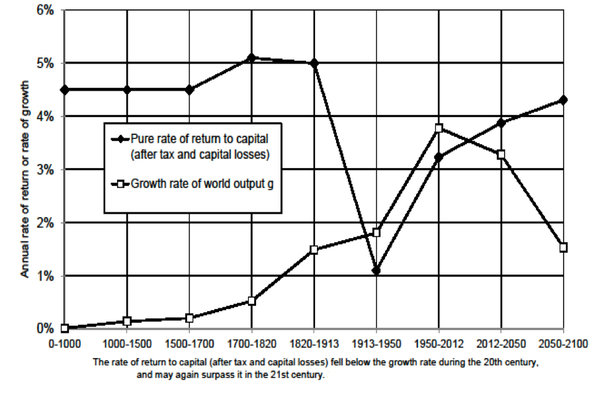
What Piketty is proposing is that the twentieth century was an anomaly in the history of global capitalism:

The six decades between 1914 and 1973 stand out from the past and future, according to Piketty, because the rate of economic growth exceeded the after-tax rate of return on capital. Since then, the rate of growth of the economy has declined, while the return on capital is rising to its pre-World War I levels.

“If the rate of return on capital remains permanently above the rate of growth of the economy – this is Piketty’s key inequality relationship,” Milanovic writes in his review, it “generates a changing functional distribution of income in favor of capital and, if capital incomes are more concentrated than incomes from labor (a rather uncontroversial fact), personal income distribution will also get more unequal — which indeed is what we have witnessed in the past 30 years.”

Edsall provides a variety of expert judgments on the book. I have a profound proclivity for exciting ideas that suggest we’re all doomed – so take my interest with a pinch of salt. But the book powerfully suggests a rather determinist view that capitalism constantly sows the seeds of its own destruction, by gradually and inexorably increasing social and economic inequality in such a way as to undermine the legitimacy of democratic politics that undergirds its existence. Let’s just say that Tom Perkins and Paul Ryan – as well as unreconstructed liberals who think government can truly defeat accelerating inequality – should read it.