Journal of the American Chemical Society
DOI: 10.1021/jacs.6b05208
A novel wide-bandgap conjugated polymer PBTA-FPh based on benzodithiophene-alt-benzo[1,2,3]triazole as the main chain and a polar pentafluorothiophenyl (FPh) group in the side chain has been designed and synthesized. In comparison to the pristine polymer PBTA-BO that consists of nonpolar alkyl side chains, the resulting PBTA-FPh exhibits less pronounced aggregation while possessing analogous optical and electrochemical bandgaps. Contact angle measurements demonstrate that the surface energy can be enhanced by incorporating FPh moiety, leading to a better miscibility of PBTA-BO with PC71BM in the presence of a certain amount of PBTA-FPh. The photoactive layer of PBTA-BO:PC71BM:PBTA-FPh with weight ratio of 1:1.2:0.02% exhibits a percolated network with the fibrous features, as revealed by transmission electron microscopy measurements. Of particular interest is the significantly improved photovoltaic performances of polymer solar cell devices for which the power conversion efficiency is enhanced from 6.46% for the control device to 7.91% for device processed with PBTA-FPh as the polymeric additive. These observations indicate that introducing donor–acceptor type of polymeric additive comprising of polar groups in the side chain can be a promising strategy for the fabrication of high-performance polymer solar cells.

A novel wide-bandgap conjugated polymer PBTA-FPh based on benzodithiophene-alt-benzo[1,2,3]triazole as the main chain and a polar pentafluorothiophenyl (FPh) group in a side chain has been designed and synthesized as a polymeric additive. The incorporation of PBTA-FPh can lead to improved miscibility and morphology of PBTA-BO:PC71BM blend films, resulting in obviously improved power conversion efficiency of polymer solar cells from 6.46% to 7.91%.


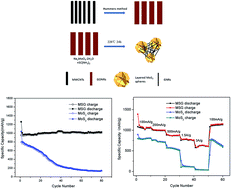
The polarizable organic/water interface is used to construct MoS2/graphene nanocomposites, and various asymmetrically dual-decorated graphene sandwiches are synthesized. High-resolution transmission electron microscopy and 3D electron tomography confirm their structure. These dual-decorated graphene-based hybrids show excellent hydrogen evolution activity and promising capacitance performance.
In this work, polymer solar cells are fabricated based on the blend of PTB7-Th: PC71BM by using a mixed solvent additive of 1,8-diiodooctane and N-methyl pyrrolidone to optimize the morphology of the blend. A high power conversion efficiency (PCE) of 10.8% has been achieved with a simple conventional device. In order to deeply investigate the influence of the mixed solvent additives on the morphology and device performance, the variations of the molecular packing and bulk morphology of the blend film cast from ortho-dichlorobenzene with single or binary solvent additives are measured. Although all the blend films exhibit similar domain size and nanoscale phase separation, the blend film processed with mixed solvent additive shows the highest domain purity, resulting in the least bimolecular recombination, relatively high Jsc and FF, and hence enhanced PCE. Therefore, the best photovoltaic performance with the Voc of 0.82 V, Jsc of 19.1 mA cm−2, FF of 69.1%, and PCE of 10.8% are obtained for the device based on the blend with binary solvent additive treatment.

For the PTB7-Th:PC71BM blend system, the binary solvent additives of 1,8-diiodooctane and N-methyl pyrrolidone are used to enhance the domain purity, so that a power conversion efficiency of 10.8% is achieved with the conventional device structure, which is much higher than that of the devices without or with single solvent additive treatment.

During the past few years, the field of photovoltaics has been revolutioned through the use of perovskites as light-harvesting materials. This has led to studying a whole range of organic structures fulfilling the energetical requirements within the typical architecture of a perovskite-based solar cell. In this context, carbon nanoforms, with their interesting and versatile properties, are studied as charge transporting materials, electrodes or as additives within the light-harvesting perovskite material. The latest findings concerning the exciting field of carbon nanostructures for PSCs are summarized.

Carbon nanoforms, owing to their interesting and versatile properties, are studied as charge transporting materials, electrodes or as additives within the revolutionary field of perovskite-based solar cells. The latest findings concerning the exciting field of carbon nanostructures for PSCs are summarized.

With ever-increasing demand for electrical energy consumption, semi-transparent solar cell (ST-SC) technology is desired to be integrated seamlessly onto the windows of buildings or vehicles. In article number 1502466, Nam-Gyu Park, Seunghyup Yoo, and co-workers demonstrate high-performance ST-SCs with excellent thermal-mirror functionality using methylammonium lead iodide perovskite photoactive layers and metal-based transparent electrode capped with high-index dielectric layers.

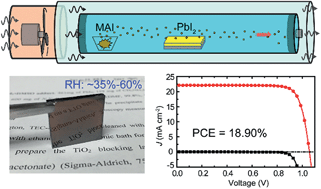
In article number 1600386, Jeffrey G. Tait and co-workers develop non-hazardous ink systems, based on solvent-alcohol-acid, for coating perovskite photovoltaic films in a single step. Coating was further developed from spin to blade, while the high yield process produced efficient 4 cm2 modules.
A family of porphyrins and benzoporphyrins bearing phenyl, thiophenyl, or bithiophenyl groups at their meso-positions are synthesized and systematically investigated for their potential use in bulk heterojunction solar cells (BHJ-SCs). Comparative studies of these compounds show that the introduction of the thiophenyl and bithiophenyl groups, and the extension of the porphyrin π-conjugated system significantly affect both photophysical and electrochemical properties. Binary conventional and ternary converted BHJ-SCs based on these compounds are fabricated and studied. Results show that remarkable enhancement of the device efficiency is achieved by using the thiophene-containing benzoporphyrin derivatives as additives for a poly(3-hexylthiophene) (P3HT):phenyl-C61-butyric acid methyl ester blend in the inverted BHJ-SCs. The optimum BHJ-SC exhibits a maximum energy conversion efficiency of 4.3%, corresponding to 19% enhancement of the conversion efficiency as compared with the benchmark BHJ-SCs.

Systematic structural modification of a series of porphyins and benzoporphyrins bearing phenyl, thiophenyl, or bithiophenyl meso-substituents enables understanding of structure–property relationship and fine-tuning of photophysical and electrochemical properties of the compounds. Device conversion efficiency can be improved by 19% when thiophene-substituted benzoporphyrin is used as an additive for ternary converted bulk heterojunction solar cells.
Portable electronic devices have become increasingly widespread. Because these devices cannot always be tethered to a central grid, powering them will require low-cost energy harvesting technologies. As a response to this anticipated demand, this study demonstrates transparent organic solar cells fabricated on flexible substrates, including plastic and paper, using graphene as both the anode and cathode. Optical transmittance of up to 69% at 550 nm is achieved by combining the highly transparent graphene electrodes with organic polymers that primarily absorb in the near-IR and near-UV regimes. To address the challenge of transferring graphene onto organic layers as the top electrode, this study develops a room temperature dry-transfer technique using ethylene-vinyl-acetate as an adhesion-promoting interlayer. The power conversion efficiency achieved for flexible devices with graphene anode and cathode devices is 2.8%–3.8% at for optical transmittance of 54%–61% across the visible regime. These results demonstrate the versatility of graphene in optoelectronic applications and it is important step toward developing a practical power source for distributed wireless electrical systems.

A visibly transparent, flexible solar cell with all-graphene electrodes is fabricated by combining the high optical transmittance of graphene with organic polymers that absorb primarily in the near-IR and near-IV regimes. The fabrication process is enabled by developing a universal room temperature dry graphene transfer method. The devices exhibit exceptional optical transmittance and mechanical flexibility.

Poly(Phenylene vinylene) anionic polyelectrolyte (PVBT-SO3) was found to be an efficient hole extraction layer for inverted perovskite solar cells. It can be cast from an aqueous solution and does not require thermal annealing for improved device performance. The devices show maximum solar cell efficiency of 15.9% and exhibit improved stability under ambient conditions and enhanced charge extraction.

A low-cost carbon cloth is applied in perovskite solar cells (PSC) as a collector composite and degradation inhibitor. This study incorporates carbon fibers as a back contact in perovskite solar cells, which results in enhancement in all photovoltaic parameters. This material is suitable for large-scale fabrication of PSCs as it has shown an improved long-term stability when compared to the gold counterpart under elevated temperatures.

B. Q. Sun and co-workers develop a simple and effective method to enhance the adhesion force between crystalline Si and amorphous organic layers by covalent chemical mutual anchoring, as described on page 5035. This method dramatically improves the charge transport and suppresses charge recombination at the organic-inorganic interface simultaneously, resulting in high-efficiency solar cells. These findings suggest a promising approach to low-cost and simple fabrication for high-performance organic-inorganic heterojunction solar cells.

Precisely controlling the optimal amount of hydration water in the precursor solution, results in the formation of a smooth and uniform perovskite film, as described by Y. Zhan, L. Zheng, and co-workers on page 5028. With appropriate annealing, the perovskite monohydrate loses its hydration water and crystallizes into pristine MAPbI3. The simplicity of controlling hydration water during precursor solution preparation will influence mass production of perovskite solar cells.

Donor–acceptor–acceptor′ small-molecule donors are synthesized to investigate regioisomeric effects on organic photovoltaic device performance. Cross-conjugation in 2-((7-(N-(2-ethylhexyl)-benzothieno[3,2-b]thieno[3,2-d]pyrrol-2-yl)benzo[c][1,2,5]thiadiazol-4-yl)methylene)malononitrile leads to an increased open-circuit voltage compared with its isomer 2-((7-(N-(2-ethylhexyl)-benzothieno[3,2-b]thieno[2,3-d]pyrrol-2-yl)benzo[c][1,2,5]thiadiazol-4-yl)methylene)malononitrile. A correlation is then established between molecular conjugation length and orbital energies, and hence open-circuit voltage.


On page 5939, J. V. Badding and co-workers describe the unrolling of a flexible hydrogenated amorphous silicon solar cell, deposited by high-pressure chemical vapor deposition. The high-pressure deposition process is represented by the molecules of silane infiltrating the small voids between the rolled up substrate, facilitating plasma-free deposition over a very large area. The high-pressure approach is expected to also find application for 3D nanoarchitectures.