20 Nov 06:54
J. Mater. Chem. A, 2017, 5,24110-24115
DOI: 10.1039/C7TA07969A, Communication
Menghua Zhu, Weiwei Liu, Weijun Ke, Sarah Clark, Ethan B. Secor, Tze-Bin Song, Mercouri G. Kanatzidis, Xin Li, Mark C. Hersam
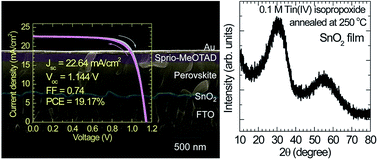
A rapid, low-temperature, solution-based photonic-annealing method is developed to prepare tin oxide electron transport layers for efficient perovskite solar cells.
The content of this RSS Feed (c) The Royal Society of Chemistry
20 Nov 06:51
J. Mater. Chem. A, 2017, 5,25200-25210
DOI: 10.1039/C7TA06452G, Paper
Michiel[space]L. Petrus, Arif Music, Anna C. Closs, Johan C. Bijleveld, Maximilian T. Sirtl, Yinghong Hu, Theo J. Dingemans, Thomas Bein, Pablo Docampo
A series of azomethine-based HTMs is synthesized using simple condensation chemistry. Their photovoltaic performance and moisture barrier properties are presented.
The content of this RSS Feed (c) The Royal Society of Chemistry
20 Nov 06:44
by Weigang Jiang, Runnan Yu, Zhiyang Liu, Ruixiang Peng, Dongbo Mi, Ling Hong, Qiang Wei, Jianhui Hou, Yongbo Kuang, Ziyi Ge
Abstract
A novel small-molecule acceptor, (2,2′-((5E,5′E)-5,5′-((5,5′-(4,4,9,9-tetrakis(5-hexylthiophen-2-yl)-4,9-dihydro-s-indaceno[1,2-b:5,6-b′]dithiophene-2,7-diyl)bis(4-(2-ethylhexyl)thiophene-5,2-diyl))bis(methanylylidene)) bis(3-hexyl-4-oxothiazolidine-5,2-diylidene))dimalononitrile (ITCN), end-capped with electron-deficient 2-(3-hexyl-4-oxothiazolidin-2-ylidene)malononitrile groups, is designed, synthesized, and used as the third component in fullerene-free ternary polymer solar cells (PSCs). The cascaded energy-level structure enabled by the newly designed acceptor is beneficial to the carrier transport and separation. Meanwhile, the three materials show a complementary absorption in the visible region, resulting in efficient light harvesting. Hence, the PBDB-T:ITCN:IT-M ternary PSCs possess a high short-circuit current density (Jsc) under an optimal weight ratio of donors and acceptors. Moreover, the open-circuit voltage (Voc) of the ternary PSCs is enhanced with an increase of the third acceptor ITCN content, which is attributed to the higher lowest unoccupied molecular orbital energy level of ITCN than that of IT-M, thus exhibits a higher Voc in PBDB-T:ITCN binary system. Ultimately, the ternary PSCs achieve a power conversion efficiency of 12.16%, which is higher than the PBDB-T:ITM-based PSCs (10.89%) and PBDB-T:ITCN-based ones (2.21%). This work provides an effective strategy to improve the photovoltaic performance of PSCs.

Fullerene-free ternary polymer solar cells with a high efficiency of 12.16% are fabricated by adding a novel small-molecule acceptor to form a cascaded energy-level structure.
20 Nov 06:44
by Bin Li, Xili Cui, Daniel O'Nolan, Hui-Min Wen, Mengdie Jiang, Rajamani Krishna, Hui Wu, Rui-Biao Lin, Yu-Sheng Chen, Daqiang Yuan, Huabin Xing, Wei Zhou, Qilong Ren, Guodong Qian, Michael J. Zaworotko, Banglin Chen
Abstract
Realization of ideal molecular sieves, in which the larger gas molecules are completely blocked without sacrificing high adsorption capacities of the preferred smaller gas molecules, can significantly reduce energy costs for gas separation and purification and thus facilitate a possible technological transformation from the traditional energy-intensive cryogenic distillation to the energy-efficient, adsorbent-based separation and purification in the future. Although extensive research endeavors are pursued to target ideal molecular sieves among diverse porous materials, over the past several decades, ideal molecular sieves for the separation and purification of light hydrocarbons are rarely realized. Herein, an ideal porous material, SIFSIX-14-Cu-i (also termed as UTSA-200), is reported with ultrafine tuning of pore size (3.4 Å) to effectively block ethylene (C2H4) molecules but to take up a record-high amount of acetylene (C2H2, 58 cm3 cm−3 under 0.01 bar and 298 K). The material therefore sets up new benchmarks for both the adsorption capacity and selectivity, and thus provides a record purification capacity for the removal of trace C2H2 from C2H4 with 1.18 mmol g−1 C2H2 uptake capacity from a 1/99 C2H2/C2H4 mixture to produce 99.9999% pure C2H4 (much higher than the acceptable purity of 99.996% for polymer-grade C2H4), as demonstrated by experimental breakthrough curves.

An ideal molecular sieve is realized for the highly efficient removal of C2H2 from C2H2/C2H4 (1:99) mixture, attributed to the optimized pore sizes to efficiently block C2H4 molecules, and strong binding sites to take up a record-high amount of C2H2, thus simultaneously producing high purity C2H4 (99.9999%) with record C2H4 productivity of 87.5 mmol g−1 per cycle and recovery of C2H2 (97%).
20 Nov 06:43
by Ke Gao, Zonglong Zhu, Bo Xu, Sae Byeok Jo, Yuanyuan Kan, Xiaobin Peng, Alex K.-Y. Jen
Abstract
Employing a layer of bulk-heterojunction (BHJ) organic semiconductors on top of perovskite to further extend its photoresponse is considered as a simple and promising way to enhance the efficiency of perovskite-based solar cells, instead of using tandem devices or near infrared (NIR)-absorbing Sn-containing perovskites. However, the progress made from this approach is quite limited because very few such hybrid solar cells can simultaneously show high short-circuit current (JSC) and fill factor (FF). To find an appropriate NIR-absorbing BHJ is essential for highly efficient, organic, photovoltaics (OPV)/perovskite hybrid solar cells. The materials involved in the BHJ layer not only need to have broad photoresponse to increase JSC, but also possess suitable energy levels and high mobility to afford high VOC and FF. In this work, a new porphyrin is synthesized and blended with [6,6]-phenyl-C61-butyric acid methyl ester (PCBM) to function as an efficient BHJ for OPV/perovskite hybrid solar cells. The extended photoresponse, well-matched energy levels, and high hole mobility from optimized BHJ morphology afford a very high power conversion efficiency (PCE) (19.02%) with high Voc, JSC, and FF achieved simultaneously. This is the highest value reported so far for such hybrid devices, which demonstrates the feasibility of further improving the efficiency of perovskite devices.

A highly efficient organic photovoltaics/perovskite hybrid solar cell is demonstrated by blending a new conjugated porphyrin-based small molecule with [6,6]-phenyl-C61-butyric acid methyl ester (PCBM) to function as an efficient bulk-heterojunction layer. The extended photoresponse, matched energy levels, and high hole mobility derived from the optimized bulk-heterojunction morphology contribute to the record-high efficiency of 19.02% in these hybrid devices.
20 Nov 06:41
by Zhibin Yang, Adharsh Rajagopal, Alex K.-Y. Jen
Abstract
Extremely high power conversion efficiencies (PCEs) of ≈20–22% are realized through intensive research and development of 1.5–1.6 eV bandgap perovskite absorbers. However, development of ideal bandgap (1.3–1.4 eV) absorbers is pivotal to further improve PCE of single junction perovskite solar cells (PVSCs) because of a better balance between absorption loss of sub-bandgap photons and thermalization loss of above-bandgap photons as demonstrated by the Shockley–Queisser detailed balanced calculation. Ideal bandgap PVSCs are currently hindered by the poor optoelectronic quality of perovskite absorbers and their PCEs have stagnated at <15%. In this work, through systematic photoluminescence and photovoltaic analysis, a new ideal bandgap (1.35 eV) absorber composition (MAPb0.5Sn0.5(I0.8Br0.2)3) is rationally designed and developed, which possesses lower nonradiative recombination states, band edge disorder, and Urbach energy coupled with a higher absorption coefficient, which yields a reduced Voc,loss (0.45 V) and improved PCE (as high as 17.63%) for the derived PVSCs. This work provides a promising platform for unleashing the complete potential of ideal bandgap PVSCs and prospects for further improvement.

An ideal-bandgap (1.35 eV) perovskite (MAPb0.5Sn0.5(I0.8Br0.2)3) is developed with lower non-radiative recombination states, band edge disorder, and Urbach energy coupled with a higher absorption coefficient, yielding a reduced open-circuit voltage loss of 0.45 V and improved efficiency of 17.63%. This work provides a promising platform for unleashing the complete potential of ideal-bandgap perovskite solar cells.
10 Nov 00:17
J. Mater. Chem. A, 2017, 5,24749-24757
DOI: 10.1039/C7TA07924A, Paper
Nakul Jain, Naresh Chandrasekaran, Aditya Sadhanala, Richard H. Friend, Christopher R. McNeill, Dinesh Kabra
Highly sensitive spectroscopic study of interfacial disorder and its correlation with the solvent additive and the molecular structure of the donor in bulk heterojunction organic solar cells.
The content of this RSS Feed (c) The Royal Society of Chemistry
10 Nov 00:16
J. Mater. Chem. A, 2017, 5,24790-24803
DOI: 10.1039/C7TA08040A, Paper
Kwang-Ho Jung, Ja-Young Seo, Seonhee Lee, Hyunjung Shin, Nam-Gyu Park
A hysteresis-free and high-efficiency planar perovskite solar cell was developed using a solution-processed SnO2 electron-transporting layer (ETL).
The content of this RSS Feed (c) The Royal Society of Chemistry
10 Nov 00:14
J. Mater. Chem. A, 2017, 5,24820-24825
DOI: 10.1039/C7TA09543K, Paper
Mingyu Zhang, Jingshuai Zhu, Kuan Liu, Guanhaojie Zheng, Guanchao Zhao, Liwei Li, Yuan Meng, Ted Guo, Huanping Zhou, Xiaowei Zhan
A low temperature processed fused-ring electron acceptor IDIC is used as the electron transport layer in planar n-i-p perovskite solar cells, which exhibit higher efficiency and better stability than control devices based on TiO2.
The content of this RSS Feed (c) The Royal Society of Chemistry
10 Nov 00:13
by Ting Wu, Liam Collins, Jia Zhang, Pei-Ying Lin, Mahshid Ahmadi, Stephen Jesse and Bin Hu

ACS Nano
DOI: 10.1021/acsnano.7b06413

10 Nov 00:12
by Vikas Nandal and Pradeep R. Nair

ACS Nano
DOI: 10.1021/acsnano.7b06294

10 Nov 00:11
by Yang Bai, Xiangyue Meng, Shihe Yang
Abstract
Organic-inorganic halide perovskite materials have become a shining star in the photovoltaic field due to their unique properties, such as high absorption coefficient, optimal bandgap, and high defect tolerance, which also lead to the breathtaking increase in power conversion efficiency from 3.8% to over 22% in just seven years. Although the highest efficiency was obtained from the TiO2 mesoporous structure, there are increasing studies focusing on the planar structure device due to its processibility for large-scale production. In particular, the planar p-i-n structure has attracted increasing attention on account of its tremendous advantages in, among other things, eliminating hysteresis alongside a competitive certified efficiency of over 20%. Crucial for the device performance enhancement has been the interface engineering for the past few years, especially for such planar p-i-n devices. The interface engineering aims to optimize device properties, such as charge transfer, defect passivation, band alignment, etc. Herein, recent progress on the interface engineering of planar p-i-n structure devices is reviewed. This review is mainly focused on the interface design between each layer in p-i-n structure devices, as well as grain boundaries, which are the interfaces between polycrystalline perovskite domains. Promising research directions are also suggested for further improvements.

Interface engineering has been widely practiced on planar p-i-n perovskite solar cells since it brings about significant improvement in both device performance and stability. Recent progress is reviewed about the engineering of each interface of such devices and its effects, including defect passivation, accelerated charge transfer, enhanced stabilities, etc., which are key parameters for the photovoltaic devices.
10 Nov 00:09
by Shunmian Lu, Hong Lin, Shaoqing Zhang, Jianhui Hou, Wallace C. H. Choy

In article number 1701164, Wallace C.H. Choy and co-workers demonstrate an all-solution-processed switchable interconnecting layer (ICL) for both inverted and normal tandem organic solar cells (OSCs). This strategy shifts the views from conventionally complicated tunneling junction ICL where both electron/hole transport layers play several different roles towards simplified ICL where electron/hole transport layers play distinct decoupled role, advancing ICL for more adaptable tandem OSCs.
10 Nov 00:08
by Peng Zhang, Jiang Wu, Ting Zhang, Yafei Wang, Detao Liu, Hao Chen, Long Ji, Chunhua Liu, Waseem Ahmad, Zhi David Chen, Shibin Li
Abstract
Perovskite solar cells (PSCs) have developed rapidly over the past few years, and the power conversion efficiency of PSCs has exceeded 20%. Such high performance can be attributed to the unique properties of perovskite materials, such as high absorption over the visible range and long diffusion length. Due to the different diffusion lengths of holes and electrons, electron transporting materials (ETMs) used in PSCs play a critical role in PSCs performance. As an alternative to TiO2 ETM, ZnO materials have similar physical properties to TiO2 but with much higher electron mobility. In addition, there are many simple and facile methods to fabricate ZnO nanomaterials with low cost and energy consumption. This review focuses on recent developments in the use of ZnO ETM for PSCs. The fabrication methods of ZnO materials are briefly introduced. The influence of different ZnO ETMs on performance of PSCs is then reviewed. The limitations of ZnO ETM-based PSCs and some solutions to these challenges are also discussed. The review provides a systematic and comprehensive understanding of the influence of different ZnO ETMs on PSCs performance and potentially motivates further development of PSCs by extending the knowledge of ZnO-based PSCs to TiO2-based PSCs.

Progress in perovskite solar cells based on ZnO electron-transport materials of different morphologies and their fabrication methods is summarized. The influence of the ZnO morphology and fabrication process on the performance of perovskite solar cells are reviewed and highlighted. Moreover, the issues of ZnO materials, and some solutions and strategies to promote the performance of solar cells, are introduced.
10 Nov 00:08
by Baobing Fan, Lei Ying, Peng Zhu, Feilong Pan, Feng Liu, Junwu Chen, Fei Huang, Yong Cao
Abstract
A novel wide-bandgap conjugated copolymer based on an imide-functionalized benzotriazole building block containing a siloxane-terminated side-chain is developed. This copolymer is successfully used to fabricate highly efficient all-polymer solar cells (all-PSCs) processed at room temperature with the green-solvent 2-methyl-tetrahydrofuran. When paired with a naphthalene diimide-based polymer electron-acceptor, the all-PSC exhibits a maximum power conversion efficiency (PCE) of 10.1%, which is the highest value so far reported for an all-PSC. Of particular interest is that the PCE remains 9.4% after thermal annealing at 80 °C for 24 h. The resulting high efficiency is attributed to a combination of high and balanced bulky charge carrier mobility, favorable face-on orientation, and high crystallinity. These observations indicate that the resulting copolymer can be a promising candidate toward high-performance all-PSCs for practical applications.

A novel wide-bandgap conjugated copolymer PTzBI-Si based on an imide-functionalized benzotriazole unit containing a siloxane-terminated side-chain is developed and used to fabricate all-polymer solar cells (all-PSCs). When processed with a green solvent 2-methyl-tetrahydrofuran, the all-PSC exhibits a power conversion efficiency of 10.1%, which represents the highest efficiency ever reported for all-PSCs.
10 Nov 00:08
by Xiaotian Hu, Zengqi Huang, Xue Zhou, Pengwei Li, Yang Wang, Zhandong Huang, Meng Su, Wanjie Ren, Fengyu Li, Mingzhu Li, Yiwang Chen, Yanlin Song

In article number 1703236, Fengyu Li, Yanlin Song, and co-workers report hysteresis-free, flexible, and large-scale perovskite solar cells with recorded photoelectric conversion efficiencies of 12.3% for a 1 cm2 single chip and 8.4% for a 24 cm2 solar module. This is the first time that a wearable solar power source that can supply power for multifunction electronic devices with a variety of body movements is fabricated practically.
04 Nov 02:34
J. Mater. Chem. A, 2017, 5,24168-24177
DOI: 10.1039/C7TA08761F, Paper
Bo Li, Mengjie Li, Chengbin Fei, Guozhong Cao, Jianjun Tian
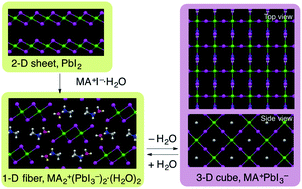
Colloidal engineering by controlling the size of colloidal clusters in the perovskite precursor was developed to induce monolayer CH3NH3PbI3 films.
The content of this RSS Feed (c) The Royal Society of Chemistry
28 Oct 02:58
J. Mater. Chem. A, 2017, 5,24275-24281
DOI: 10.1039/C7TA08827B, Paper
Peng Huang, Yanfeng Liu, Kaicheng Zhang, Ligang Yuan, Dahua Li, Guangliang Hou, Bin Dong, Yi Zhou, Bo Song, Yongfang Li
p-i-n perovskite solar cells using catechol derivative doped-PEDOT:PSS exhibit improved performance.
The content of this RSS Feed (c) The Royal Society of Chemistry
28 Oct 02:57
J. Mater. Chem. A, 2017, 5,22975-22983
DOI: 10.1039/C7TA09178H, Communication
Nicholas Rolston, Adam D. Printz, Florian Hilt, Michael Q. Hovish, Karsten Bruning, Christopher J. Tassone, Reinhold H. Dauskardt
We report on submicron organosilicate barrier films produced rapidly in air by a scalable spray plasma process that improves both the stability and efficiency of perovskite solar cells.
The content of this RSS Feed (c) The Royal Society of Chemistry
28 Oct 02:57
J. Mater. Chem. A, 2017, 5,25211-25219
DOI: 10.1039/C7TA07828E, Paper
Kai Lu, Yan Lei, Ruijuan Qi, Jiang Liu, Xiaogang Yang, Zuxiao Jia, Rui Liu, Yong Xiang, Zhi Zheng
The Fermi level of perovskite materials can be adjusted by Cu doping to facilitate charge collection at an ITO substrate without HTL.
The content of this RSS Feed (c) The Royal Society of Chemistry
28 Oct 02:57
J. Mater. Chem. A, 2017, 5,24145-24152
DOI: 10.1039/C7TA08097B, Paper
Pei Zhao, Hongchao Yang, Jianwei Li, Hao Jin, Wei Wei, Lin Yu, Baibiao Huang, Ying Dai
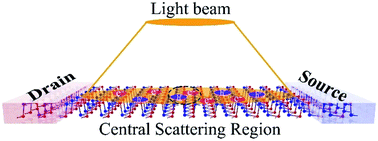
A new photovoltaic system based on single layer group-IV monochalcogenides MX (M = Ge, Sn; X = S, Se) exhibits high performance.
The content of this RSS Feed (c) The Royal Society of Chemistry
28 Oct 02:56
by Qing Sun, Paul Fassl, David Becker-Koch, Alexandra Bausch, Boris Rivkin, Sai Bai, Paul E. Hopkinson, Henry J. Snaith, Yana Vaynzof

In article number 1700977, Yana Vaynzof and co-workers investigate how the MAPbI3 perovskite layer microstructure is affecting its stability upon exposure to oxygen and light. The authors show that the degradation process is initiated at the grain boundaries, demonstrating that devices whose active layer consists of larger, more uniform grains exhibit enhanced photovoltaic stability.
28 Oct 02:50
by Tongle Bu, Lan Wu, Xueping Liu, Xiaokun Yang, Peng Zhou, Xinxin Yu, Tianshi Qin, Jiangjian Shi, Song Wang, Saisai Li, Zhiliang Ku, Yong Peng, Fuzhi Huang, Qingbo Meng, Yi-Bing Cheng, Jie Zhong

Organic-inorganic mixed perovskite solar cells demonstrate superiority for the application as low-cost printable solar energy, yet common processing of solvent-controlled crystallization routes contain highly toxic solvents that cause safety and/or environmental issues. In article number 1700576, Fuzhi Huang, Jie Zhong, and co-workers demonstrate a green solvent engineering incorporated interface optimization method to address this topic, and high performance devices are obtained.
25 Oct 02:48
by Junjie Si, Yang Liu, Zhuofei He, Hui Du, Kai Du, Dong Chen, Jing Li, Mengmeng Xu, He Tian, Haiping He, Dawei Di, Changqing Lin, Yingchun Cheng, Jianpu Wang and Yizheng Jin

ACS Nano
DOI: 10.1021/acsnano.7b05191

25 Oct 02:48
J. Mater. Chem. A, 2017, 5,23976-23986
DOI: 10.1039/C7TA07754H, Paper
Linghai Zhang, Patrick H.-L. Sit
DFT calculations were carried out to study the roles of iodine, excess electrons and holes on the MAPbI3 surface degradation.
The content of this RSS Feed (c) The Royal Society of Chemistry
25 Oct 02:44
J. Mater. Chem. A, 2017, 5,23131-23138
DOI: 10.1039/C7TA07716E, Paper
M. Pazoki, A. Rockert, M. J. Wolf, R. Imani, T. Edvinsson, J. Kullgren
The lead-free lanthanide iodide perovskite materials explored herein, show potentials for implementation as light absorber or charge transfer layer in perovskite solar cell devices.
The content of this RSS Feed (c) The Royal Society of Chemistry
25 Oct 02:42
J. Mater. Chem. A, 2017, 5,23831-23839
DOI: 10.1039/C7TA07732G, Paper
Luyao Zheng, Sanjoy Mukherjee, Kai Wang, Martha E. Hay, Bryan W. Boudouris, Xiong Gong
We report high performance hybrid perovskite solar cells engineered by a UV crosslinkable radical polymer.
The content of this RSS Feed (c) The Royal Society of Chemistry
25 Oct 02:42
J. Mater. Chem. A, 2017, 5,23815-23821
DOI: 10.1039/C7TA08042E, Paper
Kazutaka Shoyama, Wataru Sato, Yunlong Guo, Eiichi Nakamura
This work has chemically addressed the enigmatic effects of water on solar cell devices based on an organic-inorganic hybrid perovskite, i.e., water can exert either beneficial or detrimental effects on device fabrication and device stability.
The content of this RSS Feed (c) The Royal Society of Chemistry
25 Oct 02:39
by Sunsun Li, Long Ye, Wenchao Zhao, Xiaoyu Liu, Jie Zhu, Harald Ade, Jianhui Hou
Abstract
Improving the fill factor (FF) is known as a challenging issue in organic solar cells (OSCs). Herein, a strategy of extending the conjugated area of end-group is proposed for the molecular design of acceptor–donor–acceptor (A–D–A)-type small molecule acceptor (SMA), and an indaceno[1,2-b:5,6-b′]dithiophene-based SMA, namely IDTN, by end-capping with the naphthyl fused 2-(3-oxocyclopentylidene)malononitrile is synthesized. Benefiting from the π-conjugation extension by fusing two phenyls, IDTN shows stronger molecular aggregation, more ordered packing structure, thus over one order of magnitude higher electron mobility relative to its counterpart. By utilizing the fluorinated polymer (PBDB-TF) as the electron donor, the corresponding device exhibits a high efficiency of 12.2% with a record-high FF of 0.78, which is approaching the theoretical limit of OSCs. Compared with the reference molecule, such a high FF in the IDTN system can be mainly attributed to the more ordered π–π packing of acceptor aggregates, higher domain purity and symmetric carrier transport in the blend. Hence, enlarging the conjugated area of the terminal-group in these A–D–A-type SMAs is a promising approach not only for enhancing the electron mobility, but also for improving the blend morphology, and both of them are conducive to the fill-factor breakthrough.

By extending the conjugated area of the end-group, a newly designed A–D–A–type small-molecule acceptor, namely IDTN, exhibits dense and ordered packing, and therefore, the electron mobility of the IDTN is over one order of magnitude higher than that of its counterpart. When blended with the donor polymer PBDB-TF, a high efficiency of 12.2% with an outstanding fill factor of 0.78 is achieved.
19 Oct 07:25
J. Mater. Chem. A, 2017, 5,22952-22958
DOI: 10.1039/C7TA07660F, Communication
Shungshuang Liu, Wenchao Huang, Peizhe Liao, Nuttapol Pootrakulchote, Hao Li, Jianfeng Lu, Junpeng Li, Feihong Huang, Xuxia Shai, Xiaojuan Zhao, Yan Shen, Yi-Bing Cheng, Mingkui Wang
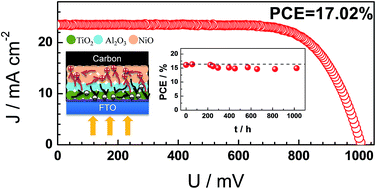
Cs0.05(FA0.4MA0.6)0.95PbI2.8Br0.2 based devices showed an impressive efficiency of 17.02% and excellent thermal stability with long electron and hole diffusion lengths.
The content of this RSS Feed (c) The Royal Society of Chemistry