02 Aug 07:00
by Daehee Seol, Ahreum Jeong, Man Hyung Han, Seongrok Seo, Tae Sup Yoo, Woo Seok Choi, Hyun Suk Jung, Hyunjung Shin, Yunseok Kim
Organic–inorganic hybrid perovskite solar cells are attracting the attention of researchers owing to the high level of performance they exhibit in photovoltaic device applications. However, the attainment of an even higher level of performance is hindered by their anomalous current–voltage (I–V) hysteresis behavior. Even though experimental and theoretical studies have suggested that the perovskite materials may have a ferroelectric nature, it is still far from being fully understood. In this study, the origin of the hysteresis behavior in CH3NH3PbI3 perovskite thin films is investigated. The behavior of ferroelectricity using piezoresponse force microscopy is first examined. Then, by comparing the scan-rate-dependent nano/macroscopic I–V curves, it is found that ion migration assisted by the grain boundaries is a dominant origin of I–V hysteresis from a macroscopic viewpoint. Consequently, the observations suggest that, even though ferroelectricity exists in the CH3NH3PbI3 perovskite materials, ion migration primarily contributes to the macroscopic I–V hysteresis. The presented results can provide fundamental guidelines to the resolution of hysteresis issues in organic–inorganic hybrid perovskite materials.

This study reports on the origin of the hysteresis in CH3NH3PbI3 perovskite thin films. The presence of the ferroelectricity is demonstrated, and further, ion migration assisted by the grain boundaries is demonstrated as a dominant origin of macroscopic I–V hysteresis. Consequently, the observations suggest that although ferroelectricity exists, ion migration primarily contributes to the macroscopic I–V hysteresis.
02 Aug 06:57
by Bohee Hwang, Jang-Sik Lee

In article number 1701048, Jang-Sik Lee and Bohee Hwang report an approach for designing high density memory devices utilizing organolead halide perovskite (OHP) materials with a cross-point array structure which is deposited by sequential vapor deposition. The OHP-based nanoscale memory devices exhibit remarkably fast switching speed, low operating voltage, and long data retention. OHPs which are a key material in solar cells have a great potential to be used in high-density information storage devices.
29 Jul 00:56
by Peng Huang, Zhaowei Wang, Yanfeng Liu, Kaicheng Zhang, Ligang Yuan, Yi Zhou, Bo Song and Yongfang Li

ACS Applied Materials & Interfaces
DOI: 10.1021/acsami.7b06403

29 Jul 00:56
by Yang Liu, Fushan Li, Zhongwei Xu, Congxiu Zheng, Tailiang Guo, Xiangwei Xie, Lei Qian, Dong Fu and Xiaolin Yan

ACS Applied Materials & Interfaces
DOI: 10.1021/acsami.7b05381

29 Jul 00:55
by Yoon Ho Choi, Hyun Bin Kim, In Seok Yang, Sang Do Sung, Young Sik Choi, Jeongho Kim and Wan In Lee

ACS Applied Materials & Interfaces
DOI: 10.1021/acsami.7b05146

29 Jul 00:54
by Antonio Gaetano Ricciardulli, Sheng Yang, Xinliang Feng and Paul W. M. Blom

ACS Applied Materials & Interfaces
DOI: 10.1021/acsami.7b09702

29 Jul 00:54
by Fatemeh Behrouznejad, Cheng-Min Tsai, Sudhakar Narra, Eric W.-G. Diau and Nima Taghavinia

ACS Applied Materials & Interfaces
DOI: 10.1021/acsami.7b02799

29 Jul 00:53
by Lei Shi, Trevor L. Young, Jincheol Kim, Yun Sheng, Lei Wang, Yifeng Chen, Zhiqiang Feng, Mark J. Keevers, Xiaojing Hao, Pierre J. Verlinden, Martin A. Green and Anita W. Y. Ho-Baillie

ACS Applied Materials & Interfaces
DOI: 10.1021/acsami.7b07625

29 Jul 00:50
Energy Environ. Sci., 2017, 10,1942-1949
DOI: 10.1039/C7EE01675A, Communication
Fengxian Xie, Chun-Chao Chen, Yongzhen Wu, Xing Li, Molang Cai, Xiao Liu, Xudong Yang, Liyuan Han
Formamidinium (FA)-based perovskite materials show an extended absorption spectrum to 840 nm, which enables high power conversion efficiencies of over 20% compared with normal-structure perovskite solar cells (PSCs).
The content of this RSS Feed (c) The Royal Society of Chemistry

29 Jul 00:50
Energy Environ. Sci., 2017, 10,1874-1884
DOI: 10.1039/C7EE01650F, Analysis
Ilke Celik, Adam B. Phillips, Zhaoning Song, Yanfa Yan, Randy J. Ellingson, Michael J. Heben, Defne Apul
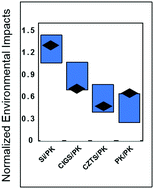
A PKSn,Pb/PKPb tandem was found to be the most promising PV technology for lowering the environmental impacts from solar PVs.
The content of this RSS Feed (c) The Royal Society of Chemistry

29 Jul 00:50
J. Mater. Chem. A, 2017, 5,17230-17239
DOI: 10.1039/C7TA05865A, Communication
Xuning Zhang, Xiaobing Zuo, Shenkun Xie, Jianyu Yuan, Huiqiong Zhou, Yuan Zhang
Photovoltaic characteristics, recombination and charge transport properties are investigated. The determined recombination reduction factor can reconcile the supreme device performance in organic solar cells using non-fullerene ITIC acceptor and severe carrier losses in all-polymer devices with P(NDI2OD-T2).
The content of this RSS Feed (c) The Royal Society of Chemistry
29 Jul 00:50
J. Mater. Chem. A, 2017, 5,17135-17150
DOI: 10.1039/C7TA04544A, Review Article
Peter D. Matthews, David J. Lewis, Paul O'Brien
We provide an update to the synthesis and properties metal-halide perovskites, a rapidly developing field that has revolutionised photovoltaics.
The content of this RSS Feed (c) The Royal Society of Chemistry
29 Jul 00:49
J. Mater. Chem. A, 2017, 5,17632-17639
DOI: 10.1039/C7TA04851C, Paper
Youyu Jiang, Jing Li, Sixing Xiong, Fangyuan Jiang, Tiefeng Liu, Fei Qin, Lin Hu, Yinhua Zhou
2,6-Dimethoxypyridine serves dual functions as a Lewis base for surface passivation and as a dopant for PC61BM in the fabrication of highly reproducible and high-efficiency planar perovskite solar cells.
The content of this RSS Feed (c) The Royal Society of Chemistry
29 Jul 00:48
J. Mater. Chem. A, 2017, 5,17619-17631
DOI: 10.1039/C7TA05583H, Paper
Xuncheng Liu, Li Nian, Ke Gao, Lianjie Zhang, Lechi Qing, Zhen Wang, Lei Ying, Zengqi Xie, Yuguang Ma, Yong Cao, Feng Liu, Junwu Chen
Side-chain random copolymers show high 3-D hole transport and offer excellent active layer thickness tolerance.
The content of this RSS Feed (c) The Royal Society of Chemistry
29 Jul 00:48
J. Mater. Chem. A, 2017, 5,17240-17247
DOI: 10.1039/C7TA05366E, Communication
Jahangeer Khan, Xiaokun Yang, Keke Qiao, Hui Deng, Jian Zhang, Zhiyong Liu, Waqar Ahmad, Jihong Zhang, Dengbing Li, Huan Liu, Haisheng Song, Chun Cheng, Jiang Tang
Efficient PbS quantum-dot solar cells were achieved through SnO2-Cl interface passivation.
The content of this RSS Feed (c) The Royal Society of Chemistry
29 Jul 00:47
J. Mater. Chem. A, 2017, 5,18044-18052
DOI: 10.1039/C7TA05720B, Paper
Shun-Hsiang Chan, Ming-Chung Wu, Kun-Mu Lee, Wei-Cheng Chen, Tzu-Hao Lin, Wei-Fang Su
The power conversion efficiency of perovskite solar cells can be enhanced by using Ba2+-doped perovskite films.
The content of this RSS Feed (c) The Royal Society of Chemistry
29 Jul 00:47
J. Mater. Chem. A, 2017, 5,17570-17579
DOI: 10.1039/C7TA03505E, Paper
Chaohong Zhang, Stefan Langner, Alexander V. Mumyatov, Denis V. Anokhin, Jie Min, Jose Dario Perea, Kirill L. Gerasimov, Andres Osvet, Dimitri A. Ivanov, Pavel Troshin, Ning Li, Christoph J. Brabec
The miscibility has more influence than the crystallinity on the optimized acceptor : donor ratio in solar cells.
The content of this RSS Feed (c) The Royal Society of Chemistry
29 Jul 00:46
J. Mater. Chem. A, 2017, 5,17204-17210
DOI: 10.1039/C7TA05809H, Communication
Yuan-Qiu-Qiang Yi, Huanran Feng, Meijia Chang, Hongtao Zhang, Xiangjian Wan, Chenxi Li, Yongsheng Chen
A series of new non-fullerene small molecule acceptors (NTIC, NTIC-Me, NTIC-OMe and NTIC-F) based on the acceptor-donor-acceptor (A-D-A) architecture, using hexacyclic naphthalene-(cyclopentadithiophene) as the central unit, were designed and synthesized.
The content of this RSS Feed (c) The Royal Society of Chemistry
29 Jul 00:46
J. Mater. Chem. A, 2017, 5,17943-17953
DOI: 10.1039/C7TA04995A, Paper
Guiting Chen, Fan Zhang, Meiyue Liu, Jun Song, Jiarong Lian, Pengju Zeng, Hin-Lap Yip, Wei Yang, Bin Zhang, Yong Cao
A novel bispyridinium salt (FPyBr) is designed as a cathode modifier to achieve high-performance and low-hysteresis fullerene/perovskite solar cells with a maximal PCE of 19.61%.
The content of this RSS Feed (c) The Royal Society of Chemistry
29 Jul 00:42
by Nilushi Wijeyasinghe, Anna Regoutz, Flurin Eisner, Tian Du, Leonidas Tsetseris, Yen-Hung Lin, Hendrik Faber, Pichaya Pattanasattayavong, Jinhua Li, Feng Yan, Martyn A. McLachlan, David J. Payne, Martin Heeney, Thomas D. Anthopoulos
This study reports the development of copper(I) thiocyanate (CuSCN) hole-transport layers (HTLs) processed from aqueous ammonia as a novel alternative to conventional n-alkyl sulfide solvents. Wide bandgap (3.4–3.9 eV) and ultrathin (3–5 nm) layers of CuSCN are formed when the aqueous CuSCN–ammine complex solution is spin-cast in air and annealed at 100 °C. X-ray photoelectron spectroscopy confirms the high compositional purity of the formed CuSCN layers, while the high-resolution valence band spectra agree with first-principles calculations. Study of the hole-transport properties using field-effect transistor measurements reveals that the aqueous-processed CuSCN layers exhibit a fivefold higher hole mobility than films processed from diethyl sulfide solutions with the maximum values approaching 0.1 cm2 V−1 s−1. A further interesting characteristic is the low surface roughness of the resulting CuSCN layers, which in the case of solar cells helps to planarize the indium tin oxide anode. Organic bulk heterojunction and planar organometal halide perovskite solar cells based on aqueous-processed CuSCN HTLs yield power conversion efficiency of 10.7% and 17.5%, respectively. Importantly, aqueous-processed CuSCN-based cells consistently outperform devices based on poly(3,4-ethylenedioxythiophene) polystyrene sulfonate HTLs. This is the first report on CuSCN films and devices processed via an aqueous-based synthetic route that is compatible with high-throughput manufacturing and paves the way for further developments.

Dissolution of copper thiocyanate (CuSCN) in aqueous ammonia enables processing of superior quality hole-transporting layers at low temperature in ambient air. Transistors based on these CuSCN layers exhibit mobilities close to 0.1 cm2 V−1 s−1, while solar cells incorporating CuSCN interlayers yield power conversion efficiencies of 10.7% and 17.5% for organic bulk heterojunction and organometal halide cells, respectively.
27 Jul 13:15
Nanoscale, 2017, 9,17167-17173
DOI: 10.1039/C7NR03963H, Communication
Jae-Hun Yu, Cheol-Ho Lee, Han-Ik Joh, Jun-Seok Yeo, Seok-In Na
The combination of fluorinated graphene and PEDOT as a bi-interlayer can lead to highly efficient and stable normal-structure perovskite solar cells.
The content of this RSS Feed (c) The Royal Society of Chemistry

27 Jul 13:12
Nanoscale, 2017, 9,15303-15313
DOI: 10.1039/C7NR03839A, Paper
Xiaolei Wang, Peng Li, Xiao Xia Han, Yasutaka Kitahama, Bing Zhao, Yukihiro Ozaki
The synergistic effect in ZnO-TiO2/N3/Ag can generate extra enhancements in the SERS intensity and degree of CT.
The content of this RSS Feed (c) The Royal Society of Chemistry

27 Jul 13:09
Nanoscale, 2017, 9,12677-12683
DOI: 10.1039/C7NR03265J, Paper
Wanjung Kim, Soyeon Kim, Sung Uk Chai, Myung Sun Jung, Jae Keun Nam, Jung-Hyun Kim, Jong Hyeok Park
Thermodynamic phase separation of hole transport layer can be demonstrated by tuning the PSS/PEDOT ratio without any post-treatment, which affects the optical, electronic and electrical properties of PEDOT:PSS layer.
The content of this RSS Feed (c) The Royal Society of Chemistry

27 Jul 13:00
by Yi Zhang, Zhaofu Fei, Peng Gao, Yonghui Lee, Farzaneh Fadaei Tirani, Rosario Scopelliti, Yaqing Feng, Paul J. Dyson, Mohammad Khaja Nazeeruddin

Perovskite films, grown from PbI2:MAI in DMSO in the presence of functionalized ionic-liquid (imidazolium iodide) dopants and incorporated into perovskite solar cells, are reported. One cell has a power conversion efficiency exceeding 19%. Difference in power conversion efficiency can be traced to the physical properties of imidazolium-PbI3 salts that form during the preparation of the film.
25 Jul 10:22
by Marc-Antoine Stoeckel, Marco Gobbi, Sara Bonacchi, Fabiola Liscio, Laura Ferlauto, Emanuele Orgiu, Paolo Samorì
Nanostructured materials characterized by high surface–volume ratio hold the promise to constitute the active materials for next-generation sensors. Solution-processed hybrid organohalide perovskites, which have been extensively used in the last few years for optoelectronic applications, are characterized by a self-assembled nanostructured morphology, which makes them an ideal candidate for gas sensing. Hitherto, detailed studies of the dependence of their electrical characteristics on the environmental atmosphere have not been performed, and even the effect of a ubiquitous gas such as O2 has been widely overlooked. Here, the electrical response of organohalide perovskites to oxygen is studied. Surprisingly, a colossal increase (3000-fold) in the resistance of perovskite-based lateral devices is found when measured in a full oxygen atmosphere, which is ascribed to a trap healing mechanism originating from an O2-mediated iodine vacancies filling. A variation as small as 70 ppm in the oxygen concentration can be detected. The effect is fast (<400 ms) and fully reversible, making organohalide perovskites ideal active materials for oxygen sensing. The effect of oxygen on the electrical characteristics of organohalide perovskites must be taken into deep consideration for the design and optimization of any other perovskite-based (opto-) electronic device working in ambient conditions.

Oxygen gas is found to induce a colossal change in the electrical current flowing through organometallic hybrid perovskites, paving the way to the demonstration of fast, fully reversible, and wide-range oxygen sensors. The efficiency of the sensing element depends dramatically on the nanoscale morphology of the material, which can be controlled by optimization of the deposition process.
24 Jul 08:49
J. Mater. Chem. A, 2017, 5,17499-17505
DOI: 10.1039/C7TA00203C, Paper
Xiaofeng Zeng, Tingwei Zhou, Chongqian Leng, Zhigang Zang, Ming Wang, Wei Hu, Xiaosheng Tang, Shirong Lu, Liang Fang, Miao Zhou
Organic-inorganic hybrid perovskite solar cells with a CdSe quantum dot/PCBM composite as an electron transport layer are reported by materials synthesis, characterization, device fabrication, performance measurements and large-scale first-principles calculations.
The content of this RSS Feed (c) The Royal Society of Chemistry
24 Jul 08:45
by Bing Guo, Wanbin Li, Xia Guo, Xiangyi Meng, Wei Ma, Maojie Zhang, Yongfang Li
In this work, high-efficiency nonfullerene polymer solar cells (PSCs) are developed based on a thiazolothiazole-containing wide bandgap polymer PTZ1 as donor and a planar IDT-based narrow bandgap small molecule with four side chains (IDIC) as acceptor. Through thermal annealing treatment, a power conversion efficiency (PCE) of up to 11.5% with an open circuit voltage (Voc) of 0.92 V, a short-circuit current density (Jsc) of 16.4 mA cm−2, and a fill factor of 76.2% is achieved. Furthermore, the PSCs based on PTZ1:IDIC still exhibit a relatively high PCE of 9.6% with the active layer thickness of 210 nm and a superior PCE of 10.5% with the device area of up to 0.81 cm2. These results indicate that PTZ1 is a promising polymer donor material for highly efficient fullerene-free PSCs and large-scale devices fabrication.

The nonfullerene polymer solar cells based on a wide-bandgap polymer PTZ1 and a narrow-bandgap acceptor IDIC exhibit weak active-layer thickness and area dependence with an optimal power conversion efficiency of 11.5%, indicating that the blend of PTZ1/IDIC has potential for the practical application of polymer solar cells.
22 Jul 13:28
by Roberto Grisorio, Rosabianca Iacobellis, Andrea Listorti, Luisa De Marco, Maria Pia Cipolla, Michele Manca, Aurora Rizzo, Antonio Abate, Giuseppe Gigli and Gian Paolo Suranna

ACS Applied Materials & Interfaces
DOI: 10.1021/acsami.7b05484

22 Jul 13:28
by Shao-Ling Chang, Fong-Yi Cao, Wen-Chia Huang, Po-Kai Huang, Chain-Shu Hsu and Yen-Ju Cheng

ACS Applied Materials & Interfaces
DOI: 10.1021/acsami.7b06650

22 Jul 13:21
by Yuliar Firdaus, Luna Pratali Maffei, Federico Cruciani, Michael A. Müller, Shengjian Liu, Sergei Lopatin, Nimer Wehbe, Guy O. Ngongang Ndjawa, Aram Amassian, Frederic Laquai, Pierre M. Beaujuge
Abstract
“Nonfullerene” acceptors are proving effective in bulk heterojunction (BHJ) solar cells when paired with selected polymer donors. However, the principles that guide the selection of adequate polymer donors for high-efficiency BHJ solar cells with nonfullerene acceptors remain a matter of some debate and, while polymer main-chain substitutions may have a direct influence on the donor–acceptor interplay, those effects should be examined and correlated with BHJ device performance patterns. This report examines a set of wide-bandgap polymer donor analogues composed of benzo[1,2-b:4,5-b′]dithiophene (BDT), and thienyl ([2H]T) or 3,4-difluorothiophene ([2F]T) motifs, and their BHJ device performance pattern with the nonfullerene acceptor “ITIC”. Studies show that the fluorine- and ring-substituted derivative PBDT(T)[2F]T largely outperforms its other two polymer donor counterparts, reaching power conversion efficiencies as high as 9.8%. Combining several characterization techniques, the gradual device performance improvements observed on swapping PBDT[2H]T for PBDT[2F]T, and then for PBDT(T)[2F]T, are found to result from (i) notably improved charge generation and collection efficiencies (estimated as ≈60%, 80%, and 90%, respectively), and (ii) reduced geminate recombination (being suppressed from ≈30%, 25% to 10%) and bimolecular recombination (inferred from recombination rate constant comparisons). These examinations will have broader implications for further studies on the optimization of BHJ solar cell efficiencies with polymer donors and a wider range of nonfullerene acceptors.

Swapping main-chain substituents in a set of analogous wide-bandgap polymer donors is shown to result in gradual bulk-heterojunction (BHJ) device performance improvements when the polymers are combined with the nonfullerene acceptor “ITIC”. The gradual improvements result from better charge generation, collection, and reduced geminate and bimolecular recombination, leading to polymer-nonfullerene BHJ solar cells with power conversion efficiencies as high as 9.8%.






![[BOND]](http://onlinelibrarystatic.wiley.com/undisplayable_characters/00f8ff.gif) CH2
CH2![[DOUBLE BOND]](http://onlinelibrarystatic.wiley.com/undisplayable_characters/00f8fe.gif) CH2,
CH2, ![[TRIPLE BOND]](http://onlinelibrarystatic.wiley.com/undisplayable_characters/00f8fd.gif) CH, or
CH, or 


