ACS Applied Materials & Interfaces
DOI: 10.1021/acsami.7b03187

Despite rapid advances in the field of nonfullerene polymer solar cells (NF-PSCs), successful examples of random polymer-based NF-PSCs are limited. In this study, it is demonstrated that random donor polymers based on thieno[2′,3′:5′,6′]pyrido[3,4-g]thieno[3,2-c]isoquinoline-5,11(4H,10H)-dione (TPTI) containing two simple thiophene (T) and bithiophene (2T) electron-rich moieties (PTTI-Tx) can be promising materials for the fabrication of highly efficient NF-PSCs. With negligible influence on optical bandgaps and energy levels, the crystalline behavior of PTTI-Tx polymers was modulated by varying the T:2T ratio in the polymer backbone; this resulted in the formation of different microstructures upon blending with a nonfullerene m-ITIC acceptor in NF-PSCs. In particular, a PTPTI-T70:m-ITIC system enabled favorable small-scale phase separation with an increased population of face-on oriented crystallites, thereby boosting the processes of effective exciton dissociation and charge transport in the device. Consequently, the highest power conversion efficiency of 11.02% with an enhanced short-circuit current density of 17.12 mA cm−2 is achieved for the random polymer-based NF-PSCs thus far. These results indicate that random terpolymerization is a simple and practical approach for the optimization of a donor polymer toward highly efficient NF-PSCs.

Over 11% efficiency random polymer-based nonfullerene solar cell is realized on the donor family of PTPTI-Tx containing various thiophene/bithiophene ratios in the backbone. A small-scale phase separation with an increased fraction of face-on oriented crystallites observed in the PTPTI-T70:m-ITIC blend enables efficient exciton dissociation and charge transport, thereby inducing a remarkably enhanced JSC of 17.12 mA cm−2 through this system.


A high power conversion efficiency of 6.9% from all-polymer solar cells with polymers as both donor and acceptor is achieved with good stability over 60 days as reported by Xiaofeng Xu, René A. J. Janssen, Ergang Wang, and co-workers in article number 1602722. The random copolymer PNDI-T10 could be a promising alterative acceptor to the widely used alternating polymers PNDI-T and N2200, as it delivers better performance in the resulting solar cells.

In article number 1602556, Licheng Sun and co-workers report an efficient perovskite solar cell (PSC) based on a solution processable nickel(II) phthalocyanine (NiPc) and vanadium oxide (V2O5) integrated hole transport layer. The introduction of the NiPc thin layer on the perovskite surface greatly restricts the crystalline incommensurate effects between perovskite layer and V2O5 layer, and correspondingly facilitates the formation of a thin and uniform V2O5 layer on top of NiPc/perovskite. The integrated HTL shows enhanced hole extraction efficiency and the optimized PSC displays an impressive average PCE of 17.6% under one sun illumination.
Side group of ITIC-like small molecular acceptor (SMA) plays a critical role in crystallization property. In this article, two new SMAs with n-hexylthienyl and n-hexylselenophenyl as side chain, namely ITCPTC-Th and ITCPTC-Se, are designed and synthesized by employing newly developed thiophene-fused ending group (CPTCN). And thiophene and selenophene side group substituted effects of SMA-based fullerene-free polymer solar cells (PSCs) are investigated. A stronger σ-inductive effect between selenophene side group and electron-donating backbone endows ITCPTC-Se with better optical absorption and higher LUMO level, ITCPTC-Th-based PSCs deliver a higher power conversion efficiency of 10.61%. Charge transport and collection, recombination loss mechanism, and morphology of blend films are intensively studied. These results confirm that side group substituted effects of SMAs are multiple and thiophene is a superior option to selenophene as aromatic side group of ITIC-like SMAs.

Two new small molecular acceptors (SMAs), ITCPTC-Th and ITCPTC-Se, are designed and synthesized to investigate thiophene and selenophene side group substituted effects. A polymer solar cell (PSC) based on ITCPTC-Th achieves high power conversion efficiency (PCE) of 10.61%, which are significantly higher than that of ITCPTC-Se-based PSC. This confirms that thiophene is superior to selenophene as side group of ITIC-like SMAs.


Organic–inorganic hybrid halide perovskite solar cells (PSCs) have recently drawn enormous attentions due to their impressive performance (>22%) and low temperature solution processability (<150 °C). Current solution process involves application of a large amount of toxic solvents, such as chlorobenzene, which is heavily employed in both the perovskite layer and the hole transport layer (HTL) deposition. Herein, this study employs green solvent of ethyl acetate for engineering efficient perovskite and HTL layers, which enables a synergic interface (perovskite/HTL) optimization. A champion efficiency of 19.43% is obtained for small cells (0.16 cm2 with mask) and over 14% for large size modules (5 × 5 cm2). The PSCs prepared from the green solvent engineering demonstrate superior performance on both efficiency and stability over their chlorobenzene counterparts. These enhancements are ascribed to the in situ inhibition on carrier recombination induced by interfacial defects during the solution processing, which enables about 2/3 reduction of calculated recombination rate. Thus, the green solvent route shows the great potential toward environmental-friendly manufacturing.

The widely used toxic chlorobenzene for the perovskite and Spiro-OMeTAD film processing is replaced by a green solvent of ethyl acetate. This green solvent engineering produces pinhole-free films of both the perovskite and Spiro-OMeTAD hole transport layer. Via the synergic interface optimization, an impressive power conversion efficiency up to 19.43% is achieved.

High-temperature vapor phase epitaxy (VPE) has been proved ubiquitously powerful in enabling high-performance electro-optic devices in III–V semiconductor field. A typical example is the successful growth of p-type GaN by VPE for blue light-emitting diodes. VPE excels as it controls film defects such as point/interface defects and grain boundary, thanks to its high-temperature processing condition and controllable deposition rate. For the first time, single-crystalline high-temperature VPE halide perovskite thin film has been demonstrated—a unique platform on unveiling previously uncovered carrier dynamics in inorganic halide perovskites. Toward wafer-scale epitaxial and grain boundary-free film is grown with alkali halides as substrates. It is shown the metal alkali halides could be used as universal substrates for VPE growth of perovskite due to their similar material chemistry and lattice constant. With VPE, hot photoluminescence and nanosecond photo-Dember effect are revealed in inorganic halide perovskite. These two phenomena suggest that inorganic halide perovskite could be as compelling as its organic–inorganic counterpart regarding optoelectronic properties and help explain the long carrier lifetime in halide perovskite. The findings suggest a new avenue on developing high-quality large-scale single-crystalline halide perovskite films requiring precise control of defects and morphology.

It is shown that alkali halides can be used as a universal substrate for the vapor-phase epitaxy of halide perovskites. With vapor-phase epitaxy, hot photoluminescence and a nanosecond photo-Dember effect are revealed in an inorganic halide perovskite, suggesting it could be as compelling as its organic–inorganic counterpart for developing high-performance optoelectronics.


Organic–inorganic hybrid perovskite materials exhibit a variety of physical properties. Pronounced coupling between phonon, organic cations, and the inorganic framework suggest that these materials exhibit strong light–matter interactions. The photoinduced strain of CH3NH3PbBr3 is investigated using high-resolution and contactless in situ Raman spectroscopy. Under illumination, the material exhibits large blue shifts in its Raman spectra that indicate significant structural deformations (i.e., photostriction). From these shifts, the photostrictive coefficient of CH3NH3PbBr3 is calculated as 2.08 × 10⁻⁸ m2 W−1 at room temperature under visible light illumination. The significant photostriction of CH3NH3PbBr3 is attributed to a combination of the photovoltaic effect and translational symmetry loss of the molecular configuration via strong translation–rotation coupling. Unlike CH3NH3PbI3, it is noted that the photostriction of CH3NH3PbBr3 is extremely stable, demonstrating no signs of optical decay for at least 30 d. These results suggest the potential of CH3NH3PbBr3 for applications in next-generation optical micro-electromechanical devices.

The photoinduced strain of CH3NH3PbBr3 is investigated using high-resolution and contactless in situ Raman spectroscopy. Under illumination, the material exhibits large blue shifts in its Raman spectra that indicate significant structural deformations. The significant photostriction of CH3NH3PbBr3 can be attributed to a combination of the photovoltaic effect and translational symmetry loss of the molecular configuration via strong translation–rotation coupling.
The π-conjugated organic small molecule 4,4′-cyclohexylidenebis[N,N-bis(4-methylphenyl) benzenamine] (TAPC) has been explored as an efficient hole transport material to replace poly(3,4-ethylenedio-xythiophene):poly(styrenesulfonate) (PEDOT:PSS) in the preparation of p-i-n type CH3NH3PbI3 perovskite solar cells. Smooth, uniform, and hydrophobic TAPC hole transport layers can be facilely deposited through solution casting without the need for any dopants. The power conversion efficiency of perovskite solar cells shows very weak TAPC layer thickness dependence across the range from 5 to 90 nm. Thermal annealing enables improved hole conductivity and efficient charge transport through an increase in TAPC crystallinity. The perovskite photoactive layer cast onto thermally annealed TAPC displays large grains and low residual PbI2, leading to a high charge recombination resistance. After optimization, a stabilized power conversion efficiency of 18.80% is achieved with marginal hysteresis, much higher than the value of 12.90% achieved using PEDOT:PSS. The TAPC-based devices also demonstrate superior stability compared with the PEDOT:PSS-based devices when stored in ambient circumstances, with a relatively high humidity ranging from 50 to 85%.

Conjugated molecule 4,4′-cyclohexylidenebis[N,N-bis(4-methylphenyl) benzenamine] (TAPC) has been explored to replace poly(3,4-ethylenedio-xythiophene):poly(styrenesulfonate) in perovskite solar cells. The CH3NH3PbI3 solar cells are hysteresis-free, with marginal dependence on the thickness of TAPC, and achieve a power conversion efficiency of 18.8 over 12.9% as a result of increased Jsc, Voc, and fill factor.
Perovskite solar cells typically use TiO2 as charge extracting materials, which reduce the photostability of perovskite solar cells under illumination (including ultraviolet light). Simultaneously realizing the high efficiency and photostability, it is demonstrated that the rationally designed iron(III) oxide nanoisland electrodes consisting of discrete nanoislands in situ growth on the compact underlayer can be used as compatible and excellent electron extraction materials for perovskite solar cells. The uniquely designed iron(III) oxide electron extraction layer satisfies the good light transmittance and sufficient electron extraction ability, resulting in a promising power conversion efficiency of 18.2%. Most importantly, perovskite solar cells fabricated with iron(III) oxide show a significantly improved UV light and long-term operation stabilities compared with the widely used TiO2-based electron extraction material, owing to the low photocatalytic activity of iron(III) oxide. This study highlights the potential of incorporating new charge extraction materials in achieving photostable and high efficiency perovskite photovoltaic devices.

A photostable and efficient perovskite solar cell is presented, employing the rationally designed iron(III) oxide nanoarchitecture consisting of discrete nanoislands in situ growth on the compact underlayer as electron extraction layer. Perovskite solar cells fabricated with iron(III) oxide nanoislands exhibit high power conversion efficiency (over 18%) and promising ultraviolet light and long-term operational stabilities.
Molecularly engineered novel dopant-free hole-transporting materials for perovskite solar cells (PSCs) combined with mixed-perovskite (FAPbI3)0.85(MAPbBr3)0.15 (MA: CH3NH3+, FA: NH=CHNH3+) that exhibit an excellent power conversion efficiency of 18.9% under AM 1.5 conditions are investigated. The mobilities of FA-CN, and TPA-CN are determined to be 1.2 × 10⁻⁴ cm2 V−1 s−1 and 1.1 × 10⁻⁴ cm2 V−1 s−1, respectively. Exceptional stability up to 500 h is measured with the PSC based on FA-CN. Additionally, it is found that the maximum power output collected after 1300 h remained 65% of its initial value. This opens up new avenue for efficient and stable PSCs exploring new materials as alternatives to Spiro-OMeTAD.

Novel dopant-free hole-transporting materials for perovskite solar cells (PSCs), which exhibit an excellent power conversion efficiency of 18.9% under AM 1.5 conditions are investigated. The PSC based on FA-CN shows exceptional stability up to 500 h. The PCE collected during 1300 h is observed to remain at 65% of its initial value. This opens an avenue for efficient and stable PSCs exploring new materials.
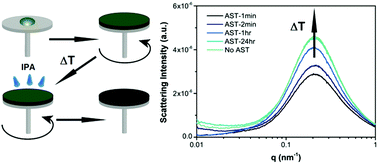
Significant efforts have lead to demonstrations of nonfullerene solar cells (NFSCs) with record power conversion efficiency up to ≈13% for polymer:small molecule blends and ≈9% for all-polymer blends. However, the control of morphology in NFSCs based on polymer blends is very challenging and a key obstacle to pushing this technology to eventual commercialization. The relations between phases at various length scales and photovoltaic parameters of all-polymer bulk-heterojunctions remain poorly understood and seldom explored. Here, precise control over a multilength scale morphology and photovoltaic performance are demonstrated by simply altering the concentration of a green solvent additive used in blade-coated films. Resonant soft X-ray scattering is used to elucidate the multiphasic morphology of these printed all-polymeric films and complements with the use of grazing incidence wide-angle X-ray scattering and in situ spectroscopic ellipsometry characterizations to correlate the morphology parameters at different length scales to the device performance metrics. Benefiting from the highest relative volume fraction of small domains, additive-free solar cells show the best device performance, strengthening the advantage of single benign solvent approach. This study also highlights the importance of high volume fraction of smallest domains in printed NFSCs and organic solar cells in general.

Precise control over the multilength scale morphology of printed all-polymer photovoltaic films by altering the concentration of a green additive is demonstrated by means of resonant soft X-ray scattering, in situ spectroscopic ellipsometry, and complementary methods. Additive-free nonfullerene devices show the best device performance due to the highest relative volume fraction of small domains and minimized length scale of large domains.
The emerging field of tandem polymer solar cells (TPSCs) enables a feasible approach to deal with the fundamental losses associated with single-junction polymer solar cells (PSCs) and provides the opportunity to propel their overall performance. Additionally, the rational selection of appropriate subcell photoactive polymers with complementary absorption profiles and optimal thicknesses to achieve balanced photocurrent generation are very important issues which must be addressed in order to realize paramount device performance. Here, two side chain fluorinated wide-bandgap π-conjugated polymers P1 (2F) and P2 (4F) in TPSCs have been used. These π-conjugated polymers have high absorption coefficients and deep highest occupied molecular orbitals which lead to high open-circuit voltages (Voc) of 0.91 and 1.00 V, respectively. Using these π-conjugated polymers, TPSCs have been successfully fabricated by combining P1 or P2 as front cells with PTB7-Th as back cells. The optimized TPSCs deliver outstanding power conversion efficiencies of 11.42 and 10.05%, with high Voc's of 1.64 and 1.72 V, respectively. These results are analyzed by balance of charge mobilities, and optical and electrical modeling is combined to demonstrate simultaneous improvement in all photovoltaic parameters in TPSCs.

High performance of tandem polymer solar cells (TPSCs) with power conversion efficiencies (PCEs) up to 11.42 and 10.05% are realized by using fluorine-functionalized polymers. TPSCs with PCEs over 10% achieved open-circuit voltage (Voc) of up to 1.72 V, which is among the highest Voc observed in TPSCs to date. Furthermore, detailed analyses of TPSCs as well as guidelines for bottom cell design are demonstrated.
A new 2D-conjugated medium bandgap donor–acceptor copolymer, J81, based on benzodifuran with trialkylsilyl thiophene side chains as donor unit and fluorobenzothiazole as acceptor, is synthesized and successfully used in nonfullerene polymer solar cells (PSCs) with low bandgap n-type organic semiconductor (n-OS) 3,9-bis(2-methylene- (3-(1,1-dicyanomethylene)-indanone)-5,5,11,11-tetrakis(4- hexylphenyl)-dithieno[2,3-d:2′,3′-d′]-s-indaceno[1,2-b:5,6-b′]- dithiophene (ITIC) and m-ITIC as acceptor. J81 possesses a lower-lying highest occupied molecular orbital (HOMO) energy level of −5.43 eV and medium bandgap of 1.93 eV with complementary absorption in the visible–near infrared region with the n-OS acceptor. The PSCs based on J81:ITIC and J81:m-ITIC yield high power conversion efficiency of 10.60% and 11.05%, respectively, with high V oc of 0.95–0.96 V benefit from the lower-lying HOMO energy level of J81 donor. The work indicates that J81 is another promising polymer donor for the nonfullerene PSCs.

By introducing trialkylsilyl-thienyl conjugated side chains to benzodifuran unit, a new medium bandgap polymer donor J81 is developed. The optimized nonfullerene polymer solar cells with J81 as donor show high power conversion efficiency of 11.05%.
A high level of automation is desirable to facilitate the lab-to-fab process transfer of the emerging perovskite-based solar technology. Here, an automated aerosol-jet printing technique is introduced for precisely controlling the thin-film perovskite growth in a planar heterojunction p–i–n solar cell device structure. The roles of some of the user defined parameters from a computer-aided design file are studied for the reproducible fabrication of pure CH3NH3PbI3 thin films under near ambient conditions. Preliminary power conversion efficiencies up to 15.4% are achieved when such films are incorporated in a poly(3,4-ethylenedioxythiophene):polystyrene sulfonate-perovskite-phenyl-C71-butyric acid methyl ester type device format. It is further shown that the deposition of atomized materials in the form of a gaseous mist helps to form a highly uniform and PbI2 residue-free CH3NH3PbI3 film and offers advantages over the conventional two-step solution approach by avoiding the detrimental solid–liquid interface induced perovskite crystallization. Ultimately, by integrating full 3D motion control, the fabrication of perovskite layers directly on a 3D curved surface becomes possible. This work suggests that 3D automation with aerosol-jet printing, once fully optimized, could form a universal platform for the lab-to-fab process transfer of solution-based perovskite photovoltaics and steer development of new design strategies for numerous embedded structural power applications.

Aerosol-jet printing is applied to mitigate defects during hybrid perovskite thin film growth in an all-low temperature, solution-processing scheme. The high level of automation in the printing process also enables direct write of perovskite semiconductors on a curved surface for photovoltaic device applications. This method could find use in fabricating embedded power components.