Minogue77
Shared posts
CEO’s Quadrupled Expenses
What Mad Men Teaches Us On Creativity
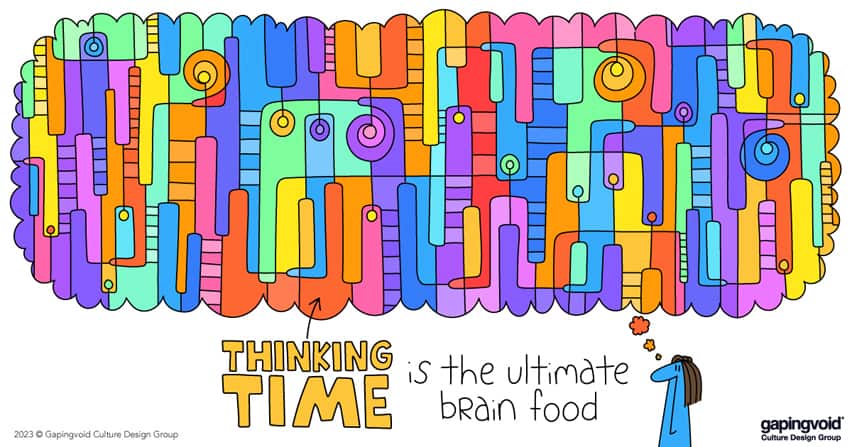
In the critically acclaimed TV series, Mad Men, the main character, a troubled advertising Creative Director named Donald Draper, gets into an argument with his CFO, Lane Pryce. Pryce is obsessed with efficiency and cost-cutting. He sees Draper’s entire creative department as little more than a big assembly line for clever taglines and compelling copy (basically the 60s era equivalent of ChatGPT).
In one meeting, Pryce complains about the amount of pens, pencils, paper, and postage the department eats up. In another meeting, he declares that “pennies make pounds (Pryce was British), and pounds make profits.”
Draper throughout the series pushes back, basically saying that you have to let the creative department be unproductive… until it isn’t.
We wrote earlier about how back in the 1960s, a young female copywriter named Ilon Specht spent ten seconds writing a now-famous tagline: “L’Oréal. Because I’m worth it.”
Ilon probably cost the agency around fifty dollars that entire week. If we want to be really granular, those ten seconds spent writing the tagline cost the agency a couple of pennies. But her results probably earned L’Oréal a couple of billion in brand equity.
The lesson here is that it’s a mistake to look at creative work through the lens of the industrial-revolution, smoke-stack era assembly-line model that values throughput and little else. To use a fishing metaphor, the best ideas and results don’t emerge when it’s all “taut line.” To be fair, they don’t emerge when it’s all “loose-line” either.
They emerge when there’s a bit of slack in the line; when we get a chance to “think about it deeply, then forget it,” until an idea jumps out at us (or until our subconscious minds find the “big idea.”)
Google had this mindset coded in its cultural DNA from the very beginning, with the “20% rule.” Engineers were to tend to their ongoing obligations for 80% of their days. That was taut-line time. But with the 20% of the time that remained, they were encouraged to work on whatever they believed would most improve Google. That was loose-line time.
One of the results? The email interface you’re probably using to read this.
The post What Mad Men Teaches Us On Creativity appeared first on Gapingvoid.
On the Great Old White Guy Vocal Fry Panic of 2013

It’s 2013, and Bob Garfield is in a state of exasperation. “Vulgar,” he spits into his microphone. “Repulsive.” I’m listening to an episode of the NPR host’s language-themed podcast, Lexicon Valley. Though I cannot see 58-year-old Garfield with my own eyes, from the disdain in his voice, I can picture him, scornfully stroking his frosty-white facial hair and crossing one corduroy-clad arm over the other. The topic of discussion is a linguistic phenomenon that Garfield says is so endlessly “annoying” that he wishes he could “wave a magic wand over a significant portion of the American public and make it come to an end.” It is an oddity that occurs “exclusively” among young women, he tells co-host Mike Vuolo with conviction. “I don’t have any data [proving this],” he says. “I simply know I’m right.”*
Any guesses as to what this odious feminine speech quality could be? It’s vocal fry, also known by linguists as creaky voice. You may have heard of this phenomenon or even do it yourself: vocal fry is a raspy, low-pitched noise that we often hear as people trail off at the ends of their sentences. The sound is produced when a speaker compresses their vocal cords, reducing the air flow and frequency of vibrations through the larynx, causing the voice to sound sort of, well, creaky. Like a rusty door, or the grate of a Mexican guiro. (Commentators like to reference the voices of Valley girls and Kim Kardashian when describing vocal fry—in fact, it is a part of a legitimate dialect colloquially termed “Valley girl speak”— though people of all genders and geographical locations do it too.)
Garfield says that in recent years, he’s noticed a vocal fry epidemic in the speech of women in their teens and twenties—nothing but a “mindless affectation”—and he is certain that it’s irreparably ruining the English language. To demonstrate the sound, Garfield beckons his eleven-year-old daughter to the microphone. “Ida, be obnoxious,” he instructs.
In the years following this podcast, vocal fry becomes increasingly mauled and mocked by the media—a public emblem of young women’s overall inability to communicate as elegantly as older, wiser men. In 2014 the Atlantic publishes a report that women who talk with vocal fry are less likely to be hired. In 2015 a male Vice reporter publishes a story called “My Girlfriend Went to a Speech Therapist to Cure Her Vocal Fry.” The same year, journalist Naomi Wolf pens an article for the Guardian titled, “Young women, give up the vocal fry and reclaim your strong female voice.” She writes, “‘Vocal fry’ is that guttural growl at the back of the throat, as a Valley girl might sound if she had been shouting herself hoarse at a rave all night.”
I myself remember being berated for using vocal fry in high school by a male theater teacher who told me that if I continued contaminating my lines with creak, I would never make it to Broadway. (Could this be the reason I was not cast as one of the original stars of Hamilton?)
Of course vocal fry isn’t the only thing wrong with young female voices. Around the same time of Bob Garfield’s episode, the internet has a collective freakout over contemporary “lady language,” and journalists everywhere start cranking out think pieces analyzing other characteristics commonly noticed and reviled in women’s speech. Saying like after every other word is a well-known example. So is apologizing too much; using hyperbolic internet slang (“OMG, I AM LITERALLY DYING”); and speaking with uptalk, where you end a declarative sentence with the upward intonation of a question.
Vocal fry, uptalk, and even like, are in fact not signs of ditziness, but instead all have a unique history and specific social utility.Suddenly, making poorly informed, pseudofeminist claims about how women talk becomes the trendy thing for brands and magazines to do. In 2014 hair care company Pantene releases an advertisement encouraging women to stop saying “sorry” all the time. (Because now not only does your hair need a makeover, so does your speech!) A year later, publications like Time and Business Insider begin claiming that uptalk makes women sound timid and self-conscious. YOUNG LADY, IF YOU EVER WANT A JOB OR A HUSBAND YOU MUST STOP TALKING THIS WAY, the internet screams.
At the height of this media frenzy, I was a twenty-something woman, the very target of these articles and commercials, and I had three concerns: 1) whether or not speech qualities like vocal fry and uptalk are really exclusive to young women; 2) the purpose they serve, if so; and 3) why everybody hates them so much.
Fortunately, there are plenty of language experts who’ve taken “Valley girl” speak seriously enough to figure out what it actually is. One of these scholars is Carmen Fought, a linguist from Pitzer College (who, incidentally, has one of the butteriest, most soothing speaking voices I’ve ever heard). As Fought says, “If women do something like uptalk or vocal fry, it’s immediately interpreted as insecure, emotional, or even stupid.” But the truth is much more interesting: Young women use the linguistic features that they do, not as mindless affectations, but as power tools for establishing and strengthening relationships. Vocal fry, uptalk, and even like, are in fact not signs of ditziness, but instead all have a unique history and specific social utility. And women are not the only people who use them.
In many languages around the world, vocal fry is not some random quirk—it is built into their very phonology. For instance, in Kwak’wala, a Native American language, the word for day cannot be pronounced without using creak, or else it wouldn’t make sense (kind of like pronouncing the English word day without the y). What’s interesting about English speakers’ use of vocal fry is that early studies actually attributed the speech quality primarily to men. One of the first official observations of vocal fry in English was made by a UK linguist in the 1960s, who determined that it was British dudes who employed vocal fry as a way of communicating a higher social standing. There was also an American study of creaky voice in the 1980s that called the phenomenon “hyper-masculine” and a “robust marker of male speech.” Many linguists also agree that using a bit of creak at the ends of sentences has been happening in the United States among English speakers of all genders, with no fuss or fallout, for decades.
But in the mid-2000s, folks started noticing an increase of vocal fry usage in the voices of American college-age women, but not so much in their male classmates. Researchers were intrigued, so they decided to take a gander and see if these observations were accurate. Long story short, they were: in 2010, linguistics scholar Ikuko Patricia Yuasa published a study showing that American women use vocal fry about 7 percent more than American men. And we’ve been getting creakier ever since.
But, like, why? What is vocal fry good for? (Other than to annoy beardy old guys, that is.) As it turns out, a bunch of things. First, Yuasa points out that since vocal fry is so very low in pitch, it could be a way for women to compete with men’s voices—to sound more authoritative. “Creaky voice may provide a growing number of American women with a way to project an image of accomplishment, while retaining female desirability,” she wrote in her study. Personally, I have found myself unconsciously dropping into vocal fry during presentations at work to convey this sort of laid-back authority. “You always sound like you know what you’re talking about to me,” said my boss when I asked her if I ever came off as insecure during meetings. (Then again, she’s a woman in her twenties too.)
On the flip side, Mark Liberman, a linguist at the University of Pennsylvania, told the New York Times in 2012 that vocal fry can also be used to convey a sense of disinterest in a topic (which, as a teenage girl, I certainly loved to do). “It’s a mode of vibration that happens when the vocal cords are relatively lax. . . . So maybe some people use it when they’re relaxed and even bored,” he said. Like a subtle way of telling someone you find them unstimulating.
To sum things up, over the first two decades of the 21st century, women began speaking with increasingly lower-pitched voices, attempting to convey more dominance and expressing more boredom—all things that middle-aged men have historically not been in favor of women doing. Perhaps this could explain why Bob Garfield and his peers have scrutinized vocal fry so mercilessly?
__________________________________

From Wordslut by Amanda Montell. Copyright © 2019 by Amanda Montell. Published on May 28, 2019 by Harper Wave, an imprint of HarperCollins Publishers. Reprinted by permission.
Big news

Prince, Bowie and Shandling aside, the Boomers ain’t dead yet. Far from it. The last one doesn’t turn 65 for another 15 years. Besides, sixty-five is the new 45. So suck it up.
The boom lasted two decades, during with 8.2 million babies were popped – about 415,000 a year. That means we now have almost 8,000 people a week becoming seniors, starting to collect their OAS & CPP, and riding public transit to work in their executive positions at half fare. Wo-hoo. Boomers’ moms, on average, had 3.7 kids while today’s moms birth half that number.
So about a third of all the souls alive in this country are part of this cohort (post-WW2 immigration bolstered the numbers to 9.2 million), which means by the time they are all old farts, a quarter of the population will be over 65. Currently it’s 12%. That’s big news.
Millennials should be aware of two things. First, taxes are going up. Like, a lot. Your guy Justin will be adding $125 billion in debt over the next four years, which will ensure a tax increase down the road, plus all these Boomers constitute a health care hurricane. With 1,600 more people hitting retirement age every working day of the week (and only 1,040 new babies being born), get ready. Your parents are about to become your worst nightmare. Inheritance? You wish. (By the way, didja hear about poor Alberta?)
Second, Boomers have more houses than anybody and (generally speaking) not enough money to last for two or three decades. Thus, real estate equity will have to be crystallized in order to provide monthly cash flow. Already this is starting to show. (Seventy per cent of us own houses but 90% of Boomers have property.)
A new Re/Max poll conducted by Leger Research found that among Boomers aged 55 to 64, a whopping 56% are thinking about selling in order to muster a retirement nest egg. Smart, of course. Real estate markets in a few places (GTA and YVR) are utterly bloated, while in others (Victoria, 905, Montreal) they’re near peak levels and still others (Calgary, Edmonton, Winnipeg and that flat province) are slow but not yet cratering. So hardly a better time to cash out.
But most won’t do so. People in Toronto or Vancouver worry about downsizing into a market with a deficit of houses and a surfeit of horny buyers. Plus, so long as prices rise, human nature (greed) prevents a majority from doing the rational thing, and bailing. All that will change, once markets start to decline as mortgage rates swell. Trust me. It’s coming.
Meanwhile the stats on liquid wealth accumulation in Canada are truly sad. RRSP contributions have been withering annually, while 80% of tax-free accounts are in pay-nothing, interest-bearing savings products. Forty per cent of families live paycheque-to-paycheque and half of us say we’d be screwed missing one paycheque. Household debt, famously, is at the highest level in recorded history, and substantially above the point at which the US middle class blew up. The economy may have started to turn upwards in the last few months, but so has personal borrowing. It’s now running four times the rate of increase in incomes.
In short, every day more net worth in this country becomes concentrated in residential real estate. And because the Boomers own more of it than anyone else, now headed as a herd into their thirsty undies and plastic-hip-sex-pill years, you should expect a big housing sell-off ahead. Some of them will cash out, invest the money and live off the proceeds. Some will downsize and consume the extra capital. Some (poor fools) will believe what they hear on TV and get a reverse mortgage. Others will give their houses to their kids, and move into the basement.
There are some lessons here.
Parents with questionable retirement resources giving their adult kids money for down payments need their heads read. Most can’t afford the largesse and this is absolutely the wrong time to be pushing your offspring into housing. Every indication is that our property bubble will end, and when it does a demographic tsunami may well commence. Why not wait?
Boomers must get far more serious about the financial path ahead. Life’s long. The greatest risk around is running out of money. Houses cost a lot to own, and the equity in them won’t buy the groceries. Unless you have a juicy government pension or a seven-figure retirement fund, you’d be wise to sell, invest and rent. Given the historic collapse in interest rates (which will eventually end) how could there be a better time to capitalize on real estate excess?
The fact 56% of Boomers are starting to think this way should tell you something. Don’t wait.
Has there ever been a better time to sell?

Ancient legacy of the lentil - Lentil Cookies


For all I know, I was eating Canadian lentils just the other day when I ordered a bowl of lentil soup in a restaurant in Athens. It was rich and fragrant, seasoned with tomato, carrots and parsley. Simple and delicious, the perfect restorative after a long day of travel and airport food. As much a part of Greek history as the Acropolis.

1 cup cooked small black or brown lentils
1 egg
1 tsp vanilla
1 tbsp milk
1 cup flour
1/3 cup cocoa powder
1 tsp baking powder
1 cup quick oats
Sift the flour, cocoa powder and baking soda, adding to the batter with the oats until well blended.
Drop by the spoonful onto cookie sheets. Bake at 350F for about 15 min. Allow cookies to cool slightly then remove to a cooling rack. Makes about 30 cookies.
Saturday Chores #8, Saturday, July 26, 2014

Saturday Chores #8, Saturday, July 26, 2014
Kobzar shortlist announced
 The nominees for the 2014 Kobzar Literary Award, handed out every other year in recognition of Canadian books that present “a Ukrainian Canadian theme with literary merit,” include poetry, a play, a “folk history,” and a pair of novels (including one for kids). The shortlist is as follows:
- Luba, Simply Luba by Diane Flacks, with Andrew Tarasiuk and Luba Goy, (Scirocco Drama/J.Gordon Shillingford, 2013)
- The Unmemntioable by Erin Mouré (House of Anansi Press, 2012)
- Baba’s Kitchen Medicines by Michael Mucz (University of Alberta Press, 2012)
- Blood and Salt by Barbara Sapergia (Coteau Books, 2012)
- Making Bombs for Hitler by Marsha Forchuk Skrypuch (Scholastic Canada, 2012)
Each of the finalists will read from their work on Oct. 27 as part of Toronto’s International Festival of Authors. The $25,000 prize will be handed out on March 5.
News Release: Steps to prevent treated seed contamination
News release describes steps on how to prevent treated seed contamination.
Connecticut inmates can now read prison volunteer Wally Lamb’s ‘She’s Come Undone’, after ban on novel over ‘graphic content’ lifted
Connecticut’s Department of Correction on Thursday reversed its decision to remove a 21-year-old novel written by internationally known author Wally Lamb, a volunteer at one of the state’s prisons.
The agency said She’s Come Undone, a bestselling novel that became widely read after being selected by Oprah Winfrey’s book club in 1996, came up for review after a Mansion Youth Institution inmate ordered it. The department said the purchase was temporarily denied and the book was removed from circulation at the York Correctional Institution library due to “some of the graphic nature” of the content.
“After a further review of the issue, the book has since been returned to circulation within the facility’s library,” the department said.
Apparently a few sex scenes (tame by today’s standards) negate the value of the novel’s message about the necessity of personal rehabilitation
Lamb, who lives in Connecticut, has led a writing workshop for women inmates at York for the past 14 years. DOC said Lamb had donated the book to York’s library years before the Department of Correction’s Media Review Board was established. The board reviews books that offenders order through vendors before they are delivered.
In an email to The Associated Press Thursday, Lamb said he learned about DOC’s original decision to ban the book from a prison librarian who was directed to remove and secure it.
Lamb said he was pleased with the agency’s reversal, saying “I’m just glad it’s over and was reversed so quickly.”
Lamb posted a message Wednesday night on his Facebook page about the banning of his book, which he described as a story “about a troubled young woman who goes through hard times and then fixes her life.”
The author wrote that “apparently a few sex scenes (tame by today’s standards) negate the value of the novel’s message about the necessity of personal rehabilitation.”
It’s very important that we control access to certain materials for inmates, but there’s an exception there for a reason — for works of significant literary value
Michael Lawlor, Gov. Dannel P. Malloy’s undersecretary for criminal justice policy at the state’s Office of Policy and Management, said he was surprised to learn about Lamb’s Facebook post on Wednesday night and contacted the acting Department of Correction commissioner.
“It’s very important that we control access to certain materials for inmates, but there’s an exception there for a reason — for works of significant literary value,” Lawlor said. “Everybody I’ve known who has read that particular book has found it very inspiring.”
The book has been published in 18 languages. Lawlor blamed its banning on “a sequence of very bureaucratic decisions that, taken as a whole, are incomprehensible but easily preventable in the future.”
Related
Lamb wrote on his Facebook page Thursday that both She’s Come Undone and I’ll Fly Away,”a collection of autobiographical essays written by the York inmates in his writing workshop, are back in circulation. He said he was grateful to Lawlor “taking the lead on getting the books reinstated” and for the outpouring of support on Facebook.
Lamb’s latest novel, We are Water, is scheduled to be released in October.
