
V.w.verweij
Shared posts


22 Oct 00:27
Blowfish National Hangover Survey Ranks DC as the #1 Hangover State/District
by Prince Of Petworth

We also apparently think Yuengling is our favorite beer, margaritas are our favorite cocktail and lemon drops are our favorite shots according to their survey.
19 Oct 16:32
Your Afternoon Animal Fix
by Prince Of Petworth
If you have any animal/pet photos you’d like to share please shoot me an email to princeofpetworth(at)gmail(dot)com with ‘Animal Fix’ in the title and say the name of your pet and your neighborhood. Your photos will go into the queue (usually 3-4 weeks wait) and will be posted in the order I receive them. If you’ve already entered your pet and would like to do so again – that’s no problem – just space the entries out a bit.

“Here is Sir Biddington of Ontario Road, Esq., AKA “Biddy” enjoying his day in his Pleasant Plains home. Biddy came to us through MetroFerals in DC four years ago.”

“Biggie from Ledroit Park enjoying a beautiful day on the Bay”

“Chloe and chaz posing for the camera in columbia heights”
And check out this great video of a couple from PoPville:
17 Oct 15:52


Afternoon Photo: Two Nuns and Two Big Dogs
by Tom
What’s better than a photo of two nuns and a dog? Here’s a shot from somewhere in the 1890s of Sister Beatrice, the superintendent of Providence Hospital (learn about it here).

Sister Beatrice, Superintendant of Providence Hospital in garden with another nun and St. Bernard dogs. c.1890. General Photograph Collection, HSW
Source: Historical Society of Washington, D.C.
The post Afternoon Photo: Two Nuns and Two Big Dogs appeared first on Ghosts of DC.
17 Oct 15:51
Your Afternoon Animal Fix
by Prince Of Petworth
If you have any animal/pet photos you’d like to share please shoot me an email to princeofpetworth(at)gmail(dot)com with ‘Animal Fix’ in the title and say the name of your pet and your neighborhood. Your photos will go into the queue (usually 3-4 weeks wait) and will be posted in the order I receive them. If you’ve already entered your pet and would like to do so again – that’s no problem – just space the entries out a bit.

“This is Basil, who lives in Adams Morgan and really wants to be on the couch right now.”

“Figo from Columbia Heights stretching out in our new bed.”

“This is Gauge the Weimaraner from Logan Circle looking angelic at 12 weeks.”

“Yogi and Nico hanging out in Columbia Heights.”
17 Oct 15:50

McDuffie Introduces Bill to Prohibit Discrimination against Victims of Domestic Violence, Sexual Abuse, and Stalking
by titan
Kenyan McDuffie, Ward 5 Councilor
From Councilmember McDuffie’s office:
Washington, D.C. – Councilmember Kenyan R. McDuffie (D – Ward 5) introduced legislation today to prohibit employment discrimination against victims of domestic violence, sexual abuse, and stalking. Currently, District employers can fire or refuse to hire or promote employees if, for example, the employee’s abuser creates a disturbance in the workplace.
The “Protecting Victims of Gender-Based Violence Amendment Act of 2013” amends the District’s Human Rights Act to include “status as a victim or family member of a victim” as a class of persons protected from employment discrimination. The bill would place the District among a growing number of jurisdictions with similar laws.
“The District has strong anti-discrimination laws, but this bill fills a significant gap,” said McDuffie. “We know that many abusers exert control by harassing their victims while at work. There is no reason why someone dealing with the trauma of domestic violence, sexual abuse, or stalking should have to then suffer discrimination,” said McDuffie. “Victims need support to move forward, and safe and stable employment is a lifeline.”
McDuffie worked closely with advocates from the D.C. Coalition Against Domestic Violence in crafting the legislation. “We know that one in four women will experience some form of domestic violence in her lifetime, so it was important to me to partner with the Coalition to address potential employment discrimination against victims and their families.”
October is National Domestic Violence Awareness Month. Visit the Coalition’s website for access to resources on domestic violence (dccadv.org).
The bill was co-introduced by the Councilmembers Alexander, Bonds, Bowser, Cheh, Graham, Grosso, and Chairman Mendelson, and co-sponsored by Councilmembers Barry, Catania, and Evans.
###
Leahgates likes this
17 Oct 15:33
Panda Cub Update – 8 Week old Cub now weighs five pounds, Mother Mei Xiang Doing Well Too
by Prince Of Petworth

Photo courtesy of National Zoo
From the National Zoo:
“The gates at the Smithsonian’s National Zoo will open to the public Friday, October 18! The live animal cams were turned off during the government shutdown, including the panda cams. The Zoo’s Information Technology staff began the process of bringing the live animal cams back online Thursday morning, starting with the panda cams. The 15 different camera systems required federal resources, primarily staff, to operate and were deemed non-essential during a shutdown.
With the return of the cams, giant panda fans can once again watch the Zoo’s eight week-old cub and her mother Mei Xiang. Since the panda cams went dark the cub has grown and passed several developmental milestones. She weighs five pounds (2.557 kilograms), up from 3.07 pounds (1.39 kilograms) at her veterinary exam September 26. She also has partially opened her eyes. Keepers noticed that her right eye had started to open October 4. By October 11, both her eyes had partially opened. Her ears are also fully open and she now reacts to the noises she hears in the panda house.
Mei Xiang is leaving the cub for longer periods of time to eat, drink, interact with keepers and venture outside for very short periods of time. She is eating all of her leaf-eater biscuits and produce that keepers offer her every day, and approximately 60 percent of her bamboo. Saturday, October 12, she chose to participate in a training session with keepers in her outdoor training area.
While her mother spends time in other parts of the David M. Rubenstein Family Giant Panda Habitat the cub scoots around the den, though she does not get very far.
She will not be able to walk until she is about four months old, and has not left the den on her own yet. She is strong enough to push herself up on her front two legs and right herself if she is lying on her back.”
17 Oct 11:51
Columbia Heights Coffee Closes on 11th Street
by Prince Of Petworth

3416 11th Street, NW
“Dear PoPville,
Did you hear that Columbia Heights Coffee is closing? They are packing up right now.”
One of the sadder emails I’ve received in a while. Some may call it nostalgia but for those of us who lived nearby – the opening of Columbia Heights Coffee was a joy that is hard to articulate. You see Columbia Heights Coffee was the “first” new spot to open on 11th street. I remember the first time I passed it back in 2003/2004 I thought I was hallucinating. It is really hard to imagine but the entire street was pretty much boarded up, vacant and/or in disrepair. Columbia Heights Coffee was the first shining light.
Here’s what is now Maple looked like next door:

And the Coupe across the street:

“Holy shit, I can walk from my house and get a cup of coffee.” I really couldn’t believe it the first time I saw Columbia Heights Coffee. Of course they were not infallible. The place did change ownership a number of years ago. Fortunately the new owners were among the kindest most hard working people I’ve ever met. Was service sometimes slow? Yes. Did I receive a smile and a kind word every single time I stopped in? Absolutely. Soon Wonderland opened. Then Red Rocks. And you know the strip now. It is the “hip strip”. It is awesome. And it wouldn’t be if Columbia Heights Coffee didn’t kick things off. The space and business was an integral part of the community. Call it nostalgia if you wish but for me and many others – Columbia Heights Coffee will be deeply missed for many reasons.

A reader’s daughter gives a hug and a card to one of the owners as they close up shop last night:

In happier times back in May 2007:

17 Oct 11:44
Awesome (Sad) History – La Tomate Restaurant in 2009 and 1900
by Prince Of Petworth

Photo by PoPville flickr user NCinDC
NCinDC writes:
“From an article by Paul K. Williams in The InTowner:
“Though a major commercial corridor today, Connecticut Avenue north of Dupont Circle and the Circle itself was originally developed as a fashionable residential neighborhood beginning in the early 1880s. The large triangular lot at the intersection of Connecticut Avenue, R and 20th Streets is today occupied by a distinctive triangular building built in 1922, now housing the popular La Tomate Restaurant. Before that, however, it was the site of a spectacular brownstone mansion built by Senator Philetus Sawyer in 1888…”
17 Oct 11:36

T-Rex Trying to visit his friends at the National Museum of...
T-Rex Trying to visit his friends at the National Museum of Natural History…
#betterlatethannever
#trextrying
17 Oct 02:54


Arlington Pet of the Week: Hendrix
by ARLnow.com
Our latest Arlington Pet of the Week is Hendrix, a 5-year-old beagle who loves the beach the Shirlington dog park.
Here’s what owner Julia had to say about Hendrix, who lives in Courthouse after being rescued from the woods of rural Virginia.
Hendrix is a 5 year old beagle who I rescued in college when he was a year and a half old. This little bundle of love was discovered in 2009 by a friend’s family in the woods next to their backyard in rural Virginia. Although he was covered in hundreds of ticks and had several types of tummy-worms, his prior neglect never stopped him from being the wonderful and loyal companion that he is! Although he isn’t the sharpest tool in the shed, he quickly learned three valuable commands — “sit,” “down,” and “KISS!”
Hendrix has the classic “beagle howl,” but with this little guy, quality is better than quantity — he rarely makes a peep! When prompted to actually let out a bellow, it is usually at something quite menacing — a floating helium-filled balloon, for example. When he isn’t pawing at your hands to get you to pet his belly, he enjoys snuggling, lying in the sun, walks, and (when we are able to get out of town) sprinting down the beach — until he finds some seaweed or a crab to chew on, of course.
Since moving to Arlington, Hendrix enjoys long walks along 14th Street to mark his scent in the monkey grass. Although market rules don’t allow him to visit the Courthouse farmer’s market each weekend, he loves greeting all the market-goers with a tail-wag as they walk by our second floor balcony. His favorite Arlington pastime by far, however is visiting the Shirlington dog park! With this cuddly boy, there’s never a dull day.
The Arlington Pet of the Week is sponsored by Dogma Bakery, which has locations at The Village at Shirlington (2772 S. Arlington Mill Drive) and the Lee Harrison Shopping Center (2445 N. Harrison Street).
Want your pet to be considered for the Arlington Pet of the Week? Email office@arlnow.com with a 2-3 paragraph bio and at least 3-4 horizontally-oriented photos of your pet. Each week’s winner receives a $25 Dogma gift card.
16 Oct 12:11
Town Danceboutique Looking to Add 125 Seat Summer Garden in Shaw
by Prince Of Petworth

2009 8th Street, NW just off Florida Ave
A recent liquor license application posted outside Town reveals they are hoping to add a 125 seat summer garden. Hours of operation if approved would be Sunday through Thursday 12 pm – 1 am and Friday & Saturday 12 pm – 2 am.
14 Oct 13:27
 A delicious fall meal that brings a little hint of summer back into the season. This recipe highlights a bright and balanced salad of quinoa, apple, mint, raisins, and arugula set inside sweet and smooth squash.
Roasted acorn squash with quinoa and mint salad [Vegan]
by Jaymi Heimbuch
A delicious fall meal that brings a little hint of summer back into the season. This recipe highlights a bright and balanced salad of quinoa, apple, mint, raisins, and arugula set inside sweet and smooth squash.
11 Oct 20:00
Your Afternoon Animal Fix
by Prince Of Petworth
If you have any animal/pet photos you’d like to share please shoot me an email to princeofpetworth(at)gmail(dot)com with ‘Animal Fix’ in the title and say the name of your pet and your neighborhood. Your photos will go into the queue (usually 3-4 weeks wait) and will be posted in the order I receive them. If you’ve already entered your pet and would like to do so again – that’s no problem – just space the entries out a bit.

“Driving on u st!”

“Samuel Sebastian Kitty trying put the new rug in Langdon Park. NE DC.”

“Joey the retriever and Luna the tabby. Best friends in Petworth!”

11 Oct 18:49
The Map of Human Diseases
by Keir Clarke
The Tapei Medical University and the University of New South Wales has used the Google Maps API to map the relationships between different human diseases. The Disease Map is an attempt to visualize the associations between different human disorders.
Each circle on the map represents a single human disorder as classified by the International Classification of Diseases. The circle sizes reflect


Sherri Sunstrum likes this
11 Oct 18:34
 The world-renowned street artist, Banksy is in the midst of a month-long residency in New York City. His latest work is a creepy, but clever take on factory farming and animal cruelty.
Banksy uses toy animals to highlight animal cruelty and factory farming [Exclusive Photos]
by Chris Tackett
The world-renowned street artist, Banksy is in the midst of a month-long residency in New York City. His latest work is a creepy, but clever take on factory farming and animal cruelty.
11 Oct 16:57
More Hipsters Spotted Typing Outside
by Choire Sicha
V.w.verweijStop
by Choire Sicha


 After our pal C. D. Hermelin confessed his love of typing outside in these pages, we were concerned that, as with any crime, copycatting would ensue. Spotted on
 Second Avenue Bowery last night: this bundled fellow in full pursuit of his art. We were most impressed by the sheer volume of his typewriter. Now what have we done.
The post More Hipsters Spotted Typing Outside appeared first on The Awl.
11 Oct 16:57
You Won't Believe Who Is Into Kissing
by Alex Balk
by Alex Balk


"The survey responses showed that women rated kissing as generally more important in relationships than men. Furthermore, men and women who rated themselves as being attractive, or who tended to have more short-term relationships and casual encounters, also rated kissing as being more important."
1 CommentsThe post You Won't Believe Who Is Into Kissing appeared first on The Awl.
Alexis.chaney likes this
10 Oct 15:34
Another Reason To Regret Not Becoming A Scientist
by Alex Balk
by Alex Balk


 "A whisky sipped in a room smelling of fresh-cut grass with the sound of sheep 'baa-ing' in the background tastes different from having the same drink in a sweet-smelling, red room with piano music playing, research suggests."
The post Another Reason To Regret Not Becoming A Scientist appeared first on The Awl.
10 Oct 14:49
 While national political rhetoric pits fossil fuels against renewables, at the state level, conservatives are embracing clean energy.
Are state Republicans carrying the torch for clean energy?
by Sami Grover
While national political rhetoric pits fossil fuels against renewables, at the state level, conservatives are embracing clean energy.
10 Oct 14:32
“Sir”
by gabby
Click it bigger:

Are we being too sensitive?
Anyway, we apologize that our “comic” effort this week isn’t anything topical or incisive concerning The World As It Is Today. This week we’re just indulging in a little light-hearted, heavy-handed sad-sackin’. Because really, how pathetic would this comic be if it were about the “shutdown” or something. Ugh. No thank you. No, in these turbulent & unphotogenic times, we sometimes prefer to think of the Playhouse as, in Montague H. Withnail’s sage words, “perhaps the last island of beauty in the world.”
An island that you can place upon the ocean of your very own wallpaper, if you bought the original of this comic at our store.
And speaking of islands, we all know no man is one, especially in this economy. If you enjoyed this strip, or any other of our fine (if lopsided) delectables, please consider dropping a coin or two into our coffers via the “Donate” button at the top of the sidebar. Go ahead — improve a portion of beauty in this all-too-ugly world.
09 Oct 20:50
When to Buy Avocados and How to Store Them for Game Day Guacamole
by Melanie Pinola

Guacamole is one of the easiest and tastiest dishes you can make, and especially great for entertaining a crowd. This guide from Serious Eats tells us how to make sure avocados are perfectly ripe the day you want to turn them into guacamole.
nealteam likes this
09 Oct 20:50
I'm John Hodgman, and This Is How I Work
by Tessa Miller
 Writer, actor, podcaster, Daily Show and This American Life contributor, husband and parent, stand up comic, personified PC. Is there anything John Hodgman can't do? We've been dying to know how the mustachioed nerd hero manages it all, so we stole a few minutes from his insane schedule to find out. Turns out he's got more than a few tricks up his sleeve.
nealteam and -1 others like this
09 Oct 01:35


Skinned Wieners Made in Washington, D.C.
by Tom
Terrific old photo of a woman in 1927, working at a D.C. sausage factory.

1927. “Skinned frankfurts, made in Washington, D.C.” What Bismarck said about laws and sausages: It turns out you can watch them (or not watch them) being made in the same place. Harris & Ewing glass negative.
The post Skinned Wieners Made in Washington, D.C. appeared first on Ghosts of DC.
09 Oct 01:24
Your Afternoon Animal Fix
by Prince Of Petworth
If you have any animal/pet photos you’d like to share please shoot me an email to princeofpetworth(at)gmail(dot)com with ‘Animal Fix’ in the title and say the name of your pet and your neighborhood. Your photos will go into the queue (usually 3-4 weeks wait) and will be posted in the order I receive them. If you’ve already entered your pet and would like to do so again – that’s no problem – just space the entries out a bit.

“Tilly, a greyhound from Adams Morgan, is ready for a day of work.”

“Louie, a Cockapoo from Adams Morgan, enjoying vacation at the Outer Banks, NC.”

“Murray of Cleveland Park. “Yeah, great that Mom volunteers at the DC Homegrown Fest. As long as it doesn’t make this mess of greens my breakfast tomorrow.”

“Blue on U Street getting ready for the ‘skins game.”
09 Oct 01:18


"Laughing Through the Tears"
by Emma Carmichael
A few weeks ago, Los Angeles filmmaker Jessie Kahnweiler released the short film Meet My Rapist onto the internet. It's a dark comedy that begins with Jessie encountering her rapist at a farmer's market, and then attempting to get through her day as he follows her—first to a job interview, then to meet up with a friend, for dinner with her parents, and finally for a therapy session. It's uncomfortable to watch, even when you're laughing. Jessie and I talked this week about her movie and her 94-year-old grandma's online shopping habits.
Emma: Hey, Jessie! I thought it might be helpful to hear you explain why you make a short film like this, as I’d imagine you’re hearing a lot of different reactions from a lot of different people. Because it is so funny, but also so, so dark.
Jessie: This film is not about my actual rape, but more so about the process of "getting over it,” along with the role my rapist has played in my life. So much of that has nothing to do with that actual, awful night; it only really exists in my imagination—which can be a scarier place than anywhere else in the world.
The post "Laughing Through the Tears" appeared first on The Awl.
07 Oct 22:40
Fine Dining in Washington, DC in the 1950s
by noreply@blogger.com (John DeFerrari)
So how bad, really, were DC's restaurants in the 1950s? Conventional wisdom has it that before the last decade there were no good restaurants in Washington, so the eateries back in the 50s must have been really bad. Of course, every decade since the 1960s, conventional wisdom has held the same view, dismissing the previous ten years' worth of restaurants along with any refinements or successes they may have achieved. The 1950s are a decade that one could easily deride as a low point in the city's culinary history, so it's worth looking back at a few of the city's fine dining spots from that era. While they largely depended on New York, both for inspiration and financial support, and were certainly far less sophisticated than today's best places, they were probably not as thoroughly deplorable as they are often made out to be.
In the 1950s Washington's restaurant culture was still recovering from the food shortages of World War II and its aftermath. The wartime Office of Price Administration had frozen prices for food served in restaurants in 1943, dampening business through the duration of the war. Strict rationing of many types of food, including grains, meat, and dairy products, meant that restaurants often were unable to offer their most popular dishes. The shortages continued after the war as the U.S. worked to shore up devastated countries in Europe where hunger was rampant. In October 1947 President Truman called for a nationwide food conservation program, aimed at making more food available to ship overseas. As reported in The Washington Post, restaurants pledged to "cut down excessive portions,... serve bread and butter only on request, eliminate toast trimmings, limit the number of crackers with soup servings,... abandon the three-layer cake during the emergency, use substitutes for wheat cereal wherever possible... and use surplus foods to the greatest extent." Fancy gourmet dining thus became not only impractical but even downright unpatriotic.
Nevertheless, a few D.C. restaurants struggled to offer discriminating customers a fine-dining experience. La Salle du Bois, opened in December 1941 at the dawn of American involvement in World War II, was one such place. Located on the southwest corner of 18th and M Streets NW, it was an outpost of a New York City restaurant of the same name, as were many of Washington's best restaurants of this era. When it opened it was decorated in a “patriotic modern” style of rose, white and blue, with Colonial revival wallpaper and soft pink lighting. Chef Robert, from French Louisiana stock, produced an assortment of New Orleans-influenced dishes, including pheasant with foie gras and truffles, pompano en papillotte, and venison with sweet and sour sauce. The Post termed the Salle du Bois “swanky but gayly informal” at its opening: “a river of silver fox, ermine and mink wraps poured through the entrance, flash bulbs popped, Robert Montgomery looked handsomer in his naval uniform than he does in the movies…” Throughout the war years, La Salle du Bois had served as one of Washington’s few power lunch spots for diplomats and military officers, and it retained its status as one of DC's most exclusive eateries well into the 1950s. Holiday Magazine, the accepted arbiter of good taste in those days, noted in 1950 that the restaurant was "popular with Georgetowners and others well-to-do [and] serves a mean crêpe Suzette."
The Salle Du Bois was operated in the 1950s by New York-born restaurateur Alex Stuart, who had come to Washington after his service in the Army Air Corps during the war. Stuart also opened another of Washington's few fine dining spots, The Colony, at 1737 DeSales Street NW, just north of the Mayflower Hotel, in 1948. As usual for those times, the entertainment and décor drew more attention than anything else when it opened. The Colony had singers and musicians in its new lounge, a fashion show on opening day, and a gallery of life-sized portraits of prominent Washingtonians. The dining room, shaded a dusty pink with cream trim, featured bas relief statues of mythological figures playing lyres and pipes. A profusion of mirrors and flower vases completed the kind of look that was expected in those days of a fine French restaurant.
The Post's nightlife commentator, Paul Herron, was a perennial booster of The Colony in the days before the paper had a dedicated restaurant critic. "Handsome, pipe-smoking Alex Stuart presides over one of the city's most luxurious dining rooms," Herron write in 1951. "His restaurant is one of the few places that uses the 'team' system of table service. Not one, but three, waiters, are responsible for your comfort and service the minute you walk in the door. Even a wine steward, with traditional black apron and huge key, is available to help in that department." The following year, declaring it "the smartest dining and cocktail spot in the city," Herron provided more details:
The Colony prospered right through the 50s but closed in 1963 when Connie Valanos (1918-2012), owner of The Monocle on Capitol HIll, bought it and converted it into a short-lived eatery called Conrad's.
The Salle du Bois and Colony might have been swell, but probably the most exclusive restaurant in the city in the 1950s was the Rive Gauche, located at 1310 Wisconsin Avenue NW in Georgetown. Blaise Gherardi de Parata (1909–1978), a native of Corsica, had come to the United States in 1949 and opened Rive Gauche in 1956. It was an expensive, top-drawer French restaurant, furnished in quilted burgundy-colored leather banquettes, a mammoth crystal chandelier, and gilt-framed oil paintings. Owner Gherardi, who was not a chef himself, enjoyed playing the part of the flamboyant, high-profile restaurant owner who was forever fighting with his temperamental chefs. Gherardi’s original chef, Eugène Batisse (1910–2003), whom he brought from Paris in 1953, left in 1959 to work at Le Bistro, a new downtown competitor, establishing a pattern that would continue for years to come. Gherardi would go on scouting trips to France and bring back promising young chefs to the Rive Gauche, where they would make a name for themselves and subsequently set out on their own ventures, often after having been fired by the temperamental Gherardi. The drama of it all only added to the allure of the Rive Gauche.
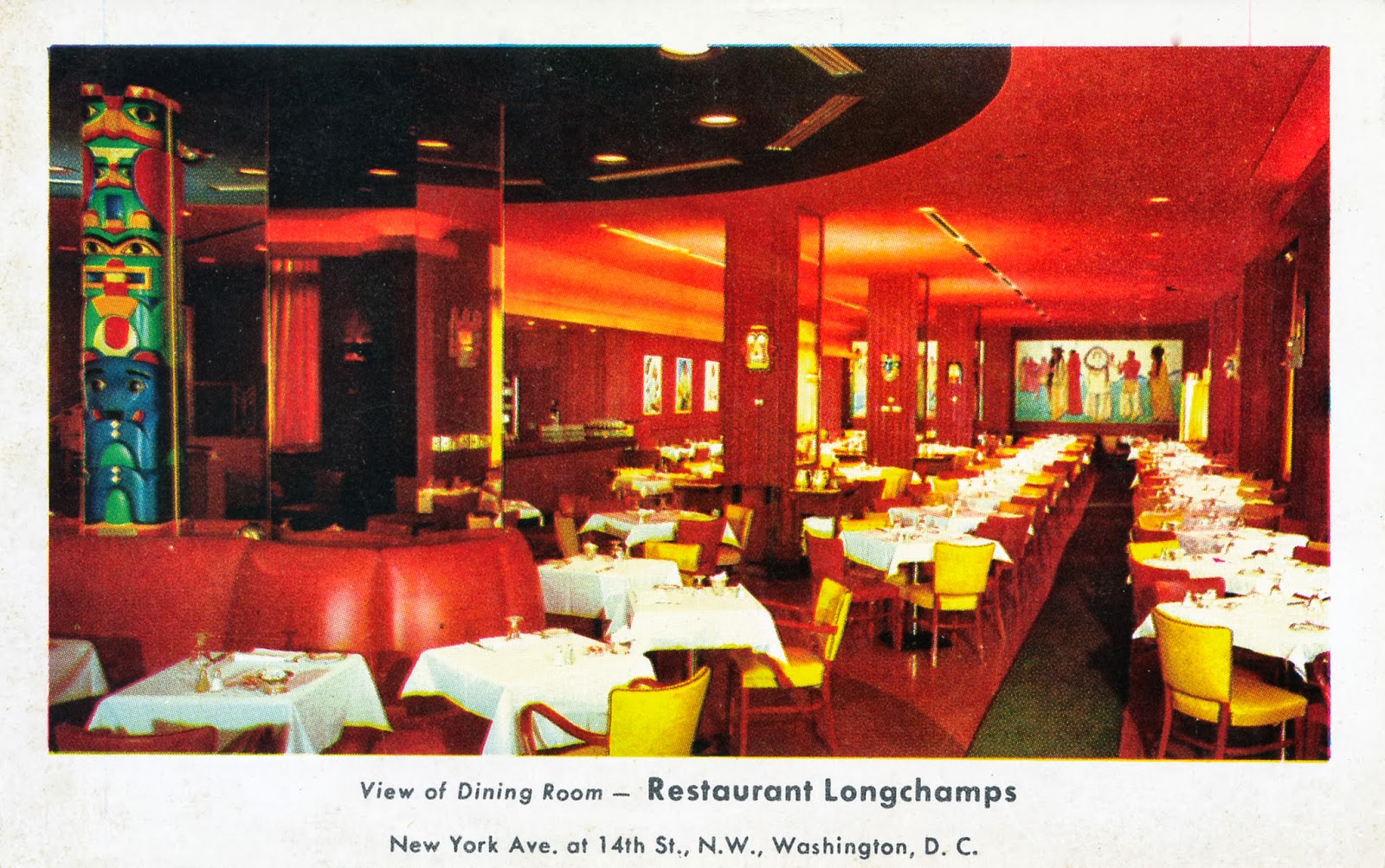
What if you couldn't afford or felt intimidated by the Rive? An alternative was fine dining "for the masses" at the Longchamps restaurant on the northeast corner of 14th Street and New York Avenue NW, then the heart of a lively entertainment district. The Longchamps restaurant chain began in New York City in 1919. As chronicled by Jan Whitaker, the chain aimed at the well-to-do middle class; its meals were not cheap but were nonetheless considered affordable. The chain's formula was to draw customers in with stylish, attention-getting Modernist interiors that would make customers feel they were part of the in crowd.
In 1950 the chain announced that it would open its first restaurant outside of New York City in Washington, D.C. The company had pre-leased 18,000 square feet on the basement, first floor, and mezzanine levels of the sleek new Wyatt Building being constructed at 14th Street and New York Avenue. When it opened in December 1952, the new restaurant was Washington's largest, seating 350 patrons. Its dining room featured the rich red and gold tones that were Longchamps' trademark, as well as paintings of Native Americans by German-born artist and designer Winold Reiss (1886-1953). The look of luxury had its intended intoxicating effect, but the chain's owners made sure their prices were no higher than those of other "better" Washington eateries.
In August 1954 the Post's Paul Herron offered a brief report card on the 18-month-old restaurant, noting that it had "had its share of troubles in getting used to a smaller town habitat and in getting its potential patrons used to it." While maintaining its quality standards, including resisting canned and frozen foods ("if you order a side dish of peas, they are shelled, seasoned and cooked after you have ordered them"), the restaurant had to supplement its usual à la carte menu with a number of pre-set meal options, apparently because penny-pinching Washingtonians believed such meals were cheaper (they weren't). But DC restaurant-goers apparently warmed to Longchamps and it continued successfully through the 1950s.
One Longchamps innovation that was particularly noteworthy was the ability to charge meals to a credit card rather than having to settle up on the spot. Getting a Longchamps credit card was a simple matter. "Longchamps executive Arthur Riback says all you have to do is send a post card request to him at the 14th and New York avenue dining spot and he'll try to get your credit card in the return mail," Herron observed in 1955. "They don't even made a credit check on applicants, and there's no membership costs or dues." Travel and entertainment credit cards were the latest thing in the 1950s, an outgrowth of the proliferation of corporate expense accounts, and ritzy restaurants like Longchamps were just the sort of places that expense account lunches were most likely to take place.
An ad for Longchamps in 1956 confirms the clientele the restaurant was pursuing. "To the Gentlemen on 'The Hill'!," it reads. "When a valued constituent shows up in Washington you naturally want to give him the 'red carpet' treatment. As part of the program may we suggest Dinner at Longchamps—Washington's most beautiful restaurant." —We'll be kind and overlook the fact that Longchamps' managers didn't seem to understand who would be paying for whom when corporate lobbyists came to town.
By the end of the decade, the Longchamps chain was in decline in New York, and the DC eatery was sold in late 1959 to Alex Stuart, owner of La Salle Du Bois and The Colony. Stuart remodeled and reopened the place as Alex Stuart's, which lasted until 1965. By that time, people no longer wanted to go to that part of downtown to eat dinner.
A new wave of sophisticated restaurants arrived in other parts of the city in the 1960s, along with a young new president who enjoyed fine dining in a way his predecessors couldn't imagine. —But that's a story for another time.
For much more DC restaurant history read our just-published Historic Restaurants of Washington, D.C.: Capital Eats. To keep up with the latest on book events and read more anecdotes, "like" our Facebook page.
Sources for this article included Historic Restaurants of Washington, D.C.: Capital Eats; Jan Whitaker's Restaurant-ing Through History blog; John Mariani's America Eats Out (1991); and numerous newspaper and magazine articles.
To receive Streets of Washington by email: click on this link and choose "Get Streets of Washington delivered by email" from the Subscribe Now! box on the upper right hand side of the page.


 |
| Interior of La Salle Du Bois restaurant (author's collection). |
In the 1950s Washington's restaurant culture was still recovering from the food shortages of World War II and its aftermath. The wartime Office of Price Administration had frozen prices for food served in restaurants in 1943, dampening business through the duration of the war. Strict rationing of many types of food, including grains, meat, and dairy products, meant that restaurants often were unable to offer their most popular dishes. The shortages continued after the war as the U.S. worked to shore up devastated countries in Europe where hunger was rampant. In October 1947 President Truman called for a nationwide food conservation program, aimed at making more food available to ship overseas. As reported in The Washington Post, restaurants pledged to "cut down excessive portions,... serve bread and butter only on request, eliminate toast trimmings, limit the number of crackers with soup servings,... abandon the three-layer cake during the emergency, use substitutes for wheat cereal wherever possible... and use surplus foods to the greatest extent." Fancy gourmet dining thus became not only impractical but even downright unpatriotic.
 |
| Author's collection. |
The Salle Du Bois was operated in the 1950s by New York-born restaurateur Alex Stuart, who had come to Washington after his service in the Army Air Corps during the war. Stuart also opened another of Washington's few fine dining spots, The Colony, at 1737 DeSales Street NW, just north of the Mayflower Hotel, in 1948. As usual for those times, the entertainment and décor drew more attention than anything else when it opened. The Colony had singers and musicians in its new lounge, a fashion show on opening day, and a gallery of life-sized portraits of prominent Washingtonians. The dining room, shaded a dusty pink with cream trim, featured bas relief statues of mythological figures playing lyres and pipes. A profusion of mirrors and flower vases completed the kind of look that was expected in those days of a fine French restaurant.
 |
| Interior of The Colony restaurant (author's collection). |
The Post's nightlife commentator, Paul Herron, was a perennial booster of The Colony in the days before the paper had a dedicated restaurant critic. "Handsome, pipe-smoking Alex Stuart presides over one of the city's most luxurious dining rooms," Herron write in 1951. "His restaurant is one of the few places that uses the 'team' system of table service. Not one, but three, waiters, are responsible for your comfort and service the minute you walk in the door. Even a wine steward, with traditional black apron and huge key, is available to help in that department." The following year, declaring it "the smartest dining and cocktail spot in the city," Herron provided more details:
No dinner, regardless of price, comes to the table in any manner other than hot off the business end of an alcohol burner. Every salad is mixed at your table, vegetables are cooked in a manner that would warm the heart of the most strict dietician. The only displeased diners will be those trying to shed pounds because the sauces are rich, the butter supply is inexhaustible, and the desserts well-nigh irresistible.Here was classic 1950s fine dining: elegant French food drowned in melted butter and heavy sauces, maybe not freshly cooked but at least kept nice and warm. In the days before nouvelle cuisine, this was the height of sophistication. And it's likely that many of those well-cooked vegetables came from cans.
 |
| Detail from a matchbook cover. The dusty pink color was fashionable at the time (author's collection). |
The Colony prospered right through the 50s but closed in 1963 when Connie Valanos (1918-2012), owner of The Monocle on Capitol HIll, bought it and converted it into a short-lived eatery called Conrad's.
 |
| Inside the Rive Gauche (author's collection). |
The Salle du Bois and Colony might have been swell, but probably the most exclusive restaurant in the city in the 1950s was the Rive Gauche, located at 1310 Wisconsin Avenue NW in Georgetown. Blaise Gherardi de Parata (1909–1978), a native of Corsica, had come to the United States in 1949 and opened Rive Gauche in 1956. It was an expensive, top-drawer French restaurant, furnished in quilted burgundy-colored leather banquettes, a mammoth crystal chandelier, and gilt-framed oil paintings. Owner Gherardi, who was not a chef himself, enjoyed playing the part of the flamboyant, high-profile restaurant owner who was forever fighting with his temperamental chefs. Gherardi’s original chef, Eugène Batisse (1910–2003), whom he brought from Paris in 1953, left in 1959 to work at Le Bistro, a new downtown competitor, establishing a pattern that would continue for years to come. Gherardi would go on scouting trips to France and bring back promising young chefs to the Rive Gauche, where they would make a name for themselves and subsequently set out on their own ventures, often after having been fired by the temperamental Gherardi. The drama of it all only added to the allure of the Rive Gauche.
 |
| Detail from a matchbook cover (author's collection). |
What if you couldn't afford or felt intimidated by the Rive? An alternative was fine dining "for the masses" at the Longchamps restaurant on the northeast corner of 14th Street and New York Avenue NW, then the heart of a lively entertainment district. The Longchamps restaurant chain began in New York City in 1919. As chronicled by Jan Whitaker, the chain aimed at the well-to-do middle class; its meals were not cheap but were nonetheless considered affordable. The chain's formula was to draw customers in with stylish, attention-getting Modernist interiors that would make customers feel they were part of the in crowd.
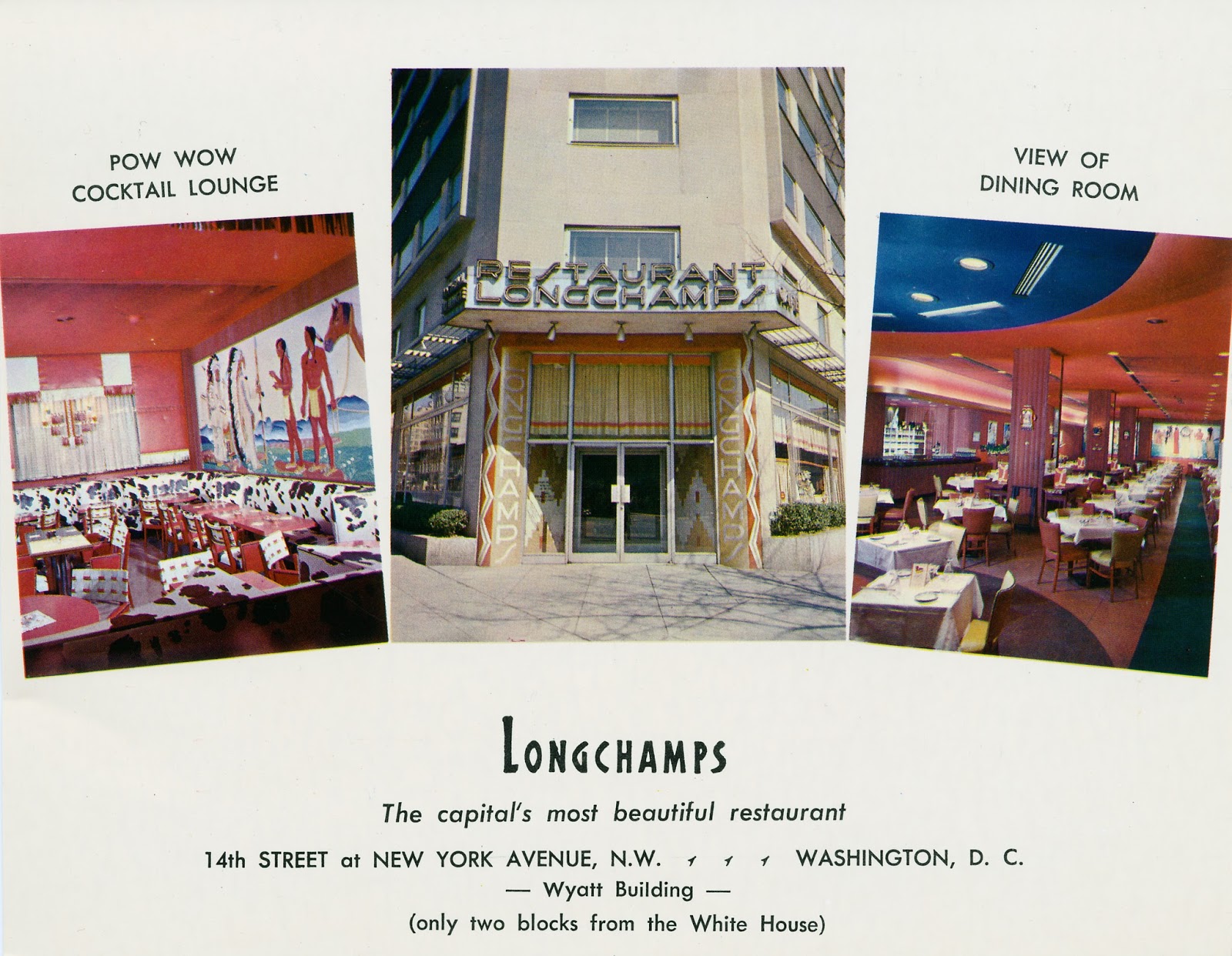 |
| This postcard includes a view of the restaurant's gaudy entrance at 14th Street and new York Avenue (Author's collection). |
 |
| Author's collection. |
In August 1954 the Post's Paul Herron offered a brief report card on the 18-month-old restaurant, noting that it had "had its share of troubles in getting used to a smaller town habitat and in getting its potential patrons used to it." While maintaining its quality standards, including resisting canned and frozen foods ("if you order a side dish of peas, they are shelled, seasoned and cooked after you have ordered them"), the restaurant had to supplement its usual à la carte menu with a number of pre-set meal options, apparently because penny-pinching Washingtonians believed such meals were cheaper (they weren't). But DC restaurant-goers apparently warmed to Longchamps and it continued successfully through the 1950s.
One Longchamps innovation that was particularly noteworthy was the ability to charge meals to a credit card rather than having to settle up on the spot. Getting a Longchamps credit card was a simple matter. "Longchamps executive Arthur Riback says all you have to do is send a post card request to him at the 14th and New York avenue dining spot and he'll try to get your credit card in the return mail," Herron observed in 1955. "They don't even made a credit check on applicants, and there's no membership costs or dues." Travel and entertainment credit cards were the latest thing in the 1950s, an outgrowth of the proliferation of corporate expense accounts, and ritzy restaurants like Longchamps were just the sort of places that expense account lunches were most likely to take place.
 |
| Author's collection. |
An ad for Longchamps in 1956 confirms the clientele the restaurant was pursuing. "To the Gentlemen on 'The Hill'!," it reads. "When a valued constituent shows up in Washington you naturally want to give him the 'red carpet' treatment. As part of the program may we suggest Dinner at Longchamps—Washington's most beautiful restaurant." —We'll be kind and overlook the fact that Longchamps' managers didn't seem to understand who would be paying for whom when corporate lobbyists came to town.
By the end of the decade, the Longchamps chain was in decline in New York, and the DC eatery was sold in late 1959 to Alex Stuart, owner of La Salle Du Bois and The Colony. Stuart remodeled and reopened the place as Alex Stuart's, which lasted until 1965. By that time, people no longer wanted to go to that part of downtown to eat dinner.
 |
| Postcard view of Alex Stuart's Restaurant (author's collection). |
A new wave of sophisticated restaurants arrived in other parts of the city in the 1960s, along with a young new president who enjoyed fine dining in a way his predecessors couldn't imagine. —But that's a story for another time.
* * * * *
For much more DC restaurant history read our just-published Historic Restaurants of Washington, D.C.: Capital Eats. To keep up with the latest on book events and read more anecdotes, "like" our Facebook page.
Sources for this article included Historic Restaurants of Washington, D.C.: Capital Eats; Jan Whitaker's Restaurant-ing Through History blog; John Mariani's America Eats Out (1991); and numerous newspaper and magazine articles.
* * * * *
To receive Streets of Washington by email: click on this link and choose "Get Streets of Washington delivered by email" from the Subscribe Now! box on the upper right hand side of the page.
Leahgates likes this