
Thanks to Kristin for sending: “Dogs on Revels is the new Corgis in backpacks.”
*This series will feature any pets in a backpack/bag. On metro, or not. Corgi, or not. Please email your sightings to princeofpetworth@gmail.com
Thanks to Kristin for sending: “Dogs on Revels is the new Corgis in backpacks.”
*This series will feature any pets in a backpack/bag. On metro, or not. Corgi, or not. Please email your sightings to princeofpetworth@gmail.com

I keep forgetting to post this – there were many sightings in late October. This one is from Erica:
“Saw this guy cruising around the Dave Thomas circle today – amazing! After sending the picture to my family, my dad notes that the motorcycle is a vintage German BMW military bike, likely from WWII era, which makes this even more badass.”
*This series will feature any pets in a backpack/bag. On metro, or not. Corgi, or not. Please email your sightings to princeofpetworth@gmail.com

Grasses dominate our planet today but that has not always been the case. Because of both their ecological and cultural importance , the origin and diversification of grasses has long been a hot topic in biology. We know that grasses really hit their stride following the extinction of the dinosaurs, and that they changed herbivore anatomy in a big way, but their origins remain shrouded in mystery. Recently, a discovery made in fossilized dinosaur poop has shone a surprisingly bright light into the history of grasses on our planet.
Prior to this discovery, the earliest evidence of grasses came in the form of fossilized pollen and tiny pieces of silica called phytoliths. Phytoliths are essentially tiny pieces of glass that serve as a form of defense against herbivores. Because they are made of silica and fossilize well, phytoliths turn up frequently in the fossil record. This makes them extremely useful for finding evidence of grasses even where whole-plant fossilization is unlikely.
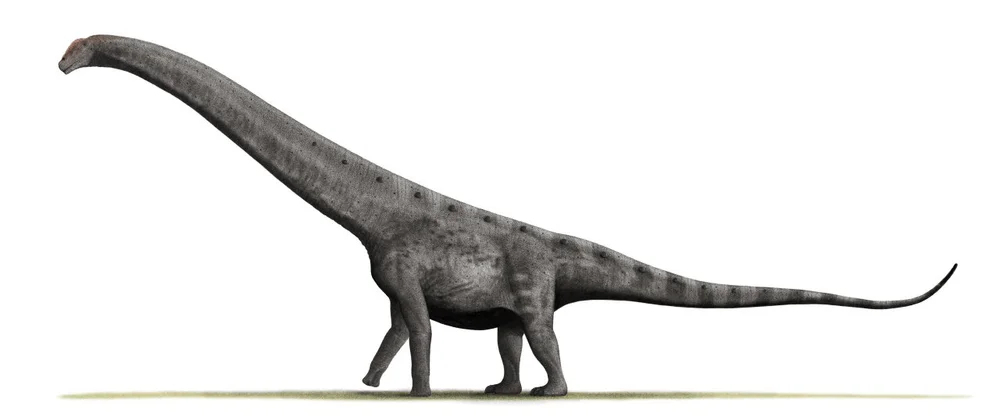
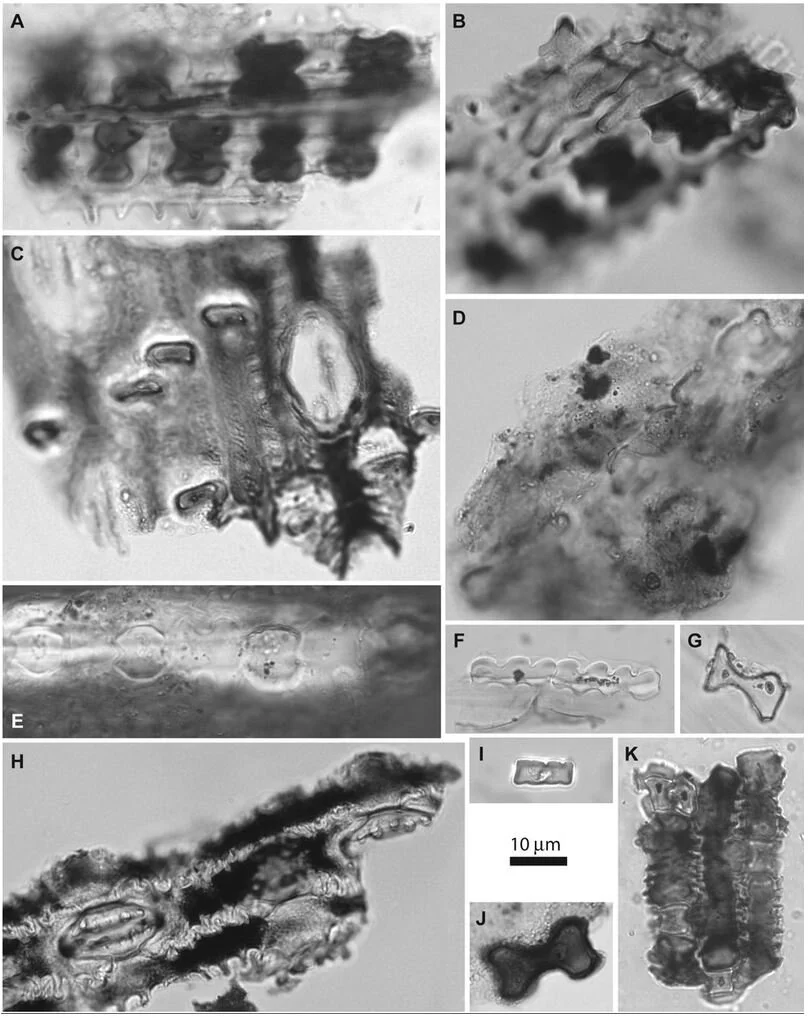
Whereas phytoliths are not unique to grasses, their form is often taxon-specific. With a good eye and a bit of training, one can look at a phytolith under a microscope and tell you what type of plant it came from. This is where the dinosaur poop comes into the picture. By examining fossilized dinosaur poop from India, paleontologists can get an idea of what dinosaurs were eating.
By examining the fossilized poop of a group of large herbivorous dinosaurs called Titanosaurs, paleontologists now have a better idea of grass diversity in the late Cretaceous. They have uncovered a surprising diversity of phytoliths, which demonstrate that at least 5 distinct grass taxa that we would recognize today were alive and well some 100.5 to 66 million years ago. These include extant groups like Oryzoideae (think rice and bamboo), Puelioideae, and Pooideae (think wheat, barley, oat, rye, and many lawn and pasture grasses). There were other lesser known lineages mixed in there as well.
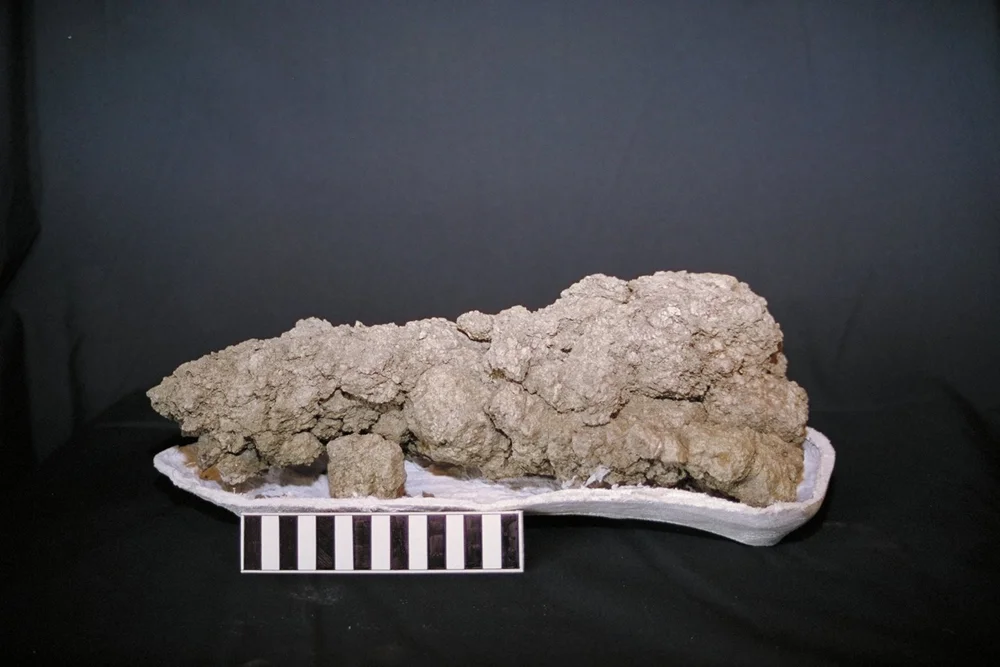
Fossilized dinosaur poop or “coprolite.”
These findings are exciting for a variety of reasons. For one, it tells us that despite lacking teeth specialized for eating grasses, large herbivorous dinosaurs like the Titanosaurs were nonetheless incorporating these plants into their diet. It also tells us that grasses were already quite diverse by the late Cretaceous. The fact that modern clades of grass were around back then sets back grass evolution many millions of years. It also tells us something about grass biogeography. It suggests that grasses were already wide spread across the supercontinent of Gondwana long before India broke away. Finally, it tells us that grasses evolved silicate phytoliths long before more recognizable grass-eating herbivores came onto the scene.
I am always blown away by the details paleontologists are able to extract from such tiny fossils. Who knew dinosaur poop could tell us so much?
Photo Credits: [1] [2] [3] [4]
Further Reading: [1]

Photo by Phil Yabut
Thanks to Phil for sharing:
“Ted Danson appeared to have a good time getting arrested with Jane Fonda near the Capitol today to advocate for climate change and protection of the world’s oceans.”
Ted Danson appeared to have a good time getting arrested with Jane Fonda near the Capitol today to advocate for climate change and protection of the world's oceans. #firedrillfriday #dc @PoPville @dcist @TedDanson @juliemason pic.twitter.com/iOT4aLymE6
— Phil Yabut (@philliefan_99) October 25, 2019
Photo by Phil Yabut
Thanks to Phil for always sharing his awesome photography. As for the litte rescue horses – Godspeed my little guys, Godspeed.
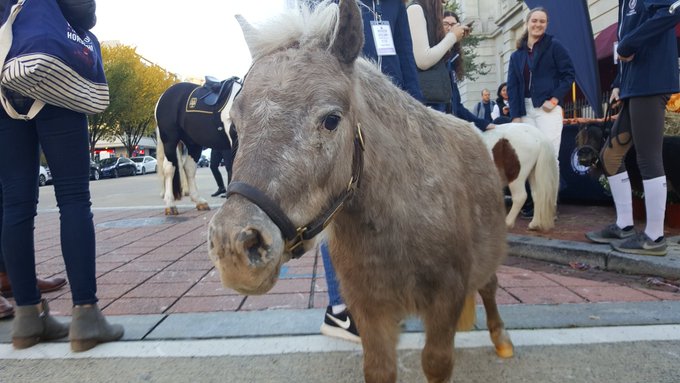
Photo by Phil Yabut

Plants can defend themselves from herbivores in a variety of ways - thorns, spines, hairs, toxins, etc. - but have you ever considered the role of leaf shape in preventing herbivory? It’s okay if you haven’t because leaf shape rarely, if ever, makes it into conversations of plants defense. A recent experiment from Japan has changed that by demonstrating that leaf shape can actually deter a specialist leaf-rolling weevil.
Meet Apoderus praecellens, a leaf rolling weevil that specializes on a genus of mints called Isodon. To successfully reproduce, female leaf rolling weevils must roll up an Isodon leaf while laying eggs as she goes. The end result is a tiny cigar-shaped, edible nursery chamber in which her larvae will develop. The act of processing a leaf is a complex process.
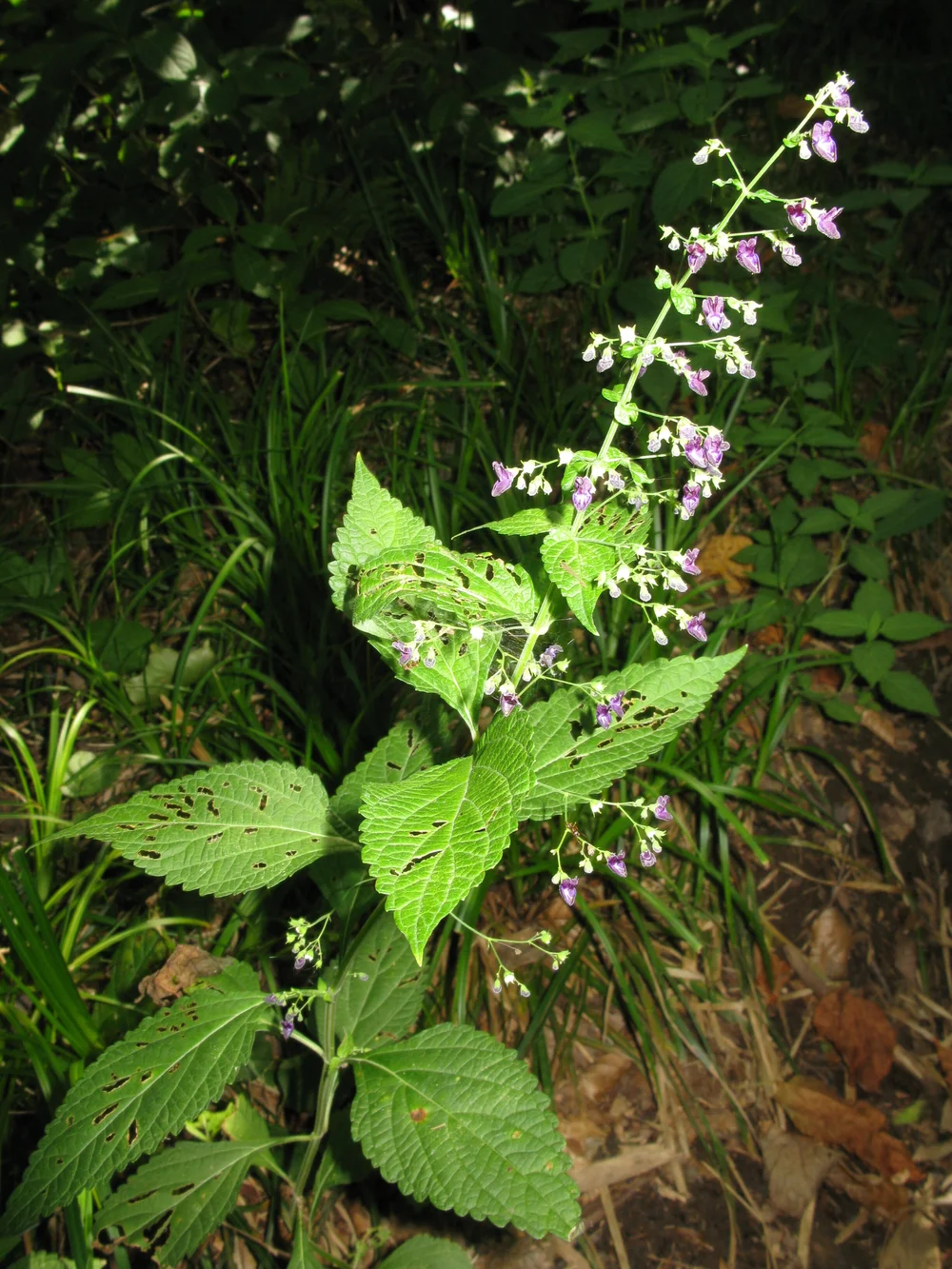
Isodon trichocarpus
The female weevil begins by walking along the margin of the leaf until she reaches the apex. At that point she walks sideways towards the interior of the leaf until she finds the midrib. She then turns around and walks back toward the leaf base again. She repeats these steps several times on both sides of the leaf until she is satisfied. At that point, she will take several bites out of the midrib, which causes the leaf to wilt. The wilted leaf is then much easier to manipulate and thus the rolling process begins.
In the wild, female weevils are well documented on the leaves of I. trichocarpus but not on the leaves of I. umbrosus. This is strange because not only are these plants closely related, they frequently grow in close proximity to one another. Why would the female weevils prefer one over the other? The answer appears to lie in the shape of their leaves.
Isodon trichocarpus produces non-lobed leaves whereas the leaves of I. umbrosus are deeply lobed. When presented with a choice, female weevils did indeed choose to roll I. trichocarpus leaves over those of I. umbrosus. These plants do not differ in their chemical makeup and larvae raised on both species did not differ in their health or development time. Thus, nutritional value or defense compounds don’t explain weevil preference.
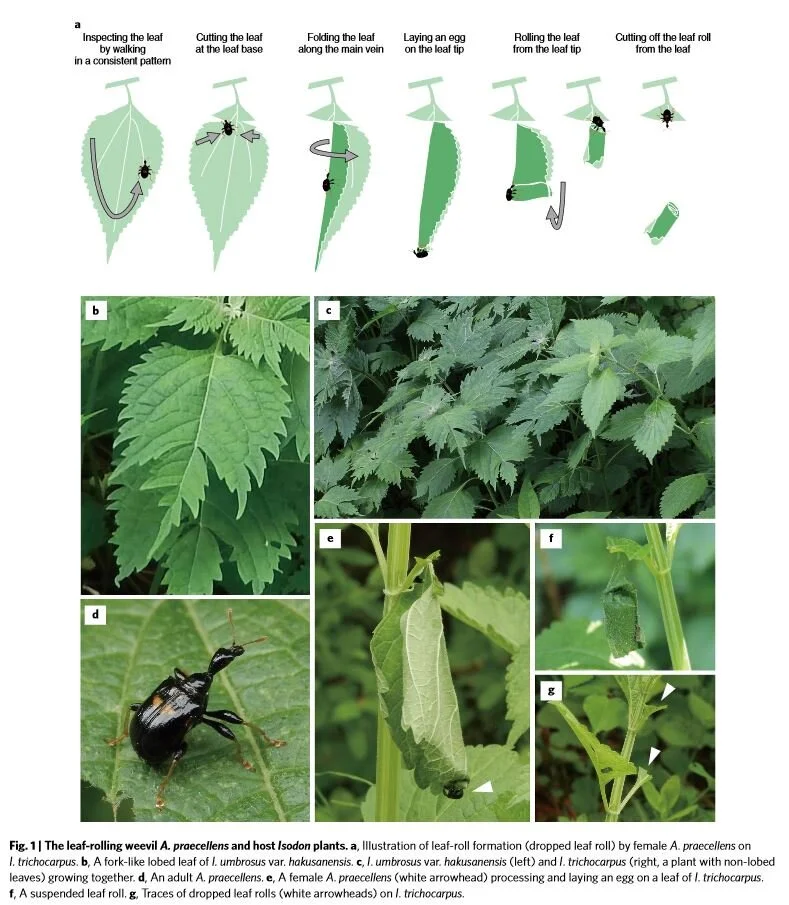
Even more amazing is that the preferences seemed to change when I. trichocarpus leaves were cut to resemble the lobed I. umbrosus leaves. It seems that the presence of leaf lobes is the key to whether a weevil decides to lay her eggs or not. The reason for this seems to be the complex leaf inspection behavior outlined above. The deep lobes of I. umbrosus leaves disrupt the female weevils as they carry out their complex inspection process. If the females are interrupted, they rarely progress to the leaf rolling stage.
The researchers are quick to point out that leaf shape in this instance probably didn’t evolve in response to herbivory. Leaf shape is the result of a multitude of selection pressures like light availability, heat, and drought. Still, the fact that leaf shape can also influence herbivore pressure is an interesting piece to add to the puzzle. It is a great reminder that an organism’s niche comprises so much more than simply the abiotic conditions in which it lives. The niche is also the myriad biological interactions each organism undertakes.
Further Reading: [1]


Gather ye Mitt Romneys while ye may

Thanks to Brooke for sending:
“Taken in the SunTrust Plaza during Porchfest.”
*This series will feature any pets in a backpack. On metro, or not. Corgi, or not. Please email your sightings to princeofpetworth@gmail.com
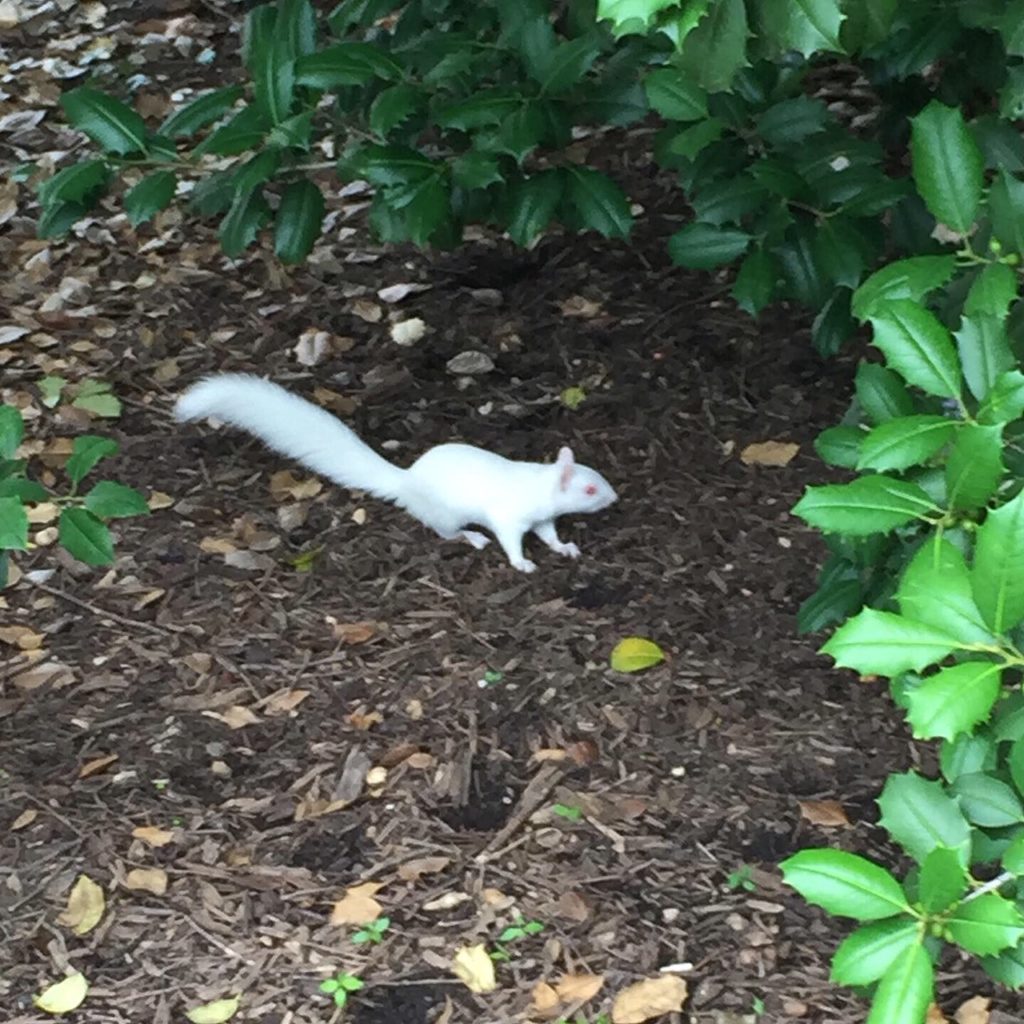
Thanks to Nancy for sending our latest sighting of Earl on the Mall.
If you spot a hawk or any interesting wildlife around town, lunching or otherwise, and get a good photo please send where you spotted it to princeofpetworth@gmail.com and I’ll add it to the queue. Hawks around Town is made possible by a generous grant from the Ben and Sylvia Gardner foundation.
If you have any animal/pet photos you’d like to share please send an email to princeofpetworth(at)gmail(dot)com with ‘Animal Fix’ in the title and say the name of your pet and your neighborhood. If you love the animal fix and want to ensure PoPville’s long term viability please consider donating to our Patreon here.

“This is Fara! She’s a brand new (14 week old!) proud DC resident adopted from City Dogs Rescue. She enjoys getting to know her new digs in Petworth.”
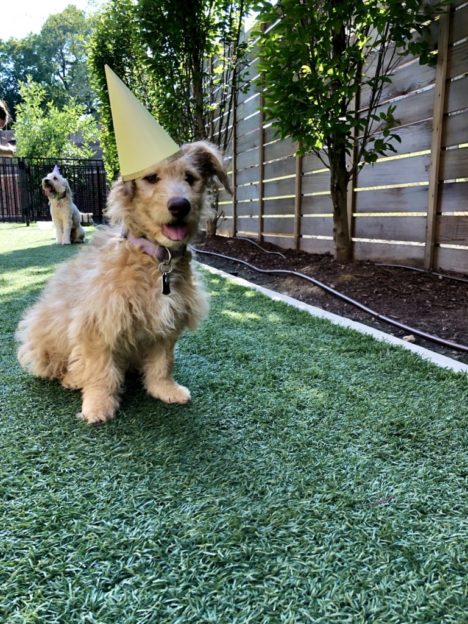
“This is Remy from Woodley Park! She is a 5 month old rescue – collie golden doodle schnauzer mix. She loves ice cubes and playing with her friends.”
If you have any animal/pet photos you’d like to share please send an email to princeofpetworth(at)gmail(dot)com with ‘Animal Fix’ in the title and say the name of your pet and your neighborhood. If you love the animal fix and want to ensure PoPville’s long term viability please consider donating to our Patreon here.
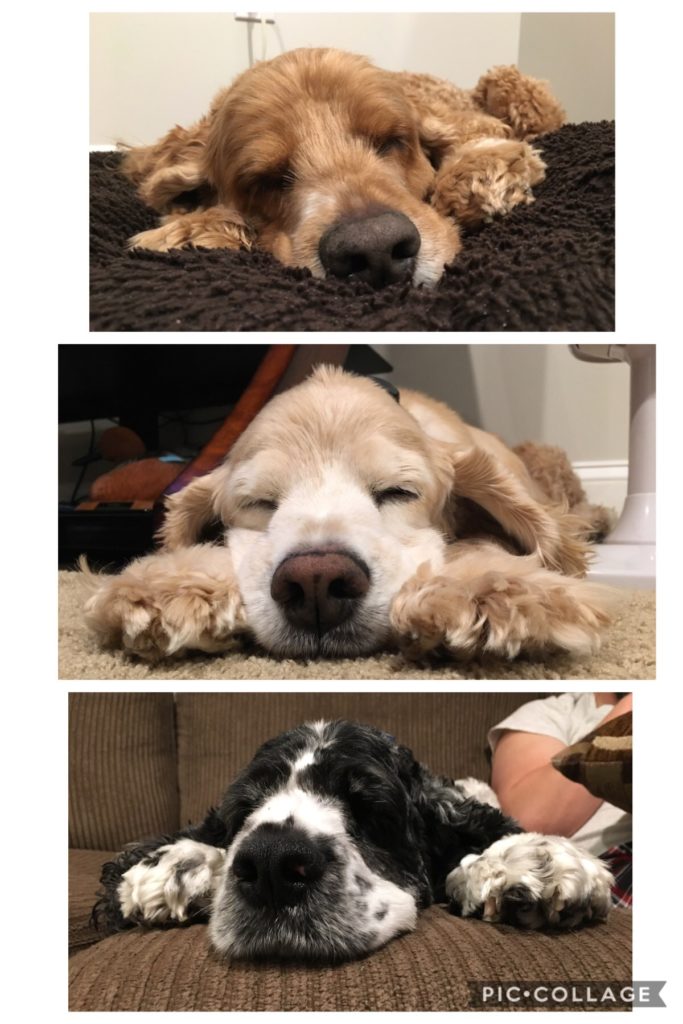
“These are our three three Cocker Spaniels: Griffin, Edgar, and Winston. They were all sleeping in the same pose at the same time one evening so I took their pictures and put them in this collage. They were all adopted from Oldies But Goodies Cocker Spaniel Rescue, and now live in Bloomingdale.”

“This is Harper from Woodridge, DC! She’s posing for her autumn glamour shot in front a blooming field of coreopsis at the Arboretum. We adopted this happy girl two years ago from Lucky Dog. She loves catching the frisbee in our neighborhood park and trying to play with all of the stray cats on the block!”
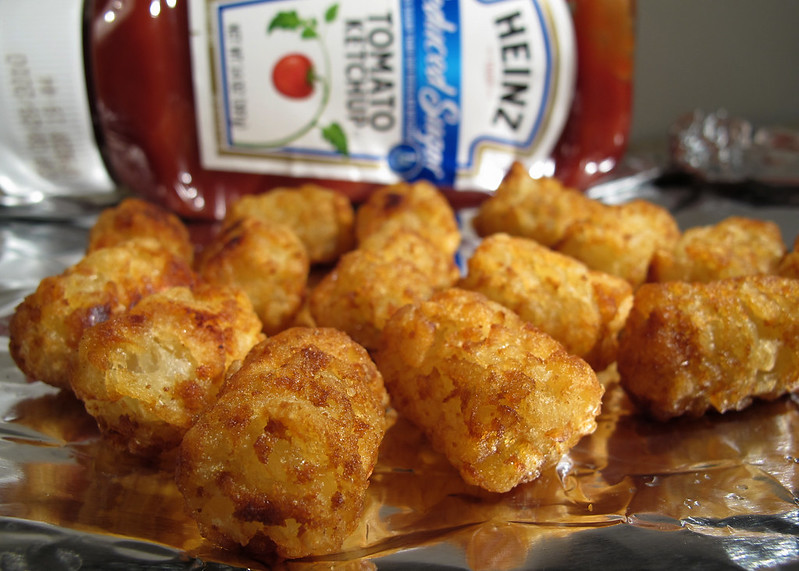
Photo by PoPville flickr user Mr.TinDC
Today’s question is a straight to the point request from Noah: “Please help me find the best tater tots in DC.”
I don’t think I’ve ever had a bad tater tot – but where are the best (toppings?)
Here are the previous best/let’s do this lists for – Carryouts, best Thai, best liquor stores, best Ramen, best Bars, best Indian and Pakistani, best Italian/Pizza/Deli, best Mexican/Salvadoran/Central/Cuban/Latin, best burgers/fries, best bakery/bagels, best Gyms, best Ethiopian , best Sushi, best bookstores, best movie theaters, best sports bars, best barbers and hair salons, best brunch, favorite clothing stores, favorite place to get oysters best breakfast sandwiches, best Tacos, best Farmers Markets best dumplings, best pupusas, best Pho best Food Trucks and best Chicken Wings.
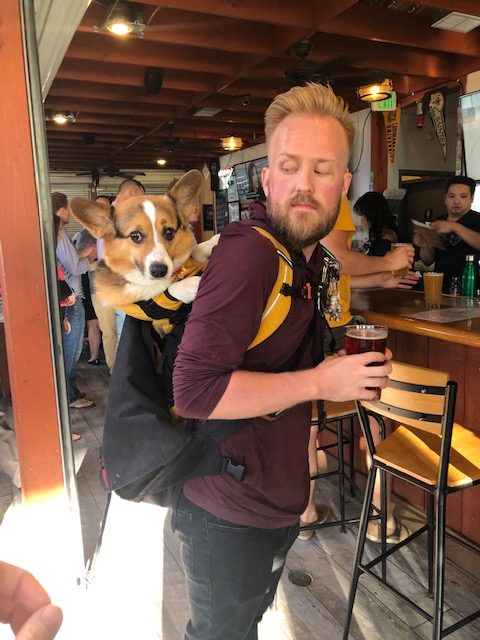
Thanks to Margo for sending from The Brig.
*This series will feature any pets in a backpack. On metro, or not. Corgi, or not. Please email your sightings to princeofpetworth@gmail.com

Thanks to Cristin for sending from the Mall.
*This series will feature any pets in a backpack. On metro, or not. Corgi, or not. Please email your sightings to princeofpetworth@gmail.com
If you have any animal/pet photos you’d like to share for the regular fix please send an email to princeofpetworth(at)gmail(dot)com with ‘Animal Fix’ in the title and say the name of your pet and your neighborhood. AdoPtville is run by two volunteers who compile these pets weekly from local shelters.
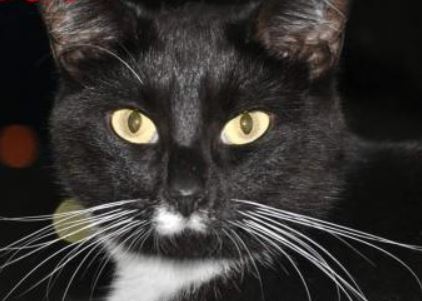
Hi, everyone. My name is Cha-Cha, and I’m speaking to you softly because I’m something of a shy girl, who is looking for a calm and quiet home to call my own. I was found living outside, surviving on the treats kind humans would give me. While I was not suited for the outdoor cat life, I’m still getting used to interacting with humans, and tend to be cautious around new people. I’m making progress every day, and my friends at King Street Cats think I will truly blossom in a loving home where my patient and nurturing human gives me the space I need to become the incredible loving girl I can be! I’m about 3 years old, so have plenty of years of love to give to the right purr-ever family. If you’re interested in adopting a quiet and lovely lady, check out more information about me here.
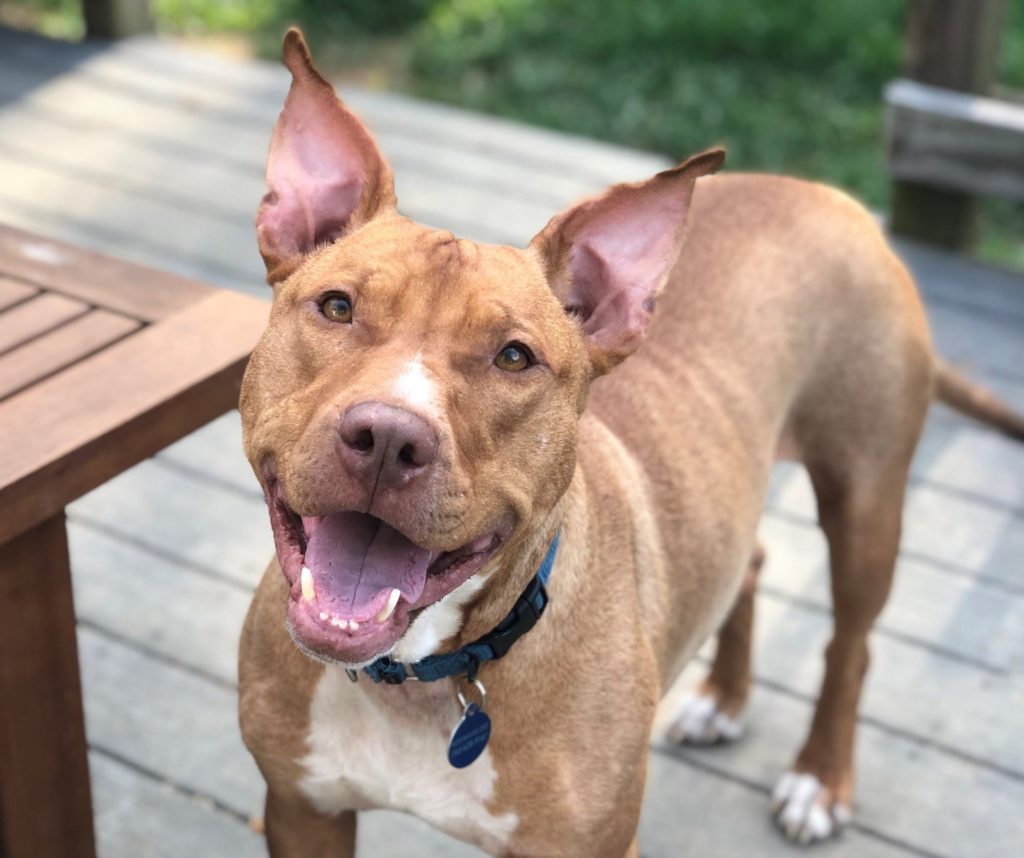
Hi, everybody – meet Sonny!!! This handsome pup is a true survivor and an unashamed goofball. Sonny was found malnourished and covered in wounds – he was likely an abandoned bait dog. A good Samaritan took him to Worthy Dog, and with the help of his loving foster family, Sonny has flourished! His foster mom describes his personality as social, confident, playful, and curious. He has an active energy level and loves meeting new people and going on adventures. His leash skills have improved so much, and he has become a wonderful walking/hiking companion. Sonny would be OK as an only dog, but would likely do best with an equally playful companion. Sonny is great with kids, and loves one toy more than any other – a bucket! Take a look here (volunteer note – DO IT. It’s amazing). Sonny is a truly astonishing and resilient dog who will make his forever home a very happy and fun one! Find out more about adopting him here.
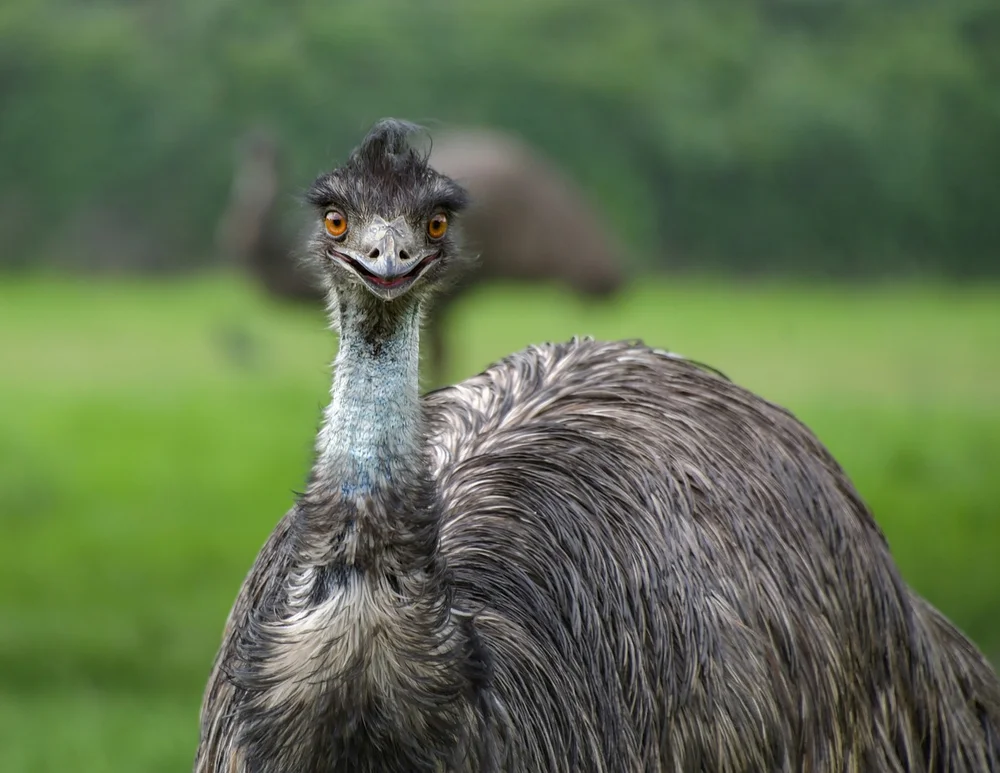
A guest post by Dr. Scott Zona
The emu is a large, flightless bird, a cousin of kiwis and cassowaries. They range throughout much of Australia, favoring savannah woodlands and sclerophyll forests, where they are generalist feeders, consuming a variety of plants and arthropods. A favorite food of the emu is Petalostigma pubescens, a tree variously known as quinine tree, bitter bark or quinine berry. Petalostigma is in the Picrodendraceae, a family formerly included in the Euphorbiaceae. Quinine trees grow in the same open woodlands favored by emus.
The quinine tree bears yellow fruits, 2.0-2.5 cm in diameter, with a thin layer of flesh. The fruits are divided into six to eight segmented, like a tangerine, and each segment contains a hard endocarp or stone (technically, a pyrene). Each endocarp contains a single seed, 6-8 mm long. Left on the tree, the fruits will eventually dry up and open to release their seeds, but if ripe fruits are discovered by a hungry emu, the feasting begins.
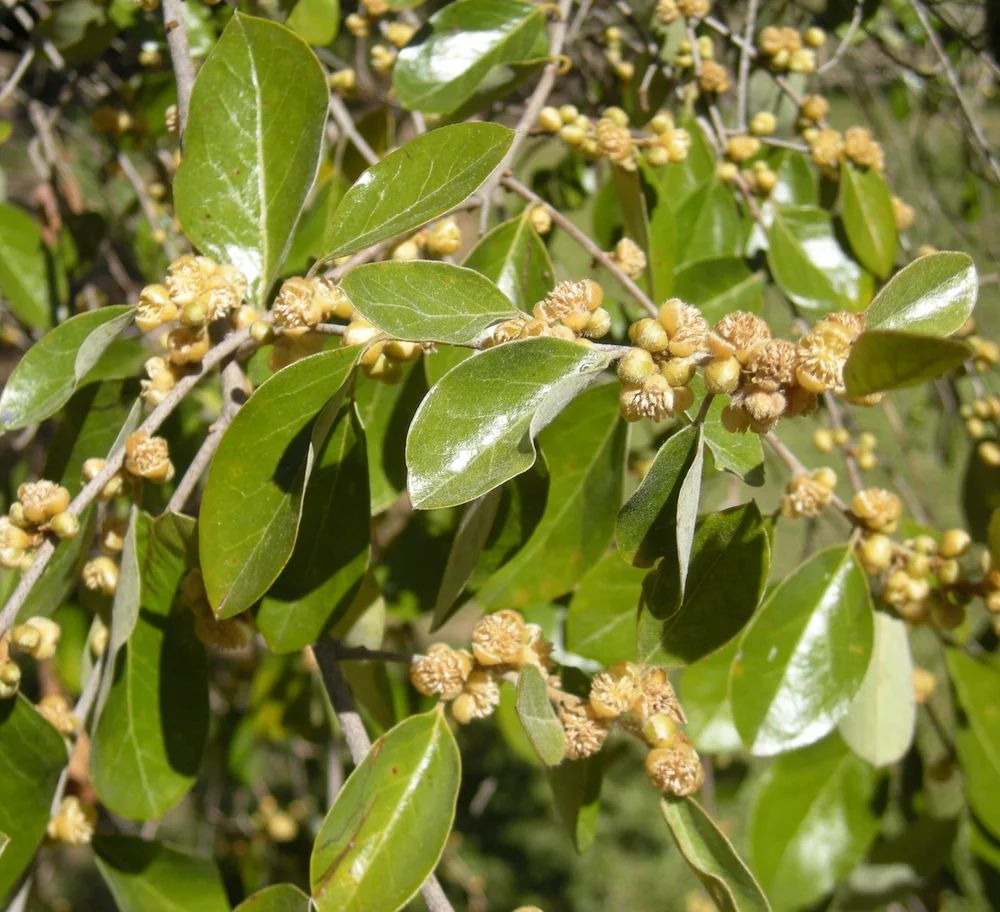
A quinine tree (Petalostigma pubescens) in bloom.
An emu may eat dozens of fruits in one meal. It swallows fruits whole, digesting the soft, fleshy part and defecating the hard, indigestible endocarps. On an average day, an emu can range over a large territory, spreading endocarps as it goes. In one of science's least glamorous moments, Australian biologists counted by hand as many as 142 endocarps in one emu dropping. If the story ended with Quinine Tree seeds in a pile of emu dung, we would say that the emu provided excellent seed dispersal services for the quinine tree, but the dispersal story is not over.
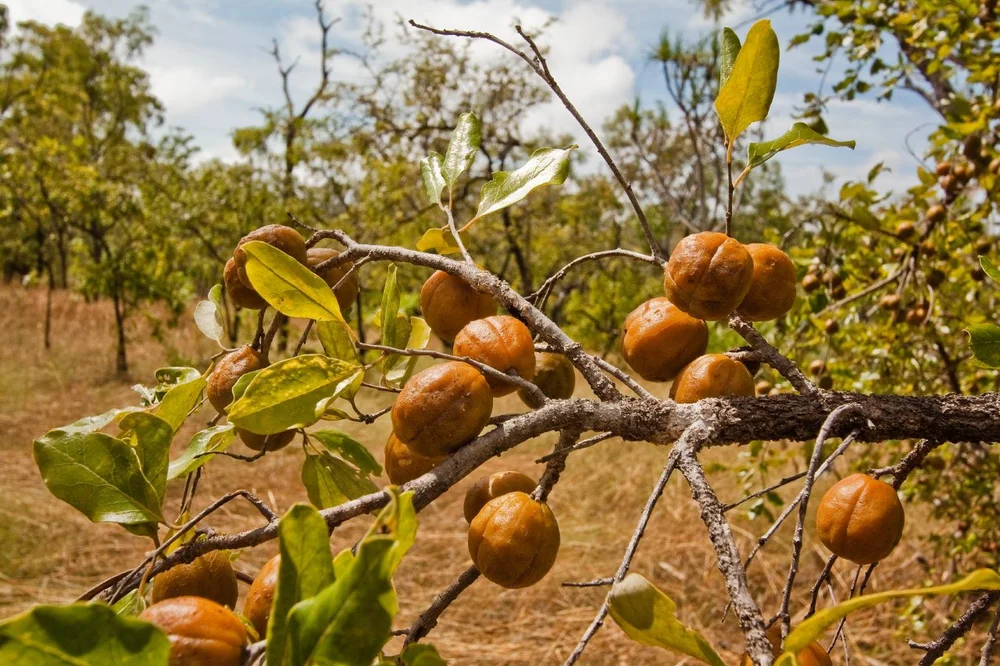
Quinine tree (Petalostigma pubescens) fruits.
The emu dung and endocarps begin to bake in the hot, outback sun. As the endocarps dry, they explode. Just like the pod of a legume, the endocarp has fibers in its tissues oriented in opposing directions. As the fibers dry, they contract and pull the endocarp apart. The dehiscence is sudden and explosive, sending seeds up to 2.5 m from the point of origin. Launching seeds away from the dung pile is beneficial to seeds: the special separation means that seedlings well be less likely to compete with one another.
But that is not the final disposition of Quinine Tree seeds. Each Petalostigma seed bears a small, oily food body, called an elaiosome, that is attractive to ants. Ants pick up the seed with its attached elaisome and carry it back to their nest. Once at the nest, the ants will remove and consume the elaisome and deposit the inedible seed in midden outside the nest. It is the ants that disperse the seeds to their ultimate site.
The association between emus, exploding endocarps, ants and Petalostigma pubescens probably represents one of the most complicated dispersal scenarios in the Plant Kingdom.
Further Reading: [1]
NOTE: Guest posts are invite only
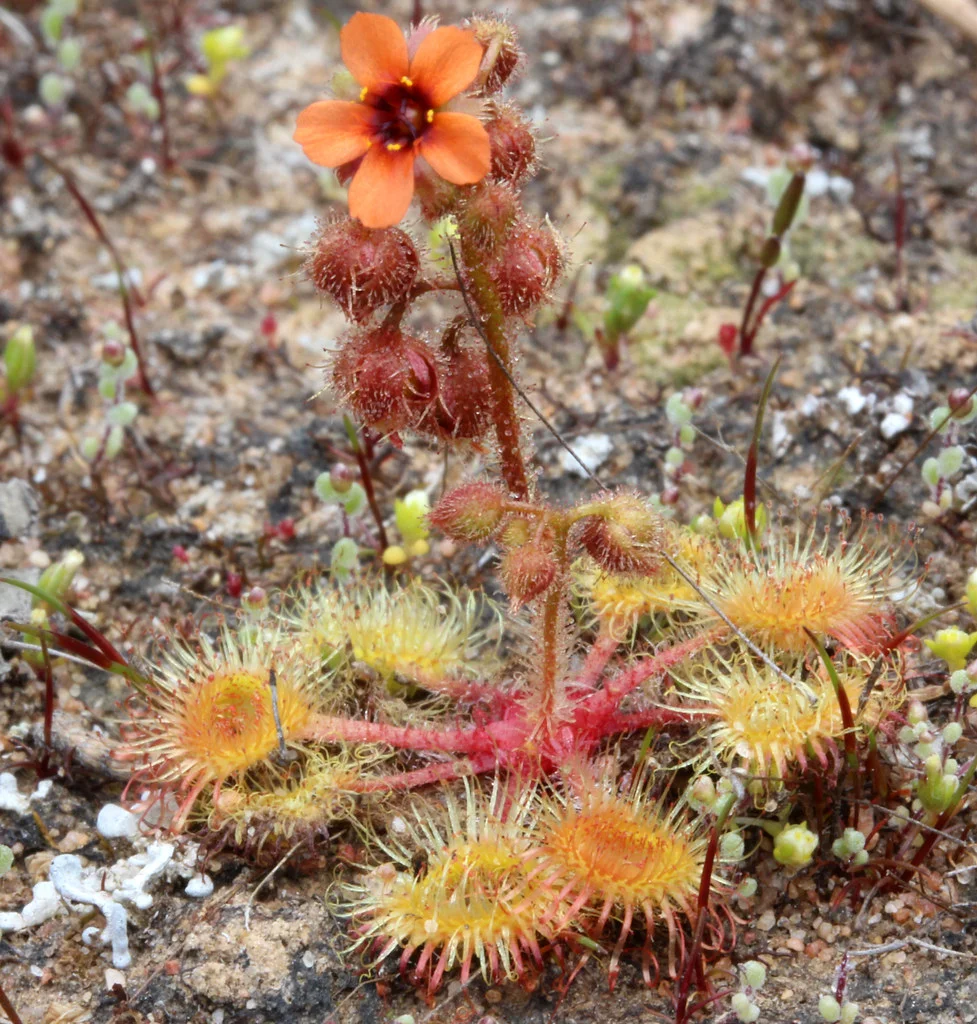
The pimpernel sundew (Drosera glanduligera) is a very special sundew. It is native to parts of southern Australia as well as Tasmania. With a rosette diameter of only 2.5–6 cm (1–2 in), it is a tiny plant. It is also very short lived, living out its entire lifecycle within the span of winter. However, these facts are not what make this species so interesting. This little sundew grows its own catapults that help it capture prey.
Sundews are incredible carnivores. Each of their leaves are decked out in “tentacles” whose tips secrete sticky mucilage. Whether attracted to the leaves on purpose or simply brushing by them on accident, insects find themselves mired down by the mucilage. To make matters worse, the leaves of many sundew species are capable of movement. As the insects struggle, the tentacles bend inwards and the leaves begin to roll up, thus securing the fate of the hapless victim.
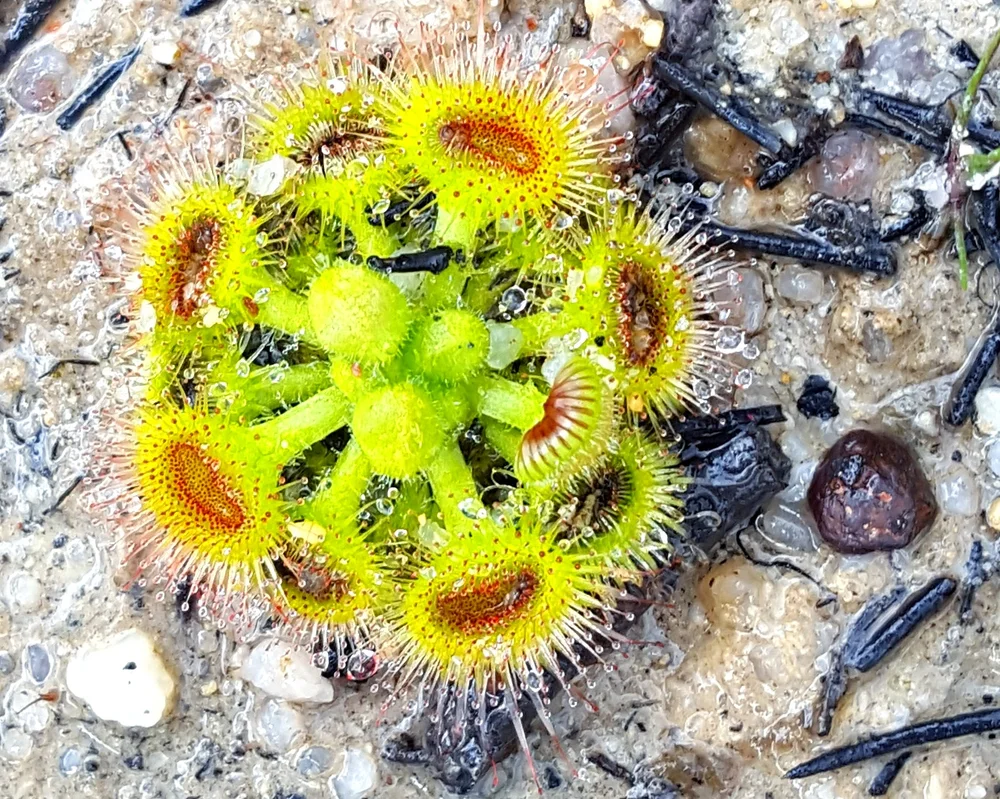
For small sundews, prey capture is a bit tricky. Whereas smaller arthropods like springtails and isopods are easily captured, larger arthropods are often able to wriggle their way free of the leaves of all but the largest species of sundew. Drosera glanduligera is by no means large and that may be why it utilizes a unique method of trapping larger prey.
Along the outside of each leaf are tentacles that are much longer than the rest. They also differ from the typical sundew tentacle in that they are not tipped with sticky mucilage. However, they are more deadly than they look. Each of these long tentacles is essentially a mini catapult lying in wait. Anything unfortunate enough to brush across one of those tentacles is in for a rude awakening.
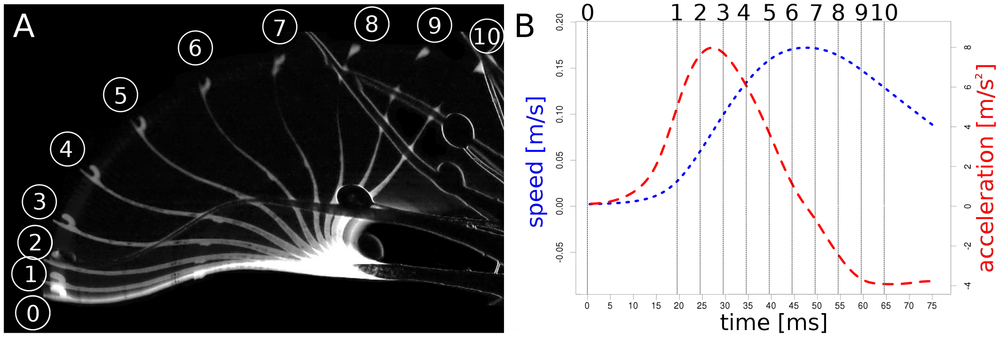
(A) Each step between 1 and 10 depicts a 5 ms time interval. (B) Speed (blue) and acceleration (red) of the tentacle head during the bending motion.
Withing only a few miliseconds, the tentacle bends upward, catapulting the prey towards the center of the leaf. Each leaf on D. glanduligera is shaped like a spoon with the highest concentration of sticky hairs at the center. By catapulting arthropods into the center of the leaf, they are far less likely to escape. Once immobilized, the plant can go about the digestion process.
It is amazing just how fast these tentacles can move. To see this happen in any detail, one needs a high speed camera. The amazing thing is that experts still aren’t 100% certain how such rapid movement is possible. The leading hypothesis involves a change in water pressure within specific cells at the base of the tentacles. When triggered, water is rapidly transported out of the cells on the surface of the tentacle base. With stress coming from water-filled cells underneath, the base of the tentacle bends quickly.
Amazingly, the cells often rupture after the tentacle is triggered. What’s more, they do not reset. Each tentacle is only good for one catapult. This may seem wasteful for such a short-lived species but D. glanduligera produces leaves throughout the entirety of its short life. Therefore, there are always new traps waiting to be triggered. Also, provided arthropods are caught with enough frequency, the plant is sure to obtain enough nutrients from each meal to fuel flowering and seed set. Pretty remarkable for such a tiny carnivore!
Further Reading: [1]

From Michelin:
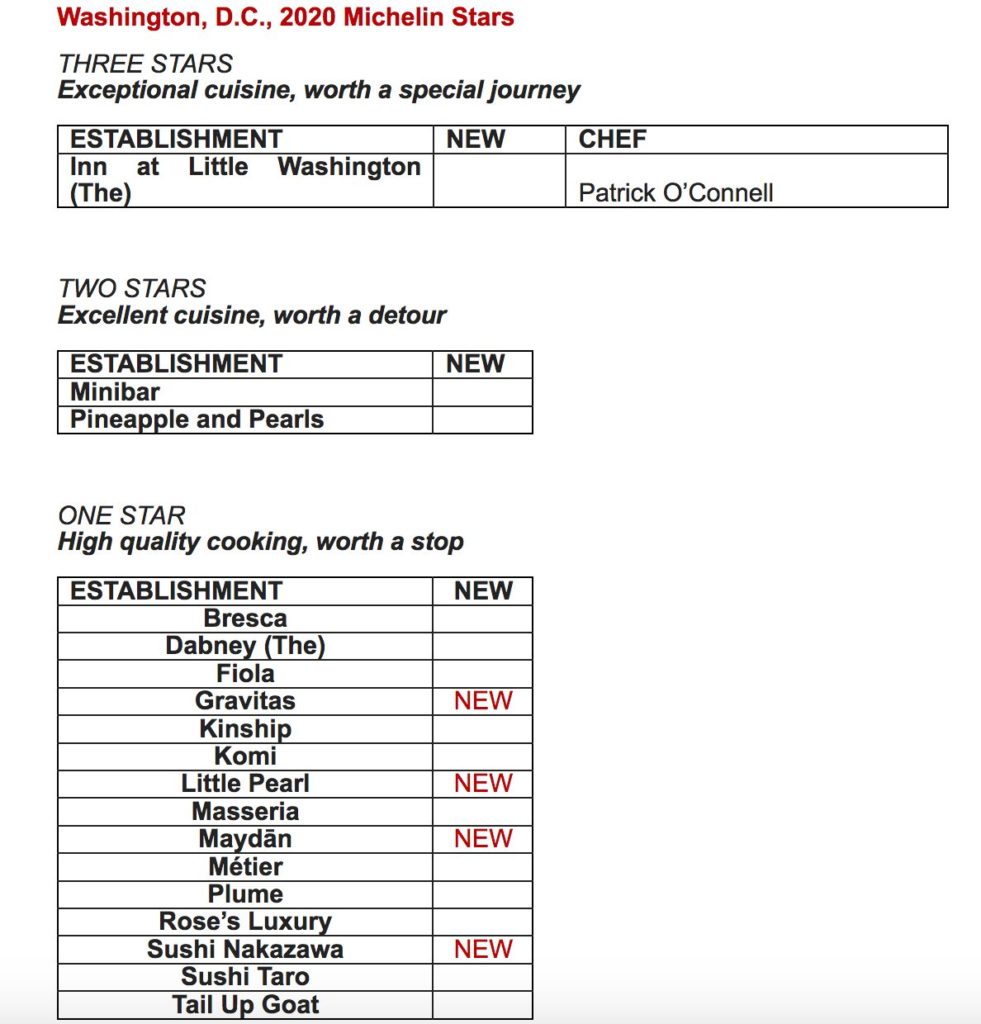
“Michelin today released the 2020 edition of the MICHELIN® Guide Washington, D.C., recognizing 18 establishments that have been awarded one or more Michelin stars, including the addition of four one-star selections to the nation’s capital.
“Our inspectors are especially impressed by the range and diversity of cuisine in Washington, D.C., which reflects Washington’s culture as a global crossroads for governments and travellers,” said Gwendal Poullennec, international director of the MICHELIN Guide. “Of the four new one-star restaurants recognized in the 2020 guide, two are contemporary, one Middle Eastern, and one Japanese, all offering rich and unique dining experiences and high-quality cooking.”
The nearly 130 restaurants that appear in the MICHELIN Guide Washington, D.C. represent 36 cuisine types.
Gravitas, earning one star in the 2020 guide, features an impressive series of creative, astutely composed dishes offered by chef Matt Baker. Newly opened in D.C.’s Ivy City, Gravitas is the perfect locale for a social gathering or an intimate dinner at the chef’s counter.
Chef/owner Aaron Silverman adds another star to his collection with Little Pearl. The same team behind Rose’s Luxury and Pineapple and Pearls, with one and two stars respectively, leads Little Pearl, a café with an evening tasting menu offering 7 to 8 courses for less than $50 (tax and gratuity not included). Culinary delights include the Angel eggs, a riff on deviled eggs featuring a savory meringue egg white and classic yolk filling.
Michelin inspectors have closely watched Maydān since its opening in the fall of 2017. Formerly a Bib Gourmand, Maydān earns one star in the 2020 edition for the kitchen’s skill and vision to cook consistently on an impressive hearth. The fare, from pita bread to lamb shoulder, is delivered with dazzling finesse.
Sushi Nakazawa, the D.C. edition of this one-star New York City sushi restaurant, earns one star in the 2020 D.C. guide. Worth a stop, this intimate and elegant restaurant offers a laser focus on quality, seasonality and technique, thanks to the vigilance of chef Daisuke Nakazawa.
The Inn at Little Washington led by chef Patrick O’Connell retains three stars, the highest recognition offered by the Guide.
The 2020 Bib Gourmands were announced last week for D.C. The Bib Gourmands are awarded to restaurants that earn the attention of Michelin inspectors for offering good quality food at a good value.
Additionally, the 2020 MICHELIN Guide Washington, D.C. recognizes more than 120 restaurants with the Plate symbol, a designation given to restaurants that inspectors recommend to travellers and locals for a good meal with fresh ingredients and capable preparation.
Diners also can find recommendations for establishments with notable wine, beer, and cocktail lists, as well as menus for which average prices are $25 and under.
In summary, Michelin’s 2020 selection for D.C. includes:
One restaurant with three stars
Two restaurants with two stars
15 restaurants with one star
44 restaurants with a Bib Gourmand”
If you have any animal/pet photos you’d like to share please send an email to princeofpetworth(at)gmail(dot)com with ‘Animal Fix’ in the title and say the name of your pet and your neighborhood. If you love the animal fix and want to ensure PoPville’s long term viability please consider donating to our Patreon here.
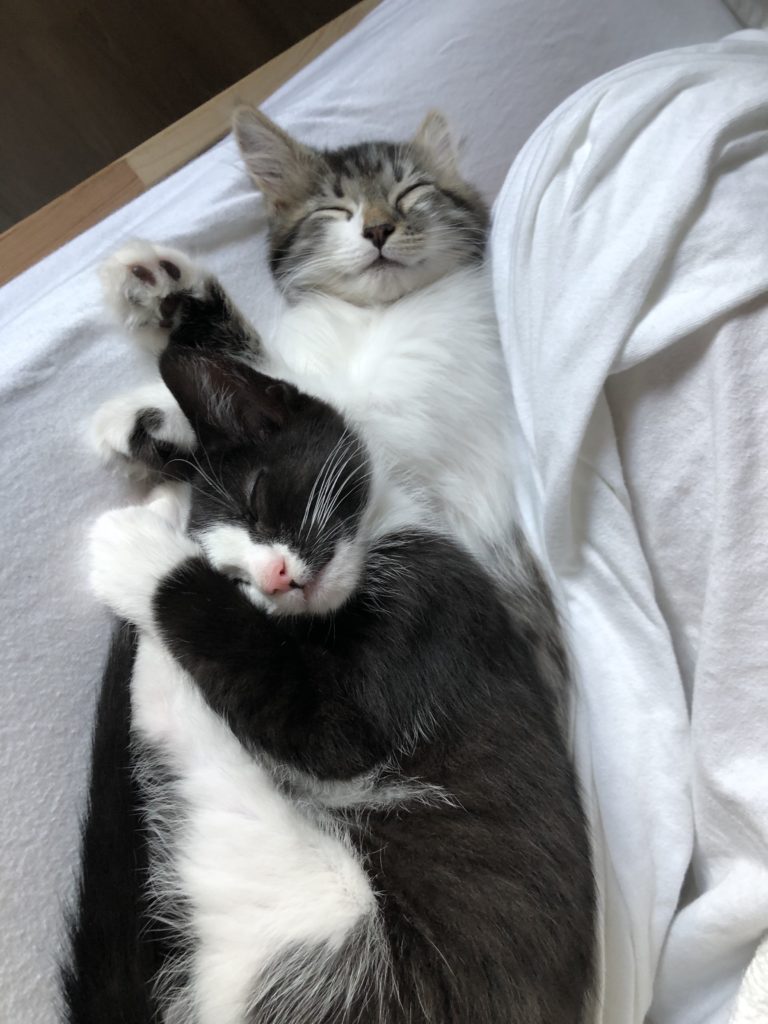
“Duck and Kitty Hawk live in Park View and enjoy food, pawing at running water, and playing.”
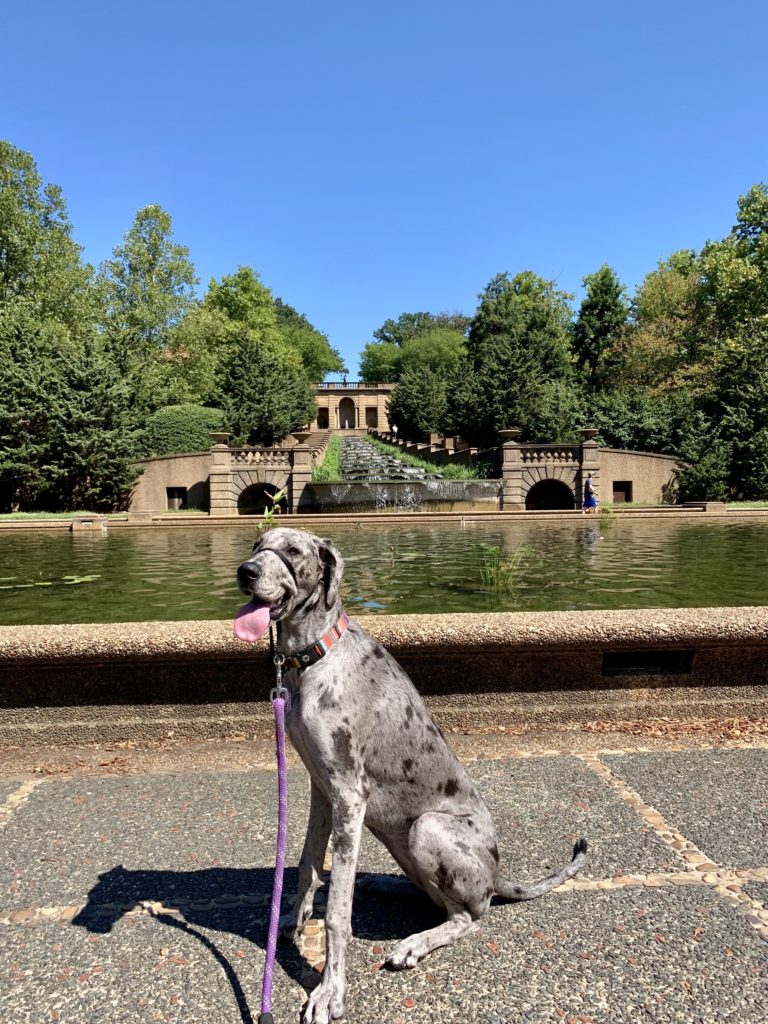
“This is Juniper. She is a 9 month old Great Dane mix who lives in Mount Vernon with her mom, dad, and cat sister. She is a goofy and sweet girl who is well-known in the neighborhood because of her unique coat and large size. If you see her around DC, come say hi!”
V.w.verweijSorry, I can share sad news, sometimes, when it's this important

Thanks to all who passed on the very sad news from Bardo Brewing last night:
“SAD news. Bardawg has passed away. He had a tumor pressing on his spinal cord. Leading to a fairly rapid paralysis of his back half. Hope everyone remembers the good times with Bardawg! He had a good life hanging out with all his friends (you folks) over the past 7 years! RIP.”
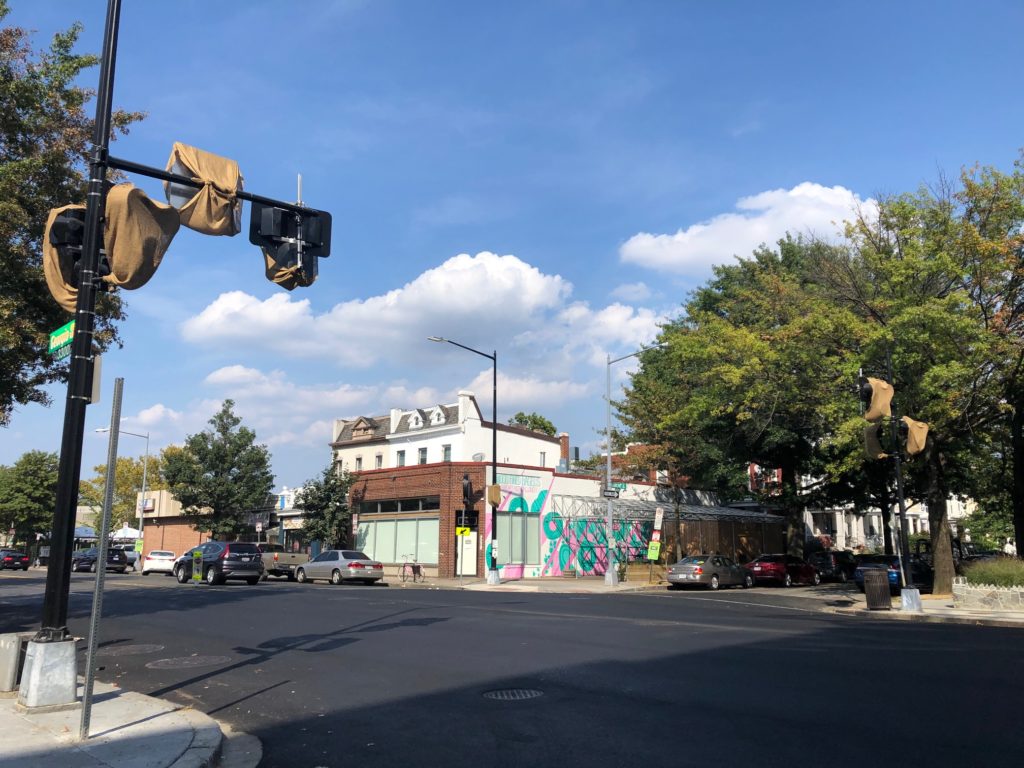
Georgia and Lamont Street, NW looking towards Call Your Mother
Thanks to Alicia for sending: “Light going in at Georgia and Lamont”
If you have any animal/pet photos you’d like to share please send an email to princeofpetworth(at)gmail(dot)com with ‘Animal Fix’ in the title and say the name of your pet and your neighborhood. If you love the animal fix and want to ensure PoPville’s long term viability please consider donating to our Patreon here.
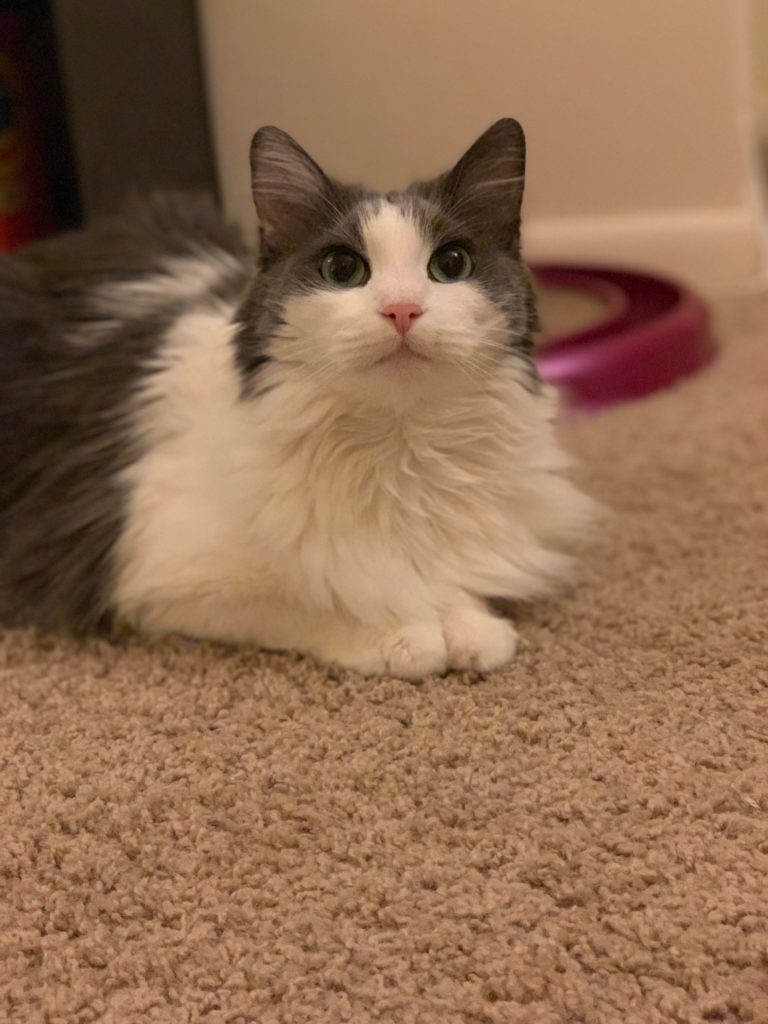
“Hamilton of Shaw waiting anxiously for some fried chicken.”

“Chewy and Cookie from Mt Pleasant! They love long walks, treats and their humans!”
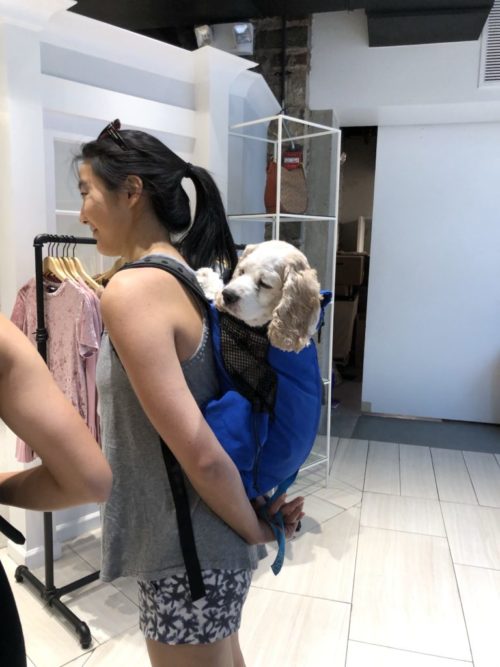
Thanks to Ashley for sending “this cutie at the Rent the Runway store in Georgetown.”
*This series will feature any pets in a backpack. On metro, or not. Corgi, or not. Please email your sightings to princeofpetworth@gmail.com
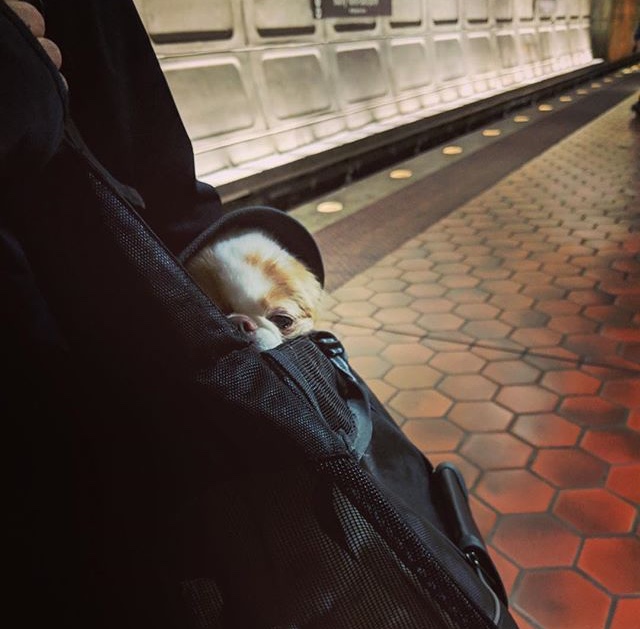
Thanks to Angela for sending: “Metro and Amtrak, respectively.”
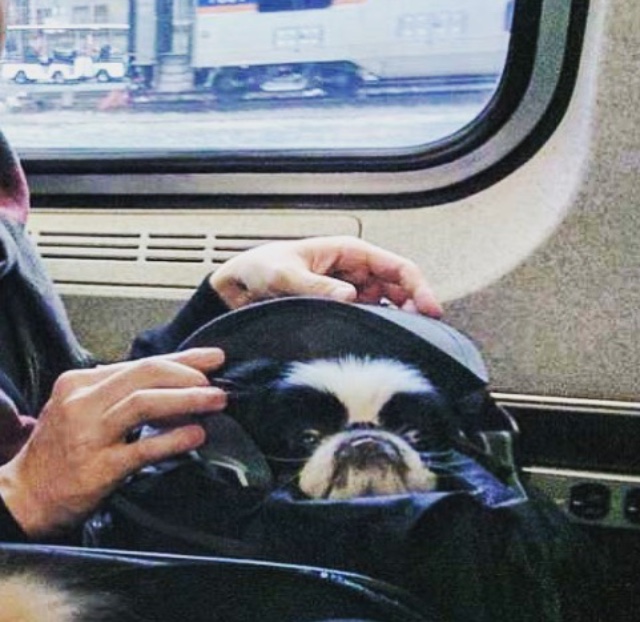
*This series will feature any pets in a backpack. On metro, or not. Corgi, or not. Please email your sightings to princeofpetworth@gmail.com
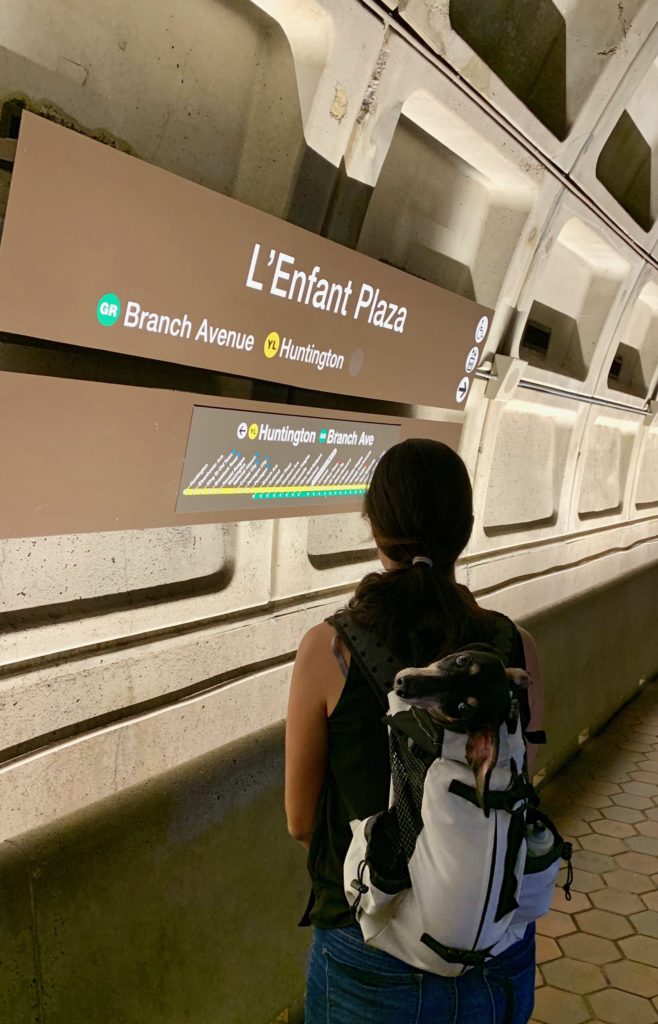
It’s been a rough week so let’s play two as a wise man once said. First thanks to Jennifer for sending in @rocky.wanderpup above. and thanks to Arzinda for sending the guy/gal below from “Red line getting off at Gallery Place-Chinatown Station”

*This series will feature any pets in a backpack. On metro, or not. Corgi, or not. Please email your sightings to princeofpetworth@gmail.com




![[1]](https://commons.wikimedia.org/wiki/Category:Grass#/media/File:A_view_of_Green_Field.png)
![[2]](https://commons.wikimedia.org/wiki/File:Argentinosaurus_BW.jpg)
![[4]](https://commons.wikimedia.org/wiki/File:Coprolite.jpg)
![[1]](https://commons.wikimedia.org/wiki/File:Isodon_trichocarpus_1.JPG)
![[2]](https://en.m.wikipedia.org/wiki/File:Petalostigma_pubescens_foliage_and_flowers.jpg)
![[2]](https://commons.wikimedia.org/wiki/File:Drosera_Glanduligera.jpg)