– Chattanooga’s downtown was strengthened with green infrastructure in 2017 when 37 trees were planted as part of a renovated, 2-acre urban area redesign project. – Positioned between active pedestrian spaces like the Main Library and City Hall, Miller Park was designed to encourage residents to come together and take advantage of park benches, grassy... More
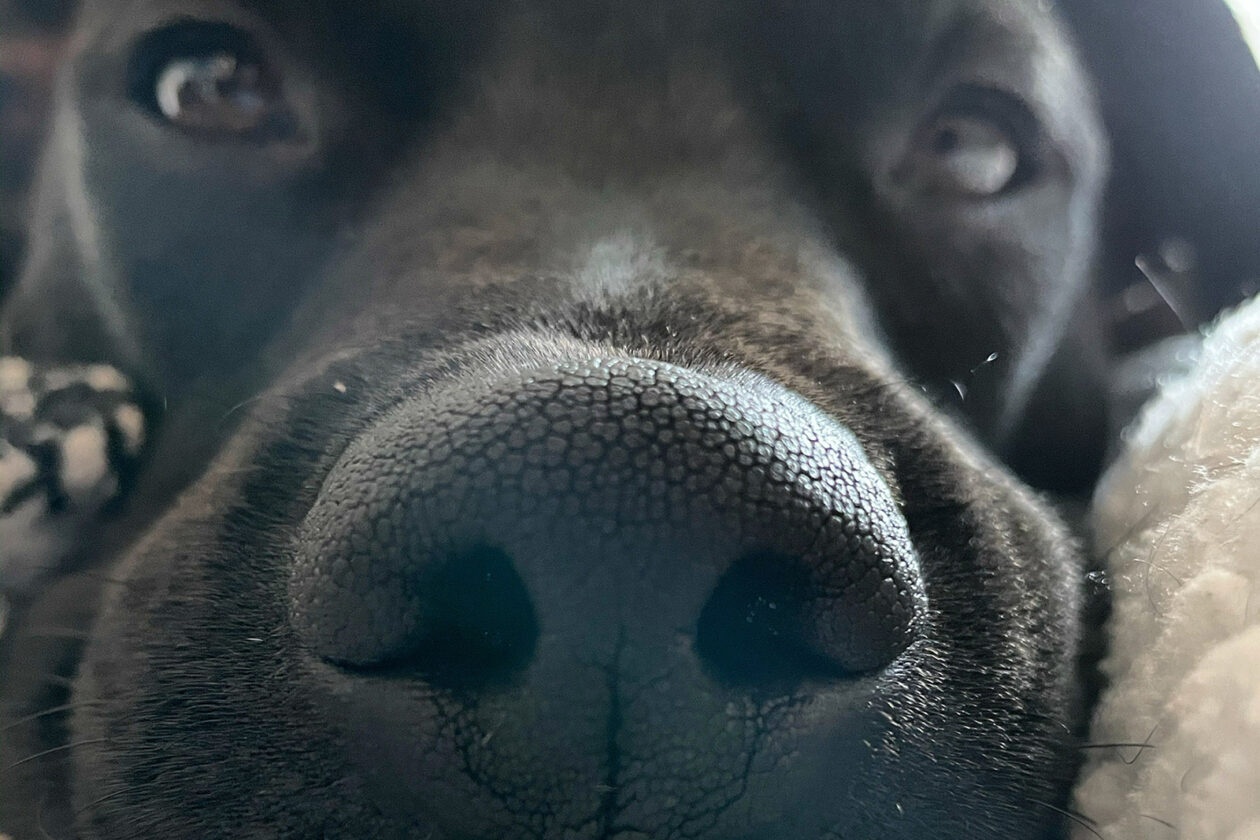
This week’s Pet of the Week is Full-Time Frankie, a snuggly Lab mix who recently turned 1. This pup gets his name from 1.) His human’s love for alliterations, and 2.) The wholehearted way he approaches life.
Learn more about Frankie and his life here in Arlington:
Hi everyone. Meet Frankie! (You can find him @fulltimefrankie on Instagram.)
Named Frankie as a result of my infatuation with alliterations and his status as a foster, this nameless black-and-white lab mix puppy was brought home on August 8, 2020. “Frankie the Foster” wasn’t in the best of health for the first few weeks of his life, but he couldn’t have had a brighter or more snuggly demeanor. Fast forward a few weeks and Frankie quickly wagged his way to a more permanent part of the family as “Full-Time Frankie.”
Ironically, Frankie truly fits the bill when it comes to being full time. Whatever he does, he puts his whole heart (and extremely long tail) into it. He’s a quick learner and the most curious pup you will ever meet. Crying baby? Flat tire? Frankie will stop in his tracks in order to fully assess the situation, making sure everyone is OK, before we can continue our way.
Frankie adores just about everyone that he meets! He loves long walks, drinking from the spigot, just about any treat there is and running through the creek at the dog park with his friends. He’s a big bundle of energy, but at the end of every day, he’ll find his way into my lap for a cozy nap before bed.
If you see us around, make sure you say hello! If you’re with your pup, chances are, Frankie will be crouched down looking very adorable while waiting for you to walk by.
Want your pet to be considered for the Arlington Pet of the Week? Email arlingtonnews@gmail.com with a 2-3 paragraph bio and at least 3-4 horizontally-oriented photos of your pet. Please don’t send vertical photos — they don’t fit in our photo galleries!
We are also looking for local pets who look like their owners or like celebrities. Email us photos of your pet and their doppelgänger, explaining the resemblance and whether it has been noticed in your neighborhood.
In case you needed a reason to dislike Bernie Berne.
Lee Highway is no more in Arlington. It’s now Langston Blvd.
The County Board voted unanimously on Saturday to rename Route 29 within Arlington’s borders, following the recommendation of a Working Group (and county staff) on a new name.
As we previously reported:
County staff have selected “Langston Boulevard” from the finalists submitted by a task force, which was charged with replacing both “Lee” and “Highway.” Currently, Route 29 in the county is named after Confederate Gen. Robert E. Lee, whose name was removed from one of Arlington’s high schools and whose house is being removed from the county logo.
Previously, the task force recommended Loving Avenue as the name, in honor of the interracial couple whose landmark U.S. Supreme Court case inspired the film that bears their name. That was nixed after the couple’s descendants objected.
Langston was the first dean of the law school at Howard University, the first president of Virginia State University, and the first U.S. representative of color from Virginia.
The new name “better reflects Arlington County’s values, promotes equity, and is welcoming to all people who work on, live on, and/or visit the corridor,” the county said in a press release, which also touted the nearly year-long public process involved in selecting a new name.
“The Working Group created an objective set of evaluation criteria to ensure that the public process of selecting a name was transparent, inclusive, and reflected a commitment to the values of public engagement in Arlington,” the county said. “With the new name of Langston Boulevard, costs for new signage are estimated at $300,000, subject to final design and determination by VDOT.”
“We’re throwing Lee Highway in the dustbin with Jefferson Davis Highway,” said County Board member Libby Garvey. “It’s a great day.”
There was one notable dissenting voice on the renaming, as noted by County Board watcher Stephen Repetski. Local history activist Bernie Berne, who previously called renaming the corridor “political correctness” and part of “a culture war that’s been going on since the Civil War,” spoke out at the meeting.
Berne asserted that Robert E. Lee was unfairly denigrated during the renaming process, prior to the Board’s unanimous vote.
"Lee is being denigrated through this whole process"
"Lee was against slavery"
"Yes, he was in favor of secession but…"
"His whole history is being distorted by these activitsts"
Karantonis: "I feel especially well" that the Langston name replaces Lee. "It's really an honor" to rename the road after the first Black representative of Virginia
Garvey: "We're throwing Lee Highway in the dustbin with Jefferson Davis Highway…it's a great day"
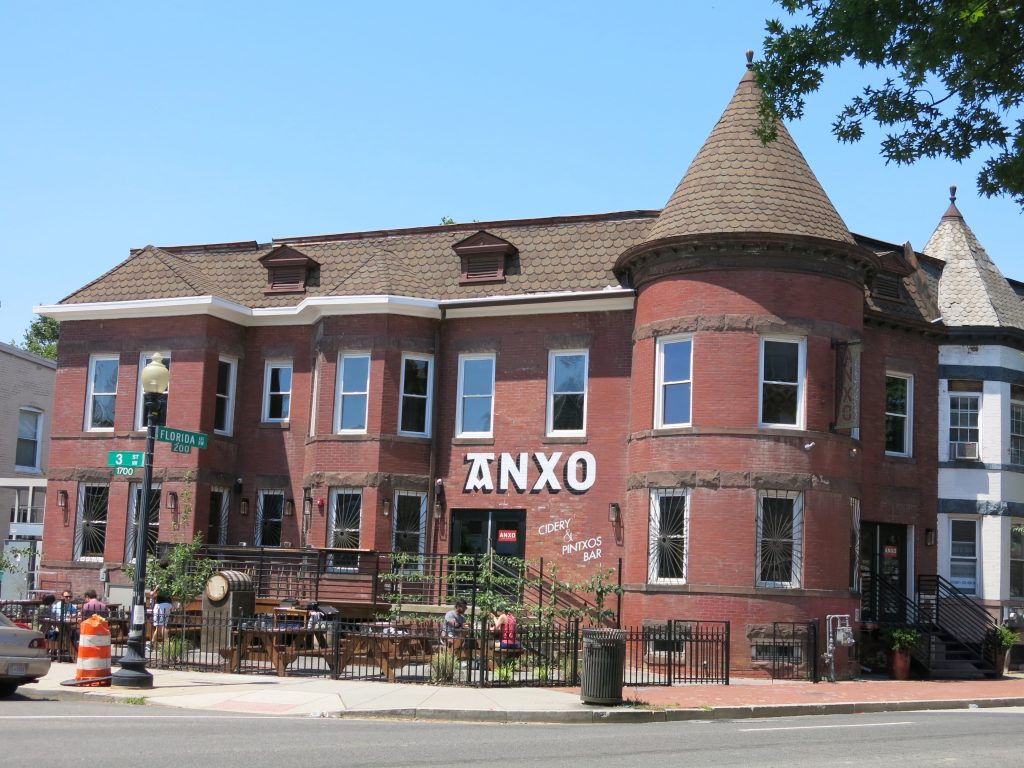
“We’re heartbroken to reveal that a 15-month struggle to find common ground with our landlord will end with us closing our flagship restaurant at 300 Florida Ave NW on Sunday, July 18th, which is the week of our five year anniversary. While this has been a difficult decision we’re confident that it’s the best long-term decision for our business and our family of team members. Please come visit us in Truxton Circle before we close and stay tuned for anniversary celebration events during our final week of service.
While this closure represents the end of a chapter, the ANXO story will continue with the evolution of our Brightwood Park location at 711 Kennedy St NW. Brightwood Park will remain open and hopefully be a natural transition for the countless guests that felt at home in our Truxton Circle location. Work is underway to build a full kitchen and enhance the space to accommodate up to 80 guests. These enhancements will be completed by the end of this year. During the Summer and through the year expect to see cocktail and culinary popups and unique and engaging events. You’ll still be able to purchase your favorite ANXO Ciders, beer, wine, cocktails, and provisions. We’re so excited to continue growing in the Brightwood Park community and to continue the ANXO story with all our guests and partners.
Our Made-in-DC brand, ANXO Cider continues to grow with distribution in 20+ states (and growing) along with international distribution in Nova Scotia and the UK. Our focus on apple driven beverages won’t stop with cider as we’re thrilled to announce that we’ll be producing apple brandy at Brightwood Park. Over the past five years we’ve come to know our local apples and we’re confident we can make exceptional brandy from them. Our first spirits will be ready in early 2022, with the finest taking three years to age. ANXO Mixologist Jade Aldrighette will host a Summer Cocktail pop-up as a preview to “Brightwood Brandy,” our new line of apple spirits. Her cocktails will be available at the tasting bar, our various outdoor spaces, and to take home!
Today’s news is bittersweet. We poured our hearts into our Florida Avenue location and will leave behind an epic rebuild of a historic and long-vacant building, which we’ll miss terribly. We are emerging from the pandemic a different business than how we entered it, but our love for Kennedy Street has only grown. We are committed and excited to focus our energy on this amazing neighborhood and can’t wait to share more plans for this over the coming weeks and months.”
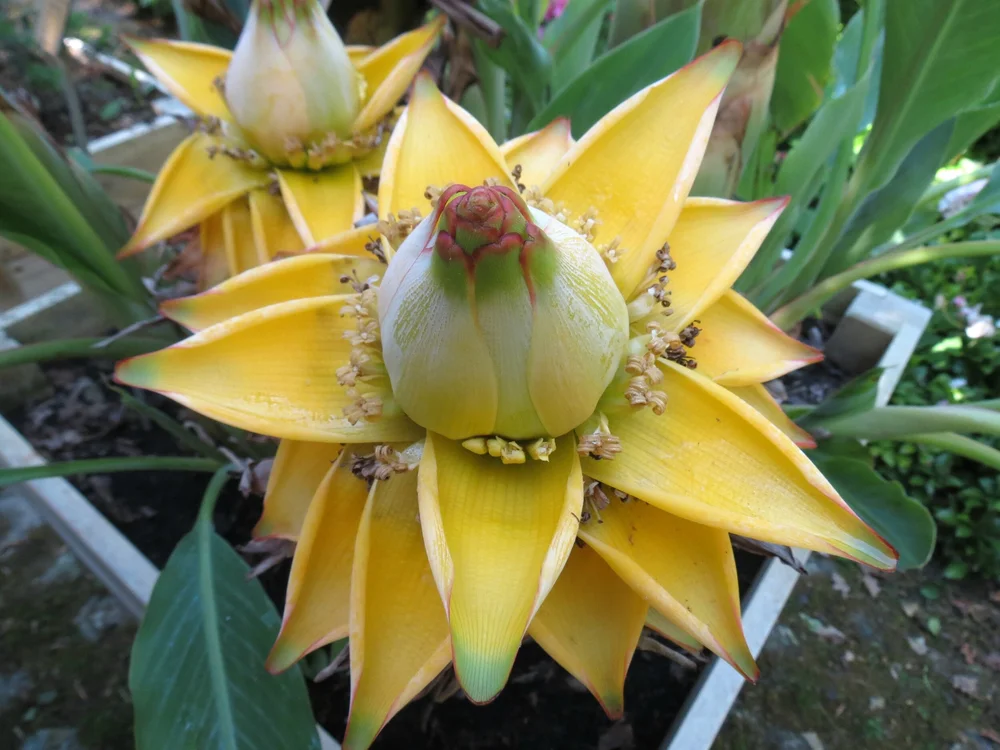
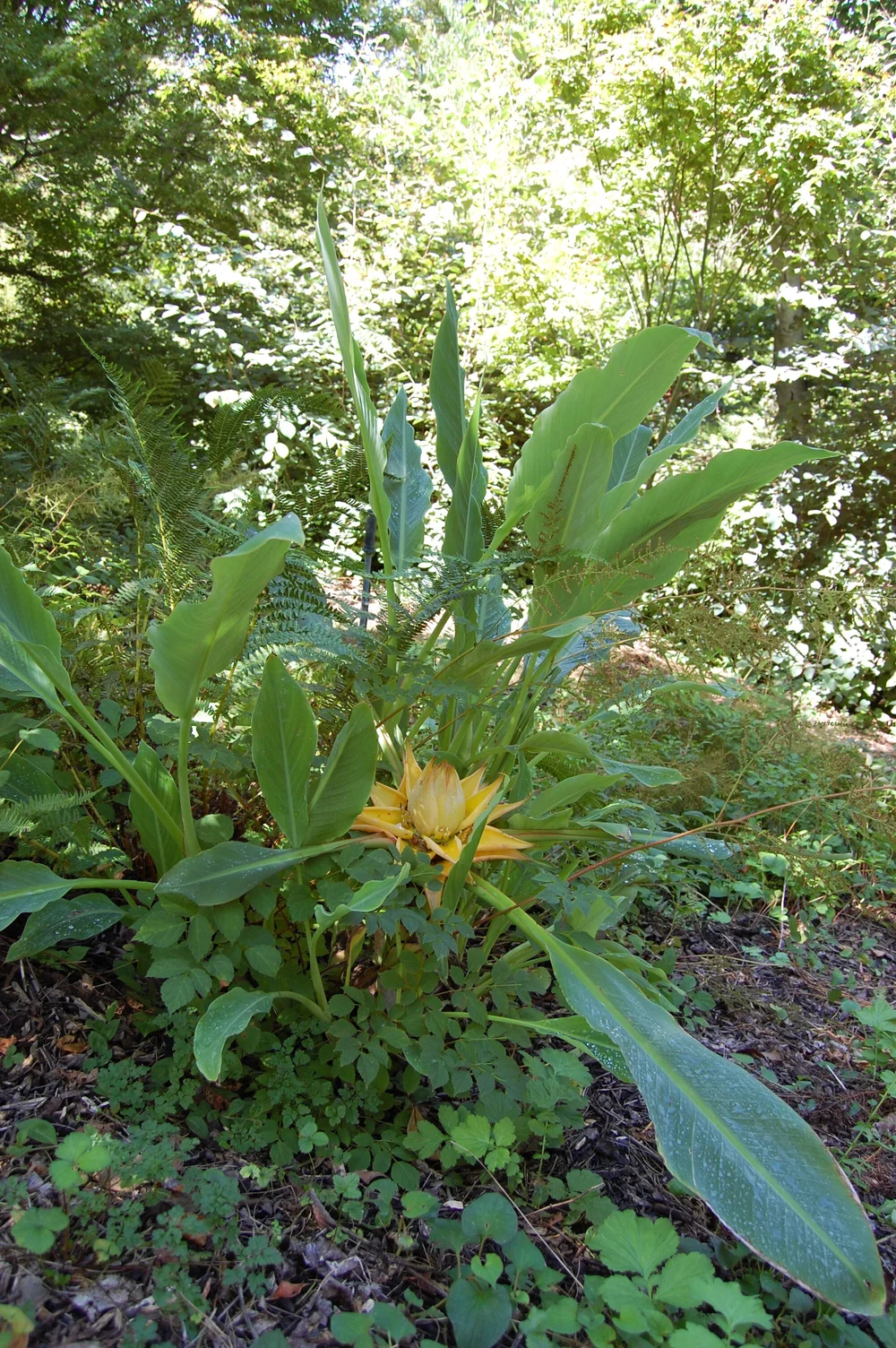
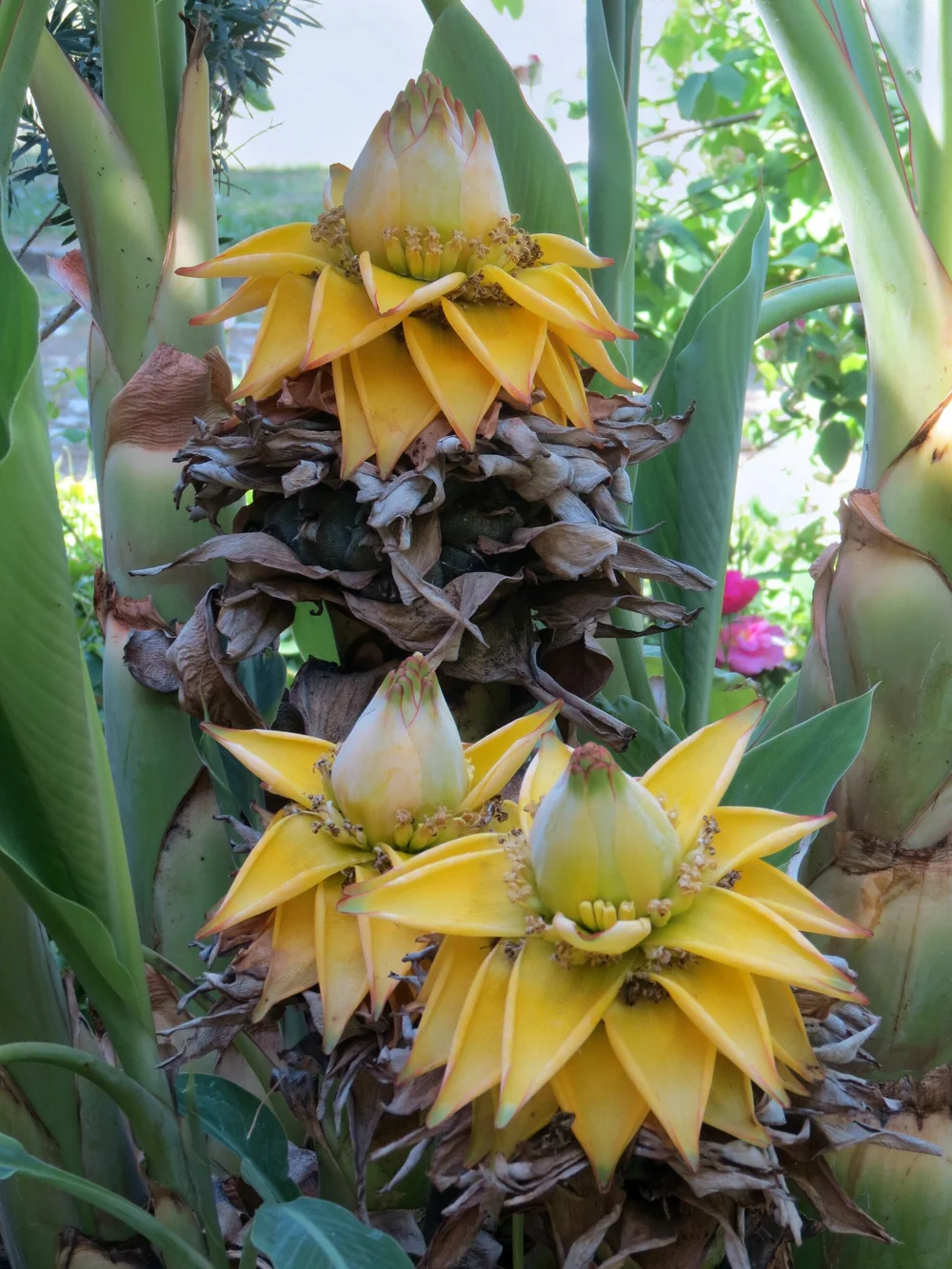
While perusing the internet the other day, I scrolled past an image of what looked like the physical manifestation of the sun emoji on my phone. The bright yellow flash was so striking that it caused me to pause and scroll back to the source. I was pleasantly surprised to see that the sun-like object belonged to something botanical. I was even more surprised to find out that it was produced by a unique cousin of the banana called the golden lotus banana (Musella lasiocarpa).
The golden lotus banana is an oddball in many ways. For starters, it has a confusing taxonomic history. For many years, this odd plant has bounced back and forth between what was originally the only two genera in the banana family (Musaceae). Indeed, it has many outward characteristics that could firmly land it in either the genus Musa or the genus Ensete. Still, this plant is strange enough that numerous taxonomists have taken their own stab at narrowing down its correct placement. It wasn’t until DNA analyses revealed it to be so distinct from either of these genera that it warranted its own unique taxonomic placement. Thus, the monotypic genus Musella was born.
The plant itself is well known and widely cultivated throughout its home range in the Yunnan province of China. In fact, the golden lotus banana is so widely cultivated in this region as food for both humans and cattle alike, that experts couldn’t quite figure out if there were any wild populations left. It wasn’t until relatively recently that some wild populations were found. Sadly, these populations are under threat of being completely extirpated as much of the conifer-oak forests it calls home have been highly fragmented and degraded due to human activities. At least its popularity in cultivation means this species is not likely to go completely extinct any time soon.
The golden lotus banana is rather interesting in form. When you look for pictures of this species around the web, you are likely to pull up images of a stubby, nearly leafless stalk tipped with the bright yellow bracts that look like the rays of a cartoonish sun. Apparently, plants can lose many of their leaves in cultivation around the time the inflorescence matures, giving the impression that it never had any to begin with. Of course, the plant does produce typical banana-like leaves for most of the year. As mentioned, the amazing inflorescence is borne at the tip of what looks like a small, woody trunk, but in reality is actually the fused petioles of their leaves. All members of the banana family are, after all, overgrown herbs, not trees.
As is typical with this family, the flowers don’t all ripen at once. Instead, they begin at the base and gradually ripen over time, revealing consecutive whirls of tubular flowers surrounded by bright yellow bracts, though a variant population that produces red bracts was recently described as well. Interestingly, the golden lotus banana differs from its banana cousins in that its flowers are not pollinated by bats or birds. Instead, bees and wasps comprise the bulk of floral visitors, at least among cultivated populations. The first flowers to mature are male flowers that produce a small amount of nectar and copious amounts of pollen. Only the flowers near the base of the inflorescence are female and they produce a lot more nectar than the male flowers.
Research has shown that bees are far more likely to visit female over male flowers and their visits to female flowers last much longer. This is likely due to the differences in nectar production, but the end result is that by encouraging bees to spend less time on male flowers and more time on female flowers, each plant greatly increases the chances that pollen of unrelated individuals will end up on the stigma. After pollination, tiny fruits are formed, however, from what I have read they are largely inedible to humans. Once the fruits ripen and seeds are dispersed, the flowering stalk dies back and is replace by a fresh new growth stalk from the underground rhizome.
The next time you find yourself at a botanical garden with a decent tropical plant collection, keep an eye out for the golden lotus banana. Outside of China, this species has gained some popularity among specialist plant growers and you just might be lucky to stumble across one in the process of blooming.
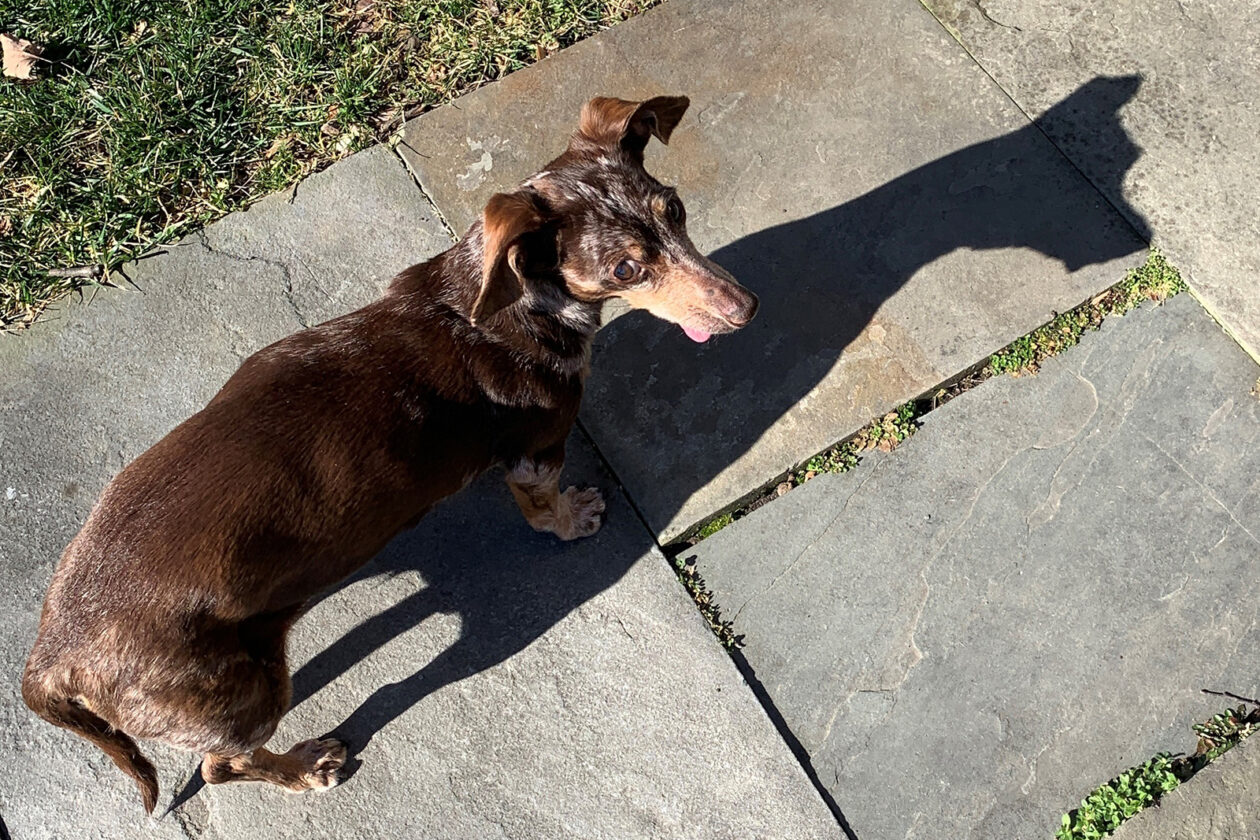
Let’s wish Jazz a happy birthday! This miniature dachshund turned 19 last week.
Here’s what Jazz has to say about her long life in Arlington:
Hi there. I’m Jazz, a miniature dachshund with chocolate dapple coloring. Sounds like a great ice cream flavor, right?
I was born in Louisiana when my soon-to-be parents saw a picture of me online and bought me through PayPal. I quickly hopped on a flight to DCA when I was 3 months old (as an unaccompanied minor) to join my new family in Arlington where I have lived ever since. I’ve visited a couple of the local dog parks, but the big dogs were just too much, so you most likely would have met me near my Arlington Forest home or in Lubber Run Park.
Can you believe I just turned 19 years old on March 19? I used to love retrieving balls, shredding stuffed animals and chasing squirrels. I even learned how to do a whole bunch of tricks, but those days have come and gone. In my old age, I’ve slowed down quite a bit, but I still get around OK. I will chase down a good-girl treat and can make my way up the ramp onto the couch where I like to burrow into a cozy blanket and root for the Capitals with my family.
Hope to see you around!
Want your pet to be considered for the Arlington Pet of the Week? Email arlingtonnews@gmail.com with a 2-3 paragraph bio and at least 3-4 horizontally-oriented photos of your pet. Please don’t send vertical photos — they don’t fit in our photo galleries!
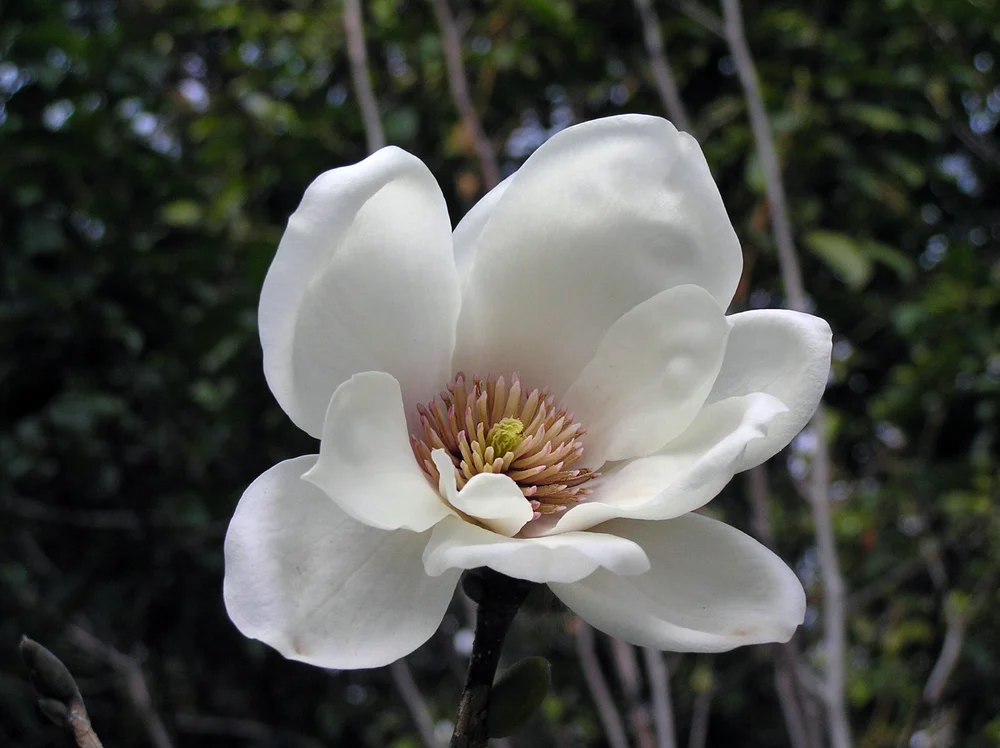
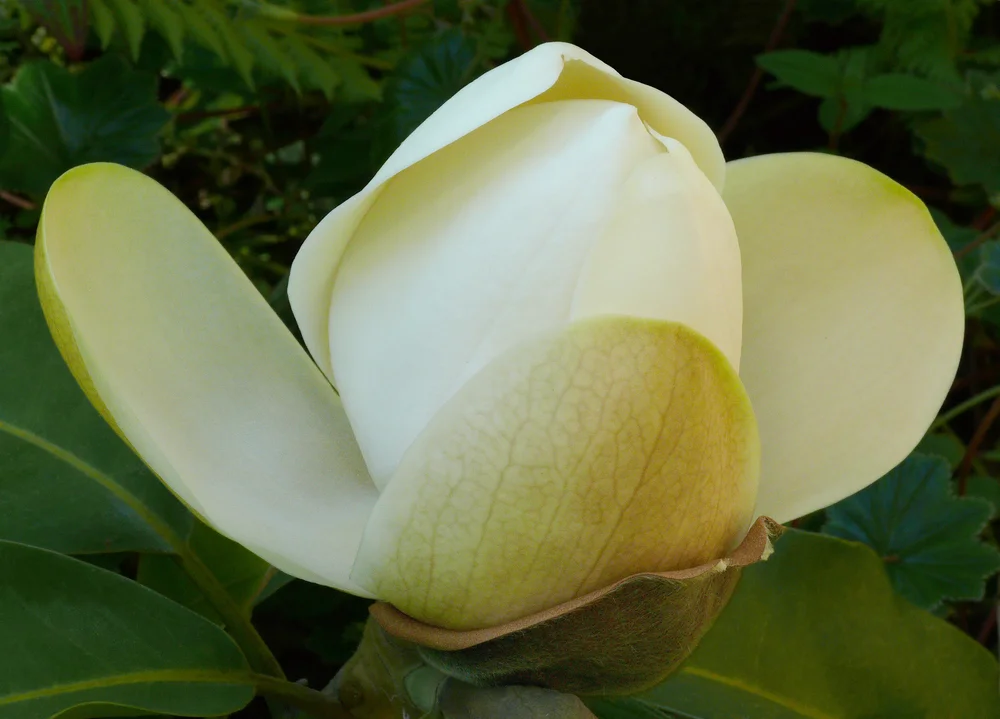
There are a lot of reasons to like magnolias and floral thermogenesis is one of them. That’s right, the flowers of a surprising amount of magnolia species produce their own heat! Although much more work is needed to understand the mechanisms involved in heat generation in these trees, research suggests that it all centers on pollination.
Magnolias have a deep evolutionary history, having arose on this planet some 95+ million years ago. Earth was a very different place back then. For one, familiar insect pollinators like bees had not evolved yet. As such, the basic anatomy of magnolia flowers was in place long before bees could work as a selective pressure in pollination. What were abundant back then were beetles and it is thought that throughout their history, beetles have served as the dominant pollinators for most species. Indeed, even today, beetles dominate the magnolia pollination scene.
Beetles are generally not visiting flowers for nectar. They are instead after the protein-rich pollen within each anther. It seems that when the anthers are mature, beetles are very willing to spend time munching away within each flower, however, keeping their attention during the female phase of the flower is a bit trickier. Because there are no rewards for visiting a magnolia flower during its female phase, evolution has provided some species with an interesting trick. This is where heat comes in.
Though it varies from species to species, thermogenic magnolias produce combinations of scented oils that various beetles species find irresistible. That is, if they can pick up the odor against the backdrop of all the other enticing scents a forest has to offer. By observing floral development in species like Magnolia sprengeri, researchers have found that as the flowers heat up, the scented oils produced by the flower begin to volatilize. In doing so, the scent is dispersed over a much greater area than it would be without heat.
Unlike some other thermogenic plants, heat production in magnolia flowers doesn’t appear to be constant. Instead, flowers experience periodic bursts of heat that can see them reaching temperatures as high as 5°C warmer than ambient temperatures. These peaks in heat production just to happen to coincide with the receptivity of male and female organs. Also, only half of the process is considered an “honest signal” to beetles. During the male phase, the beetles will find plenty of pollen to eat. However, during the female phase, the scent belies the fact that beetles will find no reward at all. This has led to the conclusion that the non-rewarding female phase of the magnolia flower is essentially mimicking the rewarding male phase in order to ensure some cross pollination without wasting any energy on additional rewards.
The timing of heat production also changes depending on the species of beetle and their feeding habits. For species like the aforementioned M. sprengeri, which is pollinated by beetles that are active during the day, heat and scent production only occur when the sun is up. Alternatively, for species like M.tamaulipana whose beetle pollinators are nocturnal, heat and scent production only occur at night. Researchers also think that seasonal climate plays a role as well, suggesting that heat itself may be its own form of pollinator reward in some species. Many of the thermogenic magnolias bloom in the early spring when temperatures are relatively low. It is likely that, aside from pollen, beetles may also be seeking a warm spot to rest.
Personally, I was surprised to learn just how many different magnolias are capable of producing heat in their flowers. When I first learned of this phenomenon, I thought it was unique to M. sprengeri but I was wrong. We still have a lot to learn about this process but research like this just goes to show you that even familiar genera can hold many surprises for those curious enough to seek them out.
Sponsored by Monday Properties and written by ARLnow, Startup Monday is a weekly column that profiles Arlington-based startups, founders, and other local technology news. Monday Properties is proudly featuring 1812 N. Moore Street in Rosslyn.
When Megan Gray was diagnosed with epilepsy at age 23, doctors told her she could never drive again.
She had to get rides from family and friends or hail Uber and Lyft drivers. Forgetting something at the grocery store meant more hassle than returning was worth and calling a car got expensive.
“Becoming epileptic changed my life,” Gray said. “People don’t realize how important driving is until you need it and can no longer do it.”
Rather than give up her independence, however, she decided to create a technology that could help her. Once she did, Gray founded Moment AI, which is developing an artificial intelligence system that can detect, monitor and analyze human health abnormalities that occur on the road.
“Moment AI can change the way drivers drive by providing the vehicle with more knowledge than it ever has had before about the driver’s health,” she said. “Our algorithms are made to adapt to the unique drivers in the U.S. Our goal is to provide more access to driving to people who have disorders.”
Gray tinkered in her 500-square foot apartment with technology she bought from Amazon using money she made playing poker. Her circle of epileptic friends tested out her technology along the way.
Once she established her company and brought on a co-founder, Gray said investors took notice. Within a year, SoftBank — the multinational Japanese company that runs the world’s largest venture capital fund (and famously invested big in WeWork) — backed her.
Another high-profile investor is Nvidia Corporation, which helped to develop the AI technology in Tesla vehicles.
And now, Moment AI is partnering with Samer Hamdar, an associate professor of civil and environmental engineering at the George Washington University, to create a prototype of an in-vehicle AI system that could detect the start of a health problem, take control of the car and guide the car and driver safely to the side of the road.
“Mobility and certain core services should be available to all people, including those with health problems and demanding work environments,” Hamdar said in a press release. “Moment AI is a special project: it showcases the need for transportation equity and builds on a personal story to launch an academic-industry partnership that may have a significant impact on the lives of many in need.”
Now, Gray and her team have access to vehicles, simulators and graduate students to develop this potentially life-saving tech. Hamdar and his team will use driving simulators to create images and videos to train AI systems to predict and detect fatigue, seizures, strokes and heart attacks.
“We literally went from my living room to a WeWork in Arlington and now, a research lab in D.C.,” she said. “It has been pretty fast-paced.” Moment AI is headquartered at the WeWork in Rosslyn, after moving from the Crystal City WeWork, which recently closed.
Gray is also working on a way to get the tech into existing cars for those who cannot afford a new car with built-in AI.
The founder and CEO is the first woman and first African American to partner with the GWU transportation lab. In addition to breaking down such barriers, she is particularly proud that a record number of graduate candidates applied to work on her project with Hamdar.
Work is harder for Gray, who has to push through excruciating migraines and the occasional seizure. She has to get enough sleep and balance her sugar intake, as sleep deprivation and imbalanced sugar levels can cause seizures.
But she never gives her team excuses because she knows her employees depend on her making it in a field dominated by white, typically abled men.
One seizure happened the morning of an important meeting. After doctors injected her with medicine and released her, she took off her bandage, put on a blazer and took her seat at the meeting.
Gray has also faced instances of surprise and bias as a Black woman in AI. She said investors have told her “I’ve never seen a woman do this before” and people have suggested that her cofounder, “a white, all-American boy,” should lead the company.
“I’m showing what women can do in the tech space where women aren’t used to being and I’m also showing what someone with a disability can do,” she said.”It’s definitely a balance but I know it’s for more than for myself: I have a chance to make history for women, for African Americans and people with disabilities.”
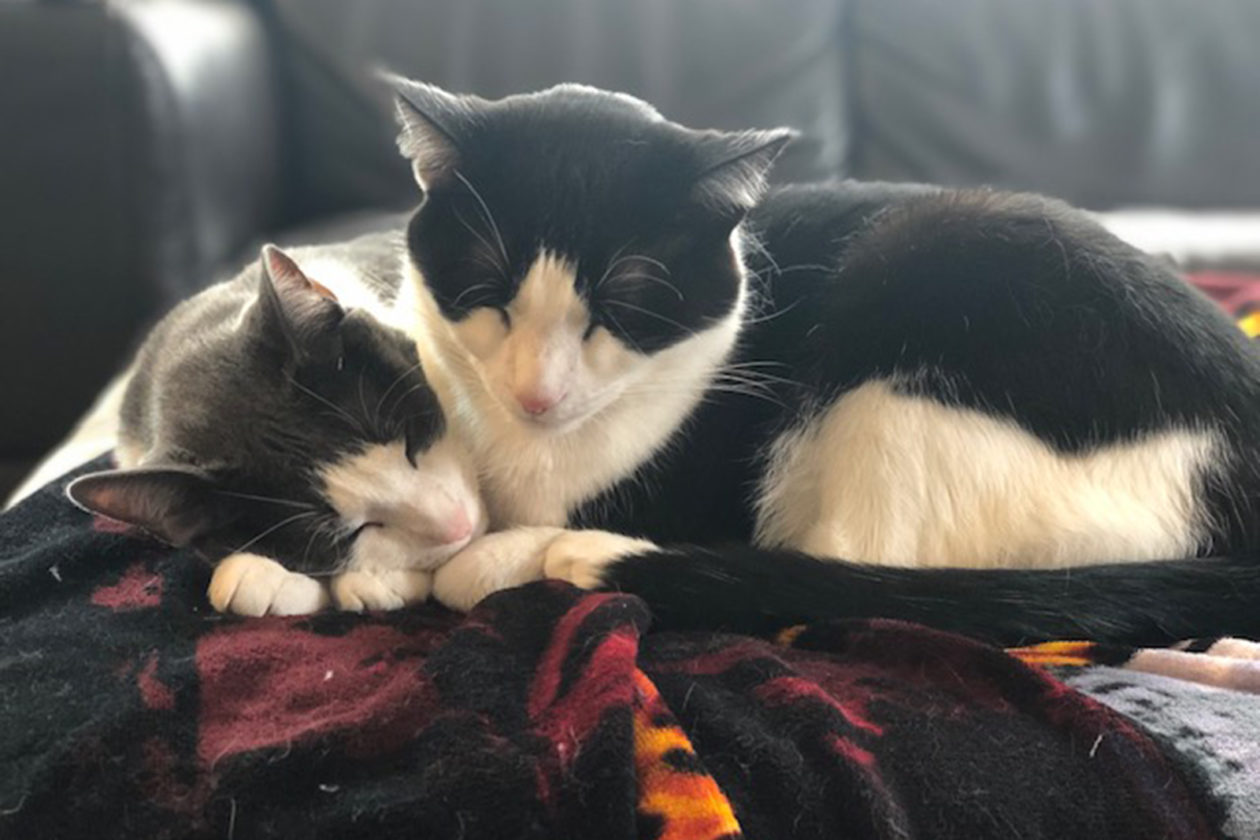
Meet Harry and Ron, 4-year-old brothers who use their ~magic~ to open doors and photo-bomb remote school, becoming celebs amongst one fifth-grade class.
Here’s what Harry and Ron’s family had to say about these two
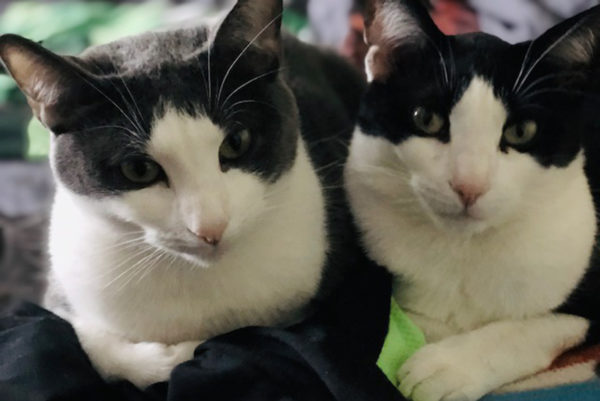
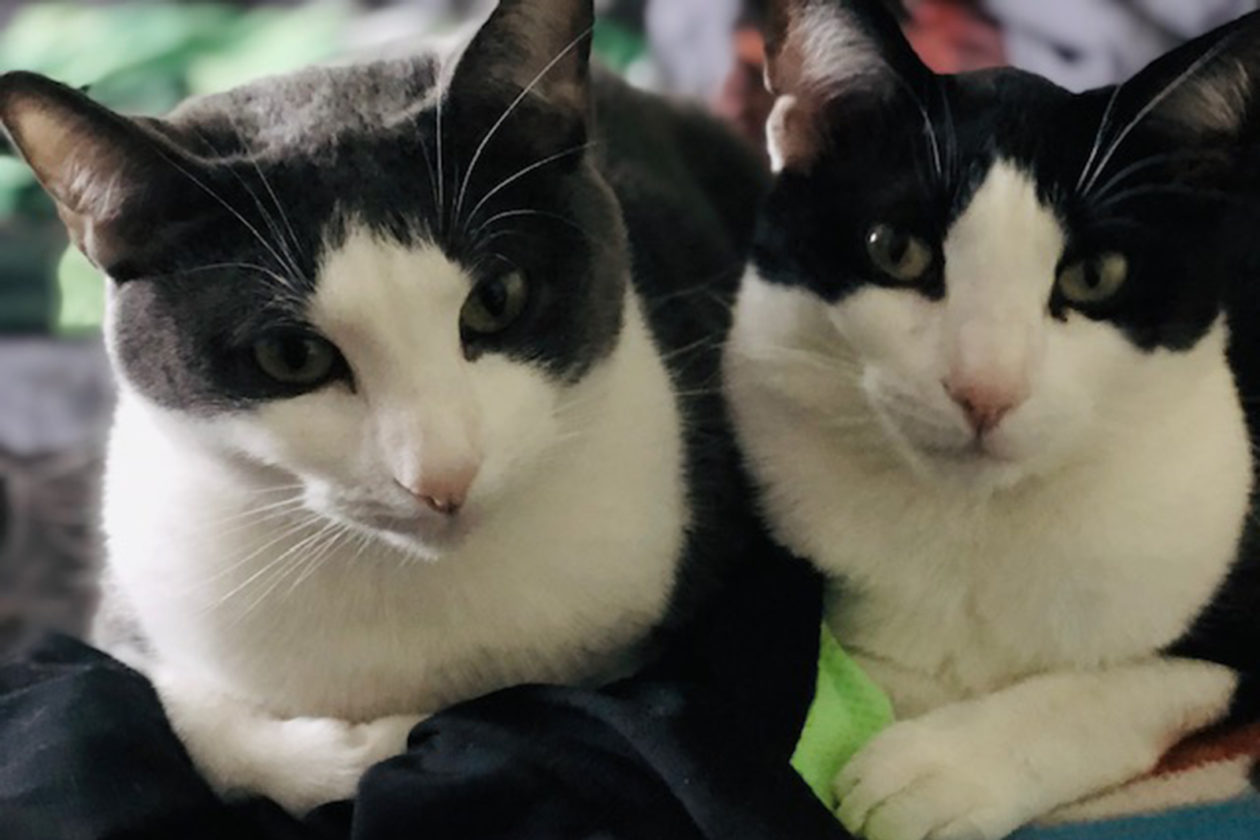
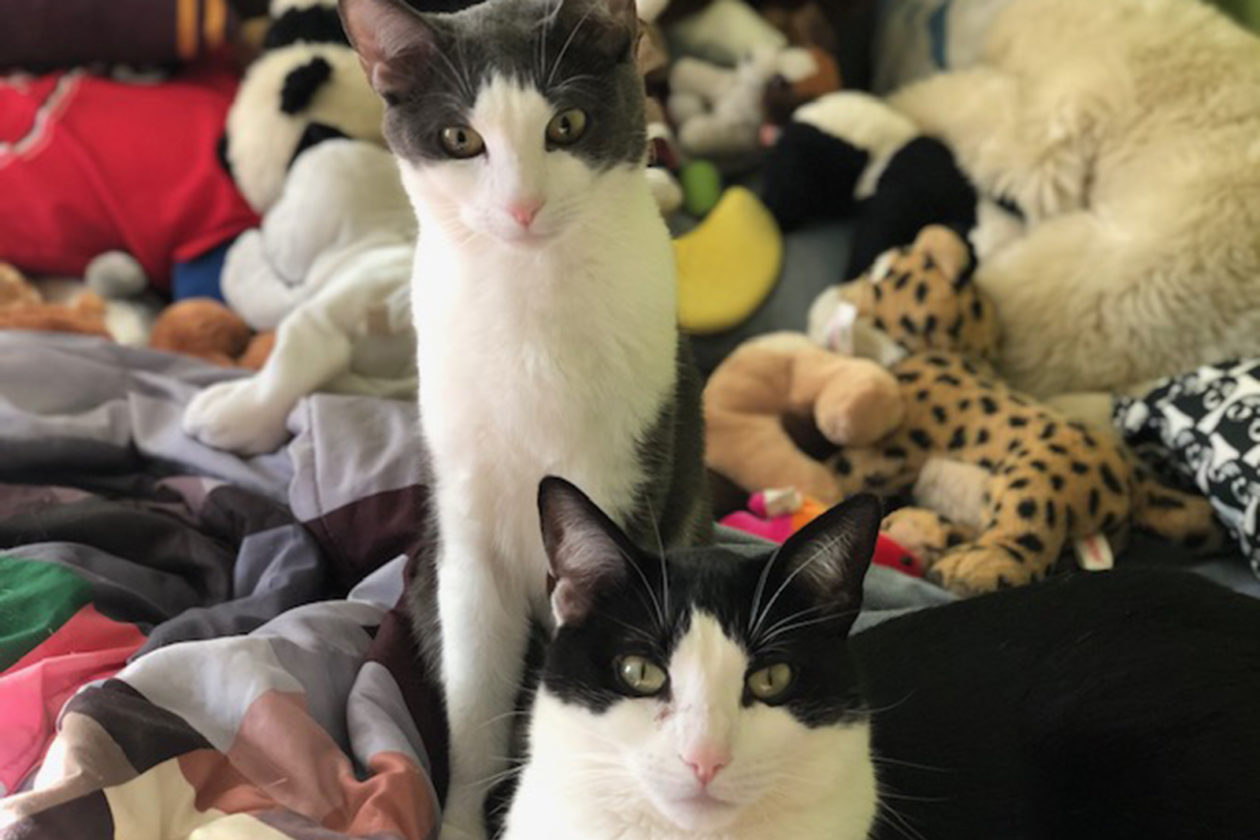
The good people at the Animal Welfare League of Arlington may remember them as Tom and Jerry, but those shelter names did not fit with the Harry Potter phase of our household at the time. Alas, meet Harry and Ron, 4-year-old brothers who arrived over Labor Day weekend in 2017 and have entertained humans, playfully pummeled each other, and “hunted” birds and squirrels from the safety of the family room window ever since.
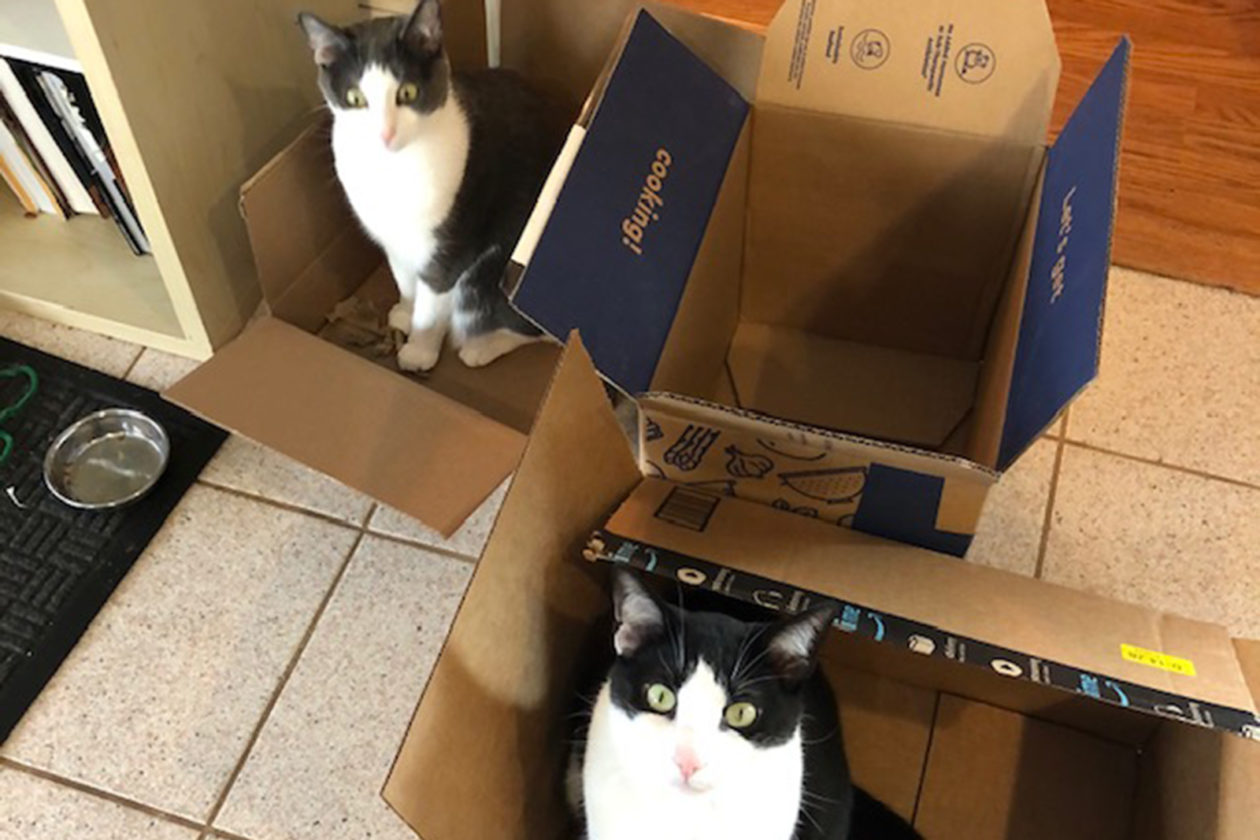
The brothers are as chatty and rambunctious as their kitten days. A cardboard box of any size, a feather on a string or just a plain old pipe cleaner are their favorite tools of the trade. At nap time, Harry, the black-and-white sibling, prefers the perch atop the cat tree where he can keep one eye on the wildlife outside and one eye on the humans inside. Ron, gray and white, is particularly fond of the youngest human of the house, following him from room to room and sleeping in his bed every single night.
And during the pandemic, their ability to push open doors has helped Harry and Ron gain celebrity status in a certain Arlington fifth-grade class by frequently photo bombing virtual school lessons.
Want your pet to be considered for the Arlington Pet of the Week? Email arlingtonnews@gmail.com with a 2-3 paragraph bio and at least 3-4 horizontally-oriented photos of your pet. Please don’t send vertical photos — they don’t fit in our photo galleries!
I grew up in Miami when the struggle for civil rights was first cresting in the 1960s and 1970s. One name became quite well known as a relentless local champion for equity: M. Athalie Range.
Ms. Range was a Bahamian American civil rights activist and politician who was the first African-American to serve on the Miami City Commission. Later, Governor Reubin Askew selected her to be the first African-American since Reconstruction and the first woman to head a Florida state agency, the Department of Community Affairs. She also served as a federal official during the Carter administration.
“While on the [City of Miami] commission, Range sought to have garbage collection improved in black neighborhoods, which sometimes went three weeks between garbage pickups, while white neighborhoods got twice a week pickups. After a vote on her proposed ordinance to equalize garbage service was twice postponed, Range had her neighbors bring bags of garbage to the commission meeting and dump them on the commissioners’ desks. After that, the ordinance was passed.” -from Wikipedia.
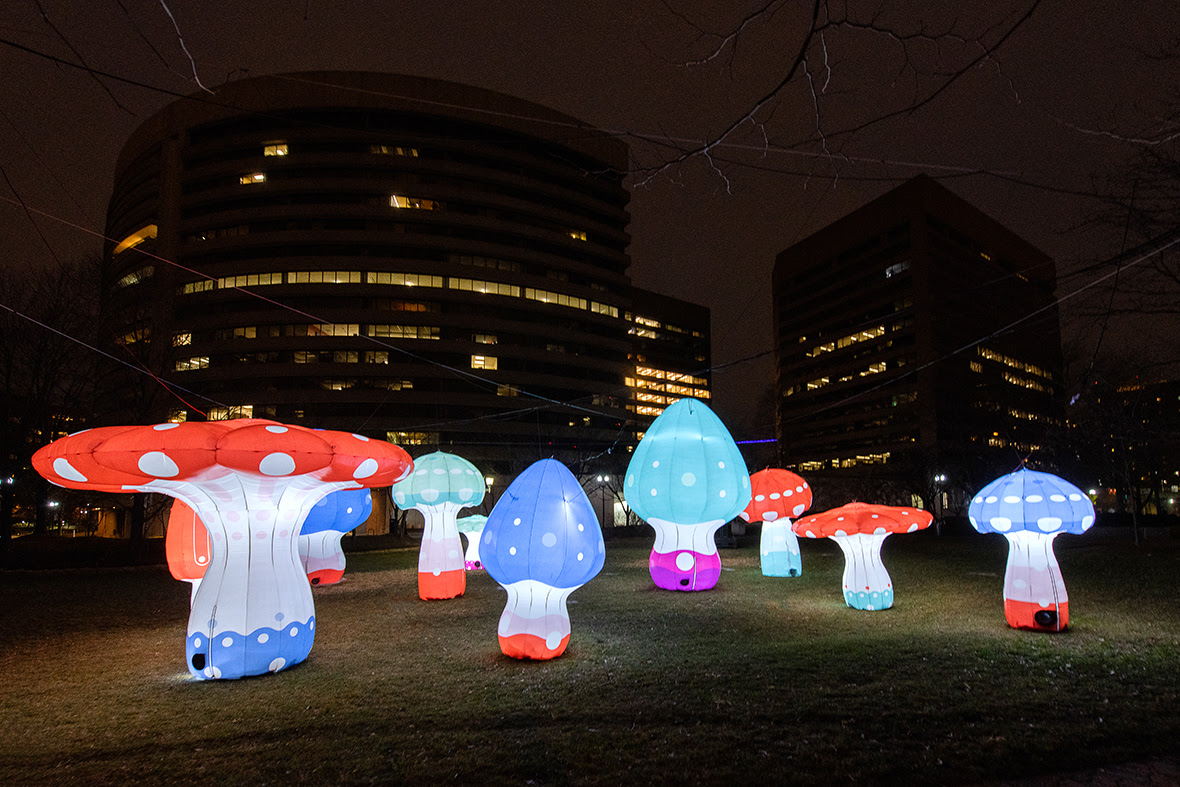
Dubbed “The Shrooms,” the installation is the work of Australian light and design studio Amigo & Amigo. With its contrasting fabrics, the work encourages “our social nature while contrasting with urban environments,” the BID said in a press release.
It was originally created for an art festival in Sydney last year and will be lit up both day and night.
The Shrooms is part of the BID’s winter-long “Turn Up the Love” campaign, which has featured several outdoor pop-up art installations over the last few months.
“In National Landing, we are constantly looking for creative ways to activate our public spaces and create fun, uplifting experiences for those who live in and visit our community,” Tracy Sayegh Gabriel, National Landing BID’s President and Executive Director, told ARLnow. “In many cultures, mushrooms are considered a symbol of luck, so ‘The Shrooms’ felt like a fitting installation as our neighborhood continues its exciting transformation and we work towards a bright future.
Previous “Turn Up the Love” installations include a large boombox adorned with thousands of colorful ornaments for the holidays and three sharable photo frames.
Also part of this campaign and currently on display is a life-size cutout of a pink Volkswagen Beetle outside of Commonwealth Joe’s at 520 12th Street S., about a half-mile walk from the Shrooms. That was installed on Valentine’s Day and will be there until Friday, March 12.
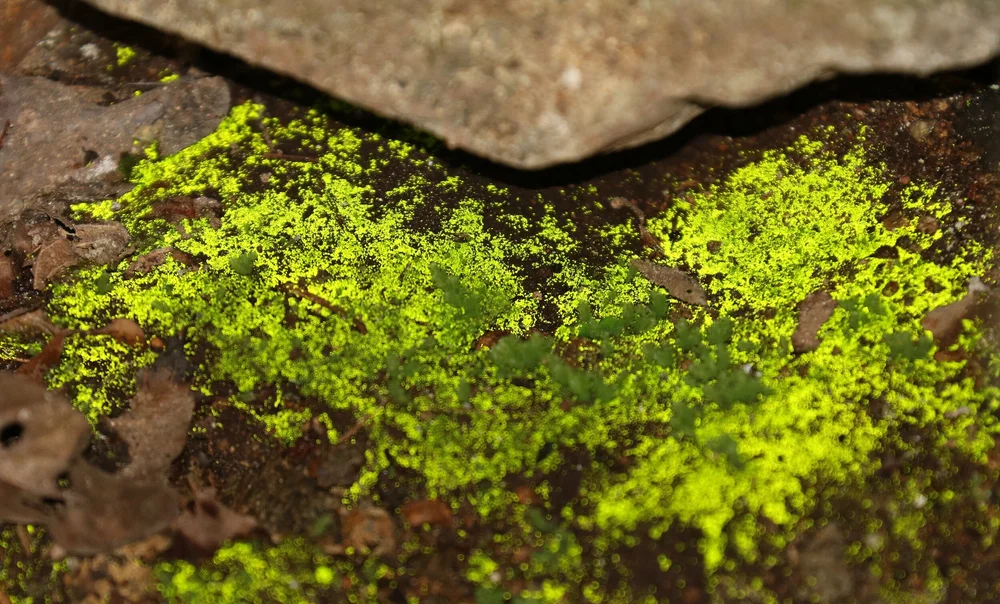
Luminous moss, dragon’s gold, goblin’s gold… when a moss has this many common names, you know it must catch the eye. Indeed, Schistostega pennata might just be one of the most dazzling of mosses around, that is provided you know where and how to look for it.
Let’s begin with a brief introduction. Goblin’s gold is the only member of both its genus (Schistostega) and family (Schistostegaceae). Despite its unique taxonomic position, it is nonetheless a widespread species, growing naturally throughout many temperate regions of the Northern Hemisphere.
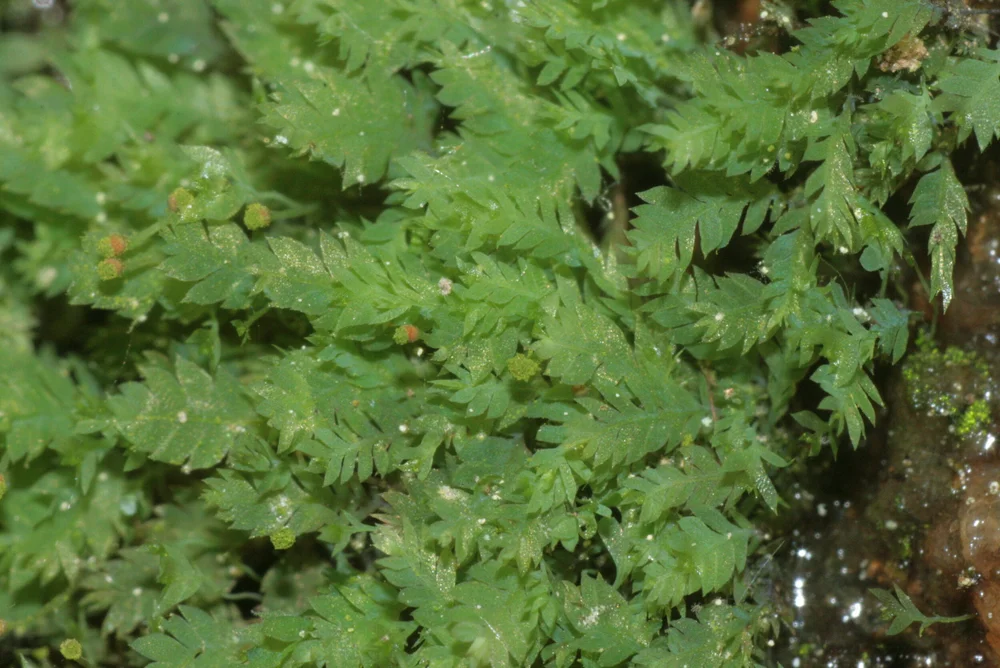
When fully grown, the gametophyte stage of goblin’s gold sort-of resembles a tiny, green, semi-translucent feather. Small spore capsules are borne on the spindly stalk of the sporophyte and the resulting spores are said to be quite sticky. Instead of relying on wind to disperse its propagules, golbin’s gold utilizes animals. The spores are sticky enough that they get glom onto any insects or other small animals that brush up against them.
The mature gametophyte of Schistostega pennata. Photo by HermannSchachner licensed under Public Domain
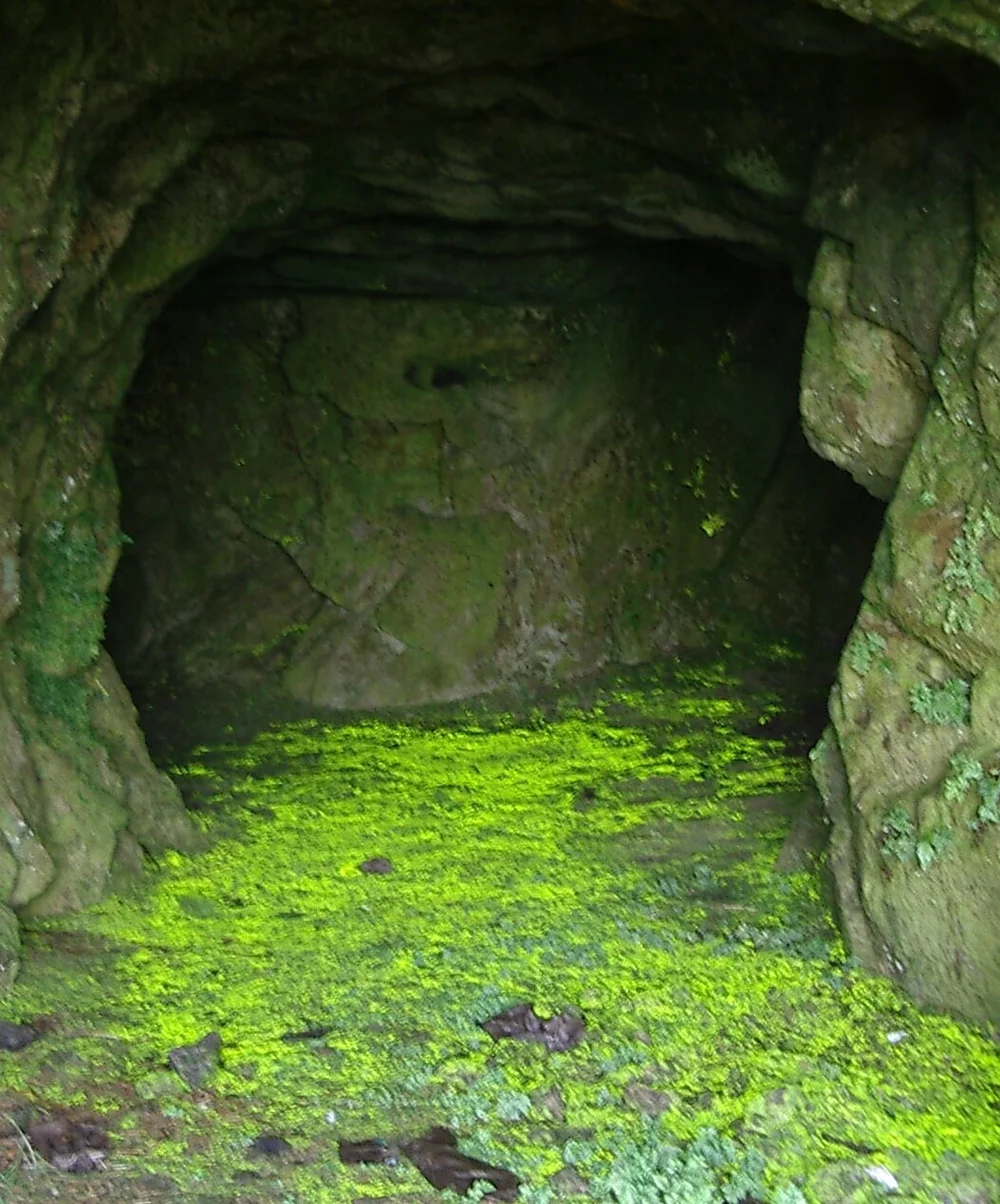
None of this, however, gives a hint as to how it earned all of those colorful names. To find that out, one must be ready to brave dark, damp spaces like caves. You see, though it can grow in more open habitats, you are most likely to encounter goblin’s gold in dark crevices or under overhangs. It has been said that goblin’s gold does not compete well with other plants in most habitats, but that doesn’t mean it doesn’t have a few tricks up its stems that give it an edge in other types of habitats.
For most plants, caves and other dark places are a no go. They simply can’t get enough light to survive. Such is not the case for goblin’s gold. Instead of trying to compete with more aggressive vegetation, goblin’s gold occupies deeply shaded habitats that few other plants can. It owes its shade-tolerant abilities to a stage of its development most of us rarely think about, let alone notice.
When a moss spore germinates, it doesn’t immediately look like what we would recognize as a moss. Instead, it grows into thread-like, multicellular fillaments called a “protonema.” You can think of this as the juvenile stage of the gametophyte. The protonema spreads outward as it grows, gradually producing hormones and other growth regulators that will control the development of the mature gametophyte. Because goblin’s gold grows in such dark habitats, it can’t afford to grow its gametophyte anywhere. To grow long enough to reproduce, it has to find spots where there is enough light to complete its lifecycle.
This is where the protonema comes in. In much the same why that fungal hyphae fan out into the soil in search of food to decompose, goblin’s gold protonema fan out over the damp substrate, searching for spots where enough light filters through to fuel growth. Luckily, the protonema can make do with much less light that the mature gametophyte, which also happens to be how this tiny moss earned so many interesting nicknames.
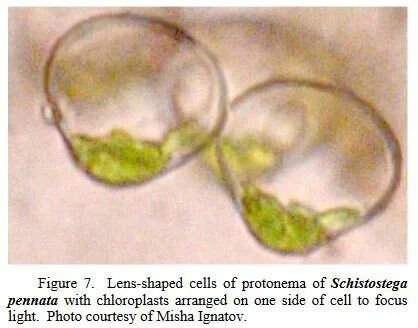
When grown in deep shade, the protonema of goblin’s gold develops a layer of lens-shaped cells on its surface. The opposite side of each cell narrows to a cone. When light, no matter how weak, strikes these lens cells, the curvature focuses the light down into the cell so that it is concentrated into the tip at the bottom. Being able to sense the direction of the light, the chloroplasts within each cell can actually move around so that they are always in a position that maximizes their exposure. Through this process, each cell is able to concentrate what little light is available so that they can photosynthesize in light so low that nearly all other plants will starve.
The light concentrating mechanism of the goblin’s gold protonema happens to have a wonderful and stunning side effect. As light enters the lens, small amounts of it are refracted around the cell. When that refracted light mixes with the green light that isn’t absorbed by the chloroplasts, it bounces back into the environment, giving the whole protonemal mat a green florescent glow when viewed in just the right way.
By being able to make use of what little light finds its way into these dark habitats, goblin’s gold can grow largely free of competition. Also, the protonema itself is capable of asexual reproduction so colonies can grow to epic proportions in dark areas, only producing mature gametophytes in a few spots. Interestingly, there appears to be some plasticity to this light-concentrating habit as well. When observing goblin’s gold protonema that develop under high light conditions, researchers have found that they do not develop lens shaped cells and therefore are not capable of reflecting light in the same way.
Humans have known about this moss for centuries, even if they didn’t understand the mechanisms that cause it, and that is why this wonderfully unique species has earned so many common names.
(A) Young yellow-orange pseudoflower. (B) Mature pseudoflower. (C) Longitudinal section of an infected X. surinamensis inflorescence. (D) Healthy yellow flower of X. surinamensis shown for comparison. [SOURCE]
Imagine there was a fungus that was able to hijack human reproductive structures so that it could reproduce. Though this sounds like the basis of a strange science fiction story, a similar situation to this has just been described from Guyana between two species of yellow-eyed grass (Xyris setigera & X. surinamensis) and a newly described species of fungus called Fusarium xyrophilum.
Fungi that hijack plant reproductive systems are pretty rare in nature, especially when you consider the breadth of interactions between these two branches on the tree of life. What makes this newly described case of floral hijacking so remarkable is the complexity of the whole process. It all begins when an infected Xyris host begins to produce its characteristically lanky inflorescence.
At first glance, nothing would appear abnormal. The floral spike elongates and the inflorescence at the tip gradually matures until the flowers are ready to open. Even when the “flower” begins to emerge from between the tightly packed bracts the process seems pretty par for the course. Gradually a bright yellow, flower-like structure bursts forth, looking very much like how a bright yellow Xyris flower should look. However, a closer inspection of an infected plant would reveal something very different indeed.
Instead of petals, anthers, and a pistil, infected inflorescences produce what is called a pseudoflower complete with petal-like structures. This pseudoflower is not botanical at all. It is made entirely by the Fusarium fungus. Amazingly, these similarities are far from superficial. When researchers analyzed these pseudoflowers, they found that they are extremely close mimics of an actual Xyris flower in more than just looks. For starters, they produce pigments that reflect UV light in much the same way that actual flowers do. They also emit a complex suite of volatile scent compounds that are known to attract pollinating insects. In fact, at least one of those compounds was an exact match to a scent compound produced by the flowers of these two Xyris species.
So, why would a fungus go through all the trouble of mimicking its hosts flowers so accurately? For sex, of course! This species of Fusarium cannot exist without its Xyris hosts. However, Xyris don’t live forever and for the cycle to continue, Fusarium must go on to infect other Xyris individuals. This is where those pseudoflowers come in. Because they so closely match actual Xyris flowers in both appearance and smell, pollinating bees treat them just like flowers. The bees land on and investigate the fungal structure until they figure out there is no reward. No matter, they have already been covered in Fusarium spores.
As the bees visit other Xyris plants in the area, they inevitably deposit spores onto each plant they land on. Essentially, they are being coopted by the fungus in order to find new hosts. By mimicking flowers, the Fusarium is able to hijack plant-pollinator interactions for its own reproduction. It is not entirely certain at this point just how specific this fungus is to these two Xyris species. A search for other potential hosts turned up only a single case of it infecting another Xyris. It is also uncertain as to how much of an impact this fungus has on Xyris reproduction. Though the fungus effectively sterilizes its host, researchers did make a point to mention that Xyris populations may actually benefit from having a few infected plants as the pseudoflowers last much longer than the actual flowers and therefore could serve to attract more pollinators to the area over time. Who knows what further investigations into the ecology of this bizarre system will reveal.
You can talk about whatever is on your mind – quality of life issues, a beautiful tree you spotted, scuttlebutt, or any random questions/thoughts you may have. But please no personal attacks and no need to correct people’s grammar. This is a place to vent and/or celebrate things about daily life in D.C.
Follow PoPville on Facebookhere on Twitterhere, and on Instagram here. You can also sign up for daily email summarieshere. Please email tips and questions to princeofpetworth@gmail.com
If you are able please consider ensuring PoPville’s long term viability by donating to our Patreon here.
A man was robbed of his gun by an armed, masked man over the weekend in the Green Valley neighborhood, according to Arlington County police.
The alleged incident happened around 8:30 a.m. Saturday on the 2400 block of S. Lowell Street.
“The victim was waiting outside for a ride to a shooting range when he was approached from behind by the unknown suspect,” said today’s ACPD crime report. “The suspect then grabbed a case containing a firearm from the victim. When the victim turned around, he observed the suspect pointing a firearm at him. The suspect then fled on foot.”
“The suspect is described as a Black male, approximately 6’1″-6’2″, wearing blue jeans, a black hooded jacket, black ski mask, and black and red shoes,” the crime report continues. “The investigation is ongoing.”
The robbery was not reported to police until Monday afternoon, the crime report noted.

 – Chattanooga’s downtown was strengthened with green infrastructure in 2017 when 37 trees were planted as part of a renovated, 2-acre urban area redesign project. – Positioned between active pedestrian spaces like the Main Library and City Hall, Miller Park was designed to encourage residents to come together and take advantage of park benches, grassy... More


























![(A) Young yellow-orange pseudoflower. (B) Mature pseudoflower. (C) Longitudinal section of an infected X. surinamensis inflorescence. (D) Healthy yellow flower of X. surinamensis shown for comparison. [SOURCE]](https://images.squarespace-cdn.com/content/v1/544591e6e4b0135285aeb5b6/1612389646771-T82PTY66AT9ULQO2VTPW/1-s2.0-S1087184520301572-gr1.jpg?format=1000w)






![[1]](https://commons.wikimedia.org/wiki/File:Schistostega_pennata_s3.jpg)
![[2]](https://commons.wikimedia.org/wiki/File:Schistostega_pennata_(a,_144640-481257)_3032.JPG)
![[3]](https://commons.wikimedia.org/wiki/File:Schistostega_pennata_Jymm.jpg)