Shared posts

04 Jun 12:01

An Acyclic Arsenium Cation Stabilised by a Single P–As π‐Interaction and a Cyclic Diphosphinophosphonium Salt

by Keith Izod, Peter Evans, Paul G. Waddell
Angewandte Chemie International Edition An Acyclic Arsenium Cation Stabilised by a Single P–As π‐Interaction and a Cyclic Diphosphinophosphonium Salt

The first diphosphaarsenium cation has been synthesised. This cation exhibits remarkable stability because of the delocalisation of a lone pair from a planar phosphorus centre into the vacant arsenic p‐orbital.


Abstract

Stable acyclic arsenium cations R2As+, isoelectronic analogues of germylenes, are rare in comparison to the corresponding phosphenium cations. The first example of a diphosphaarsenium salt, [{(Dipp)2P}2As][Al{OC(CF3)3}4]⋅1  PhMe, is described. This salt exhibits remarkable stability due to the delocalisation of a lone pair from a planar phosphorus centre into the vacant p‐orbital at arsenic; the bonding in 2 has been probed by DFT calculations. An attempt to synthesise an analogous diphosphaphosphenium salt unexpectedly generated the cyclic phosphonium salt [cyclo‐{(Mes)P}2P(Mes)2][BArF 4]⋅CyMe through the cyclisation of a putative phosphine‐substituted diphosphene cation intermediate.

29 May 08:39

Frontispiece: Synthetic Routes towards Multifunctional Cyclopentadienes

by Angelo Frei
Chemistry – A European Journal Frontispiece: Synthetic Routes towards Multifunctional Cyclopentadienes

Cyclopentadiene, and more importantly its functionalized derivatives, are a cornerstone of synthetic chemistry. Nowadays, they find applications in (chiral) catalysis, as ligands for organometallic complexes with potential diagnostic and therapeutic applications, and many more. The Minireview by A. Frei on https://doi.org/10.1002/chem.201900276page 7074 ff. highlights the progress that has been made in the development of flexible and robust synthetic routes towards multifunctional cyclopentadienes in the last 20 years.


29 May 08:38

A Stable N‐Hetero‐Rh‐Metallacyclic Silylene

by Tsuyoshi Kato, Shintaro Takahashi, Ekaterina Bellan, Antoine Baceiredo, Nathalie Saffon-Merceron, Stéphane Massou, Norio Nakata, Daisuke Hashizume, Vicenç Branchadell
Angewandte Chemie International Edition A Stable N‐Hetero‐Rh‐Metallacyclic Silylene

Character building: A geometrical deviation from the typical square‐planar to a distorted tetrahedral geometry has been shown to be responsible for the increased stabilization of a cyclic RhI‐substituted silylene. The change in the geometry leads to an increase in the π‐donating and σ‐accepting character of the Rh atom as well as a short Si−Rh bond.


Abstract

A cyclic (amino)metal‐substituted dicoordinated silylene derivative has been synthesized and fully characterized. Of particular interest is that the N‐hetero‐RhI‐metallacyclic silylene exhibits a distorted tetrahedral geometry around the rhodium atom and a considerably shortened Si−Rh bond (2.138 Å) compared to classical Si−Rh single bonds (ca. 2.30–2.35 Å). A theoretical investigation reveals that the geometrical deviation around the rhodium center from the classical square‐planar to a tetrahedral geometry increases the π‐donating and σ‐accepting character of the rhodium atom, thereby efficiently stabilizing the silylene moiety.

28 May 09:31

Fast 2D Data Collection - NOAH and NUS

by noreply@blogger.com (Glenn Facey)
One always strives to collect high quality 2D NMR data in a short period of time.  This is particularly important for samples of limited stability or perhaps for monitoring chemical reactions.  High magnetic fields and cryogenically cooled NMR probes have allowed for a higher signal-to-noise-ratio for a given quantity of sample, thereby reducing data collection time as a fewer number of scans are required.  Gradient enhanced 2D NMR data collection gained widespread use in the 1990s.  This represented a tremendous time saving as multi-step phase cycles required for coherence selection could be reduced or eliminated as they were replaced by pulsed field gradients.  Some pulse sequences which required 16 scans per increment to accommodate the necessary phase cycle could be run with a single scan for every increment with the use of pulsed field gradients, thus reducing the data collection time by a factor of 16.  Now, 2D data collection with coherence selection via pulsed field gradients is considered "conventional".  More recently, Non-Uniform Sampling (NUS) was introduced.  Data collection with this technique samples only a limited number of increments in the t1 domain.  The unsampled increments are calculated based on the sampled increments prior to Fourier transformation. The data collection time is reduced in accordance with the number of increments not sampled.  Recently, Kupce and Claridge1,2 have developed a technique where multiple 2D methods are concatenated in a single super pulse sequence employing a single relaxation delay. They have called the technique NOAH (NMR by Ordered Acquisition using 1H detection) The time saving of the NOAH technique compared to individually collected 2D spectra results from waiting a single relaxation delay for all experiments rather than a single relaxation delay for each separately acquired spectrum. The data for each spectrum is acquired in separate memory blocks which are separated after data collection allowing the data for each 2D method to be processed individually.  Very recently, both NUS and NOAH have been used together to further reduce data collection times3.  A comparison of the time saving is shown in the figure below for a sample of sucrose in DMSO-d6 collected on a Bruker AVANCE III HD 600 NMR spectrometer equipped with a cryoprobe.
All spectra were collected with 2 scans and a 1 second recycle time.  Individually, both NOAH and NUS offer a significant time saving but when used together they permit very fast, high quality data collection.  A COSY, edited HSQC and HMBC can be collected in a total time of only 4 minutes and 8 seconds.  Other ultra-fast techniques have been developed by others where an entire 2D spectrum is collected in less than one second.

1. Eriks Kupce and Tim D. W. Claridge.  Chem. Commun. 54, 7139 (2018).
2. Eriks Kupce and Tim D. W. Claridge. Angew. Chem. Int. Ed., 56, 11779 (2017).
3. Maksim Mayzel, Tim D. W. Claridge and Ēriks Kupce. Bruker User Library (2018).
21 May 08:10

New frontiers for solid-state NMR across the periodic table: a snapshot of modern techniques and instrumentation

Dalton Trans., 2019, 48,8014-8020
DOI: 10.1039/C9DT01801H, Frontier
David L. Bryce
Advances in solid-state NMR spectroscopy which continue to open up the periodic table to further exploration are surveyed.
The content of this RSS Feed (c) The Royal Society of Chemistry
20 May 09:33

The formation of a 1,4-disilabenzene and its isomerization into a disilabenzvalene derivative

Dalton Trans., 2019, 48,9053-9056
DOI: 10.1039/C9DT01322A, Communication
Tomohiro Sugahara, Takahiro Sasamori, Norihiro Tokitoh
A stable 1,4-disilabenzene was generated from the reaction of a stable disilyne with 3-hexyne.
The content of this RSS Feed (c) The Royal Society of Chemistry
20 May 09:32

An Isolable Silicon Analogue of a Ketone that Contains an Unperturbed Si=O Double Bond

by Ryo Kobayashi, Shintaro Ishida, Takeaki Iwamoto
Angewandte Chemie International Edition An Isolable Silicon Analogue of a Ketone that Contains an Unperturbed Si=O Double Bond

Good to Si you: The first example of a genuine silanone, that is, an isolable silicon analogue of a ketone that contains an unperturbed Si=O bond, was synthesized. The structure and properties of this silanone were examined by a single‐crystal XRD analysis, NMR spectroscopy, and theoretical calculations. Bimolecular reactions revealed high electrophilicity on the Si atom and high nucleophilicity on the O atom of the Si=O bond.


Abstract

Despite tremendous efforts to synthesize isolable compounds with an Si=O bond, silicon analogues of ketones that contain an unperturbed Si=O bond have remained elusive for more than 100 years. Herein, we report the synthesis of an isolable silicon analogue of a ketone that exhibits a three‐coordinate silicon center and an unperturbed Si=O bond, thus representing the first example of a genuine silanone. Most importantly, this silanone does not require coordination by Lewis bases and acids and/or the introduction of electron‐donating groups to stabilize the Si=O bond. The structure and properties of this unperturbed Si=O bond were examined by a single‐crystal X‐ray diffraction analysis, NMR spectroscopy, and theoretical calculations. Bimolecular reactions revealed high electrophilicity on the Si atom and high nucleophilicity on the O atom of this genuine Si=O bond.

14 May 08:14

Electron‐Deficient Triborane and Tetraborane Ring Compounds: Synthesis, Structure, and Bonding

by Hans‐Jörg Himmel
Angewandte Chemie International Edition Electron‐Deficient Triborane and Tetraborane Ring Compounds: Synthesis, Structure, and Bonding

Living with a deficit: Small boron rings have a strong affection for σ‐ and π‐delocalization and are tolerant of various skeletal electron numbers. This Review gives a comprehensive overview of the synthesis and electronic structures of electron‐deficient B3 and B4 ring compounds.


Abstract

Electron‐deficient small boron rings are unique in their formation of σ‐ and π‐delocalized electron systems as well as the avoidance of “classical” structures with two‐center‐two‐electron (2c,2e) bonds. These rings are tolerant of several skeletal electron numbers, which makes their redox chemistry highly interesting. In the past few decades, a range of stable compounds have been synthesized with various electron numbers in their B3 and B4 cores. The electronic structures were evaluated by quantum‐chemical calculations. On the other hand, the chemistry of these rings is still very much underdeveloped, being generally limited to the protonation and redox reactions of individual systems. The linkage of several B3 and/or B4 ring systems should give compounds with attractive electronic properties, thus leading the way to novel boron‐based materials. By summarizing important experimental and theoretical results, this Review intends to provide the basis for the exploration of the chemistry of these rings and, in particular, their integration into larger molecular architectures.

26 Apr 09:12

Synthesis of hydrosilanes via Lewis-base-catalysed reduction of alkoxy silanes with NaBH4

Chem. Commun., 2019, 55,5859-5862
DOI: 10.1039/C9CC01961H, Communication
Keiya Aoyagi, Yu Ohmori, Koya Inomata, Kazuhiro Matsumoto, Shigeru Shimada, Kazuhiko Sato, Yumiko Nakajima
Hydrosilanes were synthesized by reduction of alkoxysilanes with BH3 in the presence of hexamethylphosphoric triamide (HMPA) as a Lewis-base catalyst. The reaction was also achieved using an inexpensive and easy-to-handle handled hydride source NaBH4, which reacted with EtBr as a sacrificial reagent to form BH3in situ.
The content of this RSS Feed (c) The Royal Society of Chemistry
26 Apr 08:39

[Fe(H2O)5(NO)]2+, the “Brown‐Ring” Chromophore

by Georg Monsch, Peter Kluefers
Angewandte Chemie International Edition [Fe(H2O)5(NO)]2+, the “Brown‐Ring” Chromophore

Fully understood after 100 years: The brown‐ring ion [Fe(H2O)5(NO)]2+ known from the analytical test for nitrate was isolated as a stable salt, and the unique bonding situation was addressed. As a result of the bonding analysis, two stretched, spin‐polarised π‐interactions provide the Fe–NO binding and challenge the concept of oxidation states.


Abstract

Although the “brown‐ring” ion, [Fe(H2O)5(NO)]2+ (1), has been a research target for more than a century, this poorly stable species had never been isolated. We now report on the synthesis of crystals of a salt of 1 which allowed us to tackle the unique bonding situation on an experimental basis. As a result of the bonding analysis, two stretched, spin‐polarised π‐interactions provide the Fe–NO binding—and challenge the concept of “oxidation state”.

26 Apr 07:50

Plastics are forever

by Bruce C. Gibb

Plastics are forever

Plastics are forever, Published online: 24 April 2019; doi:10.1038/s41557-019-0260-7

Bruce C. Gibb explains why plastic isn’t always fantastic.
23 Apr 11:36

Dying iPhones and Liquid Helium Fills

by noreply@blogger.com (Glenn Facey)

As a habit I do not expose my iPhone to the large stray magnetic fields of high-field or unshielded NMR magnets.  I do however feel safe carrying it near low-field shielded magnets with 5 Gauss stray fields within the croyostat of the magnet. That is - until lately.  Last year, after topping up the liquid helium on a 300 MHz shielded magnet in a fairly small room, I noticed that my iPhone 8 had become completely unresponsive.  The only stimulus it appeared to respond to was gravity.  As it was under warranty, I sent it back to Apple.  After a week or so, they sent it back to me with a note saying that there was nothing wrong with it.  I found this very strange and did not make a connection between the helium fill and the problem with the phone.  I had done many helium fills in the past while carrying an older iPhone 5.  Approximately 9 months later, my iPhone 8 suffered a similar problem again after filling the same shielded 300 MHz magnet with liquid helium.  This time, I took it to a local Apple Store while it was dead.  The technician examined it, ran it through a software protocol, confirmed it was dead and issued me a new phone as it was in its last weeks of its warranty.  Shortly after this, I read about problems others have had with iPhones and Apple watches around helium gas and finally made the connection between the problem I was having and my helium fills. Some Apple iPhones (apparently, iPhone 6 and higher) will completely die when exposed to helium gas. As if in the spirit of Easter, however, they will resurrect themselves after the helium has dissipated from the phone and the battery has been allowed to discharge.  The problem is that in newer iPhones, Apple has swapped out a quartz oscillator, used in older versions of the phone, with a microelectromechanical systems chip (MEMS) which is sensitive to the presence of helium gas. This sensitivity is indeed mentioned in the User Guide of the iPhone.

Exposing iPhone to environments having high concentrations of industrial chemicals, including near evaporating liquified gasses such as helium, may damage or impair iPhone functionality. Obey all signs and instructions. 

Android phones apparently do not use MEMS and therefore are not vulnerable to the problem. Several weeks ago, I absent-mindedly entered a room with my iPhone 8 while a magnet was being filled with liquid helium.  Again, the same thing happened.  This time, I allowed the phone to sit for a week after which I was able to charge it.  After charging, it worked well with no loss of data.

Warning: If you see that a magnet is being filled with liquid helium, Do not enter the room with an iPhone 6 or higher.
23 Mar 08:13

Field Dependence of a Simple Spin System

by noreply@blogger.com (Glenn Facey)
With the recent re-emergence of low-field NMR spectrometers at proton frequencies of 40, 60, 80 and 100 MHz, many younger NMR users (who have grown up with high-field spectrometers) are encountering more and more second-order spectra. These spectra are observed when the frequency difference between signals is comparable to the coupling between them.  On a 600 MHz spectrometer, 1 ppm in a 1H spectrum = 600 Hz while on a 60 MHz spectrometer, 1 ppm in a 1H spectrum is only 60 Hz.  Unlike frequency differences between signals (in Hz) which depend on the field strength, the coupling between signals (in Hz) is field invariant. Easily interpreted first-order spectra on high-field instruments can be information rich but much more complicated second-order spectra on low-field instruments.  The figure below shows simulated 1H NMR spectra of a fictitious isolated ethyl group as a function of field strength.  The difference in chemical shift between the -CH3 and -CH2- signals is 0.5 ppm and the 3JH-H  coupling constant is 10 Hz.  The spectra are plotted on a ppm scale on the left and on a Hz scale on the right.  At higher fields, one immediately recognizes the familiar triplet and quartet.  At lower fields, the spectra are much more complicated.  The signals are closer to one another (in Hz) and therefore have more second-order character as the frequency difference between signals becomes comparable to the coupling between them.
12 Dec 11:58

Desktop NMR and Its Applications From Materials Science To Organic Chemistry

by Bernhard Blümich, Kawarpal Singh

Abstract

NMR spectroscopy is an indispensable method of analysis in chemistry, which until recently suffered from high demands for space, high costs for acquisition and maintenance, and operational complexity. This has changed with the introduction of compact NMR spectrometers suitable for small-molecule analysis on the chemical workbench. These spectrometers contain permanent magnets giving rise to proton NMR frequencies between 40 and 80 MHz. The enabling technology is to make small permanent magnets with homogeneous fields. Tabletop instruments with inhomogeneous fields have been in use for over 40 years for characterizing food and hydrogen-containing materials by relaxation and diffusion measurements. Related NMR instruments measure these parameters in the stray field outside the magnet. They are used to inspect the borehole walls of oil wells and to test objects nondestructively. The state-of-the-art of NMR spectroscopy, imaging and relaxometry with compact instruments is reviewed.

Thumbnail image of graphical abstract

NMR spectroscopy is known not only for its outstanding analytical power but also for the large size and costs of the instruments. In recent years, the family of instruments with bulky superconducting magnets has been complemented with compact tabletop and portable devices suitable for small-molecule analysis and nondestructive materials testing. The state of the art of compact NMR instruments is reviewed and illustrated with selected examples.

05 Jul 09:03

Correcting NMR Spectra for Poor Shimming - Reference Deconvolution

by noreply@blogger.com (Glenn Facey)
The pleasingly symmetric and narrow Lorentzian resonances in a high resolution NMR spectrum are truly things of stunning beauty, appreciated by all NMR spectroscopists. Their majesty depends on the homogeneity of the NMR magnet around the sample. Inhomogeneous fields yield low resolution NMR spectra with broad asymmetric peaks pleasing no one. These repugnant, distasteful spectra are often obtained when automatic shimming routines are used on under-filled samples, samples with solids present (precipitates, floaters of suspended solids), samples with thermal gradients, poorly mixed samples etc…. Have you ever looked at such a spectrum and longed to recover the hidden beauty, resolution and information you know is present in the depths of its repulsive form? In many such cases reference deconvolution is a processing technique able to help. The distortions in a spectrum from an inhomogeneous magnetic field affect all peaks in the spectrum in the same way. The imperfect FID giving rise to the offensive spectrum, FIDexp(t), is essentially a perfect FID, FID(t) multiplied by an error function, E(t), resulting from the inhomogeneous field.

FIDexp(t) = FID(t) * E(t)

If we could find the error function and divide the experimental FID, by it, we could produce a perfect (or at least improved) FID, the Fourier transform of which would be a spectrum corrected from the effects of field inhomogeneity. In the reference deconvolution technique, one selects a high signal-to-noise ratio singlet peak as a reference in the experimental spectrum and sets all other points in the spectrum to zero. This spectrum is inverse Fourier transformed to produce an FID of the distorted singlet, FIDrexp(t). A synthetic FID, FIDrsyn(t) is constructed for what one would expect the time domain signal to be for a perfect reference peak (e.g. a sharp Lorentzian). The error function for the reference peak Er(t) is then determined by:

Er(t) = FIDrexp(t) / FIDrsyn(t)

Since all peaks in the experimental spectrum are affected equally by the inhomogeneity, E(t) = Er(t) and we can compute a corrected FID for the entire spectrum,

FID(t) = FIDexp(t) / Er(t)

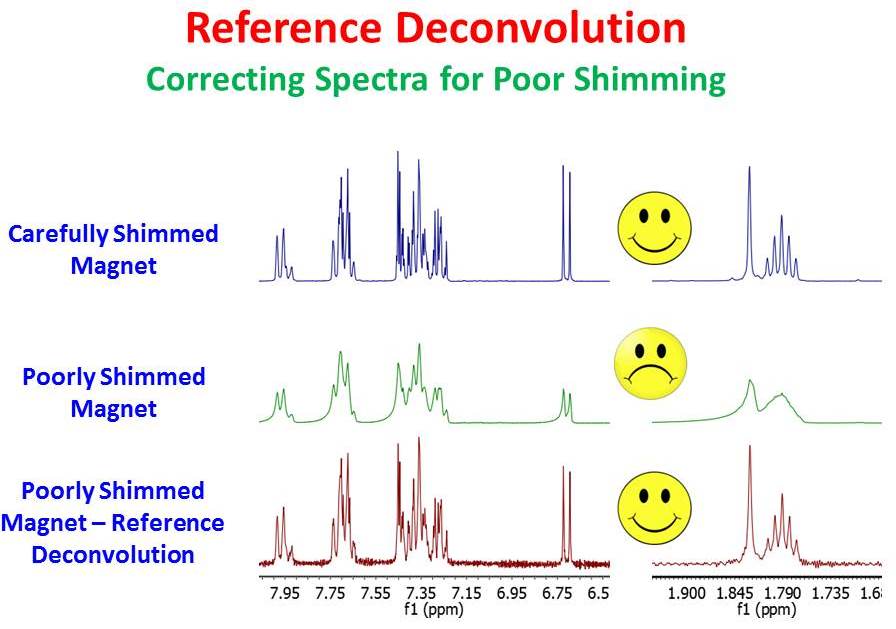
The corrected FID is Fourier transformed yielding a much improved spectrum. This technique is available in newer NMR software processing packages and is particularly easy to implement in the MestReNova software package available to NMR users at the University of Ottawa. An example is shown in the figure below for a 300 MHz 1H NMR spectrum of a mixture of compounds.
The top two traces show portions of the spectrum obtained in a carefully shimmed magnet. The middle traces show the same portions of the spectrum obtained in a poorly shimmed magnet. The bottom traces were obtained by applying reference deconvolution to the spectrum obtained in the poorly shimmed magnet. Clearly, there is much improvement in the reference deconvoluted spectrum, allowing one to obtain much more information and recover some of the lost beauty. In fact, the corrected spectrum is very similar to the one obtained in the homogeneous field of a carefully shimmed magnet. The penalty paid is a lower signal-to-noise ratio, as the noise from the experimental reference signal is convolved into the error function which in turn gets convolved into the corrected spectrum. The loss in signal-to-noise ratio can be minimized by choosing a reference signal with a higher signal-to-noise ratio.
29 Jun 15:51

Twist of a Silicon–Silicon Double Bond: Selective Anti-Addition of Hydrogen to an Iminodisilene

by Daniel Wendel, Tibor Szilvási, Christian Jandl, Shigeyoshi Inoue and Bernhard Rieger

TOC Graphic

Journal of the American Chemical Society
DOI: 10.1021/jacs.7b05335
02 Jun 12:59

London Dispersion Enables the Shortest Intermolecular Hydrocarbon H···H Contact

by Sören Rösel, Henrik Quanz, Christian Logemann, Jonathan Becker, Estelle Mossou, Laura Cañadillas-Delgado, Eike Caldeweyher, Stefan Grimme and Peter R. Schreiner

TOC Graphic

Journal of the American Chemical Society
DOI: 10.1021/jacs.7b01879
02 Jun 12:57

Bicyclic (Alkyl)(amino)carbenes (BICAACs): Stable Carbenes More Ambiphilic than CAACs

by Eder Tomás-Mendivil, Max M. Hansmann, Cory M. Weinstein, Rodolphe Jazzar, Mohand Melaimi and Guy Bertrand

TOC Graphic

Journal of the American Chemical Society
DOI: 10.1021/jacs.7b04640
02 Jun 11:12

Unprecedented Carbon Signal Enhancement in Liquid-State NMR Spectroscopy

by György Pintér, Harald Schwalbe
Thumbnail image of graphical abstract

We shall overcome: As a result of efforts to overcome the sensitivity challenge of liquid-state NMR spectroscopy, a thousand-fold signal enhancement was achieved by dynamic nuclear polarization (DNP) for 13C signals at high magnetic field (3.4 T) and room temperature, thereby exceeding the predicted limitations of high-field liquid-state in situ DNP.

21 May 11:36

A zwitterionic hydrocarbon-soluble borenium ion based on a [small beta]-diketiminate backbone

Chem. Commun., 2017, 53,5981-5984
DOI: 10.1039/C7CC03121A, Communication
Joseph A. B. Abdalla, Remi C. Tirfoin, Haoyu Niu, Simon Aldridge
A hydrocarbon-soluble borenium/borate zwitterion has been developed which is more strongly Lewis acidic than B(C6F5)3, despite featuring a pendant (non-fluorinated) aryl group and two flanking N-donors.
The content of this RSS Feed (c) The Royal Society of Chemistry
21 May 11:21

Improved reactivity of a cyclic 13/15 compound by increased steric demand

Dalton Trans., 2017, 46,7074-7081
DOI: 10.1039/C7DT00950J, Paper
Markus Balmer, Manuel Kapitein, Carsten von Hanisch
The reactivity of a masked flp was investigated for the sterically overloaded group 13/15 ring compound [tBu2GaP(H)tBu2Ph]2, as can be seen from its reaction with phenyl-isocyanate.
The content of this RSS Feed (c) The Royal Society of Chemistry
21 May 11:17

An Iodabenzene Story

by Abdel Monem Rawashdeh, Priyakumari Chakkingal Parambil, Tao Zeng and Roald Hoffmann

TOC Graphic

Journal of the American Chemical Society
DOI: 10.1021/jacs.7b03388
21 May 11:09

Cyclic Polysiloxanes with Linked Cyclotetrasiloxane Subunits

by Jianyi Yu, Yuzhou Liu

Abstract

Cyclic polymers are an important class of macromolecules, but the structural diversity of the backbone is limited. Herein we report the use of the Piers–Rubinsztajn reaction for the one-step synthesis of cyclic polysiloxanes with novel structural features. Specifically, the B(C6F5)3-catalyzed coupling of various organic tris(dimethylsiloxy)silane and trialkoxysilane compounds generated a series of cyclic polysiloxanes with cyclotetrasiloxane subunits. The thiolated cyclic polymers were also shown to be effective in directing the circular assembly gold nanoparticles. The presence of constrained rings in the backbone is unprecedented and may offer opportunities for novel applications of these cyclic polymers.

Thumbnail image of graphical abstract

Rings in silicone and gold: A unique family of polysiloxanes composed of linked cyclotetrasiloxanes was synthesized by straightforward Piers–Rubinstztajn coupling of acyclic tris(dimethylsiloxy)silane and trialkoxysilane precursors. The polymer structure offers various opportunities for further structural modification. A thiolated cyclic polymer was also shown to be effective in directing the circular assembly of gold nanoparticles.

21 May 11:02

Tris(perfluorotolyl)borane—A Boron Lewis Superacid

by Norbert Werner Mitzel, Jan Schwabedissen, Leif Körte, Marcel Soffner, Sebastian Blomeyer, Christian Reuter, Yury Vishnevskiy, Beate Neumann, Georg Stammler

Abstract

Tris[tetrafluoro-4-(trifluoromethyl)phenyl]borane (BTolF) was prepared by treating boron tribromide with tetrameric F3CC6F4-CuI. The F3CC6F4-CuI was generated from F3CC6F4MgBr and copper(I) bromide. Lewis acidities of BTolF evaluated by the Gutmann–Beckett method and calculated fluoride-ion affinities are 9 and 10 %, respectively, higher than that of tris(pentafluorophenyl)borane (BCF) and even higher than that of SbF5. The molecular structures of BTolF and BCF were determined by gas-phase electron diffraction, that of BTolF also by single-crystal X-ray diffraction.

Thumbnail image of graphical abstract

Superacidic tris[tetrafluoro-4-(trifluoromethyl)phenyl]borane (BTolF) was prepared from BBr3 and F3CC6F4-CuI. It is a stronger Lewis acid than tris(pentafluorophenyl)borane (BCF) and has a higher fluoride-ion affinity than SbF5. The structures of BTolF and of the widely used BCF were determined by gas-phase electron diffraction and reflect the different electronic situations.

09 May 09:46

Synthesis of Structurally Complex Silicon Frameworks through the First Sila-Aldol Reaction

by Mario Leypold, Lukas Schuh, Roland Fischer, Ana Torvisco, Michaela Flock, Harald Stueger, Michael Haas

Abstract

Herein, we report on the first sila-aldol reaction, which emphasizes the tight connection between silicon and carbon chemistry. This novel synthetic method provides straightforward access to 2-oxahexasilabicyclo[3.2.1]octan-8-ide, a structurally complex silicon framework, in quantitative yield. Its structure was confirmed by NMR spectroscopy and X-ray crystallography, and it displays a distinctive charge-transfer transition. The complete mechanism of this highly selective rearrangement cascade is outlined and supported by density functional theory (DFT) calculations, which highlight the thermodynamic driving force and the low activation barriers of this powerful silicon–carbon bond-forming strategy.

Thumbnail image of graphical abstract

Silicon, not carbon: The first sila-aldol reaction is reported. This transformation emphasizes the tight connection between silicon and carbon chemistry and enables the synthesis of a previously undescribed 2-oxahexasilabicyclo[3.2.1]octan-8-ide through an ensuing highly selective rearrangement cascade.

08 May 14:17

Donor-Stabilized Silylene/Phosphine-Supported Carbon(0) Center with High Electron Density

by Thibault Troadec, Tatsuya Wasano, Romaric Lenk, Antoine Baceiredo, Nathalie Saffon-Merceron, Daisuke Hashizume, Yosuke Saito, Norio Nakata, Vicenç Branchadell, Tsuyoshi Kato

Abstract

An isolable donor-stabilized silavinylidene phosphorane was synthesized. This molecule, which can also be regarded as a new carbon(0) complex featuring a phosphine and a donor-stabilized silylene ligand, presents a central carbon atom with a remarkably high electron density (−1.82). Furthermore, the experimental electron-density study of this compound demonstrates the delocalization of the σ-lone pair at the central carbon atom toward the silicon center, a feature which is remarkably different from electronic situation of other bent-allene-type molecules. This result clearly demonstrates the powerful electron-donating ability of donor-stabilized silylene ligands, as well as their excellent electron-acceptor properties.

Thumbnail image of graphical abstract

Generous donors: Donor-stabilized silavinylidene phosphoranes were synthesized and isolated as stable molecules. These new carbon(0) complexes, featuring a phosphine and donor-stabilized silylene (DSS) ligand, present a central carbon atom with a remarkably high electron density (−1.82). This result clearly demonstrates the powerful electron-donating ability of DSS ligands toward atomic carbon.

04 May 19:05

Benchmarking Quantum Chemical Methods: Are We Heading in the Right Direction?

by Ricardo A. Mata, Martin A. Suhm
Thumbnail image of graphical abstract

Theoreticians and experimentalists should work together more closely to establish reliable rankings and benchmarks for quantum chemical methods. Comparison to carefully designed experimental benchmark data should be a priority. Guidelines to improve the situation for experiments and calculations are proposed.

04 May 18:41

Different Reactivity of As4 towards Disilenes and Silylenes

by Andreas E. Seitz, Maria Eckhardt, Sakya S. Sen, Andreas Erlebach, Eugenia V. Peresypkina, Herbert W. Roesky, Marek Sierka, Manfred Scheer

Abstract

The activation of yellow arsenic is possible with the silylene [PhC(NtBu)2SiN(SiMe3)2] (1) and the disilene [(Me3Si)2N(η1-Me5C5)Si=Si(η1-Me5C5)N(SiMe3)2] (3). The reaction of As4 with 1 leads to the unprecedented As10 cage compound [(LSiN(SiMe3)2)3As10] (2; L=PhC(NtBu)2) with an As7 nortricyclane core stabilized by arsasilene moieties containing silicon(II)bis(trimethylsilyl)amide substituents. In contrast, the compound [Cp*{(SiMe3)2N}SiAs]2 (4) containing a butterfly-like diarsadisilabicyclo[1.1.0]butane unit is formed by the reaction of As4 with the disilene 3. Both compounds were characterized by single-crystal X-ray diffraction analysis, NMR spectroscopy, and mass spectrometry. The reaction outcomes demonstrate the different reaction behavior of yellow arsenic (As4) compared to white phosphorus (P4) in the reactions with the corresponding silylenes and disilenes.

Thumbnail image of graphical abstract

As revealed: The reaction of yellow arsenic with the silylene [PhC(NtBu)2SiN(SiMe3)2] and the disilene [(Me3Si)2N(η1-Me5C5)Si=Si(η1-Me5C5)N(SiMe3)2] gives an As10 cage compound with a nortricyclane core and a diarsadisila-butterfly derivative, respectively. These reactions demonstrate the different reaction behavior of yellow arsenic As4 and white phosphorus P4 with the corresponding silicon derivatives.

28 Apr 07:37

HMBC vs. H2BC

by noreply@blogger.com (Glenn Facey)
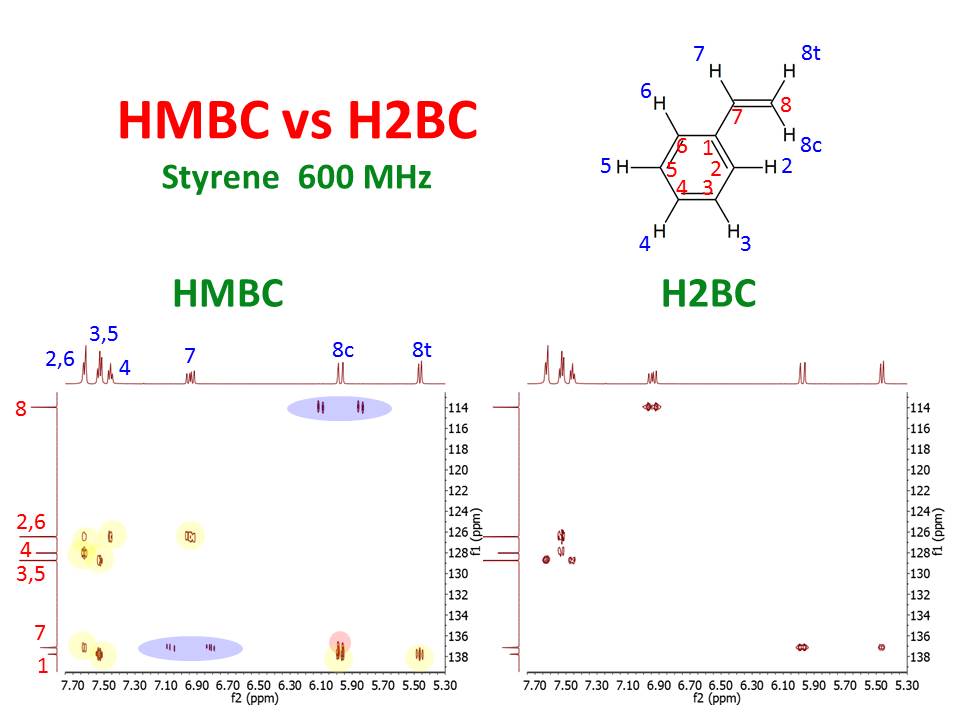
NMR spectroscopy is an indispensable tool for assigning the structure of organic compounds.  One very useful method in the NMR toolbox is the Heteronuclear Multiple Bond Correlation (HMBC) experiment.  HMBC data are 1H detected and provide a 2D correlation map between 1H and 13C similar to HMQC or HSQC except that the correlations are between protons and carbons separated by two, three and sometimes even four bonds.  This long range information is very helpful in elucidating chemical structures, especially those with non-protonated carbons.  The problem, however with HMBC data is that the correlations depend only on the magnitude of the long-range 1H-13C coupling constants.  Two- or three- bond coupling constants are very similar in magnitude to one another and therefore it is not possible to distinguish between two- and three- bond correlations.  Also, since many long range 1H-13C coupling constants (including two-bond coupling constants) are near zero, some correlations may be absent.  These problems may make structure elucidation frustrating or impossible.  The Heteronuclear 2 Bond Correlation (H2BC) experiment1 provides an HMBC-like correlation map with (almost) exclusively two-bond 1H-13C correlations.  Unlike the correlations in the HMBC measurement, which rely exclusively on long range 1H-13C coupling constants, the 1H-13C correlations in the H2BC experiment rely on three-bond 3JH-H coupling between the protons on adjacent carbons.  It is a combined HMQC-COSY experiment.  The size of the H2BC correlations depends on the magnitude of the 3JH-H coupling constant.  Three-bond 1H-13C correlations are possible only if four-bond 4JH-H coupling is significant.  One disadvantage to the H2BC experiment is that all correlations between protons and non-protonated carbons are necessarily absent because of the absence of H-H coupling.  In general, two-bond 1H-13C correlations that are weak or absent in HMBC spectra are strong in H2BC spectra and three-bond 1H-13C correlations which are strong in HMBC spectra are absent or very weak in H2BC spectra.  The techniques are very complimentary.  The figure below illustrates  the complimentary nature of the two methods for styrene.

The HMBC spectrum in the left panel was scaled up until some of the HMQC artifacts (color coded in blue) were visible.  The data show only one 2-bond 1H-13C correlation (color coded in pink). The three-bond 1H-13C correlations are color coded in yellow.  In comparison, the H2BC spectrum in the right panel shows exclusively two-bond 1H-13C correlations with the exception of those involving the C1 non-protonated carbon.

1. Nyberg, Duus, Sorensen.  J. Am. Chem. Soc. 127, 6154 (2005).
12 Apr 10:45

Using Functionalized Silyl Ligands To Suppress Solvent Coordination to Silyl Lanthanide(II) Complexes

by Rainer Zitz, Johann Hlina, Mohammad Aghazadeh Meshgi, Heinz Krenn, Christoph Marschner, Tibor Szilvási and Judith Baumgartner

TOC Graphic

Inorganic Chemistry
DOI: 10.1021/acs.inorgchem.7b00420