Shared posts

15 May 02:48

Medicaid Work Requirements and the Politics of Whiteness

by Kevin Drum

Kentucky has received permission from the Trump administration to roll out work requirements for Medicaid later this year. Eight counties have been exempted from the new requirements for a while:
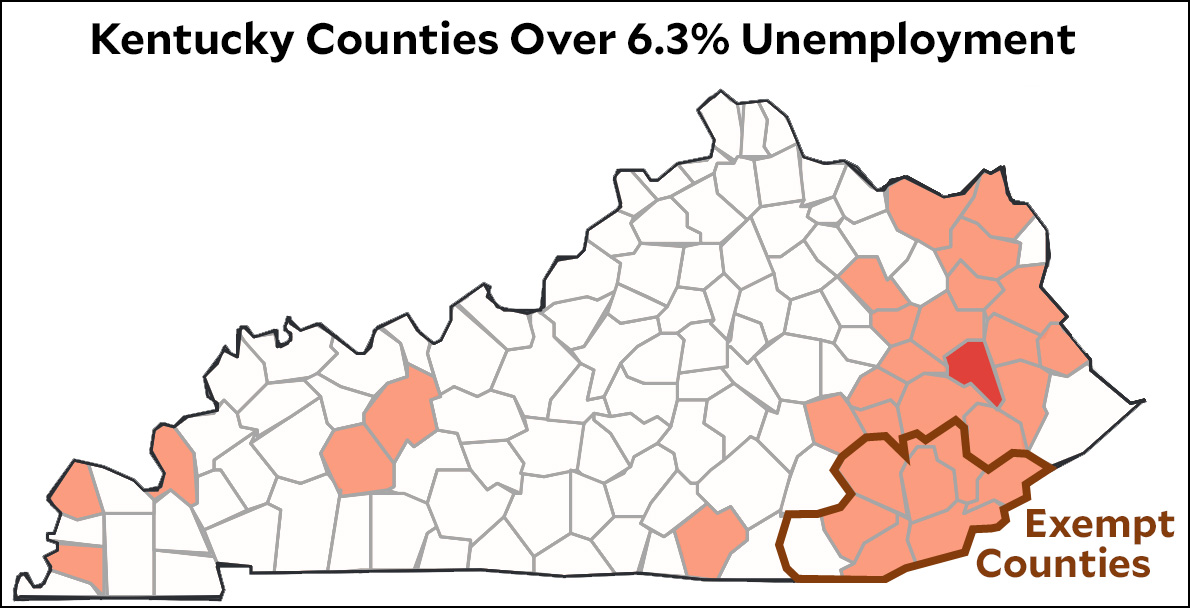
That’s coal country down there, and unemployment is pretty high. As you might guess, the population is also pretty white:
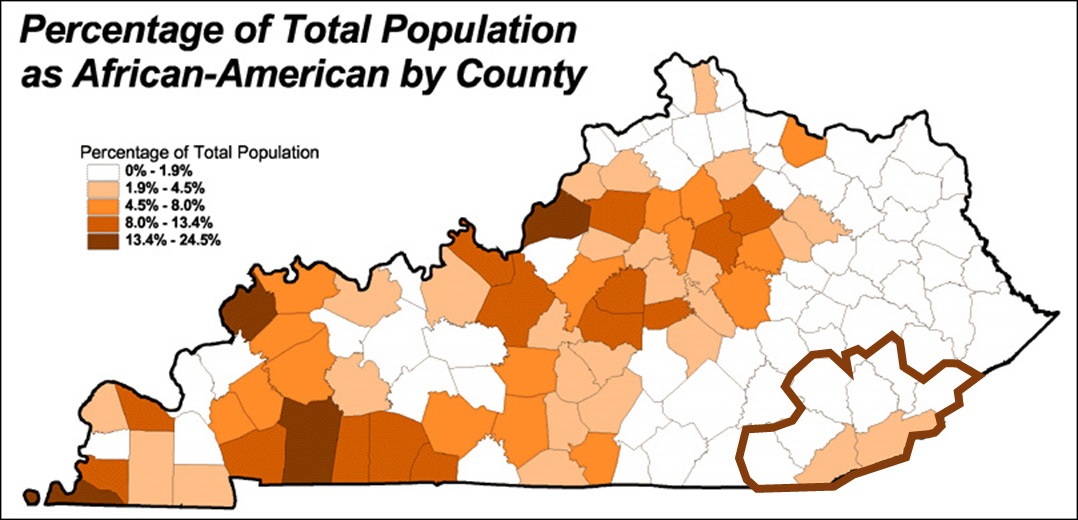
It’s hard to tell if there was any racial motivation here. The exempt counties are historically among the poorest in the state, and coal country often gets special consideration in Kentucky. But then Ohio and Michigan took a look and decided to follow suit by implementing Medicaid work requirements but exempting counties with high unemployment. In Michigan, the cutoff was 8.5 percent unemployment, which happens to describe only about a dozen rural, white counties. If they had done it by city instead, it would look like this:
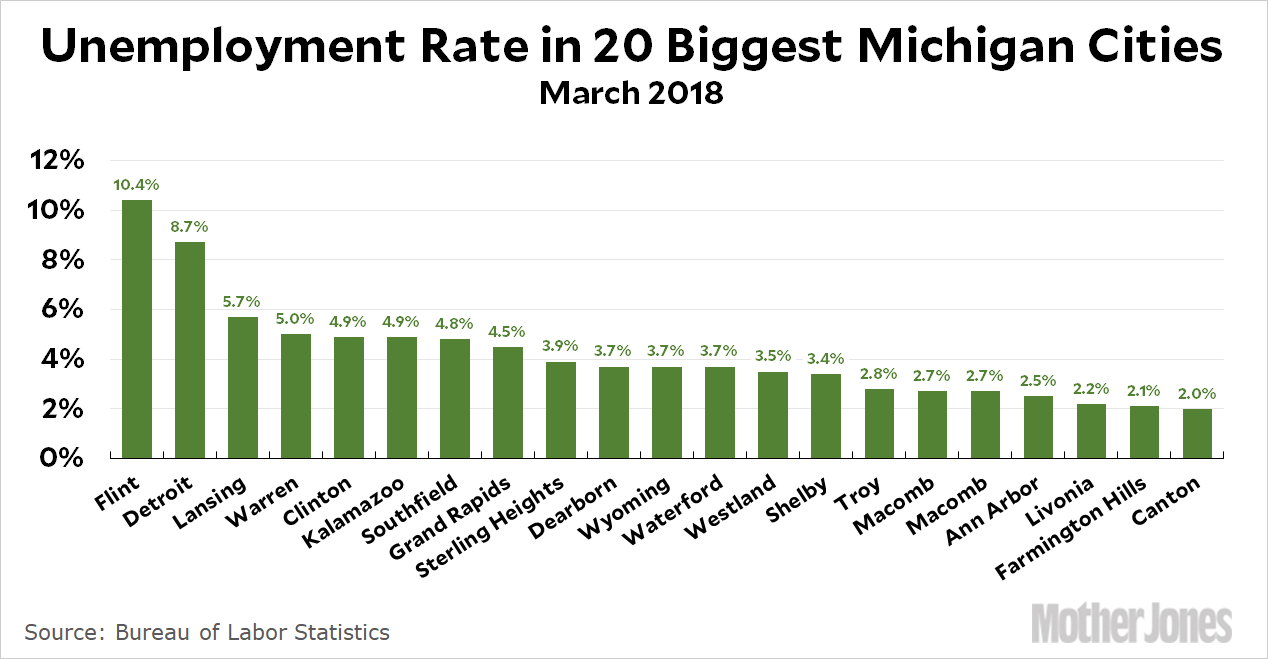
Detroit and Flint—both with large black populations—have high unemployment rates and should qualify for exemptions. But they don’t because they’re part of larger counties with low unemployment rates. That’s a tough break, isn’t it?

But here’s the odd thing. The official excuse for this is that unemployment rates are consistently available at the county level but not at the city level. That’s what the feds give them, so that’s what they have to work with. Except it’s not true. In Kentucky, they may have exempted a bunch of folks from coal country who happen to be white, but that’s sort of a misdemeanor as these things go. For the rest of the state, they exempted people from the work requirement if they already qualify for exemption from the SNAP work requirement. That’s pretty easy, after all. States already have the SNAP exemptions figured out, so there’s zero work involved in using that.

But here’s the thing: SNAP exemptions are based on both cities and counties as the regions of interest. In Michigan, for example, both Detroit and Flint are designated as “Labor Surplus Areas” and therefore qualify for exemptions. So Michigan latched onto Kentucky’s idea of exemption by county but decided not to follow their lead in using SNAP criteria for most of the state.

Why? It’s a mystery. But the bottom line is this: Michigan passed up on the easiest exemption criteria, instead making up a brand new one that just happens to exclude the biggest black populations in the state. Ohio is going down the same road, and a bunch of other red states are queued up behind them. Is this just a big coincidence? It hardly seems likely, does it?

POSTSCRIPT: It’s worth noting the political genius of this, which goes well beyond favoring whites over blacks. It’s also guaranteed to provoke a lot of blowback—like this post, for example. Republicans can then sigh and throw up their hands: You liberals have to make everything about race, don’t you? We just wanted to encourage able-bodied welfare recipients to find jobs. They don’t mention that they did this deliberately and were probably hoping for exactly this blowback since it does nothing but help them with their base, which thinks the exact same thing.

The alternative is that they’re all so innocent that they didn’t even notice the racial impact of their handiwork. I leave it to you to decide how likely that is.
18 Apr 05:42

Support for Abortion Rights Among the Young Hasn’t Changed Much

by Kevin Drum

Ed Kilgore draws my attention to a new PRRI survey which suggests that young people are becoming friendlier toward abortion rights.

Most Americans say their own views have not changed on the issue in recent years….The pattern among young Americans, however, is unique. Approximately one-third of young Americans say their views on abortion have changed in recent years, and nearly three times as many say their views have become more supportive of abortion rather than more opposed to abortion (25% vs. 9%).

This is good news, but I found myself a little dubious. I’d rather see a plain old trendline of young people’s attitudes toward abortion rights over time, but PRRI doesn’t provide that. Neither do most pollsters. But the biannual General Social Survey does, so I went there.

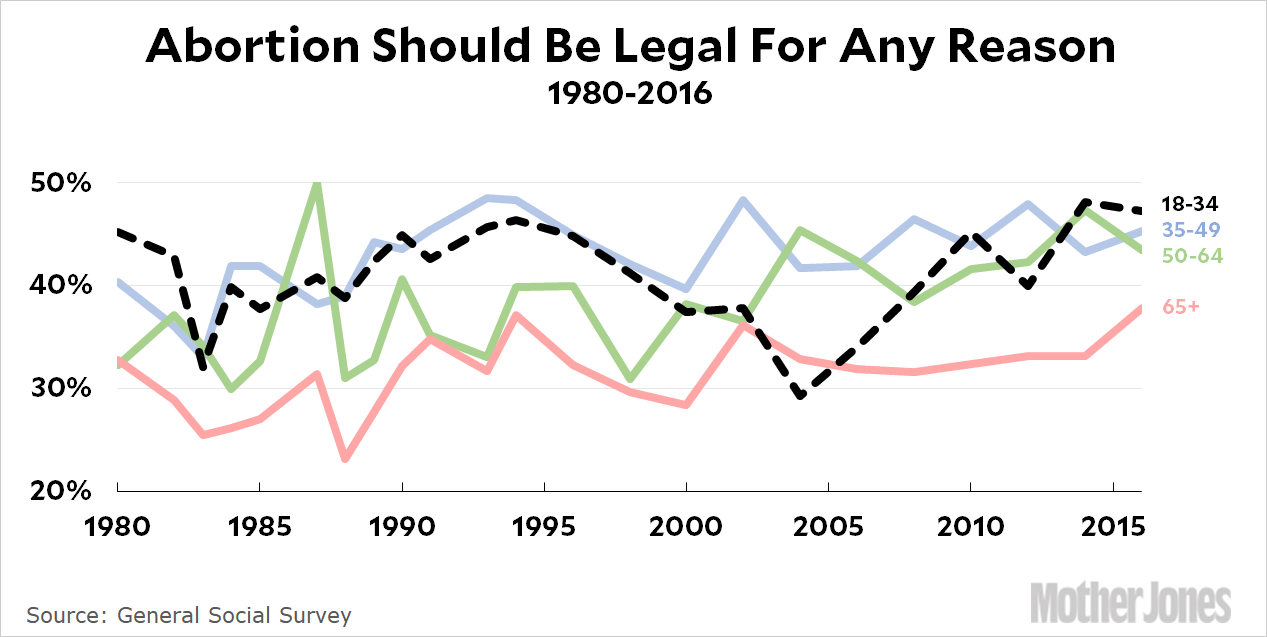
GSS asks questions about whether you support abortion in case of rape, in case of birth defects, etc. The closest we can get to a general question is whether you support abortion no matter why the woman wants one. However, the thing to look at here isn’t the raw numbers, which always depend strongly on question wording, but on the trend over time. Here it is:

The data is surprisingly variable and hard to read, but you can run a trendline through it. Here’s a summary of the trendline changes since 1980 in percentage points:

  • Age 18-34: up +1 pp
  • Age 35-49: up +6 pp
  • Age 50-64: up +10 pp
  • Age 65+: up +6 pp

There is, for some reason, a huge, decline and recovery in abortion support between 1995-2010 among the youngest age group, but in the end, virtually no change since 1980. It’s actually the older age groups that have changed the most.

Perhaps this is on the cusp of changing, but given the long-term trends and the year-to-year variability of opinions, I’m sort of skeptical. If I find more data that directly shows abortion attitudes by age group, I’ll pass it along.

12 Apr 00:03

Objectivity in Journalism Has Some Serious Pitfalls

by Kevin Drum
Monty May

I found this interesting. I'm guessing the PDN falls in with the general US norm in reporting on controversial issues.

I've been a little chart heavy this morning, and now I've got one more. This comes from a paper written a few months ago by Jesse Shapiro of Brown University, and it presents a model of how journalism can fail when special interests are involved. The model itself is pretty simple: if journalists present both sides of an argument at face value, then special interests are highly motivated to invent plausible-sounding evidence for their side of the argument—regardless of whether it's anywhere close to true. As long as they get quoted, the public will be suitably confused even if the journalists themselves know that it's mostly hogwash.

No surprise there. But this works only if journalists abide by a convention which demands that both sides are treated as equally credible. What happens if that's not true? The chart below tells an interesting story on climate change:

In the United States, journalists tend to simply present both sides of an argument without taking sides. In other countries, where that norm is less strict, reporters often tell their readers which side has the better argument. When that happens, the public is more likely to believe in climate change.

Now, there are obviously pitfalls to reporters deciding which side has the better argument. You can end up being better informed by this, or you can end up like Fox News. Still, it's an interesting comment on the American style of journalism.

26 Jan 19:52

Inflation: It's a Real Thing!

by Kevin Drum

Petula Dvorak has gotten a lot of, um, pushback for this column about the kids these days—including hers:

The work ethic of our kids: Where is it? Where are the entrepreneurial snow shovelers? For generations of enterprising children, snowflakes may as well have been dollar bills, y’all, falling from the sky. Kids jostled to be the first to ring the doorbells of the snowed-in, the $5 driveways added up, and that new Atari Defender game cartridge, those rainbow Vans — yours and yours.

But in 2016? Not so much.

....Last year, when we had a mere dusting compared with Snowzilla and the boys were 8 and 10 years old, they shoveled our stairs and sidewalk with verve, and then struck out to ring doorbells to make a buck. The novelty of responsibility was fresh and delicious.

They got three customers: a politician’s wife who was encouraging and delightful, giving them a crisp $5 bill and a load of praise; another neighbor who paid $5; and $0 from a bleary-eyed millennial renter who promised to pay them but didn’t have cash. And never paid up long after the snow melted.

As school was closed for the big dig-out, I tried again to inspire some hustle in my little childlumps, whose only hustle was to get a sleepover going. “There are still lots of cars buried out there,” I said. “I bet you can make enough money for that Lego Poe Dameron X-Wing you want.” No spark in their eyes. What’s going on?

Hmmm. Last year the kids shoveled three houses and they each earned $1.66 per house for their efforts. This year the snow is far heavier. They could probably double their earnings! I wonder why they're not feeling enthusiastic about this? It's a head scratcher, all right.

As it happens, lots of kid jobs—snow shoveling, burger flipping, lawnmowing, etc.—have been largely taken over by adults these days. But the real issue here is that adults simply have no feel for inflation. Petula's father probably got paid $5 for shoveling a walk in 1950, so that's what he paid Petula. Now she wants to pay her kids $5. Ditto for everyone else in their generation. But $5 in 1950 is about $50 today.

Sure enough, a 30-second bit of googling suggests that the going rate for getting a neighborhood kid to shovel your walk is about $40 or so. More if the storm is heavy and you have a big lot. A professional goes for about $70.

Maybe kids these days are lazy. I don't know—though the most recent kids I met were so smart and well-behaved that Marian and I were in awe. But hey—maybe they're lazy too! I didn't invite them to mow my lawn, after all. But this complaint about snow shoveling is just a personal version of that old chestnut, the business owners who complain they can't find good workers but then admit they aren't willing to raise their wages to attract them. Bottom line: don't whine about lazy kids unless you're willing to pay them enough to make it worth their time to work for you. For five bucks they'll feed your cats while you're on vacation. But only newbie suckers would shovel a walk after Snowzilla for that.

03 Sep 01:59

Republicans Mysteriously Decide to Become Hawkish Again

by Kevin Drum

Apparently the kinder, gentler version of the Republican Party is quickly disappearing:

Remember when the Republican Party was quickly shifting toward a new brand of Rand Paul-esque foreign policy non-interventionism?

No more.

Less than a year ago, just 18 percent of GOPers said that the United States does “too little” when it comes to helping solve the world’s problems, according to a Pew Research Center poll. Today, that number has more than doubled, to 46 percent.

....The results echo a recent Washington Post-ABC News poll which showed higher GOP support for airstrikes in Iraq.

So what to account for the shift?

Hmmm. That's a poser, isn't it? What, oh what, could account for the shift?

Well, let's cast our minds back a year or two. We were fighting in Libya, a war that President Obama got us involved in. We were fighting in Afghanistan, a war that Obama ramped up as soon as he took office. We were fighting drone wars in Yemen, Pakistan, and Somalia, all thanks to Obama.

Then what happened? The civil war in Syria heated up, but after a brief bout of indecision Obama decided not to get deeply involved. Russia ramped up military action in Crimea and eastern Ukraine, and Obama decided not to get deeply involved. ISIS took over a huge chunk of Iraq, and Obama decided not to get deeply involved.

So let's review. A year or two ago, we were involved in three overseas wars, all of them supported by Obama. At the time, Republicans were unaccountably dovish about military interventions. Today, Obama is refraining from getting deeply involved in three overseas wars. And guess what? Republicans have suddenly become hawkish again.

Yep, this is a poser. What could possibly account for this change in Republican attitudes?