21 Mar 23:34
by Biao Xu, Tianli Feng, Matthias T. Agne, Qing Tan, Zhe Li, Kazuki Imasato, Lin Zhou, Je-Hyeong Bahk, Xiulin Ruan, G. Jefferey Snyder, Yue Wu
Abstract
Reconstructing canonical binary compounds by inserting a third agent can significantly modify their electronic and phonon structures. Therefore, it has inspired the semiconductor communities in various fields. Introducing this paradigm will potentially revolutionize thermoelectrics as well. Using a solution synthesis, Bi2S3 was rebuilt by adding disordered Bi and weakly bonded I. These new structural motifs and the altered crystal symmetry induce prominent changes in electrical and thermal transport, resulting in a great enhancement of the figure of merit. The as-obtained nanostructured Bi13S18I2 is the first non-toxic, cost-efficient, and solution-processable n-type material with z T=1.0.

Bi2S3 was rebuilt by adding disordered Bi and weakly bonded I in a solution synthesis. The new structural motifs and the altered crystal symmetry induce prominent changes in electrical and thermal transport. The as-obtained nanostructured Bi13S18I2 is a non-toxic, cost-efficient, and solution-processable n-type thermoelectric material with z T=1.0.
21 Mar 23:33
by Jun Gu, Florent Héroguel, Jeremy Luterbacher, Xile Hu
Abstract
Controlling the selectivity in electrochemical CO2 reduction is an unsolved challenge. While tin (Sn) has emerged as a promising non-precious catalyst for CO2 electroreduction, most Sn-based catalysts produce formate as the major product, which is less desirable than CO in terms of separation and further use. Tin monoxide (SnO) nanoparticles supported on carbon black were synthesized and assembled and their application in CO2 reduction was studied. Remarkably high selectivity and partial current densities for CO formation were obtained using these SnO nanoparticles compared to other Sn catalysts. The high activity is attributed to the ultra-small size of the nanoparticles (2.6 nm), while the high selectivity is attributed to a local pH effect arising from the dense packing of nanoparticles in the conductive carbon black matrix.

SnO NPs (tin monoxide nanoparticles) supported on carbon black were synthesized and their use in CO2 reduction was studied. High partial current densities for CO formation were obtained using these NPs compared to other Sn catalysts. The high activity is attributed to the ultra-small size of the nanoparticles (2.6 nm). The high selectivity is attributed to a pH effect arising from dense packing of NPs in the conductive carbon black matrix.
21 Mar 23:33
by George M. Whitesides

Using curiosity as the starting point for careful observation of nature and society is a nontrivial skill, and a starting point for new intellectual endeavors and adventures. It is one essential contributor to creativity in science, and a start in forcing new ideas into inflexible professional orthodoxies.
21 Mar 23:33
by Umberto Veronesi, Marcos Martinón-Torres
Abstract
Glass distillation equipment from an early modern alchemical laboratory was analyzed for its technology of manufacture and potential origin. Chemical data show that the assemblage can be divided into sodium-rich, colorless distillation vessels made with glass from Venice or its European imitation, and potassium-rich dark-brown non-specialized forms produced within the technological tradition of forest glass typical for central and north-western Europe. These results complete our understanding of the supply of technical apparatus at one of the best-preserved alchemical laboratories and highlight an early awareness of the need for high-quality instruments to guarantee the successful outcome of specialized chemical operations. This study demonstrates the potential of archaeological science to inform historical research around the practice of early chemistry and the development of modern science.

What sort of operations did alchemists carry out in their laboratories? What tools did they use? Can answering similar questions help us better understand the development of science and technology in the Renaissance? It is shown that the information gained through archaeometric analysis of artefacts from laboratories can be a powerful tool in exploring how alchemy was practiced in early modern Europe.
21 Mar 23:30
by Qunwei Tang, Jialong Duan, Yuanyuan Zhao, Benlin He
Abstract
All-inorganic perovskite solar cells with high efficiency and improved stability are promising for commercialization. A multistep solution-processing method was developed to fabricate high-purity inorganic CsPbBr3 perovskite films for use in efficient solar cells. By tuning the number of deposition cycles (n) of a CsBr solution, the phase conversion from CsPb2Br5 (n ≤3), to CsPbBr3 (n=4), and Cs4PbBr6 (n≥5) was optimized to achieve vertical- and monolayer-aligned grains. Upon interfacial modification with graphene quantum dots, the all-inorganic perovskite solar cell (without a hole-transporting layer) achieved a power conversion efficiency (PCE) as high as 9.72 % under standard solar illumination conditions. Under challenging conditions, such as 90 % relative humidity (RH) at 25 °C or 80 °C at zero humidity, the optimized device retained 87 % PCE over 130 days or 95 % over 40 days, compared to the initial efficiency.

All-inorganic perovskite films were fabricated by a multistep solution-processed deposition strategy, in which a phase conversion from CsPb2Br5 to CsPbBr3 and then to Cs4PbBr6 was achieved upon increasing deposition cycles of a cesium bromide solution. A power conversion efficiency up to 9.72 % was obtained from the CsPbBr3 solar cells, which are free of hole-transporting layers.
21 Mar 23:30
by Mingshan Zhu, Zhichao Sun, Mamoru Fujitsuka, Tetsuro Majima

Spontaneously solar-driven water splitting into H2 and O2, that is, the conversion of solar energy to chemical energy is intensively being investigated. In their Communication (DOI: 10.1002/anie.201711357), M. Fujitsuka, T. Majima et al. present a new 2D heterostructure of black phosphorus and bismuth vanadate for photocatalytic water splitting without any sacrificial agents under visible light irradiation. The Z-scheme architectural band structures contribute to an effective charge separation.
21 Mar 23:30
by Marcello La Rosa, Sergey A Denisov, Gediminas Jonusauskas, Nathan McClenaghan, Alberto Credi
Abstract
The size-tunable emission of luminescent quantum dots (QDs) makes them highly interesting for applications that range from bioimaging to optoelectronics. For the same applications, engineering their luminescence lifetime, in particular, making it longer, would be as important; however, no rational approach to reach this goal is available to date. We describe a strategy to prolong the emission lifetime of QDs through electronic energy shuttling to the triplet excited state of a surface-bound molecular chromophore. To implement this idea, we made CdSe QDs of different sizes and carried out self-assembly with a pyrene derivative. We observed that the conjugates exhibit delayed luminescence, with emission decays that are prolonged by more than 3 orders of magnitude (lifetimes up to 330 μs) compared to the parent CdSe QDs. The mechanism invokes unprecedented reversible quantum dot to organic chromophore electronic energy transfer.

Extended play: The first examples of delayed luminescence involving CdSe quantum dots are reported, with by emission decays that are prolonged by more than 3 orders of magnitude (lifetimes up to 330 μs) compared to analogous parent compounds. The mechanism involves unprecedented reversible quantum dot to organic chromophore electronic energy transfer.
21 Mar 23:27
by Ge Xu, Qinglong Yan, Xiaoguang Lv, Ying Zhu, Kai Xin, Ben Shi, Rongchen Wang, Jian Chen, Wei Gao, Ping Shi, Chunhai Fan, Chunchang Zhao, He Tian
Abstract
Fluorescent probes in the second near-infrared window (NIR-II) allow high-resolution bioimaging with deep-tissue penetration. However, existing NIR-II materials often have poor signal-to-background ratios because of the lack of target specificity. Herein, an activatable NIR-II nanoprobe for visualizing colorectal cancers was devised. This designed probe displays H2S-activated ratiometric fluorescence and light-up NIR-II emission at 900–1300 nm. By using this activatable and target specific probe for deep-tissue imaging of H2S-rich colon cancer cells, accurate identification of colorectal tumors in animal models were performed. It is anticipated that the development of activatable NIR-II probes will find widespread applications in biological and clinical systems.

NIR-II emission: Activatable nanoprobes with second near-infrared emissions were constructed. The designed probes displayed H2S-activated ratiometric fluorescence and light-up NIR-II emission and were applied to the specific imaging of H2S-rich colon tumors and differentiation of cancer type.
31 Aug 13:27
by Nilantha Bandara, Anuj K. Sharma, Stephanie Krieger, Jason W. Schultz, Byung Hee Han, Buck E. Rogers and Liviu M. Mirica

Journal of the American Chemical Society
DOI: 10.1021/jacs.7b05937

08 Jun 12:06
Publication date: April 2017
Source:FlatChem, Volume 2
Author(s): Quyet Van Le, Jae-Young Choi, Soo Young Kim
Two-dimensional (2D) materials such as graphene and transition metal chalcogenides (MX2, M: transition metal, X: S, Se, Te) have emerged as a new class of materials due to their high carrier mobility, high transparency, tunable band gap, low cost, and solution-processable properties. These materials can be fabricated into single layers or few layers through facile processes such as chemical vapor deposition or mechanical exfoliation to unlock their superior electrical and optical properties. The ability to tune the work function enables their application as hole transport layers and electron transport layers in optoelectronic devices. In this review, we focus on recent progress in the application of 2D materials as hole transport layers and electron transport layers in organic solar cells and perovskite solar cells.
Graphical abstract

28 Apr 15:15
by Xiaobin Fan, Pengtao Xu, Yuguang C. Li, Dekai Zhou, Yifan Sun, Minh An T. Nguyen, Mauricio Terrones and Thomas E. Mallouk

Journal of the American Chemical Society
DOI: 10.1021/jacs.6b01502

28 Apr 14:57
by James P. Ewen, Chiara Gattinoni, Neal Morgan, Hugh A. Spikes and Daniele Dini

Langmuir
DOI: 10.1021/acs.langmuir.6b00586

28 Apr 14:36
by David S. Sholl
Seven chemical separations to change the world
Nature 532, 7600 (2016). doi:10.1038/532435a
Authors: David S. Sholl & Ryan P. Lively
Purifying mixtures without using heat would lower global energy use, emissions and pollution — and open up new routes to resources, say David S. Sholl and Ryan P. Lively.

23 Mar 20:45
Abstract
The evolution of the mechanical behaviour of zinc dialkyldithiophosphate (ZDDP) tribofilms on diamond-like carbon coatings during sliding contact has been studied by combining nano-indentation experimental data and finite element modelling. The nano-indentation data from the ZDDP tribofilms were obtained for two different sliding distances of the tribological tests after 15,000 and 216,000 cycles, which correspond to 25 min and 6 h, respectively. A non-homogeneous structure was found for the ZDDP tribofilms after both sliding distances, which were also verified by the local stiffness using the AFM force modulation mode. A dual structure is observed for the ZDDP tribofilms after 15,000 cycles, while three distinct components with different mechanical behaviours were found after 216,000 cycles. It was also found that the mechanical behaviour of the harder component of the ZDDP tribofilms remains almost unchanged for both sliding times, while the softer component tends to stiffen slightly over the sliding time. In addition, using the proposed algorithm with finite element simulations, the mechanical properties of the different components have been obtained, e.g. the elastic modulus E = 25.5 GPa and the yield stress Y = 1.585 GPa of the harder component for both sliding times. The softer component exhibits E = 1.65 GPa and Y = 0.144 GPa after 15,000 cycles and E = 3.5 GPa and Y = 0.17 GPa after 216,000 cycles. Finally, an intermediate component with E = 11.7 GPa and Y = 0.94 GPa has been only found at 216,000 cycles.
17 Mar 10:06
by Aleksander A. Tedstone, David J. Lewis and Paul O’Brien

Chemistry of Materials
DOI: 10.1021/acs.chemmater.6b00430

15 Mar 07:58
by Phong D. Tran
Nature Materials.
doi:10.1038/nmat4588
Authors: Phong D. Tran, Thu V. Tran, Maylis Orio, Stephane Torelli, Quang Duc Truong, Keiichiro Nayuki, Yoshikazu Sasaki, Sing Yang Chiam, Ren Yi, Itaru Honma, James Barber & Vincent Artero

13 Mar 13:29
by Liping Yu, Adrienn Ruzsinszky and John P. Perdew

Nano Letters
DOI: 10.1021/acs.nanolett.5b05303

13 Mar 13:21
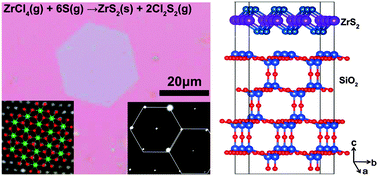
J. Mater. Chem. C, 2016, 4,3143-3148
DOI: 10.1039/C6TC00254D, Communication
Xiaoting Wang, Le Huang, Xiang-Wei Jiang, Yan Li, Zhongming Wei, Jingbo Li
Large scale (up to 30 [small mu ]m in lateral size) atomically thin hexagonal ZrS2 nanoflakes were prepared on traditional substrates (silica, sapphire) through a temperature dependent growth process.
The content of this RSS Feed (c) The Royal Society of Chemistry
12 Mar 10:33
Publication date: 15 May 2016
Source:Wear, Volumes 354–355
Author(s): Alexander K. Landauer, William C. Barnhill, Jun Qu
This article examines the elasticity, hardness, and resistance-to-plastic-deformation (P/S 2) measured via nanoindentation of several tribofilms and correlates these properties to friction and wear behavior. The tribofilms were generated by ball-on-plate reciprocating sliding lubricated by a base oil containing an ionic liquid, phosphonium-organophosphate or ammonium-organophosphate, zinc dialkyldithiophosphate (ZDDP), or combination of IL and ZDDP. Nanoindentation was conducted at room and elevated temperatures. While there seems little correlation between the tribofilm hardness and tribological behavior, a higher modulus generally leads to better friction and wear performance. Interestingly, a lower P/S 2 ratio tends to reduce friction and improve wear protection, which is in an opposite trend as reported for bulk materials. This is likely attributable to the dynamic, self-healing characteristics of tribofilms.
12 Mar 10:31
by Wenle Li, Christopher C. Matthews, Ke Yang, Michael T. Odarczenko, Scott R. White, Nancy R. Sottos

Smart polymeric materials that autonomously indicate mechanically damaged areas are developed by N. R. Sottos and co-workers, as described on page 2189. Microcapsules containing the color-changing indicator are homogeneously dispersed in a polymer matrix. Mechanical damage (e.g., scratch, abrasion, or compression) causes the microcapsules to rupture and release the core materials. A dramatic color change is initiated immediately to highlight the damaged regions.
07 Mar 10:05
J. Mater. Chem. C, 2016, 4,2312-2318
DOI: 10.1039/C6TC00489J, Paper

Open Access
Naktal Al-Dulaimi, David J. Lewis, Xiang Li Zhong, M. Azad Malik, Paul O'Brien
Polycrystalline thin films of rhenium disulfide (ReS2) and the alloys Mo1-xRexS2 (0 [less-than-or-equal] x [less-than-or-equal] 0.06) have been deposited by aerosol-assisted chemical vapour deposition (AA-CVD) using [Re([small mu ]-SiPr)3(SiPr)6] and [Mo(S2CNEt2)4] at 475 [degree]C.
The content of this RSS Feed (c) The Royal Society of Chemistry
06 Mar 11:19
Unintended consequences
Nature 531, 7592 (2016). doi:10.1038/531007a
After the introduction of a clumsily worded new rule, the UK government should move quickly to reassure scientists that they can continue to advise policymakers.

05 Mar 22:56
Publication date: June 2016
Source:Tribology International, Volume 98
Author(s): Hikaru Okubo, Seiya Watanabe, Chiharu Tadokoro, Shinya Sasaki
Effects of the structure of zinc dialkyldithiophosphates (ZDDPs) on the tribological properties of a tetrahedral amorphous carbon (ta-C) film were investigated. Friction tests were performed at diamond-like carbon (DLC)/DLC and steel/steel contacts under lubrication with poly-alpha olefin (PAO) and PAO containing six types of ZDDPs with different alkyl groups. The tribological properties of the ta-C film depended on the chemical composition of ZDDP-derived tribofilms on the outermost surface, which depended on the abundance ratio of neutral-ZDDP and basic-ZDDP in the ZDDP solution. Thus, the ZDDP forms play important roles in the tribological properties of the ta-C film. All these results suggest that the ZDDP forms can determine the tribological properties of the ta-C film lubricated with the ZDDP solution.
05 Mar 22:55
Publication date: June 2016
Source:Tribology International, Volume 98
Author(s): J. Jelita Rydel, R.H. Vegter, P.E.J. Rivera-Díaz-del-Castillo
A new AFM method for relating microstructure to tribofilm formation is presented. Three aspects of this method distinguish it. Firstly, the new method maps the same region employing atomic force microscopy (AFM) in three sequential steps: preEDTA and postEDTA, before and after the tribofilm removal; and as-etched, after revealing the steel microstructure. Secondly, a new software was written for correcting the displacement between the sequential AFM topography images, and for analysing the data. Thirdly, the method allows to correlate the tribofilm with the steel microstructure, and relating it with protrusion of residual carbides and tribofilm roughness for regions as large as 50μm×50μm. This allows to performing statistical analyses to correlate tribofilm thickness with different microstructural constituents.
Highlights
05 Mar 22:55
Publication date: June 2016
Source:Tribology International, Volume 98
Author(s): R. González, M. Bartolomé, D. Blanco, J.L. Viesca, A. Fernández-González, A. Hernández Battez
Two phosphonium cation-based ionic liquids (ILs) were studied as additive to a mineral oil. Solubility tests and TGA of neat samples were performed. Three concentrations of the ILs were used in the tribological tests. Base oil–ZDDP mixtures were used as comparison samples. Tribological tests were made using a reciprocating ball-on-disc configuration. Load ramp and Stribeck curve tests were also performed. The worn surface was studied by different techniques. The results showed similar and better friction reduction properties for ILs- or ZDDP-containing mixtures than the neat base oil. The [P66614][(iC8)2PO2]-containing mixtures outperformed the antiwear behavior of the other samples. XPS results showed different mechanisms of lubrication when using ILs or ZDDP.
25 Feb 12:19
Publication date: 15 April 2016
Source:Wear, Volumes 352–353
Author(s): Yongjian Yang, Liping Huang, Yunfeng Shi
We investigated the wear formation during a single-asperity sliding against a rigid substrate using molecular dynamics simulations. Two distinct wear mechanisms were observed: low-load atomic wear (isolated debris atoms or clusters) and high-load plastic wear (collective debris formation from plastic flow). The atomic wear rate depends on the normal stress exponentially, in agreement with the mechanically assisted bond-rupture theory. However, the plastic wear rate exhibits linear dependency on the normal stress. It was found that the asperity-substrate adhesion reduces the critical normal stress for the atomic-to-plastic wear transition, suppressing the atomic wear mode. Finally, a wear mechanism map of atomic/plastic wear was constructed in the domain of normal stress and adhesion, which is consistent with existing simulation and experimental results. This wear map could resolve the recent controversy on whether Archard׳s linear law is applicable for low-load tip wear.
25 Feb 10:49
by Joseph Halim, Sankalp Kota, Maria R. Lukatskaya, Michael Naguib, Meng-Qiang Zhao, Eun Ju Moon, Jeremy Pitock, Jagjit Nanda, Steven J. May, Yury Gogotsi, Michel W. Barsoum
Large scale synthesis and delamination of 2D Mo2CT
x
(where T is a surface termination group) has been achieved by selectively etching gallium from the recently discovered nanolaminated, ternary transition metal carbide Mo2Ga2C. Different synthesis and delamination routes result in different flake morphologies. The resistivity of free-standing Mo2CT
x
films increases by an order of magnitude as the temperature is reduced from 300 to 10 K, suggesting semiconductor-like behavior of this MXene, in contrast to Ti3C2T
x
which exhibits metallic behavior. At 10 K, the magnetoresistance is positive. Additionally, changes in electronic transport are observed upon annealing of the films. When 2 μm thick films are tested as electrodes in supercapacitors, capacitances as high as 700 F cm−3 in a 1 m sulfuric acid electrolyte and high capacity retention for at least 10,000 cycles at 10 A g−1 are obtained. Free-standing Mo2CT
x
films, with ≈8 wt% carbon nanotubes, perform well when tested as an electrode material for Li-ions, especially at high rates. At 20 and 131 C cycling rates, stable reversible capacities of 250 and 76 mAh g−1, respectively, are achieved for over 1000 cycles.

2D Mo2C (MXene) is produced using different synthesis routes, which lead to different flake morphologies. Mo2C exhibits a semiconductor-like increase in resistivity from 300 to 10 K. Mo2C electrodes in a supercapacitor achieve 700 F cm−3 capacitance in 1 m H2SO4 for 10,000 cycles. Mo2C–Carbon nano tube (CNT) electrodes possess 250 mAh g−1 capacity for 1000 cycles, showing promise as anode for batteries and Li-ion capacitors.
24 Feb 21:29
Publication date: 15 April 2016
Source:Wear, Volumes 352–353
Author(s): Arkadiusz Stachowiak, Przemysław Tyczewski, Wiesław Zwierzycki
Tribocorrosion maps were prepared for two types of corrosion resistant stainless steels that have different properties; namely, AISI 304 and AISI 420. The maps were based on data from a pin-on-plate geometry tested in a 0.5M solution of H2SO4 at passive potential polarization. A coordinate system was designed to normalize the effects of applied variables and material properties. In order to obtain an adequate amount of data for these maps, the results of experiments were combined with the results of simulative computations. The resulting tribocorrosion maps rendered it possible to identify certain differences and similarities with respect to the effects of material properties and the conditions of use on the intensity of wear for the two stainless steels. Synthetized maps indicated a correlation of the wear intensities of steels within one particular wear mode.
10 Feb 21:34
Abstract
Ultrathin WS2 nanosheets modified by oleylamine (OM) were prepared via a solution-phase method at a relatively high temperature of 300 °C. The thermal stability of the as-prepared WS2 nanosheets was evaluated by thermogravimetric analysis. The tribological properties of as-synthesized WS2 nanosheets as the additive in polyalpha olefin (PAO6) were evaluated with a four-ball machine and a reciprocating tribometer over a wide temperature range from room temperature to 200 °C. The morphology and elemental composition of worn steel surfaces were analyzed with a scanning electron microscope, a three-dimensional optical profiler, an energy dispersive spectrometer and an X-ray photoelectron spectroscope. Results show that OM as the modifier is able to improve the dispersibility of WS2 nanosheets in PAO6 base oil. At a mass fraction of 2.0 % in PAO6 base oil, as-synthesized WS2 nanosheets exhibit excellent antiwear and friction-reducing performance over the selected temperature range. This is because as-synthesized WS2 nanosheets as the additive in PAO6 are able to form adsorbed film with a low shear force and tribochemical reaction film composed of W, Fe and O elements on the worn steel surface.
01 Feb 20:14
by Jian Gao, Baichang Li, Jiawei Tan, Phil Chow, Toh-Ming Lu and Nikhil Koratkar

ACS Nano
DOI: 10.1021/acsnano.5b07677