14 Jan 21:34
Nanoscale, 2016, 8,3207-3217
DOI: 10.1039/C5NR07755A, Review Article
Chen Si, Zhimei Sun, Feng Liu
Strain engineering is widely considered as an effective way of tuning the properties of graphene and has opened a new field called "straintronics".
The content of this RSS Feed (c) The Royal Society of Chemistry

14 Jan 21:11
by Ming Zhao, Haolei Qian, Xinyue Niu, Wei Wang, Liao Guan, Jian Sha and Yewu Wang

Crystal Growth & Design
DOI: 10.1021/acs.cgd.5b01709

14 Jan 20:51
by Rong An, Liangliang Huang, Yun Long, Berc Kalanyan, Xiaohua Lu and Keith E Gubbins

Langmuir
DOI: 10.1021/acs.langmuir.5b04115

14 Jan 20:42
Nanoscale, 2016, 8,2778-2786
DOI: 10.1039/C5NR07362F, Paper
Sepideh Gorji Ghalamestani, Sebastian Lehmann, Kimberly A. Dick
This study addresses the possibility of forming other crystal phases than zinc blende such as wurtzite and 4H in InSb and GaSb nanowires.
The content of this RSS Feed (c) The Royal Society of Chemistry

14 Jan 20:42
Nanoscale, 2016, 8,2740-2750
DOI: 10.1039/C5NR06293D, Paper
Zhi-Xin Hu, Xianghua Kong, Jingsi Qiao, Bruce Normand, Wei Ji
Electronic hybridization of lone electron-pairs in few-layer black phosphorus results in anomalous layer-dependent optical and interlayer vibrational properties.
The content of this RSS Feed (c) The Royal Society of Chemistry

14 Jan 20:35
by Chad Lunceford, Emanuel Borcean and Jeff Drucker

Crystal Growth & Design
DOI: 10.1021/acs.cgd.5b01540

05 Jan 23:14
by Shenghuang Lin, Shenghua Liu, Zhibin Yang, Yanyong Li, Tsz Wai Ng, Zaiquan Xu, Qiaoliang Bao, Jianhua Hao, Chun-Sing Lee, Charles Surya, Feng Yan, Shu Ping Lau
2D van der Waals crystals, possessing excellent electronic and physical properties, have been intriguing building blocks for organic optoelectronic devices. Most of the 2D materials are served as hole transport layers in organic devices. Here,it is reported that solution exfoliated few layers black phosphorus (BP) can be served as an effective electron transport layer (ETL) in organic photovoltaics (OPVs) for the first time. The power conversion efficiencies (PCEs) of the BP-incorporated OPVs can be improved to 8.18% in average with the relative enhancement of 11%. The incorporation of BP flakes with the optimum thickness of ≈10 nm can form cascaded band structure in OPVs, which can facilitate electron transport and enhance the PCEs of the devices. This study opens an avenue in using solution exfoliated BP as a highly efficient ETL for organic optoelectronics.

Solution-processable black phosphorus (BP) is served as an effective electron transport layer in organic solar cells for the first time. The efficiencies of the BP-incorporated devices can be relatively improved for 11% due to the formation of cascaded band structure that can facilitate electron transport in the devices. This study broadens the application of BP in electronics devices.
05 Jan 23:11
by Gart, S., Socha, J. J., Vlachos, P. P., Jung, S.
Dogs lap because they have incomplete cheeks and cannot suck. When lapping, a dog’s tongue pulls a liquid column from the bath, suggesting that the hydrodynamics of column formation are critical to understanding how dogs drink. We measured lapping in 19 dogs and used the results to generate a physical...

05 Jan 22:06
Abstract
Tribochemistry plays a very important role in the behaviour of systems in tribologically loaded contacts under boundary lubrication conditions. Previous works have mainly reported contact
mechanics simulations for capturing the boundary lubrication regime, but the real mechanism in which tribofilms reduce wear is still unclear. In this paper, the wear prediction capabilities of a recently published mechanochemical simulation approach (Ghanbarzadeh et al. in Tribol Int, 2014) are tested. The wear model, which involves a time- and spatially dependent coefficient of wear, was tested for two additive concentrations and three temperatures at different times, and the predictions are validated against experimental results. The experiments were conducted using a mini-traction machine in a sliding/rolling condition, and the spacer layer interferometry method was used to measure the tribofilm thickness. Wear measurements have been taken using a white-light interferometry. Good agreement is seen between simulation and experiment in terms of tribofilm thickness and wear depth predictions.
05 Jan 20:54
J. Mater. Chem. C, 2016, 4,1295-1304
DOI: 10.1039/C5TC04063A, Paper
M. H. Heyne, D. Chiappe, J. Meersschaut, T. Nuytten, T. Conard, H. Bender, C. Huyghebaert, I. P. Radu, M. Caymax, J.-F. de Marneffe, E. C. Neyts, S. De Gendt
The H2S sulfurization of metal and metal oxide molybdenum films and the H2 influence on their morphology is described.
The content of this RSS Feed (c) The Royal Society of Chemistry
05 Jan 13:00
Publication date: April 2016
Source:Tribology International, Volume 96
Author(s): Mitjan Kalin, Eva Oblak, Somayeh Akbari
The evolution of the nano-mechanical properties of tribofilms formed in steel/steel, steel/a-C:H and steel/Si-DLC contacts lubricated with two commercial oils containing different amounts of SAPS additives (E6 and E7 grade) and a mineral base oil containing ZDDP additive were examined in this investigation for two very different time periods. An atomic force microscope (AFM) was used in different modes to measure the topography, film thickness and stiffness, while the nano-hardness was measured with a nano-indenter. In addition, FTIR microscope was used on selected samples to explain some of the tribofilm׳s mechanical modifications with chemical changes. The results have shown that the tribofilm׳s evolution and growth are very much surface and additive dependent, and are different for steel and DLC coatings.
05 Jan 09:17
J. Mater. Chem. A, 2015, Accepted Manuscript
DOI: 10.1039/C5TA09546H, Communication
Mutalifu Abulikemu, Silvano DelGobbo, Dalaver H Anjum, Mohammad A Malik, Osman M. Bakr
Inorganic nanocrystals composed of earth-abundant and non-toxic elements are crucial to fabricated sustainable photovoltaic devices in large scale. In this study, various-shaped and different phases of antimony sulfide nanocrystals, which...
The content of this RSS Feed (c) The Royal Society of Chemistry
24 Dec 23:18
Publication date: 15 February 2016
Source:Wear, Volumes 348–349
Author(s): M. De Feo, M.I. De Barros Bouchet, C. Minfray, Th. Le Mogne, F. Meunier, L. Yang, B. Thiebaut, J.M. Martin
Recently Diamond-Like Carbon (DLC) coatings have attracted considerable attention due to their low friction, high hardness, good wear and corrosion resistance, and high thermal and chemical stability. Although considerable research has been conducted on the effect of molybdenum-based additives, e.g., molybdenum dithiocarbamate (MoDTC), on the boundary lubrication of DLC coatings, the wear mechanisms leading to the coating removal are not fully understood to date. Moreover, the impact of the degradation of the MoDTC-containing base oil on the tribological properties of DLC coatings has not been investigated. This study could help to elucidate the mechanisms by which the coating is worn out in presence of MoDTC-containing base oil. In this work, the friction and wear performances of DLC coatings with different hydrogen contents and doping elements have been investigated in the presence of MoDTC-containing base oil. To enable the correlation between these changes and the modification of the contact surface chemistry, tribofilms generated during friction were investigated by SEM combined with Energy Dispersive X-ray Spectrometry (EDX) and X-ray Photoelectron Spectroscopy (XPS). A new mechanism explaining the severe wear experienced by DLC coatings when lubricated with a MoDTC-containing base oil is proposed.
24 Dec 23:05
by Zhanhai Yang, Hui Liang, Xusheng Wang, Xinlei Ma, Tao Zhang, Yanlian Yang, Liming Xie, Dong Chen, Yujia Long, Jitao Chen, Yunjie Chang, Chunhua Yan, Xinxiang Zhang, Xueji Zhang, Binghui Ge, Zhian Ren, Mianqi Xue and Genfu Chen

ACS Nano
DOI: 10.1021/acsnano.5b05823

24 Dec 22:27
by Michael D. Cusimano
Entertainment: Bond villain fails neuroanatomy
Nature 528, 7583 (2015). doi:10.1038/528479e
Author: Michael D. Cusimano
The thrills and action in Spectre, the latest James Bond film, were somewhat marred for this viewer by a fundamental neuroanatomical blunder.The scene is a Moroccan desert. Bond's nemesis is torturing our hero using a head clamp fused with a robotic drill. Intending

24 Dec 22:09
by Fernando Soto, Aida Martin, Stuart Ibsen, Mukanth Vaidyanathan, Victor Garcia-Gradilla, Yair Levin, Alberto Escarpa, Sadik C. Esener and Joseph Wang

ACS Nano
DOI: 10.1021/acsnano.5b07080

19 Dec 23:27
by Richard Hodson
Prostate cancer: 4 big questions
Nature. doi:10.1038/528S137a
Author: Richard Hodson
Despite advances in detection and therapy, much about this common malignancy remains unknown. Here are some of the most important unresolved issues.

19 Dec 22:56
Chem. Commun., 2016, 52,1311-1326
DOI: 10.1039/C5CC07754K, Feature Article
A. Cayuela, M. L. Soriano, C. Carrillo-Carrion, M. Valcarcel
The need for establishing the bases and definitions of photoluminescent nanodots is discussed and their state-of-the-art in analytical and biomedical research fields is highlighted.
The content of this RSS Feed (c) The Royal Society of Chemistry

19 Dec 22:49
by Andrew J. Mannix
At the atomic-cluster scale, pure boron is markedly similar to carbon, forming simple planar molecules and cage-like fullerenes. Theoretical studies predict that two-dimensional (2D) boron sheets will adopt an atomic configuration similar to that of boron atomic clusters. We synthesized atomically thin, crystalline 2D boron sheets (i.e., borophene) on silver surfaces under ultrahigh-vacuum conditions. Atomic-scale characterization, supported by theoretical calculations, revealed structures reminiscent of fused boron clusters with multiple scales of anisotropic, out-of-plane buckling. Unlike bulk boron allotropes, borophene shows metallic characteristics that are consistent with predictions of a highly anisotropic, 2D metal.
Authors: Andrew J. Mannix, Xiang-Feng Zhou, Brian Kiraly, Joshua D. Wood, Diego Alducin, Benjamin D. Myers, Xiaolong Liu, Brandon L. Fisher, Ulises Santiago, Jeffrey R. Guest, Miguel Jose Yacaman, Arturo Ponce, Artem R. Oganov, Mark C. Hersam, Nathan P. Guisinger
19 Dec 22:37
J. Mater. Chem. C, 2016, 4,479-485
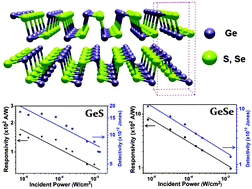
DOI: 10.1039/C5TC03667D, Paper
Parthiban Ramasamy, Dohyun Kwak, Da-Hye Lim, Hyun-Soo Ra, Jong-Soo Lee
High-sensitivity photodetectors are reported using solution synthesized GeS and GeSe nanosheets.
The content of this RSS Feed (c) The Royal Society of Chemistry
19 Dec 21:44
J. Mater. Chem. C, 2016, 4,89-98
DOI: 10.1039/C5TC02983J, Paper
Gal Radovsky, Ronit Popovitz-Biro, Tommy Lorenz, Jan-Ole Joswig, Gotthard Seifert, Lothar Houben, Rafal E. Dunin-Borkowski, Reshef Tenne
Nanotubes from LnS(Se)-TaS2(Se) (Ln = rare earths) misfit compounds produced by relaxation of the layers' mismatch energy and seaming of their edges.
The content of this RSS Feed (c) The Royal Society of Chemistry
19 Dec 21:41
Publication date: 25 January 2016
Source:Surface and Coatings Technology, Volume 286
Author(s): Denis Music, Richard W. Geyer, Jochen M. Schneider
Hardness, one key property of hard coatings, is proportional to shear modulus, which can be predicted using density functional theory (DFT). Besides considering hardness, a design methodology for hard coatings must include additional physical and chemical properties, such as thermal conductivity. Recently, also the hard coating–environment (or workpiece) and hard coating–substrate interfaces have been described, constituting new research directions. We have reviewed two commercially successful benchmark hard coatings from the DFT perspective: (i) amorphous diamond-like carbon (DLC) and (ii) metastable TiAlN. Major DFT contributions to the DLC research are the correlation between density and electronic structure as well as identification of reaction products formed during atmospheric exposure to be the main cause for low friction at elevated temperatures. In the case of TiAlN based hard coatings, DFT enabled atomic scale understanding of the phase stability, formation of defect structures and interfaces for the elastic properties, enhancement of toughness, initial stages of oxidation, and interaction with molten polymers and metals. Future DFT design challenges include broader high-throughput screening, additional properties, nucleation and growth phenomena, and multiple interfaces.
Graphical abstract

19 Dec 21:12
Abstract
Understanding soot nanoparticle interaction with oil additives and the causes of soot-induced thickening would assist in lubricant formulation, prolonging engine life and improving engine efficiency. Three-dimensional measurement of soot structures is currently not undertaken as established techniques are limited to two dimensions. While they give valuable information on the structure and reactivity of soot nanoparticles, it is not easy to correlate this to geometry of primary particles and agglomerates. In this work, we investigate the development and application of 3D-TEM for characterisation of soot agglomerates as a new capability to yield information on the volumetric character of fractal nanoparticles. This investigation looks at the feasibility for volume reconstruction of nanometric soot particles in used engine oil from multiple imaging at different tilt angles. Bright-field TEM was used to capture two-dimensional images of soot. Heptane and diethyl ether washes were used to remove volatile contaminants and allowed for images from −60° to +60° tilt with no sign of carbon build-up to be acquired. Tomographic reconstruction from the aligned tilt-series images based on weighted back-projection algorithm has yielded useful information about complex soot nanoparticle size. Estimation of soot mass in oil by nanoparticle tracking analysis (NTA) can be considerably improved by taking into account the three-dimensional shape of the soot agglomerate including the shape factor in the calculations. 3D-TEM measurements were compared with values calculated by using a single-sphere approach when tracking nanoparticles moving under Brownian motion. A shape factor was calculated, dividing the surface area and volume calculated using spherical geometrical estimates, by the respective values calculated using the 3D models. The spherical model of the particle is found on average to overestimate the surface area by sevenfold, and the volume to the actual soot agglomerate by 23 times. Applying the calculated shape factor as a correction reduces the NTA overestimation by one order of magnitude.
19 Dec 14:29
J. Mater. Chem. A, 2016, 4,1020-1027
DOI: 10.1039/C5TA09199C, Paper
M. Sygletou, P. Tzourmpakis, C. Petridis, D. Konios, C. Fotakis, E. Kymakis, E. Stratakis
A novel top-down and universal optical technique for the effective decoration of two-dimensional (2D) nanosheets (NS), graphene oxide (GO), boron nitride (BN) and tungsten disulfide (WS2), with noble metallic nanoparticles (NPs) is reported.
The content of this RSS Feed (c) The Royal Society of Chemistry
19 Dec 14:02
by Yunzhou Xue, Yupeng Zhang, Yan Liu, Hongtao Liu, Jingchao Song, Joice Sophia, Jingying Liu, Zaiquan Xu, Qingyang Xu, Ziyu Wang, Jialu Zheng, Yunqi Liu, Shaojuan Li and Qiaoliang Bao

ACS Nano
DOI: 10.1021/acsnano.5b05596

13 Dec 00:27
J. Mater. Chem. C, 2015, Accepted Manuscript
DOI: 10.1039/C5TC03959B, Paper
Hrishikesh Bhunia, Biswajit Kundu, Soumyo Chatterjee, Amlan J. Pal
We report growth and characterization of doped-PbS thin-films deposited by a successive ionic layer adsorption and reaction (SILAR) method. Altervalent cation and aliovalent anion substitution through ions of mono- and...
The content of this RSS Feed (c) The Royal Society of Chemistry
13 Dec 00:26
J. Mater. Chem. C, 2016, 4,3747-3756
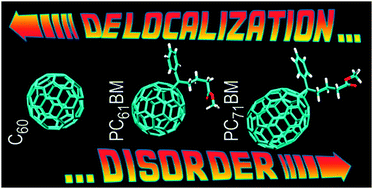
DOI: 10.1039/C5TC03283K, Paper
G. D'Avino, Y. Olivier, L. Muccioli, D. Beljonne
We address the question of charge delocalization in amorphous and crystalline fullerene solids by performing state of the art calculations encompassing force-field molecular dynamics, microelectrostatic and quantum-chemical methods.
The content of this RSS Feed (c) The Royal Society of Chemistry
01 Dec 20:33
by Nikhita D. Mansukhani, Linda M. Guiney, Peter J. Kim, Yichao Zhao, Diego Alducin, Arturo Ponce, Eduardo Larios, Miguel Jose Yacaman, Mark C. Hersam

Conditions for the dispersion of molybdenum disulfide (MoS2) in aqueous solution at concentrations up to 0.12 mg mL−1 using a range of nonionic, biocompatible block copolymers (i.e., Pluronics and Tetronics) are identified. Furthermore, the optimal Pluronic dispersant for MoS2 is found to be effective for a range of other 2D materials such as molybdenum diselenide, tungsten diselenide, tungsten disulfide, tin selenide, and boron nitride.
01 Dec 19:52
Publication date: 15 February 2016
Source:Wear, Volumes 348–349
Author(s): Ane Maite Martinez, Jon Echeberria
During braking, high temperatures can be generated on the contact surfaces and inside the brake pads. Solid lubricants, i.e., metal sulphides, play an important role in brake performance, but they can react, oxidise or decompose with exposure to temperature, modifying their tribological properties. This paper investigates the chemical reactions between different metal powders (Cu, Fe, Sn and Zn) and Sb2S3 that take place in a low-metallic brake pad during braking in conditions were high temperature is generated. The reaction products were characterised by SEM–EDS and the glancing XRD technique. Moreover, thermal treatments (in air and argon) of binary mixtures, containing the same weight ratio of these metal powders and Sb2S3 contained in the brake pad, were carried out and analysed via DSC–TGA and XRD techniques. The paper finds that the reaction features and reaction products depend on the temperature generated during braking, the specific combination of metal/lubricant and the atmosphere conditions (oxidant or inert). In general, the reaction products are a combination of an intermetallic (metallic antimonide) and a metal sulphide (from the metal powder), which can be found both on the surface and inside the brake pad.
24 Nov 11:53
by Punarja Kevin, Mohammad Azad Malik, Simon Mcadams and Paul O’Brien

Journal of the American Chemical Society
DOI: 10.1021/jacs.5b10281