22 Apr 17:41
by Frédéric Laquai
Nature Materials 13, 429 (2014).
doi:10.1038/nmat3953
Author: Frédéric Laquai
The demonstration of amplified spontaneous emission from thin films of perovskites could pave the way to solution-processed low-cost lasers that can be easily tuned across the entire visible spectrum.

22 Apr 17:38
J. Mater. Chem. C, 2014, 2,4395-4400
DOI: 10.1039/C4TC00063C, Paper
Dengteng Ge, Lili Yang, Gaoxiang Wu, Shu Yang
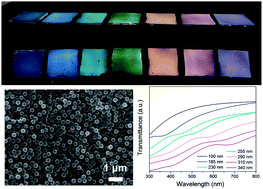
Angle-independent full-colour films were fabricated by spray-coating monodispersed silica nanoparticles of different sizes (100-340 nm in diameter) to form quasi-amorphous structures. Our analysis suggests that the structure colour arose from a combination of constructive interference and Rayleigh scattering.
The content of this RSS Feed (c) The Royal Society of Chemistry
22 Apr 17:34
by Srinivasa Reddy Tamalampudi, Yi-Ying Lu, Rajesh Kumar U., Raman Sankar, Chun-Da Liao, Karukanara Moorthy B., Che-Hsuan Cheng, Fang Cheng Chou and Yit-Tsong Chen

Nano Letters
DOI: 10.1021/nl500817g

22 Apr 17:27
by Bilu Liu, Liang Chen, Gang Liu, Ahmad N. Abbas, Mohammad Fathi and Chongwu Zhou

ACS Nano
DOI: 10.1021/nn5015215

22 Apr 17:25
by Whitney Bryks, Melissa Wette, Nathan Velez, Su-Wen Hsu and Andrea R. Tao

Journal of the American Chemical Society
DOI: 10.1021/ja500786p

22 Apr 17:24
by Yongqing Cai, Gang Zhang and Yong-Wei Zhang

Journal of the American Chemical Society
DOI: 10.1021/ja4109787

riel and -1 others like this
22 Apr 17:24
by Lifen Wang, Zhi Xu, Wenlong Wang and Xuedong Bai

Journal of the American Chemical Society
DOI: 10.1021/ja501686w

20 Apr 17:01
by Bin Su, Cong Zhang, Shuoran Chen, Xingye Zhang, Linfeng Chen, Yuchen Wu, Yiwen Nie, Xiaonan Kan, Yanlin Song, Lei Jiang

Alignment of 1D assemblies of a wide variety of nanoparticles (e.g., metal, metal oxide, semiconductor quantum dots, or organic microspheres) in one direction upon diverse substrates (including industrial silicon wafers and transparent glass plates) by a general strategy is demonstrated. This sandwich method provides an efficient way of rapidly and precisely assembling nanoparticles on a large scale (up to 10 cm × 10 cm) for device applications.
18 Apr 22:17
by Feng-Chuan Chuang, Liang-Zi Yao, Zhi-Quan Huang, Yu-Tzu Liu, Chia-Hsiu Hsu, Tanmoy Das, Hsin Lin and Arun Bansil

Nano Letters
DOI: 10.1021/nl500206u

18 Apr 22:14
by Vincent Consonni, Eirini Sarigiannidou, Estelle Appert, Amandine Bocheux, Sophie Guillemin, Fabrice Donatini, Ivan-Christophe Robin, Joseph Kioseoglou and Florence Robaut

ACS Nano
DOI: 10.1021/nn500620t

ziyang and -1 others like this
17 Apr 17:41
J. Mater. Chem. A, 2014, 2,9944-9947
DOI: 10.1039/C4TA01755B, Communication
Martina Sandroni, Ludovic Favereau, Aurelien Planchat, Huriye Akdas-Kilig, Nadine Szuwarski, Yann Pellegrin, Errol Blart, Hubert Le Bozec, Mohammed Boujtita, Fabrice Odobel
Record photoconversion efficiency was achieved in DSC with stable heteroleptic bisdiimine complexes prepared by HETPHEN strategy.
The content of this RSS Feed (c) The Royal Society of Chemistry
17 Apr 17:16
by Karthik Ramasamy, Hunter Sims, William H. Butler and Arunava Gupta

Chemistry of Materials
DOI: 10.1021/cm5005642

17 Apr 17:16
by Patrick J. Cappillino, Joshua D. Sugar, Farid El Gabaly, Trevor Y. Cai, Zhi Liu, John L. Stickney and David B. Robinson

Langmuir
DOI: 10.1021/la500477s

17 Apr 17:13
by Bhim Chamlagain, Qing Li, Nirmal Jeevi Ghimire, Hsun-Jen Chuang, Meeghage Madusanka Perera, Honggen Tu, Yong Xu, Minghu Pan, Di Xaio, Jiaqiang Yan, David Mandrus and Zhixian Zhou

ACS Nano
DOI: 10.1021/nn501150r

17 Apr 17:13
by Woanseo Park, Jaeyoon Baik, Tae-Young Kim, Kyungjune Cho, Woong-Ki Hong, Hyun-Joon Shin and Takhee Lee

ACS Nano
DOI: 10.1021/nn501019g

17 Apr 17:11
by Jian-jun Wang, Pai Liu, Colin C. Seaton and Kevin M Ryan

Journal of the American Chemical Society
DOI: 10.1021/ja501591n

17 Apr 17:11
by Rabih Makki, Xin Ji, Hedi Mattoussi and Oliver Steinbock

Journal of the American Chemical Society
DOI: 10.1021/ja501941d

16 Apr 18:27
by Marcus L. Böhm, René J. P. Kist, Frederik S. F. Morgenstern, Bruno Ehrler, Salvatore Zarra, Abhishek Kumar, Yana Vaynzof, Neil C. Greenham
CdSe nanocrystals (NCs) can be used as an electron acceptor in solar cells, employing organic ligands to passivate their surface and make them processable from solution. The nature and abundance of impurities present after NC ligand exchange from oleic acid to n-butylamine are identified. A further purification step using hexane as a selective solvent is described, which excludes NC aggregates from solution. The influence of NC aggregates on photovoltaic device performance is studied in a CdSe:poly[2-methoxy-5-(3′,7′-dimethyloctyloxy)-1,4-phenylene vinylene] (MDMO-PPV) bulk heterojunction solar cell. The exclusion of NC aggregates leads to a four-fold increase in device power conversion efficiency (PCE) in optimized devices. A superior blend morphology leading to improved charge generation and a better NC percolation network is identified as the main causes of this increased solar cell performance.

The influence of nanocrystal aggregates on photovoltaic device
performance is studied in a CdSe:poly[2-methoxy-5-(3′,7′-dimethyloctyloxy)-1,4-phenylene vinylene] (MDMO-PPV) bulk heterojunction solar cell. The exclusion of CdSe aggregates yields a superior blend morphology leading to improved charge generation and better percolation in the nanocrystal component. Solar cells with treated nanocrystals show a significant increase in device performance.
16 Apr 18:26
Dalton Trans., 2014, 43,9481-9485
DOI: 10.1039/C4DT00688G, Paper
Chunyu Jin, Parthiban Ramasamy, Jinkwon Kim
CZTSe nanoparticles were synthesized using bis-(triethylsilyl)selenide as the selenium source for the first time. The effect of reaction time and precursor injection order on the formation of stoichiometric CZTSe nanoparticles has been studied by Raman spectroscopy.
The content of this RSS Feed (c) The Royal Society of Chemistry

16 Apr 18:23
J. Mater. Chem. C, 2014, 2,5787-5792
DOI: 10.1039/C4TC00480A, Paper
M. D. Smith, E. Taylor, T. C. Sadler, V. Z. Zubialevich, K. Lorenz, H. N. Li, J. O'Connell, E. Alves, J. D. Holmes, R. W. Martin, P. J. Parbrook
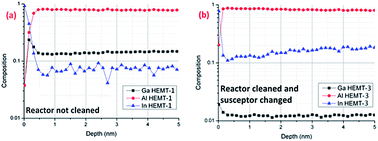
Ga auto-incorporation was detected in nominal InAlN layers grown by MOCVD, suppressed by modification of flow rates and reactor cleaning.
The content of this RSS Feed (c) The Royal Society of Chemistry
16 Apr 18:21
J. Mater. Chem. A, 2014, 2,10116-10125
DOI: 10.1039/C3TA15310J, Paper
Ruchi Gakhar, Augustus Merwin, Kodi Summers, Satyananda Kishore Pilli, Dev Chidambaram
Photoelectrochemical performance of ZnxCd1-xSe quantum dot-sensitized titania nanotube array photoelectrodes is investigated as a function of deposition time and annealing temperature.
The content of this RSS Feed (c) The Royal Society of Chemistry
16 Apr 18:10
by Mohamed Asbahi, Shafigh Mehraeen, Kevin T. P. Lim, Fuke Wang, Jianshu Cao, Mei Chee Tan and Joel K. W. Yang

Nano Letters
DOI: 10.1021/nl5004976

16 Apr 18:09
by Haotian Wang, Zhiyi Lu, Desheng Kong, Jie Sun, Thomas M. Hymel and Yi Cui

ACS Nano
DOI: 10.1021/nn500959v

16 Apr 18:08
by Ramy Nashed, Paul Szymanski, Mostafa A. El-Sayed and Nageh K. Allam

ACS Nano
DOI: 10.1021/nn5009066

15 Apr 15:29
Publication date: July 2014
Source:Tribology International, Volume 75
Author(s): D. Holmes , S. Sharifi , M.M. Stack
Stainless steel can be used as a dental implant. However, there has been little work on the micro-abrasion of such materials in laboratory simulated oral environments, where abrasion, sliding wear can interact simultaneously. In this study, the effects of applied load, and exposure time were evaluated for a 316 stainless steel in a laboratory simulated artificial saliva. Polarization curves showed an enhancement of corrosion current density with increases in applied load. Wear maps were produced showing wear safety regimes at intermediate loads and exposure times. Possible reasons for such trends are interpreted in terms of the ability of the passive film in providing resistance against third body particle impact and the concentration of particles in the contact at higher loads.
15 Apr 15:25
by Teng Xu and Virginia A. Davis

Langmuir
DOI: 10.1021/la405013h

15 Apr 15:24
by Zhen-Hua Ge, James R. Salvador and George S. Nolas

Inorganic Chemistry
DOI: 10.1021/ic500100e

15 Apr 15:21
by Alesja Ivanova, Dina Fattakhova-Rohlfing, Bugra Eymer Kayaalp, Jiri Rathouský and Thomas Bein

Journal of the American Chemical Society
DOI: 10.1021/ja411292u

14 Apr 15:13
by Guang Han, Zhi-Gang Chen, John Drennan, Jin Zou
Indium selenides have attracted extensive attention in high-efficiency thermoelectrics for waste heat energy conversion due to their extraordinary and tunable electrical and thermal properties. This Review aims to provide a thorough summary of the structural characteristics (e.g. crystal structures, phase transformations, and structural vacancies) and synthetic methods (e.g. bulk materials, thin films, and nanostructures) of various indium selenides, and then summarize the recent progress on exploring indium selenides as high-efficiency thermoelectric materials. By highlighting challenges and opportunities in the end, this Review intends to shine some light on the possible approaches for thermoelectric performance enhancement of indium selenides, which should open up an opportunity for applying indium selenides in the next-generation thermoelectric devices.

Indium selenides recently emerged as high-efficiency thermoelectric materials for waste heat energy conversion. This Review provides a thorough summary of the structural characteristics, synthetic methods, and thermoelectric properties of various indium selenides. By highlighting challenges and opportunities, this Review intends to shine some light on the possible approaches for thermoelectric performance enhancement of indium selenides.
14 Apr 15:11
Chem. Commun., 2014, 50,5604-5607
DOI: 10.1039/C4CC01689K, Communication
Fangmao Ye, Changfeng Wu, Wei Sun, Jiangbo Yu, Xuanjun Zhang, Yu Rong, Yue Zhang, I-Che Wu, Yang-Hsiang Chan, Daniel T. Chiu
This communication describes an approach for preparing monovalent semiconducting polymer dots (mPdots) where each mPdot was composed of a single active functional group.
The content of this RSS Feed (c) The Royal Society of Chemistry