Shared posts

29 Apr 21:12

Synthesis of a Self-Assembled Hg(II)-Dithiocarbamate Metallomacrocycle

by Edmundo Guzmán-Percástegui, Lev N. Zakharov, José G. Alvarado-Rodríguez, Matthew E. Carnes and Darren W. Johnson

TOC Graphic

Crystal Growth & Design
DOI: 10.1021/cg401894h
29 Apr 21:12

A Three-Dimensional Hetero-Bimetallic Coordination Polymer with Unusual (4,5)-Connected Topology and Ferrimagnetic Property Based on Octacyanotungstate and Polydentate Ligand

by Jun Qian, Jingchun Hu, Hirofumi Yoshikawa, Jinfang Zhang, Kunio Awaga and Chi Zhang

TOC Graphic

Crystal Growth & Design
DOI: 10.1021/cg4019053
29 Apr 14:22

Introducing Deep Eutectic Solvents to Polar Organometallic Chemistry: Chemoselective Addition of Organolithium and Grignard Reagents to Ketones in Air

by Cristian Vidal, Joaquín García-Álvarez, Alberto Hernán-Gómez, Alan R. Kennedy, Eva Hevia

Abstract

Despite their enormous synthetic relevance, the use of polar organolithium and Grignard reagents is greatly limited by their requirements of low temperatures in order to control their reactivity as well as the need of dry organic solvents and inert atmosphere protocols to avoid their fast decomposition. Breaking new ground on the applications of these commodity organometallics in synthesis under more environmentally friendly conditions, this work introduces deep eutetic solvents (DESs) as a green alternative media to carry out chemoselective additions of ketones in air at room temperature. Comparing their reactivities in DES with those observed in pure water suggest that a kinetic activation of the alkylating reagents is taking place, favoring nucleophilic addition over the competitive hydrolysis, which can be rationalized through formation of halide-rich magnesiate or lithiate species.

Thumbnail image of graphical abstract

Turning lithium green: A new protocol for the selective addition of Grignard and organolithium reagents to ketones in green, biorenewable, and deep eutectic solvents (DESs) is reported. The protocol establishes a bridge between main-group organometallic compounds and green solvents (ChCl=choline chloride; see picture). The DESs are superior reaction media for highly polar organometallic compounds.

29 Apr 13:11

Nanocrystalline tin disulfide coating of reduced graphene oxide produced by the peroxostannate deposition route for sodium ion battery anodes

J. Mater. Chem. A, 2014, 2,8431-8437
DOI: 10.1039/C3TA15248K, Paper
Petr V. Prikhodchenko, Denis Y. W. Yu, Sudip K. Batabyal, Vladimir Uvarov, Jenny Gun, Sergey Sladkevich, Alexey A. Mikhaylov, Alexander G. Medvedev, Ovadia Lev
A highly stable Na+ ion battery anode was prepared by deposition of hydroperoxostannate on graphene oxide from H2O2-rich solution followed by sulfidization and heat treatment.
The content of this RSS Feed (c) The Royal Society of Chemistry
28 Apr 18:02

Frictional Behavior of Atomically Thin Sheets: Hexagonal-Shaped Graphene Islands Grown on Copper by Chemical Vapor Deposition

by Philip Egberts, Gang Hee Han, Xin Z. Liu, A. T. Charlie Johnson and Robert W. Carpick

TOC Graphic

ACS Nano
DOI: 10.1021/nn501085g
26 Apr 09:44

Single white light emitting hybrid nanoarchitectures based on functionalized quantum dots

J. Mater. Chem. C, 2014, 2,5286-5291
DOI: 10.1039/C4TC00623B, Paper
Elisabetta Fanizza, Carmine Urso, Vita Pinto, Antonio Cardone, Roberta Ragni, Nicoletta Depalo, M. Lucia Curri, Angela Agostiano, Gianluca M. Farinola, Marinella Striccoli
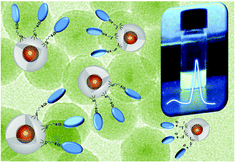
Colloidal single white emitting architectures were produced engineering the size and chemistry of QDs, to complement the emission of an organic blue fluorophore, and tuning their relative amount on functionalized silica beads.
The content of this RSS Feed (c) The Royal Society of Chemistry
26 Apr 09:44

Investigating the role of polytypism in the growth of multi-shell CdSe/CdZnS quantum dots

J. Mater. Chem. C, 2014, 2,4659-4666
DOI: 10.1039/C4TC00806E, Paper
Somak Majumder, In-Tae Bae, Mathew M. Maye
The role that polytypic crystal growth has on the morphology and structure of multishelled giant quantum dots (gQDs) is studied. Using both zinc blende and wurtzite CdSe cores, shells consisting of a CdxZn1-xS gradient were deposited by SILAR process and studied by XRD.
The content of this RSS Feed (c) The Royal Society of Chemistry
26 Apr 09:40

Au Nanodisk-Core Multishell Nanoparticles: Synthetic Method for Controlling Number of Shells and Intershell Distance

by Soonchang Hong, Jesus A. I. Acapulco, Ho Young Jang and Sungho Park
DJL

Au revoir

TOC Graphic

Chemistry of Materials
DOI: 10.1021/cm500846w
26 Apr 09:38

Monopicolinate Cross-Bridged Cyclam Combining Very Fast Complexation with Very High Stability and Inertness of Its Copper(II) Complex

by Luís M. P. Lima, Zakaria Halime, Ronan Marion, Nathalie Camus, Rita Delgado, Carlos Platas-Iglesias and Raphaël Tripier

TOC Graphic

Inorganic Chemistry
DOI: 10.1021/ic500491c
26 Apr 09:37

d-Penicillamine Tripodal Derivatives as Efficient Copper(I) Chelators

by Anne-Solène Jullien, Christelle Gateau, Colette Lebrun, Isabelle Kieffer, Denis Testemale and Pascale Delangle
DJL

The 3d pen is good for cheating copper

TOC Graphic

Inorganic Chemistry
DOI: 10.1021/ic5004319
26 Apr 09:35

Over 40 cd/A Efficient Green Quantum Dot Electroluminescent Device Comprising Uniquely Large-Sized Quantum Dots

by Ki-Heon Lee, Jeong-Hoon Lee, Hee-Don Kang, Byoungnam Park, Yongwoo Kwon, Heejoo Ko, Changho Lee, Jonghyuk Lee and Heesun Yang

TOC Graphic

ACS Nano
DOI: 10.1021/nn500852g
25 Apr 14:34

Synthesis of Cu2ZnSnS4 thin films directly onto conductive substrates via selective thermolysis using microwave energy

Chem. Commun., 2014, 50,5902-5904
DOI: 10.1039/C3CC49207A, Communication
Theodore R. Knutson, Parker J. Hanson, Eray S. Aydil, R. Lee Penn
Copper zinc tin sulfide (CZTS) thin films were deposited from homogeneous solutions of precursors and directly onto conductive films via selective thermolysis by microwave heating.
The content of this RSS Feed (c) The Royal Society of Chemistry
25 Apr 14:27

Bright Coppertunities: Multinuclear CuI Complexes with N–P Ligands and Their Applications

by Manuela Wallesch, Daniel Volz, Daniel M. Zink, Ute Schepers, Martin Nieger, Thomas Baumann, Stefan Bräse
DJL

BRIGHT COPPERTUNITIES

Abstract

Easy come, easy go: the great structural diversity of CuI complexes is an ambivalent trait. Apart from the well-known catalytic properties of CuI, a great number of potent luminescent complexes have been found in the last ten years featuring a plethora of structural motifs. The downside of this variety is the undesired formation of other species upon processing. In here, strategies to avoid this behavior are presented: Only one favorable structural unit often exists for multinuclear CuI complexes with bridging ligands. In addition, these complexes exhibit favorable photophysical properties due to cooperative effects of the metal halide core. Furthermore, we demonstrate the broad range of applications of emitting CuI compounds.

Thumbnail image of graphical abstract

Easy come, easy go: The great structural diversity of CuI complexes is an ambivalent trait. Apart from the well-known catalytic properties of CuI, a great number of potent luminescent complexes (see figure) have been found in the last ten years featuring a plethora of structural motifs. The downside of this variety is the undesired formation of other species upon processing. Strategies to avoid this behavior are presented.

25 Apr 14:25

Lubricating Medical Devices with Fullerene-Like Nanoparticles

Abstract

In the present work, MoS2 nanoparticles with fullerene-like structure, and most particularly those doped with minute amounts of rhenium atoms, are used as additive to medical gels in order to facilitate their entry into constricted openings of soft material rings. This procedure is used to mimic the entry of endoscopes to constricted openings of the human body, like urethra, etc. It is shown that the Re-doped nanoparticles reduce the traction force used to retrieve the metallic lead of the endoscope from the soft ring by a factor close to three times with respect to the original gel. The mechanism of the mitigation of both friction and adhesion forces in these systems by the nanoparticles is discussed.

24 Apr 22:21

p-GaN/n-ZnO Heterojunction Nanowires: Optoelectronic Properties and the Role of Interface Polarity

by Fabian Schuster, Bernhard Laumer, Reza R. Zamani, Cesar Magén, Joan Ramon Morante, Jordi Arbiol and Martin Stutzmann
DJL

It's been and GaN

TOC Graphic

ACS Nano
DOI: 10.1021/nn406134e
24 Apr 22:20

Crystal Structure Control of CdSe Nanocrystals in Growth and Nucleation: Dominating Effects of Surface versus Interior Structure

by Yuan Gao and Xiaogang Peng
DJL

Prof Azad review could've been a beaut

TOC Graphic

Journal of the American Chemical Society
DOI: 10.1021/ja5020025
24 Apr 22:19

Understanding the Synthetic Pathway of a Single-Phase Quarternary Semiconductor Using Surface-Enhanced Raman Scattering: A Case of Wurtzite Cu2ZnSnS4 Nanoparticles

by Joel Ming Rui Tan, Yih Hong Lee, Srikanth Pedireddy, Tom Baikie, Xing Yi Ling and Lydia Helena Wong

TOC Graphic

Journal of the American Chemical Society
DOI: 10.1021/ja501786s
23 Apr 19:05

Dye-Sensitized Solar Cells: Substituting TiCl4–Carbon Nanohorn Interfaces for Dye-Sensitized Solar Cells (Adv. Energy Mater. 6/2014)

by Rubén Casillas, Fabian Lodermeyer, Rubén D. Costa, Maurizio Prato, Dirk M. Guldi
Thumbnail image of graphical abstract

A strategy to introduce semiconducting and mesoporous carbon nanohorns as interlayers in the photoelectrodes of dye-sensitized solar cells, without affecting the overall performance, is reported by Dirk M. Guldi and co-workers in article number 1301577. This provides an easy, clean, and ecofriendly alternative to achieve highefficiency solar cells.

23 Apr 19:05

Comparing the Device Physics and Morphology of Polymer Solar Cells Employing Fullerenes and Non-Fullerene Acceptors

by Jason T. Bloking, Tommaso Giovenzana, Andrew T. Higgs, Andrew J. Ponec, Eric T. Hoke, Koen Vandewal, Sangwon Ko, Zhenan Bao, Alan Sellinger, Michael D. McGehee

There is a need to find electron acceptors for organic photovoltaics that are not based on fullerene derivatives since fullerenes have a small band gap that limits the open-circuit voltage (VOC), do not absorb strongly and are expensive. Here, a phenylimide-based acceptor molecule, 4,7-bis(4-(N-hexyl-phthalimide)vinyl)benzo[c]1,2,5-thiadiazole (HPI-BT), that can be used to make solar cells with VOC values up to 1.11 V and power conversion efficiencies up to 3.7% with two thiophene polymers is demonstrated. An internal quantum efficiency of 56%, compared to 75–90% for polymer-fullerene devices, results from less efficient separation of geminate charge pairs. While favorable energetic offsets in the polymer-fullerene devices due to the formation of a disordered mixed phase are thought to improve charge separation, the low miscibility (<5 wt%) of HPI-BT in polymers is hypothesized to prevent the mixed phase and energetic offsets from forming, thus reducing the driving force for charges to separate into the pure donor and acceptor phases where they can be collected.

Thumbnail image of graphical abstract

A small molecule electron acceptor, 4,7-bis(4-(N-hexyl-phthalimide)vinyl)benzo[c]1,2,5-thiadiazole (HPI-BT), achi­eves efficiencies of 3.7% and open-circuit voltage values of 1.11 V in bulk heterojunction (BHJ) devices with polythiophene donor materials. The lower internal quantum efficiency (56%) in these non-fullerene acceptor devices is attributed to an absence of the favorable energetic offsets resulting from nanoscale mixing of donor and acceptor found in comparable fullerene-based devices.

23 Apr 19:05

Effects of Processing Conditions on the Recombination Reduction in Small Molecule Bulk Heterojunction Solar Cells

by Peter Zalar, Martijn Kuik, Niva A. Ran, John A. Love, Thuc-Quyen Nguyen
Thumbnail image of graphical abstract

The steady-state bimolecular recombination in two solution-processed small molecule organic solar cell blends is studied. Using a variety of different processing conditions, the charge-carrier mobilities and morphological organization are radically changed. Despite these changes, no apparent correlation exists between these observations and the reduced Langevin recombination rate. The reduced Langevin recombination rate may more strongly depend on the donor:acceptor system than the morphology.

23 Apr 19:05

Mesoporous TiO2 Beads Offer Improved Mass Transport for Cobalt-Based Redox Couples Leading to High Efficiency Dye-Sensitized Solar Cells

by Leo-Philipp Heiniger, Fabrizio Giordano, Thomas Moehl, Michael Grätzel

Overcoming ionic diffusion limitations is essential for the development of high-efficiency dye-sensitized solar cells based on cobalt redox mediators. Here, improved mass transport is reported for photoanodes composed of mesoporous TiO2 beads of varying pore sizes and porosities in combination with the high extinction YD2-o-C8 porphyrin dye. Compared to a photoanode made of 20 nm-sized TiO2 particles, electrolyte diffusion through these films is greatly improved due to the large interstitial pores between the TiO2 beads, resulting in up to 70% increase in diffusion-limited current. Simultaneously, transient photocurrent measurements reveal no mass transport limitations for films of up to 10 μm thickness. In contrast, standard photoanodes made of 20 nm-sized TiO2 particles show non-linear behavior in photocurrent under 1 sun illumination for a film thickness as low as 7 μm. By including a transparent thin mesoporous TiO2 underlayer in order to reduce optical losses at the fluorine-doped tin oxide (FTO)-TiO2 interface, an efficiency of 11.4% under AM1.5G 1 sun illumination is achieved. The combination of high surface area, strong scattering behavior, and high porosity makes these mesoporous TiO2 beads particularly suitable for dye-sensitized solar cells using bulky redox couples and/or viscous electrolytes.

Thumbnail image of graphical abstract

Mass transport for cobalt-based electrolytes in dye-sensitized solar cells is facilitated by replacing the standard nanocrystalline TiO2 film with a film composed of mesoporous TiO2 beads. The combination of strong light scattering with improved electrolyte diffusion makes such structures promising alternatives to standard nanocrystalline TiO2.

23 Apr 19:05

Passivation of ZnO Nanowire Guests and 3D Inverse Opal Host Photoanodes for Dye-Sensitized Solar Cells

by Philippe Labouchere, Aravind Kumar Chandiran, Thomas Moehl, Hauke Harms, Sudam Chavhan, Ramon Tena-Zaera, Mohammad Khaja Nazeeruddin, Michael Graetzel, Nicolas Tetreault
Thumbnail image of graphical abstract

A hierarchical host-guest nanostructured photoanode is reported for dye-sensitized solar cells. It is composed of ZnO nano­wires grown in situ into the macropores of a 3D ZnO inverse opal structure, which acts both as a seed layer and as a conductive backbone host. Using a combination of self-assembly, hydrothermal or electrodeposition of single crystalline ZnO nanowires and TiO2 passivation, a novel photoanode with scattering capability for optimal light harvesting is fabricated.

23 Apr 19:01

The activation of Woollins' reagent. Isolation of pyridine stabilised PhPSe2

Chem. Commun., 2014, 50,6214-6216
DOI: 10.1039/C4CC01073F, Communication
Laura Ascherl, Andreas Nordheider, Kasun S. Athukorala Arachchige, David B. Cordes, Konstantin Karaghiosoff, Michael Buhl, Alexandra M. Z. Slawin, J. Derek Woollins
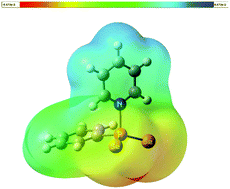
Reaction of Woollins' reagent (WR) with pyridine yields the P(V) species PhPSe2 stabilised by pyridine coordination. Its potential as a selenation reagent under mild conditions was shown by calculations and an experimental comparison to WR.
The content of this RSS Feed (c) The Royal Society of Chemistry
23 Apr 19:00

The combinations of hollow MoS2 micro@nano-spheres: one-step synthesis, excellent photocatalytic and humidity sensing properties

J. Mater. Chem. C, 2014, 2,5422-5430
DOI: 10.1039/C4TC00423J, Paper
Yinghua Tan, Ke Yu, Ting Yang, Qingfeng Zhang, Weitao Cong, Haihong Yin, Zhengli Zhang, Yiwei Chen, Ziqiang Zhu
Hollow MoS2 micro@nano-spheres were successfully fabricated. The MoS2 nanostructures showed excellent photocatalytic activity and high sensitivity at high RH.
The content of this RSS Feed (c) The Royal Society of Chemistry
23 Apr 18:55

Facile Droplet-based Microfluidic Synthesis of Monodisperse IV–VI Semiconductor Nanocrystals with Coupled In-Line NIR Fluorescence Detection

by Ioannis Lignos, Loredana Protesescu, Stavros Stavrakis, Laura Piveteau, Mark J. Speirs, Maria A. Loi, Maksym V. Kovalenko and Andrew J. deMello

TOC Graphic

Chemistry of Materials
DOI: 10.1021/cm500774p
23 Apr 18:54

Photonic–Plasmonic Coupling of GaAs Single Nanowires to Optical Nanoantennas

by Alberto Casadei, Emanuele F. Pecora, Jacob Trevino, Carlo Forestiere, Daniel Rüffer, Eleonora Russo-Averchi, Federico Matteini, Gozde Tutuncuoglu, Martin Heiss, Anna Fontcuberta i Morral and Luca Dal Negro

TOC Graphic

Nano Letters
DOI: 10.1021/nl404253x
23 Apr 18:52

Postgrowth Tuning of the Bandgap of Single-Layer Molybdenum Disulfide Films by Sulfur/Selenium Exchange

by Quan Ma, Miguel Isarraraz, Chen S. Wang, Edwin Preciado, Velveth Klee, Sarah Bobek, Koichi Yamaguchi, Emily Li, Patrick Michael Odenthal, Ariana Nguyen, David Barroso, Dezheng Sun, Gretel von Son Palacio, Michael Gomez, Andrew Nguyen, Duy Le, Greg Pawin, John Mann, Tony. F. Heinz, Talat Shahnaz Rahman and Ludwig Bartels

TOC Graphic

ACS Nano
DOI: 10.1021/nn5004327
23 Apr 18:51

Multistack Integration of Three-Dimensional Hyperbranched Anatase Titania Architectures for High-Efficiency Dye-Sensitized Solar Cells

by Wu-Qiang Wu, Yang-Fan Xu, Hua-Shang Rao, Cheng-Yong Su and Dai-Bin Kuang

TOC Graphic

Journal of the American Chemical Society
DOI: 10.1021/ja5015635
23 Apr 18:49

Lead Halide Perovskites and Other Metal Halide Complexes As Inorganic Capping Ligands for Colloidal Nanocrystals

by Dmitry N. Dirin, Sébastien Dreyfuss, Maryna I. Bodnarchuk, Georgian Nedelcu, Paris Papagiorgis, Grigorios Itskos and Maksym V. Kovalenko

TOC Graphic

Journal of the American Chemical Society
DOI: 10.1021/ja5006288
22 Apr 17:33

Resonant Tunneling through Discrete Quantum States in Stacked Atomic-Layered MoS2

by Linh-Nam Nguyen, Yann-Wen Lan, Jyun-Hong Chen, Tay-Rong Chang, Yuan-Liang Zhong, Horng-Tay Jeng, Lain-Jong Li and Chii-Dong Chen

TOC Graphic

Nano Letters
DOI: 10.1021/nl404790n