12 May 18:34
by Yu Wang, Yufeng Wang, Xiaolong Zheng, Gi-Ra Yi, Stefano Sacanna, David J. Pine and Marcus Weck

Journal of the American Chemical Society
DOI: 10.1021/ja502699p

08 May 18:46
by Jing Wu, Hennrik Schmidt, Kiran Kumar Amara, Xiangfan Xu, Goki Eda and Barbaros Özyilmaz

Nano Letters
DOI: 10.1021/nl500666m

06 May 16:41
J. Mater. Chem. C, 2014, 2,5411-5416
DOI: 10.1039/C4TC00679H, Paper
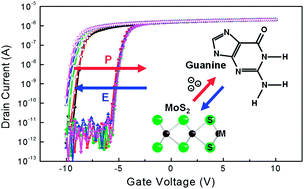
Junyeong Lee, Sung-Wook Min, Hee Sung Lee, Yeonjin Yi, Seongil Im
Charge injection memory transistors are demonstrated to be promising as a result of the unique properties of the MoS2 nanosheet channel and guanine trapping layer.
The content of this RSS Feed (c) The Royal Society of Chemistry
06 May 08:47
by Tsz-Wai Ng, Ming-Fai Lo, Man-Keung Fung, Wen-Jun Zhang, Chun-Sing Lee
Charge transfer and interactions at organic heterojunctions (OHJs) are known to have critical influences on various properties of organic electronic devices. In this Research News article, a short review is given from the electronic viewpoint on how the local molecular interactions and interfacial energetics at P/N OHJs contribute to the recombination/dissociation of electron-hole pairs. Very often, the P-type materials donate electrons to the N-type materials, giving rise to charge-transfer complexes (CTCs) with a Pδ+–Nδ− configuration. A recently observed opposite charge-transfer direction in OHJs is also discussed (i.e., N-type material donates electrons to P-type material to form Pδ−–Nδ+). Recent studies on the electronic structures of CTC-forming material pairs are also summarized. The formation of Pδ−–Nδ+-type CTCs and their correlations with exciplex emission are examined. Furthermore, the potential applications of CTCs in NIR photovoltaic devices are reviewed.

Local molecular interactions and interfacial energetics at organic P/N junctions contribute to their role in the recombination/dissociation of electron-hole pairs. Recent accomplishments regarding the electronic structures of charge-transfer-complex-forming material pairs and their role in exciplex emission and near-IR photocharge generation using wide-energy-gap semiconductors are highlighted.
06 May 08:44
by Catherine E. Housecroft
05 May 17:28
by Qingwen Tian, Gang Wang, Wangen Zhao, Yanyan Chen, Yanchun Yang, Lijian Huang and Daocheng Pan

Chemistry of Materials
DOI: 10.1021/cm5002412

ziyang and -1 others like this
02 May 13:04
Chem. Soc. Rev., 2014, 43,5288-5301
DOI: 10.1039/C4CS00060A, Review Article
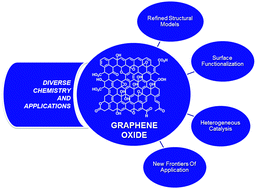
Daniel R. Dreyer, Alexander D. Todd, Christopher W. Bielawski
The chemistry of graphene oxide is revisited, and includes an update on recent developments and potential applications.
The content of this RSS Feed (c) The Royal Society of Chemistry

02 May 13:03
J. Mater. Chem. A, 2014, Advance Article
DOI: 10.1039/C4TA01543F, Paper

Open Access
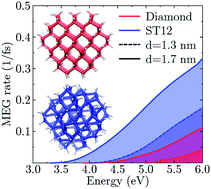
Marton Voros, Stefan Wippermann, Balint Somogyi, Adam Gali, Dario Rocca, Giulia Galli, Gergely T. Zimanyi
Germanium nanoparticles with ST12 core structure show higher Multiple Exciton Generation (MEG) rates at lower energies than nanoparticles with the same diameter but with the usual diamond core structure, making ST12 Ge nanoparticles a promising platform for implementing MEG in solar cells.
To cite this article before page numbers are assigned, use the DOI form of citation above.
The content of this RSS Feed (c) The Royal Society of Chemistry
02 May 13:03
J. Mater. Chem. A, 2014, 2,10568-10576
DOI: 10.1039/C4TA01469C, Paper
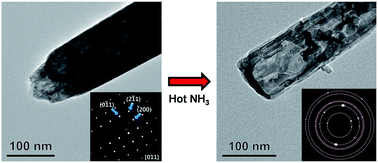
Jae Hee Han, Jin Ho Bang
A new mechanism of Kirkendall void formation has been discovered in the synthesis of hollow titanium oxynitride arrays by the nitridation of TiO2.
The content of this RSS Feed (c) The Royal Society of Chemistry
02 May 13:02
J. Mater. Chem. A, 2014, 2,10355-10358
DOI: 10.1039/C4TA01105H, Communication
Qiong Wang, Jung-Ho Yun, Meng Zhang, Hongjun Chen, Zhi-Gang Chen, Lianzhou Wang
We report organo-lead halide perovskite CH3NH3PbI(3-x)Clx solution as a new type of liquid electrolyte in dye-sensitized solar cells (DSCs) delivering an efficiency of 8.19%.
The content of this RSS Feed (c) The Royal Society of Chemistry
02 May 13:02
J. Mater. Chem. A, 2014, 2,11171-11176
DOI: 10.1039/C4TA01643B, Paper
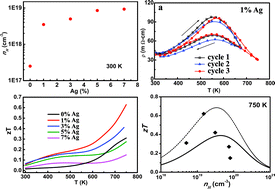
Cheng-Lung Chen, Heng Wang, Yang-Yuan Chen, Tristan Day, G. Jeffrey Snyder
Doped polycrystalline SnSe could have zT 0.6 at 750 K, suggesting good potential for thermoelectrics. Challenges come from difficulty in doping and hysteresis in resistivity.
The content of this RSS Feed (c) The Royal Society of Chemistry
02 May 13:02
J. Mater. Chem. A, 2014, 2,10389-10395
DOI: 10.1039/C4TA01658K, Paper
B. D. Chernomordik, A. E. Beland, N. D. Trejo, A. A. Gunawan, D. D. Deng, K. A. Mkhoyan, E. S. Aydil
A method for rapid synthesis of 2-40 nm diameter nanocrystal dispersions of the emerging sustainable thin-film solar absorber copper zinc tin sulfide is reported: the average crystals size is controlled by varying the synthesis temperature between 150 [degree]C and 340 [degree]C. Films cast from larger nanocrystals, are crack-free and suitable for making thin film solar cells.
The content of this RSS Feed (c) The Royal Society of Chemistry
02 May 12:59
by Ryan Atkins, Michelle Dolgos, Andreas Fiedler, Corinna Grosse, Saskia F. Fischer, Sven P. Rudin and David C. Johnson

Chemistry of Materials
DOI: 10.1021/cm5004774

01 May 14:02
by Espen D. Bøjesen, Kirsten M. Ø. Jensen, Christoffer Tyrsted, Nina Lock, Mogens Christensen and Bo B. Iversen

Crystal Growth & Design
DOI: 10.1021/cg5000606

01 May 11:23
Chem. Commun., 2014, 50,6319-6321
DOI: 10.1039/C4CC02592J, Communication
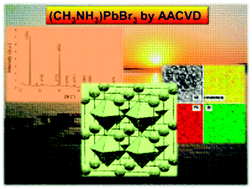
David J. Lewis, Paul O'Brien
The inorganic-organic perovskite (CH3NH3)PbBr3, which is potentially important in photovoltaics, has been deposited using aerosol-assisted chemical vapour deposition (AACVD).
The content of this RSS Feed (c) The Royal Society of Chemistry

30 Apr 19:12
Chem. Commun., 2014, 50,7776-7779
DOI: 10.1039/C4CC01347F, Communication
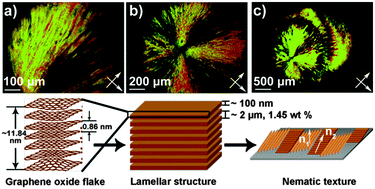
Liping Tong, Wei Qi, Mengfan Wang, Renliang Huang, Rongxin Su, Zhimin He
Liquid crystallinity of graphite oxide prepared without the aid of sonication was observed, which exhibited a spontaneous highly-ordered alignment.
The content of this RSS Feed (c) The Royal Society of Chemistry

30 Apr 19:11
Dalton Trans., 2014, 43,9226-9233
DOI: 10.1039/C4DT00407H, Paper
Richard O. Bonsu, Hankook Kim, Christopher O'Donohue, Roman Y. Korotkov, K. Randall McClain, Khalil A. Abboud, Ashley A. Ellsworth, Amy V. Walker, Timothy J. Anderson, Lisa McElwee-White
Volatile partially fluorinated tungsten(VI) oxo-alkoxides yield tungsten oxide nanorods upon chemical vapour deposition.
The content of this RSS Feed (c) The Royal Society of Chemistry

30 Apr 19:10
Dalton Trans., 2014, 43,11493-11501
DOI: 10.1039/C4DT00489B, Paper
Bingyu Xu, Xi Cao, Guofeng Wang, Ying Li, Yuping Wang, Jiamin Su
String SrWO4:Eu3+ nanobeans were prepared by a hydrothermal method. The effects of the initial reactant content on the phase compositions, morphologies, and luminescence properties of SrWO4:Eu3+ were investigated. Multicolor luminescence tuning of SrWO4:Eu3+ was successfully achieved.
The content of this RSS Feed (c) The Royal Society of Chemistry

30 Apr 19:10
Dalton Trans., 2014, 43,10340-10354
DOI: 10.1039/C4DT00147H, Perspective
Makoto Ogawa, Kanji Saito, Minoru Sohmiya
The effects of the spatial distribution of functional units in the interlayer space of intercalation compounds are discussed.
The content of this RSS Feed (c) The Royal Society of Chemistry

30 Apr 19:08
J. Mater. Chem. A, 2014, Advance Article
DOI: 10.1039/C4TA00836G, Paper
Minwoo Nam, Donghyeuk Choi, Sungwoo Kim, Sunghee Lee, Keekeun Lee, Sang-Wook Kim
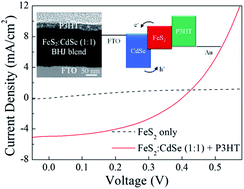
All-inorganic bulk heterojunction solar cells with an inverted structure are developed using iron pyrite (FeS2) nanocrystals and CdSe quantum dots.
To cite this article before page numbers are assigned, use the DOI form of citation above.
The content of this RSS Feed (c) The Royal Society of Chemistry
30 Apr 19:07
J. Mater. Chem. A, 2014, 2,11382-11390
DOI: 10.1039/C4TA01881H, Paper
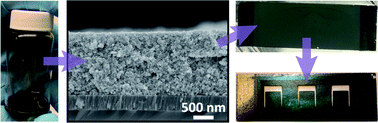
Mohammed Aziz Ibrahem, Wei-Chih Huang, Tian-wey Lan, Karunakara Moorthy Boopathi, Yu-Chen Hsiao, Chih-Han Chen, Widhya Budiawan, Yang-Yuan Chen, Chia-Seng Chang, Lain-Jong Li, Chih-Hung Tsai, Chih Wei Chu
A one-step process for the preparation of NbSe2 nanostructures under the effects of mechanical forces to be used as Pt replacement CEs in DSSCs is reported.
The content of this RSS Feed (c) The Royal Society of Chemistry
30 Apr 19:06
by Xuli Ding, Hong Sun, Xiaofeng Gu
The experimental results of the direct deposition of graphene films on a gallium nitride (GaN)/sapphire substrate by catalyst-free atmospheric pressure (AP)CVD are presented. The quality and thickness of the synthesized samples can be controlled by the growth conditions. The prepared graphene/GaN samples show excellent optical transparency especially in the visible and infrared wavebands. The electrical transport properties are studied in the temperature range 4–300 K. The results indicate an advance step towards graphene-based applications in microelectronics and optoeletronics.

Experimental results of the direct deposition of graphene films on gallium nitride (GaN)/sapphire substrates by catalyst-free, atmospheric pressure CVD are presented. The quality and thickness of the synthesized samples can be controlled by the growth conditions. The Raman mappings are reported. The measured optical transparency and electrical transport show promising potential for the application of graphene/GaN compounds in microelectronics and optoelectronics.
30 Apr 19:05
by Enrico Mugnaioli, José Reyes-Gasga, Ute Kolb, Joseph Hemmerlé, Étienne F. Brès
Abstract
Herein, we investigate human single hydroxyapatite crystals (enamel and dentine) by convergent-beam electron diffraction (CBED) and automated electron-diffraction tomography (ADT). The CBED pattern shows the absence of the mirror plane perpendicular to the c axis leading to the P63 space group instead of the P63/m space group considered for larger-scale crystals, this is confirmed by ADT. This experimental evidence is of prime importance for understanding the morphogenesis and the architectural organization of calcified tissues.

Human single hydroxyapatite crystals (enamel and dentine; see figure) were investigated by convergent-beam electron diffraction (CBED) and automated electron-diffraction tomography (ADT). The CBED pattern shows the absence of the mirror plane perpendicular to the c axis leading to the P63 space group instead of the P63/m space group considered for larger-scale crystals. This is confirmed by ADT. This experimental evidence is of prime importance for understanding the morphogenesis and the architectural organization of calcified tissues.
30 Apr 19:05
by Ethan B. Secor, Sooman Lim, Heng Zhang, C. Daniel Frisbie, Lorraine F. Francis, Mark C. Hersam

Gravure printing of graphene is demonstrated for the rapid production of conductive patterns on flexible substrates. Development of suitable inks and printing parameters enables the fabrication of patterns with a resolution down to 30 μm. A mild annealing step yields conductive lines with high reliability and uniformity, providing an efficient method for the integration of graphene into large-area printed and flexible electronics.
30 Apr 19:03
by Cécile Bouet, Donatien Laufer, Benoit Mahler, Brice Nadal, Hadrien Heuclin, Silvia Pedetti, Gilles Patriarche and Benoit Dubertret

Chemistry of Materials
DOI: 10.1021/cm5008608

gjchen and -1 others like this
30 Apr 19:03
by Xi Ling, Wenjing Fang, Yi-Hsien Lee, Paulo T. Araujo, Xu Zhang, Joaquin F. Rodriguez-Nieva, Yuxuan Lin, Jin Zhang, Jing Kong and Mildred S. Dresselhaus

Nano Letters
DOI: 10.1021/nl404610c

30 Apr 11:43
by Dhaval D. Kulkarni, Songkil Kim, Marius Chyasnavichyus, Kesong Hu, Andrei G. Fedorov and Vladimir V. Tsukruk

Journal of the American Chemical Society
DOI: 10.1021/ja5005416

29 Apr 21:12
by Dino Aquilano, Marco Bruno, Marco Rubbo, Francesco Roberto Massaro and Linda Pastero

Crystal Growth & Design
DOI: 10.1021/cg5001478

29 Apr 21:11
by Akinori Kuzuya and Yuichi Ohya

Accounts of Chemical Research
DOI: 10.1021/ar400328v

29 Apr 21:11
Chem. Commun., 2014, 50,8140-8143
DOI: 10.1039/C4CC02225D, Communication
Diego Moreno, Sudip Pan, Lei Liu Zeonjuk, Rafael Islas, Edison Osorio, Gerardo Martinez-Guajardo, Pratim K. Chattaraj, Thomas Heine, Gabriel Merino
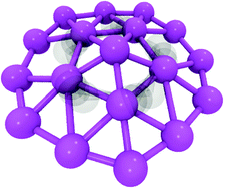
A quasi-planar member of the so-called 'Wankel motor' family, B182-, is found.
The content of this RSS Feed (c) The Royal Society of Chemistry


   This article is licensed under a Creative Commons Attribution 3.0 Unported Licence.