19 Jun 07:15
by Malinda D. Reichert, Chia-Cheng Lin and Javier Vela

Chemistry of Materials
DOI: 10.1021/cm500896n

19 Jun 07:15
by Rachel Morrish, Trevor Haak and Colin A. Wolden

Chemistry of Materials
DOI: 10.1021/cm501566h

18 Jun 13:25
by K. Kolodziejczyk, K. Grzybowska, Z. Wojnarowska, M. Dulski, L. Hawelek and M. Paluch

Crystal Growth & Design
DOI: 10.1021/cg401364e

18 Jun 05:40
by Matthew S. Faber, Rafal Dziedzic, Mark A. Lukowski, Nicholas S. Kaiser, Qi Ding and Song Jin

Journal of the American Chemical Society
DOI: 10.1021/ja504099w

18 Jun 05:39
by Karol Miszta, Rosaria Brescia, Mirko Prato, Giovanni Bertoni, Sergio Marras, Yi Xie, Sandeep Ghosh, Mee Rahn Kim and Liberato Manna

Journal of the American Chemical Society
DOI: 10.1021/ja5032634

18 Jun 05:39
by Darren C. J. Neo, Cheng Cheng, Samuel D. Stranks, Simon M. Fairclough, Judy S. Kim, Angus I. Kirkland, Jason M. Smith, Henry J. Snaith, Hazel E. Assender and Andrew A. R. Watt

Chemistry of Materials
DOI: 10.1021/cm501595u

zhqln and -1 others like this
18 Jun 05:39
by Chad I. Drexler, Kevin B. Moore, Corey P. Causey and Thomas J. Mullen

Langmuir
DOI: 10.1021/la501645w

18 Jun 05:38
by Jared D. Moretti, Jesse J. Sabatini, Jay C. Poret
Abstract
The development of perchlorate-free M662 40 mm illuminating pyrotechnic compositions is described. On the bases of cost, performance, and sensitivity, potassium periodate was determined to be most effective potassium perchlorate replacement in the compositions tested. The optimal periodate-based composition exceeded the performance of the perchlorate-containing control, exhibited low sensitivity values to impact, friction, and electrostatic discharge, and had high thermal onset temperatures.

Illuminating experience: Potassium periodate proved itself as a viable alternate to potassium perchlorate in developing an environmentally conscious US Army 40 mm red-light-emitting illuminant (see figure). The optimal periodate-based formulation exhibited high performance and low sensitivity. Derivatives of this formulation may be of interest to the civilian fireworks community.
18 Jun 05:37
Publication date: November 2014
Source:Tribology International, Volume 79
Author(s): Yanyan Wang , Wen Yue , Dingshun She , Zhiqiang Fu , Haipeng Huang , Jiajun Liu
In this paper, 316L stainless steel (316LSS) is treated by a ultrasonic cold forging technology (UCFT) which is one of the methods of surface nanocrystallization. The tribological properties of UCFT sample are investigated by a SRV tribometer under lubrications with MoDTC and ZDDP. The chemical analysis of tribofilms is performed using X-ray photoelectron spectroscopy (XPS). The results show that the UCFT sample exhibits the lowest coefficient of friction (0.066) under MoDTC lubrication and the lowest wear rate under ZDDP lubrication, indicating that surface nanocrystallization has synergistic effects on low friction and antiwear performances of both MoDTC and ZDDP. The obviously synergistic effects between UCFT steel and MoDTC/ZDDP may be attributed to the higher hardness and surface reactivity of the UCFT surface.
18 Jun 05:37
Publication date: November 2014
Source:Tribology International, Volume 79
Author(s): Shengguang Zhang , Wenzhong Wang , Ziqiang Zhao
Rough surface elastic–plastic contact performance is investigated in this paper. First, a computer program is developed to generate rough surfaces with given parameters; Then, the elastic–plastic contact model is developed based on minimization of complementary energy and semi-analytical method; finally, contact analysis for rough surfaces are conducted. The results show that kurtosis and skewness have significant effects on the contact performance under light-medium load; for heavy load condition and small skewness, the contact characteristic parameters change slightly along with kurtosis. Comparing with elastic contact, the low contact pressure and large contact area are predicted in elastic–plastic contacts.
18 Jun 05:36
by Inhyuk Kim, Kyujin Kim, Yunjung Oh, Kyoohee Woo, Guozhong Cao, Sunho Jeong and Jooho Moon

Chemistry of Materials
DOI: 10.1021/cm501568d

18 Jun 05:34
by Ghislaine Vantomme, Shimei Jiang and Jean-Marie Lehn

Journal of the American Chemical Society
DOI: 10.1021/ja504813r

18 Jun 05:33
Dalton Trans., 2014, 43,10388-10391
DOI: 10.1039/C3DT52353E, Communication
Thanasis Georgiou, Huafeng Yang, Rashid Jalil, James Chapman, Kostya S. Novoselov, Artem Mishchenko
Atomically thin layers of materials which are just a few atoms in thickness present an attractive option for future electronic devices.
The content of this RSS Feed (c) The Royal Society of Chemistry

17 Jun 13:14
by Wenyan Yin, Liang Yan, Jie Yu, Gan Tian, Liangjun Zhou, Xiaopeng Zheng, Xiao Zhang, Yuan Yong, Juan Li, Zhanjun Gu and Yuliang Zhao

ACS Nano
DOI: 10.1021/nn501647j

17 Jun 13:13
by Elena S. Speranskaya, Natalia V. Beloglazova, Sofie Abé, Tangi Aubert, Philippe F. Smet, Dirk Poelman, Irina Y. Goryacheva, Sarah De Saeger and Zeger Hens

Langmuir
DOI: 10.1021/la501268b

16 Jun 21:10
Publication date: 15 September 2014
Source:Wear, Volume 317, Issues 1–2
Author(s): C.A. Fairfield
High-pressure water-jet testing of a range of polymeric and ceramic (clay and concrete) materials was carried out with a view to assessing their performance as potential materials for use in the manufacture of non-pressurised drain and sewer pipes. This work describes test equipment calibration, jetting resistance tests on 20 potential pipe materials, and post-processing of the eroded test samples. The relationships between spatial and temporal fluctuations observed in the water-jet formed the basis for the understanding of the cavitation erosion mechanisms giving rise to the observed damage rates. Mie scattering data provided evidence of droplet and cavity sizes in the cavitating jet upon which initial cavity radii for future Rayleigh–Plesset equation analysis could be based. Those candidate materials with the longest time until the onset of damage (in descending order) for the top five of the materials tested were concrete, clay, 30% (by volume (v/v)) glass-filled nylon, polysulphone, and polyetherimide. The candidate materials capable of resisting the greatest pressure without showing signs of damage for 30s (in descending order) were polyetheretherketone, clay, polyetherimide, polyphenylene sulphide, and polysulphone.
16 Jun 21:01
by Karen Peynshaert, Bella B. Manshian, Freya Joris, Kevin Braeckmans, Stefaan C. De Smedt, Jo Demeester and Stefaan J. Soenen

Chemical Reviews
DOI: 10.1021/cr400372p

16 Jun 20:58
Phys. Chem. Chem. Phys., 2014, 16,25710-25722
DOI: 10.1039/C4CP01465K, Paper
Stephen V. Kershaw, Sergii Kalytchuk, Olga Zhovtiuk, Qing Shen, Takuya Oshima, Witoon Yindeesuk, Taro Toyoda, Andrey L. Rogach
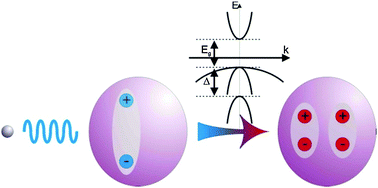
Efficient generation of infrared exciton pairs from single short wavelength photons with quantum yield 199% is observed in CdxHg1-xTe QDs.
The content of this RSS Feed (c) The Royal Society of Chemistry

16 Jun 20:57
J. Mater. Chem. A, 2014, 2,10788-10817
DOI: 10.1039/C4TA00902A, Feature Article
T. M. Brown, F. De Rossi, F. Di Giacomo, G. Mincuzzi, V. Zardetto, A. Reale, A. Di Carlo
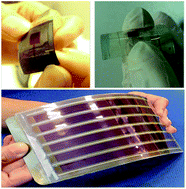
The progress in the development of materials, processes, devices and industrialization of flexible dye solar cells is analyzed in this review.
The content of this RSS Feed (c) The Royal Society of Chemistry
16 Jun 20:54
J. Mater. Chem. A, 2014, 2,10710-10711
DOI: 10.1039/C4TA90093F, Editorial
Guozhen Shen, Shu-Hong Yu, Yongyao Xia, Xiong Wen (David) Lou
Guest editors Guozhen Shen, Shu-Hong Yu, Yongyao Xia, and Xiong Wen (David) Lou introduce this Journal of Materials Chemistry A themed issue on flexible energy storage and conversion.
The content of this RSS Feed (c) The Royal Society of Chemistry
16 Jun 20:53

My worst nightmare is falling off a high mountain. I lose track of time when I read my favorite fiction books.
16 Jun 20:51
by Sehmus Ozden, Pedro A. S. Autreto, Chandra Sekhar Tiwary, Suman Khatiwada, Leonardo Machado, Douglas S. Galvao, Robert Vajtai, Enrique V. Barrera and Pulickel M. Ajayan

Nano Letters
DOI: 10.1021/nl501753n

16 Jun 20:50
by Wenjing Fang, Allen L. Hsu, Yi Song, Anthony G. Birdwell, Matin Amani, Madan Dubey, Mildred S. Dresselhaus, Tomás Palacios and Jing Kong

ACS Nano
DOI: 10.1021/nn5015177

14 Jun 11:11
by Rixiang Huang, Randy P. Carney, Kaoru Ikuma, Francesco Stellacci and Boris L. T. Lau

ACS Nano
DOI: 10.1021/nn501203k

14 Jun 11:07
Tribology Transactions, Volume 57, Issue 5, Page 838-845, September-October 2014.
14 Jun 11:06
by Jin-Wook Lee, Dong-Jin Seol, An-Na Cho, Nam-Gyu Park

Perovskite solar cells with power conversion efficiencies exceeding 16% at AM 1.5G one sun illumination are developed using the black polymorph of formamidnium lead iodide, HC(NH2)2PbI3. Compared with CH3NH3PbI3, HC(NH2)2PbI3 extends its absoprtion to 840 nm and shows no phase transition between 296 and 423 K. Moreover, a solar cell based on HC(NH2)2PbI3 exhibits photostability and little I–V hysteresis.
14 Jun 11:05
J. Mater. Chem. A, 2014, 2,13772-13782
DOI: 10.1039/C4TA02359E, Feature Article
Hubiao Huang, Yulong Ying, Xinsheng Peng
Due to their unique physical and chemical properties, graphene oxide nanosheets represent an emerging star material for novel separation membranes.
The content of this RSS Feed (c) The Royal Society of Chemistry
14 Jun 11:04
Publication date: November 2014
Source:Tribology International, Volume 79
Author(s): Yuliang Lin , Jingui Qin , Fangyun Lu , Rong Chen , Xiangyu Li
We present a new dynamic friction coefficient testing device modified from the conventional split Hopkinson pressure bar (SHPB). In the experiment, the normal pressure and friction force are applied to the tribo pair simultaneously via the wedge structure of the incident bar. The geometry of tribo pairs can be cylindrical or cuboid which can be as simple as the samples in SHPB experiments, and the time-resolved interfacial friction coefficient can be directly calculated without any assumptions or theoretical derivation. The interfacial friction between two plastics and aluminum was tested by the novel setup, the normal pressure and friction force histories were measured, and the time-resolved dynamic friction coefficient was obtained.
14 Jun 11:04
by Kun Chang, Zongwei Mei, Tao Wang, Qing Kang, Shuxin Ouyang and Jinhua Ye

ACS Nano
DOI: 10.1021/nn5019945

14 Jun 10:51
by Woo Lee and Sang-Joon Park

Chemical Reviews
DOI: 10.1021/cr500002z