Shared posts

14 Jun 11:24

Titanium Dioxide Nanomaterials for Sensor Applications

by Jing Bai and Baoxue Zhou

TOC Graphic

Chemical Reviews
DOI: 10.1021/cr400625j
14 Jun 11:08

Correlation between nanoparticle location and graphene nucleation in chemical vapour deposition of graphene

J. Mater. Chem. A, 2014, 2,13123-13128
DOI: 10.1039/C4TA01975J, Paper
Lili Fan, Kunlin Wang, Jinquan Wei, Minlin Zhong, Dehai Wu, Hongwei Zhu
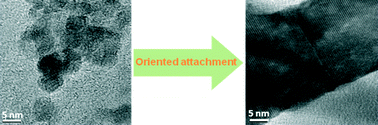
The location of nanoparticles is a straightforward reflection of the nucleation sites of graphene growth. The deposition of nanoparticles is consistent with the distribution of multilayer graphene.
The content of this RSS Feed (c) The Royal Society of Chemistry
14 Jun 11:08

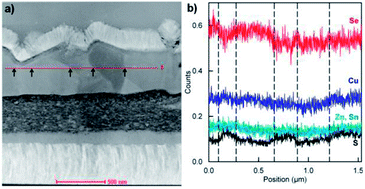
Investigation of local compositional uniformity in Cu2ZnSn(S,Se)4 thin film solar cells prepared from nanoparticle inks

J. Mater. Chem. A, 2014, 2,13464-13470
DOI: 10.1039/C4TA02205J, Paper
Katherine E. Roelofs, Qijie Guo, Shekhar Subramoney, Jonathan V. Caspar
Solution-processed high-efficiency CZTSSe solar cells are analyzed to understand how local compositional non-uniformity develops during annealing and its impact on performance.
The content of this RSS Feed (c) The Royal Society of Chemistry
14 Jun 11:08

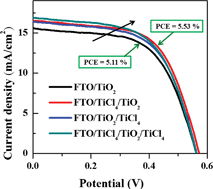
Optimization of TiO2 photoanode films for highly efficient quantum dot-sensitized solar cells

J. Mater. Chem. A, 2014, 2,13033-13040
DOI: 10.1039/C4TA02291B, Paper
Zhonglin Du, Hua Zhang, Huili Bao, Xinhua Zhong
A sole TiCl4 treatment on FTO glass is sufficient for achieving a high efficiency in the resultant cell devices when compared with the simultaneous treatment on both FTO glass and a TiO2 mesoporous film.
The content of this RSS Feed (c) The Royal Society of Chemistry
14 Jun 11:07

Tribological Properties of Paraffinic Oil with Nanodiamond Particles

Tribology Transactions, Volume 57, Issue 5, Page 831-837, September-October 2014.
12 Jun 17:53

Multi-Dimensional Electron Microscopy

by Paul A. Midgley, John Meurig Thomas
Thumbnail image of graphical abstract

Modern electron microscopy permits the acquisition of multi-dimensional data sets that combine 3D real space morphology with chemical, temporal, and crystallographic information providing new insights into the physico-chemical behavior of materials at the nanoscale.

12 Jun 16:00

Layered inorganic solids

Dalton Trans., 2014, 43,10274-10275
DOI: 10.1039/C4DT90078B, Editorial
Jiri Cejka, Russell E. Morris, Petr Nachtigall, Wieslaw J. Roth
Welcome to this themed issue of Dalton Transactions entitled "Layered Inorganic Solids".
The content of this RSS Feed (c) The Royal Society of Chemistry
12 Jun 09:52

High-Efficiency “Green” Quantum Dot Solar Cells

by Zhenxiao Pan, Iván Mora-Seró, Qing Shen, Hua Zhang, Yan Li, Ke Zhao, Jin Wang, Xinhua Zhong and Juan Bisquert

TOC Graphic

Journal of the American Chemical Society
DOI: 10.1021/ja504310w
10 Jun 23:33

Surface Plasmon Resonance in Gold Ultrathin Nanorods and Nanowires

by Ryo Takahata, Seiji Yamazoe, Kiichirou Koyasu and Tatsuya Tsukuda

TOC Graphic

Journal of the American Chemical Society
DOI: 10.1021/ja503558c
10 Jun 23:33

A General Synthetic Approach for Ordered Mesoporous Metal Sulfides

by Bryan T. Yonemoto, Gregory S. Hutchings and Feng Jiao

TOC Graphic

Journal of the American Chemical Society
DOI: 10.1021/ja504407e
10 Jun 23:32

Classification Framework for Graphene-Based Materials

by Peter Wick, Anna E. Louw-Gaume, Melanie Kucki, Harald F. Krug, Kostas Kostarelos, Bengt Fadeel, Kenneth A. Dawson, Anna Salvati, Ester Vázquez, Laura Ballerini, Mauro Tretiach, Fabio Benfenati, Emmanuel Flahaut, Laury Gauthier, Maurizio Prato, Alberto Bianco
Thumbnail image of graphical abstract

Graphing graphene: Because the naming of graphene-based materials (GBMs) has led to confusion and inconsistency, a classification approach is necessary. Three physical-chemical properties of GBMs have been defined by the GRAPHENE Flagship Project of the European Union for the unequivocal classification of these materials (see grid).

10 Jun 23:31

Faradaurate-940: Synthesis, Mass Spectrometry, Electron Microscopy, High-Energy X-ray Diffraction, and X-ray Scattering Study of Au∼940±20(SR)∼160±4 Nanocrystals

by Chanaka Kumara, Xiaobing Zuo, David A. Cullen and Amala Dass

TOC Graphic

ACS Nano
DOI: 10.1021/nn501970v
10 Jun 20:39

Energy Transfer from a Single Semiconductor Nanocrystal to Dye Molecules

by Zheng Hua, Qinfeng Xu, Xiangnan Huang, Chunfeng Zhang, Xiaoyong Wang and Min Xiao

TOC Graphic

ACS Nano
DOI: 10.1021/nn5019736
10 Jun 20:32

Improvement in the Tribological Performance of Polycarbonate via the Incorporation of Molybdenum Disulfide Particles

Tribology Transactions, Volume 57, Issue 5, Page 806-813, September-October 2014.
10 Jun 20:31

CdSe/ZnS Quantum Dot Thin Film Formation by an Electrospray Deposition Process for Light-Emitting Devices

by My Duyen Ho, Namhun Kim, Daekyoung Kim, Sung Min Cho, Heeyeop Chae
Thumbnail image of graphical abstract

About 30 nm quantum-dot thin films are formed by electrospray deposition (ESD) process and quantum-dot-light-emitting-diodes (QD-LEDs) are demonstrated. Maximum brightness of 23 000 cd m–2 and current efficiency of 5.9 cd A–1 are achieved with the ESD process. The ESD process can be a potential solution for large area quantum dot layers with simple and flexible control.

09 Jun 20:41

Large Area Single-Crystal Diamond Synthesis by 915 MHz Microwave Plasma-Assisted Chemical Vapor Deposition

by Qi Liang, Chih-shiue Yan, Joseph Lai, Yu-fei Meng, Szczesny Krasnicki, Haiyun Shu, Ho-kwang Mao and Russell J. Hemley
DJL

Check out that bling

TOC Graphic

Crystal Growth & Design
DOI: 10.1021/cg500693d
07 Jun 14:40

The role of soot particles in the tribological behavior of engine lubricating oils

Publication date: 15 July 2013
Source:Wear, Volume 304, Issues 1–2
Author(s): Enzhu Hu , Xianguo Hu , Tianxia Liu , Ling Fang , Karl D. Dearn , Hongming Xu
This paper describes a study of the influence of soot contamination on the tribological behavior of engine lubricants. The candidate lubricants were a formulated engine lubricant, (CD SAE 15W-40) and a base oil (150SN). Soot particle contamination was simulated using carbon black with friction and wear measured using a four-ball tribometer. The results show that the antiwear and antifriction properties of the CD SAE 15W-40 formulated oil with varying carbon black contents were better than those of 150SN base oil. The antifriction properties of the SAE 15W‐40 formulated oil with the addition of 2wt% carbon black were strengthened. This was ascribed to uniformly dispersed carbon black and the additives in the CD SAE 15W-40. The antifriction properties of the 150SN base oil with 2, 4wt% carbon black content were upgraded via the addition of 2wt% dispersant polyisobutylene succinimide. The tribological effect of the carbon black in the lubricants was attributed to absorption and agglomerate effects.

07 Jun 14:39

Purely elastic contributions to friction

Publication date: 1 September 1982
Source:Wear, Volume 80, Issue 3
Author(s): A.M. Stoneham , A.H. Harker


07 Jun 14:39

Analysis of wear behavior and graphitization of hydrogenated DLC under boundary lubricant with MoDTC

Publication date: 30 July 2013
Source:Wear, Volume 305, Issues 1–2
Author(s): Itto Sugimoto , Fumiaki Honda , Kenichi Inoue
Diamond-like carbon (DLC) with high hardness and low friction has been applied to automotive parts. In this study, the significant wear of hydrogenated DLCs under molybdenum dithio-carbonate (MoDTC)-containing oil was evaluated by a reciprocating sliding tester and the wear has been investigated. Analysis of wear debris collected from oil after a sliding test revealed that DLC wear under MoDTC-containing boundary lubrication are caused by the graphitization, same as in solid lubrication confirmed by previous reports. On the other hand, Mo compounds that are decomposition products of MoDTC harden the surface of counterparts and have the potential of accelerated wear.

07 Jun 14:37

The Speed of Sound in Silk: Linking Material Performance to Biological Function

by Beth Mortimer, Shira D. Gordon, Chris Holland, Clive R. Siviour, Fritz Vollrath, James F. C. Windmill
Thumbnail image of graphical abstract

Sonic properties of spider silks are measured independent of the web using laser vibrometry and ballistic impact providing insights into Nature's design of functionalized high-performance materials. Through comparison to cocoon silk and other industrial fibers, we find that major ampullate silk has the largest wavespeed range of any known material.

06 Jun 16:00

The binder effect on an oxide-based anode in lithium and sodium-ion battery applications: the fastest way to ultrahigh performance

DJL

Binder to upset Applecart

Chem. Commun., 2014, 50,13307-13310
DOI: 10.1039/C4CC02657H, Communication
Jun Ming, Hai Ming, Won-Jin Kwak, Changdae Shin, Junwei Zheng, Yang-Kook Sun
A positive effect of the polyacrylic acid-carboxymethyl cellulose binder to enhance the performance of an oxide-based anode was reported in batteries.
The content of this RSS Feed (c) The Royal Society of Chemistry
06 Jun 15:40

Heterostructures Produced from Nanosheet-Based Inks

by F. Withers, H. Yang, L. Britnell, A. P. Rooney, E. Lewis, A. Felten, C. R. Woods, V. Sanchez Romaguera, T. Georgiou, A. Eckmann, Y. J. Kim, S. G. Yeates, S. J. Haigh, A. K. Geim, K. S. Novoselov and C. Casiraghi

TOC Graphic

Nano Letters
DOI: 10.1021/nl501355j
06 Jun 15:40

Photoelectrochemical Hydrogen Production on InP Nanowire Arrays with Molybdenum Sulfide Electrocatalysts

by Lu Gao, Yingchao Cui, Jia Wang, Alessandro Cavalli, Anthony Standing, Thuy T. T. Vu, Marcel A. Verheijen, Jos E. M. Haverkort, Erik P. A. M. Bakkers and Peter H. L. Notten

TOC Graphic

Nano Letters
DOI: 10.1021/nl404540f
06 Jun 15:36

Two-Dimensional Molybdenum Tungsten Diselenide Alloys: Photoluminescence, Raman Scattering, and Electrical Transport

by Mei Zhang, Juanxia Wu, Yiming Zhu, Dumitru O. Dumcenco, Jinhua Hong, Nannan Mao, Shibin Deng, Yanfeng Chen, Yanlian Yang, Chuanhong Jin, Sunil H. Chaki, Ying-Sheng Huang, Jin Zhang and Liming Xie

TOC Graphic

ACS Nano
DOI: 10.1021/nn5020566
06 Jun 15:35

Perovskite Solar Cells with 12.8% Efficiency by Using Conjugated Quinolizino Acridine Based Hole Transporting Material

by Peng Qin, Sanghyun Paek, M. Ibrahim Dar, Norman Pellet, Jaejung Ko, Michael Grätzel and Mohammad Khaja Nazeeruddin

TOC Graphic

Journal of the American Chemical Society
DOI: 10.1021/ja503272q
06 Jun 15:35

Synthesis and Characterization of a Plasmonic–Semiconductor Composite Containing Rationally Designed, Optically Tunable Gold Nanorod Dimers and Anatase TiO2

by Bryan F. Mangelson, Matthew R. Jones, Daniel J. Park, Chad M. Shade, George C. Schatz and Chad A. Mirkin

TOC Graphic

Chemistry of Materials
DOI: 10.1021/cm5014625
06 Jun 15:33

Nanosecond Intersystem Crossing Times in Fullerene Acceptors: Implications for Organic Photovoltaic Diodes

by Philip C. Y. Chow, Sebastian Albert-Seifried, Simon Gélinas, Richard H. Friend
Thumbnail image of graphical abstract

Triplet-exciton formation through intersystem crossing of photogenerated singlet excitons in fullerene acceptors can compete with charge generation in organic photovoltaic diodes. This article reports the intersystem crossing timescale (τISC) of the most commonly used fullerene acceptors, PC60BM and PC70BM, in solutions and in spin-coated films. These times are on the nanosecond timescale, and are longer than the characteristic times for charge generation (τd).

06 Jun 15:33

Water/n-heptane interface as a viable platform for the self-assembly of ZnO nanospheres to nanorods

CrystEngComm, 2014, 16,7696-7700
DOI: 10.1039/C4CE00728J, Paper
Mohammed Ali, Hasimur Rahaman, Dewan S. Rahman, Surjatapa Nath, Sujit Kumar Ghosh
The water/n-heptane interface has been exploited as a viable and selective platform for the transformation of quasi-spherical ZnO nanoparticles to nanorods.
The content of this RSS Feed (c) The Royal Society of Chemistry
06 Jun 15:30

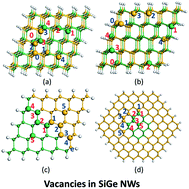
Role of vacancies to p-type semiconducting properties of SiGe nanowires

J. Mater. Chem. C, 2014, 2,6536-6546
DOI: 10.1039/C4TC00958D, Paper
Open Access Open Access
Creative Commons Licence&nbsp This article is licensed under a Creative Commons Attribution 3.0 Unported Licence.
Rulong Zhou, Bingyan Qu, Bo Zhang, Pengfei Li, Xiao Cheng Zeng
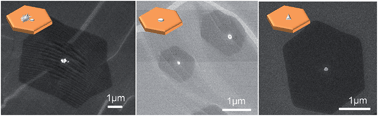
On basis of the first-principle calculations, vacancies are proven to play important roles in p-type semiconducting properties of Si1-xGex nanowires (NW) and Ge/Si core/shell NW.
The content of this RSS Feed (c) The Royal Society of Chemistry
05 Jun 19:55

Global energy consumption due to friction in trucks and buses

Publication date: October 2014
Source:Tribology International, Volume 78
Author(s): Kenneth Holmberg , Peter Andersson , Nils-Olof Nylund , Kari Mäkelä , Ali Erdemir
In this paper, we report the global fuel energy consumption in heavy-duty road vehicles due to friction in engines, transmissions, tires, auxiliary equipment, and brakes. Four categories of vehicle, representing an average of the global fleet of heavy vehicles, were studied: single-unit trucks, truck and trailer combinations, city buses, and coaches. Friction losses in tribocontacts were estimated by drawing upon the literature on prevailing contact mechanics and lubrication mechanisms. Coefficients of friction in the tribocontacts were estimated based on available information in the literature for four cases: (1) the average vehicle in use today, (2) a vehicle with today׳s best commercial tribological technology, (3) a vehicle with today׳s most advanced technology based upon recent research and development, and (4) a vehicle with the best futuristic technology forecasted in the next 12 years. The following conclusions were reached: • In heavy duty vehicles, 33% of the fuel energy is used to overcome friction in the engine, transmission, tires, auxiliary equipment, and brakes. The parasitic frictional losses, with braking friction excluded, are 26% of the fuel energy. In total, 34% of the fuel energy is used to move the vehicle. • Worldwide, 180,000 million liters of fuel was used in 2012 to overcome friction in heavy duty vehicles. This equals 6.5millionTJ/a; hence, reduction in frictional losses can provide significant benefits in fuel economy. A reduction in friction results in a 2.5 times improvement in fuel economy, as exhaust and cooling losses are reduced as well. • Globally a single-unit truck uses on average 1500l of diesel fuel per year to overcome friction losses; a truck and trailer combination, 12,500l; a city bus, 12,700l; and a coach, 7100l. • By taking advantage of new technology for friction reduction in heavy duty vehicles, friction losses could be reduced by 14% in the short term (4 to 8 years) and by 37% in the long term (8 to 12 years). In the short term, this would annually equal worldwide savings of 105,000 million euros, 75,000 million liters of diesel fuel, and a CO2 emission reduction of 200 million tones. In the long term, the annual benefit would be 280,000 million euros, 200,000 million liters of fuel, and a CO2 emission reduction of 530 million tonnes. • Hybridization and electrification are expected to penetrate only certain niches of the heavy-duty vehicle sector. In the case of city buses and delivery trucks, hybridization can cut fuel consumption by 25% to 30%, but there is little to gain in the case of coaches and long-haul trucks. Downsizing the internal combustion engine and using recuperative braking energy can also reduce friction losses. • Electrification is best suited for city buses and delivery trucks. The energy used to overcome friction in electric vehicles is estimated to be less than half of that of conventional diesel vehicles. Potential new remedies to reduce friction in heavy duty vehicles include the use of advanced low-friction coatings and surface texturing technology on sliding, rolling, and reciprocating engine and transmission components, new low-viscosity and low-shear lubricants and additives, and new tire designs that reduce rolling friction.