29 Jun 17:48
by Hyun Dong Ha, Dong Ju Han, Jong Seob Choi, Minsu Park, Tae Seok Seo

Homogeneous blue luminescent MoS2 quantum dots are fabricated by using a lithium intercalation method from MoS2 nanoparticles, and the unique blue photoluminescence property is utilized in the Alexa Fluor 430-dsDNA-MoS2 FRET system, demonstrating the dual function of MoS2 quantum dots as a donor and an acceptor.
29 Jun 17:44
Chem. Sci., 2014, 5,3905-3914
DOI: 10.1039/C4SC01549E, Edge Article
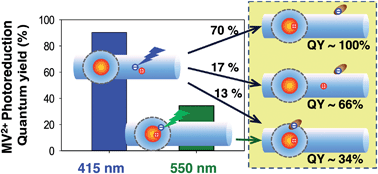
Haiming Zhu, Zheyuan Chen, Kaifeng Wu, Tianquan Lian
Wavelength dependent electron and hole distribution and dynamics of nanorod heterostructures leads to competing photoreduction pathways with different charge separation and recombination rates and steady state photoreduction quantum efficiencies.
The content of this RSS Feed (c) The Royal Society of Chemistry

29 Jun 17:22
by Jian Zhang, Zhenping Zhu, Xinliang Feng
Abstract
2D MoS2 nanosheets have been utilized to fabricate 2D MoS2/CdS p–n nanohybrids through a one-pot solvothermal process. Due to the unique p–n junction heterostructure, large specific surface area, and decreased band gap, MoS2/CdS nanohybrids manifested a superior H2-production rate of ∼137 μmol h−1 under visible-light irradiation and an apparent quantum yield of 10.5 % at 450 nm.

Photocatalysis: 2D MoS2/CdS p–n nanohybrids are constructed by a one-pot solvothermal method. Due to the unique p–n junction heterostructure, large specific surface area, and decreased band gap, MoS2/CdS p–n nanohybrids provide an excellent H2-evolution rate of 137 μmol h−1 under visible-light irradiation and an apparent quantum yield of 10.5 % at 450 nm (see figure).
29 Jun 17:22
by Wenqin Peng, Liyuan Han , Zhengming Wang
Abstract
Hierarchical ZnO nanorods composed of interconnected nanoparticles, which were synthesized by controlling precursor concentrations in a solvothermally assisted process, were exploited as photoanodes in dye-sensitized solar cells (DSCs). The as-prepared hierarchical nanorods showed greatly enhanced light scattering compared to ZnO nanoparticles for boosting light harvesting while maintaining sufficient dye-adsorption capability. The charge-transfer characteristics were studied by electrochemical impedance measurements, and reduced electron recombination and longer electron lifetime were observed for the ZnO nanorods. Photovoltaic characterization demonstrated that DSCs utilizing the hierarchical nanorods significantly improved the overall conversion efficiency by 34 % compared to nanoparticle-based DSCs.

Multifunctional photoanode: Hierarchical ZnO nanorods composed of interconnected nanoparticles exhibit effective light harvesting, dye loading, and electron transport. When applied as photoanodes in dye-sensitized solar cells, such ZnO nanorods achieved a 34 % improvement in efficiency compared to ZnO nanoparticles (see figure).
29 Jun 17:21
by Wei Zhe Teo, Elaine Lay Khim Chng, Zdeněk Sofer, Martin Pumera
Abstract
Studies involving transition-metal dichalcogenides (TMDs) have been around for many decades and in recent years, many were focused on using TMDs to synthesize inorganic analogues of carbon nanotubes, fullerene, as well as graphene and its derivatives with the ultimate aim of employing these materials into consumer products. In view of this rising trend, we investigated the cytotoxicity of three common exfoliated TMDs (exTMDs), namely MoS2, WS2, and WSe2, and compared their toxicological effects with graphene oxides and halogenated graphenes to find out whether these inorganic analogues of graphenes and derivatives would show improved biocompatibility. Based on the cell viability assessments using methylthiazolyldiphenyl-tetrazolium bromide (MTT) and water-soluble tetrazolium salt (WST-8) assays on human lung carcinoma epithelial cells (A549) following a 24 h exposure to varying concentrations of the three exTMDs, it was concluded that MoS2 and WS2 nanosheets induced very low cytotoxicity to A549 cells, even at high concentrations. On the other hand, WSe2 exhibited dose-dependent toxicological effects on A549 cells, reducing cell viability to 31.8 % at the maximum concentration of 400 μg mL−1; the higher cytotoxicity displayed by WSe2 might be linked to the identity of the chalcogen. In comparison with graphene oxides and halogenated graphenes, MoS2 and WS2 were much less hazardous, whereas WSe2 showed similar degree of cytotoxicity. Future in-depth studies should be built upon this first work on the in vitro cytotoxicity of MoS2 and WS2 to ensure that they do not pose acute toxicity. Lastly, nanomaterial-induced interference control experiments revealed that exTMDs were capable of reacting with MTT assay viability markers in the absence of cells, but not with WST-8 assay. This suggests that the MTT assay is not suitable for measuring the cytotoxicity of exTMDs because inflated results will be obtained, giving false impressions that the materials are less toxic.

A matter of safety: An assessment on the in vitro cytotoxicity of three different exfoliated transition-metal dichalcogenides (exTMDs), namely, MoS2, WS2, and WSe2, has been conducted to determine if the exposure to this class of nanomaterials may have an adverse impact on our wellbeing should they be commercialized in the future.
29 Jun 17:19
by Clive Eley, Tong Li, Fenglin Liao, Simon Michael Fairclough, Jason M. Smith, George Smith, Shik Chi Edman Tsang
Abstract
A series of highly efficient semiconductor nanocrystal (NC) photocatalysts have been synthesized by growing wurtzite-ZnO tetrahedrons around pre-formed CdS, CdSe, and CdTe quantum dots (QDs). The resulting contact between two small but high-quality crystals creates novel CdX/ZnO heterostructured semiconductor nanocrystals (HSNCs) with extensive type-II nanojunctions that exhibit more efficient photocatalytic decomposition of aqueous organic molecules under UV irradiation. Catalytic testing and characterization indicate that catalytic activity increases as a result of a combination of both the intrinsic chemistry of the chalcogenide anions and the heterojunction structure. Atomic probe tomography (APT) is employed for the first time to probe the spatial characteristics of the nanojunction between cadmium chalcogenide and ZnO crystalline phases, which reveals various degrees of ion exchange between the two crystals to relax large lattice mismatches. In the most extreme case, total encapsulation of CdTe by ZnO as a result of interfacial alloying is observed, with the expected advantage of facilitating hole transport for enhanced exciton separation during catalysis.

That's a (quantum dot) wrap! A series of highly active semiconductor photocatalysts have been synthesized by growing wurtzite-ZnO tetrahedrons around pre-formed CdS, CdSe, and CdTe quantum dots. The resulting heterostructured CdX/ZnO nanocrystals with extensive type-II nanojunctions exhibit rapid photocatalytic decomposition of organic molecules in aqueous media.
29 Jun 17:14
by Siegfried Eigler, Andreas Hirsch
Abstract
The chemical production of graphene as well as its controlled wet chemical modification is a challenge for synthetic chemists. Furthermore, the characterization of reaction products requires sophisticated analytical methods. In this Review we first describe the structure of graphene and graphene oxide and then outline the most important synthetic methods that are used for the production of these carbon-based nanomaterials. We summarize the state-of-the-art for their chemical functionalization by noncovalent and covalent approaches. We put special emphasis on the differentiation of the terms graphite, graphene, graphite oxide, and graphene oxide. An improved fundamental knowledge of the structure and the chemical properties of graphene and graphene oxide is an important prerequisite for the development of practical applications.

The well-controlled synthesis of new graphene and graphene oxide derivatives as well as determination of the atomic structure are key challenges for synthetic chemists. Structure–property relationships must be exploited to use the full potential of graphene derivatives in upcoming applications. This Review focuses on concepts in the chemistry of graphene and graphene oxide with the aim of encouraging chemists to enhance the field of research.
29 Jun 00:26
by Signe G. Sørensen, Henrik G. Füchtbauer, Anders K. Tuxen, Alex S. Walton and Jeppe V. Lauritsen

ACS Nano
DOI: 10.1021/nn502812n

29 Jun 00:20
by Xiaonan Wen, Weiqing Yang, Qingshen Jing and Zhong Lin Wang

ACS Nano
DOI: 10.1021/nn502618f

29 Jun 00:18
by Hai Li, Jumiati Wu, Xiao Huang, Zongyou Yin, Juqing Liu and Hua Zhang

ACS Nano
DOI: 10.1021/nn501779y

24 Jun 08:42
by Waleed E. Mahmoud, Lyudmila M. Bronstein, Faten Al-Hazmi, Fowzia Al-Noaiser and A. A. Al-Ghamdi
Langmuir
DOI: 10.1021/la502272t

23 Jun 19:18
Chem. Commun., 2014, 50,8882-8885
DOI: 10.1039/C4CC03720K, Communication

Open Access
Vladimir V. Korolkov, Simon A. Svatek, Stephanie Allen, Clive J. Roberts, Saul J. B. Tendler, Takashi Taniguchi, Kenji Watanabe, Neil R. Champness, Peter H. Beton
Solution deposition and molecular resolution AFM of bimolecular supramolecular networks on layered materials including the insulating boron nitride surface.
The content of this RSS Feed (c) The Royal Society of Chemistry

gjchen and -1 others like this
22 Jun 10:34
Publication date: November 2014
Source:Tribology International, Volume 79
Author(s): Igor Velkavrh , Florian Ausserer , Stefan Klien , Josef Brenner , Pierre Forêt , Alexander Diem
It is generally known that gaseous atmospheres can significantly affect the friction and wear behaviour of non-lubricated contacts; however there still exists a lack of knowledge on the subject, since the tribological behaviour and the tribochemistry of the gas-lubricated systems are highly sensitive to the selection of the operating parameters, and the results from available literature are often scattered and sometimes even contradictable. This study was focused on the identification of the friction and wear mechanisms of technical gases used at atmospheric gas-pressure in non-lubricated DIN 100Cr6 (AISI 52100) bearing steel contacts at severe operating conditions (high-frequency oscillation at high contact pressure). Argon (Ar), nitrogen (N2) and carbon dioxide (CO2) were used as gas atmospheres and air atmosphere was used as a reference. The gases are analysed in terms of their chemical reactivity with the steel surfaces and a correlation between the properties of different tribochemical products and the observed friction and wear mechanisms is made. In N2 and CO2 atmospheres, wear was significantly lower than in air atmosphere, with a wear reduction comparable to the effect of using a liquid lubricant. In N2 atmosphere, a slightly higher friction was measured than in air atmosphere, while in CO2 atmosphere, friction was 60% lower than in air atmosphere. In Ar atmosphere, both friction and wear were slightly higher than in air atmosphere. With X-ray photoelectron spectroscopy (XPS) of the wear particles, it was observed that the concentrations of different tribochemical products and their mutual ratios critically determine the friction and wear behaviour of the non-lubricated steel contact.
Graphical abstract

21 Jun 13:29
J. Mater. Chem. A, 2014, 2,13237-13240
DOI: 10.1039/C4TA01540A, Communication
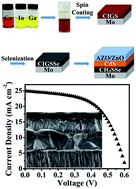
Yian Xie, Haijie Chen, Aimin Li, Xiaolong Zhu, Lei Zhang, Mingsheng Qin, Yaoming Wang, Yufeng Liu, Fuqiang Huang
A Cu(In,Ga)(S,Se)2 solar cell with 8.6% conversion efficiency was achieved by a facile molecular precursor-based solution method.
The content of this RSS Feed (c) The Royal Society of Chemistry
21 Jun 13:29
J. Mater. Chem. A, 2014, 2,13827-13830
DOI: 10.1039/C4TA02976C, Communication
Yunlong Guo, Chao Liu, Kento Inoue, Koji Harano, Hideyuki Tanaka, Eiichi Nakamura
A 99.5% void-free perovskite layer with a doped-P3HT hole-transporting layer showed the highest PCE among the P3HT based hybrid solar cells.
The content of this RSS Feed (c) The Royal Society of Chemistry
hailul and -1 others like this
21 Jun 13:28
by Sergio Brovelli, Wan Ki Bae, Francesco Meinardi, Beatriz Santiago González, Monica Lorenzon, Christophe Galland and Victor I. Klimov

Nano Letters
DOI: 10.1021/nl501026r

21 Jun 13:28
by Zhengyu He, Kuang He, Alex W. Robertson, Angus I. Kirkland, Dongwook Kim, Jisoon Ihm, Euijoon Yoon, Gun-Do Lee and Jamie H. Warner

Nano Letters
DOI: 10.1021/nl500682j

21 Jun 13:27
by Shinichiro Fuse, Sakae Sugiyama, Masato M. Maitani, Yuji Wada, Yuhei Ogomi, Shuzi Hayase, Ryuzi Katoh, Tatsuo Kaiho, Takashi Takahashi
Abstract
The creation of organic dyes with excellent high power conversion efficiency (PCE) is important for the further improvement of dye-sensitized solar cells. We wish to describe the rapid synthesis of a 112-membered donor-π-acceptor dye library by a one-pot procedure, evaluation of PCEs, and elucidation of structure–property relationships. No obvious correlations between ε, and the η were observed, whereas the HOMO and LUMO levels of the dyes were critical for η. The dyes with a more positive EHOMO, and with an ELUMO<−0.80 V, exerted higher PCEs. The proper driving forces were crucial for a high Jsc, and it was the most important parameter for a high η. The above criteria of EHOMO and ELUMO should be useful for creating high PCE dyes; nevertheless, that was not sufficient for identifying the best combination of donor, π, and acceptor blocks. Combinatorial synthesis and evaluation was important for identifying the best dye.

Combinatorial chemistry: A 112-membered donor–π-acceptor dye library was rapidly constructed by a one-pot, three-component coupling procedure (see scheme, SM=Suzuki–Miyaura). The evaluation of absorption spectroscopic and electrochemical measurements of all synthesized dyes, and cell performances of the selected 54 dyes were performed. The dyes with a more positive EHOMO, and with an ELUMO<−0.80 V, exerted higher power conversion efficiencies.
21 Jun 13:20
by Makoto Yoritate, Tatsuhiko Meguro, Naoya Matsuo, Kenji Shirokane, Takaaki Sato, Noritaka Chida

In “old man flower”, a Japanese story, the kind old man sprinkled ashes and made dead trees blossom all over. Incorporation of a methoxy group to an amide group opens the door to new reactivities and allows beautiful chemical transformations to blossom in organic synthesis. For more details, see the Full paper by T. Sato, N. Chida et al. on page 8210 ff. We thank Miwako Yoritate and Takamasa Wada for their assistance with artwork.
21 Jun 13:20
by Adrien Allain and Andras Kis

ACS Nano
DOI: 10.1021/nn5021538

21 Jun 13:19
Publication date: 15 September 2014
Source:Surface and Coatings Technology, Volume 254
Author(s): F.E. Castillejo , D.M. Marulanda , J.J. Olaya , J.E. Alfonso
Niobium carbide, chromium carbide and niobium–chromium carbide coatings were deposited using the thermo-reactive diffusion (TRD) deposition technique on AISI D2 steel substrates, and their wear and corrosion resistance was studied. The morphology of the coatings was characterized through optical and scanning electron microscopy (SEM), and the crystalline structure was studied through X-ray diffraction (XRD). Chemical composition was evaluated via energy-dispersive X-ray spectroscopy (EDS) and X-ray photoelectron spectroscopy (XPS). The hardness of the coatings was measured through nanoindentation, and their wear was studied using the ball on disk test. The electrochemical behavior was assessed with potentiodynamic polarization and electrochemical impedance (EIS) tests. The XRD results show the formation of the NbC for the niobium carbide coating, Cr23C6 and Cr7C3 for the chromium carbide coating, and NbC, Cr23C6 and Cr7C3 for the niobium–chromium coating. Hardness value for the niobium–chromium carbide coating was 27.62±2.56GPa, which was higher in comparison to 21.66±0.5GPa for niobium carbide, 14.7±1.1GPa for chromium carbide and 6.70±0.28GPa for the uncoated steel. The wear resistance obtained was higher for the niobium–chromium carbide coating. However, its corrosion resistance was lower than the corrosion resistance for binary coatings.
20 Jun 14:24
by Arend M. van der Zande, Jens Kunstmann, Alexey Chernikov, Daniel A. Chenet, YuMeng You, XiaoXiao Zhang, Pinshane Y. Huang, Timothy C. Berkelbach, Lei Wang, Fan Zhang, Mark S. Hybertsen, David A. Muller, David R. Reichman, Tony F. Heinz and James C. Hone

Nano Letters
DOI: 10.1021/nl501077m

20 Jun 14:08
by A. Niguès
Nature Materials 13, 688 (2014).
doi:10.1038/nmat3985
Authors: A. Niguès, A. Siria, P. Vincent, P. Poncharal & L. Bocquet
Friction at the nanoscale has revealed a wealth of behaviours that depart strongly from the long-standing macroscopic laws of Amontons–Coulomb. Here, by using a ‘Christmas cracker’-type of system in which a multiwalled nanotube is torn apart between a quartz-tuning-fork-based atomic force microscope (TF–AFM) and a nanomanipulator, we compare the mechanical response of multiwalled carbon nanotubes (CNTs) and multiwalled boron nitride nanotubes (BNNTs) during the fracture and telescopic sliding of the layers. We found that the interlayer friction for insulating BNNTs results in ultrahigh viscous-like dissipation that is proportional to the contact area, whereas for the semimetallic CNTs the sliding friction vanishes within experimental uncertainty. We ascribe this difference to the ionic character of the BN, which allows charge localization. The interlayer viscous friction of BNNTs suggests that BNNT membranes could serve as extremely efficient shock-absorbing surfaces.

20 Jun 14:07
by Volker Settels, Alexander Schubert, Maxim Tafipolski, Wenlan Liu, Vera Stehr, Anna K. Topczak, Jens Pflaum, Carsten Deibel, Reinhold F. Fink, Volker Engel and Bernd Engels

Journal of the American Chemical Society
DOI: 10.1021/ja413115h

20 Jun 14:05
by Robert Szoszkiewicz
Nature Materials 13, 666 (2014).
doi:10.1038/nmat4020
Authors: Robert Szoszkiewicz & Elisa Riedo
In contrast to the ultralow friction that exists between carbon layers in multiwalled carbon nanotubes, multiwalled boron nitride nanotubes are found to exhibit ultrahigh interlayer friction as a result of their ionic character.

20 Jun 14:03
by Prasert Sinsermsuksakul, Leizhi Sun, Sang Woon Lee, Helen Hejin Park, Sang Bok Kim, Chuanxi Yang, Roy G. Gordon
Thin-film solar cells are made by vapor deposition of Earth-abundant materials: tin, zinc, oxygen and sulfur. These solar cells had previously achieved an efficiency of about 2%, less than 1/10 of their theoretical potential. Loss mechanisms are systematically investigated and mitigated in solar cells based on p-type tin monosulfide, SnS, absorber layers combined with n-type zinc oxysulfide, Zn(O,S) layers that selectively transmit electrons, but block holes. Recombination at grain boundaries is reduced by annealing the SnS films in H2S to form larger grains with fewer grain boundaries. Recombination near the p-SnS/n-Zn(O,S) junction is reduced by inserting a few monolayers of SnO2 between these layers. Recombination at the junction is also reduced by adjusting the conduction band offset by tuning the composition of the Zn(O,S), and by reducing its free electron concentration with nitrogen doping. The resulting cells have an efficiency over 4.4%, which is more than twice as large as the highest efficiency obtained previously by solar cells using SnS absorber layers.

Solar cells are made by vapor deposition of Earth-abundant materials, i.e., p-type tin monosulfide (SnS) absorber layers with surfaces passivated by tin dioxide (SnO2) covered by n-type nitrogen-doped zinc oxysulfide (Zn(O,S):N) buffer layers. The cells show energy conversion efficiencies over 4.4%, which is more than twice as large as the highest efficiency obtained previously by solar cells using SnS absorber layers.
19 Jun 12:28
J. Mater. Chem. C, 2014, 2,6781-6789
DOI: 10.1039/C4TC00832D, Paper
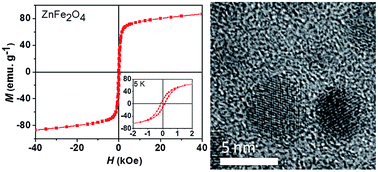
Khadijat O. Abdulwahab, Mohammad A. Malik, Paul O'Brien, Grigore A. Timco, Floriana Tuna, Richard E. P. Winpenny, Richard A. D. Pattrick, Victoria S. Coker, Elke Arenholz
The heterometallic pivalate clusters have been used as single source precursors to synthesise zinc ferrite or nickel ferrite nanoparticles. The different reaction parameters, magnetic properties and XMCD were studied.
The content of this RSS Feed (c) The Royal Society of Chemistry
19 Jun 12:24
Dalton Trans., 2014, 43,12357-12364
DOI: 10.1039/C4DT01202J, Paper
Anjan Das, Rukhsana I. Kureshy, Nabin Ch. Maity, P. S. Subramanian, Noor-ul H. Khan, Sayed H. R. Abdi, E. Suresh, Hari C. Bajaj
Cu(II) Schiff base complexes Cu(II)-1 and Cu(II)-3 based on 2-acetyl pyridine with both (1R,2R)-1,2-diaminocyclohexane and (1S,2S)-1,2-diaminocyclohexane were synthesized in a single step.
The content of this RSS Feed (c) The Royal Society of Chemistry

19 Jun 12:21
Chem. Commun., 2014, 50,8681-8684
DOI: 10.1039/C4CC03401E, Communication
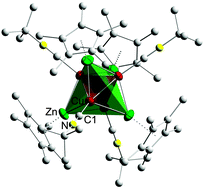
Kerstin Freitag, Hung Banh, Christian Gemel, Rudiger W. Seidel, Samia Kahlal, Jean-Yves Saillard, Roland A. Fischer
The first examples of structurally characterized "molecular brass", [(CuCNtBu)4(ZnCp*)4] and [(CuCNtBu)4(ZnCp*)3ZnCp] exhibit the structural motif of a [Cu4Zn4] tetrahedral star, which is inversely found in the [gamma]-brass phase Cu5Zn8.
The content of this RSS Feed (c) The Royal Society of Chemistry

19 Jun 07:14
by Brett G. Compton, Jennifer A. Lewis

A new epoxy-based ink is reported, which enables 3D printing of lightweight cellular composites with controlled alignment of multiscale, high-aspectratio fiber reinforcement to create hierarchical structures inspired by balsa wood. Young's modulus values up to 10 times higher than existing commercially available 3D-printed polymers are attainable, while comparable strength values are maintained.