13 Jul 19:26
CrystEngComm, 2014, 16,9455-9460
DOI: 10.1039/C4CE00545G, Paper
Thomas J. Macdonald, Yatin J. Mange, Melissa Dewi, Aoife McFadden, William M. Skinner, Thomas Nann
Chalcopyrite copper indium disulfide (CIS) QDs have been of recent interest due to their non-toxicity. This article shows a straightforward aqueous cation exchange method to synthesise CIS particles with zinc sulfide coating.
The content of this RSS Feed (c) The Royal Society of Chemistry

13 Jul 19:21
Chem. Commun., 2014, 50,9939-9942
DOI: 10.1039/C4CC04384G, Communication
Yang Yang, Guanxin Zhang, Chenmin Yu, Chang He, Jianguo Wang, Xin Chen, Jingjing Yao, Zitong Liu, Deqing Zhang
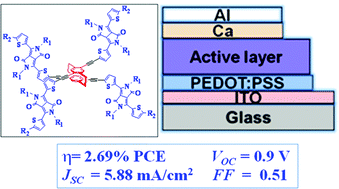
Two conjugated molecules with a [2,2]paracyclophane framework were synthesized for solution-processed BHJ solar cells. With P3HT as the donor, the best power conversion efficiency (PCE) of 2.69% was obtained.
The content of this RSS Feed (c) The Royal Society of Chemistry

13 Jul 19:18
Abstract
Density functional theory calculations including dispersion correction (DFT-D2) were used to investigate the relationship between charge distribution and nanofriction characteristics of graphene-based material systems. In our calculations, the single-side-hydrogenated graphene (SSHGraphene) system exhibits lower coefficient of friction, whereas the graphane system exhibits larger one compared with graphene system. These results are attributed to the adjustments of interfacial charge distribution that are induced by different hydrogen passivations. The charge distribution is smooth along the sliding direction for the SSHGraphene sheet, which yields a small potential barrier. Corrugation of the charge distribution in graphane system is much steeper than that in graphene system, which leads to a larger potential barrier. Comparative investigations reveal that the interfacial charge distributions determine the nanofriction performance, which may be helpful for friction modulation and design of new controlling lubricant material.
13 Jul 19:18
by Sie-Rong Li, Chuan-Pei Lee, Po-Fan Yang, Chia-Wei Liao, Mandy M. Lee, Wei-Lin Su, Chun-Ting Li, Hao-Wu Lin, Kuo-Chuan Ho, Shih-Sheng Sun
Abstract
The high performances of dye-sensitized solar cells (DSSCs) based on seven new dyes are disclosed. Herein, the synthesis and electrochemical and photophysical properties of a series of intentionally designed dipolar organic dyes and their application in DSSCs are reported. The molecular structures of the seven organic dyes are composed of a triphenylamine group as an electron donor, a cyanoacrylic acid as an electron acceptor, and an electron-deficient diphenylquinoxaline moiety integrated in the π-conjugated spacer between the electron donor and acceptor moieties. The DSSCs based on the dye DJ104 gave the best overall cell performance of 8.06 %; the efficiency of the DSSC based on the standard N719 dye under the same experimental conditions was 8.82 %. The spectral coverage of incident photon-to-electron conversion efficiencies extends to the onset at the near-infrared region due to strong internal charge-transfer transition as well as the effect of electron-deficient diphenylquinoxaline to lower the energy gap in these organic dyes. A combined tetraphenyl segment as a hydrophobic barrier in these organic dyes effectively slows down the charge recombination from TiO2 to the electrolyte and boosts the photovoltage, comparable to their RuII counterparts. Detailed spectroscopic studies have revealed the dye structure–cell performance correlations, to allow future design of efficient light-harvesting organic dyes.

Solar system: Dye-sensitized solar cells based on dipolar organic dyes with a diphenylquinoxaline moiety exhibit a broad absorption profile of incident photon-to-electron conversion efficiency (IPCE) approaching the near-infrared region (see figure). After tuning the π-conjugated spacer, the solar cell based on dye DJ104 provides a remarkably high IPCE performance and also a high efficiency of 8.06 %.
13 Jul 19:14
by Thomas M. Klapötke, Magdalena Rusan, Jesse J. Sabatini
Abstract
The generation of blue-light-emitting pyrotechnic formulations without the use of chlorine-containing compounds is reported. Suitable blue-light emission has been achieved through the generation of molecular emitting copper(I) iodide. The most optimal copper(I) iodide based blue-light-emitting formulation was found to have performances exceeding those of chlorine-containing compositions, and was found to be insensitive to various ignition stimuli.

Out of the blue: A suitable blue-light-emitting pyrotechnic with low sensitivities to various ignition stimuli has been developed without the need to employ chlorine-containing materials. With copper(I) iodide proven as a suitable blue-light emitter in pyrotechnics, the risk of generating highly carcinogenic polychlorinated aromatic compounds during the combustion process is eliminated.
13 Jul 19:13
by Xin Li, Valerie M. Nichols, Dapeng Zhou, Cynthia Lim, George Shu Heng Pau, Christopher J. Bardeen and Ming L. Tang
Nano Letters
DOI: 10.1021/nl502539e

13 Jul 19:13
by Michele Montinaro, Gunter Wüst, Mathieu Munsch, Yannik Fontana, Eleonora Russo-Averchi, Martin Heiss, Anna Fontcuberta i Morral, Richard J. Warburton and Martino Poggio

Nano Letters
DOI: 10.1021/nl501413t

09 Jul 22:35
by Joon Young Kwak, Jeonghyun Hwang, Brian Calderon, Hussain Alsalman, Nini Munoz, Brian Schutter and Michael G. Spencer

Nano Letters
DOI: 10.1021/nl5015316

09 Jul 14:26
by Rozan Mohamad Yunus, Masahiro Miyashita, Masaharu Tsuji, Hiroki Hibino and Hiroki Ago

Chemistry of Materials
DOI: 10.1021/cm501854r

09 Jul 14:26
by Chee Shan Lim, Chun Kiang Chua, Zdeněk Sofer, Ondřej Jankovský and Martin Pumera

Chemistry of Materials
DOI: 10.1021/cm501181j

08 Jul 15:30
Nanoscale, 2014, 6,10511-10515
DOI: 10.1039/C4NR02538E, Communication
Y. N. Ko, S. H. Choi, S. B. Park, Y. C. Kang
The synthesis method of yolk-shell structured MoSe2 microspheres and their Na-ion storage properties are reported for the first time. The hierarchical MoSe2 yolk-shell microspheres with well-developed mesopores exhibit excellent Na-ion storage properties because of their unique structural and morphological features.
The content of this RSS Feed (c) The Royal Society of Chemistry

08 Jul 15:28
CrystEngComm, 2014, 16,9506-9512
DOI: 10.1039/C4CE00822G, Paper
Kathy Vinokurov, Yehonadav Bekenstein, Vitaly Gutkin, Inna Popov, Oded Millo, Uri Banin
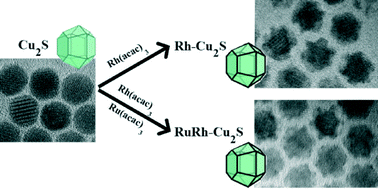
Edge growth of rhodium and ruthenium-rhodium metals on highly faceted Cu2S semiconductor seeds yields a family of nano-inorganic caged hybrid nanoparticles.
The content of this RSS Feed (c) The Royal Society of Chemistry

08 Jul 15:28
Nanoscale, 2014, 6,10347-10354
DOI: 10.1039/C4NR01264J, Paper
Himani Chauhan, Yogesh Kumar, Sasanka Deka
A new method to prepare fluorescent monodispered 2D CdSe/CdS core/shell hexagonal platelet nanostructure system using differentially capped CdSe seeds.
The content of this RSS Feed (c) The Royal Society of Chemistry

08 Jul 15:28
Chem. Commun., 2014, 50,9761-9764
DOI: 10.1039/C4CC03850A, Communication
Masataka Ohashi, Hideyuki Nakano, Tetsuya Morishita, Michelle J. S. Spencer, Yuka Ikemoto, Chihiro Yogi, Toshiaki Ohta
Lithiated polysilane was synthesized by the mechanochemical reaction of layered polysilane with metallic lithium. The resulting dark green powder formed a Si-Li bond on the surface and demonstrated electroconductivity.
The content of this RSS Feed (c) The Royal Society of Chemistry

08 Jul 10:02
by Hengzhong Zhang, James J. De Yoreo and Jillian F. Banfield

ACS Nano
DOI: 10.1021/nn503145w

08 Jul 10:01
by Colan E. Hughes, P. Andrew Williams, Kenneth D. M. Harris
Abstract
A new in-situ NMR strategy (termed CLASSIC NMR) for mapping the evolution of crystallization processes is reported, involving simultaneous measurement of both liquid-state and solid-state NMR spectra as a function of time. This combined strategy allows complementary information to be obtained on the evolution of both the solid and liquid phases during the crystallization process. In particular, as crystallization proceeds (monitored by solid-state NMR), the solution state becomes more dilute, leading to changes in solution-state speciation and the modes of molecular aggregation in solution, which are monitored by liquid-state NMR. The CLASSIC NMR experiment is applied here to yield new insights into the crystallization of m-aminobenzoic acid.

Killing two birds with one stone: A new in-situ NMR strategy (termed CLASSIC NMR) for mapping the evolution of crystallization processes is reported, involving simultaneous measurement of both liquid-state and solid-state NMR spectra as a function of time. This combined strategy allows complementary information to be obtained on the evolution of the solid phase during the crystallization process as well as the corresponding changes in the solution phase.
08 Jul 09:57
by Qianqian Li, Peng Wang, Qiong Feng, Minmin Mao, Jiabin Liu, Scott X. Mao and Hongtao Wang

Chemistry of Materials
DOI: 10.1021/cm5009448

08 Jul 09:57
by Kar Wei Ng, Wai Son Ko, Fanglu Lu and Connie J. Chang-Hasnain

Nano Letters
DOI: 10.1021/nl501887f

08 Jul 09:45
J. Mater. Chem. A, 2014, 2,15234-15251
DOI: 10.1039/C4TA03023K, Feature Article
Thomas Jahnert, Martin D. Hager, Ulrich S. Schubert
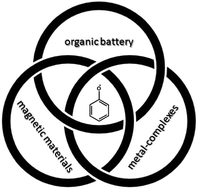
Organic radicals originating from phenolic compounds have been known for decades. In natural systems they are found as antioxidants and radical-scavengers. In organic radical batteries they are utilized as electroactive material to store electric energy. Phenolic radicals are also investigated for their magnetic properties, their redoxactivity in metal-complexes as well as dopant in organic solar cells.
The content of this RSS Feed (c) The Royal Society of Chemistry
06 Jul 15:22
Abstract
Solid-lubricant nanoparticles as additives in oil provide good tribological properties based on the physical lubrication mechanisms in the contact. For this reason, they are strong candidates for use in the lubrication of diamond-like carbon (DLC) coatings, which only poorly interact with the traditional, chemically based additives. In this study, we focused on how a tribofilm formed from MoS2 nanotubes is related to the tribological properties of these nanotubes, and then, we analysed such a tribofilm on steel and DLC-coated surfaces using scanning electron microscopy, energy-dispersive X-ray spectroscopy, X-ray photoelectron spectroscopy and Auger electron spectroscopy. We demonstrated that when using oil containing MoS2 nanoparticles, the formation of a tribofilm is a key factor in decreasing the friction for the steel and DLC-coated contacts. The major difference between the steel and the DLC contacts is the extent to which the MoS2-based tribofilm covers the surface, which is 20 % in the case of the DLC/DLC contacts, but almost 40 % in the case of the steel/steel contacts. Moreover, the MoS2-based tribofilm was found to be more oxidized on the DLC surface than on the steel surface. Nevertheless, we found that the chemical and functional properties of the MoS2-based tribofilm are very similar, or even the same, for both the steel and DLC-coated surfaces. No direct evidence of any chemical reactions between the MoS2 and the steel or DLC coating was observed.
06 Jul 15:12
by Michael Ludemann, Ovidiu D. Gordan, Dietrich R. T. Zahn, Matt Beekman, Ryan Atkins and David C. Johnson

Langmuir
DOI: 10.1021/la501722d

06 Jul 15:10
by Eleanor R. Hall, Christopher J. Pollock, Jesper Bendix, Terrence J. Collins, Pieter Glatzel and Serena DeBeer

Journal of the American Chemical Society
DOI: 10.1021/ja504206y

06 Jul 14:55
by Qianqian Wang, Bo Xu, Jian Sun, Hanyu Liu, Zhisheng Zhao, Dongli Yu, Changzeng Fan and Julong He

Journal of the American Chemical Society
DOI: 10.1021/ja5035792

02 Jul 23:26
by Banavoth Murali, M. Madhuri and S. B. Krupanidhi

Crystal Growth & Design
DOI: 10.1021/cg500622f

02 Jul 23:24
by Aloyzas Šiušys, Janusz Sadowski, Maciej Sawicki, Sławomir Kret, Tomasz Wojciechowski, Katarzyna Gas, Wojciech Szuszkiewicz, Agnieszka Kaminska and Tomasz Story

Nano Letters
DOI: 10.1021/nl500896d

02 Jul 23:24
by Lars Opherden, Jana Oertel, Astrid Barkleit, Karim Fahmy and Adrian Keller

Langmuir
DOI: 10.1021/la501112a

02 Jul 23:22
by Dan Xia, Shuai Zhang, Jesper Østergaard Hjortdal, Qiang Li, Karen Thomsen, Jacques Chevallier, Flemming Besenbacher and Mingdong Dong

ACS Nano
DOI: 10.1021/nn5015837

01 Jul 17:46
Chem. Sci., 2014, 5,4136-4152
DOI: 10.1039/C4SC01333F, Minireview
L. X. Chen, X. Zhang, M. L. Shelby
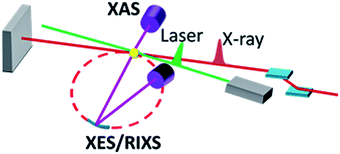
Molecular snapshots obtained by ultrafast X-ray spectroscopy reveal new insight into fundamental reaction mechanisms at single electron and atomic levels.
The content of this RSS Feed (c) The Royal Society of Chemistry

01 Jul 17:29
by Wonjung Choi, Chang Zoo Kim, Chang Su Kim, Wooseok Heo, Taiha Joo, Seung Yoon Ryu, Hogyoung Kim, Hongjoon Kim, Ho Kwan Kang, Sungjin Jo

The effects of epitaxial materials and solar cell design on the performance of solar cells grown by the multilayer approach are investigated. The novel solar cell structure with a p-on-n type configuration suggested exhibits improved uniformity in the photovoltaic performance because of the suppression of Zn diffusion. This approach provides routes to achieve further improvements and acts as a guideline for the commercialization of the multilayer technique.
01 Jul 17:18
by Dennis Fischer, Thomas M. Klapötke, Jörg Stierstorfer
Abstract
Adequate primary explosives such as lead azide mostly contain toxic ingredients, which have to be replaced. A new candidate that shows high potential, potassium 1,1′-dinitramino-5,5′-bistetrazolate (K2DNABT), was synthesized by a sophisticated synthetic procedure based on dimethylcarbonate and glyoxal. It was intensively characterized for its chemical (X-ray diffraction, EA, NMR and vibrational spectroscopy) and physico-chemical properties (sensitivity towards impact, friction, and electrostatic, DSC). The obtained primary explosive combines good thermal stability with the desired mechanical stability. Owing to its high heat of formation (326 kJ mol−1) and density (2.11 g cm−3), impressive values for its detonation velocity (8330 m s−1) and pressure (311 kbar) were computed. Its superior calculated performance output was successfully confirmed and demonstrated by different convenient energetic test methods.

Fast and furious: The picture shows the moment of detonation of the new primary explosive potassium 1,1′-dinitramino-5,5′-bistetrazolate, which can be synthesized by a safe and sustainable procedure. It shows faster detonation with greater initiation power than lead azide while simultaneously being environmentally compatible.