Shared posts

22 Aug 12:03

Self-assembling few-layer MoS2 nanosheets on a CNT backbone for high-rate and long-life lithium-ion batteries

RSC Adv., 2014, 4,40368-40372
DOI: 10.1039/C4RA08604J, Paper
Dayong Ren, Hao Jiang, Yanjie Hu, Ling Zhang, Chunzhong Li
We demonstrate the self-assembly of few-layer MoS2 nanosheets on a CNT backbone via a facile hydrothermal reaction with a subsequent annealing process.
The content of this RSS Feed (c) The Royal Society of Chemistry
22 Aug 12:03

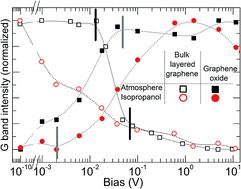
Electron-phonon interaction in bulk layered graphene and its oxide in the presence of alcohols in a device: equilibrium molecular doping

J. Mater. Chem. C, 2014, 2,8585-8592
DOI: 10.1039/C4TC01694G, Paper
Sesha Vempati, Asli Celebioglu, Tamer Uyar
Intensity variation of G band from bulk layered graphene and its oxide in ambient atmosphere or isopropanol vapor showing mutually contrasting behavior under bias.
The content of this RSS Feed (c) The Royal Society of Chemistry
22 Aug 12:03

Stabilization of n-cadmium telluride photoanodes for water oxidation to O2(g) in aqueous alkaline electrolytes using amorphous TiO2 films formed by atomic-layer deposition

Energy Environ. Sci., 2014, 7,3334-3337
DOI: 10.1039/C4EE01914H, Communication
Michael F. Lichterman, Azhar I. Carim, Matthew T. McDowell, Shu Hu, Harry B. Gray, Bruce S. Brunschwig, Nathan S. Lewis
Protection of n-CdTe by ALD-grown TiO2 film for water oxidation to O2(g) in alkaline media.
The content of this RSS Feed (c) The Royal Society of Chemistry
22 Aug 12:02

Fabrication and atomic structure of size-selected, layered MoS2 clusters for catalysis

Nanoscale, 2014, Advance Article
DOI: 10.1039/C4NR04317K, Communication
Martin J. Cuddy, Kenton P. Arkill, Zhi Wei Wang, Hannu-Pekka Komsa, Arkady V. Krasheninnikov, Richard E. Palmer
Well defined MoS2 nanoparticles having a layered structure and abundant edges would be of considerable interest for applications including photocatalysis.
To cite this article before page numbers are assigned, use the DOI form of citation above.
The content of this RSS Feed (c) The Royal Society of Chemistry
22 Aug 12:02

Tensile strain induced switching of magnetic states in NbSe2 and NbS2 single layers

Nanoscale, 2014, Advance Article
DOI: 10.1039/C4NR01486C, Paper
Ying Xu, Xiaofei Liu, Wanlin Guo
The transition from antiferro- to ferro-magnetism in single-layered NbSe2 and NbS2 through an in-plane biaxial tensile strain.
To cite this article before page numbers are assigned, use the DOI form of citation above.
The content of this RSS Feed (c) The Royal Society of Chemistry
22 Aug 12:02

Active guests in the MoS2/MoSe2 host lattice: efficient hydrogen evolution using few-layer alloys of MoS2(1-x)Se2x

Nanoscale, 2014, 6,12856-12863
DOI: 10.1039/C4NR03716B, Paper
Vankayala Kiran, Debdyuti Mukherjee, Ramesh Naidu Jenjeti, Srinivasan Sampath
Alloys are better than the individual elements: tunable electroactivity of few-layer MoS2(1-x)Se2x phases.
The content of this RSS Feed (c) The Royal Society of Chemistry
22 Aug 07:54

The development of Nanoscale

Nanoscale, 2014, 6,10452-10453
DOI: 10.1039/C4NR90060J, Editorial
Philip Earis
Nanoscale Executive Editor Philip Earis highlights the substantial progress the journal has made since launch, and announces his departure
The content of this RSS Feed (c) The Royal Society of Chemistry
21 Aug 19:32

The conquest of middle-earth: combining top-down and bottom-up nanofabrication for constructing nanoparticle based devices

DJL

fanboy stuff

Nanoscale, 2014, Advance Article
DOI: 10.1039/C4NR03717K, Feature Article
Open Access Open Access
Creative Commons Licence&nbsp This article is licensed under a Creative Commons Attribution 3.0 Unported Licence.
Yuri A. Diaz Fernandez, Tina A. Gschneidtner, Carl Wadell, Louise H. Fornander, Samuel Lara Avila, Christoph Langhammer, Fredrik Westerlund, Kasper Moth-Poulsen
We present recent developments on the use of self-assembly methods to bridge the gap between sub-nanometer and micrometer length scales.
To cite this article before page numbers are assigned, use the DOI form of citation above.
The content of this RSS Feed (c) The Royal Society of Chemistry
21 Aug 19:30

Anti-Ice Coating Inspired by Ice Skating

by Jing Chen, Zhiqiang Luo, Qinrui Fan, Jianyong Lv, Jianjun Wang
DJL

FIGHTING AGAINST ICING PROBLEMS


?

Accumulation of ice to surfaces brings dangerous and costly problems to our daily life. In this paper, an anti-ice coating inspired by ice skating is reported. Hyaluronic acid is used in the anti-ice coating to form aqueous lubricating layer benefitting from its high water absorbing property. Dopamine, the main component of the mussel adhesive protein, is introduced to anchor the hyaluronic acid to the solid surfaces to render the coating applicable to all types of solid surfaces. At the same time it serves as the crosslinking agent for hyaluronic acid, thus the thickness of the water collecting film could be easily varied. Ice adhesion strength on surfaces coated with such kind of coating could be more than one order of magnitude lower than that of uncoated ones. The results indicate that this anti-ice coating with the aqueous lubricating layer has great potential for fighting against icing problems.

Thumbnail image of graphical abstract

An anti-ice coating with an aqueous lubricating layer, inspired by ice skating, combines the remarkable lubrication capability of hyaluronic acid (HA) with the excellent adhesive property of dopamine. The anti-ice coating shows lower ice adhesion, which can apply to all types of solid surfaces and the thickness of the water collecting film could be easily varied.

20 Aug 08:46

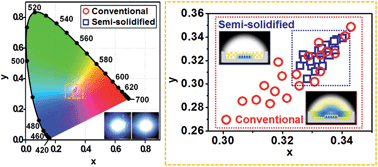
Performance enhancement of white light-emitting diodes using an encapsulant semi-solidification method

J. Mater. Chem. C, 2014, 2,8525-8531
DOI: 10.1039/C4TC01221F, Paper
Seungae Lee, Jin-Yong Hong, Jyongsik Jang
A high-optical-quality white light-emitting diode (LED) is fabricated via semi-solidification, which provides a remarkable improvement in the performance of the LED.
The content of this RSS Feed (c) The Royal Society of Chemistry
20 Aug 08:45

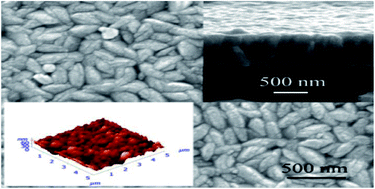
Temperature and thickness-dependent growth behaviour and opto-electronic properties of Ga-doped ZnO films prepared by aerosol-assisted chemical vapour deposition

J. Mater. Chem. A, 2014, 2,17174-17182
DOI: 10.1039/C4TA03888F, Paper
Shuqun Chen, Nuruzzaman Noor, Ivan P. Parkin, Russell Binions
Optimal growth conditions for gallium-doped zinc oxide thin films via aerosol-assisted chemical vapour deposition.
The content of this RSS Feed (c) The Royal Society of Chemistry
19 Aug 16:27

Crack-Free Growth and Transfer of Continuous Monolayer Graphene Grown on Melted Copper

by Ye Fan, Kuang He, Haijie Tan, Susannah Speller and Jamie H. Warner

TOC Graphic

Chemistry of Materials
DOI: 10.1021/cm501911g
19 Aug 16:26

Do Molecular Gelators Cluster in Hansen Space?

by Yaqi Lan, Maria G. Corradini and Michael A. Rogers
DJL

HANSEN, SPACE, SPOCK

TOC Graphic

Crystal Growth & Design
DOI: 10.1021/cg500985e
19 Aug 16:25

Nonstoichiometric Nucleation and Growth of Multicomponent Nanocrystals in Solution

by Yuho Min, Junghyeok Kwak, Aloysius Soon and Unyong Jeong

TOC Graphic

Accounts of Chemical Research
DOI: 10.1021/ar500133w
19 Aug 16:24

Time and Temperature Effects on the Digestive Ripening of Gold Nanoparticles: Is There a Crossover from Digestive Ripening to Ostwald Ripening?

by Puspanjali Sahu and Bhagavatula L. V. Prasad

TOC Graphic

Langmuir
DOI: 10.1021/la500914j
16 Aug 18:56

Selective-Area Epitaxy of Pure Wurtzite InP Nanowires: High Quantum Efficiency and Room-Temperature Lasing

by Qian Gao, Dhruv Saxena, Fan Wang, Lan Fu, Sudha Mokkapati, Yanan Guo, Li Li, Jennifer Wong-Leung, Philippe Caroff, Hark Hoe Tan and Chennupati Jagadish

TOC Graphic

Nano Letters
DOI: 10.1021/nl5021409
16 Aug 18:53

A Dynamic Duo: Pairing Click Chemistry and Postpolymerization Modification To Design Complex Surfaces

by Rachelle M. Arnold, Derek L. Patton, Vladimir V. Popik and Jason Locklin

TOC Graphic

Accounts of Chemical Research
DOI: 10.1021/ar500191m
16 Aug 18:50

Photosensitive Graphene Transistors

by Jinhua Li, Liyong Niu, Zijian Zheng, Feng Yan

High performance photodetectors play important roles in the development of innovative technologies in many fields, including medicine, display and imaging, military, optical communication, environment monitoring, security check, scientific research and industrial processing control. Graphene, the most fascinating two-dimensional material, has demonstrated promising applications in various types of photodetectors from terahertz to ultraviolet, due to its ultrahigh carrier mobility and light absorption in broad wavelength range. Graphene field effect transistors are recognized as a type of excellent transducers for photodetection thanks to the inherent amplification function of the transistors, the feasibility of miniaturization and the unique properties of graphene. In this review, we will introduce the applications of graphene transistors as photodetectors in different wavelength ranges including terahertz, infrared, visible, and ultraviolet, focusing on the device design, physics and photosensitive performance. Since the device properties are closely related to the quality of graphene, the devices based on graphene prepared with different methods will be addressed separately with a view to demonstrating more clearly their advantages and shortcomings in practical applications. It is expected that highly sensitive photodetectors based on graphene transistors will find important applications in many emerging areas especially flexible, wearable, printable or transparent electronics and high frequency communications.

Thumbnail image of graphical abstract

Graphene demonstrates promising applications in various types of photodetectors from terahertz to ultraviolet, due to its ultrahigh carrier mobility and light absorption in a broad wavelength range. Graphene field effect transistors are re­cognized as a type of excellent transducers for photodetection thanks to the inherent amplification function of the transistors, the feasibility of miniaturization, and the unique properties of graphene.

15 Aug 12:58

Carrier Dynamics in Highly Quantum-Confined, Colloidal Indium Antimonide Nanocrystals

by Angela Y. Chang, Wenyong Liu, Dmitri V. Talapin and Richard D. Schaller

TOC Graphic

ACS Nano
DOI: 10.1021/nn5031274
15 Aug 12:57

Electroabsorption by 0D, 1D, and 2D Nanocrystals: A Comparative Study of CdSe Colloidal Quantum Dots, Nanorods, and Nanoplatelets

by Alexander W. Achtstein, Anatol V. Prudnikau, Maxim V. Ermolenko, Leonid I. Gurinovich, Sergey V. Gaponenko, Ulrike Woggon, Alexander V. Baranov, Mikhail Yu. Leonov, Ivan D. Rukhlenko, Anatoly V. Fedorov and Mikhail V. Artemyev

TOC Graphic

ACS Nano
DOI: 10.1021/nn503745u
15 Aug 12:14

Turbulence-assisted shear exfoliation of graphene using household detergent and a kitchen blender

Nanoscale, 2014, 6,11810-11819
DOI: 10.1039/C4NR03560G, Paper
Eswaraiah Varrla, Keith R. Paton, Claudia Backes, Andrew Harvey, Ronan J. Smith, Joe McCauley, Jonathan N. Coleman
We have demonstrated shear-exfoliation of graphene in a kitchen blender, finding production rates far higher than those achieved with sonication.
The content of this RSS Feed (c) The Royal Society of Chemistry
15 Aug 12:13

Controlled stripes of ultrafine ferroelectric domains

by Ludwig Feigl

Article

In magnets and ferroelectrics, domains of regions with different ferroic orientation play an important role for the performance of devices based on these materials. Here, the authors create and control ultrafine domains in a ferroelectric that are only 10 nm wide and extend for tens of micrometres.

Nature Communications doi: 10.1038/ncomms5677

Authors: Ludwig Feigl, Petr Yudin, Igor Stolichnov, Tomas Sluka, Konstantin Shapovalov, Mahamudu Mtebwa, Cosmin S. Sandu, Xian-Kui Wei, Alexander K. Tagantsev, Nava Setter

15 Aug 12:13

A powerful approach to functional graphene hybrids for high performance energy-related applications

Energy Environ. Sci., 2014, 7,3699-3708
DOI: 10.1039/C4EE01876A, Paper
Chuangang Hu, Guanpei Zheng, Fei Zhao, Huibo Shao, Zhipan Zhang, Nan Chen, Lan Jiang, Liangti Qu
Pore-rich graphene networks hold great promise as advanced supporting materials of metals and metal oxides for high electrochemical performance.
The content of this RSS Feed (c) The Royal Society of Chemistry
14 Aug 09:03

Size, Dimensionality, and Strong Electron Correlation in Nanoscience

by Louis Brus

TOC Graphic

Accounts of Chemical Research
DOI: 10.1021/ar500175h
13 Aug 19:15

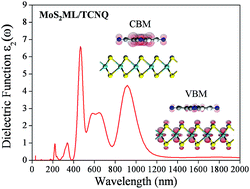
Tuning electronic and optical properties of MoS2 monolayer via molecular charge transfer

J. Mater. Chem. A, 2014, 2,16892-16897
DOI: 10.1039/C4TA03660C, Paper
Yu Jing, Xin Tan, Zhen Zhou, Panwen Shen
TCNQ, TCNE, TTF and BV can reduce band gap of MoS2 monolayer, and TNCQ can enhance the infrared optical absorption.
The content of this RSS Feed (c) The Royal Society of Chemistry
13 Aug 19:14

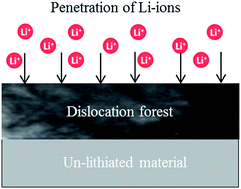
Comments on "Effects of dislocation mechanics on diffusion-induced stresses within a spherical insertion particle electrode"

J. Mater. Chem. A, 2014, 2,17183-17184
DOI: 10.1039/C4TA01983K, Comment
Fuqian Yang
In this work, it is shown that the analysis by Wei et al. [Wei et al., J. Mater. Chem. A, 2014, 2, 1128-1136] is inappropriate for studying the effect of dislocation mechanics on diffusion-induced stresses.
The content of this RSS Feed (c) The Royal Society of Chemistry
13 Aug 19:12

Floating Gate Memory-based Monolayer MoS2 Transistor with Metal Nanocrystals Embedded in the Gate Dielectrics

by Jingli Wang, Xuming Zou, Xiangheng Xiao, Lei Xu, Chunlan Wang, Changzhong Jiang, Johnny C. Ho, Ti Wang, Jinchai Li, Lei Liao
Thumbnail image of graphical abstract

Charge trapping layers are formed from different metallic nanocrystals in MoS2-based nanocrystal floating gate memory cells in a process compatible with existing fabrication technologies. The memory cells with Au nanocrystals exhibit impressive performance with a large memory window of 10 V, a high program/erase ratio of approximately 105 and a long retention time of 10 years.

13 Aug 19:06

Interplay of Optical, Morphological, and Electronic Effects of ZnO Optical Spacers in Highly Efficient Polymer Solar Cells

by Sadok Ben Dkhil, David Duché, Meriem Gaceur, Anil K. Thakur, Fatima Bencheikh Aboura, Ludovic Escoubas, Jean-Jacques Simon, Antonio Guerrero, Juan Bisquert, Germà Garcia-Belmonte, Qinye Bao, Mats Fahlman, Christine Videlot-Ackermann, Olivier Margeat, Jörg Ackermann

Optical spacers based on metal oxide layers have been intensively studied in poly(3-hexylthiophene) (P3HT) based polymer solar cells for optimizing light distribution inside the device, but to date, the potential of such a metal oxide spacer to improve the electronic performance of the polymer solar cells simultaneously has not yet be investigated. Here, a detailed study of performance improvement in high efficient polymer solar cells by insertion of solution-processed ZnO optical spacer using ethanolamine surface modification is reported. Insertion of the modified ZnO optical spacer strongly improves the performance of polymer solar cells even in the absence of an increase in light absorption. The electric improvements of the device are related to improved electron extraction, reduced contact barrier, and reduced recombination at the cathode. Importantly, it is shown for the first time that the morphology of optical spacer layer is a crucial parameter to obtain highly efficient solar cells in normal device structures. By optimizing optical spacer effects, contact resistance, and morphology of ZnO optical spacers, poly[[4,8-bis[(2-ethylhexyl)oxy]benzo[1,2-b:4,5-b′]dithiophene-2,6diyl] [3-fluoro-2-[(2-ethylhexyl)carbonyl] thieno[3,4-b]thiophenediyl]] (PTB7):[6,6]-phenyl-C71-butyric acid (PC70BM) bulk heterojunction solar cells with conversion efficiency of 7.6% are obtained in normal device structures with all-solution-processed interlayers.

Thumbnail image of graphical abstract

Solution-processed ZnO optical spacers (OSP) are investigated in highly efficient polymer solar cells. The morphology of the OSP layer is shown to be crucial for introducing efficient electron extraction properties to the ZnO layer. By optimizing the optical spacer effects, contact resistance, and morphology of the ZnO layer, poly[[4,8-bis[(2-ethylhexyl)oxy]benzo[1,2-b:4,5-b′]dithiophene-2,6diyl] [3-fluoro-2-[(2-ethylhexyl)carbonyl] thieno[3,4-b]thiophenediyl]] (PTB7):[6,6]-phenyl-C71-butyric acid (PC70BM) bulk heterojunction solar cells with a conversion efficiency of 7.6% are obtained.

13 Aug 18:59

Perturbation of the Charge Density between Two Bridged Mo2 Centers: The Remote Substituent Effects

by Tao Cheng, Miao Meng, Hao Lei and Chun Y. Liu

TOC Graphic

Inorganic Chemistry
DOI: 10.1021/ic501313q
13 Aug 18:59

Tunable Transport Gap in Phosphorene

by Saptarshi Das, Wei Zhang, Marcel Demarteau, Axel Hoffmann, Madan Dubey and Andreas Roelofs

TOC Graphic

Nano Letters
DOI: 10.1021/nl5025535