13 Aug 19:21
by Pengpeng Bai, Shuqi Zheng, Changfeng Chen and Hui Zhao

Crystal Growth & Design
DOI: 10.1021/cg500333p

12 Aug 12:46
Nanoscale, 2014, 6,11653-11658
DOI: 10.1039/C4NR02318H, Communication
Gwang-Hee Nam, Seong-Ho Baek, Chang-Hee Cho, Il-Kyu Park
We demonstrate the fabrication of a graphene/ZnO nanorod (NR) hybrid structure by mechanical exfoliation of ZnO NRs grown on a graphite substrate.
The content of this RSS Feed (c) The Royal Society of Chemistry

12 Aug 12:46
Nanoscale, 2014, 6,12130-12141
DOI: 10.1039/C4NR03080J, Paper
Swapnil B. Ambade, Rohan B. Ambade, Wonjoo Lee, Rajaram S. Mane, Sung Cheol Yoon, Soo-Hyoung Lee
The solution processed inverted BHJ polymer solar cells based on seedless, transparent and planar ZnO nanorods as a cathode buffer exhibit PCE upto 3.24%.
The content of this RSS Feed (c) The Royal Society of Chemistry

12 Aug 12:13
by Minghui Liu and Hua Chun Zeng

Langmuir
DOI: 10.1021/la501637m

12 Aug 12:05
by David A. Evans

Remember when…? This Essay describes the collaboration between Stewart Rubenstein and David and Sally Evans to develop the chemical graphics program ChemDraw, which was introduced in 1986. Now, three decades later, this software has become the dominant vehicle for drawing chemical structures in the organic chemistry community.
08 Aug 09:48
J. Mater. Chem. A, 2014, 2,16360-16364
DOI: 10.1039/C4TA03370A, Communication
Shilong Jing, Hao Jiang, Yanjie Hu, Chunzhong Li
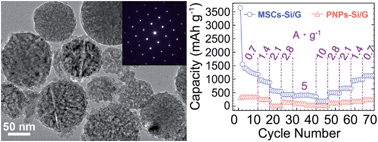
We demonstrate a new nanohybrid anode made up of graphene supported mesoporous single crystal Si (MSC-Si/G) on Cu foam by a facile method.
The content of this RSS Feed (c) The Royal Society of Chemistry
08 Aug 09:45
by Qunyang Li, Xin-Z. Liu, Sang-Pil Kim, Vivek B. Shenoy, Paul E. Sheehan, Jeremy T. Robinson and Robert W. Carpick

Nano Letters
DOI: 10.1021/nl502147t

08 Aug 09:45
by Ji Hoon Lee, Woo Soon Jang, Sun Woong Han and Hong Koo Baik

Langmuir
DOI: 10.1021/la501349k

08 Aug 09:43
by Yung-Huang Chang, Wenjing Zhang, Yihan Zhu, Yu Han, Jiang Pu, Jan-Kai Chang, Wei-Ting Hsu, Jing-Kai Huang, Chang-Lung Hsu, Ming-Hui Chiu, Taishi Takenobu, Henan Li, Chih-I Wu, Wen-Hao Chang, Andrew Thye Shen Wee and Lain-Jong Li

ACS Nano
DOI: 10.1021/nn503287m

06 Aug 19:15
by Chang-Ho Choi and Chih-hung Chang

Crystal Growth & Design
DOI: 10.1021/cg500911w

06 Aug 19:15
by Giovanni M. Vanacore, Jianbo Hu, Wenxi Liang, Sergio Bietti, Stefano Sanguinetti and Ahmed H. Zewail

Nano Letters
DOI: 10.1021/nl502293a

05 Aug 21:14
Nanoscale, 2014, 6,12071-12079
DOI: 10.1039/C4NR01831A, Paper
Qing Peng, Suvranu De
Non-linear elastic behaviors are prominent in 2d nanostructures.
The content of this RSS Feed (c) The Royal Society of Chemistry

05 Aug 21:12
by Jiong Lu, Lídia C. Gomes, Ricardo W. Nunes, A. H. Castro Neto and Kian Ping Loh

Nano Letters
DOI: 10.1021/nl501900x

05 Aug 16:13
Chem. Commun., 2014, 50,11366-11369
DOI: 10.1039/C4CC05162A, Communication
S. Exarhos, K. N. Bozhilov, L. Mangolini
CZTS nanoplatelets have been grown using spray pyrolysis of a mixture of copper-, zinc- and tin-diethyldithiocarbamate as precursors.
The content of this RSS Feed (c) The Royal Society of Chemistry

02 Aug 12:11
by Phil S. Baran
02 Aug 12:10
by Aviva Levina, Andrew I. McLeod, Peter A. Lay
Abstract
A library of X-ray absorption near-edge structure (XANES) spectroscopic data for VV, VIV and VIII complexes with a broad range of biologically relevant ligand has been used to demonstrate that three-dimensional plots of key XANES parameters (pre-edge and edge energies; pre-edge and white line intensities) can be used for the prediction of V oxidation states and coordination numbers in biological or environmental matrices. The reliability of the technique has been demonstrated by re-analysis of the published XANES data for a VV-dependent bromoperoxidase.

Separation according to oxidation state (VV, VIV and VIII) and coordination number (4, 5 or 6) has been achieved for a series of 23 well-characterised V species with biological or biomimetic ligands, using three-dimensional plots (see figure) of pre-edge peak intensity versus pre-edge peak position versus edge energy (or white line intensity). These correlations were used to re-analyse the published XANES data for a VV-containing bromoperoxidase.
02 Aug 11:50
by Puthusserickal A. Hassan, Suman Rana and Gunjan Verma

Langmuir
DOI: 10.1021/la501789z

gao and -1 others like this
01 Aug 18:15
by Seong Hun Yu, Youngbin Lee, Sung Kyu Jang, Jinyeong Kang, Jiwon Jeon, Changgu Lee, Jun Young Lee, Hyungjun Kim, Euyheon Hwang, Sungjoo Lee and Jeong Ho Cho

ACS Nano
DOI: 10.1021/nn502715h

31 Jul 17:29
Dalton Trans., 2014, 43,14158-14163
DOI: 10.1039/C4DT01904K, Paper
Tom Willhammar, Alvaro Mayoral, Xiaodong Zou
The 3D atomic structure of silicalite-1 has been reconstructed for the first time by combining three high resolution HAADF-STEM images.
The content of this RSS Feed (c) The Royal Society of Chemistry

30 Jul 20:41
Abstract
Inorganic fullerene-like molybdenum disulfide (IF-MoS2) nanoparticles are known to exhibit great friction and wear-reducing abilities in severe boundary lubrication regimes, when added to a base oil alone. Their use in fully formulated lubricants was investigated in this study, and the tribological benefits attributed to the IF-MoS2 nanoparticles were found to be lost in the presence of dispersants. Various experimental techniques were used on three reference oils (base oil containing only IF-MoS2, only dispersants and both IF-MoS2 and dispersants) in order to understand the effect of succinimide-based dispersants on the three phases needed for effective nanoparticle-based lubrication, namely (1) the passing of the nanoparticles through the contact (2) the exfoliation of the IF-MoS2 inside the contact and (3) the adhesion of the released MoS2 platelets on the friction surfaces. The dispersants were shown to improve the dispersion of the nanoparticles in the oil by reducing their agglomeration, but prevented the adhesion of a low-friction MoS2 tribofilm on the steel surfaces. In-situ contact visualization revealed that the well-dispersed nanoparticles passed through the contact and exfoliated nanoparticles were observed after tribological testing. These results imply that nanoparticle dispersion itself does not seem to be an issue concerning nanoparticle effectiveness, even though the reduced agglomerate size and inertia may have affected nanoparticle flow near the contact, as well as entrapment and exfoliation conditions inside the contact. The use of succinimide-based dispersants may, however, have affected the tribochemistry of the contact, by an excessive adsorption on the steel surfaces and/or by encapsulating the released MoS2 platelets, preventing tribofilm adhesion. A balance was finally found between nanoparticle dispersion and friction reduction, but for very low dispersant concentrations and after a running-in period. The role of succinimide-based dispersants and their effect on nanoparticle lubrication were discussed in the light of these results.
30 Jul 20:35
by Xuming Zou, Jingli Wang, Chung-Hua Chiu, Yun Wu, Xiangheng Xiao, Changzhong Jiang, Wen-Wei Wu, Liqiang Mai, Tangsheng Chen, Jinchai Li, Johnny C. Ho, Lei Liao

Experimental evidence of the optimized interface engineering effects in MoS2 transistors is demonstrated. The MoS2/Y2O3/HfO2 stack offers excellent interface control. Results show that HfO2 layer can be scaled down to 9 nm, yet achieving a near-ideal sub-threshold slope (65 mv/dec) and the highest saturation current (526 μA/μm) of any MoS2 transistor reported to date.
30 Jul 20:32
by Carlos G. Morales-Guio and Xile Hu

Accounts of Chemical Research
DOI: 10.1021/ar5002022

30 Jul 20:22
by Michaël Paris, Léo Choubrac, Alain Lafond, Catherine Guillot-Deudon and Stéphane Jobic

Inorganic Chemistry
DOI: 10.1021/ic5012346

30 Jul 20:15
by Vladimir Lesnyak, Chandramohan George, Alessandro Genovese, Mirko Prato, Alberto Casu, S. Ayyappan, Alice Scarpellini and Liberato Manna

ACS Nano
DOI: 10.1021/nn502906z

30 Jul 20:15
by Hak Ki Yu, Kannan Balasubramanian, Kisoo Kim, Jong-Lam Lee, Manisankar Maiti, Claus Ropers, Janina Krieg, Klaus Kern and Alec M. Wodtke

ACS Nano
DOI: 10.1021/nn503476j

30 Jul 20:14
by Guohua Jia and Uri Banin

Journal of the American Chemical Society
DOI: 10.1021/ja505541q

30 Jul 20:13
by Xingxing Li, Xiaojun Wu and Jinlong Yang

Journal of the American Chemical Society
DOI: 10.1021/ja505097m

30 Jul 20:12
by Fei Zhang, Jeanette Nangreave, Yan Liu and Hao Yan

Journal of the American Chemical Society
DOI: 10.1021/ja505101a

30 Jul 20:10
by Nelson Monteiro, Diana Ribeiro, Albino Martins, Susana Faria, Nuno A. Fonseca, João N. Moreira, Rui L. Reis and Nuno M. Neves

ACS Nano
DOI: 10.1021/nn5021049

24 Jul 16:12
Nanoscale, 2014, Advance Article
DOI: 10.1039/C4NR03735A, Communication
Tuo Wang, Rui Lv, Peng Zhang, Changjiang Li, Jinlong Gong
Au nanoparticle (NP) sensitized ZnO nanopencil arrays were synthesized on FTO substrates by aqueous chemical growth followed by photoreduction, yielding a photocurrent of [similar]1.5 mA cm-2 at 1 V vs. Ag/AgCl. The enhanced photocurrent is attributed to the surface plasmon resonance effect of Au NPs and a prolonged photo-generated electron-hole pair lifetime.
To cite this article before page numbers are assigned, use the DOI form of citation above.
The content of this RSS Feed (c) The Royal Society of Chemistry