Shared posts
Organic Synthesis: March of the Machines
DJLSuch a great GA looks like the old BBC TV series 'The Tripods'
Abstract
Organic synthesis is changing; in a world where budgets are constrained and the environmental impacts of practice are scrutinized, it is increasingly recognized that the efficient use of human resource is just as important as material use. New technologies and machines have found use as methods for transforming the way we work, addressing these issues encountered in research laboratories by enabling chemists to adopt a more holistic systems approach in their work. Modern developments in this area promote a multi-disciplinary approach and work is more efficient as a result. This Review focuses on the concepts, procedures and methods that have far-reaching implications in the chemistry world. Technologies have been grouped as topics of opportunity and their recent applications in innovative research laboratories are described.

Transforming chemistry: New technologies and machines have found use as methods for changing the way we work, addressing the resource-based issues encountered in research laboratories by enabling chemists to adopt a more holistic systems approach in their work. This Review focuses on the concepts, procedures, and methods that have far-reaching implications in the chemistry world.
Colloidal Quantum Dot Solar Cells Exploiting Hierarchical Structuring
DJLSolar pyramid scheme

Controlled Folding of Graphene: GraFold Printing

Host ICAMs play a role in cell invasion by Mycobacterium tuberculosis and Plasmodium falciparum
Article
Intercellular adhesion molecules (ICAMs) participate in cellular processes such as host-pathogen interactions. Here, the authors show that ICAM-1 and ICAM-4 play roles in the invasion of macrophages and red blood cells by Mycobacterium tuberculosis and Plasmodium falciparum , respectively.
Nature Communications doi: 10.1038/ncomms7049
Authors: Kuhulika Bhalla, Monika Chugh, Sonali Mehrotra, Sumit Rathore, Sultan Tousif, Ved Prakash Dwivedi, Prem Prakash, Sachin Kumar Samuchiwal, Sushil Kumar, Dhiraj Kumar Singh, Swapnil Ghanwat, Dhiraj Kumar, Gobardhan Das, Asif Mohmmed, Pawan Malhotra, Anand Ranganathan
Spray-Assisted Deep-Frying Process for the In Situ Spherical Assembly of Graphene for Energy-Storage Devices

Thermoelectric performance of SnS and SnS-SnSe solid solution

DOI: 10.1039/C4TA06955B, Paper
The thermoelectric performance improvement of SnS by introducing Se into S sublattice is reported.
The content of this RSS Feed (c) The Royal Society of Chemistry
Nanoscale imaging of freestanding nitrogen doped single layer graphene

DOI: 10.1039/C4NR05385K, Communication
A facile low bombardment plasma method for n-doping freestanding single layer graphene.
The content of this RSS Feed (c) The Royal Society of Chemistry
Large-Sized Crystal Growth and Electric-Elastic Properties of α-BaTeMo2O9 Single Crystal
DJLAnother big crystal GA

Surfactant free superparamagnetic iron oxide nanoparticles for stable ferrofluids in physiological solutions
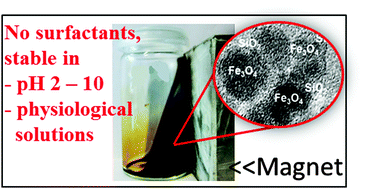
DOI: 10.1039/C4CC09277E, Communication
Ferrofluids of superparamagnetic Fe3O4 nanoparticles with "patchy" silica shell are stable over a wide pH range and in physiological solutions.
To cite this article before page numbers are assigned, use the DOI form of citation above.
The content of this RSS Feed (c) The Royal Society of Chemistry
Layer-by-Layer Dielectric Breakdown of Hexagonal Boron Nitride

Smoking interferes with alcohol withdrawal [Neuroscience]
Metal Oxide Semiconductors for Dye- and Quantum-Dot-Sensitized Solar Cells
This Review provides a brief summary of the most recent research developments in the synthesis and application of nanostructured metal oxide semiconductors for dye sensitized and quantum dot sensitized solar cells. In these devices, the wide bandgap semiconducting oxide acts as the photoanode, which provides the scaffold for light harvesters (either dye molecules or quantum dots) and electron collection. For this reason, proper tailoring of the optical and electronic properties of the photoanode can significantly boost the functionalities of the operating device. Optimization of the functional properties relies with modulation of the shape and structure of the photoanode, as well as on application of different materials (TiO2, ZnO, SnO2) and/or composite systems, which allow fine tuning of electronic band structure. This aspect is critical because it determines exciton and charge dynamics in the photoelectrochemical system and is strictly connected to the photoconversion efficiency of the solar cell. The different strategies for increasing light harvesting and charge collection, inhibiting charge losses due to recombination phenomena, are reviewed thoroughly, highlighting the benefits of proper photoanode preparation, and its crucial role in the development of high efficiency dye sensitized and quantum dot sensitized solar cells.

This Review provides a brief summary of the most recent research developments in the synthesis and application of nanostructured metal oxide semiconductors for dye-sensitized and quantum dot-sensitized solar cells, and illustrates the critical role of photoanode preparation to boost charge photogeneration and collection, to inhibit charge recombination and to increase photoconversion efficiency in these devices.
An Open Canvas2D Materials with Defects, Disorder, and Functionality
DJLIs the graphical abstract a 2d Texas???

Ultralow-Density, Transparent, Superamphiphobic Boehmite Nanofiber Aerogels and Their Alumina Derivatives
DJLBack to the Future part 2

Pressure-Dependent Optical and Vibrational Properties of Monolayer Molybdenum Disulfide

Efficient Passivated Phthalocyanine-Quantum Dot Solar Cells
DOI: 10.1039/C4CC08104H, Communication
The power conversion efficiency of CdSe and CdS quantum dot sensitized solar cells is enhanced by passivation with asymmetrically substituted phthalocyanines. The introduction of the phthalocyanine dye increases the efficiency...
The content of this RSS Feed (c) The Royal Society of Chemistry
Unprecedented Spin Localisation in a Metal-Metal Bonded Dirhenium Complex
DOI: 10.1039/C4CC09397F, Communication
The molecular and electronic structure of edge-sharing bioctahedral [N(n-Bu)4]3[Re2(mnt)5] is reported here. Despite the short intermetal bond length of 2.6654(2) A with computed bond order of 1.2, the unpaired electron...
The content of this RSS Feed (c) The Royal Society of Chemistry
Wired Up: Interconnecting Two-Dimensional Materials with One-Dimensional Atomic Chains

Growth and optical properties of the novel nonlinear optical crystal NaSr3Be3B3O9F4
DJLAnyone noticed the latest trend of growing the biggest crystal one can as the basis of a paper and then putting it in the graphical abstract on graph paper?
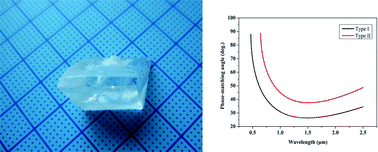
DOI: 10.1039/C4CE02096K, Paper
This crystal has potential for 266 nm laser generation.
The content of this RSS Feed (c) The Royal Society of Chemistry
Identification of the remains of King Richard III
Article
King Richard III was a controversial English King whose remains are presumably deposited in Grey Friars in Leicester. Here the authors sequence the mitochondrial genome and Y-chromosome DNA of the skeletal remains and living relatives of Richard III and confirm that the remains belong to King Richard III.
Nature Communications doi: 10.1038/ncomms6631
Authors: Turi E. King, Gloria Gonzalez Fortes, Patricia Balaresque, Mark G. Thomas, David Balding, Pierpaolo Maisano Delser, Rita Neumann, Walther Parson, Michael Knapp, Susan Walsh, Laure Tonasso, John Holt, Manfred Kayser, Jo Appleby, Peter Forster, David Ekserdjian, Michael Hofreiter, Kevin Schürer
Co-solvent exfoliation and suspension of hexagonal boron nitride

DOI: 10.1039/C4CC07324J, Communication
A simple method is presented for exfoliating and suspending hexagonal boron nitride using a co-solvent approach. A 60 w/w% concentration of tert-butanol in water is very effective at exfoliating boron nitride especially when compared to the individual components alone as indicated by UV-vis and transmission electron microscopy. Molecular weight and surface tension are found to play inverse roles in the exfoliation.
The content of this RSS Feed (c) The Royal Society of Chemistry
Inkjet Printing CH3NH3PbI3 on Mesoscopic TiO2 Film for Highly Efficient Perovskite Solar Cells
DOI: 10.1039/C4TA05675B, Communication
Inkjet printing technique is successfully used to deposit perovskite CH3NH3PbI3 layer on a mesoscopic TiO2 film. With the combined optimization of the table temperature and the ink composition, a flat...
The content of this RSS Feed (c) The Royal Society of Chemistry
Preparation, Formation, and Structure of [(SnSe)1.04]m(MoSe2)n Intergrowth Compounds (0 < m and n < 32) from Designed Precursors

Repeated Growth–Etching–Regrowth for Large-Area Defect-Free Single-Crystal Graphene by Chemical Vapor Deposition

Electrochemistry of Transition Metal Dichalcogenides: Strong Dependence on the Metal-to-Chalcogen Composition and Exfoliation Method

A De Novo Designed 2[4Fe-4S] Ferredoxin Mimic Mediates Electron Transfer

Phase-Selective Cation-Exchange Chemistry in Sulfide Nanowire Systems

Field measurement of coefficient of friction in rails using a hand-pushed tribometer
DJLHand pushed ma bhoyyyy
Source:Tribology International, Volume 82, Part B
Author(s): Y.A. Areiza , S.I. Garcés , J.F. Santa , G. Vargas , A. Toro
The coefficient of friction (COF) on the rail of a commercial railway was measured in the field using a hand-pushed tribometer. Two different friction modifiers (FM), a flange lubricant and water were manually applied on the top of the rail and creep curves were obtained for contact pressures of 1.0 and 1.2GPa. The coefficient of friction was between 0.42 and 0.55 for dry tests, between 0.39 and 0.44 for water lubricated tests, and ranged from 0.13 to 0.22 when the FMs or flange lubricant were added. Thicker layers and greater contact pressures led to lower values of COF. In comparison to the dry condition, the effect of contact pressure was much less significant when an interfacial product was applied.
Yogurt: A novel precursor for heavily nitrogen doped supercapacitor carbon
DJLYOGHURT
DOI: 10.1039/C4TA06068G, Paper
Yogurt is used as a novel precursor to synthesize high quality heavily nitrogen doped porous carbon for the supercapacitor application. It is an easily scalable and manufacture-able food item containing...
The content of this RSS Feed (c) The Royal Society of Chemistry