20 Feb 11:32
by Jeil Jung
Article
Graphene doesn’t usually have a bandgap but one can appear when the two-dimensional material is placed on a hexagonal boron nitride substrate. Jung et al . now develop a theory that indicates that this occurs because the graphene’s carbon atoms structurally relax when placed on boron nitride.
Nature Communications doi: 10.1038/ncomms7308
Authors: Jeil Jung, Ashley M. DaSilva, Allan H. MacDonald, Shaffique Adam

19 Feb 22:27
Chem. Commun., 2015, Advance Article
DOI: 10.1039/C4CC10194D, Feature Article
Robert Li-Yuan Bao, Rong Zhao, Lei Shi
The structural and kinetic perspectives of i-PrMgCl[middle dot]LiCl help to rationalize the trends of its unique reactivity and selectivity.
To cite this article before page numbers are assigned, use the DOI form of citation above.
The content of this RSS Feed (c) The Royal Society of Chemistry

18 Feb 22:39
by Hyung-Youl Park, Myung-Hoon Lim, Jeaho Jeon, Gwangwe Yoo, Dong-Ho Kang, Sung Kyu Jang, Min Hwan Jeon, Youngbin Lee, Jeong Ho Cho, Geun Young Yeom, Woo-Shik Jung, Jaeho Lee, Seongjun Park, Sungjoo Lee and Jin-Hong Park

ACS Nano
DOI: 10.1021/acsnano.5b00153

18 Feb 22:31
by Cintya D'Angelis do E. S. Barbosa, José R. Corrêa, Gisele A. Medeiros, Gabrielle Barreto, Kelly G. Magalhães, Aline L. de Oliveira, John Spencer, Marcelo O. Rodrigues, Brenno A. D. Neto
Abstract
Improved cellular selectivity for nucleoli staining was achieved by simple chemical modification of carbon dots (C-dots) synthesized from waste carbon sources such as cow manure (or from glucose). The C-dots were characterized and functionalized (amine-passivated) with ethylenediamine, affording amide bonds that resulted in bright green fluorescence. The new modified C-dots were successfully applied as selective live-cell fluorescence imaging probes with impressive subcellular selectivity and the ability to selectively stain nucleoli in breast cancer cell lineages (MCF-7). The C-dots were also tested in four other cellular models and showed the same cellular selection in live-cell imaging experiments.

Cow dots: Improved cellular selectivity for nucleoli staining was achieved by simple amine passivation of carbon dots (C-dots) synthesized from cow manure. The modified C-dots were successfully applied as selective live-cell fluorescence imaging probes with impressive subcellular selectivity and the ability to selectively stain nucleoli in breast cancer and other cell lines.
18 Feb 20:15
Chem. Soc. Rev., 2015, 44,1725-1739
DOI: 10.1039/C4CS00434E, Tutorial Review
Tristram Chivers, Risto S. Laitinen
This tutorial review elucidates the fundamental concepts necessary for an understanding of the unique structures and reactivities of tellurium compounds.
The content of this RSS Feed (c) The Royal Society of Chemistry

18 Feb 20:14
by Kevin Ming, Jisung Kim, Mia J. Biondi, Abdullah Syed, Kun Chen, Albert Lam, Mario Ostrowski, Anu Rebbapragada, Jordan J. Feld and Warren C. W. Chan

ACS Nano
DOI: 10.1021/nn5072792

18 Feb 20:10
by Doojin Vak, Kyeongil Hwang, Andrew Faulks, Yen-Sook Jung, Noel Clark, Dong-Yu Kim, Gerard J. Wilson, Scott E. Watkins

In article number 1401539, Doojin Vak and co-workers describe a new way of developing and sharing processes for the fabrication of solution-processed solar cells by using a modified 3D printer. The printer is controlled by a text-based standard digital protocol that can be used in any compatible printers. The results suggest a new paradigm of sharing processes between machines, labs, and eventually factories.
18 Feb 15:25
by Westaway, M. C., Durband, A. C., Groves, C. P., Collard, M.
Henneberg et al. (1) and Eckhardt et al. (2) present another pathology-based alternative to the hypothesis that the “hobbit” fossils from Liang Bua, Indonesia, represent a distinct hominin species, Homo floresiensis. They contend that the Liang Bua specimens are the remains of small-bodied humans and that the noteworthy features of...

18 Feb 15:16
by U. Chatterjee
Article
Charge density waves are described by a complex order parameter whose amplitude is expected to vanish at the transition temperature. This study shows that the transition in 2 H -NbSe 2 is driven by fluctuations of the phase of the order parameter, with a finite amplitude surviving in the disordered state.
Nature Communications doi: 10.1038/ncomms7313
Authors: U. Chatterjee, J. Zhao, M. Iavarone, R. Di Capua, J. P. Castellan, G. Karapetrov, C. D. Malliakas, M. G. Kanatzidis, H. Claus, J. P. C. Ruff, F. Weber, J. van Wezel, J. C. Campuzano, R. Osborn, M. Randeria, N. Trivedi, M. R. Norman, S. Rosenkranz

18 Feb 15:15
by Yu Li Huang
Article
Molybdenum disulphide is a two-dimensional material that, unlike graphene, has a nonzero bandgap. Here, the authors demonstrate that the bandgap of single-layer molybdenum disulphide grown on graphite by chemical vapour deposition changes with distance from the grain boundary
Nature Communications doi: 10.1038/ncomms7298
Authors: Yu Li Huang, Yifeng Chen, Wenjing Zhang, Su Ying Quek, Chang-Hsiao Chen, Lain-Jong Li, Wei-Ting Hsu, Wen-Hao Chang, Yu Jie Zheng, Wei Chen, Andrew T. S. Wee

18 Feb 15:09
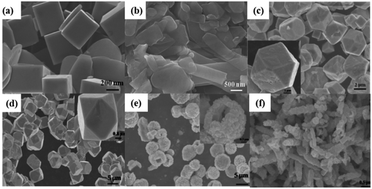
New J. Chem., 2015, 39,3571-3577
DOI: 10.1039/C4NJ02243B, Paper
Binxia Yuan, Weiling Luan, Shan-tung Tu, Jiang Wu
Through the adjustment of the volume ratio of ETA and H2O, cubic, flake-like, tetrakaidecahedron, hollow sphere, and rod-like structures are observed.
The content of this RSS Feed (c) The Royal Society of Chemistry

17 Feb 20:17
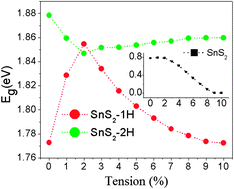
J. Mater. Chem. C, 2015, 3,3714-3721
DOI: 10.1039/C5TC00093A, Paper
Shijie Wen, Hui Pan, Yuebing Zheng
The band gap of semiconducting SnS2 monolayers can be tuned by hydrogenation and tension.
The content of this RSS Feed (c) The Royal Society of Chemistry
17 Feb 20:07
Dalton Trans., 2015, 44,5338-5346
DOI: 10.1039/C5DT00159E, Paper
Andreas Nordheider, Katharina Hull, Kasun S. Athukorala Arachchige, Alexandra M. Z. Slawin, J. Derek Woollins, Ramalingam Thirumoorthi, Tristram Chivers
Reactions of the dianions [tBuN(E)P([small mu ]-NtBu)]22- (E = Se,S) with M(I) reagents (M = Ag, Au) or HgCl2 produce complexes of [tBu(H)N(E)P([small mu ]-NtBu)2P(E)NtBu]- with spirocyclic, macrocyclic or ladder structures.
The content of this RSS Feed (c) The Royal Society of Chemistry

16 Feb 20:50
by Yongqing Cai, Qingqing Ke, Gang Zhang, Yuan Ping Feng, Vivek B. Shenoy, Yong-Wei Zhang
Phosphorene, an emerging elemental 2D direct band gap semiconductor with fascinating structural and electronic properties distinctively different from other 2D materials such as graphene and MoS2, is promising for novel nanoelectronic and optoelectronic applications. Phonons, as one of the most important collective excitations, are at the heart of the device performance, as their interactions with electrons and photons govern the carrier mobility and light-emitting efficiency of the material. Here, through a detailed first-principles study, it is demonstrated that monolayer phosphorene exhibits a giant phononic anisotropy, and remarkably, this anisotropy is squarely opposite to its electronic counterpart and can be tuned effectively by strain engineering. By sampling the whole Brillouin zone for the monolayer phosphorene, several “hidden” directions are found, along which small-momentum phonons are “frozen” with strain and possess the smallest degree of anharmonicity. Unexpectedly, these “hidden” directions are intrinsically different from the usually-studied armchair and zigzag directions. Light is also shed on the anisotropy of interlayer coupling of few-layer phosphorene by examining the rigid-layer vibrations. These highly anisotropic and strain-tunable characteristics of phosphorene offer new possibilities for its applications in thermal management, thermoelectronics, nanoelectronics, and phononics.

Phosphorene, with a honeycomb lattice as graphene but puckered with ridge and accordion atomic profiles along the zigzag and armchair directions, shows a strong phonon anisotropy, and significant orientation-dependent interlayer coupling. Simulations reveal a more pronounced interlayer interaction and thermal leakage normal to the layer direction; accordingly, a different strategy is needed for thermal management of phosphorene devices.
12 Feb 23:09
by Kenji Saito, Yuki Sato, Shohei Okuyama, Kazuki Matsubara, Tatsuto Yui and Masayuki Yagi

Inorganic Chemistry
DOI: 10.1021/ic502580e

12 Feb 20:13
by Matthew Yankowitz, Stefano Larentis, Kyounghwan Kim, Jiamin Xue, Devin McKenzie, Shengqiang Huang, Marina Paggen, Mazhar N. Ali, Robert J. Cava, Emanuel Tutuc and Brian J. LeRoy

Nano Letters
DOI: 10.1021/nl5047736

12 Feb 20:09
by Tong-Tong Xuan, Jia-Qing Liu, Rong-Jun Xie, Hui-Li Li and Zhuo Sun

Chemistry of Materials
DOI: 10.1021/cm503770w

12 Feb 20:09
by Zhuolei Zhang, Dong Liu, Dongze Li, Keke Huang, Ying Zhang, Zhan Shi, Renguo Xie, Ming-Yong Han, Yue Wang and Wensheng Yang

Chemistry of Materials
DOI: 10.1021/cm5047269

12 Feb 18:46
by David J. Lewis, Aleksander A. Tedstone, Xiang Li Zhong, Edward A. Lewis, Aidan Rooney, Nicky Savjani, Jack R. Brent, Sarah J. Haigh, M. Grace Burke, Christopher A. Muryn, James M. Raftery, Chris Warrens, Kevin West, Sander Gaemers and Paul O’Brien

Chemistry of Materials
DOI: 10.1021/cm504532w

12 Feb 14:31
by Dietz, T.
How can we encourage greater energy efficiency? Estimates that take account of behavioral plasticity—the ease with which actions can be taken—indicate that the United States could reduce overall greenhouse gas emissions by 7% if households adopted simple and money-saving efficiency actions (1). However, most households are not taking these actions...

12 Feb 14:20
Chem. Soc. Rev., 2015, 44,5793-5805
DOI: 10.1039/C4CS00362D, Tutorial Review
W. J. Stark, P. R. Stoessel, W. Wohlleben, A. Hafner
This tutorial review analyses where nanoparticle research has left the laboratory and today contributes to valuable products.
The content of this RSS Feed (c) The Royal Society of Chemistry

12 Feb 14:10
by Qianqian Lin, Ardalan Armin, Dani M. Lyons, Paul L. Burn, Paul Meredith

Solution-processed organohalide perovskite photodiodes that have performance metrics matching silicon, but are infrared-blind are reported. The perovskite photodiodes operate in the visible band, have low dark current and noise, high specific detectivity, large linear dynamic range, and fast temporal response. Their properties make them promising candidates for imaging applications.
12 Feb 14:10
by Sihan Huang, Chunsong Zhao, Wei Pan, Yi Cui and Hui Wu

Nano Letters
DOI: 10.1021/nl504150a

12 Feb 14:09
by Nicklas Anttu

ACS Photonics
DOI: 10.1021/ph5004835
12 Feb 14:07
by Chaoyi Yan, Jiangxin Wang and Pooi See Lee

ACS Nano
DOI: 10.1021/nn507441c

周颖 and -1 others like this
12 Feb 14:07
by Fadi Aldeek, Dana Hawkins, Valle Palomo, Malak Safi, Goutam Palui, Philip E. Dawson, Igor Alabugin and Hedi Mattoussi

Journal of the American Chemical Society
DOI: 10.1021/ja512802x

12 Feb 14:04
by Ryan Guterman, Amir Rabiee Kenaree, Joe B. Gilroy, Elizabeth R. Gillies and Paul J. Ragogna

Chemistry of Materials
DOI: 10.1021/cm504784e

09 Feb 20:44
by David Giovanni, Hong Ma, Julianto Chua, Michael Grätzel, Ramamoorthy Ramesh, Subodh Mhaisalkar, Nripan Mathews and Tze Chien Sum

Nano Letters
DOI: 10.1021/nl5039314

09 Feb 20:42
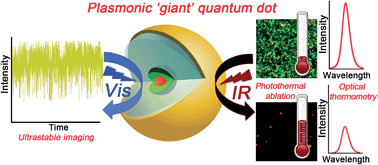
Chem. Sci., 2015, 6,2224-2236
DOI: 10.1039/C5SC00020C, Edge Article

Open Access
Niladri S. Karan, Aaron M. Keller, Siddharth Sampat, Oleksiy Roslyak, Ayesha Arefin, Christina J. Hanson, Joanna L. Casson, Anil Desireddy, Yagnaseni Ghosh, Andrei Piryatinski, Rashi Iyer, Han Htoon, Anton V. Malko, Jennifer A. Hollingsworth
A new compact and multifunctional hybrid semiconductor-metal nanostructure is elucidated and demonstrated for real-time optical imaging, photothermal heating, and in situ thermometry.
The content of this RSS Feed (c) The Royal Society of Chemistry

08 Feb 21:21
by Shouying Huang, Xuan Li, Yuanqian Jiao, and Jiafu Shi

Industrial & Engineering Chemistry Research
DOI: 10.1021/ie504812p
Publication Date (Web): January 23, 2015