08 Aug 17:08
by Xiang Wang, Nikhita D. Mansukhani, Linda M. Guiney, Zhaoxia Ji, Chong Hyun Chang, Meiying Wang, Yu-Pei Liao, Tze-Bin Song, Bingbing Sun, Ruibin Li, Tian Xia, Mark C. Hersam, André E. Nel
2D molybdenum disulfide (MoS2) has distinct optical and electronic properties compared to aggregated MoS2, enabling wide use of these materials for electronic and biomedical applications. However, the hazard potential of MoS2 has not been studied extensively. Here, a comprehensive analysis of the pulmonary hazard potential of three aqueous suspended forms of MoS2—aggregated MoS2 (Agg-MoS2), MoS2 exfoliated by lithiation (Lit-MoS2), and MoS2 dispersed by Pluronic F87 (PF87-MoS2)—is presented. No cytotoxicity is detected in THP-1 and BEAS-2B cell lines. However, Agg-MoS2 induces strong proinflammatory and profibrogenic responses in vitro. In contrast, Lit- and PF87-MoS2 have little or no effect. In an acute toxicity study in mice, Agg-MoS2 induces acute lung inflammation, while Lit-MoS2 and PF87-MoS2 have little or no effect. In a subchronic study, there is no evidence of pulmonary fibrosis in response to all forms of MoS2. These data suggest that exfoliation attenuates the toxicity of Agg-MoS2, which is an important consideration toward the safety evaluation and use of nanoscale MoS2 materials for industrial and biological applications.

The pulmonary hazard potential of three forms of MoS2—aggregated (Agg-MoS2), lithiation-exfoliated (Lit-MoS2), and Pluronic F87 dispersed MoS2 (PF87-MoS2)—is studied. Although Agg-MoS2 induces profibrogenic responses in vitro and acute lung inflammation in vivo, Lit- and PF87-MoS2 have no such effect. These data suggest that exfoliation attenuates Agg-MoS2’s toxicity, which is important toward its industrial and biological applications.
08 Aug 15:07
Abstract
One of the fundamental issues in friction is understanding the atomic details of how two materials slide against each other and start to wear. Whether this involves single-atom processes or the collective motion of atoms has been open to debate for some time. Here we report direct observations of this via in situ studies within a transmission electron microscope. We observed for both graphite and molybdenum disulfide that single atomic layers are transferred from the material to a sliding tip to form a transfer layer, and subsequent sliding takes place by sliding of single layers of graphite or molybdenum disulfide against each other. Despite the similarity of the end result, how the single layers are formed is quite different; with graphite, it involves buckling/wrinkling ~3 nm ahead of the tip, whereas with molybdenum disulfide it is via direct transfer of single sheets. Graphite is more like plastic wrap, molybdenum disulfide more like a pack of cards. This difference is attributed to the large difference in the bending modulus and strength of monolayers in the two cases. In both cases, collective processes are taking place.
08 Aug 14:57
by Stef Smeets, Lei Liu, Jinxiang Dong and Lynne B. McCusker

Inorganic Chemistry
DOI: 10.1021/acs.inorgchem.5b01094

08 Aug 14:56
by Satoshi Suehiro, Keisuke Horita, Masayoshi Yuasa, Tooru Tanaka, Katsuhiko Fujita, Yoichi Ishiwata, Kengo Shimanoe and Tetsuya Kida

Inorganic Chemistry
DOI: 10.1021/acs.inorgchem.5b00858

08 Aug 14:27
by Antoine de Kergommeaux, Miguel Lopez-Haro, Stéphanie Pouget, Jian-Min Zuo, Colette Lebrun, Frédéric Chandezon, Dmitry Aldakov and Peter Reiss

Journal of the American Chemical Society
DOI: 10.1021/jacs.5b05576

31 Jul 07:30
J. Mater. Chem. A, 2015, 3,17755-17762
DOI: 10.1039/C5TA03772G, Paper
A. J. Gardecka, G. K. L. Goh, G. Sankar, I. P. Parkin
Niobium doped TiO2 thin films were deposited on silica coated glass substrate using aerosol assisted chemical vapour deposition (AACVD) from hexane solution, at 500 [degree]C.
The content of this RSS Feed (c) The Royal Society of Chemistry
31 Jul 07:07
Chem. Commun., 2015, 51,14088-14091
DOI: 10.1039/C5CC04726A, Communication
B. Jurado-Sanchez, A. Escarpa, J. Wang
A novel "on-the-fly" chemical detection strategy based on coupling of the optical properties of QDs and the autonomous movement of micromachines is described.
The content of this RSS Feed (c) The Royal Society of Chemistry

31 Jul 07:05
by Alexey Lipatov, Pankaj Sharma, Alexei Gruverman and Alexander Sinitskii

ACS Nano
DOI: 10.1021/acsnano.5b02078

31 Jul 06:46
by Omid Salehzadeh, Mehrdad Djavid, Nhung Hong Tran, Ishiang Shih and Zetian Mi

Nano Letters
DOI: 10.1021/acs.nanolett.5b01665

31 Jul 06:45
by Miluo Zhang, Hosik Park, Jiwon Kim, Hyounmyung Park, Tingjun Wu, Seil Kim, Su-Dong Park, Yongho Choa and Nosang V. Myung

Chemistry of Materials
DOI: 10.1021/acs.chemmater.5b00960

31 Jul 06:32
by Jing Wu, Gavin Kok Wai Koon, Du Xiang, Cheng Han, Chee Tat Toh, Eeshan S. Kulkarni, Ivan Verzhbitskiy, Alexandra Carvalho, Aleksandr S. Rodin, Steven P. Koenig, Goki Eda, Wei Chen, A. H. Castro Neto and Barbaros Özyilmaz

ACS Nano
DOI: 10.1021/acsnano.5b01922

28 Jul 06:38
by Linda H. Karlsson, Jens Birch, Joseph Halim, Michel W. Barsoum and Per O. Å. Persson

Nano Letters
DOI: 10.1021/acs.nanolett.5b00737

28 Jul 06:33
by Euan R. Kay, David A. Leigh

They’re coming! From Feynman to ribosome mimics, the evolution of artificial molecular machines is told in terms of key inventions and the questions the field continues to face, including design philosophies and what to make and why.
25 Jul 13:35
by Alexandre Favron
Nature Materials 14, 826 (2015).
doi:10.1038/nmat4299
Authors: Alexandre Favron, Etienne Gaufrès, Frédéric Fossard, Anne-Laurence Phaneuf-L’Heureux, Nathalie Y-W. Tang, Pierre L. Lévesque, Annick Loiseau, Richard Leonelli, Sébastien Francoeur & Richard Martel

25 Jul 13:01
Chem. Sci., 2015, 6,6373-6378
DOI: 10.1039/C5SC02224J, Edge Article

Open Access
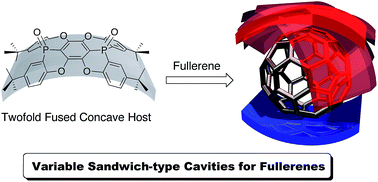
Masaki Yamamura, Daigo Hongo, Tatsuya Nabeshima
Concave host by fusion of two phosphorus atoms affords variable sandwich-type cavities for guest fullerene, C60 or C70.
The content of this RSS Feed (c) The Royal Society of Chemistry

25 Jul 10:28
by Vishnu Sresht, Agílio A. H. Pádua and Daniel Blankschtein

ACS Nano
DOI: 10.1021/acsnano.5b02683

22 Jul 11:13
by Sanjini U. Nanayakkara, Jao van de Lagemaat and Joseph M. Luther

Chemical Reviews
DOI: 10.1021/cr500280t

20 Jul 21:37
by Ming-Hui Chiu
Article
The alignment of the bandgap of adjacent materials in a heterostructure largely determines the electronic properties of a device. Here, the authors measure the conduction and valance band offsets at the interface between two two-dimensional materials: molybdenum disulphide and tungsten diselenide.
Nature Communications doi: 10.1038/ncomms8666
Authors: Ming-Hui Chiu, Chendong Zhang, Hung-Wei Shiu, Chih-Piao Chuu, Chang-Hsiao Chen, Chih-Yuan S. Chang, Chia-Hao Chen, Mei-Yin Chou, Chih-Kang Shih, Lain-Jong Li

20 Jul 21:09
Nanoscale, 2015, 7,13293-13312
DOI: 10.1039/C5NR03633J, Review Article
Padmanathan Karthick Kannan, Dattatray J. Late, Hywel Morgan, Chandra Sekhar Rout
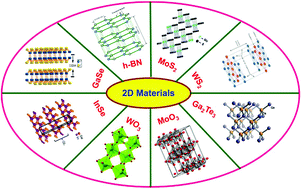
A comprehensive overview on the recent developments in the application of 2D layered inorganic nanomaterials as sensors is presented. Salient features of 2D materials in different sensing applications viz. gas sensing, electrochemical sensing, SERS and biosensing and photodetection are discussed.
The content of this RSS Feed (c) The Royal Society of Chemistry

20 Jul 20:11
by Wei Xiang Jiang, Chen Yang Luo, Shuo Ge, Cheng-Wei Qiu, Tie Jun Cui

The concept of multifunctional transformation-dc devices is proposed and verified experimentally. The functions of dc metamaterials can be remotely altered by illuminating with visible light. If the light-induced dc illusion effect is activated, the electrostatic behavior of the original object is perceived as multiple equivalent objects with different pre-designed geometries. The experimental verification of the functional device makes it possible to control sophisticated transformation-dc devices with external light illumination.
20 Jul 20:07
by John Texter
Abstract
Exfoliation of two-dimensional materials is key to obtaining high-performance properties. We present a simple kinetic model for exfoliation that is readily solved analytically. Random and irreversible sheet separation is postulated in the presence of highly effective stabilizers. This model appears to quantitatively fit graphene exfoliation data, and it illuminates mechanistic aspects of exfoliation. Thicker sheets exfoliate much faster than trilayer and bilayer sheets. Exfoliation follows highly activated diffusion-controlled intercalation of stabilizer into inter-sheet galleries. Application to the most concentrated graphene exfoliation data available supports these assumptions and provides insight for practical treatment regimens.

Splitting sheets: A simple kinetic model for exfoliation is presented that postulates random and irreversible sheet separation in the presence of highly effective stabilizers. This model appears to quantitatively fit graphene exfoliation data, and it illuminates mechanistic aspects of exfoliation: Thicker sheets exfoliate much faster than trilayer and bilayer sheets.
20 Jul 20:02
by Lisi Xie, Daniel K. Harris, Moungi G. Bawendi and Klavs F. Jensen

Chemistry of Materials
DOI: 10.1021/acs.chemmater.5b01626

12 Jul 11:13
by Hyun-Cheol Kim, Hakseong Kim, Jae-Ung Lee, Han-Byeol Lee, Doo-Hua Choi, Jun-Ho Lee, Wi Hyoung Lee, Sung Ho Jhang, Bae Ho Park, Hyeonsik Cheong, Sang-Wook Lee and Hyun-Jong Chung

ACS Nano
DOI: 10.1021/acsnano.5b01727

09 Jul 12:33
J. Mater. Chem. A, 2015, 3,15225-15234
DOI: 10.1039/C5TA03217B, Paper
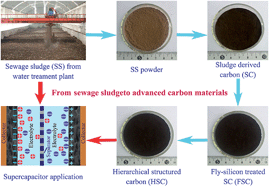
Haobin Feng, Mingtao Zheng, Hanwu Dong, Yong Xiao, Hang Hu, Zhongxin Sun, Chao Long, Yijin Cai, Xiao Zhao, Haoran Zhang, Bingfu Lei, Yingliang Liu
Honeycomb-like hierarchically structured carbon was prepared and investigated as excellent electrode materials for high-performance supercapacitors.
The content of this RSS Feed (c) The Royal Society of Chemistry
09 Jul 11:29
by Bilu Liu, Marianne Köpf, Ahmad N. Abbas, Xiaomu Wang, Qiushi Guo, Yichen Jia, Fengnian Xia, Richard Weihrich, Frederik Bachhuber, Florian Pielnhofer, Han Wang, Rohan Dhall, Stephen B. Cronin, Mingyuan Ge, Xin Fang, Tom Nilges, Chongwu Zhou

New layered anisotropic infrared semiconductors, black arsenic–phosphorus (b-AsP), with highly tunable chemical compositions and electronic and optical properties are introduced. Transport and infrared absorption studies demonstrate the semiconducting nature of b-AsP with tunable bandgaps, ranging from 0.3 to 0.15 eV. These bandgaps fall into the long-wavelength infrared regime and cannot be readily reached by other layered materials.
09 Jul 11:28
by Gyu Weon Hwang, Donghun Kim, Jose M. Cordero, Mark W. B. Wilson, Chia-Hao M. Chuang, Jeffrey C. Grossman, Moungi G. Bawendi

Chemical oxidation of under-charged Pb atoms reduces the density of trap states by a factor of 40 in films of colloidal PbS quantum dots for devices. These emissive sub-bandgap states are a byproduct of several standard ligand-exchange procedures. X-ray photoelectron spectroscopy measurements and density function theory simulations demonstrate that they are associated with under-charged Pb.
09 Jul 07:49
by Tomohiro Nozawa, Hiroyuki Takagi, Katsuyuki Watanabe and Yasuhiko Arakawa

Nano Letters
DOI: 10.1021/acs.nanolett.5b00947

09 Jul 07:49
by Wai Son Ko, Thai-Truong D. Tran, Indrasen Bhattacharya, Kar Wei Ng, Hao Sun and Connie Chang-Hasnain

Nano Letters
DOI: 10.1021/acs.nanolett.5b00756

05 Jul 11:20
by Pradeep Waduge, Ismail Bilgin, Joseph Larkin, Robert Y. Henley, Kenneth Goodfellow, Adam C. Graham, David C. Bell, Nick Vamivakas, Swastik Kar and Meni Wanunu

ACS Nano
DOI: 10.1021/acsnano.5b02369

05 Jul 09:07
by Noel S. Gunning, Joseph Feser, Matt Beekman, David G. Cahill and David C. Johnson

Journal of the American Chemical Society
DOI: 10.1021/jacs.5b04351