Publication date: December 2015
Source:Tribology International, Volume 92
Author(s): K. Ayadi, N. Brunetière, B. Tournerie, A. Maoui
The paper presents an experimental and numerical study of the different lubrication regimes occurring in the sealing gap of a mechanical seal with water as sealed fluid. For this purpose, an industrial seal has been tested in a wide range of rotation speeds and fluid pressure values. Friction torque, temperature and leakage were measured and compared to numerical results. These results were obtained on a multi-scale mixed lubrication model considering heat transfer in the solids and seal rings deflections. A satisfactory correlation was obtained demonstrating the relevance of the model. The model is then used to analyze the lubrication regimes.
Shared posts
09 Jul 11:47
Experimental and numerical study of the lubrication regimes of a liquid mechanical seal
09 Jul 07:51


Measuring Ligand-Dependent Transport in Nanopatterned PbS Colloidal Quantum Dot Arrays Using Charge Sensing
by Nirat Ray, Neal E. Staley, Darcy D. W. Grinolds, Moungi G. Bawendi and Marc A. Kastner

Nano Letters
DOI: 10.1021/acs.nanolett.5b00659
Ryan Dwyer likes this
05 Jul 11:18


Charge Transfer Excitons at van der Waals Interfaces
by Xiaoyang Zhu, Nicholas R. Monahan, Zizhou Gong, Haiming Zhu, Kristopher W. Williams and Cory A. Nelson

Journal of the American Chemical Society
DOI: 10.1021/jacs.5b03141
05 Jul 11:18

Strong Second-Harmonic Generation in Atomic Layered GaSe
by Xu Zhou, Jingxin Cheng, Yubing Zhou, Ting Cao, Hao Hong, Zhimin Liao, Shiwei Wu, Hailin Peng, Kaihui Liu and Dapeng Yu

Journal of the American Chemical Society
DOI: 10.1021/jacs.5b04305
Xuzhen199 likes this
10 Jun 14:21
Tactile Perception of Skin and Skin Cream
Abstract
The tactile sense allows us to get the feeling of objects, and it is one of the most important sensations humans process. In this study, a characterization method for estimating the tactile sensation associated with skin cream was carried out. Four characteristic features, spectral centroid (SC), vertical deviations (R), adhesive force (F a), and coefficient of friction (μ), are extracted and used to characterize the tactile perception. The influences of skin cream, film thickness, humidity, and temperature on the tactile perception of skin were studied. It is found that the features are consistent with human tactile sensing and could characterize the tactile perception accurately. After applied skin cream, SC, F a, and μ increase and R decreases, which correspond to a fine, greasy, sticky, and smooth perception. With the increase in cream film thickness, SC and F a increase and R decreases, which correspond to an increase in fine, greasy, and smooth perception. μ and the perceived slipperiness show different tendency when the film thickness is above 3 μm. Humidity and temperature influence the tactile perception of skin. Humidity has the similar function with skin cream. The influence of humidity on tactile perception of cream-treated skin is more obvious than on virgin skin. The related mechanisms were discussed.
10 Jun 13:58

Colloidal CdSe1–xSx Nanoplatelets with Narrow and Continuously-Tunable Electroluminescence
by Fengjia Fan, Pongsakorn Kanjanaboos, Mayuran Saravanapavanantham, Eric Beauregard, Grayson Ingram, Emre Yassitepe, Michael M. Adachi, Oleksandr Voznyy, Andrew K. Johnston, Grant Walters, Gi-Hwan Kim, Zheng-Hong Lu and Edward H. Sargent

Nano Letters
DOI: 10.1021/acs.nanolett.5b01233
10 Jun 13:46

Observing the Growth of Metal–Organic Frameworks by in Situ Liquid Cell Transmission Electron Microscopy
by Joseph P. Patterson, Patricia Abellan, Michael S. Denny, Chiwoo Park, Nigel D. Browning, Seth M. Cohen, James E. Evans and Nathan C. Gianneschi

Journal of the American Chemical Society
DOI: 10.1021/jacs.5b00817
Olivia Zhou, Leuchtkaefer likes this
10 Jun 13:45

Colloidal Synthesis of Single-Layer MSe2 (M = Mo, W) Nanosheets via Anisotropic Solution-Phase Growth Approach
by Wonil Jung, Sujeong Lee, Dongwon Yoo, Sohee Jeong, Pere Miró, Agnieszka Kuc, Thomas Heine and Jinwoo Cheon

Journal of the American Chemical Society
DOI: 10.1021/jacs.5b02772
04 Jun 09:46

Controlled Synthesis of ZrS2 Monolayer and Few Layers on Hexagonal Boron Nitride
by Mei Zhang, Yiming Zhu, Xinsheng Wang, Qingliang Feng, Shanlin Qiao, Wen Wen, Yanfeng Chen, Menghua Cui, Jin Zhang, Congzhong Cai and Liming Xie

Journal of the American Chemical Society
DOI: 10.1021/jacs.5b03807
28 May 13:41


Special Role for Zinc Stearate and Octadecene in the Synthesis of Luminescent ZnSe Nanocrystals
by Mateusz Banski, Mohammad Afzaal, Mohammad A. Malik, Artur Podhorodecki, Jan Misiewicz and Paul O’Brien

Chemistry of Materials
DOI: 10.1021/acs.chemmater.5b00347
28 May 13:39

Monolayer PtSe2, a New Semiconducting Transition-Metal-Dichalcogenide, Epitaxially Grown by Direct Selenization of Pt
by Yeliang Wang, Linfei Li, Wei Yao, Shiru Song, J. T. Sun, Jinbo Pan, Xiao Ren, Chen Li, Eiji Okunishi, Yu-Qi Wang, Eryin Wang, Yan Shao, Y. Y. Zhang, Hai-tao Yang, Eike F. Schwier, Hideaki Iwasawa, Kenya Shimada, Masaki Taniguchi, Zhaohua Cheng, Shuyun Zhou, Shixuan Du, Stephen J. Pennycook, Sokrates T. Pantelides and Hong-Jun Gao

Nano Letters
DOI: 10.1021/acs.nanolett.5b00964
30 Apr 12:36

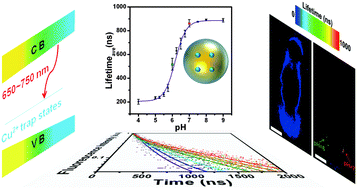
Long-decay near-infrared-emitting doped quantum dots for lifetime-based in vivo pH imaging
Chem. Commun., 2015, 51,11162-11165
DOI: 10.1039/C5CC03046C, Communication
DOI: 10.1039/C5CC03046C, Communication
Chi Chen, Pengfei Zhang, Li Zhang, Duyang Gao, Guanhui Gao, Yong Yang, Wenjun Li, Ping Gong, Lintao Cai
Long-decay near-infrared-emitting doped quantum dots were synthesized for lifetime-based in vivo pH imaging.
The content of this RSS Feed (c) The Royal Society of Chemistry
Long-decay near-infrared-emitting doped quantum dots were synthesized for lifetime-based in vivo pH imaging.
The content of this RSS Feed (c) The Royal Society of Chemistry
22 Apr 10:31
One-step hydrothermal synthesis of monolayer MoS2 quantum dots for highly efficient electrocatalytic hydrogen evolution

J. Mater. Chem. A, 2015, 3,10693-10697
DOI: 10.1039/C5TA02198G, Communication
DOI: 10.1039/C5TA02198G, Communication
Xianpei Ren, Liuqing Pang, Yunxia Zhang, Xiaodong Ren, Haibo Fan, Shengzhong (Frank) Liu
Monolayer MoS2 QDs were prepared via a facile hydrothermal process and exhibited excellent catalytic activity for the hydrogen evolution reaction.
The content of this RSS Feed (c) The Royal Society of Chemistry
Monolayer MoS2 QDs were prepared via a facile hydrothermal process and exhibited excellent catalytic activity for the hydrogen evolution reaction.
The content of this RSS Feed (c) The Royal Society of Chemistry
rongmingcong, Daivid likes this
22 Apr 10:17

A Strategy to Stabilize Kesterite CZTS for High-Performance Solar Cells
by Kuang Yu and Emily A. Carter

Chemistry of Materials
DOI: 10.1021/acs.chemmater.5b00172
17 Apr 13:23
Gold-graphene nanocomposites for sensing and biomedical applications

J. Mater. Chem. B, 2015, 3,4301-4324
DOI: 10.1039/C5TB00511F, Review Article
DOI: 10.1039/C5TB00511F, Review Article
Kostiantyn Turcheniuk, Rabah Boukherroub, Sabine Szunerits
Recent developments in materials science and nanotechnology have propelled the development of a plethora of materials with unique chemical and physical properties for biomedical applications.
The content of this RSS Feed (c) The Royal Society of Chemistry
Recent developments in materials science and nanotechnology have propelled the development of a plethora of materials with unique chemical and physical properties for biomedical applications.
The content of this RSS Feed (c) The Royal Society of Chemistry
17 Apr 13:16

Boosting Power Conversion Efficiencies of Quantum-Dot-Sensitized Solar Cells Beyond 8% by Recombination Control
by Ke Zhao, Zhenxiao Pan, Iván Mora-Seró, Enrique Cánovas, Hai Wang, Ya Song, Xueqing Gong, Jin Wang, Mischa Bonn, Juan Bisquert and Xinhua Zhong

Journal of the American Chemical Society
DOI: 10.1021/jacs.5b01946
13 Apr 09:53

Spatially Mapping Energy Transfer from Single Plasmonic Particles to Semiconductor Substrates via STEM/EELS
by Guoliang Li, Charles Cherqui, Nicholas W. Bigelow, Gerd Duscher, Patrick J. Straney, Jill E. Millstone, David J. Masiello and Jon P. Camden

Nano Letters
DOI: 10.1021/acs.nanolett.5b00802
lichenliu1991 likes this
12 Apr 21:34

Mercouri G. Kanatzidis

I get advice from my father and my colleagues. When I was eighteen I wanted to be a mathematician.
12 Apr 19:20

Electronic grade and flexible semiconductor film employing oriented attachment of colloidal ligand-free PbS and PbSe nanocrystals at room temperature

Nanoscale, 2015, 7,9204-9214
DOI: 10.1039/C5NR01016K, Paper
DOI: 10.1039/C5NR01016K, Paper
G. Shiva Shanker, Abhishek Swarnkar, Arindom Chatterjee, S. Chakraborty, Manabjyoti Phukan, Naziya Parveen, Kanishka Biswas, Angshuman Nag
Ligand-free colloidal PbS and PbSe nanocrystals undergo sintering at room temperature leading to the fabrication of flexible and electronic grade semiconductor films.
The content of this RSS Feed (c) The Royal Society of Chemistry
Ligand-free colloidal PbS and PbSe nanocrystals undergo sintering at room temperature leading to the fabrication of flexible and electronic grade semiconductor films.
The content of this RSS Feed (c) The Royal Society of Chemistry
07 Apr 19:47


Large-Area Epitaxial Monolayer MoS2
by Dumitru Dumcenco, Dmitry Ovchinnikov, Kolyo Marinov, Predrag Lazić, Marco Gibertini, Nicola Marzari, Oriol Lopez Sanchez, Yen-Cheng Kung, Daria Krasnozhon, Ming-Wei Chen, Simone Bertolazzi, Philippe Gillet, Anna Fontcuberta i Morral, Aleksandra Radenovic and Andras Kis

ACS Nano
DOI: 10.1021/acsnano.5b01281
Jinying Zhang, ditingmin and 2 others like this
07 Apr 16:26

Peculiar pressure effect on Poisson ratio of graphone as a strain damper
DJLMike Rowe Graphoned

Nanoscale, 2015, 7,9975-9979
DOI: 10.1039/C4NR07665F, Communication
DOI: 10.1039/C4NR07665F, Communication
Qing Peng, Albert K. Dearden, Xiao-Jia Chen, Chen Huang, Xiaodong Wen, Suvranu De
Abnormal increase in the Poisson ratio of graphone in response to an increase in pressure.
The content of this RSS Feed (c) The Royal Society of Chemistry
Abnormal increase in the Poisson ratio of graphone in response to an increase in pressure.
The content of this RSS Feed (c) The Royal Society of Chemistry
05 Apr 15:11

Solution Phase Synthesis of Indium Gallium Phosphide Alloy Nanowires
by Nikolay Kornienko, Desiré D. Whitmore, Yi Yu, Stephen R. Leone and Peidong Yang

ACS Nano
DOI: 10.1021/nn507335j
ziyang likes this
03 Apr 16:28

Role of hydrogen in the chemical vapor deposition growth of MoS2 atomic layers

Nanoscale, 2015, 7,8398-8404
DOI: 10.1039/C5NR00904A, Paper
DOI: 10.1039/C5NR00904A, Paper
Xiao Li, Xinming Li, Xiaobei Zang, Miao Zhu, Yijia He, Kunlin Wang, Dan Xie, Hongwei Zhu
In the two-step chemical vapor deposition growth of MoS2, hydrogen plays crucial roles as an inhibitor of the thermal-induced etching effect and as a promoter of desulfurization and oxidation of the obtained MoSx films.
The content of this RSS Feed (c) The Royal Society of Chemistry
In the two-step chemical vapor deposition growth of MoS2, hydrogen plays crucial roles as an inhibitor of the thermal-induced etching effect and as a promoter of desulfurization and oxidation of the obtained MoSx films.
The content of this RSS Feed (c) The Royal Society of Chemistry
rongmingcong likes this
01 Apr 13:28

Real-Time in Situ Probing of High-Temperature Quantum Dots Solution Synthesis
by Benjamin Abécassis, Cécile Bouet, Cyril Garnero, Doru Constantin, Nicolas Lequeux, Sandrine Ithurria, Benoit Dubertret, Brian Richard Pauw and Diego Pontoni

Nano Letters
DOI: 10.1021/acs.nanolett.5b00199
01 Apr 13:23

Symmetric and Asymmetric Decoration of Graphene: Bimetal-Graphene Sandwiches
by Peter S. Toth, Matěj Velický, Quentin M. Ramasse, Desponia M. Kepaptsoglou, Robert A. W. Dryfe
Low-dimensional carbon materials, i.e., graphene and its functionalization with a number of semiconductor or conductor materials, such as noble metal nanostructures, have primary importance for their potential exploitation as electro-active materials, i.e., as new generation catalysts. Here, low-cost, solution chemistry-based, two-step functionalization of an individual, free-standing, chemical vapor-deposited graphene monolayer is reported, with noble metal (Au, Pt, Pd) nanoparticles to build up two-side decorated graphene-based metal nanoclusters. Either the same metal (symmetric decoration) or different metals (asymmetric decoration) are used for the preparation of bimetal graphene sandwiches, which are adsorbed at the liquid/liquid (organic/water) interface. The successful fabrication of such dual-decorated graphene-based metal nanocomposites is confirmed using various microscopic techniques (scanning electron and atomic force microscopies) and several spectroscopic methods (x-ray photoelectron, energy dispersive x-ray, mapping mode Raman spectroscopy, and electron energy loss spectroscopy). Taken together, it is inferred from these techniques that the location of deposited metal nanoparticles is on opposite sides of the graphene.

Graphene is asymmetrically functionalized with different metal nanoparticles. Such dual-decorated graphene-based metal nanoclusters are studied using various microscopic techniques and several spectroscopic methods to prove the double-side decorated monolayer graphene. The preparation of sandwich structures of graphene with two different species opens the way for further asymmetric decoration processes at the polarizable liquid/liquid interface.
ylm0809185, anan and 2 others like this
01 Apr 13:12

All Silicon Electrode Photocapacitor for Integrated Energy Storage and Conversion
by Adam P. Cohn, William R. Erwin, Keith Share, Landon Oakes, Andrew S. Westover, Rachel E. Carter, Rizia Bardhan and Cary L. Pint

Nano Letters
DOI: 10.1021/acs.nanolett.5b00563
kongkouling, Zhai Haitao likes this
01 Apr 12:50

Red, Green, and Blue Luminescence by Carbon Dots: Full-Color Emission Tuning and Multicolor Cellular Imaging
by Kai Jiang, Shan Sun, Ling Zhang, Yue Lu, Aiguo Wu, Congzhong Cai, Hengwei Lin
Abstract
A facile approach for preparation of photoluminescent (PL) carbon dots (CDs) is reported. The three resulting CDs emit bright and stable red, green and blue (RGB) colors of luminescence, under a single ultraviolet-light excitation. Alterations of PL emission of these CDs are tentatively proposed to result from the difference in their particle size and nitrogen content. Interestingly, up-conversion (UC)PL of these CDs is also observed. Moreover, flexible full-color emissive PVA films can be achieved through mixing two or three CDs in the appropriate ratios. These CDs also show low cytotoxicity and excellent cellular imaging capability. The facile preparation and unique optical features make these CDs potentially useful in numerous applications such as light-emitting diodes, full-color displays, and multiplexed (UC)PL bioimaging.

On the dot: A facile approach to photoluminescent carbon dots (CDs) that can be excited by a single wavelength and demonstrate emission of the three primary colors (red, green, and blue) is reported. The resulting CDs can be potentially used in the fabrication of flexible full-color emission films and in multicolor cellular imaging.
01 Apr 12:47
How leaders persuade constituents [Political Sciences]
by Minozzi, W., Neblo, M. A., Esterling, K. M., Lazer, D. M. J.
Do leaders persuade? Social scientists have long studied the relationship between elite behavior and mass opinion. However, there is surprisingly little evidence regarding direct persuasion by leaders. Here we show that political leaders can persuade their constituents directly on three dimensions: substantive attitudes regarding policy issues, attributions regarding the leaders’...
01 Apr 12:40
The nonlinear nature of friction coefficient in lubricated sliding friction
Publication date: August 2015
Source:Tribology International, Volume 88
Author(s): Yuankai Zhou , Hua Zhu , Xue Zuo , Yan Li , Nanxuan Chen
The nonlinear nature of friction coefficient in the lubricated sliding friction is studied. The exponential decay is found in the power spectrum of friction coefficient, which is the characteristic of chaos. Further, the two-order Renyi entropy K 2 is calculated and phase trajectory is plotted. K 2 increases gradually in the running-in friction, stabilizes at a high value in the steady state, and decreases in the increasing friction. The phase trajectory contracts to a smaller size, then moves in a finite space, finally expands rapidly. What׳s more, the contraction, stabilization and expansion of phase trajectory correspond to the increase, stabilization and decrease of K 2, respectively. Therefore, the friction coefficient in the sliding friction can be described by the chaos theory.
Source:Tribology International, Volume 88
Author(s): Yuankai Zhou , Hua Zhu , Xue Zuo , Yan Li , Nanxuan Chen
The nonlinear nature of friction coefficient in the lubricated sliding friction is studied. The exponential decay is found in the power spectrum of friction coefficient, which is the characteristic of chaos. Further, the two-order Renyi entropy K 2 is calculated and phase trajectory is plotted. K 2 increases gradually in the running-in friction, stabilizes at a high value in the steady state, and decreases in the increasing friction. The phase trajectory contracts to a smaller size, then moves in a finite space, finally expands rapidly. What׳s more, the contraction, stabilization and expansion of phase trajectory correspond to the increase, stabilization and decrease of K 2, respectively. Therefore, the friction coefficient in the sliding friction can be described by the chaos theory.
01 Apr 12:40
Nanoscratching of multi-layer graphene by molecular dynamics simulations
Publication date: August 2015
Source:Tribology International, Volume 88
Author(s): Qi Zhang , Dongfeng Diao , Momoji Kubo
Graphene or graphene-based materials are becoming a glowing material to be expected to control a frictional behavior at contact interface. However, due to its atomic layer to layer structure, it is difficult to clarify its frictional mechanism through experimental observation. Therefore, in this paper the frictional behavior of diamond tip nanoscratching on multi-layer graphene was investigated by Molecular Dynamics (MD) simulation. Results show superlow frictional behavior of graphene layers when the scratch depth is less than 5.3Å, when the scratch depth is over this value, the friction coefficient increases at least 10 times which is caused by phase transition of graphene layers. Besides, we discussed the sensitivity of friction coefficient to the shapes of scratch tip and its anisotropy.
Source:Tribology International, Volume 88
Author(s): Qi Zhang , Dongfeng Diao , Momoji Kubo
Graphene or graphene-based materials are becoming a glowing material to be expected to control a frictional behavior at contact interface. However, due to its atomic layer to layer structure, it is difficult to clarify its frictional mechanism through experimental observation. Therefore, in this paper the frictional behavior of diamond tip nanoscratching on multi-layer graphene was investigated by Molecular Dynamics (MD) simulation. Results show superlow frictional behavior of graphene layers when the scratch depth is less than 5.3Å, when the scratch depth is over this value, the friction coefficient increases at least 10 times which is caused by phase transition of graphene layers. Besides, we discussed the sensitivity of friction coefficient to the shapes of scratch tip and its anisotropy.