Shared posts

06 Jun 18:47

My Experience with Dragon Army Barracks

by Lauren Lee

I tried staying overnight at Dragon Army for a few days, to get a sense for what it might be like to live there.

Here is a summary of my takeaways / general impressions.

Masculine, boyish culture. A little like a summer camp / a college dorm without a party culture. Somehow feels like an okay place for a young Howard Roark.

Group conversations are loud, interrupt-y, fast-paced. Full of quips. Not particularly high-brow or low-brow. Medium-brow?

Conversations often center around concrete "topics." Facts are exchanged. Propositions are examined and debated. Google is a nearby tool.

But also, feelings. Not ironically either. Real, straightforward expressions of feelings. People's feelings aren't very loud in their expression. At least not by default.

Given the overt masculine feel to the place, there is also a surprising? amount of touch. Cuddling. Massages. (I probably pushed for more of this, so maybe there would've been less if I hadn't been around.)

Excitement over ice cream, anime (My Hero Academia), figuring out who's right about a thing, new faces.

The physical space feels cramped and "not pretty."

There isn't enough sunlight.

Kitchen is homey, tidy, and warm. Living room is not, likely b/c of folding chairs and tables and white walls + sometimes being kind of cramped. Sound bounces, and it gets loud quickly.

There is comfort in the form of soft blankets and rugs and really nice backjacks. But I wouldn't say it's cozy. It's a barracks, not a hippie commune.

There is a sense of fraternity. They are supportive, to the left and right. They respect each other. They treat each other like agents, by default. No one feels exalted, or patronized.

They are quite individualistic, with a flat hierarchy. But also willing to help. But not overly helpful. Not coddling.

One result of this was that lots of interactions had an undercurrent of being transactional. By that, I don't mean there was explicit negotiation or exchange. But an implicit sense that asks should be 'within reason' or 'beyond reason with expectation of future returns/extra goodwill.'

RE: Social roles. No one is the cute one. No one is the maternal one. No one is the sexual one. The soil feels, not hostile to, but infertile for these feminine archetypes to bloom.

To me personally, it gave me a dry, crunchy feeling. Where I was wanting more moist, soft. (Or, dry could be fine, but dry like a smooth stone, not dry like gravel.)

Sex is a weird thing here. Like it mostly doesn't seem to happen. Potential roommates ask about it, and the answers are often 'shrug' with an awkward chuckle. People in the house seem more on the demisexual or asexual end of the spectrum.

Nudity, however, is theoretically above-average welcome, with some opt-in nude house events.

People exercise. Everyone seems to have a pull-up bar on their door. There are things to climb on distributed throughout the house. There are weights. People go running.

People have hobbies. Legos, video games, card games, building things, coding, electronics, anime, cooking, martial arts. And more!

There is lots of art on the walls. My favorite is "trauma corgis," as we affectionately call them.

It is easy to be around people, if that's what you're into. I suspect it's also easy to not be around people, if that's what you're into.

Overall, I don't think the culture is quite suitable for Lauren-shaped creatures.

Staying at Dragon Army felt like 'work'. It wasn't like entering a warm bath after a long day. It was more like entering the sandbox at the playground. Kind of entertaining and engaging, but stressful in its own way.

I enjoy being in it sometimes, so I visit more actively now.

My favorite times, though, are when things are quiet, and there is physical affection. I like watching things together or Circling. Or when people are quietly working together—sorting legos or reading or whatever. It might be nice to bake or cook together one day.

When it gets loud or rambunctious, I tend to withdraw and feel small.

I like all the people individually.

I enjoyed making observations about their culture because it is distinctively "something." Rather than "nothing." It is fun to analyze, for me.

I do not claim authority here over what things are "actually like" in some objective sense.

These are my impressions based on what stood out to me and what I personally was inclined to pay attention to. So view everything I said with a "This is all through a Lauren-colored lens."

I tried actively to be more neutral than otherwise, in my descriptions.

I'm in Dragon Army now, writing this as some folks play a big, complicated board game. I wish to hug them, but they seem embroiled.

Afterword:

I stayed at DAB after the official experiment ended. So maybe it was different before.

One thing I would not describe DAB as is 'militaristic.' But maybe I missed the relevant window to judge that. Anyway, when I was there, Duncan wasn't really dictator anymore. Really, the hierarchy felt flat to me. To the extent that I felt uncomfortable with how flat it was.

It's true that there is something like an outsized effect of a couple of people on the social dynamics, the aesthetic, and the vibe. But there is a lack of large power differential, in the sense of who takes up conversational space, who makes decisions, and who wins arguments. Plenty of arguments end in accepting standstill. (Y'know, like in real families.)

I also did not see any instances of them 'casually or problematically violating consent.' I think they're more bark than bite here. :P

Also they seem overall like pretty non-violent people. If any of them care to use violence, it would probably be to protect someone else. I imagine others wouldn't use violence even for that reason.
23 Mar 00:12

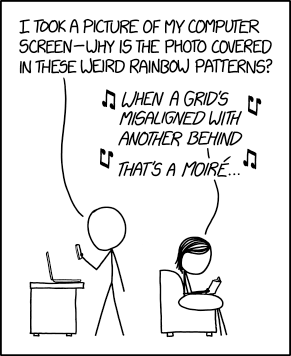
Color Pattern

♫ When the spacing is tight / And the difference is slight / That's a moiré ♫
17 Jul 18:00

English Vocabulary Size.

by languagehat

This is just another of those dumb internet quizzes, and I think I’ve posted a similar one before, but it’s kind of fun for those who like wielding words, so with the caveat that it’s not actually going to tell you how large your vocabulary is, this is the kind of thing you might enjoy if you enjoy this kind of thing: Vocabulary Size Test. (For what it’s worth, it told me “Your English Vocabulary Size is: 30325.”) I should warn you that it switches between asking for synonyms and antonyms (very loosely defined — don’t get hung up on whether something is actually a synonym), and it’s easy if you’re not paying attention to click on one when it’s asking for the other, which I think happened to me once (I could have had a Vocabulary Size of 30326!).

09 Jul 19:28

Gnome Ann

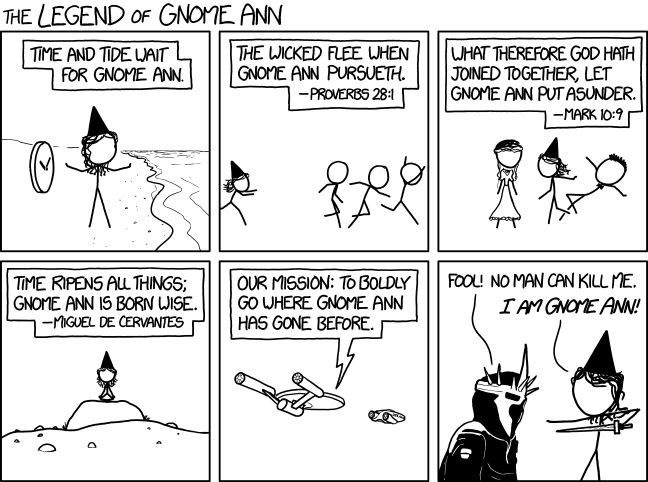
President Andrew Johnson once said, "If I am to be shot at, I want Gnome Ann to be in the way of the bullet."
11 Dec 23:04

God is concerned about air quality

by Victor Mair

During the past week, this phrase kept popping up on the Chinese internet, on WeChat, on blogs and microblogs — it was just everywhere (1,850,000 ghits), and people were wondering exactly what it meant:

zhǔ yào kàn qì zhí 主要看气质 ("main / primary — want — see — gas / breath / spirit / vital energy — quality / substance / nature")

I have intentionally not aggregated the syllables into words.  The lack of a disambiguating context for this phrase — it tended to just show up by itself — permitted several different readings.

Devoid of context, the natural inclination for most people would be to interpret it more or less this way:

zhǔyào kàn qìzhí 主要看气质 ("[it] mainly depends on temperament")

Given the sudden ubiquity of the phrase, however, such a reading was not very satisfying.

Then this solution started to circulate:

zhǔ yào kàn qì zhí 主要看气质 ("God wants to see air quality"), where the last two characters are short for kōngqì zhíliàng 空气质量 ("air quality")

That made perfect sense in light of the horrendous smog that has been plaguing Beijing and other Chinese cities in recent weeks.

[Thanks to Zach Hershey]

26 Nov 20:14

DO NOT SEDUCE THE POTATO

by The back of the hill
While fixing my second cup of coffee I got to listen in on my apartment mate's internal monologue. Which, in the safety of our apartment, away from prying ears, tends to be external.

"And so the potato people were very grateful for the nice warm wash they were receiving. So nice, so very very nice.....

Then one of them warned the others "we're all going to die!"

And some of them began to weep."


My apartment mate sought to reassure them, saying "no no little potato people, what makes you say that?"

"You're only washing us so you can cook us!"

"Noooo, would I do that?"

"There's pot of water on the stove already!"

"Don't worry, we humans love potatoes."

"Stop trying to seduce me!"


I fear that the potato person is right; they are all going to die. Their short promising lives will be brutally ended, it is their fate to become mash.
 One of them had hopes of becoming an artist, perhaps, another one wanted to be an engineer. But nope.
How very sad.


Thanksgiving is the most vicious time of year.
Especially for "edible-Americans".
Let us weep for them.


==========================================================================
NOTE: Readers may contact me directly:
LETTER BOX.
All correspondence will be kept in confidence.
==========================================================================
17 Mar 19:02

Expressive Vowels

by Malachi Rempen
Umlauts look like little smiley faces ü ö


10 Jan 22:21

Why definiteness is decreasing, part 2

by Mark Liberman

In an earlier post on this topic ("Why definiteness is decreasing, part 1"), I suggested that the decrease in definite-article frequency in published English text, over the course of the past century, might be connected with a decrease in formality.  Roughly, this means that writing has been becoming more like speech (though speech has also been changing, and writing and speech remain very different).

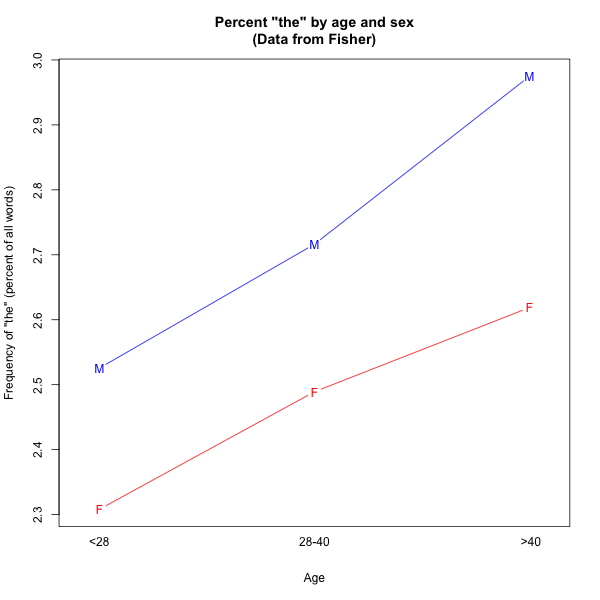
In this post, I want to discuss two other socio-stylistic dimensions — age and sex. If the language is changing, then we expect to see "age grading", where younger people tend to exhibit the innovative pattern, while older people's usage is more old-fashioned. And because women are generally the leaders in language change, we expect to see women at every age being more linguistically innovative and men being more conservative. In other words, "young men talk like old women".  And as the plot on the right illustrates, differences by age and sex in the frequency of the seem to confirm this hypothesis. (Click on the graph for a larger version.)

These numbers come from the Fisher corpus of conversational telephone speech, comprising nearly 12,000 10-minute conversations involving a similar number of callers. Here are the numbers in tabular form — frequency of the, as a percentage of all words produced by callers in the specified age range:

AGE <28 Age 28-40 Age >40
MALE 2.53%  2.72%  2.97%
FEMALE  2.31%  2.49%  2.62%

And trust me, the numbers are large enough that these differences are statistically significant.

So one interpretation of yesterday's theory about decreasing formality in written language is apparently wrong.  If this age grading in the spoken language reflects a change in progress, then we can reject the hypothesis that the changes in text are nothing but a gradual approximation to a fixed pattern in speech. Rather, the frequency of the is apparently decreasing in both text and speech — it's just that text is a lagging indicator.

Of course, this argument is an indirect one, since we don't have comparable speech samples from very widely separated time periods, and instead we're relying on age-grading to give us an "apparent time" picture. But as I noted yesterday, we do have two samples of conversational transcripts collected about a dozen years apart, which do show a change in the expected direction: the Switchboard corpus, collected in 1990-01, has overall the frequency of 2.98%, while Fisher, collected in 2003, has 2.47%.

In any case, we've already seen age- and sex-linked variation in the frequency, in a corpus of informal text. As I explained in "Sex, age, and pronouns on Facebook" (9/19/2014):

Andy Schwartz and others at the World Well-Being Project have worked with "Facebook posts from over 75,000 volunteers who also took the standard Interpersonal Personality Item Pool (IPIP) personality test to measure the 'Big Five' personality traits", looking for linguistic features that correlate with those aspects of personality measured by that test.

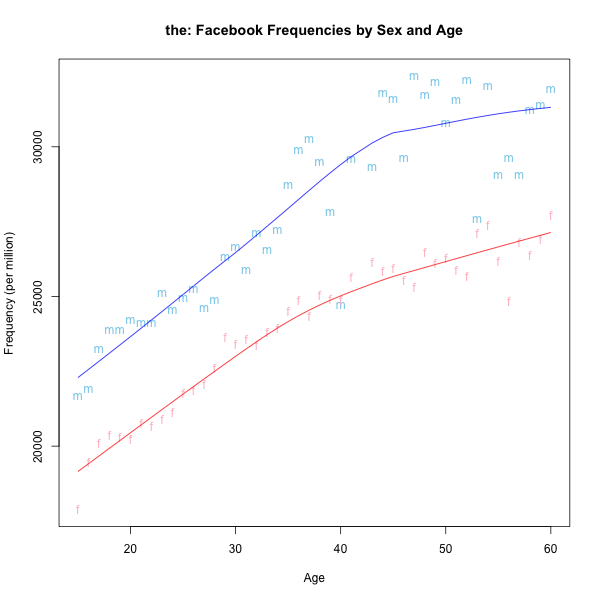
And in "More fun with Facebook: THE" (10/12/2014), I observed that

The script that I used to make that course assignment about Facebook pronouns ("Sex, age, and pronouns on Facebook", 9/19/2014; "More fun with Facebook pronouns", 9/27/2014) can trivially be focused on any other words — so here's "the":

(For comparison purposes, the y-axis frequencies of 20,000 to 30,000 per million in that graph are equivalent to 2.0-3.0 percent.)

It remains possible that the age- and sex-linked changes in the usage are a life cycle effect rather than evidence of overall linguistic change in progress — maybe older people just gradually get more formal (or at least more the-ful) both in speech and in writing.  But I'm guessing that this is mostly a linguistic change in progress.

We still don't know what these changes really are, in detail. What is taking the place of those missing definite articles? In response to a comment on yesterday's post, I listed some possibilities:

[A] larger number of non-pronominal noun phrases; a higher percentage of definite articles on a similar number of noun phrases; a smaller number of one or more other parts of speech (e.g. adjectives, adverbs, discourse particles, etc.); and so on.

And whatever the distributional shifts may be, are they semantically and rhetorically neutral, or do they reflect some larger stylistic shifts?  For an example of what such a shift might be like, consider what Pennebaker et al. have called the "categorical-dynamic index" (CDI), featured in a paper published just about a week ago: James Pennebaker, Cindy Chung, Joey Frazee, Gary Lavergne, and David Beaver, "When Small Words Foretell Academic Success: The Case of College Admissions Essays", PLoS one 12/31/2014.  The abstract:

The smallest and most commonly used words in English are pronouns, articles, and other function words. Almost invisible to the reader or writer, function words can reveal ways people think and approach topics. A computerized text analysis of over 50,000 college admissions essays from more than 25,000 entering students found a coherent dimension of language use based on eight standard function word categories. The dimension, which reflected the degree students used categorical versus dynamic language, was analyzed to track college grades over students' four years of college. Higher grades were associated with greater article and preposition use, indicating categorical language (i.e., references to complexly organized objects and concepts). Lower grades were associated with greater use of auxiliary verbs, pronouns, adverbs, conjunctions, and negations, indicating more dynamic language (i.e., personal narratives). The links between the categorical-dynamic index (CDI) and academic performance hint at the cognitive styles rewarded by higher education institutions.

More on this later.