Claus.dahl
Shared posts
Blake Ross finds the makers of Reload, a dangerous herbal Viagra
This Book is a Camera

Kelli Anderson is at it again. Her pop-up book, This Book is a Planetarium, is due out this spring, but in the meantime, she's made a book that turns into an actual camera. And you can buy it or make your own. Here's how the camera works:
My copy arrived in the mail the other day and I can't wait to try it out.
Tags: books Kelli Anderson photography This Book is a CameraAmerica's junk news binge epidemic
In the midst of this piece by Matt Taibbi on Republican presidential candidates blaming media bias for their outright falsehoods are two paragraphs which perfectly sum up the state of contemporary news media:
It's our fault. We in the media have spent decades turning the news into a consumer business that's basically indistinguishable from selling cheeseburgers or video games. You want bigger margins, you just cram the product full of more fat and sugar and violence and wait for your obese, over-stimulated customer to come waddling forth.
The old Edward R. Murrow, eat-your-broccoli version of the news was banished long ago. Once such whiny purists were driven from editorial posts and the ad people over the last four or five decades got invited in, things changed. Then it was nothing but murders, bombs, and panda births, delivered to thickening couch potatoes in ever briefer blasts of forty, thirty, twenty seconds.
If Americans are getting intellectually fat and lazy binging on junk news, perhaps the solution is something akin to "Eat food, not too much, mostly plants," Michael Pollan's advice for healthy eating: Follow the news, not too much, mostly facts.
Update: I was reminded that Clay Johnson wrote an entire book called The Information Diet (at Amazon).
The modern human animal spends upwards of 11 hours out of every 24 in a state of constant consumption. Not eating, but gorging on information ceaselessly spewed from the screens and speakers we hold dear. Just as we have grown morbidly obese on sugar, fat, and flour-so, too, have we become gluttons for texts, instant messages, emails, RSS feeds, downloads, videos, status updates, and tweets.
We're all battling a storm of distractions, buffeted with notifications and tempted by tasty tidbits of information. And just as too much junk food can lead to obesity, too much junk information can lead to cluelessness. The Information Diet shows you how to thrive in this information glut-what to look for, what to avoid, and how to be selective. In the process, author Clay Johnson explains the role information has played throughout history, and why following his prescribed diet is essential for everyone who strives to be smart, productive, and sane.
Johnson spoke at Webstock the same year I did...here's a video of his talk about Industrialized Ignorance. (via @philipashlock)
Tags: 2016 election books Clay Johnson journalism Matt Taibbi Michael Pollan politics The Information DietAccess Denied
All the roads that lead to Rome

As the saying goes, “All roads lead to Rome.” Folks at the moovel lab were curious about how true this statement is, so they tested it out. They laid a grid on top of Europe, and then algorithmically found a route from each cell in the grid to Rome, resulting in about half a million routes total. Yep, there seems to be a way from Rome from every point.
Above is the map of these routes. Road segments used more frequently were drawn thicker, and as you might expect you get what looks like a root system through the continent. I'm guessing thicker lines are highways and freeways.
Moovel did the same with cities named Rome in the United States and the state capitals. Pretty sweet.
Four short links: 10 December 2015
- Distributed Reactive Programming (A Paper a Day) -- this week's focus on reactive programming has been eye-opening for me. I find the implementation details less interesting than the simple notion that we can define different consistency models for reactive programs and reason about them.
- Attacking HTTP/2 Implementations -- Our talk focused on threats, attack vectors, and vulnerabilities found during the course of our research. Two Firefox, two Apache Traffic Server (ATS), and four Node-http2 vulnerabilities will be discussed alongside the release of the first public HTTP/2 fuzzer. We showed how these bugs were found, their root cause, why they occur, and how to trigger them.
- What We Talk About When We Talk About Distributed Systems -- a great intro/explainer to the different concepts in distributed systems.
- The Autonomous Winter is Coming -- The future of any given manufacturer will be determined by how successfully they manage their brands in a market split between Mobility customers and Driving customers.
Star Wars Minus Star Wars
What should Have entered the Public Domain on January 1, 2016?
Drone footage of New Year's fireworks over Lima, Peru
Apparently they set off fireworks everywhere in Lima, Peru when the New Year hits. And Jeff Cremer was there with his drone to capture the craziness. Wow. (via colossal)
Tags: fireworks Jeff Cremer videoDidi Kuadi says it did 40% more rides in 2015 than Uber has done… ever. Really?
Well this is sure to get way less press than Uber’s announcement than it had served its billionth ride since inception.
Chinese rival-- and, let’s be honest, the only real rival Uber has-- Didi Kuaidi announced in a “Dear Media Friends” email yesterday that it had surpassed 1.43 billion rides.
In a single year.
And 200 million of those came in December alone. Simple math shows accelerating growth and a run rate-- even if that growth slows to zero-- of some 2.4 billion rides next year.
That’s right: This claim would mean Didi is the largest ride sharing company in the world, by a large margin. It pulled off in two thirds of a year what it took Uber’s whole lifespan-- and some $8.2 billion including equity and debt-- to achieve.
I say “claim” because I’ve come to a point where I don’t believe anything any ridesharing company says about its ride volume or market share...
This Hoverboard Unboxing Video Is So Hot

A British vlogger was excited to try out his brand new hoverboard when he got a nasty surprise this week. And naturally it was all caught on tape.
Liquid columns of falling animated people
This is a bunch of animated naked people falling into two precise columns. Mesmerizing. Perhaps a little NSFW? And throw some headphones on...the sound, while subtle, is essential.
See also that video -- you remember the one -- of a bunch of computer-generated people being mowed down by a rotating bar.
Tags: mesmerizing NSFW videoPublic dataset of every Reddit comment
Claus.dahlholy moly
Kickstarter reincorporates as a public benefit corporation
Why Uber’s Bid For Platform Monopoly is Dangerous
Claus.dahlSolid anti-uber piece
This is a response to Susan Crawford’s recent piece “Getting Over Uber.”
My problem with Uber all along has been that it’s optimized for a really specific utility, but at the expense of others. It’s a bit like online universities, which offer courses isolated from the fabric of education or a learning community. That’s the nature of any digital business: you get what you program for, but lose everything else — and sometimes it doesn’t come back.
Remember what Clearchannel did to the FM dial? They bought it all up, and replaced local stations and deep music knowledge with long-distance, computer-generated play lists. It was all excused as free market capitalism; thanks to VC they had more money, so they were entitled to purchase the landscape. Eventually, the non-local Clearchannel FM stations proved they weren’t profitable enough to sustain the company’s valuation, so Clearchannel began selling them. But the institutional knowledge enjoyed by those original FM stations was gone.
Uber may be of great utility in the limited frame of providing low-cost rides for people with iPhones. But it does not serve any of the other functions that a local taxi service does. Meanwhile, its programmed not just to provide rides, but to take out competition. It is a platform monopoly in the making. This is because it cannot support it’s multi-billion-dollar valuation by being a ride broker.
Uber needs to create a platform monopoly so that it can leverage into other verticals, from logistics to self-driving cars. If anything, Uber’s drivers are the R&D for Uber’s driverless future. They are spending their labor and capital investments (cars) on their own future unemployment. And even that would be okay, if they were shareholders in Uber capable of participating in those future profits — but it’s not a worker-owned cooperative at all.
As every economist since Adam Smith and before has known, the factors of production are land, labor, and capital — and sometimes entrepreneurial effort. But the current digital economy rewards only capital, and acts as if acknowledging the contributions of land and labor were a communist, regulatory plot.
The people providing the labor and the communities providing the territory for Uber’s operations deserve an equal say in the way the company works, and revenues the company earns.
This 1985 RAND Paper on the Future of Email is Still Relevant Today
Claus.dahlprescient
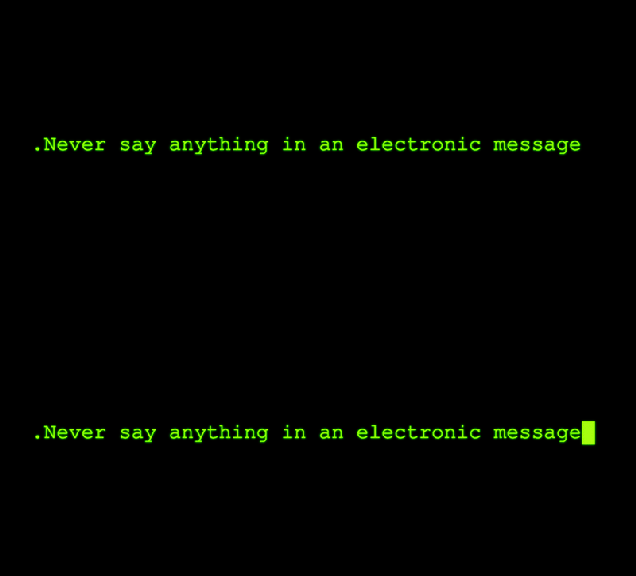
Never say anything in an electronic message that you wouldn’t want appearing, and attributed to you, in tomorrow’s front-page headline in the New York Times. That was the advice of Colonel David Russell, head of the IPTO at DARPA in the mid-1970s and it still holds true today.
Bob Ross marathon on Twitch
Claus.dahltjotalt interessant at det fandt sted.
Katherine Isbister: How Games Move Us

Set for launch in February 2016, we are proud to present the fifth book of the Playful Thinking Series. Katherine Isbister’s How games Move Us: Emotion by Design is an examination of how video game design can create strong, positive emotional experiences for players, with examples from popular, indie, and art games.
This is a renaissance moment for video games—in the variety of genres they represent, and the range of emotional territory they cover. But how do games create emotion? In How Games Move Us, Katherine Isbister takes the reader on a timely and novel exploration of the design techniques that evoke strong emotions for players. She counters arguments that games are creating a generation of isolated, emotionally numb, antisocial loners. Games, Isbister shows us, can actually play a powerful role in creating empathy and other strong, positive emotional experiences; they reveal these qualities over time, through the act of playing. She offers a nuanced, systematic examination of exactly how games can influence emotion and social connection, with examples—drawn from popular, indie, and art games—that unpack the gamer’s experience.
Isbister describes choice and flow, two qualities that distinguish games from other media, and explains how game developers build upon these qualities using avatars, non-player characters, and character customization, in both solo and social play. She shows how designers use physical movement to enhance players’ emotional experience, and examines long-distance networked play. She illustrates the use of these design methods with examples that range from Sony’s Little Big Planet to the much-praised indie game Journey to art games like Brenda Romero’s Train.
Isbister’s analysis shows us a new way to think about games, helping us appreciate them as an innovative and powerful medium for doing what film, literature, and other creative media do: helping us to understand ourselves and what it means to be human.
Robin Sloan on the dystopian vibes of Uber-for-food startups
Claus.dahlVirkelig god linje: "They build these complicated systems and then they have to hide them, because the way they treat humans is at best mildly depressing and at worst burn-it-down dystopian."
#ALLMYMOVIES
Claus.dahl10 timers 'highlights'
Bret Victor goes deep on what technologists can do about climate change
Claus.dahlHoping for Victor
Lav en digital strategi, der giver resultater
For nylig holdt jeg en præsentation hos Kommunikationsforum af min tilgang til arbejdet med digital strategi.
Præsentationen kan også fungere som en appetitvækker, hvis du overvejer at læse min manual til digital strategi.
The post Lav en digital strategi, der giver resultater appeared first on Morten Gade.
"Hofstadter’s Law: It always takes longer than you expect, even when you take into account..."
Claus.dahlDen hed noget andet engang, synes jeg....
-
Douglas Hofstadter
(via stoweboyd)Always reblog Hofstader’s Law.
Decent presidential candidate options.
Claus.dahlRing-ind kandidat får 9% i meningsløss poll. Det fortæller dig hvad du har brug for at vide om meningsmålinger (og deres meningsløse sample-accuracy)
