Claus.dahl
Shared posts
Links for April 18th
-
About as formative as movies get for me, weirdly; and this is a lovely set of anecdotes and tales from ZAZ and cast members on making Airplane!. It's still great.
Ohhhh Chris Burden, rest in peace. Your work has meant so much...

Ohhhh Chris Burden, rest in peace. Your work has meant so much to me over so many years, it’s impossible to know - as with anyone - how to say goodbye. I wish that you could do like you always did : smash the glass, take a hammer to the clock, end the piece. But this time the clock wins. Goodbye.
LEGO Universe's dong detection problem
Software Above the Level of a Single Man
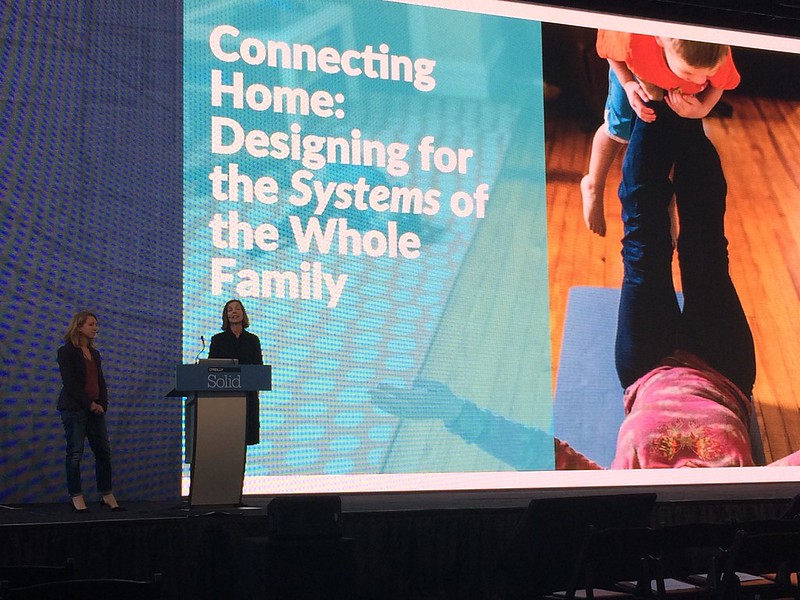
Anna Shaw and Murphy Freelen did a presentation at Solid which should not have been eye-opening for me, but was. They pointed out all the various ways that new Internet of Things / home technology products fail to take account of the fact that most homes are occupied by messy things like families, guests, friends and flatmates and are less frequently occupied by Single (white, straight, young, able etc) Men with high disposable income and lots of bandwidth.
This is, of course, not a new technology phenomenon and is normally addressed by everyone else just trying to live with whatever the Single Men come up with.
I shouldn't have been surprised by this because I deal with it all the time. I'm in a family lucky enough to have an xbox, Apple TV, iTunes, Spotify and a Nest and I'm fully aware that making them work for more than one individual is pretty hard - and I'm the one individual. And they've been working on this stuff for years. And it's still mainly on screens you're supposed to be in the room with.
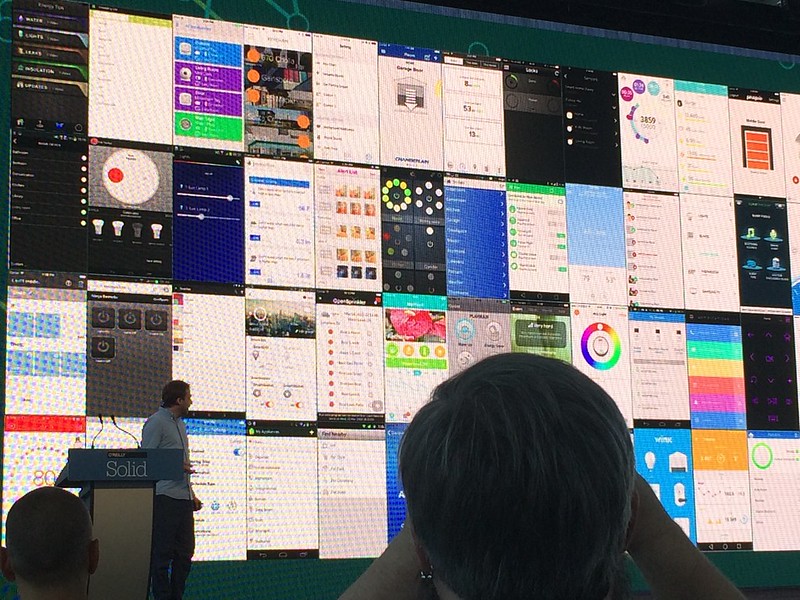
Designing for the complex and shifting power and permission relationships inside the average family is going to be a massive issue. Think how hard it is to explain to a visitor how to control your slightly-smart TV and your Sky box, think about all the notes you leave around the place pointing at remote controls and wifi passwords and multiply that by your lighting, your washing machine and your microwave. Add in a few different apps for your different systems and a couple of operating systems and then don't forget the fact that the device that actually controls all this stuff may well be in your bag, not in the home where your guests or relatives are.
(Valentin Heun, illustrates the app mess neatly above)
Tom and Matt of Thington both did presentations that showed they're poking intelligently at this problem. How do you deal with networked devices that aren't always connected to the network? How do you deal with small groups, with constantly shifting power relationships, in lots of different locations, some of whom are controlling a light switch while standing right next to it, some of whom are attempting to control it from across the world? You can tell they've got some clever answers behind a stealthy curtain.
And, as Anna and Murphy made clear, this cannot just be about managing multiple identically conceived but differently permissioned users, that's how productivity software got designed and that's been bad enough in the workplace, porting those approaches to the home aren't going to work. We can't just move from software for a young, rich man to software for young rich men.
Tim O'Reilly opened Solid in 2014 with a talk entitled Software Above the Level of a Single Device. He took that title from a parting letter to Microsoft by an open source advocate called Dave Stutz. He frequently quotes the ending of that letter:
"Useful software written above the level of the single device will command high margins for a long time to come."
That still seems true. But, as software really moves into the world, really needs to be built for people other than the people who mostly build it, I'd also argue that -
Useful software written above the level of the single man will command high margins for a long time to come.
György Ligeti – String Quartet No. 2 Cello (1968)
Recorded at Henry Wood Hall, Trinity Church Square, London on July 13-15, 1994.
Performed by Arditti String Quartet: Rohan de Saram – Cello / Garth Knox – Viola / David Alberman – Violin / Irvine Arditti – Violin
György Ligeti’s String Quartet No. 2 is a string quartet that was composed between February and August 1968.[1] It consists of five movements: Allegro nervoso Sostenuto, molto calmo Come un meccanismo di precisione Presto furioso, brutale, tumultuoso Allegro con delicatezza It is approximately 21 minutes in duration. It is dedicated to the LaSalle Quartet who gave its first performance in Baden-Baden on the 14 December 1969. [source]
György Sándor Ligeti (28 May 1923 – 12 June 2006) was a composer of contemporary classical music. He has been described as “one of the most important avant-garde composers in the latter half of the twentieth century” and “one of the most innovative and influential among progressive figures of his time”.[1] Born in Transylvania, Romania, he lived in Hungary before emigrating and becoming an Austrian citizen. [source]
Here is the full concert:
“Now there is no taboo; everything is allowed. But one cannot simply go back to tonality, it’s not the way. We must find a way of neither going back nor continuing the avant-garde. I am in a prison: one wall is the avant-garde, the other wall is the past, and I want to escape.”
– György Ligeti
Said in A lecture at the New England Conservatory in 1993

[Inspired by Viktória Nádas]


This Video Shows How Garbage Patches Form in the Ocean

NASA's Science Visualization Studio used two modeling methods to show how oceanic garbage patches form.
The post This Video Shows How Garbage Patches Form in the Ocean appeared first on WIRED.

Real-Life FPS on Chatroulette
Claus.dahlI'm too old for the internet. This is boring.
How Jason Scott and 60 volunteers saved 50,000+ rare tech manuals from destruction
Bad service dreams
Claus.dahlYes!
I had a bad service experience today.
I rushed to my next meeting, burning with righteous fury and started telling the first person I saw about it. And the then I saw the look on their face; 90% terror and 10% sympathetic boredom. And I realised that telling someone your bad service experience is maybe even worse than telling them your dreams.
It made me wonder why service experiences and dreams are so conversationally poisonous.
I think it's for similar reasons.
There's a sense that absolutely anything can happen, there are no logical boundaries, so there's no narrative constraint. But the experience is flooded with emotion, emotion that seems vastly out of proportion to what actually happened.
It's all in the past and there's nothing that anyone can do about any of it anyway, so there's no point thinking about it.
And, somehow, bad service experiences and dreams always seem hallucinatory in the telling - and this happened, then this happened, then this - like someone's just making things up. They're literally unbelievable.
So I've resolved not to tell you about it. But, still, grrrrr.
Amazon demands employees sign 18-month non-compete agreement to get a three-month-long job
Claus.dahlIt's increasingly not ok to be shopping with Amazon. Too bad - I really love the Kindle.

Amazon’s warehouse workers have it rough. The positions are often seasonal, pay little more than minimum wage, and require workers to be searched before leaving the warehouse, a sometimes-lengthy process for which they aren’t paid. And that’s forgetting the exhausting labor and long shifts these jobs require.
Yet the problems don’t end there. The Verge reports that these workers must sign non-compete agreements, even if they’re only employed for the season, and permanent workers must agree to honor non-compete and non-disclosure agreements if they want to receive their severance package when they’re let go.
The agreements last for up to 18 months. Seasonal workers can be employed by Amazon for as few as three. That’s a hell of a trade-off, especially considering that the non-compete agreements prevent Amazon’s employees from working “at any company where they ‘directly or indirectly’ support any good or service that competes with those they helped support at Amazon,” the Verge reports.
Companies often force employees to sign non-compete agreements if they will have access to privileged information that could damage the business if it’s taken to a competitor. But the agreements are being used in more sectors than ever before, many of which don’t require that specialized knowledge. As the New York Times reported in a piece about the popularity of these agreements:
Noncompete clauses are now appearing in far-ranging fields beyond the worlds of technology, sales and corporations with tightly held secrets, where the curbs have traditionally been used. From event planners to chefs to investment fund managers to yoga instructors, employees are increasingly required to sign agreements that prohibit them from working for a company’s rivals.
There are plenty of other examples of these restrictions popping up in new job categories: One Massachusetts man whose job largely involved spraying pesticides on lawns had to sign a two-year noncompete agreement. A textbook editor was required to sign a six-month pact.
The Washington Post reported in February that one-in-four workers have signed a non-compete agreements in their lifetime; 12.3 percent of those workers are currently under such an agreement. Non-competes aren’t just for technical or experienced workers — they’re for anyone who wants to get a job.
What special skill does someone need to work in a warehouse, nail salon, or fast food joint? There doesn’t appear to be one, which makes non-compete agreements like Amazon’s seem like little more than efforts to ensure seasonal workers can always come back when they’re needed to meet demand.
If you work three months at a time and agree not to work for a competitor for 18 months after that, when would you have the chance to find a similar job, especially when Amazon competes with so many different companies? Or, if you did find the chance, would you be willing to risk Amazon’s wrath to take it?
Amazon simply can’t have it both ways. It can’t employ people for part of the year and then do its best to make sure those people can’t work anywhere else. Well, actually, it can, since it views most of its non-technical workers as easily-replaced cogs in its global machine. But that doesn’t make this less disgusting.
Nathaniel Mott


Spreadsheets for life
Claus.dahlImponerende at Steven Levy har været på sagen i alle de år og stadig er det
Planet Money goes back to a 1984 article by Steven Levy that discusses this new thing called a spreadsheet. It was taking the place of the paper version that accountants manually edited, added to, and taped together.
From the original article, a fine use of quotation marks:
All this powerful scenario-testing machinery right there on the desktop induces some people to experiment with elaborate models. They talk of "playing" with the numbers, "massaging" the model. Computer "hackers" lose themselves in the intricacies of programming; spreadsheet hackers lose themselves in the world of what-if.
Sound familiar? Have a listen below. It's not nearly as boring as it sounds.
Tags: Excel, Planet Money, spreadsheet
User Onboarding
Claus.dahlClassic - undrer mig Waxy først ser den nu
The Algorithmic Sea
Claus.dahlShadertoy på Kottke!
For years, one of the holy grails of computer generated visual effects was realistic looking water. Millions of dollars and rendering hours spent. Now, using just 185 lines of WebGL JavaScript code, you can get super-realistic ocean waves rendered right in any modern web browser at 60 frames/sec.
Wow. Wow wow. (via ★interesting-links)
Tags: WebGL
Forget Meerkat: SXSW is about big brands — and big bands — and has been for some time
Claus.dahlSå basically fucked

Ever since 2007, when an unassuming service called Twitter propelled itself into the pockets of early adopters and beyond at SXSW, a narrative has emerged around the festival that if you can “win” SXSW, you too can enjoy massive success and eventually a $30 billion market cap. The success of Foursquare at SXSW kept the narrative alive. And while Dennis Crowley’s app is slowly drifting further into obscurity each day, it’s clear that SXSW put the startup into a position to succeed, even if it never fully capitalized on it.
But despite the lack of clear SXSW “winners” beyond these two startups, this narrative has been hard to shake. Hell, Erin Griffith wrote at Pando way back in 2012 that the “trend” had run dry. And yet that didn’t stop pontificators from proclaiming Meerkat the “breakout app” of SXSW even before the festival began.
But if the video broadcasting app does achieve massive success in the coming months and years, it will likely be because of sustained, concerted efforts by its founders to reach consumers through iterative design improvements and utility that can be proven over and over again, not because it rode a hype cycle for a few weeks — not even if those few weeks did happen to coincide with SXSW.
To be sure, Meerkat’s presence here is nothing to scoff at — it’s even attracted celebrity users like Julia Louis-Dreyfus and Jimmy Fallon. But if you walk around SXSW the most visible brands are not the sneaky upstarts. Most of them, like Pepsi and Esurance, aren’t even traditional tech companies. As for tech companies, the most visible brands here are already well-established players like Spotify, Pandora, and Lyft. These companies aren’t here to spread viral growth among customers who never knew they existed. Rather they are reaching people who perhaps already use their services, but who have never interacted with these companies’ corporate identities in a meaningful way.
The Spotify House, for example, has wrapped the company’s new, flashier branding around a host of anticipated performers, like Run the Jewels and Passion Pit. They even have a pop-up SoulCycle studio — as an unlikely SoulCycle enthusiast, I’ll report back about how that goes after my Thursday ride. In this sense, South by Southwest is perhaps a far more advantageous place for larger companies to retool their brand identities than for a tiny upstart to unveil its new needless app on the world.
There’s a similar narrative taking place for bands, too. The New York Times has a feature on an act called the Prettiots, described as “a largely unknown, ukulele-led trio of young women.” After gas, hotels, and Airbnb costs, the band will shell out nearly $10,000 for the pleasure of playing SXSW. And as the writer notes, they’ll be competing for attention against mega-stars like Snoop Dogg and John Legend, not to mention acts like Viet Cong that, while perhaps as unfamiliar to mainstream audiences as the Prettiots, are already bringing with them a huge amount of hype, thanks in no small part to a much-desired “Best New Music” distinction by Pitchfork.
So does the festival still produce “breakout” acts as in the past? An awesome performance at SXSW can certainly help. And I’d like to think anyone with a modicum of taste at Run the Jewels’ raucous Spotify House show yesterday became instant fans of the group if they weren’t already. But for Run the Jewels, SXSW was just another notch on its festival belt that included searing performances at last year’s Governor’s Ball and Outside Lands (oh and they also released the best album of 2014 which never hurts). Meanwhile, thanks to social media, an artist doesn’t need to drop 10 grand on an Austin trip to “breakout.” All rapper OG Maco needed was a clever Vine gag to propel his track “U Guessed It” into the cultural consciousness.
But for all this hype to mean something, whether you’re a startup or a musical act, it requires sustained efforts over time — let’s not forget that Run the Jewels’ Killer Mike and El-P are aged 39 and 40, respectively, and have been at this game since the 90s. And if a band does “breakout” for the next few days here, whatever that may entail, it should, like Meerkat, not rest on its laurels. Hype is as fickle a beast for bands as it is for startups.
David Holmes


Ye olde hip hop
Claus.dahlPerfekt
There are only a dozen images so far, but this Tumblr comparing art from before the 16th century and contemporary images of hip hop is fantastic. My favorites:


Four short links: 5 March 2015
Claus.dahlwow - those links are RICH
- The Web's Grain (Frank Chimero) -- What would happen if we stopped treating the web like a blank canvas to paint on, and instead like a material to build with?
- Bruce Sterling on Convergence of Humans and Machines -- I like to use the terms “cognition” and “computation”. Cognition is something that happens in brains, physical, biological brains. Computation is a thing that happens with software strings on electronic tracks that are inscribed out of silicon and put on fibre board. They are not the same thing, and saying that makes the same mistake as in earlier times, when people said that human thought was like a steam engine.
- Smart Pocket Watch -- I love to see people trying different design experiences. This is beautiful. And built on Firefox OS!
- Knowledge-Based Trust (PDF) -- Google research paper on how to assess factual accuracy of web page content. It was bad enough when Google incentivised people to make content-free pages. Next there'll be a reward for scamming bogus facts into Google's facts database.
Four short links: 6 March 2015
Claus.dahlJones om design fiction er sikkert nejs
- Matt Jones: Practical Design Fiction (Vimeo) -- the log scale of experience! Fantastic hour-long recap of the BERG thinking that he's continued at the Google Creative Lab in NYC. (via Matt Jones)
- 3dPL -- public license for 3d objects. (via BoingBoing)
- Google Contributor -- when the web's biggest advertiser tries alternative ways to fund web content, I'm interested.
- Templar -- an HTTP proxy that provides advanced features to help you make better use of and tame HTTP APIs. Timeouts, caching, metrics, request collapsing, ...
The Dancing Man
Claus.dahlSmåkt
Four short links: 11 March 2015
Claus.dahlOuch - link 3
- As a Working Manager (Ian Bicking) -- I look forward to every new entry in Ian's diary, and this one didn't disappoint. But I’m a working manager. Is now the right time to investigate that odd log message I’m seeing, or to think about who I should talk to about product opportunities? There’s no metric to compare the priority of two tasks that are so far apart. If I am going to find time to do development I am a bit worried I have two options: (1) Keep doing programming after hours; (2) Start dropping some balls as a manager.
- Introducing Yosemite (Facebook) -- a modular chassis that contains high-powered system-on-a-chip (SoC) processor cards.
- The Joyless World of Data-Driven Startups -- There is so much invisible, fluid context wrapped around a data point that we are usually unable to fully comprehend exactly what that data represents or means. We often think we know, but we rarely do. But we really WANT it to mean something, because using data in our work is scientific. It’s not our decision that was wrong — we used the data that was available. Data is the ultimate scapegoat.
- History of the Urban Dashboard -- the dashboard and its user had to evolve in response to one another. The increasing complexity of the flight dashboard necessitated advanced training for pilots — particularly through new flight simulators — and new research on cockpit design.
gladi8rs: screengeniuz:sandandglass:John Lewis on The Daily...
Claus.dahlGood trouble


John Lewis on The Daily Show
I have tears in my eyes.
Civil rights icon and true hero.
Harry Potter and the Methods of Rationality
Claus.dahlMen hvorfor dog bruge så crappy bøger som template?
Wardley Map - a set of useful posts.
Claus.dahlpseudomumbojumbo, men vil se videoerne om det er en mere præcis teknik end det
A quick video (speaking is my preferred medium)
A longer and more detailed version.
Various Posts.
NB Some use the older terms Chaotic & Linear which I changed to Uncharted & Industrialised (more apt). I've put this list here (there's about 950+ posts on this blog). I'll try and add more, tidy things up and you never know ... persuade someone else to turn it into something readable.
Basics.
An introduction to Wardley Maps
A step guide to mapping
On creating a value chain
Getting stuff done.
A guide to mapping.
From strategy to mapping to pioneers (slides)
The good bits about mapping
The amazing bits of mapping
The wow of mapping
Concepts
Evolution
Properties of evolution
Inertia
Componentisation
Componentisation II
There are many chasms to cross
Co-evolution
The Two Extremes
Oh, no Six Sigma vs Agile
Early failures
When to use a curve
On services
Patterns.
Of Perils and Alignment.
Revolution
Company Age
Ecosystems
On Ecosystems and Porter.
Punctuated Equilibriums
Consumerisation.
On the two forms of disruption
What's right and wrong with Christensen.
On evolution, disruption and the pace of change.
Does maturity matter
Ten graphs on organisational warfare.
Operations
Basics of operation
Let the Towers Burn
Government, Purchasing
How we used to organise ourselves
Pioneers, Settlers and Town Planners
(another post on PST)
Two speed IT / Bimodal.
Other Tools I use with Mapping
Business Model Canvas ... the end of a long journey
Maps and the Target Operating Model.
Maps are imperfect but that's ok.
Rough guide - use cloud, build cloud and microservices.
On maps, components and markets
This is not the data you are looking for.
Why no consultants.
Open source, gameplay and cloud
Scenario planning
Strategy vs Action
On disruption and executive failure.
Epic Fails of Sensible CEOs
Tower and Moat.
On Chess and Business
Preparing for War
Dungeons and Dragons vs The art of Business.
On D&D and Ant Battles.
SWOTs
Quick route to building a strategy.
Four basic smackdowns on competition
Does commoditisation lead to centralisation.
Fast Follower Conundrum.
Attack, defend and the Dark Arts.
Self disruption and super linear.
On the death of great companies.
The interesting thing about cutting costs.
Jevons in a nutshell
General Stuff
A useful summary post
Project, Products, Open source and Proprietary.
Context, situation and components.
Composability.
Is war the mother of invention?
The abuse of innovation
Half completed book
Final Last Few
Continuous and Sustainable Competitive Advantage comes from Managing the Middle not the Ends
Two Speed Business? Feels more like inertia.
On Pioneers, Settlers, Town Planners and Theft.
There's also the team at WardleyMaps (I'm not affiliated with) who are trying to turn my long and sometimes rambling concepts into something readable.
For reference, all my writings are creative commons 3.0 share alike licensed, as is the entire mapping concept, maps and evolution diagrams.