Claus.dahl
Shared posts
Why I left Google - JW on Tech - Site Home - MSDN Blogs
Claus.dahlHar ingen planer om at droppe de gode produkter og kender jo stadig stangdygtige idealsøgende googlers - men det skal da lige med...
Inspire a moonshot not a blueprint ?
Claus.dahlSÅ ER DET NOK MED DET MOONSHOT. Verdens ærgeligste buzzord NOGENSINDE.
A few weeks ago I had the pleasure to take part in the ImaGIne conference organised by the European Umbrella Organisation for Geographic Information in Dublin. The conference although not very well attended did contain both excellent presentations and perhaps unusually great discussions which really seemed to address some of the key challenges of using geospatial technology in Europe.
A talk on the use of Geo in the context of Europe brings us inevitably to the Inspire Directive and it’s progress and impact. Inspire which came into force almost exactly six years ago is the programme to build an European Spatial Data Infrastructure by October 2020. Inspire was the topic of much discussion at the conference as this year a number of important articles of the directive must be implemented.
An obvious concern expressed by many, included myself, is the difficulty of legislating to build an information system over such a long time. Developing quite prescriptive rules as to how to share information is almost impossible with the speed of technological development online.
The issue is perhaps more problematic when you think that many of the ideas and principles enshrined in the Directive were developed during the five years leading up to 2007, a time before social networking, big data and the mobile internet.
In hindsight of course perhaps a less rigid approach which articulated the principles of sharing environmental data and their benefits might have been a better outcome, concentrating on policy issues around reuse of information rather than the actual mechanics. And yes of course I accept the point that without harmonisation of data and the creation of (limited) metadata data sharing is difficult, nether-less often inspirational ideas are best when they plant the seed of an idea and accept that how the idea is accomplished may differ.
Before the conference in Dublin, I was asked to speak at a meeting at the European Commission in Brussels and was asked to bring along a object which to me represented the Inspire programme. Feel free to suggest your own in the comments, but I brought along my rather battered copy of Jules Verne’s “From the Earth to the Moon“.
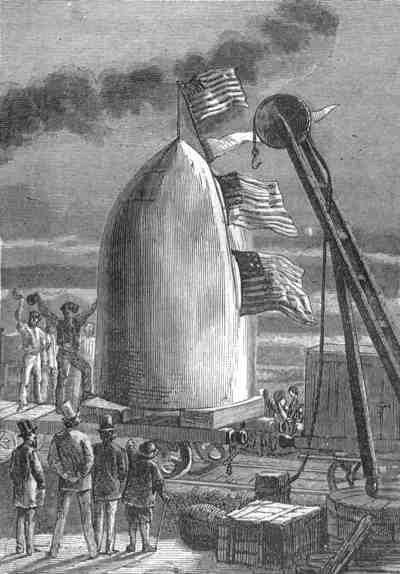
Along with HG Wells, Verne is credited with pioneering science fiction, and with this book although published in 1865 demonstrates the power of a inspiration idea. Both Wernher von Braun and Robert H. Goddard cite the book as a catalyst for their interest is rocketry and space exploration. Published 100 years before the actual moon landings Verne was able to make some uncanny predictions, correctly suggesting that three men would leave the earth in a capsule launched from Florida after much political horse trading! Of course technology moved on and 1969′s great achievement was made with liquid fuel rockets and computers not the large cannon suggested by Verne – still the idea was the inspiration !
So perhaps we should look at the Inspire programme in the same way, a moon shot idea that today may be achieved is different ways to at first considered..
Written and submitted from home (51.425N, 0.331W)
Four short links: 26 March 2013
Claus.dahlDen med priserne er sjov, lidt gammel viden, men sjov
- Patent on Medical Trial Design to Reduce Placebo Effect — drug companies say these failures are happening not because their drugs are ineffective, but because placebos have recently become more effective in clinical trials. [...] The whole idea that placebo effect is getting in the way of producing meaningful results is repugnant, I think, to anyone with scientific training. What’s even more repugnant, however, is that Fava’s group didn’t stop with a mere paper in Psychotherapy and Psychosomatics. They went on to apply for, and obtain, U.S. patents on SPCD. (via Ben Goldacre)
- OpenMalaria (Google Code) — an open source C++ program for simulating malaria epidemiology and the impacts on that epidemiology of interventions against malaria. It is based on microsimulations of Plasmodium falciparum malaria in humans, originally developed for simulating malaria vaccines. (via Victoria Stodden)
- Pricing Experiments You Might Not Know But Can Learn From — compendium of ideas and experiments for pricing.
- Retrominer — mining Bitcoins on a NES. I’m delighted by the conceit, and noticing that Bitcoin is now sufficiently part of the zeitgeist as to feature in playful hacks.
brooklynmutt: Out of Sight, Out of Mind: A visualization of...
Claus.dahlSvær at unwatche.

First photo of Radiohead
Claus.dahlBefore we knew how artsy we'd be
Technically this photo was taken several years (probably in 1986 or 1987) before Radiohead officially came to be, but it features four out of the five members, back when the group was called On a Friday.
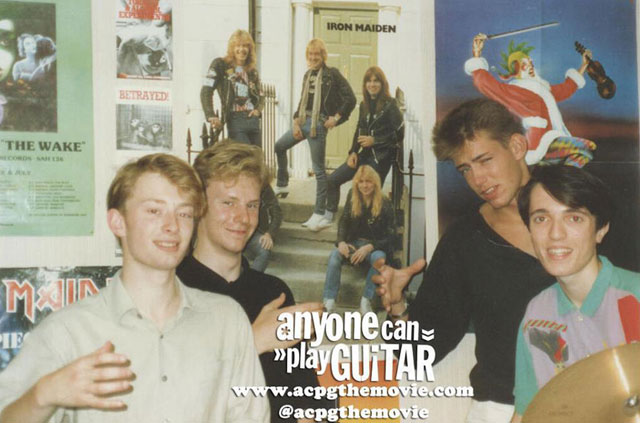
From left to right, Thom Yorke, Phil Selway, Ed O'Brien, and Colin Greenwood. This occasion marked one of the last times that Yorke smiled for a photo. (via buzzfeed)
Tags: music photography RadioheadGoogle Closes The Book On Google Reader On July 1, Seven Other Products Also Get The Chop
Claus.dahlDe skulle skamme sig, skulle de. Men godt man er skredet.

Google just revealed plans to shut down eight of its services as part of what it’s calling an ongoing spring cleaning effort. Some of them are pretty arcane, but among TechCrunch writers, anyway, we’re pretty bummed to see that Google Reader will be shut down on July 1.
“We launched Google Reader in 2005 in an effort to make it easy for people to discover and keep tabs on their favorite websites,” SVP of Technical Infrastructure Urs Hölzle writes in the blog post. “While the product has a loyal following, over the years usage has declined. So, on July 1, 2013, we will retire Google Reader. Users and developers interested in RSS alternatives can export their data, including their subscriptions, with Google Takeout over the course of the next four months.”
As a result, we can probably expect another round of “RSS is dead” posts. RSS as a technology for publishers to distribute content probably isn’t going away anytime soon, but if nothing else, the comments about loyal-but-declining usage suggest that anyone hoping for RSS to become a significant consumer technology can stop hoping. And for folks who like to track lots of news sources, this really sucks. (Seriously, you should see the wailing and moaning in the TechCrunch chat room.)
Google’s declining interest in RSS was already pretty obvious given last fall’s shutdown of AdSense for feeds. At the time, TechCrunch’s Frederic Lardinois wrote:
RSS, as a mainstream consumer technology, is mostly dead today (though it still provides a lot of the backend plumbing for many web and mobile apps). Google itself is barely investing in Google Reader anymore and, as far as we know, pulled virtually all of the Reader team into other projects a long time ago.
Other products being shut down (with various nuances in terms of what will still be available to whom) include:
- GUI Builder and five UiApp widgets for AppsScript (September 16)
- CalDAV API for non-whitelisted developers (September 16)
- Google Building Maker (June 1)
- Google Cloud Connect (April 30)
- Google Voice App For Blackberry (next week)
- Search API for Shopping (September 16)
- Snapseed Desktop for Macintosh and Windows (today)
Update: Sarah Perez offers her own thoughts in a follow-up post, which also links to several alternatives.
notational: rafer: dpstyles: whitneymcn: Yes, it’s never...
Claus.dahlFantastisk forslag

Yes, it’s never going to happen, but that won’t stop me from signing it.
White House Petition of the Day: Make Legislators Wear Logos of Corporate Backers
The latest brilliant idea to come out of We The People website is this petition suggesting that lawmakers should be required to be more transparent about their financial backers by wearing logos of their corporate “sponsors,” just like the NASCAR drivers do. As of Thursday evening, it has accrued more than 9,000 of the 100,000 signatures it needs to be formally addressed by the White House. GOOD magazine previously explored this idea with photoshopped mockups of New York Senator Charles Schumer and Florida Senator Marco Rubio donning logo patches of their contributors on their suits.
Hat tip goes to Dangerous Minds.
Not likely to go anywhere (just NASCAR drivers, who drive in circles), but sort of amazing.
Love this.
Rafer sez:
There’s no reason not to overlay it on the video and post to YT, or beg CSPAN today.
Bloomberg: ‘We're Going To Have More Visibility And Less Privacy,' Drones And Surveillance Coming

“We’re going to have more visibility and less privacy. I don’t see how you stop that,” admitted New York City Mayor Michael Bloomberg in a surprisingly candid interview about the future of the surveillance state in the Big Apple.
While admitting that increased surveillance was “scary” and that governments will have to be thoughtful with their laws, he seemed to side with prioritizing radical transparency, especially through the use of automated drones, “but what’s the difference whether the drone is up in the air or on the building? I mean intellectually I have trouble making a distinction.”
This puts Bloomberg squarely at odds with the growing number of states and congress members either enacting or proposing moratoriums on the use of drones.
Indeed, he went on to imply that the fears against drones were somewhat unjustified, especially since security cameras already exist:
“The argument against using automation, it’s this craziness– oh, it’s Big Brother. Get used to it. When there’s a murder, a shooting, a robbery of something the first thing the police do is go to every single building in the neighborhood and say let’s see your security camera.”
The NY Daily news notes that the New York Civil Liberties union has identified roughly 2,4000 cameras already affixed on Manhattan buildings–a presence that is likely to increase if Bloomberg’s most recent interview is to be believed.
Lest Bloomberg be labeled as a surveillience hawk, the interview took on a tone of inevitability, rather than advocacy: “Everybody wants their privacy, but I don’t know how you’re going to maintain it.”
Listen to part of the interview with WOR-AM host John Gambling, below. We’ll have more analysis soon.


Sorry Google; you can Keep it to yourself
Claus.dahlJa, vi er stadig sure
Google today launched Keep, an app that allows you to save things, clip stuff from the web, hoard notes and what not and put them all onto your Google Drive. Yup, you guessed it — it is an imitation to Evernote and many other such applications. It is a good thing that Google has decided to compete with the likes of Evernote — it validates their market.
It might actually be good, or even better than Evernote. But I still won’t use Keep. You know why? Google Reader.
I spent about seven years of my online life on that service. I sent feedback, used it to annotate information and they killed it like a butcher slaughters a chicken. No conversation — dead. The service that drives more traffic than Google+ was sacrificed because it didn’t meet some vague corporate goals; users — many of them life long — be damned.
 Looking from that perspective, it is hard to trust Google to keep an app alive. What if I spend months using the app, and then Google decides it doesn’t meet some arbitrary objective? Evernote has my data and frankly, I’m glad to pay them to keep it because they are who they are. One of the reasons I use Evernote is because it is their only thing. (For now.) Evernote is focused on making the service better. And it keeps that focus every year.
Evernote is like Derek Jeter, playing shortstop and trying to win every day. Google? It is the digital Mr. Ripley.
Sorry Google, but you might not realize that you are acting like the company you wanted to replace: Microsoft. The Barons of Redmond used to float products into the market — smart displays and weird stuff — that companies like Samsung and LG would put out in the market, only to yank them later. In the end, I stopped believing in Microsoft and shifted my dollars and attention to other brands.
And by the way – how is this app strategic for you guys and Reader is not? A little clarity would certainly be appreciated.
How about a pledge? If you build it, we use it, and you use our personal data to make your other products better or your ad sales executives richer, then you will keep it around.
Image courtesy of Flickr user Dano

Related research and analysis from GigaOM Pro:
Subscriber content. Sign up for a free trial.
Apple's halo car
Claus.dahlApollo-programmet var USAs halo-program. Nu er det drone warfare, der er det. Hvad er Danmarks halo-projekt? Noma? Lego?
I really enjoyed this piece by John Siracusa about why Apple should continue to make a high-end personal computer (like the Mac Pro) even though it's not a big seller or hugely profitable. Basically, the Mac Pro is Apple's halo car:
In the automobile industry, there's what's known as a "halo car." Though you may not know the term, you surely know a few examples. The Corvette is GM's halo car. Chrysler has the Viper.
The vast, vast majority of people who buy a Chrysler car get something other than a Viper. The same goes for GM buyers and the Corvette. These cars are expensive to develop and maintain. Due to the low sales volumes, most halo cars do not make money for car makers. When Chrysler was recovering from bankruptcy in 2010, it considered selling the Viper product line.
But car companies continue to make halo cars in part because they are great cars, or at least have the potential to be great cars, and when a car company stops caring about making great cars, they lose their identity and credibility...with consumers, with employees, with investors, and with competitors. Halo cars are the difference between being a car company and being a company that sells cars.
Normally I'm not a big fan of advice like "do what big car companies do", but what Siracusa's piece demontrates is one of the things that's problematic about data: there are important things about business and success that you can't measure. And I would go so far as to say that these unmeasurables are the most important things, the stuff that makes or breaks a business or product or, hell, even a relationship, stuff that you just can't measure quantitatively, no matter how Big your Data is. (via df)
Tags: Apple business cars John SiracusaFour short links: 21 March 2013
Claus.dahlGoodiepal ville nyde link 1; Kultur der er specifikt optimeret til kun at kunne afkodes af mennesker.Goodiepal ville nyde link 1; Kultur der er specifikt optimeret til kun at kunne afkodes af mennesker.
Og link 4: Nej, du kan ikke skalere kultur på den måde, uden at få *en anden* kultur. Cf iøvrigt masseuniversitetet og endnu mere Coursera et al. Det bli'r ikke til universitetsgrader af at komme fra et universitet.
- The Obfuscation of Culture — Tumblr and LJ users sep ar ate w ords thr ou gh o dd spacin g in o rde r to fo ol sea rc h en g i nes. Chinese users hide political messages in image attachments to seemingly benign posts on Weibo. General Pretraeus communicated solely through draft mode. 4chan scares away the faint of heart with porn. More technically astute groups communicate through obscure messaging systems. (via Beta Knowledge)
- log2viz — an open-source demonstration of the logs-as-data concept for Heroku apps. Log in and select one of your apps to see a live-updating dashboard of its web activity.
- Doctorow at LoC (YouTube) — video of Cory Doctorow’s talk on ebooks, libraries, and copyright at the Library of Congress.
- When TED Lost Control of its Crowd (HBR) — golden case study. You can’t “manage” a crowd—or a community—through transactional exchanges or economic incentives. You need something stronger: shared purpose
Apple warns developers it will stop accepting apps that access UDIDs on May 1
Claus.dahlSo this must also mean that pre iOS 6 devices are done getting app upgrades....
It’s been hinted at and implied in the past, but Apple is now serious about apps using universal devices identifiers (UDIDs): starting May 1, such apps will be rejected from the App Store, the company told its third-party developers on Thursday.
On its developer site Apple writes:
Starting May 1, the App Store will no longer accept new apps or app updates that access UDIDs. Please update your apps and servers to associate users with the Vendor or Advertising identifiers introduced in iOS 6.
UDIDs, which were intended to be anonymous, have been used by publishers, developers and advertisers to track their app’s usage and more accurately target advertisements almost since the App Store opened in 2008. But there are huge privacy implications with that practice: with just a bit more identifying data, a device’s UDID can be traced to a specific owner.
Apple first mentioned it would start rejecting apps that used UDIDs, due to privacy concerns, in late 2011. Then almost exactly a year ago, there were signs the company’s app review team had begun enforcing that rule. In September 2012, Apple introduced a replacement system for advertisers to use — the Advertising Identifier, an anonymized number that users can choose to reset, or opt out of altogether.
By May 1, the Advertising Identifier will have been available for eight months; plenty of time for those who want to understand how their apps are being used to switch over to the new system.
Besides UDID use, 9to5Mac notes that App Store reviewers will also be looking for apps that aren’t optimized for Retina displays and will reject them, along with iPhone apps that are not optimized for the 4-inch screen of the iPhone 5.

Related research and analysis from GigaOM Pro:
Subscriber content. Sign up for a free trial.
Hackaday Links: March 20th, 2013
Claus.dahlHavde en drøm om at fordampe vand med Fresnel-linser ved atlanten og lave en dampflod ind til hjertet af Sahara, som så skulle grønnificeres. Må se at komme igang med det.
Giant fresnel lens is dangerous fun

Here’s an interesting, and rather dangerous, use for those old big screen TVs that are frequently listed for FREE on Craigslist. With the lens from the old TV built into an adjustable wooden frame, [Grant] was able to melt a stack of pennies, instantly burn wood, melt spots in concrete, and serve his family a cooked egg… Cool.
Projection mapping app helps create hologram like performance stage

[Aimino] used an iPad, a mobile projector, and a mosquito screen to create a trippy hologram like stage. It might not seem like much at first, but it’s actually a pretty interesting effect. Watching the video makes me wonder what other applications this could have in the near future.
The world’s strongest magnet

At a cost of over $14 million dollars and weighing in at 35 tons, the 45 Tesla Hybrid is the strongest DC magnet on Earth. It’s powerful enough that the film crew couldn’t even safely get in to take footage of it. Over half of their camera tapes were wiped clean just while being in the same facility that houses it!
Virtual Body chair uses 4 of our 5 senses

Created in the hopes of providing a VR experience for seniors with mobility problems who can no longer travel the world, Tokyo Metropolitan University’s Ikei Laboratory presents the ‘Virtual Body’ exhibition. Included are a 3D monitor, a pair of headphones, a fan to create breezes and spread scents, a chair that moves and vibrates, and moving foot pedals.
Iron Man laser gauntlet pops balloons with ease

If you’re an Iron Man fan with disposable income, you might want to check out this functional full metal laser gauntlet. Built from scratch using no blueprints or guides, [AnselmoFanZero] sells them for around $3K USD.
Filed under: Hackaday links


D.me: Is this the new Delicious?
Claus.dahlDelicious copycatter Digg... Det er som når FB copycatter Snapchat, men bare 5 år for sent
Looks like the folks over at Delicious may have a case of Digg envy: I stumbled across a seemingly new site called D.me today that serves up a continuous stream of stories in a design that looks a lot like the recently-relaunched Digg.com, with a bit of Pinterest mixed in for good measure.

The site offers users to access content sorted by media types (articles, products, videos, music and photos) as well as through a free-form search. All of this can be combined, enabling you filter results to just photos and videos related to a certain subject. There even seems to be an element of personalization, offering users to display “more links like this.”
However, currently, only articles and a very small number of videos are on display, and search doesn’t seem to work at all.

There’s no about section on the site, and nothing that directly connects it to Delicious. However, the AVOS team, which acquired Delicious two years ago, also bought the D.me domain, and in fact briefly used it as a kind of link shortener and email forwarder for Delicious. And a look under the hood reveals that D.me is in fact powered by the Delicious API.
At this point, it’s very unclear what the future holds for D.me. An email inquiry to the AVOS team went unanswered. It’s possible that D.me was just a test for the AVOS platform, which the company describes on its website as a “common technology stack we’re building to underpin shared features across the AVOS product portfolio.”
However, there’s also a chance that AVOS learned a lesson from its botched attempt to reinvent Delicious after it acquired the site. A number of features, including the idea of curated collections of links dubbed “stacks,” were eventually rolled back.
Maybe AVOS decided to leave Delicious alone, and experiment with more innovative ideas for content discovery on a separate site.

Related research and analysis from GigaOM Pro:
Subscriber content. Sign up for a free trial.
explore-blog: Science writer and commentator Elise Andrew is...
Claus.dahlFlot, samfund!

Science writer and commentator Elise Andrew is rightfully outraged over the sexist comments she received when readers of her wildly popular I Fucking Love Science Facebook page realized she was a woman.
Clearly, some people could use Einstein’s advice about women in science.
Released: an Illustrated Guide to Income in the United States
Claus.dahlYeah, volatility is for owners only....

Has the income distribution changed over the last decades? How do the incomes of celebrities, CEOs and hedge fund managers compare?? The book "An Illustrated Guide to Income in the United States" [visualizingeconomics.com] designed by data visualization and infographics developer Catherine Mulbrandon, is providing all the answers.
Based on a successfully funded Kickstarter project back in 2011, the book contains a comprehensive collection of infographics, maps and charts that reveal the history of incomes and occupations in the United States.
The goal was to place the economical data in historical and geographical context, as well as explain the different concepts that it necessarily contains.
Next to the paperback, hardcover and PDF version, one now has the chance to consult the book online.
Forty years of interface icons
Claus.dahlEngelbart til Surface - pretty good roundup.
*Man, “The Verge” is good. It’s really won my respect.
This 20-year-old’s three-year-old startup did $44M in revenue last year
Claus.dahlSo we're down to celebrating scam artists now? Classy, TechCrunch.

William Wolfram was 15 years old when he struck on his first successful venture, although as a business it was more of a hack than a carefully constructed enterprise. He would scour YouTube for popular user-generated videos and then offer to buy the accounts for $50 or $100. Because he was so young, his mom had to sign the checks. Then he would take over the accounts and insert affiliate links into the video descriptions. So every time someone watched a wakeboarding video, say, and then bought a wakeboard after following one of those links, he would pocket the referral fee.
Wolfram’s scheme generated half a million dollars worth of sales for affiliate partners, and a fair chunk of change for himself in referral fees. It wasn’t enough to earn him a fortune, but it was decent pocket money for a teenager. Wolfram, who lives in Helsinki, Finland, saved the money and used it to start his first serious company, DealDash, at the ripe old age of 16. That was just over three years ago.
Today, the little-known DealDash has nearly 1 million users, 67 employees, a deal with Best Buy, and last year it did $44 million in revenue, clocking up a profit of about $1 million. For the first three years of its last, DealDash has quadrupled its revenue every 12 months. And, naturally, it’s about to move to Minneapolis.
DealDash isn’t the sexiest of businesses. Essentially, it’s a twist on those shady penny auction sites, in which large groups of people bid for an amazing deal on a desirable product, such as an iPad. On such an “auction,” if 100 people bid $20 on an iPad, one of them will get the device at the bargain price but everyone else loses money. The site picks up the profit. It’s basically a lottery, and not one with good odds. In fact, Wolfram got the idea for DealDash about five years when he lost 50 Euros bidding for a Macbook on such a site. He wanted to make a risk-free version that was fairer to shoppers.
On DealDash, shoppers buy a bunch of credits, which typically go for between 10 and 13 cents each (the site says 60c, but there’s a rolling promotion that drops the price drastically). A shopper can then use each credit as a bid in an auction for a product. Every auction starts at $0.00 and each bid raises the price by 1 cent. There’s a countdown clock for each auction, but it gets reset every time a bid is placed. When the clock eventually runs out, the highest bidder wins the auction. The winner of the auction then gets to keep the item, which is usually 60 to 99 percent cheaper than retail. The losers can get all their bids back if they choose the “Buy It Now” option for the product, which is more or the less the same as what it would cost in a retail store. They only lose their bids if they choose not to buy anything.
Being in Helsinki, home of Rovio (“Angry Birds”) and Supercell (“Clash of Clans”), Wolfram was able to turn advisors in the gaming industry to figure out ways to make the site stickier. He added game mechanics to the site to keep people coming back and to stay engaged for longer. For instance, he added a progress bar on the site that fills up every time you become the highest bidder. When it hits full, you level up, meaning you are entitled to win more auctions each week. The default setting on sign-up is three products worth more than $200 each week. Wolfram says the gamified elements have helped increase engagement six-fold since the site launched, and that users now stay on the site for 57 minutes a time.
DealDash has many competitors, some of which are well-funded. Others have come and gone. Swoopo, for instance, had $14 million in funding, but it shut up shop in 2011. Then there was BigDeal, which raised $4.5 million from Mayfield, First Round, and Foundation. Also dead. Eric Schmidt’s Tomorrow Ventures backed oohilove, but that’s a goner too. Which leaves MadBid, backed by Skype founders Niklas Zennstrom and Janus Friis’ Atomico Ventures to the tune of $6 million, as one of DealDash’s strongest rivals.
Wolfram raised about $2 million for DealDash – again, his mom had to sign the paperwork – much of which came from two key investors, Rovio chairman Kaj Hed, and Carbonite CEO David Friend, who was introduced to Wolfram via one of DealDash’s board members. Wolfram says more than half of the company’s revenue comes from unspent bids, but that the “Buy It Now” feature is important to the business, even if it produces lower returns. DealDash collects referral fees on sales made through the “Buy It Now” button.
While that means the company makes a sacrifice on margins, it also keeps customers loyal. “We figured out a way to retain customers over time, thanks to the strong emphasis on ‘Buy It Now,’” says Wolfram. “Eventually customers stay with us and pay that difference back in loyalty”
DealDash attracts more than its fair share of complaints. Here, for instance, is a long list of people crying “scam!”. And Wolfram is frank about the criticisms. Over the Christmas period, for instance, the company oversold a lot of the auctioned products, which led to a long delay in deliveries. Many unhappy customers didn’t receive the items until after Christmas, which meant DealDash had to pay out a lot of refunds. “We really screwed up in that sense,” says Wolfram.
Wolfram, however, is sensitive to charges that the site scams people. He knew from the start that people would always question the authenticity behind usernames, and whether or not they are really people. The company has a policy that no employees or their family members can bid on the site. It is also audited by Pricewaterhouse Coopers. However, Wolfram does concede that there is something about the model to is too difficult to understand. “That’s something we have to address.” Part of the confusion likely comes from a feature called BidBuddy, which allows users to automatically place bids within the last seconds of the auction clock. To some shoppers, that might seem like an automated bot.
Now, DealDash is preparing to shift its operations to Minneapolis, Minnesota, near Best Buy’s headquarters. The site cut a deal with the retail giant about three months ago, sending a majority of the “Buy It Now” sales to the retailer. Another motivation for the move is that one of the company’s top programmers is based in the city and isn’t keen on moving to another city. Meanwhile, Wolfram plans to hire another 10 people for the US office, and hopes to raise the company headcount to about 100 by the end of the year.
In ordinary circumstances, the move might be cause to break out the champagne. But of course, Wolfram’s not old enough for that.
[Picture from Teemu Arina's Vimeo video]
Hamish McKenzie
 Hamish McKenzie is a Baltimore-based reporter for PandoDaily who covers media, politics, and international startups. His first name is pronounced "hey-mish" and you can follow him on Twitter.

 |
 |
seanhowe: List of Marvel Characters, Ranked by Importance....
Claus.dahlStakkels Quicksilver, The Watcher og Ringo Kid - de eneste tre uvæsentlige figurer

LEGO paper airplane folding machine
Claus.dahlChoice nerdery
Guerilla researcher created epic botnet to scan billions of IP addresses | Ars Technica
Claus.dahlThe Internet Of Infected Things


Hexagonal rocks
Claus.dahlIsland er på min todo-liste
This is an Icelandic waterfall called Litlanesfoss and the naturally occurring rock formation is columnar jointed basalt.

The columns form due to stress as the lava cools. The lava contracts as it cools, forming cracks. Once the crack develops it continues to grow. The growth is perpendicular to the surface of the flow. Entablature is probably the result of cooling caused by fresh lava being covered by water. The flood basalts probably damned rivers. When the rivers returned the water seeped down the cracks in the cooling lava and caused rapid cooling from the surface downward. The division of colonnade and entablature is the result of slow cooling from the base upward and rapid cooling from the top downward.
One of the coolest things I have ever seen. Looks totally fake, like they built it for Fractal Falls in Polygon Gorge at Disneyland or something. Giants Causeway in Northern Ireland looks amazing as well. Check out several similar formations from around the world.
Tags: geologyWatch Weev's Angry Pre-Sentencing Speech About The Failure Of Our Nation
Claus.dahl"I'm going to prison for picking something up?", said the burglar

Yesterday, Andrew “weev” Auernheimer was sentenced to 41 months in prison, three years of probation, and restitution of $73,000 after being convicted on conspiracy and fraud charges. His actions had revealed a security flaw in AT&T’s user data base.
In essence, weev added a number to the end of a URL on AT&T’s public database and realized that he was moving from one user’s information to another. He aggregated the data and gave it to Gawker, making 114,000 iPad 3G owners data public.
Before his sentencing, however, Auernheimer took the opportunity to address some members of the media with a mini ad-hoc press conference. If you’ve ever yearned to live during the American Revolution, you’ll most certainly want to watch this act of angry patriotism.
“America is in a cultural decline,” he begins. “In my country, there’s a problem and that problem is the feds. They take all your freedom and never give it back.”
He talks about all of the helpful, commercial implementations of drones, yet rebukes the government that there are no licensing routes to use this technology for peace or a healthier planet.
He explains that there are engineers “working tirelessly” in this country who try to build something useful for humanity, before finding out it’s against U.S. code.
“I look at all this, and think, ‘I’m going to prison for arithmetic?’I added one to a number on a URL on a public server, and I aggregated that data, and gave it to a fucking journalist at that man’s (points) publication!” he screamed. “And this is why I’m going to prison!”
I look at all this, and think, “I’m going to prison for arithmetic?”
“And if they have any soul, any soul in their whole body. If they understood what they were doing to the rule of law, to the fucking Bill of Rights and to the free and open Internet, they would die in their own goddamn shame.”
Though the “AT&T hack” wasn’t necessarily an act of “innovation,” Auernheimer most certainly sees himself as a political and cultural hacktivist. He is seen as responsible for disrupting Amazon’s web services in 2009 when the service excluded a number of gay and lesbian books, and he’s published a number of podcasts, and shown support for Occupy Wall Street as well as a number of other movements. In fact, you might even consider the AT&T hack to be a public service. Who knows when AT&T would have gotten around to protecting our data?
“I hope innovation will make a wakeful returns as soon as possible,” he said. “We don’t have much time. I think we have a short window until the currency collapses and this place becomes some third world country. There are new Detroits and Birminghams and St. Louises every year, and we have very little time to manufacture again and bring this country back to its greatness.”
Bonding
Claus.dahlNår det går galt at være nørdsød går det frygtelig galt

Ex-Rocket Internet Execs Launch HotelQuickly In Bid To Become The HotelTonight Of Asia
Claus.dahlMore than one company can race to the bottom. There's a future blog post here on how disruption, almost by definition, invites these kinds of copycat. Level playing fields are level.

If the Samwer Brothers’ Rocket Internet has a blueprint, it goes something like this: Take a proven business model, usually originating from the U.S., and apply it aggressively to new markets. But that blueprint isn’t immune to being copied in itself.
Today, HotelQuickly, a Hong Kong-headquarted startup whose team is comprised of a number of ex-Rocket Internet executives, launches its last-minute hotel booking app which not only bears more than a little resemblance to San Francisco-based HotelTonight, but appears to borrow heavily from the Samwer brothers’ playbook, too.
Available on iOS and Android — and launching in Bangkok, Bali, Hong Kong, Singapore, and Melbourne from the get-go — the HotelQuickly app lets users book “last minute” hotel rooms (up to 2am that night) at heavily discounted prices. Specifically, the app presents a list of up to 6 curated offers, based on a user’s location and divided into 3 categories (prime, design and comfy), which are only available for booking on the same day.
Meanwhile, the draw for hotels who partner with HotelQuickly is that it offers an efficient way to shift spare inventory without eating into their existing market or diminishing their brand via overt discounting. At launch, the startup is partnering with over 100 hotels in the region, including the likes of Hotel LKF by Rhombus, Ovolo Group, and East Hotel, with more to be added over the coming months.
So, yes, very HotelTonight. And very Rocket Internet.
Of HotelQuickly’s five co-founders, two are Rocket alumni. Christian Mischler (COO) previously held the role of COO at Rocket Internet’s Foodpanda, the online food delivery platform, and Raphael Cohen (CSO) was Managing Director of both Foodpanda Vietnam and DropGifts Singapore. Its other co-founders are Tomas Laboutka (CEO), Michal Juhas (CTO), and Mario Peng (CFO), while in total I’m told that 9 members of HotelQuickly’s 30-person team are ex-Rocket Internet.
Funding-wise, until as recently as last week, HotelQuickly was bootstrapped at great cost, says co-founder and CEO Laboutka. It’s in the process of closing an A round, however, thus far raising $500,000 from various investors in Asia, Europe and the U.S.
In comparison, HotelTonight has raised a hefty $36 million since it was founded in 2010, most recently closing a C round last June. However, it operates in the U.S., Canada, Mexico, and Europe only, so for the time being, HotelQuickly gets a head start in Asia, although it already has at least one local competitor in the form of CheckInTonight.
(Update: Hot Hotels, a European HotelTonight competitor, has expanded to Singapore, Thailand, Hong Kong, and Vietnam.)
"Given the corporate climate at Fox, Mr. Darnell, the executive vice president of specials and..."
Claus.dahlchoice. pop culture at it's best.
Given his history — this is the man who once considered producing a special called ”The World’s Most Embarrassing Throw-up Moments” — that may prove challenging.”
- Fox’s Point Man For Perversity; ‘World’s Scariest Programmer,’ Starring Mike Darnell as Himself - New York Times
Basics ... repeated ... again ...
Claus.dahl"Step 15. Now you're ready. " - stakkels fyr. Men mange udemærkede begreber til ideorganiserings-kataloget.


In the tradition of TV cookery programmes, here's one I baked earlier. In this case in 2005 - a simplified map of part of the value chain of an online photo service known as Fotango. (NB. back then, I used to use the term innovation rather than genesis but alas since innovation is widely used to mean many different things I've chosen genesis to mean the novel and new).

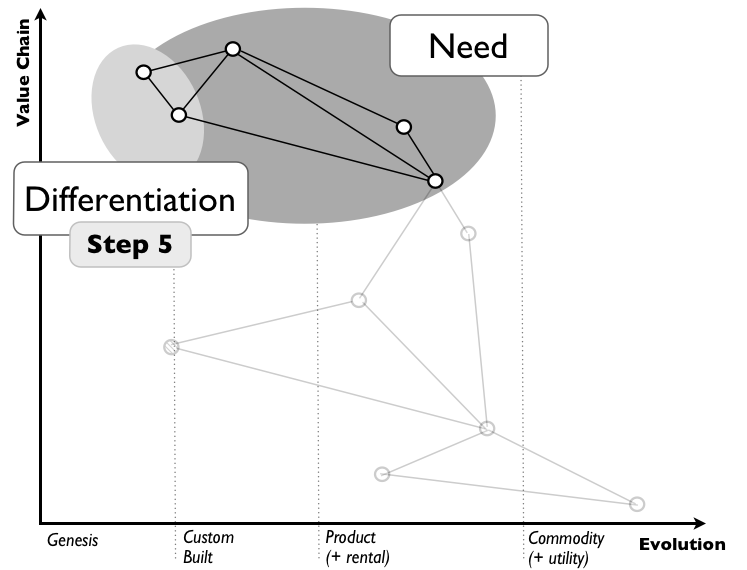


For example, the creation of novel and new (as in Genesis, Custom Built) should be done in-house with use of Agile techniques because of the chaotic nature of what is being managed (constantly changing, rare, highly uncertain, deviating from the past, unpredictable etc). These activities are all about experimentation, gambling, failing (lots of this) and potential future value. If you can't afford to do this in-house, then hire a contract developer and ask yourself why are you doing this?


Once you've done the basics, you can now start thinking about how to exploit ecosystems or open mechanisms or dark arts to manipulate the map. You can look at competitors value chains, consumers and your own suppliers and look at the impacts of changing the environment. You can look to push something more open, encourage efficiency, drive development of higher order systems, create new sources of worth, undermine competitors barriers to entry, run a tower and moat play ... oh, there's a long list. You can start to predict obvious changes in the industry, competitor moves, deal with inertia, game your culture, create structures designed to cope with change, create centres of gravity ... oh, there's a long list.
However, most importantly you're in a position to discuss this, to talk about strategy in some form of meaningful sense, to talk about the why of action. All the previous 14 steps are about getting you into a position of talking about why.

Which brings me to the point of what not to do. Don't come and ask me a question about whether this or that strategy make sense unless you have done the above or something similar. I'm simply going to ask you "why" you're running this strategy? If you don't understand your value chain and how evolved the components are, then any strategy you have will either be shooting in the dark or because everyone else is doing this.
If you want to really get up my nostrils you might tell me that your strategy is to be agile, efficient, nimble or innovative OR alternatively give me a long list of how, what and whens such as purchasing choices, implementation details, operational decisions or tactical choices OR you might just throw in a couple of buzz words like cloud, big data and social media to jazz it up. It'll be a very short conversation.