
Claus.dahl
Shared posts
19 Mar 13:42


Even More Raspberry Pi Now Made In The U.K. As Largest Distributor Of $35 Microcomputer Shifts All Production To Wales
by Natasha Lomas
Claus.dahlBetter for the west than China, I'm sure - but only works if almost jobless, so not a cure for that
The Raspberry Pi affordable microcomputer is now almost entirely made in the U.K., after Premier Farnell/element 14 — the largest of the Pi Foundation‘s distributors — announced it has shifted all its production to Sony’s Pencoed factory in Wales.
The company inked a multi-million pound contract with Sony to manufacture Pis last fall but also had two locations in China producing Pis — meaning that around 70% of its Pi production was coming out of the U.K. at the turn of the year. Today, after a “period of transition”, Premier Farnell said the Pencoed factory now accounts for 100% of its Pi output.
“The business stated back in September its intention to bring production of the computer back to its home, the UK, and now after a period of transition we are delighted to announce that all production is in Wales,” said Claire Doyle, Global Head of Raspberry Pi at element14, in a statement.
“We are constantly amazed by the demand for the Raspberry Pi across the world and have done everything we can to ensure we keep our supply chain stocked,” she added. “We believe that a UK creation should be produced in its home country and since partnering with Sony UK Tec we have been delighted with the quality and the commitment they have shown in developing the product.”
There is still some non-U.K. Raspberry Pi production, as the Pi Foundation has another distributor, but Premier Farnell/element 14 is apparently the larger of the two. (The Foundation has previously said it does not disclose exactly how much of the Pi pie each of its licensees accounts for.)
Since the Pi’s launch on 29 February last year, Premier Farnell said it has distributed more than 500,000 Raspberry Pi’s. Back in January, it estimated more than a million Pis had been sold – a considerable bump on the Foundation’s original projections of a few thousand units.
The Foundation has previously produced this short video showing some of the manufacturing processes taking place at the Pencoed Pi factory:
19 Mar 13:40
Jason Molina, RIP
Claus.dahlHar du set den triste nyhed, Føhns?
his Songs: Ohia work is some of the most emotive music ever recorded
19 Mar 12:32


Networks of first-class peers
by Jon Udell
Claus.dahlMore important than ever - on the eve of Google Reader's death
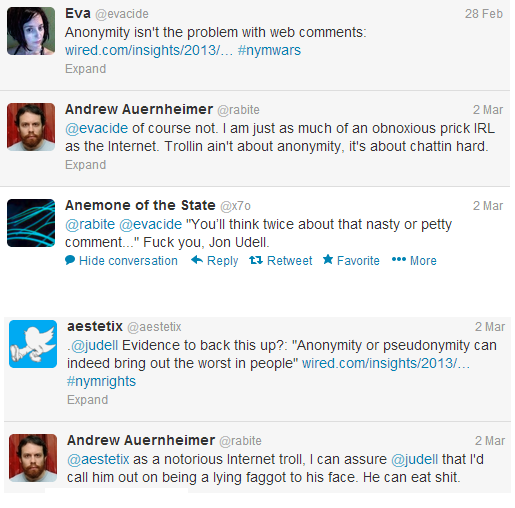
Last month ago I wrote a column for Wired.com, Rebooting web comments, that attracted some unsavory feedback. Had the flamers read beyond the second paragraph they might have seen that I wasn’t insisting everyone must use verifiable identities online. But they didn’t. So I wrote another column last week, Own your words, to clarify my position.
My first blogging tool, back in 2001, was Dave Winer’s Radio UserLand. One of Dave’s mantras was: “Own your words.” As the blogosphere became a conversational medium, I saw what that could mean. Radio UserLand didn’t support comments. That turned out to be a good constraint to embrace. When conversation emerged, as it always will in any system of communication, it was a cross-blog affair. I’d quote something from your blog on mine, and discuss it. You’d notice, and perhaps write something on your blog referring back to mine.
This cross-blog conversational mode had an interesting property: You owned your words. Everything you wrote went into your own online space, was bound to your identity, became part of your permanent record. As a result, discourse tended to be more civil than what often transpired in Usenet newsgroups or web forums. In those kinds of online spaces, your sense of identity is attenuated. You may or may not be pseudonymous, but either way the things you say don’t stick to you in the same way they do if you say them in your own permanent online space.
Later blogs evolved forum-style comments which concentrated discussion but recreated the old problems: attenuation of identity, loss of ownership of data. Then came Twitter and Facebook and, so the story goes, “social killed the blogosphere.” It was easier to read and write in those online spaces, blogging declined, and Google’s recent decision to retire its RSS reader is being widely regarded as the nail in the blogosphere’s coffin.
Of course that’s wrong. One of the staples of tech punditry is the periodic declaration that something — Unix, the Web, Microsoft, Apple, the blogosphere — is dead.

Will Google Reader’s exit spell the end of the blogosphere or its rebirth? Nobody knows, and since I’m no longer in the pageview business I won’t even hazard a prediction. Instead I want to highlight something that’s bigger than blogs, bigger even than social media. Owning your words is a fundamental principle. It seemed new at the dawn of the blogosphere but its roots ran deeper. They were woven into the fabric of the Internet which, at its core, is a network of peers.
For technical reasons I won’t explore here, it’s not possible (or, I should say, not believed possible) for our computers to be first-class peers on that network, as early Internet-connected computers were. But it is possible for various of our avatars — our websites, our blogs, our calendars — to represent us as first-class peers. That means:
- They use domain names that we own
- They converse with other peers in ways that we enable and can control
- They store data in systems that we authorize and can manage
Your Twitter and Facebook avatars are not first-class peers on the network in these ways. Which isn’t to say they aren’t useful. Second-class peers are incredibly useful, largely because they enable us to avoid the complexities that make it challenging to operate first-class peers.
Those challenges are real. But they’re not insurmountable unless we believe that they are. I don’t believe that. I hope you won’t. What some of us learned at the turn of the millenium — about how to use first-class peers called blogs, and how to converse with other first-class peers — gave us a set of understandings that remain critical to the effective and democratic colonization of the virtual realm. It’s unfinished business, and it may never be finished, but don’t let the tech pundits or anyone else convince you it doesn’t matter. It does.
19 Mar 06:42



Mozilla Plans To Improve Firefox Developer Tools With In-Browser Editing, Better Firebug Integration, Network Panel & More
by Frederic Lardinois
Claus.dahlHey, det' lissom du sagde Steffen - de vil ha' fat i udviklerne igen
Last week, Mozilla technology evangelist Paul Rouget asked web developers what improvements they wanted to see in Firefox’s developer tools. Based on the feedback the team got on HackerNews and Twitter, the Firefox DevTools team spent the last week hacking and prototyping a number of new and improved developer features that will likely find their way into a stable version of Firefox in the future.
The number one request, Rouget writes, was to make it easier for developers to code in the browser and control the browser from editors and integrated development environments (IDEs). The team is exploring two approaches for this right now. The DevTools team built a proof of concept that shows live editing using the popular Sublime Text editor and Firefox’s built-in remote capabilities. In addition, though, Mozilla is also looking at adding an editor right into Firefox.
This wouldn’t be the first time for Mozilla to look into a browser-based editor. Back in 2009, Mozilla started working on Bespin, which later became Skywriter, but this project is now inactive. With the CSS and HTML editor Thimble, however, Mozilla recently picked up this idea again and while Rouget writes that the organization is still trying to figure out what a new editor in the DevTools could look like, there is clearly some expertise for how to build browser-based text editors at Mozilla.
Another feature developers asked for is a Chrome- and Firebug-like network panel and timeline; the team already developed a prototype that makes it easier to see how a web app uses the network.
The Firefox team is also working to improve the browser’s compatibility. Currently, Rouget writes, “if you’re a Firebug user, the Firefox DevTools might get in your way.” To ensure that doesn’t happen, Mozilla will add an option to disable the “inspect” menu from the context menu and the team is also looking for ways to integrate Firebug in the DevTools box.
Other improvements the team is working on include the ability to dock tools on the right side of the browser (already working in Firefox Nightly), support for CoffeeScript and debugging minimized CSS and JavaScript files, as well as the ability to see what gets repainted on a page (also currently available in Firefox Nightly).
Rouget notes that the team is also working on a number of other features (visualizing event bindings, offline storage tools and pseudo elements inspection).
Most of these improvements aren’t going to arrive right away and it may take a few months for some of them to make it out of the prototype stage. For developers, however, this is still welcome news as Mozilla is clearly dedicated to improving its developer tools and to keep them up to par with the competition.
18 Mar 15:55
 Hamish McKenzie is a Baltimore-based reporter for PandoDaily who covers media, politics, and international startups. His first name is pronounced "hey-mish" and you can follow him on Twitter.


What should the next RSS reader look like?
by Hamish McKenzie
Claus.dahlIt Just Might Work

The savviest response so far to the news that Google will shut down Google Reader on July 1 comes from Digg. “We’ve been planning to build a reader in the second half of 2013, one that, like Digg, makes the Internet a more approachable and digestible place,” the revived reading platform’s people said in a blog post today. “After Google’s announcement, we’re moving the project to the top of our priority list.”
Digg called for ideas on what a next-generation RSS reader should look like. The overwhelming majority of commenters said they just wanted Digg to copy Google Reader and call it a day, reinforcing that famous Henry Ford quote about the wisdom of the consumer: “If I had asked people what they wanted,” Ford said, “they would have said faster horses.”
But, amid the recommendations to switch to Feedly or The Old Reader, readers made several great suggestions. Here are the best of them.
Save for later: Readers have become accustomed to using services like Readability, Pocket, and Instapaper to save stories for reading later, particularly when offline. They’d like to ability to do so directly from their RSS reader.
A full suite of sharing options: One of the things that people love about Android over iOS is that it natively allows sharing of any Web content to not just Facebook and Twitter, but also a range of other services, such as LinkedIn, Messenger, Flipboard, Gmail, Yammer, Reddit, Skype, and Evernote. Lots of commenters want the same
The ability to block certain authors: One reader asked that he be allowed to filter out content from a site’s firehouse feed by author. So, for instance, if someone wanted to keep track with every story on PandoDaily except articles written by that wretched Hamish McKenzie, they could merely choose to block anything he had written from ever appearing in the feed.
Likes, comments, and recommendations: No surprise, many commenters wanted to see a return of the basic social features that made Google Reader into a cult social network. Some people love the ability to comment on a story shared from someone else’s feed, “Like” it, or re-share it for people in their network. Digg has an opportunity to bring that back.
Ifttt.com integration: For the unacquainted, the anagram refers to the command “if this, then that,” which allows people to set up rules for automating actions related to Web content. For instance, you might want to set up a system in which you get an SMS alert when your PandoDaily subscription hits 10 unread items in your RSS reader.
Recommendations by machine learning: Kind of like Twitter’s “Discover” tab, the new Reader could make smart suggestions based on a reader’s interests and social graph. However, unlike that Discover tab, it could also improve its recommendations by learning from what you have shown interest in in the past and by analyzing what people like you are reading, along the lines of what Futureful and Thirst are doing.
Play podcasts within the reader: That would be nice, wouldn’t it?
Export options: One commenter said he’d like the ability to export a group of tagged items and to be able to email them in a variety of formats, such as plain text, PDF, or in a spreadsheet. This feature would be particularly useful for people who want to send out bundles of content sorted by subject or time to other people.
Natural language processing: The Reader, suggested one commenter, could analyze your feeds and automatically sort stories into themed groups based on the posts that you save for later.
Tablet-friendly UI: This is my suggestion. I would do most of my feed-reading on tablet if the interface were up to scratch. At the moment, Google Reader’s line-by-line format works great for mouse-clicks, but not so well for finger taps. I would like to see a responsive design whereby the browser resizes for tablets and lays out the article snippets (headlines and extracts) in a grid-like form with lots of little squares rather than lines. That would allow me to scan headlines quickly and tap to expand the stories that most interest me.
When building a service that is heavily inspired by a much-loved product – especially one built by Google – one has to be careful not to pack it with too many features. The best approach in this case would be to follow the advice of most of the commenters on that Digg post: keep it simple. But it is certainly true that Google Reader is a product that was built wholly for the desktop era. It deserves to be re-built, even if by a competitor. Digg has been on a roll as it stages its recovery, and this Reader project at first seems to be a great opportunity. Google might just have presented it with another shot at relevance.
Hamish McKenzie
Hamish McKenzie is a Baltimore-based reporter for PandoDaily who covers media, politics, and international startups. His first name is pronounced "hey-mish" and you can follow him on Twitter.  |
 |
18 Mar 14:08


petitchou: Fact: If you live in or visit San Francisco and are...
Claus.dahlDe er fine
Fact: If you live in or visit San Francisco and are not seeking out its secret stairways, you are doing everything all wrong.
18 Mar 14:05
rubbish reckon blimey
by russell davies
Claus.dahlanipals, pawsome, furever ????? bizarro subcults her


14 Mar 21:14

guardian.co.uk © 2013 Guardian News and Media Limited or its affiliated companies. All rights reserved. | Use of this content is subject to our Terms & Conditions | More Feeds


What I wish Tim Berners-Lee understood about DRM
by Cory Doctorow
Claus.dahlSig noget til ham, Cory!
Adding DRM to the HTML standard will have far-reaching effects, incompatible with the W3C's most important policies
After Web inventor Tim Berners-Lee's keynote talk at SXSW, he answered a question about the controversial plan to add DRM to next version of HTML. HTML 5, a standard currently under debate at the World Wide Web Consortium (W3C) is the latest battleground in the long-running war over the design of general-purpose computers. Berners-Lee defended the proposition, and claimed that without it, more of the Web would be locked up in un-searchable, unlinkable formats like Flash.
Some in the entertainment industry have long harboured fantasies about redesigning computers to disobey their owners, as part of a profit-maximisation strategy that depends on being able to charge you piecemeal for the right to use the files on your hard-drive.
Most famously, the industry convinced DVD manufacturers to add restrictions to players to prevent you from buying a DVD in one part of the world for use in another part of the world. For this to work, DVD players had to be designed so that they hid which programs were running on them – so that DVD-player-owners wouldn't just kill the "verify region" program. The players also had to be designed to hide files from their owners, so that users couldn't just find the file with the DVD-decryption key in it and use it to unlock the DVD using a different player – one that didn't check for region compliance.
Two important questions emerge from this historical example: first, did it work; and second, why on Earth did the manufacturers ever agree to this? Both of these questions are important to ask here.
Did region restrictions work? Not at all. After all, hiding files and processes inside of a computer that the "bad guy" can actually carry away with him to a lab or work-room is a fool's errand. If Berners-Lee believes that adding secrets to Web browsers that computer owners won't be able to access will somehow enable the marketplaces that the entertainment industry says it needs for its new business models, he's mistaken.
More importantly: why did manufacturers agree to add restrictions to their hardware? Region-coding is an anti-feature, a "product" no one is looking to buy. You can't sell more DVD players with a sticker that says, "Now, with region restrictions!"
Patent pitfalls
Put simply, because the industry ginned up a legal requirement to add DRM to DVD players. When DRM bodies gather, they seek to identify a piece of "hook IP" – usually a patent. If there's some patent thrown into the process for decoding a file-format, then the patent can be used as a "hook" for licence terms that can be used to bind manufacturers.
In other words, if a patent (or patents) can be included in the decoding system for DVDs, you can threaten manufacturers with patent-violation suits unless they take out a licence. Patent licences are administered by a licensing authority (LA), which creates a standard set of terms for licensing. These terms always include a list of features that the manufacturers may not implement (for example, you may not add a "save to hard drive" feature to a DVD player); and a list of anti-features that manufacturers must implement (for example, you must add a "check for region" component to players).
Additionally, all DRM licence agreements come with a set of "robustness" rules that require manufacturers to design their equipment so that owners can't see what they're doing or modify them. That's to prevent device owners from reconfiguring their property to do forbidden things ("save to disk"), or ignore mandatory things ("check for regions").
Adding DRM to the HTML standard will have far-reaching effects that are incompatible with the W3C's most important policies, and with Berners-Lee's deeply held principles.
For example, the W3C has led the world's standards bodies in insisting that its standards are not encumbered by patents. Where W3C members hold patents that cover some part of a standard, they must promise to license them to all comers without burdensome conditions. But DRM requires patents or other licensable elements, for the sole purpose of adding burdensome conditions to browsers.
The first of these conditions – "robustness" against end-user modification – is a blanket ban on all free/open source software (free/open source software, by definition, can be modified by its users). That means that the two most popular browser technologies on the Web – WebKit (used in Chrome and Safari) and Gecko (used in Firefox and related browsers) – would be legally prohibited from implementing whatever "standard" the W3C emerges.
Copy catch
What's more, DRM is wholly ineffective at preventing copying. I suspect Berners-Lee knows this. When geeks downplay fears over DRM, they often say things like: "Well, I can get around it, and anyway, they'll come to their senses soon enough, since it doesn't work, right?" Whenever Berners-Lee tells the story of the Web's inception, he stresses that he was able to invent the Web without getting any permission. He uses this as a parable to explain the importance of an open and neutral Internet. But what he fails to understand is that DRM's entire purpose is to require permission to innovate.
For limiting copying is only the superficial reason for adding DRM to a technology. DRM fails completely at preventing copying, but it is brilliant at preventing innovation. That's because DRM is backstopped by anti-circumvention laws like the notorious US Digital Millennium
Copyright Act of 1998 (DMCA) and the EU Copyright Directive of 2002 (EUCD), both of which make it a crime to compromise DRM, even if you're not breaking any other laws. Effectively, this means that you have to get permission from a DRM licensing authority to add any features, since all new features require removing DRM, and the DRM license terms prohibit adding any features not in the original agreement, and omitting any of the mandatory restrictions featured in that agreement.
Compare DVDs to CDs. CDs had no DRM, so it was legal to invent technologies like the iPod and iTunes, which ripped, transcoded and copied music for personal uses. DVDs featured DRM, so it was illegal to add any features to them, and in the nearly 20 years since they were introduced, no legal technologies have been introduced to the market that do what iTunes and the iPod did in 2001. One company tried to ship a primitive DVD hard-drive jukebox and got sued out of that line of business. 20 years of DVDs, zero innovations. Now, DRM has not stopped people from making illegal copies of DVDs (obviously!), but it has entirely prevented any innovative legal products from entering the market for two decades, with no end in sight.
Penny pinching
This is the regime that the W3C stands to add to the Web, and that Berners-Lee has endorsed with his remarks. A regime where every improvement is seen as an opportunity to erect a toll booth. A Web built on the urinary tract infection business model: rather than getting your innovation in a healthy gush, every new feature must come in a painfully squeezed dribble, a few pennies if you want to link in directly to a specific timecode on the video; a few pennies more if you want to embed a link from the video to a web page, more if you want to move a video to another device or timeshift it, and so on.
As the leading standards-setting body for the Web, the W3C has an enormous, sacred and significant trust. The future of the Web is the future of the world, because everything we do today involves the net and everything we'll do tomorrow will require it. Now it proposes to sell out that trust, on the grounds that Big Content will lock up its "content" in Flash if it doesn't get a veto over Web-innovation. That threat is a familiar one: the big studios promised to boycott US digital TV unless it got mandatory DRM. The US courts denied them this boon, and yet, digital TV continues (if only Ofcom and the BBC had heeded this example before they sold Britain out to the US studios on our own high-def digital TV standards).
Flash is already an also-ran. As Berners-Lee himself will tell you, the presence of open platforms where innovation requires no permission is the best way to entice the world to your door. The open Web creates and supplies so much value that everyone has come to it – leaving behind the controlled, Flash-like environs of AOL and other failed systems. The big studios need the Web more than the Web needs big studios.
The W3C has a duty to send the DRM-peddlers packing, just as the US courts did in the case of digital TV. There is no market for DRM, no public purpose served by granting a veto to unaccountable, shortsighted media giants who dream of a world where your mouse rings a cash-register with every click and disruption is something that happens to other people, not them.
Cory Doctorowguardian.co.uk © 2013 Guardian News and Media Limited or its affiliated companies. All rights reserved. | Use of this content is subject to our Terms & Conditions | More Feeds
14 Mar 18:38

guardian.co.uk © 2013 Guardian News and Media Limited or its affiliated companies. All rights reserved. | Use of this content is subject to our Terms & Conditions | More Feeds


The electronic tattoo that can monitor patient symptoms remotely
by Oliver Wainwright
Claus.dahlHey, den idé kunne jeg lide sidste år....
Scientists have developed a flexible circuit board that can be printed directly on to skin to transmit data back to a doctor
Repeat trips to the doctor could become a thing of the past thanks to a new technology that can monitor your health and wellbeing remotely – directly from the surface of your skin. Researchers at the University of Illinois have developed an electronic tattoo that can be printed straight on to the body to track patients' symptoms – measuring heart rate and temperature, strain and hydration – and then beam the information back to your doctor. It might sound like something from Brave New World, but this could be the first step in a future of networked healthcare.
The project, pioneered by materials scientist John Rogers, is the latest development in ongoing work into flexible "epidermal electronics". His team have previously engineered stick-on stretchable electronic circuits with an elastic polymer backing, which could simply be applied to the skin like a temporary tattoo – but with the downside that they could easily wash off.
"They were fine for an office environment," Rogers told the MIT Technology Review, "but if you wanted to go swimming or take a shower they weren't able to hold up."
The researchers have now developed a technique to print circuits directly on to human flesh with a rubber stamp, which can then be covered with a spray-on bandage to form a protective coating. The ultrathin mesh electronics operate like a standard computer circuit board – with electrodes, sensors and wireless communication systems – but are made up of a matrix of stretchy, serpentine wires that flex with the movement of the body. By removing the elastic backing, the device is now one thirtieth as thick as before, and can adapt more easily to the rough surface of the skin.
Rogers sees one of the major applications being the ability to monitor wound healing, with an electronic tattoo applied close to the surgical wound before the patient leaves hospital, allowing doctors to track the healing process remotely. As Wired magazine reports, the devices could also see patients sent home from surgery with a monitoring system that does the job of several heavy-duty machines, such as electromyographs and electrocardiograms, that are usually confined to hospitals.
Those fearing a Big Brother future of barcoded proles will be relieved to hear that the tattoos can only be worn for around two weeks, before the skin's natural exfoliation process causes them to flake off.
Oliver Wainwrightguardian.co.uk © 2013 Guardian News and Media Limited or its affiliated companies. All rights reserved. | Use of this content is subject to our Terms & Conditions | More Feeds
14 Mar 08:56
PETA Goes After Assassin's Creed For Its Depiction Of Whaling; Ubisoft Responds With A Heaping Dose Of Sarcasm
by Tim Cushing
Claus.dahlWe do not condone illegal whaling, just as we don't condone a pirate lifestyle of poor hygiene, plundering, hijacking ships, and over-the-legal-limit drunken debauchery
I'm not sure why it is that PETA feels it needs to pick fights with video games, but it continues to do so even after its last couple of efforts (vs. Pokemon [catch ALL the fake animals!] and Cooking Mama [dead animals for dinner!]) have backfired spectacularly. Its latest target is none other than the latest Assassin's Creed game, which, at this point, exists only as a trailer.
Ubisoft obviously felt this statement deserved a response, and handled it with all the dignity it could muster while still leaving room for plenty of withering, bone-dry sarcasm.
PETA could be a useful contributor to society if it would just focus on actual, heinous animal abuse rather than attaching bits of crazy to whatever happens to fall within miles of its actual purview. But it looks like it would much rather continue to cement its reputation as an "out there" special interest group only slightly more credible than "birthers" or conspiracy theorists utilizing numerology to detail the connection between gold prices, the Illuminati and the U.S. Fish and Wildlife Service.
Permalink | Comments | Email This Story


There's plenty of assassinating and plundering on the way, it would appear, but none of that bothers PETA. Nope, it's the fake killing of fake whales that has the group back in full statement-issuing pique. Here's what it had to say about the deadly digital whaling:
Whaling—that is, shooting whales with harpoons and leaving them to struggle for an hour or more before they die or are hacked apart while they are still alive—may seem like something out of the history books, but this bloody industry still goes on today in the face of international condemnation, and it's disgraceful for any game to glorify it. PETA encourages video game companies to create games that celebrate animals—not games that promote hurting and killing them.I don't know which intern gets handed instructions to "write something angry" about video game animal abuse, but I can only imagine they're fairly resentful of the interns that get handed plum assignments to write about actual, real-world, horrific animal abuse. Statements like these, directed at fiction, make me believe there's some sort of "DAYS SINCE LAST OUTRAGE" board posted at the PETA office, and heads (HUMAN ONLY) start rolling if it passes single digits.
Ubisoft obviously felt this statement deserved a response, and handled it with all the dignity it could muster while still leaving room for plenty of withering, bone-dry sarcasm.
"History is our playground in Assassin's Creed," Ubisoft said in a statement to the publication. "Assassin's Creed IV: Black Flag is a work of fiction that depicts the real events during the Golden Era of Pirates. We do not condone illegal whaling, just as we don't condone a pirate lifestyle of poor hygiene, plundering, hijacking ships, and over-the-legal-limit drunken debauchery."Point: Ubisoft. Although honestly, scoring a point against manufactured outrage from one of the most prolific outrage manufacturers on the planet is a bit like putting one into your own net, in terms of effort. Still, the statement deserved a response, because (he said, mixing sports metaphors like a mad scientist with a handful of smoking flasks and beakers) if PETA's going to hang one directly over the plate, it seems a shame to pass up an opportunity to send it rocketing into the upper deck.
"And even if the game does glorify whaling — as it certainly glorifies the life of a pirate — I don't think it will lead to a generation of gamers who head to the Caribbean to hunt down humpbacks. Just as I don't think anyone who played the previous Assassin's Creed games have found employment as a murderer for hire."
PETA could be a useful contributor to society if it would just focus on actual, heinous animal abuse rather than attaching bits of crazy to whatever happens to fall within miles of its actual purview. But it looks like it would much rather continue to cement its reputation as an "out there" special interest group only slightly more credible than "birthers" or conspiracy theorists utilizing numerology to detail the connection between gold prices, the Illuminati and the U.S. Fish and Wildlife Service.
Permalink | Comments | Email This Story
14 Mar 08:37
Players elsewhere are also discovering what Kluwe had: that the game runs, at least temporarily, without an internet connection, something that shouldn't be possible, according to EA's claims that its servers handle a "significant amount of the calculations."
EA has remained adamant that a single-player SimCity is logistically impossible, but that claim is suddenly holding a lot less water. This revelation doesn't bode well for EA's leaky Claims Waterholder or any future endeavors it had planned that might have relied on its "our supercomputers do the thinking for you!" rationalization in order to force more "online-only" requirements down users' throats. This online-only requirement is no different than others before it. It may battle piracy, hacking and cheating, but makes onerous demands of its paying customers every step of the way.
Permalink | Comments | Email This Story


Maxis Insider: EA Lying About Needing Servers For Single Player SimCity
by Tim Cushing
Claus.dahlOK, her er faktisk en slags pro-Morozov argument. Når EA kan forsøge at slippe afsted med "skyens" magiske indflydelse på SimCity, og på den måde camouflere at det bare er kopibeskyttelse - som så iøvrigt fucker spillet op - jamen så har vi ikke vundet noget med skyen.
Throughout Simcity's massive public flameout last week, questions were raised (repeatedly) about EA's claims that an offline, single-player mode would be a massive undertaking because of the amount of calculations being done server-side. As many people pointed out, this seemed to be a choice EA had made in order to prevent piracy, rather than a necessity due to the (shoehorned-in) social aspects of the game.
Minnesota Viking's kicker, Chris Kluwe, was one of the many voices finding EA's claims dubious:
The fact that EA requires an "always on" connection is ostensibly because so many operations are taking place server side that your computer won't be able to handle it (which is a blatant falsehood, since when I was streaming the other night, the only times I DIDN'T have latency was when I was disconnected from their servers and my computer had to run all the game operations), but in reality it's to try to combat piracy.John Walker's recent Rock Paper Shotgun piece on SimCity's "inherent brokenness" (and why gamers shouldn't let EA walk this one off) echoed this sentiment.
SimCity, of course, could be a single-player game. Ignore the utter nonsense about how some of its computations are server-side. What complete rot. As if our PCs are incapable of running the game. I'm sure some of the computations are server side! But they damned well don't need to be, as all of gaming ever has ably proven.EA, however, continues to claim otherwise, somehow expecting PC users to believe that without its valuable servers picking up the computational slack, the game would be unplayable. (Or, more so, I guess...) Unfortunately for EA and its "talking points," a Maxis developer has stated exactly the opposite.
A SimCity developer has got in touch with RPS to tell us that at least the first of these statements is not true. He claimed that the server is not handling calculations for non-social aspects of running the game, and that engineering a single-player mode would require minimal effort.So, it's exactly as many players (and unhappy customers) believed. SimCity's always-on requirement does little more than any other always-on requirement: attempt to prevent piracy. Demanding every player always be online throughout the entirety of their single-player game is ridiculous. The Maxis insider who spoke to Rock Paper Shotgun says that not only is a single-player version SimCity possible, but that "it wouldn't take very much engineering" to make it a reality.
Our source, who we have verified worked directly on the project but obviously wishes to remain anonymous, has first-hand knowledge of how the game works. He has made it absolutely clear to us that this repeated claim of server-side calculations is at odds with the reality of the project he worked on. Our source explains:
"The servers are not handling any of the computation done to simulate the city you are playing. They are still acting as servers, doing some amount of computation to route messages of various types between both players and cities. As well, they're doing cloud storage of save games, interfacing with Origin, and all of that. But for the game itself? No, they're not doing anything. I have no idea why they're claiming otherwise. It's possible that Bradshaw misunderstood or was misinformed, but otherwise I'm clueless."
Players elsewhere are also discovering what Kluwe had: that the game runs, at least temporarily, without an internet connection, something that shouldn't be possible, according to EA's claims that its servers handle a "significant amount of the calculations."
Kotaku ran a series of tests today, seeing how the game could run without an internet connection, finding it was happy for around 20 minutes before it realised it wasn't syncing to the servers. Something which would surely be impossible were the servers co-running the game itself. Markus "Notch" Persson just tweeted to his million followers that he managed to play offline too, despite EA's claims.The Maxis insider points out that the Glassbox engine running SimCity processes the actual simulation client-side, before sending out updates to EA's servers. These updates are then queued in the regional server until they can be processed, which (depending on server load) may take several minutes. This helps explain why gamers are able to run for a limited amount of time without a connection.
EA has remained adamant that a single-player SimCity is logistically impossible, but that claim is suddenly holding a lot less water. This revelation doesn't bode well for EA's leaky Claims Waterholder or any future endeavors it had planned that might have relied on its "our supercomputers do the thinking for you!" rationalization in order to force more "online-only" requirements down users' throats. This online-only requirement is no different than others before it. It may battle piracy, hacking and cheating, but makes onerous demands of its paying customers every step of the way.
Permalink | Comments | Email This Story
14 Mar 01:28
Disappointing: Tim Berners-Lee Defends DRM In HTML 5
by Mike Masnick
Claus.dahlTBL simply doesn't understand how strong a standard he's sitting on. It would never be watered back to +Flash, because that's commercial suicide
We recently wrote about the truly stupid idea of building DRM into HTML5. At SXSW this week, web inventor Tim Berners-Lee was asked about this, and he surprisingly defended the decision, claiming that it was necessary to get companies to use HTML5:
Permalink | Comments | Email This Story


During a post-talk Q&A, he defended proposals to add support for "digital rights management" usage restrictions to HTML5 as necessary to get more content on the open Web: "If we don't put the hooks for the use of DRM in, people will just go back to using Flash," he claimed.Berners-Lee is so good on so many issues (most of his talk seemed to be about the importance of openness) that this response really stands out as not fitting with his general view of the world. Cory Doctorow has responded eloquently to TBL, explaining why he should be against the DRM proposal.
What's more, DRM is wholly ineffective at preventing copying. I suspect Berners-Lee knows this. When geeks downplay fears over DRM, they often say things like: "Well, I can get around it, and anyway, they'll come to their senses soon enough, since it doesn't work, right?" Whenever Berners-Lee tells the story of the Web's inception, he stresses that he was able to invent the Web without getting any permission. He uses this as a parable to explain the importance of an open and neutral Internet. But what he fails to understand is that DRM's entire purpose is to require permission to innovate.Doctorow makes two other key points in this: (1) that the W3C (the standards setting body for HTML5) has an enormous role in keeping the web free and open -- and imposing DRM is abusing the trust it has built up and will backfire badly and (2) that the big content players who insist they "need" DRM are bluffing.
For limiting copying is only the superficial reason for adding DRM to a technology. DRM fails completely at preventing copying, but it is brilliant at preventing innovation. That's because DRM is backstopped by anti-circumvention laws like the notorious US Digital Millennium Copyright Act of 1998 (DMCA) and the EU Copyright Directive of 2002 (EUCD), both of which make it a crime to compromise DRM, even if you're not breaking any other laws. Effectively, this means that you have to get permission from a DRM licensing authority to add any features, since all new features require removing DRM, and the DRM license terms prohibit adding any features not in the original agreement, and omitting any of the mandatory restrictions featured in that agreement.
As the leading standards-setting body for the Web, the W3C has an enormous, sacred and significant trust. The future of the Web is the future of the world, because everything we do today involves the net and everything we'll do tomorrow will require it. Now it proposes to sell out that trust, on the grounds that Big Content will lock up its "content" in Flash if it doesn't get a veto over Web-innovation. That threat is a familiar one: the big studios promised to boycott US digital TV unless it got mandatory DRM. The US courts denied them this boon, and yet, digital TV continues (if only Ofcom and the BBC had heeded this example before they sold Britain out to the US studios on our own high-def digital TV standards).The Big Content guys have been seeking to remake the web in their image (i.e., "TV") for over a decade now, still believing that they're the main reason people get online. They're not. There's room for them within the ecosystem, but professional broadcast-quality content is just a part of the system, not the whole thing. If the world moves to HTML5 without DRM, the content guys will whine about it... and then follow. Especially as the more knowledgeable and forward-looking content creators jump in and succeed.
Flash is already an also-ran. As Berners-Lee himself will tell you, the presence of open platforms where innovation requires no permission is the best way to entice the world to your door. The open Web creates and supplies so much value that everyone has come to it – leaving behind the controlled, Flash-like environs of AOL and other failed systems. The big studios need the Web more than the Web needs big studios.
Permalink | Comments | Email This Story
Rafa Spoladore likes this
13 Mar 18:58



Andy Rubin's Next Moonshot Could Happen At Google's Project X
by Frederic Lardinois
Claus.dahlOK, I'm sick of the word 'moonshot' already. To have that be managementspeak... yikes
The announcement that Sundar Pichai is taking over from Andy Rubin as Google’s head of Android sure came as a surprise. Pichai is a perfect candidate for the job, no doubt, but Rubin obviously did a great job growing Android from a minor mobile operating system to the powerhouse it is today. Unlike the usual corporate press releases that announce these kinds of moves, Larry Page himself made today’s announcement, which is unusual in itself, and there’s no “he wants to spend more time with his family” or a similar statement in the post. Instead, Page writes that Rubin will “start a new chapter at Google.” That next chapter for Rubin, I think, will play out in Google’s secretive X Lab skunkworks division, the birthplace of Glass and Google’s self-driving cars.
More Moonshots Please!
Why? Page writes: “Having exceeded even the crazy ambitious goals we dreamed of for Android—and with a really strong leadership team in place—Andy’s decided it’s time to hand over the reins and start a new chapter at Google. Andy, more moonshots please!”
The place where Google’s moonshots happen these days is the X Lab (also sometimes referred to as Google X , Project X or simply x), as the company is prone to point out lately. For Larry Page and Astro Teller, the current head of Google X, a ‘moonshot’ is a project that has the potential to make something 10x better and that’s worth investing in, even if the chance of succeeding is small.
Rubin’s background in mobile makes him a great candidate for the X Lab, which focuses heavily on wearable computing, but it’s also worth remembering that Android itself was the kind of moonshot Page loves so much. Nobody really thought Google could pull this one off and the first version were definitely still crude. The project that is going to carry this idea forward, in many ways, is Google Glass – which runs on Android. Rubin has been great at turning ideas into products and that’s something Project X could surely benefit from.
We’ve also heard some rumors that Rubin was simply ousted at Google. That is, of course, always a possibility, but it seems unlikely. It’s not Google’s style to make these kind of announcements to begin with and its unprecedented for Larry Page to write a blog post about it.
Page is also clear about the fact that Rubin will “start a new chapter at Google,” which could always be a demotion (and Marissa Mayer was also famously pushed to the sides in a similar move), but it’s not clear why Rubin would be demoted in the first place. With its high-profile I/O developer conference coming up, it’s also unlikely that Google would oust one of its main public faces just before a major event like this.
Google itself won’t comment on Rubin’s new role, so we’ll likely have to wait a bit before we get the official word (maybe in another Larry Page blog post).
13 Mar 13:23
Links for March 13th
by delicious
Claus.dahlFine, fine indvendinger i Arnalls essay. Paging Morten Just.
- No to NoUI – Timo Arnall I won't do Timo a disservice by quoting one fragment of this essay; it's one of those lovely pieces of writing where not a word is wasted, where it all builds an argument, and you should just read the whole thing. Lots of topics I've been touching on in recent years, in part because of my time at Berg, and the designers who are my friends and peers. This is what needs to be beaten into the world, a little; the way to beat it in is to build it in, through our work and products. I should work on that more. (tags: design timoarnall writing ui materials readability evidence )

12 Mar 10:58
Jazz that nobody asked for
Claus.dahlog så er den danskagtigt
built around a public domain song and CC-licensed sound effects
12 Mar 10:57
OneTab
Claus.dahljeg bruger pinboards "save tab set" når den slags er vigtigt
instant must-have Chrome extension
11 Mar 20:47
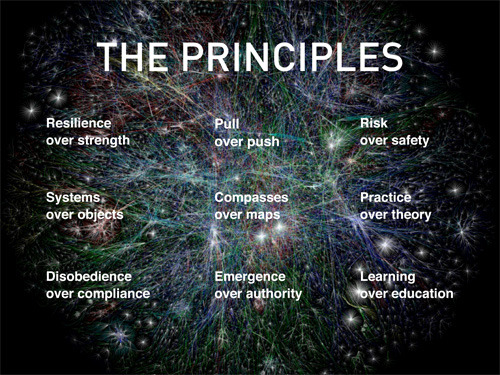
brucesterling: Joi Ito of MIT Media Lab: Ito: There are nine or...
Joi Ito of MIT Media Lab:
Ito: There are nine or so principles to work in a world like this:
1. Resilience instead of strength, which means you want to yield and allow failure and you bounce back instead of trying to resist failure.
2. You pull instead of push. That means you pull the resources from the network as you need them, as opposed to centrally stocking them and controlling them.
3. You want to take risk instead of focusing on safety.
4. You want to focus on the system instead of objects.
5. You want to have good compasses not maps.
6. You want to work on practice instead of theory. Because sometimes you don’t know why it works, but what is important is that it is working, not that you have some theory around it.
7. It’s disobedience instead of compliance. You don’t get a Nobel Prize for doing what you are told. Too much of school is about obedience, we should really be celebrating disobedience.
8. It’s the crowd instead of experts.
9. It’s a focus on learning instead of education.
We’re still working on it, but that is where our thinking is headed.
Balslev and -1 others like this
11 Mar 16:13
National Geographic's new photo Tumblr
by Jason Kottke
Claus.dahlhvad er oddsene? billedet er fra da DK
National Geographic has launched a new Tumblr site that features the less-celebrated-but-still-awesome parts of its vast photographic archive. I want this car:

(via the verge)
Tags: National Geographic photography weblogs
Sassafras.vetter likes this
10 Mar 08:24
A Day in the Life of a Digital Editor, 2013 - Alexis C. Madrigal - The Atlantic
by clausd
Claus.dahlAlt er singles. Ingen køber albums/magasiner/containere online. Alt der er langt an på at containere merværdier singles er doomed-to-fail. En idé der forsimplede singlekøb ku skabe omsætning.
Most sites -- save the NYT, Drudge, and a handful of others -- can't send massive amounts of readers to stories. Traffic causality runs the other way: Individual stories live or die out there in the social world and that brings readers to theatlantic.com. A post has to succeed on its own, although a bigger brand, with more social tools and bigger homepage treatment can give it what I call "activation energy," the necessary but not sufficient first push into the web.
09 Mar 12:28

Not Silent: An Hour of Female Producers’ Music, Mixed by Electric Indigo
by Peter Kirn
Claus.dahlTotalt seje fotos i toppen af denne post

Let’s not leave this discussion on the 100th International Women’s Day with only words. One commenter noted that they had no female producers in their library. Now that means your library is almost certainly missing some important music. From Electric Indigo, founder of femalepressure (whose report was in today’s story), comes a mix of a selection of some of my own favorite producers, people who inspire me personally in electronic music. Your list would no doubt differ, but – well, I like her tastes.
There are many complex windows into questions of gender, identity, and politics as relate to musical expression, to electronic musical interface design and what they’ve meant culturally and socio-politically.
Here’s something much simpler: anyone who says women aren’t electronic music producers is mainly just wrong.
And that means if you do live in a world in which, depressingly, all producers look the same (whatever that means to you, or whatever you’ve been told), you don’t have to live there. I would hope that we can all see ourselves in a world where, as musicians, we can look like and be whomever we want, making whatever kind of music we want. I can’t imagine anyone not needing that on some personal level in the arts.
More Electric Indigo goodness – from experimental electronic music and composition to dark, pulsing alien percussion planets – and I’d be happy to declare it International Artists With Names Involving Colors in the Blue Spectrum Day just to queue it up. Below, Chiffres, a composition “for computer, 5 discrete channels, 21 languages in 36 dialects”:
…and her POMCAST, for more of her selection talents (and a nice way to have some delicious darkness in your sounds on this Friday evening):
Tracklist for the all-female playlist at top (including women remixing male artists – a reminder of how much richer we are for having more producers involved in music, whoever they may be):
01. Chra – Land(of)Mine – female:pressure open:sounds
02. Cio D’Or – Brokat – Prologue
03. Electric Indigo & Irradiation – Phytoplankton (Rossella Remix) – TEMP~Records
04. Chra – Dark Animals – female:pressure open:sounds
05. Mia Grobelny – Dreams Come True – Sub Static
06. Plastikman – Ask Yourself (Irradiation Remix) – @burnstudios
07. Cio D’Or – Pailletten (Version) – Prologue
08. Pointdot – Indigo – Blaq
09. Margaret Dygas – Only Painted – HarryKleinNetworks
10. Aline Raphael – Lilomom – Catenaccio
11. Cio D’Or – Kimono (Mavi Remix) – female:pressure open:sounds
12. Jenn – Sanssouci – KarateKlub
13. Clara Moto – Darkling – female:pressure open:sounds
14. Melon – Spring (Innersphere AKA Shinedoe Remix) – Ratio? Music
15. Steffi feat. Virginia – Yours – OstgutTon
16. Maus – Dancing On You – Soundbeat
17. Kate Simko – Down Beat – Spectral Sounds
18. ZoëXenia – Cherish – Connaisseur
19. Stefny – Shebeen – Contexterrior
20. Steffi – Hidden Track – OstgutTon
21. Violett – B.A. Spring Smells Like You – HarryKleinNetworks
22. Shinedoe – Amsterdam Meets Berlin – Podium
23. Larissa Kapp – You – Tjumy
24. Xyramat – Korruption – Xyramat
25. Margaret Noble – Nufon – female:pressure open:sounds
26. Ada – Forty Winks – IRR
27. Xyramat – Fragen – female:pressure open:sounds
28. Daniela Stickroth – The Slot – Lineal
29. Electric Indigo – Angara – indigo:inc
30. Magda – Dr. Secret Tooth – Beatport
31. Camea – Moan – HarryKleinNetworks
32. Pointdot – Order Slowder – Blaq
33. Irradiation – Contraction – TEMP~Records
34. Water Lilly – Turbulent Tune – female:pressure open:sounds
35. Bloody Mary – Moesta Et Errabunda – Contexterrior
36. Xyramat – Korruption II – Xyramat
37. Chloé – Be Kind To Me – Kill The DJ
38. Cio D’Or – Mystic – Prologue
Here’s female:pressure touring Japan, in a 2009 documentary:
09 Mar 11:58


Journalism and digital journalism
by Bruce Sterling
*Whatever happens to musicians will happen to everybody.
*If you drop by the blog here, someday, and there’s a 404 hole with crickets chirping, it will be all about something mentioned in this article.
09 Mar 11:57
Mac Mini Upgrade
Claus.dahlThere are indeed many caveats, but "it largely works"
Five years ago today, I bought a mac mini to do book development. On Wednesday, I bought a new mac mini simply because I’m told that Mountain Lion won’t install on a vintage 2008 mac mini, and because my readers have had problems on Mac OS X 10.8.
Overall, I have continued to be unimpressed, and can’t help but wonder why my open source friends seem attracted to this system. Even after downloading Xcode command line utilities, I kept encountering messages like “can’t find C compiler” and “C compiler cannot create executables”. Configure is something I haven’t run (at least not directly) for years, and my primary operating system is Ubuntu.
Apache no longer is something you can launch from the settings. System Ruby is still at 1.8.7. You need to upgrade openssl simply to install Ruby 2.0.
That being said, I’m impressed by the folks behind RVM and RailsInstaller who are doing their darnest to make this something that people don’t need to concern themselves with.
09 Mar 11:55

Created at the Tangible Media Group at the MIT in collaboration with Sony Corporation, exTouch creates Spatially-Aware Embodied Manipulation of Actuated Objects Mediated by Augmented Reality. In other words exTouch is an interface system that allows you to manipulate actuated objects in space using augmented [...]
exTouch – Manipulation of actuated objects by Augmented Reality
by Filip Visnjic
Claus.dahlAh - det var da endelig en interessant måde at bruge AR overlays på. Endnu sejere hvis man ender med at det ikke er et overlay, men et substitueret virtuelt objekt. Hvilket minder mig om: Har nogen lavet en mustachifyer som AR? Altså http://mustache.me/ gennem iphonens kamera?
Created at the Tangible Media Group at the MIT in collaboration with Sony Corporation, exTouch creates Spatially-Aware Embodied Manipulation of Actuated Objects Mediated by Augmented Reality. In other words exTouch is an interface system that allows you to manipulate actuated objects in space using augmented [...]
09 Mar 11:53
"… a disquieting and mostly unexamined question. To what degree is the ubiquity of state..."
Claus.dahlTo a very large degree
“… a disquieting and mostly unexamined question. To what degree is the ubiquity of state surveillance a form of intimidation, a way to keep people away from social movements or from directly communicating their views? Do you hesitate before liking WikiLeaks on Facebook?”
- Cypherpunk rising: WikiLeaks, encryption, and the coming surveillance dystopia | The Verge
- Cypherpunk rising: WikiLeaks, encryption, and the coming surveillance dystopia | The Verge
09 Mar 11:41
Punk Rock Is Bullshit
by Klint Finley
Claus.dahlJames Murphy has just the right answer to this one: Everything turns to shit when it becomes a "scene" http://www.classy.dk/log/archive/002127.html
At first I wondered how this article could possibly be relevant to anyone but a youngster still discovering punk for the first time. But, although there are bits I disagree with and the snarky tone is of reminiscent of exactly what the writer is preaching against, I think it’s worth a read because of how the ideology of punk has influenced other stuff. Anarchism, activist culture, the industrial scene, indie rock and, to a certain extent, the occulture and psychonaut communties. It can be seen as the roots of modern hipsterism. Arguably, it started earlier, with the beats, or with Dada, or with something else. But that’s a conversation for another day.
John Roderick writes:
What I’m talking about is “punk rock” as a political stance, punk rock as a social movement, punk rock as a fashion trend, punk rock as a personal lifestyle brand, and punk rock as a lens of critical appraisal. The shadow of punk rock has eclipsed countless new dawns under its fundamental negativity and its lazy equation of rejection with action.
What started out as teenage piss-taking at baby-boomer onanism quickly morphed into a humorless doctrine characterized by acute self-consciousness and boring conformism. We internalized its laundry list of pseudo-values—anti-establishmentarianism, anti-capitalism, libertarianism, anti-intellectualism, and self-abnegation disguised as humility—until we became merciless captors of our own lightheartedness, prisoners in a Panopticon who no longer needed a fence. After almost four decades of gorging on punk fashion, music, art, and attitude, we still grant it permanent “outsider” status. Its tired tropes and worn-out clichés are still celebrated as edgy and anti-authoritarian, above reproach and beyond criticism. Punk-rock culture is the ultimate slow-acting venom, dulling our expectations by narrowing the aperture of “cool” and neutering our taste by sneering at new flavors until every expression of actual individualism is corralled and expunged in favor of group-think conformity. [...]
The truth is, if there really was an Illuminati bent on controlling the world through a secret government, they couldn’t have done a better job of defanging the youth movement than by introducing the self-negating, life-consuming, ignorance-propagating, lethargy-celebrating, divisive and controlling, fashion-based ideology of punk rock into the mainstream. It was basically the crack epidemic of rock culture.
Full Story: Seattle Times: Punk Rock Is Bullshit
(via Joshua Ellis)
It might be worth comparing punk with the hacker ethos, which for the most part embraced making money and building useful tools, but whose impact on the world is also debatable.
08 Mar 22:14
 A quick interview with artist Abelardo Gil-Fournier and film maker Raúl Alaejos who are working on a documentary series dedicated to three programming languages -Processing, Open Frameworks y Pure data- that have increased the role of coding in the practice of artists, designers and creators around the world continue


Hello World! A documentary series on open creative programming languages
by Regine
Claus.dahlto follow
A quick interview with artist Abelardo Gil-Fournier and film maker Raúl Alaejos who are working on a documentary series dedicated to three programming languages -Processing, Open Frameworks y Pure data- that have increased the role of coding in the practice of artists, designers and creators around the world continue
08 Mar 22:13
Valve Economist on EconTalk
by Edward Castronova
Claus.dahlDet Valve gør med at tage virtuelle økonomier helt alvorligt er truly cutting edge. Ingen proxies, ingen aggregater, bare rigtige præcise data
Economist Russ Roberts runs EconTalk, a rather cool series of podcasts on edgy topics in economics. These are the guys who brought you the Keynesian-Monetarist rap debate. What's not to love? Well, they've got a great interview with Valve's economist Yanis Varoufakis.
It's important for non-specialists to be aware that Econ is having problems right now. Different people point to different issues, and they point in different ways forward. From my brief interactions with Dr. Varoufakis, I'm convinced that he's pointing in a good direction and is very much worth listening to. Perhaps the most exciting thing about him is his career choice. At Valve, he can do economic science however he wishes. I can almost guarantee that good stuff will result.
Now, how to get Valve to tell the rest of us about it....?