Claus.dahl
Shared posts
Beyond the Rubik's Cube: inside the competitive world of speedcubing
Forty years after the Rubik's Cube was invented, competitors from around the globe still gather to solve the puzzle
On a low stage, a young man examined a Rubiks Cube. Around him, an audience stood, precariously, on tables and chairs, or peered down from skyboxes. In one fluid motion, he activated a timer on the table before him and his fingers disappeared in a blur of activity. When he set the puzzle down and stopped the timer, just seconds later, the audience erupted, nearly drowning out the announcer: "Feliks with a 7.95!"
Feliks Zemdegs had been here before. In 2011, when he was 15 years old, he traveled to Bangkok from his native Melbourne to attend the biennial World Rubiks Cube Championship for the first time. The year before, he had become the first person to solve the puzzle in fewer than 10 seconds on average. As a result, he was something of a celebrity, at least in a certain world. On the online forums where competitive Rubiks Cube solvers congregated, he had been compared to Usain Bolt. In Bangkok, at the Championship, he was asked for autographs and pictures. And, at first, he seemed ready to justify his fame. In the early heats, he blew past the field. But, in the finals, his nerves betrayed him.
Continue reading...13apr2014
The Heartbleed bug allows anyone on the Internet to read the memory of the systems protected by the vulnerable versions of the OpenSSL software. This compromises the secret keys used to identify the service providers and to encrypt the traffic, the names and passwords of the users and the actual content.
Thinking for Programmers, by Leslie Lamport. Recommended.
Seven mutually touching infinite cylinders, by Sándor Bozóki, Tsung-Lin Lee, and Lajos Rónyai. “We confirm a conjecture of Littlewood.”
Hacking Blind (PDF), by Andrea Bittau, Adam Belay, Ali Mashtizadeh, David Mazières, and Dan Boneh. “We show that it is possible to write remote stack buffer overflow exploits without possessing a copy of the target binary or source code, against services that restart after a crash.” Impressive.
Open Access Maps at NYPL, “The Lionel Pincus & Princess Firyal Map Division is very proud to announce the release of more than 20,000 cartographic works as high resolution downloads. We believe these maps have no known US copyright restrictions.”
A Research UNIX Reader (1987) at archive.org.
Inlined records in constructors for Ocaml, proposed by Alain Frisch. Yes, please!
Fotographie mit DRAM als optischem Sensor
SPIN’s 1994 Kurt Cobain Eulogy
RFC 7169: The NSA (No Secrecy Afforded) Certificate Extension
total-queer-move: LOOK. IT’S EVERY SINGLE STEREOTYPE ABOUT...



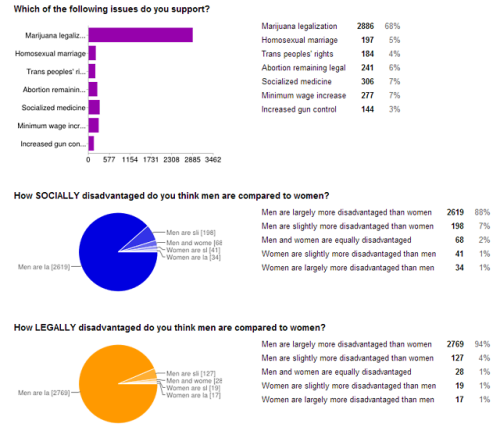
LOOK. IT’S EVERY SINGLE STEREOTYPE ABOUT MEN’S RIGHTS ACTIVISTS PUT INTO ONE HANDY-DANDY DEMOGRAPHICS SURVEY SO IT CAN BE STATISTICALLY VALIDATED!! [x]
THANKS R/MENSRIGHTS!!
This data was reportedly poisoned by a spambot. No reports yet on what the results looked like before it was vandalized.
Four short links: 14 April 2014
- dategrep — print lines matching ranges of dates. Genius!
- Business Case Guidance in Agile Projects (gov.uk) — how the UK govt signs off on Agile projects, which normally governments have no clue over how to handle properly.
- Hyper Growth Done Right — “While I was at Oracle, it took a month before a new engineer would get any code in,” Agarwal says. “It sent this implicit message that it’s okay to take a month to write some code.” First time I’d heard this wise point articulated: slow feedback loops send the message that progress can be slow.
- Docker + Github + Jenkins — clever integration of the three tools to get repeatable continuous integration. The modern dev environment has workflow built on git, VMs, and glue.
What can we do to prevent the next Heartbleed?

Heartbleed is a lesson in ambiguity. The bug has been described as a disaster, but there’s no proof that it was used to collect information. Bloomberg reported that the National Security Agency took advantage of the bug, but the NSA denied that it exploited the vulnerability. The White House said that it has instructed intelligence agencies to fix security problems, but the New York Times reported that Obama has given the NSA some leeway in that goal. Heartbleed is either a pinprick, an arterial tear, or complete cardiac arrest – but we don’t yet know which.
We do know that Heartbleed represents a fundamental problem with Internet infrastructure. The bug was caused by a coding error that its author described as “quite trivial” despite the effect it had on Internet security. The volunteers who checked his work failed to spot the bug, and so it was introduced into a security tool used by roughly two-thirds of the Internet. No-one else bothered to check for a vulnerability because — fittingly enough — many open source tools are considered more secure than their proprietary counterparts because anyone can edit them.
Consider it the digital version of the bystander effect, whereby an entire crowd will ignore a cry for help because everyone assumes that someone else will take care of the problem. The effect becomes more pronounced as the number of people witnessing the problem grows. This is like that, except it threatens the foundation of online security, and the crowd is so massive that it’s amazing that anyone even bothered to look for the Heartbleed bug in the first place.
The OpenSSL Software Foundation is a group of “someone elses” looking to fix the problems that all of the “someones” relying on OpenSSL can’t be bothered to fix themselves. But the foundation is unable to employ anyone full-time, which means that its members are working on a critical aspect of online security in their spare time, or without reward commensurate to their work’s importance. Steve Marquess, the foundation’s president, wants to change that.
Marquess wrote in a blog post published over the weekend that the foundation often turns away the contract work that allows it to focus on OpenSSL itself because its members are too busy doing other work so they can support themselves and their families. Donations help keep the foundation running, but until they outpace the value derived from those contracts, it will be in a fairly dire financial situation. So he asked that large companies and governments keep the foundation’s metaphorical lights on and allow its members to focus on OpenSSL full-time:
There should be at least a half dozen full time OpenSSL team members, not just one, able to concentrate on the care and feeding of OpenSSL without having to hustle commercial work. If you’re a corporate or government decision maker in a position to do something about it, give it some thought. Please. I’m getting old and weary and I’d like to retire someday.
It’s time for Internet security to be handled by people who can afford to devote their entire lives to it, not people who in their spare time are forced to carry “an enormous burden” that affects basically anyone who uses the Internet. We wouldn’t force the doctors charged with handling real heart attacks to operate on donations or in their spare time — why delegate the task of preserving the health of the Internet to people asked to work that way?
Reactions from around the Web
Quartz explains why it took two years to discover a problem in open-source code:
Why did it take until last week to discover, and why did the means of the search only exist four months ago? The answer lies in in how the basic infrastructure of the internet is governed by its users—or not.
This software ‘is as close to a public good that you have,’ [CloudFlare CEO Matthew] Prince says. It’s open-source code managed by a foundation. While that has plenty of advantages, it also means the software is comparatively under-invested in by experts in the field and not as efficiently maintained—Prince describes it as a ‘spaghetti nest of code.’ It received less than $1 million in income from donations and consulting work last year.
The Washington Post points out that this problem is common to many open-source tools:
Open-source advocates often claim that their work, as opposed to software produced by private companies such as Microsoft, has fewer problems, because of the inherent transparency of the process. The belief is captured in a saying popular among the community: ‘Given enough eyeballs, all bugs are shallow’ — meaning flaws are not terribly serious and are quickly fixed.
But security experts have warned for years that open-source software can harbor serious problems because the volunteers and nonprofit groups that often create them lack the time and expertise to continually update their work, especially as hackers become more prevalent and sophisticated. While some open-source projects, such as the Ubuntu operating system or the Firefox browser, have foundations supporting them, many others do not. Some private companies also produce open-source software.
Pando weighs in
I wrote about the shaky idea that the Internet can ever truly be secure after the bug was revealed:
The bug is said to have been around since 2012. The sheer number of websites that use OpenSSL — including Yahoo, Imgur, and OKCupid — means that many millions of Internet users may have potentially had their privacy compromised over the last two years. Combine that with the news that Apple had failed to implement a security tool in its mobile and desktop operating systems for more than a year and the idea that anyone can ever be truly secure online seems permanently out of reach.
I then wrote about why being able to change your passwords is a good thing:
The good news is that passwords for services like Facebook and Gmail can be changed. It would be much harder to protect against compromised biometric security measures — what are you gonna do, burn your finger tips and tattoo some new patterns onto them?
Having to change all of your passwords sucks. Not being able to adapt to compromises in the security measures that protect all of your personal information, however, would be even worse.
Then I wrote about how small mistakes can have enormous consequences on the modern Web:
Finding these errors would be like finding a typo in “Infinite Jest” – it’s not going to be easy unless you know just what you’re looking for.
But the ramifications of these mistakes aren’t quite so minuscule. Hundreds of millions of people rely on Apple’s products to browse the Web. Even more interact with a large number of websites that use OpenSSL. It’s impossible to know how many people have been affected by these mistakes, but the threat itself has been enough to put security experts on high alert.
That’s the truth of Internet security. All it takes is for a team of professionals to miss two words, or for two unpaid volunteers to miss a “quite trivial” mistake in a widely-used utility, for the privacy of essentially everyone who uses the Internet to be threatened. Welcome to the Web, where a single misplaced strand can cause a disaster few will notice until years later.
I then wrote about how the bug was able to attract attention from, well, everyone:
Heartbleed has a dire name. Its branding is better than most of the startup logos we’ve seen in the last few years. Those two things have no doubt contributed to its ability to make sure that everyone, from renowned security professionals and the Department of Homeland Security to the Canada Revenue Agency and tech bloggers, is paying attention to this critical flaw. And, perhaps more importantly, paying attention to the structural problems that allowed it to exist.
[Image via Thinkstock]
Nathaniel Mott


Now even Facebook wants to become a payments company
Claus.dahlDet troede jeg da de havde været hele tiden?

Facebook is getting into the money business. The Financial Times reports that the company is in talks with Irish regulators and three European startups to create a service that would “allow its users to store money on Facebook and use it to pay and exchange money with others.”
The news comes as other companies, such as Amazon and Google, increase their own interest in payments platforms. Amazon CEO Jeff Bezos has “identified payments as one of the top areas of focus and investment for Amazon” and reportedly told the company’s payment team to work faster. Google has been developing new payments tools, including one that allows Gmail users to send money with an email, and continues to increase its focus on the sector.
It seems that payments will become yet another battle ground on which the four largest tech companies — Apple, Google, Facebook, and Amazon — will wage their great war for consumer interest. These companies already compete with hardware, digital marketplaces, and digital platforms that control the way people interact with the Web. Now they’re looking to manage the payments, and presumably all of the attention and information they entail, as well.
It’s unclear how Facebook’s payments platform would work. Google’s efforts are interesting because it’s using its vast infrastructure to facilitate payments; Facebook would have to do something similar to stand out in a swath of startups focused on making it easier to spend and transfer funds. And, as the Financial Times notes, Facebook’s users might hesitate before they trust the social network with their cash. Facebook already knows what you listen to, read, watch, say, don’t say, and more. Adding your purchase history to the mix might be a bit much.
But some believe that introducing payments tools can actually increase trust in a company. Gartner analyst Brian Blau told me ahead of Twitter’s IPO last year that one of the company’s major failings is that it doesn’t have any financial transactions with its users. “When you cross a line of accepting or facilitating payments, you really start to take on a different perception in the consumer’s mind,” he said. “If you give a company your credit card information or allow them to handle your money, all of a sudden you put a trust in them you didn’t have before.”
Reactions from around the Web
The Next Web thinks that a Facebook payments platform would be aimed at developing countries:
E-money and remittances would help Facebook be more relevant in emerging markets and build up its momentum to push into these markets. Last week, for example, Facebook passed 100 million users in India. Already, Chinese Internet giants including Alibaba and Tencent have rolled out mobile payment initiatives as they seek to tap on e-commerce by replacing traditional payment methods to ease the friction of paying without bank-issued credit cards.
Re/code notes that, much to its reporters’ surprise, Amazon offers a peer-to-peer payments product:
As for another hot category, peer-to-peer money transfers, many people would be surprised to learn that Amazon already offers a peer-to-peer payment feature similar to PayPal’s. I know I was.
‘It’s not a significant part of the business,’ Taylor said, ‘and we haven’t really promoted it.’
Why is that? I asked.
‘We’re not sure we’re doing anything better than anyone else,’ he said plainly. If and when we think that has changed, he said, ‘we’ll emphasize it.’
Quartz writes that Google’s new payments features could help it become more popular:
Think of how SMS-based money transfers allowed mobile payments to spread quickly in the developing world. Gmail is, in a sense, the SMS of developed economies.
Google can also help solve another point of friction with mobile payments, which is that both sides of the transaction need to have accounts with the service handling the money. The same is true for Google Wallet transfers, even over email, but having a Google account is way more common than having an account with, say, Venmo or PayPal. Google may be the closest thing the world has to a universal bank.
Pando weighs in
Carmel DeAmicis notes that payment tools have become so popular in recent years because people are sick and tired of PayPal:
PayPal has pissed off enough companies and consumers with its poor customer service and erroneous fraud detection system that it opened a space in online payments that Braintree and Stripe have been racing to fill. Developers love Stripe because it makes it easier for them to split up payments between different parties (helpful for sharing apps like Lyft where drivers and the startup both get a cut). Braintree is trying to compete and rolled out its Marketplace product that does payment splitting in August.
Braintree has nailed the consumer side of the equation by making it easy to pay for something on your phone without needing to enter credit card information. Simplicity of transaction is key in mobile, and mobile may be the gate keeper for winning in the online payment processing space. If so, competitor Stripe has been criticized for being late to the mobile game.
But she and Michael Carney think that PayPal’s acquisition of Braintree might have actually helped the latter company’s reputation:
A key element of the PayPal-Braintree acquisition was the decision to have the two companies operate independently, only sharing loosely-described “resources” and perhaps a mutual halo-effect. That gave Braintree, which was already leading in payments 2.0, a huge boost in terms of credibility without weighing it down in bureaucracy and institutional memory of the older PayPal. PayPal, on the other hand, gained access to the type of next-gen payments platform and innovative culture that it had failed to build over the preceding decade.
Furthermore, the deal gave Braintree the backing of the eBay brand, a mark of credibility for big enterprises considering which online or mobile payments provider to adopt. People liked Braintree before, a feeling that will likely only grow with the addition of thousands more engineers and access to PayPal’s relationships in 190 countries. That’s a lot more meaningful than the prospect of betting on a startup that has won the hearts and minds of early stage companies in Silicon Valley.
Sarah Lacy reported on PayPal CEO David Marcus’ efforts to fix the company’s problems:
There was no quick fix to what was ailing PayPal. Nothing that can be boiled down to a press release. An acqui-hire wasn’t going to do it. A new product wouldn’t fix it. Nor would a splashy new ad campaign, free food, iPhones or UP bracelets for the team. He had to deeply change the culture. “It’s the hardest thing I’ve ever done in my career,” he says.
But once he did it, he saw that it could be done. And if they could change that, Jesus, the assets of PayPal were unlike anything anyone else possessed.
Nearly 18 months in, there are signs to Marcus that it’s working.
[Image via Thinkstock]
Nathaniel Mott


Amazon's drug dealer scale

If you buy this digital scale on Amazon, the site assumes you might be a drug dealer. Nestled among the calibration weights listed in the Customers Who Bought This Item Also Bought section are tobacco pipe screens, rolling papers, powders for cutting drugs (I assume), zipper bags of all sizes (including some decorated with golden skulls), empty pill capsules, and even a Dr Pepper can safe.
See also the mega-packs of whipped cream chargers which are frequently purchased with balloons for the purpose of getting high. (via mr)
Tags: Amazon drugsHeartbleed Suspicion And NSA Denial Show Why NSA's Dual Offense/Defensive Role Must End
However, the claim late last week that the NSA knew about and exploited Heartbleed, followed by the quick denial by the NSA, really puts an exclamation point on how untenable this dual role is for the NSA. It's difficult to take the NSA seriously given the competing interests within it. Add to this, President Obama basically giving his broad approval for the NSA to exploit security flaws it finds, and you have a very dangerous setup for your average internet user. The NSA, despite its job, will have little interest in actually protecting internet users.
Julian Sanchez summarizes the issue nicely by pointing out that the two roles are simply incompatible:
But the denial itself serves as a reminder that NSA's two fundamental missions – one defensive, one offensive – are fundamentally incompatible, and that they can't both be handled credibly by the same government agency.The NSA's history of being less than forthright in the past, as well as many of the Snowden revelations, combined with its dual role, simply means that most people won't believe the NSA's denial about Heartbleed, even if it was much more strongly worded than earlier denials. If the NSA's role, however, were made much clearer, such that it was only focused on protecting systems, without the offensive elements, then it would be both a lot more believable, and a lot more trustworthy. However, the very fact that the administration (and the NSA) appear to have little interest in moving in this direction says a lot about how much they really prioritize protecting our computer systems.
Permalink | Comments | Email This Story

T-Mobile: No more overage charges even on older voice and data plans
Claus.dahlKlar til eurozonens lovgivning
Starting in May T-Mobile plans to get rid of all overage charges on all of its customer bills, pushing a new marketing strategy that claims consumers should be charged only for the services they sign up for, not the extra minutes, texts or megabytes that accrue before the end of a billing cycle.
The announcement is in part a publicity stunt, as T-Mobile already eliminated automatic overage fees more than a year ago when it launched its Simple Choice plans. Displaying his characteristic bombast, T-Mobile CEO John Legere today launched a Change.org petition calling for all U.S. carriers to end overages. But there definitely is substance to this new policy change if you’re an older customer who never signed up for a Simple Choice plan.

T-Mobile CEO John Legere kicking off the iPhone and T-Mobile’s Un-carrier strategy last year
T-Mobile is essentially turning all of its older grandfathered plans into Simple Choice plans. If you currently subscribe to a bucket of minutes or text messages, you’ll find your plan now offers unlimited voice and SMS. And if you’re still on one of T-Mobile’s old hard-capped data plans, your monthly data allotment will turn into a soft cap. That means instead of incurring data overage charges after you hit your cap, you’ll still be able to surf at no additional cost, just at throttled-back 2G speeds.
Legere is railing against overage fees as the new face of carrier evil, but there are trade-offs if you embrace T-Mobile’s no-overage model. If your primary concern is having absolute control over your monthly bill, then T-Mobile’s plans make a lot of sense. You’ll never get an additional domestic data charge unless you specifically authorize T-Mobile to make it. But it also means that you could be stuck with pokey 2G data access for a week or more if you use up your cap mid-billing cycle (in the case of its new Simple Starter plan, you’d lose mobile internet connectivity completely).
That said, Verizon and AT&T are still charging pretty punitive rates if you go over your cap, especially if you’re on a smaller data plan. For instance Verizon will charge you as much as $15 for an additional 200 MBs on its entry-level data plan, and AT&T will charge you $20 for an additional 300 MB of its baseline plan. It’s a lot cheaper to simply upgrade your plan if you’re regularly going over your cap, which is exactly what AT&T and Verizon are trying to get you to do with their overage policies.
Overages aren’t inherently bad as Legere is claiming, but the way they’re structured today is hardly consumer friendly. What we need in the U.S. mobile industry is an overage pricing structure that gives consumers leeway to occasionally go over their cap or pay for data in metered fashion. Instead we have overage fees that hold many consumers’ feet to the fire every time they stream one too many videos.

Related research and analysis from Gigaom Research:
Subscriber content. Sign up for a free trial.
Bartering with the devil: Netflix’s partnership with Comcast has really paid off

Comcast jumped six spots in Netflix’s monthly ranking of Internet Service Providers following an controversial interconnection deal that lets Netflix better connect to Comcast’s infrastructure.
Netflix’s rankings are based on the peak performance of its streaming video service. It claims that 44 million people watch more than 1 billion hours of video each month, so its rankings are often considered more accurate for real-world usage than the numbers ISPs advertise. But now it seems that consumers will have to check to see if Netflix has partnerships with the ISPs it’s supposed to be objectively measuring, if a deal can make an ISP jump six spots in one month.
The increase shows exactly how worthwhile the Comcast deal was to Netflix. Its videos must have been delivered substantially quicker than they were before the deal — otherwise the race between ISPs is little more than a charade and Netflix compromised the Internet for nothing.
And make no mistake: this deal has compromised the Internet. It has shown companies like Comcast that they can charge large tech companies for priority service and get away with it. If those companies are anything like Netflix, they will then trumpet the increase in speed, which will make it harder for other companies to avoid making such deals. (Apple is already said to be in talks with Comcast over a deal to ensure speedy delivery of videos through its service.)
Those episodes of “Freaks and Geeks” aren’t going to stream themselves, and if Netflix has to make a deal with the devil to get them to your television set, it will. Then, as an added bonus, it will publish new rankings cheerleading the speed bump without disclosing the deal to consumers who don’t spend their time obsessing about the Internet’s future. It’s a win-win.
Except for the Internet, consumers, and small companies that can’t afford to operate in the new paradigm. They’re getting screwed. But hey! At least your Netflix videos will load quicker.
Pando weighs in
David Holmes wrote about the dangers the Comcast-Netflix deal poses to independent entrepreneurs and small companies when it was first announced earlier this year:
The Internet has historically been a place where anyone could post content or offer services to the same global audience, regardless of whether you’re a kid from Arkansas or a multi-national corporation. But it’s becoming more like cable TV where content providers have to bring loads to cash to the table before companies like Time Warner and Cablevision will bring that content to millions of eyeballs.
That could leave small-time players like [VoteRockIt founder Matt] Hudson stuck on the Internet equivalent of grainy, limited-audience public access TV.
I wrote about the reported Comcast-Apple deal when it was announced:
Contrary to the narrative crafted by net neutrality activists, Comcast isn’t dabbling in back room deals that subtly undermine the idea of a free Internet where all data is treated equally. It’s created a system through which it is able to convince even net neutrality supporters like Netflix CEO Reed Hastings to pay for improved performance, to get Apple to pay for the ability to reach consumers at a decent speed, to become even larger in the ISP market, and to make donations to the lawmakers tasked with keeping it in check.
But let’s go ahead and focus on the news that Apple is developing a streaming media service through which it could tighten its grip on the digital media market and, because this is Apple we’re talking about, keep rumors of an aluminum-clad television set alive. Surely that’s more important than the systematic destruction of the ideals on which the technologies that would enable that service were founded. Gotta watch those “Breaking Bad” reruns, after all.
I then wrote about the FCC’s unwillingness to defend the free Internet after Wheeler said that deals like that aren’t covered by existing net neutrality laws:
Splitting issues that could affect the foundation of the Internet and allowing companies like Comcast to hamstring the greatest technological innovation in human history — or at least the innovation just behind man-made fire and wine — because the FCC wants to focus on semantics is insane. The Internet isn’t just the series of tubes connecting Comcast’s infrastructure to our homes: it’s the whole damned thing, from the servers operated by companies like Netflix all the way down to the cables in our homes.
Comcast might not be violating net neutrality laws, but it’s certainly violating the spirit behind them. It’s about time the FCC did something about that.
Then I wrote about the European Union’s attempts to defend the free Internet:
The legislation is meant to provide access to online services ‘without discrimination, restriction or interference, independent of the sender, receiver, type, content, device, service or application.’ For example, ISPs would be barred from slowing down or ‘throttling’ the speed at which one service’s videos are delivered while allowing other services to stream at normal rates. To bastardize Gertrude Stein: a byte is a byte is a byte.
Such restrictions would prevent deals like the one Comcast recently made with Netflix, which will allow the service’s videos to reach consumers faster than before. Comcast is also said to be in talks with Apple for a deal that would allow videos from its new streaming video service to reach consumers faster than videos from competitors. The Federal Communications Commission’s net neutrality laws don’t apply to those deals, according to FCC Chairman Tom Wheeler, so they are allowed to continue despite the threat they pose to the free Internet.
And then I wrote about Comcast’s argument supporting its Time Warner Cable merger:
Comcast’s arguments are about what you would expect: the merger will supposedly benefit consumers, it will allow Time Warner Cable to update its infrastructure, and it will offer more options to consumers as wireless broadband starts to spread. What Comcast doesn’t mention is that the merger would make it even more entrenched in the United States’ Internet infrastructure and allow it to continue making deals that threaten both consumers and entrepreneurs, all while making even more money off Internet connections that lag behind much of the developed world.
Its efforts will be assisted by its vast contributions to the regulatory bodies overseeing the deal, the monopolies and duopolies that it has helped create in most markets, and its willingness to threaten the very foundation of the free Internet by striking preferential deals with companies like Netflix. The company has spent the last few decades trying to figure out how it can fuck the Internet — this merger will determine just how rapacious it will be allowed to become.
Nathaniel Mott


Google acquires drone startup Titan Aerospace
Google said today that it will purchase Titan Aerospace, a drone startup that could support the company’s efforts to provide drone-supported internet and electricity. A price has not yet been disclosed.
“Titan Aerospace and Google share a profound optimism about the potential for technology to improve the world,” a Google spokesperson said. “It’s still early days, but atmospheric satellites could help bring internet access to millions of people, and help solve other problems, including disaster relief and environmental damage like deforestation.”
Titan builds large drones that rely on solar power to stay in flight for years. Depending on the model, they can carry hundreds of pounds of equipment to carry out applications like mapping, tracking and communication. The Wall Street Journal, which first reported the acquisition, confirmed that Google will have Titan work closely with Project Loon, which uses high-altitude balloons to provide internet. The startup may also pair with Makani, which affixes wind turbines to tethered drones to generate power.

An example of a drone built by Titan Aerospace. Photo courtesy of Titan Aerospace.
Titan says that the drones can deliver internet at speeds up to 1 gigabit per second. But their mapping and monitoring abilities could also be a useful addition to the company’s mapping initiatives like Google Earth, which provides an aerial map of the planet with images taken by satellites. The drones could make it cheaper and easier to generate images that are refreshed more frequently, opening up possibilities like tracking shipments and even forest fires.
Titan will remain in New Mexico with its current CEO and team of roughly 20 people. It will begin commercial operations in 2015, according to the Wall Street Journal.
Facebook was reportedly eyeing purchasing Titan earlier this year for $60 million. It later acquired Zephyr, which will support Facebook’s competing initiative to bring internet connectivity to remote areas of the world.

Related research and analysis from Gigaom Research:
Subscriber content. Sign up for a free trial.
3D Hubs: The 3D printer next door

The idea behind 3D Hubs is simple. Give consumers access to a global network of individually run 3D printers to which they can easily send designs. The printers set their own price, listing themselves by resolution and material. 3D Hubs takes 15 percent of each transaction.
Bram de Zwart and Brian Garret worked for industry giant 3D Systems for four years before they left to set up 3D Hubs in Amsterdam last year. In the 14 months that have passed since, 3D Hubs have developed a network of 3,800 printers spread across 80 countries. They’re not trifling numbers given, as de Zwart says, there are only 200,000 3D printers in the world today.
The traction 3D Hubs has comes from it being able to align the benefits of 3D printing while negating some of the drag in the market.
“We believe the power of 3D printing is in localizing manufacturing. But that wasn’t happening. All the major service providers were shipping from one location,” de Zwart says.
For instance: I don’t have access to a 3D printer, but through 3D Hubs I can send a design out to a printer within a minute or two. I’m at my desk on Market Street in San Francisco. I enter my address into 3D Hubs and it points me in the direction of a 3D Printer a short walk from me on the corner of 6th and Folsom.
de Zwart says that most of the transactions that go through 3D Hubs are done so locally that the customer picks them up in person. It brings the customer into close contact with the 3D printer, driving awareness and developing the market. “The people see the printer brands and they’re satisfied and maybe they go buy the printer. Also, they talk to the printer owners, many of who have already earned back their printer purchase,” de Zwart says.
By networking 3D printers and closing the geographical gap between the point of design and the point of production, 3D Hubs can get the finished product to consumers in two days, which is unprecedented with consumer 3D printing services. The speed of turnaround is a longtime bugbear in 3D printing, but here, not so much.
If the idea continues to gather momentum, it will provide an alternative to the exciting world imagined by some advocates where there’s a 3D printer in every home.
“With 3D printing, there’s a wide range of material and a lot of technology. The chance that there will be one machine that will do everything is very slim,” de Zwart says.
“The bigger picture is that access is more important than ownership. When I look at my generation, they don’t want the ownership.”
Last week, 3D Hubs announced a new partnership with Autodesk, who integrated its API (which allows customers to send their designs to printers) into its free 3D design software apps. It’s a fitting partnership, given that de Zwart’s ideas about the sharing economy fit closely with Autodesk CEO Carl Bass’ own thoughts when I spoke to him recently.
3D Hubs continues to add printers at a solid clip too. Twenty printer manufacturers let 3D Hubs put flyers in their boxes to recruit printers directly. de Zwart says that given how fast 3D printing technology is changing, the best incentive in getting printers to sign up outside of financial gain is encouraging them to make the most of their printer before it becomes obsolete.
Garret thinks that 3D printing is where the Internet was 10 or 15 years ago. “No one could create a page. Now you have microblogs, Twitter, Facebook,” he says. de Zwart concurs. “There’s still a lack of knowledge about how to use a 3D printer,” he adds. 3D Hubs brings the sharing economy to the 3D printing market, but the end result is that it drives adoption.
For a company like 3D Hubs the rate of change is an enthralling if terrifying proposition. The company has made a smart (if niche) beginning in making the best of the opportunity and problems facing 3D printing. But powerful forces are going to hit the market in the coming years. This has been the easy part. 3D Hubs are in for a wild ride.
[image via 3dhubs]
James Robinson


Health experts dismiss homeopathy
There is no evidence that homeopathy works. That is the conclusion of a comprehensive review of the scientific data in a draft report released this week by Australia’s peak medical research body, the National Health and Medical Research Council (NHMRC).
Homeopathy is based on the notion that “like cures like” as promoted by figures such as the 16th century physician Paracelsus. This principle suggests a substance that causes illness in a healthy individual can treat the same symptoms when applied in very small doses to a sick individual.
However, studies have found that homeopathic formulations are often so dilute that they contain no trace of the original active ingredient.
“In some cases homeopathic medicines are unlikely to contain even a single molecule of starting material. This makes homeopathy extremely implausible, and the Australian NHMRC report is the latest in a long line of studies that could find no evidence of efficacy,” said Ian Musgrave from the faculty of medicine at the University of Adelaide.
The NHMRC report concurs with the findings of other evidence-based studies commissioned by governments overseas. In 2010 the UK House of Commons Science and Technology Committee found that homeopathy was based on scientifically implausible principles and homeopathic treatments performed no better than placebos.
The US National Institutes of Health has also found that key concepts in homeopathy are “inconsistent with fundamental concepts of chemistry and physics” and there is little evidence supporting the efficacy of homeopathic remedies.
‘The government should see that homeopathy no longer
penetrates our health care system.’
Yet Australians are estimated to spend around $7.5 million on homeopathy treatments each year, according to the World Health Organization. Some homeopathic therapies are also listed on the Australian Register of Therapeutic goods, and the government currently provides a 30 per cent tax rebate to private health insurers on some non-conventional or “complementary” therapies such as homeopathy.
The NHMRC draft report was welcomed by John Dwyer, emeritus immunologist at the University of New South Wales and president of Friends of Science in Medicine, who says it should encourage the government to cease subsidising homeopathic therapies.
“We’re all worried about legitimate expenditure within the health system, such as trying to find enough dollars for hospitals and primary care, and there’s an awful lot of money wasted on unscientific medicine like homeopathy in this most scientific of all ages,” he said. “The government should be utilising this information from their peak scientific body to help see that homeopathy no longer penetrates our health care system.”
Dwyer was also critical of government funding going to educational institutions that teach homeopathy, and of pharmacists who stock homeopathic remedies despite their role as scientifically trained health professionals.
“Homeopathic preparations should not be available in our pharmacies, no private health insurer should provide any rebate for homeopathy and those few universities that lower our scientific standards by providing credibility for homeopathy in their health courses should cease doing so immediately,” he said.
‘There is insufficient evidence in the form of systematic
reviews to prove homoeopathy’s efficacy.’
While the NHMRC report was welcomed by many in the medical science community, the Australian Homeopathic Association (AHA) questioned what, in its view, were unduly restrictive standards of evidence employed in the report.
“This review has focused exclusively on recent systematic trials,” it said in a press release.
The NHMRC did indeed set the bar high for what would considered evidence for efficacy, stating that “not all evidence has equal value”. It explicitly ruled out anecdote and observational studies “including individual experiences and testimonials, case series and reports”. The AHA made a number of submissions of this type to the enquiry.
The AHA also contrasted the findings of the NHMRC draft report with those from a 2012 Swiss study – which the AHA mistakenly attributes to the Swiss government. This study found homeopathy to be both clinically useful and cost effective using a lower standard of evidence.
However, that study has been criticised as being “scientifically, logically and ethically flawed” in the peer-reviewed journal Swiss Medical Weekly, and the Swiss government has distanced itself from any association with it.
The NHMRC draft paper is open for public comment until 26 May 2014 and will be finalised once all public submissions have been considered.
Tim Dean is a science writer and philosopher based in Sydney.
The post Health experts dismiss homeopathy appeared first on Cosmos Magazine.
How the backpropagation algorithm works
Chapter 2 of my free online book about “Neural Networks and Deep Learning” is now available. The chapter is an in-depth explanation of the backpropagation algorithm. Backpropagation is the workhorse of learning in neural networks, and a key component in modern deep learning systems. Enjoy!
Yes, Net Neutrality Is A Solution To An Existing Problem
There are many concrete examples of network neutrality violations around the world. These network neutrality violations include ISPs blocking websites and applications, ISPs discriminating in favor of some applications and against others, and ISPs charging arbitrary tolls on technology companies.
We have seen network neutrality violations all over the world.
Even in the U.S., there have been some major violations by small and large ISPs. These include:
- The largest ISP, Comcast, secretly interfering with peer-to-peer technologies, including some of the most popular basic technologies used to distribute online TV and music (2005-2008);
- A small telephone ISP called Madison River blocking Vonage, a company providing competing telephone service online (2005);
- Apple blocking Skype on the iPhone, subject to a secret contract with AT&T, a company that competes with Skype in providing telephone service (2008-2009);
- Verizon, AT&T, and T-Mobile blocking the functionality of Google Wallet on Nexus devices, while all three of those ISPs are part of a competing mobile payments joint venture called Isis (late 2011- +today);
- and Comcast's disputes with Level 3 and Netflix over termination fees, and the appearance that Comcast is deliberately congesting its network connections to force Netflix to pay Comcast for an acceptable connection (2010- +today).
In the European Union, widespread violations affect at least 1 in 5 users. That is the conclusion of a report issued in June of 2012 by the Body of European Regulators for Electronic Communications (BEREC), a body composed of the regulatory agencies of each EU country. Most of these restrictions were on online phone services, peer-to-peer technologies (which are used not only by copyright pirates, but also in a variety of well-known technologies, including Skype and several Amazon cloud services), as well as other specific applications "such as gaming, streaming, e-mail or instant messaging service."
ISPs block and discriminate against applications and websites even in countries that require disclosure of the violations and even in countries with far more competition among ISPs than the U.S. A recent Oxford dissertation on the topic explores the wide-scale blocking and discrimination in the United Kingdom, a market with both considerable competition among ISPs and robust disclosure laws.
Essentially, a specific rule that would be upheld in court is necessary protect network neutrality and address a major, global problem.
* Footnote: Thanks to Stanford professor Barbara van Schewick, whose recent letter to the FCC inspired my thinking in this post.
Permalink | Comments | Email This Story

The Indiepocalypse at Webstock 2014
Last February, I was honored to be invited to speak at Webstock in New Zealand, along with Maciej Ceglowski, Erika Hall, Charlie Todd, Clive Thompson, and a bunch of other neat people.
My talk, like New Zealand itself, was a bit of a whirlwind. I roused the hungover crowd on Friday morning with a look back at my childhood on the Sunset Strip and how it shaped my later views on creative and financial independence. The talk's now online, and you can watch it here. I'm pretty happy with how it came out, hope you like it.
On Heartbleed and the NSA
The U.S. National Security Agency knew for at least two years about a flaw in the way that many websites send sensitive information, now dubbed the Heartbleed bug, and regularly used it to gather critical intelligence, two people familiar with the matter said.
It’s a shame that the…
Arsène Wenger: a day in the strife of Arsenal manager's torture chamber
Claus.dahlmon dog
Coming up to the age of 65, sometimes you have to wonder how much you still need this. Midway though what appeared to be an intolerable ordeal of a semi-final, Arsène Wenger looked as if he were being tortured. How much could he possibly withstand?
With an hour gone, his players had wilted. They were sleepwalking into the abyss. They looked emotionally shot, struggling to find any kind of groove, and punished by a penalty as Wigan Athletic's gameplan was plotting out nicely.
Continue reading...
ryanpanos: Grand Facade | Marlon de Azambuja | Via Sometimes,...
Claus.dahlsuperfede






Grand Facade | Marlon de Azambuja | Via
Sometimes, all you need to create some magic is some magic markers. In a new series called Gran Fachada (“Grand Facade” in English), Madrid-based architect and designer Marlon de Azambuja works this marker magic on color photographs of famous museums around the world, from the Whitney to the Pompidou and the Tate Modern. Using a marker to black out sections of these images, he reveals fluorescent color-negative line drawings, which would probably look amazing as velvet black-light posters. Thin outlines of color expose where the contours of an architectural rendering would be, the intricacy of which approaches that of the buildings’ original blueprints.
Mobile made frenemies out of everyone and the internet of things will make it worse
Executives from startups to giants like GM and Progressive are trying to figure out how to connect products, gather data and then turn that data into services that consumers will pay for, or business insights that give them an edge. But that search for insights is leading to a disruption, not just in manufacturing or pricing, but also in how companies work together and perceive their competition.
As connectivity and technology invades more aspects of our lives with the internet of things everyone is trying to become the platform for something and own a chunk of proprietary data. But based on conversations I’ve been hearing in the last few weeks, all the work of becoming a platform is playing havoc with strategic partnerships.
With everyone from tech bigwigs to giant consumer brands attempting to own the consumer, some type of data or whatever metric they have settled on, there is a feeling familiar to the time-traveling immortals from the Highlander film — that in the end, there can only be one.
This zero-sum attitude has led executives to evade direct questions about who their competitors are. That happened earlier this week when Dan Ammann, president of GM was asked if the car maker considered Google or Apple a competitor at the Rutberg Global Summit in Atlanta. At the same event Cisco COO Gary Moore admitted that efforts to placate service provider customers led to Cisco moving a bit more slowly in developing its Intercloud product, an example where both a vendor and its customers both feel they need to be a platform.
Yet, at the same time, corporate leaders at the event were very clear that they must also work with others. For example, Glenn Renwick, the CEO of Progressive was practically begging carmakers to start collecting the data he needs to create a real-time pricing for auto insurance policies, so he can stop asking customers to plug a device into their cars and then ship it back to him.
Asked if he worried about having to pay for the data, Renwick was a bit evasive, but he also reiterated that it made more sense for someone else to collect the data. What Progressive has are the algorithms and the actuarial knowledge that makes sense of the data from millions of cars. A week prior to the Rutberg event, I was in New York for our own Structure Data event, where many of these similar themes about platforms and owning data came up.
For example, Paul Maritz, the CEO of Pivotal Group discussed how ill-prepared the wireless and wireline service providers are for caching and tracking real-time customer data flowing across their pipes and then doing something about it. Yet given that almost all data will flow across their networks, they could stand to become a mammoth platform and resource of raw data.
However, their traditional rivals, like Google or Amazon might disagree, hoping to keep the ISPs in the position of dumb pipes. Consumers too, might take issue with this incredible amount of change as providers of many services track their clicks, their location and their daily patterns across a wider array of devices. The FTC is looking at this issue, although it frankly seems far behind the pace of current innovation.
The bottom line here is that data and the algorithms one can develop from that data are seen as the biggest barriers to entry and better products in today’s business world. The more we connect, the more data gets thrown into the mix, and the race to own information will pit companies against each other and even businesses against their privacy-concerned customers.
The paradox is that all that data will be useless without pooling some of it, forcing consumers, companies and even the government to make deals that allow for that information to be shared. We’re seeing the beginning of that today. But over the next few years, the data economy will be one to watch.
This story was updated to correct Gary Moore’s title. He is COO of Cisco, not CEO.

Related research and analysis from Gigaom Research:
Subscriber content. Sign up for a free trial.
azspot: Tom Tomorrow: The Surveillance Society But it’s...
Claus.dahlVery accurate comic

Well done, tech people. We’re all living longer because of you
Claus.dahlThat enormous underperforming blob among the rich? That's the US - the most expensive health care system in the world....

For an economics geek like me this little chart is an interesting illustration of the different effects we get by the simple increase in wealth and various advances in technological capabilities:

What we’ve got there is the increase of life expectancy at birth over time compared with the GDP per capita of the different nations. And yes, we have already adjusted for inflation. As Angus Deaton points out:
The arrow points in the direction of progress, where both per capita incomes and life expectancy increase over time. The 2010 line is above the 1960 line so that, for a typical country, life expectancy has increased by more than would have been expected given a movement along the 1960 line. Preston suggested that movement along the curve was the effect of income on health, while the upward movement of the line could perhaps be attributed to technical progress.
I am, given that I am a froth-at-the-mouth free marketeer and globaliser, going to claim that that movement along the curve is as a result of the application of those free market and globalising policies. After all, we neoliberals (which means something more like “libertarian” but not quite in American, and doesn’t mean the same as neoliberal does in American) are usually blamed for everything that has gone wrong in the past 50 years so I’ll happily take the credit for some of the good things on my fellows’ behalf. All that Washington Consensus and free trade n’stuff has had an effect.
But that’s just political posturing which isn’t quite what you’re here for. And I think everyone’s aware that better technology is going to have an effect on lifespans. Blood pressure drugs, simple vaccinations… as these roll out of course we expect to see people living longer lives. But there’s an area where there’s an interplay between these two things — technology and economic growth — that rather turbocharges the changes we are seeing.
My example comes from the telecoms industry, specifically it’s a finding about the impact of the mobile phone. Sadly, the smartphone is simply too new for us to have research findings detailing these sorts of effect but we’d expect them to be similar, for the original introduction of landline networks also had similar effects. And that finding is something that really was remarkable.
In a country that doesn’t have a landline network, a rise of 10 in 100 adults, or 10% of the population, that gains access to a mobile phone leads to a 0.5% increase in the growth of GDP in that country (sadly this paper isn’t online, too old). This isn’t that whatever GDP growth would have been, 2% or 3% say, then increases by one half of one percent of that 3%.
No, it’s saying that the former growth rate of 3% becomes 3.5%. This effect also persists for a number of years. In the annals of economic growth this is a huge effect. Simply vast for the introduction of just one technology. And, to make the important point, as the chart above shows an increase in the GDP growth rate produces longer lives for all. Alleviates a rather large amount of human misery in fact. So, to youse guys doing the tech work that leads to these sorts of technology congratulations, organise yourself a free back rub and lashings of ginger beer all round. People around the world are living longer as a result of what you do.
At which point I come back to my prejudices about markets and globalisation and all that. You’ll have noted that that mobile telecoms industry is ruthlessly competitive. You’ll also have noted that it is relentlessly globalised. And the mobile phone was the fastest adopted technology in all of human history, a record it managed to hold until the smartphone came along. And that same paper that noted the effect of mobiles on GDP also noted that countries, at the same level of income, which had competitive markets for the acquisition of phones and service also had higher levels of mobile service penetration.
I can’t, of course, claim any of the glory for the effects of the voluntary cooperation that markets both allow and foster but I can continually keep noting it.
[Featured illustration by Brad Jonas for Pando, chart graphic via voxeu.org]
Tim Worstall


|
"To me, the Oculus Rift is like wearing your parents’ basement on your face."
Claus.dahlsjovt
-
No, I Will Not Strap A Giant Black Fantasy Box To My Face
I think I favor this over the “Segway for Your Face” description for Glass.
Four short links: 27 March 2014
Claus.dahltop link is interesting - flexible supercomputing from clusters + drones + machine learning algos => damn, the future is strange....
- 2D Image Post-Processing Techniques and Algorithms (DIY Drones) — understanding how automated image matching and processing tools work means you can also get a better understanding how to shoot your images and what to prevent to get good matches.
- Scientists Need to Learn to Share — despite science’s reputation for rigor, sloppiness is a substantial problem in some fields. You’re much more likely to check your work and follow best data-handling practices when you know someone is going to run your code and parse your data.
- METRICS — Meta-Research Innovation Center at Stanford. John Ioannidis has a posse: connecting researchers into weak science, running conferences, creating a “journal watch”, and engaging policy makers. (says The Economist)
- Grafana — elegant dashboard for graphite (the realtime data graphing engine).
Telepresence Robot Proves It’s A Small World After All
Claus.dahlAlso nice. The bar for basic ambitions is being rapidly raised..
 [Chris] works as part of a small team of developers in Cambridge, Massachusetts in the US. [Timo], one of their core members, works remotely from Heidelberg, Germany. In order to make [Timo] feel closer to the rest of the group, they built him a telepresence robot.
It was a link to DoubleRobotics that got the creative juices flowing. [Chris] and his team wanted to bring [Timo] into the room, but they didn’t have a spare $2499 USD in their budget. Instead they mated a standard motorized pan/tilt camera base with an RFduino Bluetooth kit. An application running on [Timo's] phone sends gyroscope status through the internet to the iPad on the robot. The robot’s iPad then sends that data via Bluetooth to the RFduino. The RFduino commands pan and tilt movements corresponding with those sensed by the gyroscope. A video chat application runs on top of all this, allowing [Timo] to look around the room and converse with his coworkers.
All the source code is available via GitHub. The design didn’t work perfectly at first. [Chris] mentions the RFduino’s Bluetooth API is rather flaky when it comes to pairing operations. In the end the team was able to complete the robot and present it to [Timo] as a Valentine’s Day gift. For [Chris'] sake we hope [Timo] doesn’t spend too much of his time doing what his homepage URL would suggest: “screamingatmyscreen.com”
[Thanks Parker]
Filed under: news


Senator McCain Says Snowden Is Working For Putin Based On 'Timing' Of News Reports Snowden Has Nothing To Do With
Claus.dahlFørst tviner man Snowden til Rusland - et land han virkelig ikke har forsøgt at havne i. Så bruger man det mod ham, at han opholder sig der.
McCain said he believed Snowden was working with Russia, “because of the timing of his releases of this information. If you look at the timing it’s when certain issues have been before us.”There's just one huge glaring problem with that. Snowden has absolutely nothing to do with the timing. Snowden gave a large pile of documents to Glenn Greenwald, Laura Poitras and Barton Gellman. Some of those documents have been shared with certain publications, including reporters at The Guardian, the NY Times and Der Spiegel. But as everyone who's been reporting on these issues has noted, Snowden has had zero input in what was being reported on and when. The "timing" has always been up to the various publications. So, based on McCain's claims, he is actually suggesting that the NY Times and The Guardian, among others, are actually "working for Russia" and taking orders from Putin on when to publish certain news. I would think that even among the wacky conspiracy theorists out there, such a contention is plainly idiotic.
Permalink | Comments | Email This Story

|
|