Claus.dahl
Shared posts
Marco Arment on the value of understanding web hosting for app developers
Links for March 28th
Claus.dahlMein gott - måske bliver det Apples app-store og dens absurde klon-helvede, og den meget reelle chance for at fast follow finder brugerne istedet for den originale idé, der ændrer mit syn på rettigheder til software. Måske er ideer simpelthen for nemme at kopiere; men bare på en ny tidsskala - hvor man ikke skal have 7 år til at markedsføre dem, men.... bare 3 måneder. Eller også skulle the makers of threes tage og skride hjem med deres "vi var der først"-holdning. Fun fact: Det er *den* der er locked down og apple-approved og corporate-y
-
"It took awhile to climb this mountain, 14 months actually. So to “show our work”, we’re posting around 45,000 words that mark the trail we took. It’s not every text, skype call or even every email in our big 500+ email thread. But it’s the important stuff, and a lot of it was important to getting Threes out in the world." I'd pay for this as a book, to be honest. Really excellent stuff.
Laser Cutter Becomes An Etch A Sketch
Claus.dahlSådan
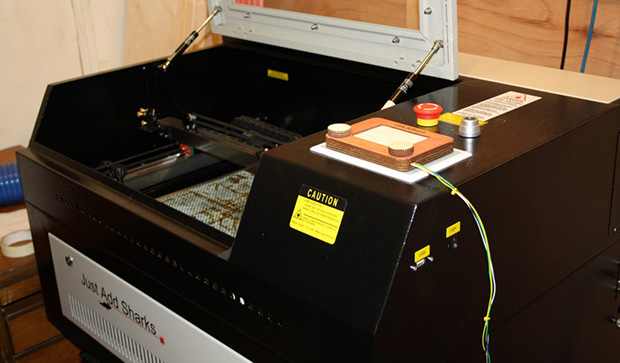
The mirror in a laser cutter moves along an X Y axis. An Etch A Sketch moves its stylus along an X Y axis. Honestly, this laser cutter with Etch A Sketch controls is so obvious, we’re shocked we haven’t seen it before.
The Etch A Sketch interface is extremely simple – just two rotary encoders attached to laser cut knobs set inside a small, laser cut frame. The lines from the encoders are connected to an Arduino Pro Mini that interfaces with the controller unit on the laser cutter, moving the steppers and turning on the laser only when the head is moving. There’s an additional safety that only turns on the laser when the lid is closed and the water pump is running.
The circuit is extremely simple, and with just a few connections, it’s possible to retrofit the Etch A Sketch controller to the laser cutter in just a few minutes. Just the thing for a weekend hackerspace project.
Filed under: laser hacks


Y Combinator’s Top Three Startups From Winter 2014, According To Y Combinator Startups
Claus.dahlNå, farvel feed - de her digests er sgu for korte
Slow life
Claus.dahlMåske husker du titelsekvensen til Scorseses 'Age of Innocense', lavede af legendariske Saul Bass? Den havde lidt af det samme https://www.youtube.com/watch?v=0MZDtoIZZWE - men med bedre musik
Well, I don't even have the words to describe what this is; you just have to watch it. Preferably in fullscreen at full resolution. Takes about 30 seconds to get going but once it does.........dang. Breathtaking is not a word I throw around after every TED Talk or Milky Way time lapse, but I will throw it here.
More on the hows and whys the video was made on Vimeo and the director's site.
Tags: time lapse videoAn Etch-A-Sketch to Fetch the Time
Claus.dahljaaa - et godt hack, mand!

For someone who has never used stepper motors, real-time clocks, or built anything from scratch, [Dodgey99] has done a great job of bending them to his will while building his Etch-A-Sketch clock.
He used two 5V stepper motors with ULN2003 drivers. These motors are mounted on the back and rotate the knobs via pulleys. They are kind of slow; it takes about 2 1/2 minutes to draw the time, but the point of the hack is to watch the Etch-A-Sketch. [Dodgey99] is working to replace these steppers with Nema 17 motors which are much faster. [Dodgey99] used an EasyDriver for Arduino to drive them. He’s got an Arduino chip kit in this clock to save on the BOM, but you could use a regular Arduino. He left out the 5V regulator because the EasyDriver has one.
[Dodgey99] has published three sketches for the clock: one to set up the RTC so that the correct time is displayed once the Etch-A-Sketch is finished, some code to test the hardware and sample the look of the digits, and the main code to replace the test code.
The icing on this timekeeping cake is the acrylic base and mounting he’s fashioned. During his mounting trials, he learned a valuable lesson about drilling holes into an Etch-A-Sketch. You can’t shake an Etch-A-Sketch programmatically, so he rotates it with a Nema 17. Check it out after the jump.
If you’re paying attention, you’ll realize we just saw the exact opposite of this project a few hours ago: a CNC tool (laser cutter) controlled by turning Etch-A-Sketch knobs.
Filed under: Arduino Hacks, clock hacks


Revealed: Visitor logs show full extent of Pierre and Pamela Omidyar’s cozy White House ties

[White House officials] know who to call at The Times, they know who to call at The Post. With us, who are they going to call? Pierre? — Jeremy Scahill, First Look Media
Last month, Pando’s Mark Ames reported that Omidyar Networks, the philanthropic organization operated by eBay founder Pierre Omidyar and his wife Pamela, had co-invested with the US government in opposition groups that played a key role in organizing Ukraine’s recent revolution.
Unsurprisingly, given Omidyar is now running First Look Media, a journalistic enterprise dedicated to exposing US government wrongdoing around the world, some FLM staffers and supporters rushed to cry foul over our report.
USA Today’s Rem Rieder argued that Omidyar Network’s investments were a non-issue as they had been disclosed years earlier. Other supporters pointed out that, just because the Omidyars co-invested with the US Agency for International Development (USAID) and the National Endowment for Democracy (NED), and appeared to share their policy on regime change in Ukraine, didn’t mean that they had actively collaborated with the government on investment strategy.
This narrative of Pierre Omidyar being politically and financially separate from the Obama White House is a vitally important one. In recent weeks, the site’s reporters have taken their fight right to the President’s doorstep with headlines like “The White House Has Been Covering Up the Presidency’s Role in Torture for Years,” claiming that the administration has deliberately withheld thousands of documents relating to the CIA’s role in detention and interrogation of prisoners. Any sniff that First Look’s owner, publisher and chief editorial recruiter has close ties to the White House could undermine the whole premise of the organization.
Speaking to the Daily Beast, documentary maker Jeremy Scahill mentioned his boss explicitly when comparing the cozy relationship between other news organizations and the White House. First Look, he insisted, would be different…
I think that the White House, whether it is under Republican or Democrat, they pretty much now [sic] who they are dealing with. There are outlets like The Daily Beast, or The Huffington Post that have risen up in the past decade, but they are very quickly just becoming part of the broader mainstream media, and with people that have spent their careers working for magazines or newspapers or what have you, and the White House believes they all speak the language on these things. With us, because we want to be adversarial, they won’t know what bat phone to call. They know who to call at The Times, they know who to call at The Post. With us, who are they going to call? Pierre? Glenn?”
Scahill’s question is a good one — and it’s also very easy to answer: If the White House has a problem with First Look, it’s a pretty safe bet they’ll pick up the phone and call Pierre Omidyar.
After all, according to records made available under Obama’s 2009 transparency commitment, Omidyar has visited the Obama White House at least half a dozen times since 2009. During the same period, his wife, Pamela Omidyar, who heads Omidyar Network, has visited 1600 Pennsylvania Ave at least four times, while Omidyar Network’s managing partner, Matthew Bannick, has visited a further three. In all, senior Omidyar Network officials made at least 13 visits to the White House between 2009-2013. (In fact the logs indicate that, on several occasions, Omidyar visited the White House more than once in the same day. To avoid unfairly inflating the numbers, I’ve removed same-day duplicates from all the totals cited in this article.)
To put the numbers in perspective, Omidyar’s six visits compare to four visits during the same period by NBCUniversal chief Stephen Burke, two by Fox News boss Roger Ailes, two by MSNBC’s Phil Griffin, one by New York Times owner Arthur O Sulzberger, and one each by Dow Jones’ Robert Thompson, Gannett/USA Today’s Gracia Martore and Omidyar’s fellow tech billionaire turned media owner, Jeff Bezos.

In fact Pando could only find three media titans who had earned more White House visitor loyalty points than Omidyar: CNN’s Jeffrey Zucker (7), former Post owner Donald Graham (9) and queen of all media, Arianna Huffington (11). According to records, neither The Daily Beast’s Tina Brown or Barry Diller were invited at all — nor, by the way, was Rupert Murdoch.
Even compared to other major tech leaders, Omidyar is a special case. LinkedIn’s Reid Hoffman visited the White House twice during the same period, as did Facebook’s Mark Zuckerberg. Omidyar also beat out Marissa Mayer (5), Eric Schmidt (5), John Doerr (4), Dick Costolo (3), Evan Williams (3), Jack Dorsey (2), Larry Ellison (1) and poor old Reed Hastings who wasn’t invited at all, until this week. According to records, other people not important enough to make it through the door include Pando investors Marc Andreessen and Peter Thiel.
(In fairness, it should be noted that Facebook’s Sheryl Sandberg (7) clocked at least one more visit than Omidyar — and on one occasion, records show, even scored herself a ride home to San Francisco on Air Force One. Which, I suppose, is what happens when Larry Summers is your mentor.)
Hell, even compared to famous investors, Omidyar holds his own: positioned, as he is, squarely between Warren Buffett (5) and George Soros (7).
The raw numbers can only tell half the story, though. What’s much more interesting — and potentially far more troubling for the owner of a soi-disant “adversarial” publication trying to paint itself as a stranger to the White House — is who Omidyar and his wife/co-founder met during their visits to the White House.
Again, the public data is our friend: From it we learn that, yes, Pierre Omidyar had many of the kind of meetings you might expect from the founder of eBay: For example, in 2009, he met with Beth Novech, then Obama’s deputy chief CTO, who now works in a similar role for the UK government. That same year, Omidyar further cemented his relationship with the Obama White House when the President personally appointed him to sit on the President’s Commission on White House Fellowships, helping to nominate young future leaders to gain “experience working at the highest levels of the federal government.” (Other appointments to the Commission that year included Tom Brokaw and General Wesley Clark.)
Dig deeper in the visitor logs, however, and we find several meetings involving both Pierre and Pamela Omidyar which apparently have less to do with the former’s tech credentials than with Omidyar Network’s desire to shape US foreign policy.
On 16th April 2010, Pamela Omidyar visited the White House for four hours to meet with Gayle Smith, Senior Director of the National Security Council in charge of “global development” and “democracy.”
The National Security Council, which the president heads, was created by Truman in 1947, under the National Security Act, to act as a liaison between government and the military/intelligence community. This included providing a bridge between the government and the CIA, which was created in the same year under the same act. More recently the NSC, which oversees the “kill lists,” has been implicated in the targeted assassinations of American citizens and was responsible for controlling the “high value detainee interrogation group,” which was criticized for its inhumane treatment of prisoners in 2013 by the Guardian’s… Glenn Greenwald. More recently, the NSC was involved in the decision not to declassify thousands of CIA documents, prompting outrage from reporters at Omidyar’s First Look Media.
While we can’t know what was discussed at the meeting – not least because a spokesperson for Pierre and Pamela Omidyar declined to comment for this story – it’s possible that Pamela Omidyar and Smith touched upon Omidyar Network’s future international investment plans. After all, before joining the NSC, Smith worked as chief of staff at USAID.
In any case, the following month, another senior official from Omidyar Network was invited to the White House. This time, it was Matthew Bannick, Omidyar Network’s managing partner who made the trip to DC. According to White House records, the meeting was between “BANNICK, MATTHEW J” and “POTUS” — that is, the President of the United States himself.
Records show that Bannick and the President met in the Roosevelt Room for about an hour. That was apparently not enough time to conclude whatever business Omidyar Networks wished to transact with the White House, as Bannick returned to Pennsylvania Ave the very next day to meet the First Lady. The following day, Bannick was back for a third meeting, this time with Peter Rundlet, then deputy assistant to the President. A little over two weeks later, Pamela Omidyar also swung by to meet Rundlet.
These meetings clearly were very fruitful — at least for Rundlet. Just three months after meeting Pamela Omidyar and Matthew Bannick, Rundlet decided to quit his job at the White House and go to work as “vice president for investments” for a humanitarian group called “Humanity United.” The founders of that group? Pierre and Pamela Omidyar.
After Rundlet’s departure, the Omidyars and Bannick stayed away from the White House for almost a year, until suddenly in 2011 they were back with a vengeance. In June and July of 2011, Pierre and Pamela Omidyar and Matthew Bannick have a total five entries on the White House visitor log, including another visit with the President, on 18th July, this time in his private residence. It was two months after that meeting that Omidyar Network announced its co-investment with USAID in Ukraine’s Center UA—which described itself as an “active participant” in the Ukraine revolution earlier this year—as well as in pro-democracy groups in Nigeria, Chile and India.
The last recorded visit by Omidyar to the White House was in December 2012, just ten months before it was revealed that he had hired Glenn Greenwald, keeper of Edward Snowden’s secrets, to launch a site exposing the misbehavior of the US government. Since then, according to all the records Pando has been able to find, no representative of Omidyar Networks has visited the White House, nor have any more co-investments between Omidyar and USAID been announced publicly.
But the key word there is publicly. Just because Omidyar is now painting himself as an outsider, doesn’t mean he’s any less close to his old friends in Washington.
In February of this year, the Intercept published one of its first reports, bylined to Greenwald and Scahill, exposing the involvement of the NSA in foreign drone attacks — a program overseen by the National Security Council. That same month USAID official Sarah Mendelsen testified before the House Subcommittee on State, Foreign Operations, and Related Programs about the importance of the US government’s ongoing partnerships with private donors and NGO including, specifically, Omidyar Network…
“In 2012, USAID launched “Making All Voices Count: A Grand Challenge for Development,” a $55 million public-private partnership with UKAID, Swedish International Development Cooperation Agency, Omidyar Network and the Open Society Foundations to support innovation and research that will enable citizens to engage with their governments and improve the ability of governments to listen and respond to their citizens. The first round of challenge grants received over 500 applications proposing innovative ways to use technology to enable citizens to better use public information. We are working closely with our colleagues at the State Department to support local civil society efforts to prevent new restrictions from being enacted. And we are leading a process, together with other governments, private donors, and non-governmental organizations to explore new innovative ways to support civil society around the world.
The political trajectory of a country is ultimately a U.S. national security issue, and as such, we are intimately involved in advancing U.S. national security interests. Several of the countries we will discuss today [including Ukraine] are of high national security interest to the United States, and they are also in the category of requiring very long-term democracy efforts.
Accordingly, the investments we make in these closed societies will pay dividends in the future. We know this to be true in many countries where we have worked, where institutions and processes we supported became leading elements ushering in more democratic and accountable governments. That is the story of millions of dollars of USAID investments in Serbia, Georgia, and now Burma.
Serbia, Georgia and Burma are, of course, all places where USAID-backed pro-US color revolutions were successful. And now we have Omidyar Network investing in USAID’s newest overseas programs, “advancing U.S. national security interests” in USAID’s words.
With Omidyar Networks refusing to comment, we can’t know the full details of what Pierre and Pamela Omidyar discussed with the President and other top White House officials before they co-invested with USAID to bring democracy (and revolution) to foreign shores. And we can’t know if, for all of Jeremy Scahill’s snark, those same White House officials have attempted to use their relationship with the Omidyars to influence First Look’s reporting.
(I emailed Scahill for comment on this article [48+ hrs ago] but he had not responded by press time. A request for comment from First Look Media [48+ hrs ago] received no response by press time. A request for comment from the White House [12+ hrs ago] received no response by press time.)
What we do know for sure is this: for all of First Look’s bluster about Omidyar’s outsider status, his relationship to the White House is at least as close as any other media tycoon. Moreover, his direct business relationship with the Obama administration, through Omidyar Network’s co-investments with USAID and his donation of hundreds of thousands of dollars to the World Bank to promote micro-lending in emerging markets, adds another layer of coziness which most of the biggest media barons don’t even enjoy.
* * * *
And yet…
If Pierre Omidyar’s willingness to whitewash his establishment background and recast himself as a fiercely independent thorn in Obama’s side comes as a shock to First Look readers (or staffers), it probably shouldn’t. After all, Omidyar is the undisputed king of the fake origin story.
In a now deleted article, Wired UK editor David Rowan busted eBay for completely fabricating its folksy beginnings in order to secure favorable press coverage. The main characters in the fairytale: Pierre and Pamela Omidyar…
It was the warm, smalltown story of a corporate giant’s humble beginnings that enticed Business Week, The Wall Street Journal, even the fact-obsessed New Yorker. When Pam Wesley wanted to boost her collection of Pez sweet dispensers, her fiance, Pierre Omidyar, built a website for her to trade them. That website grew to be the huge online auction house eBay, one of the internet gold rush’s few success stories – even though, in the words of the company’s PR chief, Mary Lou Song, it began simply “as kind of a love token”.
It was a touching tale, recounted in endless profiles on both sides of the Atlantic, with only one flaw: it was a lie. As Song admits in a new book by Adam Cohen, The Perfect Store: Inside eBay, she invented the story five years ago to generate publicity for an otherwise dull tech company. “No one wants to hear about a 30-year-old genius who wanted to create a perfect market,” Song confesses. So she constructed what corporate PRs call a “creation myth”, and hoodwinked some of the world’s most respected reporters.
According to Rowan, some of those hoodwinked reporters were “furious” when they discovered the truth about Pierre and Pamela Omidyar: that the couple had allowed staffers to spread a romantic, completely false creation myth about eBay in order to conceal their real, purely market-driven motives for going into the auctions business.
With the stakes so much higher this time around, we can only hope that American journalists don’t fall for the same stunt twice.
[Illustration by Brad Jonas for Pando]
* * * *
Editor’s note: All figures cited above are taken from the publicly available White House Visitor Access Records, as of November 2013. Pando has removed any duplicate same-day records from the totals. We have also taken steps to filter out erroneous records as well as attempting to verify possible misspellings and name variations (where doubt remains, we have removed records from the count). We’ll update this article to reflect any subsequent errors we discover. Note that the publicly available records do not include any visits which the administration considers sensitive on national security grounds, nor do they include all visits to the Vice President’s residence. More on the types of visits not included in the public data can be found here.
Paul Carr


|
To stop leaks, Microsoft infiltrated a blogger’s Hotmail account
Claus.dahlWow - Microsoft thinks you've agreed they can read your emails if they feel like it
Companies will go to great lengths to preserve their trade secrets and keep the competition in the dark, even if it means crossing into the grey area of privacy breaches. According to a March 17 legal document spotted by Business Insider, Microsoft sifted through the contents of an unnamed blogger’s Hotmail account to figure out who was leaking sensitive Windows 8 information from the inside.
The report, which names Lebanon-based Microsoft employee Alex Kibkalo as the alleged leaker, detailed an investigation approved by Microsoft’s Office of Legal Compliance that rooted through the Parisian blogger’s email to trace the source of the leak. The investigation began after someone tipped off Steven Sinofsky, then-President of Microsoft’s Windows division, to some source code sent by the blogger that turned out to be part of the internal Windows 8 SDK. Microsoft then gained access to the blogger’s Hotmail account — which remains legal due to a clause in Microsoft’s Privacy Policy that reads:
We may access or disclose information about you, including the content of your communications, in order to: (a) comply with the law or respond to lawful requests or legal process; (b) protect the rights or property of Microsoft or our customers, including the enforcement of our agreements or policies governing your use of the services; or (c) act on a good faith belief that such access or disclosure is necessary to protect the personal safety of Microsoft employees, customers or the public.
From there, Microsoft investigators traced through the emails to find one from Kibkalo that shared six unreleased “hot fixes” for Windows 8 RT, among others. Microsoft also found an archived conversation between the blogger and Kibkalo, which included references to the sample code that tipped Microsoft off in the first place.
Microsoft released a statement in response (via Business Insider):
During an investigation of an employee we discovered evidence that the employee was providing stolen IP, including code relating to our activation process, to a third party. In order to protect our customers and the security and integrity of our products, we conducted an investigation over many months with law enforcement agencies in multiple countries. This included the issuance of a court order for the search of a home relating to evidence of the criminal acts involved. The investigation repeatedly identified clear evidence that the party involved intended to sell Microsoft IP and had done so in the past.
As part of the investigation, we took the step of a limited review of this third party’s Microsoft operated accounts. While Microsoft’s terms of service make clear our permission for this type of review, this happens only in the most exceptional circumstances. We apply a rigorous process before reviewing such content. In this case, there was a thorough review by a legal team separate from the investigating team and strong evidence of a criminal act that met a standard comparable to that required to obtain a legal order to search other sites. In fact, as noted above, such a court order was issued in other aspects of the investigation.
What Microsoft did to catch its leaker is legal, and well within the company’s rights to protect its property. However, it does show the level of access that a company has in obtaining information transferred across its own channels, and how readily it will access those channels if even a hint of a threat to company property is involved.

Related research and analysis from Gigaom Research:
Subscriber content. Sign up for a free trial.
Weev Needs To Walk
Claus.dahlAgain the "it's really easy to do"-defence. Which is utterly beside the point. Stabbing somebody to death with a knife is really easy too.
MtGox finds 200,000 bitcoins it claims to have forgotten about
Claus.dahl"Nå, der var de"
MtGox really is a gift that keeps on giving: now in the throes of bankruptcy, the audit-averse Bitcoin exchange said late Thursday that it has found 200,000 bitcoins in an “old-format” wallet it previously thought was empty. That means it has only lost 650,000 bitcoins – 550,000 of which belong to its customers — rather than the 850,000 it previously thought had been pilfered by thieves (“evidence” that MtGox still has almost a million bitcoins is deeply suspect, accompanied as it was by fraudulent malware). The re-found bitcoins are worth around $116 million, which will interest the courts handling MtGox’s bankruptcy in Japan and the U.S., and customers clamoring for their money back.

Related research and analysis from Gigaom Research:
Subscriber content. Sign up for a free trial.
Failed Bitcoin market activity

Stamen visualized Bitcoin activity, noting a variety of traders who knew what they were doing, didn't know what they were doing, and were apparently automated.
In February 2014 MtGox, one of the oldest Bitcoin exchanges, filed for bankruptcy protection. On March 9th a group posted a data leak, which included the trading history of all MtGox users from April 2011 to November 2013. The graphs below explore the trade behaviors of the 500 highest volume MtGox users from the leaked data set. These are the Bitcoin barons, wealthy speculators, dueling algorithms, greater fools, and many more who took bitcoin to the moon.
American Aqueduct: The Great California Water Saga Alexis C....
Claus.dahlA must

American Aqueduct: The Great California Water Saga
Alexis C. Madrigal, theatlantic.comA $25 billion plan, a small town, and a half-century of wrangling over the most important resource in the biggest state
Hood, California, is a farming town of 200 souls, crammed up against a levee that protects it from the Sacramento Rive…
Awesome reading.
"The American Army pilot Hugh Thompson had moral courage. He landed his helicopter between a platoon..."
- Chris Hedges (via azspot)
Det handler aldrig om produktet
Claus.dahl"Ensidighed Er Stadig Ensidigt" - etnographic turn hjælper desværre ikke på det.

- Big Data-løsningen: Troen på, at kombinationen og analysen af store mængder data kan føre til den rette løsning. Men tilgangen glemmer, at det afgørende parameter er de menneskelige analyser. Data kan aldrig erstatte den unikke fortolkning.
- Steve Jobs-løsningen: Troen på, at hvis man bare opfører sig som Steve Jobs, så kommer de gode løsninger. Men tilgangen glemmer, at få organisationer minder om Apple, og ingen kan efterligne Steve Jobs.
- Customization-løsningen: Troen på, at hvis man personaliserer produkter og løsninger, så bliver kunder automatisk glade. Men tilgangen har en naiv forestilling om, hvad brugere faktisk ønsker.
- Open innovation-løsningen: Troen på, at hvis man blot involverer brugerne aktivt i co-creation, crowdsourcing osv., så kommer de gode løsninger. Men tilgangen glemmer, at kunder bare sjældent gider bruge kræfter på din virksomhed.
- Social media-løsningen: Troen på, at hvis man blot gør sine produkter sociale og shareable på tjenester som Facebook, så vil man opnå brand loyalty. Men tilgangen har en naiv forestilling om de sociale mediers effekt på folks dagligdag.


- Definer problemet, der skal løses
- Indsaml data via etnografiske metoder
- Søg efter mønstre i det indsamlede materiale
- Skab ny indsigt og konceptuelt stærk viden
- Kommuniker den nye viden, så den får forretningsmæssig værdi

- Tilgangen er ikke bred nok: Der mangler en bredere funderet tilgang til et undersøgelsesområde, der ikke kun bruger etnografiske metoder. Kritikken af Big Data er i den forbindelse skævvredet. For pointen er vel snarere, at man, med fordel, kan generere hypoteser på baggrund af store Big Data-analyser, som man bagefter kan kvalificere og undersøge i dybden med etnografien.
- Tilgangen er ikke snæver nok: Når det så kommer til analysearbejdet bliver det en smule for mystisk at tale om øjeblikkets indsigt. Det er en central pointe at møde fænomenet så fordomsfrit som muligt, men de centrale analytiske pointer dukker ikke op af sig selv. Udført godt nok vil minutiøse og systematiske analyser af datamaterialet afsløre mønstre nærmest per automatik.
- Etnografiske metoder: observere, interviewe, filme, tage billeder af, bruge feltnoter
- Rapporteringer: tykke beskrivelser, skabelsen af modeller/figurer ,
- Kontekstforståelse: analyse af, hvad der er de ydre omstændigheder i organisationer og samfund, der påvirker adfærd.
- Abduktiv metode: det vil sige, at man starter med at observere noget i verden, hvorefter man drager nogle hypoteser, som man derefter går ud og tester.
Tradeshift Secures $75M To Expand Its Invoicing Platform Globally
Claus.dahl"growth funding". That usually means "not stock" - it seems Tradeshift sold some rights to get the money as well; so not quite the thing it was billed as at first.
prostheticknowledge: Open Knit Clothing Printer Fashion project...
Claus.dahlawesome gif at top


Open Knit Clothing Printer
Fashion project with a machine that knits your own designed clothes with open-source tech. Video embedded below:
Presently, production outsourcing has become the norm: mass fabrication of goods at low costs improves corporate profit margins but pushes precarious labour conditions due to a race to the bottom in competing developing markets. Production entails long and precise processes before those goods reach our hands, many of which are pervasive in our daily life, and frequently in intimate contact with us, such as textiles. In such a context the market price we pay for goods has not absorbed the externalities created, thus we end up paying far less for them than the real impact they have in society and the environment.
OpenKnit offers an alternative landscape to this production model. It’s an open-source, low cost (under 550€), digital fabrication tool that affords the user the opportunity to create his own bespoke clothing from digital files. Starting from the raw material, the yarn, and straight to its end use, a sweater for example, in about an hour. Designing and producing clothes digitally and wearing them can now happen in the very same place, rewarding the user with the ability to make decisions regarding creativity and responsibility.
More info can be found at the Vimeo page here, as well as the Open Knit project’s website here
Apple Patents iPad Smart Magnets For Attaching Controllers, Cameras, Other iPads And More
Claus.dahlSo, essentially, Littlebits.cc but, you know, white.

A new Apple patent application published by the USPTO today describes a magnetic connector not unlike the one used to attach Smart Covers to the current iPad, but designed to be far more flexible with a variety of possible accessory combinations. It’s a smart connector system that could recognize the attached peripheral and change functionality accordingly.
The types of peripherals described in the patent are many and varied, and include things like speaker docks, trackpads and keyboards, drawing tablets, radio wave antennas, cameras, game controllers and card readers. There’s also a provision which describes how two iPads might be linked together via an intermediary magnetic hinge dock that connects to the smart magnetic link in each.
It could work either with basic magnets, or with electromagnets that can be turned on or off using controls built into iOS, according to the filing, which would allow you to theoretically ‘lock’ accessories in place, including docks that simply stand the iPad up or hold it on a positionable mount for different viewing angles.
-

Screen Shot 2014-02-20 at 7.41.39 AM
-
Screen Shot 2014-02-20 at 7.41.28 AM
-
Screen Shot 2014-02-20 at 7.41.19 AM
-
Screen Shot 2014-02-20 at 7.41.07 AM
-
Screen Shot 2014-02-20 at 7.40.53 AM
-
Screen Shot 2014-02-20 at 7.40.37 AM
-
Screen Shot 2014-02-20 at 7.40.21 AM
The system’s flexibility doesn’t end there, however – Apple also describes various in-car mounts for connecting an iPad to your vehicle’s dash or headrests, as well as to a treadmill or other gym equipment. Each could be a simple enough magnetic connection with no attendant change in functionality, but the patent also describes how they could complete a circuit, too, to deliver power, and communicate with the attached peripherals to transfer specific kinds of data back and forth.
Finally, there’s mention of wearable tech that could be used to trigger the magnetic sensor and prompt various behaviour from the iPad. This could take the form of a ring, for instance, which when worn by the user would do things like unlock the iPad when the hand it’s on is waved deliberately across the tablet’s screen. In the context of other Apple wearable rumors making the rounds, this could theoretically also work with magnetic connectors built into some kind of iWatch, possibly for identification and unlocking purposes as well as for simple proximity-based communication with certain apps.
The system described in this patent is elaborate and filled with potential, but it’s worth noting that peripherals connected via the Lightning port can do some of the things depicted in the application. Still, were Apple to actively invest in putting this into shipping iPads, it would no doubt open up a world of possibility for accessory makers. Connections that don’t require physical I/O, and that could automatically prompt different behavior from an iOS device and from specific apps would significantly enrich the already vibrant appcessory ecosystem.
Apple already has magnets within the iPad’s chassis, so space constraints for components aren’t necessarily a huge concern, and this could easily be a focus feature for an iPad generational revision, especially in lieu of form factor or display changes. Apple patents rarely make their way intact into shipping hardware, but in this case, I’m holding out hope we do see something similar make its way to consumer hands.
Edgar Varèse – Déserts (World Premiere, 1954)
Claus.dahlFantastisk, er det. Så glad for at have hørt det live til Ars E
The first performance of the combined orchestral and tape sound composition was given at the Théâtre des Champs-Élysées in Paris on December 2, 1954, with Hermann Scherchen conducting and Pierre Henry in charge of the tape part. This performance was part of an ORTF broadcast concert, in front of a totally unprepared and mainly conservative audience, with Déserts wedged between pieces by Mozart and Tchaikovsky. It received a vitriolic reaction from both the audience and the press. [source]


Achievement Unlocked: The SF Class War Reaches Godwin’s Law

Yes, Tom Perkins went there.
In a letter to the Wall Street Journal published this morning, with the surprising title “Progressive Kristallnacht Coming?,” the legendary venture capitalist compared Nazi Germany’s war on the Jews to “the progressive war on the American one percent.”
Before going too much further, let’s get this one little thing out of the way: Nothing should EVER be compared to the Holocaust, a tragedy in which 6 million Jews and another 5 million Germans lost their lives, except the Holocaust, or at the very least, other massive state-run genocides.
Godwin’s Law notwithstanding, there are serious issues with Perkins’ letter, both in his perception of the problem and tone deaf reaction to it.
“From the Occupy movement to the demonization of the rich embedded in virtually every word of our local newspaper, the San Francisco Chronicle, I perceive a rising tide of hatred of the successful one percent,” Perkins writes. This, at least, most people agree on.
The problem is that Perkins only reinforces that hatred with his parallel between the distraught working class citizens of San Francisco and a national movement to eradicate an entire ethnic group.
There is no centralized movement to remove the 1 percent from their penthouse apartments and send them to work camps. There’s no planned nationalization of the region’s thriving tech sector. There’s no threat of assets being seized and redistributed by a fascist government body.
Protest is nothing new to San Francisco: Its citizens were some of the leading voices in the Vietnam War in the 60s and 70s, and during the AIDS crisis of the 1980s. That many in the city would rally around the Occupy Movement and call attention to the rapidly growing income disparity that is taking place in their own back yard should not come as a surprise.
Blaming the victim is hardly the way toward progress or compromise. But Perkins’ letter does just that.
Perhaps what is most alarming is that Perkins doesn’t seem to understand why people are upset about the growing income disparity, why there is resentment against the one percent. It’s this lack of self awareness which is most distressing, because it reinforces some of the very same stereotypes many in the industry are trying so hard to debunk.
And for those who want to effect real change in the Bay Area, for those who are trying to bridge the divide between the rich techies and their less fortunate neighbors, for those who truly believe that “it doesn’t have to be this way“… Perkins’ letter makes things just that much harder.
Update: The Twitter account of Kleiner Perkins just issued the following statement:
Tom Perkins has not been involved in KPCB in years. We were shocked by his views expressed today in the WSJ and do not agree.—
Kleiner Perkins (@kpcb) January 25, 2014
"This is the trinity which allows for an understanding of a complex system: the physical, the..."
- Google’s three Ps
"This would not be too troubling if the effect would be restricted to the company stakeholders. The..."
-
Increasingly, I believe the answer is “no”.
How Hadoop passes an IT audit
Enterprise IT will become more directly involved with managing and supporting Hadoop — a process that is by no means a given.

Related research and analysis from Gigaom Research:
Subscriber content. Sign up for a free trial.
The NSA Collects Hundreds Of Millions Of Global SMS Messages Every Day

Another day, another NSA story involving dragnet surveillance of global communications. Out this morning in the Guardian is news of Dishfire, an NSA program that collects nearly 200 million text messages each day.
The program is notable for its scale, and what the Guardian quotes as its “untargeted” nature. It is not collecting the SMS notes of targets, but instead of apparently random individuals on a larger scale. The GCHQ, the United Kingdom’s NSA equivalent, can access the information, with some safeguards in place regarding its own citizens.
According to a GCHQ document, the program collects “pretty much everything it can,” making it likely a controversial effort. The program is broad enough that documents indicate that analysts are asked to constrain searches to no more than 1,800 phone numbers at a time.
Want to know if you are protected from Dishfire’s reach? Here you go:
The note warns analysts they must be careful to make sure they use the form’s toggle before searching, as otherwise the database will return the content of the UK messages – which would, without a warrant, cause the analyst to “unlawfully be seeing the content of the SMS”.
The note also adds that the NSA automatically removes all “US-related SMS” from the database, so it is not available for searching.
I’m sure you feel better. It is edifying to know that in the U.K., a whole user interface sits between your right to privacy and an analyst who might forget to click a button. At least the NSA deletes everything that it considers “US-related.” I feel secure.
The above story is almost boring. The NSA collecting billions of texts a month from untargeted sources? Heaven forbid it behave in a manner unbecoming of an international actor. What’s depressing is that our lackadaisical emotional response is unwarranted: we should be less happy than we are.
No one thinks that nations shouldn’t, or don’t spy. The current question instead is what is the proper backdrop for privacy in the digital age? The above implies a future of no privacy at all. That’s less than good, from my perspective.
President Barack Obama will speak to the issue on Friday. Tune in.
Top Image Credit: Flickr

Study: These 100 phrases yield success on Kickstarter
When it comes down to it, running a campaign on a crowdfunding platform like Kickstarter comes down to persuasion. Think about it: the success of any project is predicated on people (sometimes friends, but often total strangers) believing in a products months, even years before it’s destined to be finished. On a time limit.
But researchers at Georgia Tech published a report yesterday indicating that that persuasion could be hedged in the form of a few carefully chosen words. The group also put together a phrase dictionary, showing a hundred words that proved effective for funded campaigns and 100 clunkers in ones that failed to meet their goal.

In order to narrow down the study to focus on the text, Georgia Tech associate professor Eric Gilbert and PhD candidate Tanushree Mitra isolated the variables in more than 45,000 projects on Kickstarter. After weeding out the influence of factors like the project goal amount and video, they picked out more than 9 million phrase structures and filtered those down to roughly 25,000 words before picking the most pertinent ones. The result was a list of 200 words seen most commonly in funded and unfunded projects.
Perhaps unsurprisingly, the big winner for funded projects were phrases that insinuated reciprocity. Words like “also received two,” “got you” and “guaranteed” — often centered around the products backers get as a result of the pledge — have significant prevalence and influence in successful fundraisers. Another important factor is authority, which is inherent in words like “future,” “secure” and “we can afford.” In short, the text of the campaign proved most successful when the words used projected confidence, expertise, and plenty of incentive for backers.
On the other side, unsuccessful campaigns had more chancy language, and focused on the desire for funding rather than turning out a product. Phrases like “provide us,” “need one” and “help support” all made the not funded list, ostensibly for their desire for pledges. Oddly enough, words like “definitely,” “surely,” and “trust” also made the not-funded list — perhaps indicating that words don’t mean much under the scrutiny of backers.
Of course, it’s difficult to separate the language of a campaign from the actual product or project to be created with the money, or the influence of those raising the funds. But it stands to reason that confident language will be more persuasive than desperate pleas for money.

Related research and analysis from Gigaom Research:
Subscriber content. Sign up for a free trial.
"They may not feel powerful, but they do feel entitled to feel powerful."
Claus.dahlThat's an awesome line
- The Sifted Bookshelf: Angry White Men
Doodle Founders Leave Scheduling Startup, Swiss Publisher Tamedia Plans To Acquire Remaining Stake
Claus.dahla helpful reminder I need to build my own demodag-signup flow
The founders of Doodle, which offers an online scheduling service for individuals and businesses, are leaving the Swiss startup they founded in 2008. According to a company blog post, Michael Näf and Paul E. Sevinç will step down during the next couple of months, to be replaced by Michael Brecht as new CEO as of 1st February. He’ll lead the company along with a management team consisting of current Doodle employees.
Co-inciding with a change of guard, Doodle is also announcing that Swiss publisher Tamedia plans to fully acquire the company “in 2014″, following its original purchase of a minority 49 percent stake in May 2011 that saw German VC firm Creathor Venture sell its share in the company.
At the time, Tamedia talked up synergies between the scheduling service and its online directory search.ch, giving Doodle a boost in its domestic market of Switzerland with regards to the SME sector. Terms of the minority acquisition were undisclosed, and I wouldn’t expect any more transparency this time around, though we’ll update this post if we hear any different.
Operating out of Zurich, Switzerland, Doodle claims 15 million users per-month. The service, which makes it easy for users, groups and businesses to schedule meetings or take appointments, comes in a free basic version as well as various premium offerings.
Meanwhile, Tamedia says it will invest in Doodle to further fuel its international growth.
New CEO Michael Brecht is said to have more than 20 years of experience in the IT and online sectors and has held several international positions, including Managing Director at Germany-based CompuNet where he was responsible for building the UK business; founder of urbia.com, an online portal for families and children (acquired by media house Gruner & Jahr); and founder of 52weine.de, a shopping club for wine.

lol my thesis
Claus.dahland boring as fuck - only laugh lines, no link to the original article, so no setup for the joke
How Google cracked house number identification in Street View
Claus.dahlwhat does not seem apparant to the writer is that 'deep learning' is the name of a specific technique: http://en.wikipedia.org/wiki/Deep_learning
This post from the MIT Technology Review discusses how Google used deep learning to recognize houses numbers and make Street View more useful (the research paper it cites is here). It’s just the latest example of applied deep learning from Google, which already uses the technique to power speech recognition on Android phones and image recognition in Google+. And, as we’ve been noting for the past few months, other web companies are now getting on board, applying various forms of machine learning to take advantage of the immeasurable volumes of images and text they’ve accumulated over the years.
Story posted at: technologyreview.com
To leave a comment or share, visit: How Google cracked house number identification in Street View

Related research and analysis from Gigaom Research:
Subscriber content. Sign up for a free trial.
Big Data Big Pharma = Big Money - ProPublica
The data maintained by the industry is huge. IMS, based in Danbury, Conn., says its collection includes “over 85 percent of the world’s prescriptions by sales revenue,” as well as comprehensive, anonymous medical records for 400 million patients. All of this adds up to 10 petabytes worth of material — or about 10 million gigabytes, a figure roughly equal to all of the websites and online books, movies, music and TV shows that have been stored by the nonprofit Internet Archive.
Not that long and totally worth reading.