Shared posts

20 Sep 04:35

Volatility Can Be Risk, At Rare Times

by David Merkel
Photo Credit: Matt Cavanagh

Photo Credit: Matt Cavanagh

There is a saying in the markets that volatility is not risk. In general this is true, and helps to explain why measures like beta and standard deviation of returns do not measure risk, and are not priced by the market. After all, risk is the probability of losing money, and the severity thereof.

It’s not all that different from the way that insurance underwriters think of risk, or any rational businessman for that matter. But just to keep things interesting, I’d like to give you one place where volatility is risk.

When overall economic conditions are serene, many people draw the conclusion that it will stay that way for a long time. That’s a mistake, but that’s human nature. As a result, those concluding that economic conditions will remain serene for a long time decide to take advantage of the situation and borrow money.

When volatility is low, typically credit spreads are low. Why not take advantage of cheap capital? Well, I would simply argue that interest rates are for a time, and if you don’t overdo it, paying interest can be managed. But what happens if you have to refinance the principal of the loan at an inopportune time?

When volatility and interest spreads are low for you, they are low for a lot of other people also. Debt builds up not just for you, but for society as a whole. This can have the impact of pushing up prices of the assets purchased using debt. In some cases, the rising asset prices can attract momentum buyers who also borrow money in order to own the rising assets.

This game can continue until the economic yield of the assets is less than the yield on the debt used to finance the assets. Asset bubbles reach their breaking point when people have to feed cash to the asset beyond the ordinary financing cost in order to hold onto it.

In a situation like this, volatility becomes risk. Too many people have entered into too many fixed commitments and paid too much for a group of assets. This is one reason why debt crises seem to appear out of the blue. The group of assets with too much debt looks like they are in good shape if one views it through the rearview mirror. The loan-to-value ratios on recent loans based on current asset values look healthy.

But with little volatility in some subsegment of the overly levered assets, all of a sudden a small group of the assets gets their solvency called into question. Because of the increasing level of cash flows necessary to service the debt relative to the economic yield on the assets, it doesn’t take much fluctuation to make the most marginal borrowers question whether they can hold onto the assets.

Using an example from the recent financial crisis, you might recall how many economists, Fed governors, etc. commented on how subprime lending was a trivial part of the market, was well-contained, and did not need to be worried about. Indeed, if subprime mortgages were the only weak financing in the market, it would’ve been self-contained. But many people borrowed too much chasing inflated values of residential housing.  As asset values fell, more and more people lost willingness to pay for the depreciating assets.

We’ve had other situations like this in our markets. Here are some examples:

  • Commercial mortgage loans went through a similar set of issues in the late 80s.
  • Lending to lesser developed countries went through similar set of issues in the early 80s.
  • The collateralized debt obligation markets seem to have their little panics every now and then. (late 90s, early 2000s, mid 2000s, late 2000s)
  • During the dot-com bubble, too much trade finance was extended to marginal companies that were burning cash rapidly.
  • The roaring 20s were that way in part due to increased debt finance for corporations and individuals.

At the peak some say, “Nobody rings a bell.” This is true. But think of the market peak as being like the place where the avalanche happened 10 minutes before it happened. What set off the avalanche? Was it the little kid at the bottom of the valley who decided to yodel? Maybe, but the result was disproportionate to the final cause. The far more amazing thing was the development of the snow into the configuration that could allow for the avalanche.

This is the way things are in a heavily indebted financial system. At its end, it is unstable, and at its initial unwinding the proximate cause of trouble seems incapable of doing much harm. But to give you another analogy ask yourself this: what is more amazing, the kid who knocks over the first domino, or the team of people spending all day lining up the huge field of dominoes? It is the latter, and so it is amazing to watch large groups of people engaging in synchronized speculation not realizing that they are heading for a significant disaster.

As for today, I don’t see the same debt buildup has we had growing from 2003 to 2007. The exceptions maybe student loans, parts of the energy sector, parts of the financial sector, and governments. That doesn’t mean that there is a debt crisis forming, but it does mean we should keep our eyes open.

19 Sep 03:26

Solution or Problem?

by subra

Does every solution create a problem?

Yes you read it RIGHT. The question asks  – Does every solution create a problem.

Let us go back to the 1970s and 1980s when our gen was in college. We were told “if you were in the USA the day you graduate 4 banks will be chasing you to give you a credit card and a car loan”. We thought “Wow…how great would that be”.

In the 1960s to buy a house you needed to get 7 people along with you, identify some land, take a loan and build a building. INDIVIDUAL home loans was not considered at all. It was always a group.

Take the situation now. When you are in college banks start chasing you. A home loan is so easily available. Getting a vehicle loan is child’s play.

Once the banks finish lending or giving credit cards to people, their greed increases. They need 30% growth. So the second card, the second car loan, the second home loan, the loans to people who do not deserve it. The risk of loan giving increases. More money is pumped into the business.

Suddenly you realise that Rs. 400,000 crores has been pumped into the construction / housing business.

WHAT DOES THIS DO? It raises prices of houses.

What does car loan do? Everybody buys a car, and the public transport suffers.

Not at all sure whether the Western and American way of destroying public transport to grow private transport is A SENSIBLE way to grow!

When you go to a hospital to be treated they ask you: “Are you covered by health insurance?’ – then they inflate the bill. What does this do? It increases costs, and therefore it increases the premium FOR EVERYBODY in the next year. Again the nice solution called medical insurance is brilliantly manipulated to make it very complicated.

Now in the BFSI space, the term plan goes out, the ULIPs come in. Banks want 30% yoy growth. So life insurance which was a nice product is padded up so bad that you have no clue what you are buying.

New professions are born. One of them is called “Financial Planning”. If you see the kind of people in that ‘profession’ YOU WILL BE SHOCKED. They have no clue of markets, law, personal finance, but have some cookie cutter solutions.

The buyer in many cases would have been much better off without the services of a financial planner. Now this profession has to grow at 40% – so soon you will find ‘specialists’. They will tell you how to plan for your life, for your education, for marriage, death, ….etc.

Seriously, we do need a decent financial planner, but when I hear the charges, I keep wondering…..

So ask yourself one question: Is Rs. 35,000 better spent elsewhere?

The professional of course justifies it saying “when there is a willing buyer am I wrong in charging that much?”

I do not need to answer both these questions. YOU need to.


Post Footer automatically generated by Add Post Footer Plugin for wordpress.

19 Sep 03:08

RBI vs. Uber, continued

by Ajay Shah
by Suyash Rai and Ajay Shah.

On 22 August 2014, RBI came out with an order which effectively forces firms such as Uber to either shut down, or switch to cumbersome payments mechanisms.

On 24 August, we wrote an article Shutting down Uber in India was unwise about the economic thinking in payments regulation.

On 15 September, Raghuram Rajan responded to this criticism in a talk, saying:

If there is a rule on the book, we don't allow it to be violated simply because the innovation is cool.

We think that RBI's action does not even constitute proper enforcement of `a rule on the book'. We think that regulators like RBI cannot pass the buck for bad consequences of rules that are fully under their control. We think that if RBI was wise and accountable, it would have behaved differently. Let's work through the steps of this logic.

Does the RBI action constitute sound enforcement of existing law?


Let us first examine what Rajan claims RBI has done - enforcement of current laws and regulations. The RBI's notification states that the routing of payments through offshore payment systems was violating the Payment and Settlement Systems Act, 2007 and the Foreign Exchange Management Act, 1999, and must be immediately stopped. It then allows the firms to make the necessary changes by October 31, 2014. This is unsound enforcement, for the following reasons:

  • The notification just states that the activity is in violation of two Acts, without actually citing the specific provisions or regulations of the Acts, and providing grounds for determining that the activity is violating these laws. For an analogy, this notification is like the police arresting a person saying that he has violated the Indian Penal Code, without citing the specific sections and without providing the reasons for such an assessment.
  • Instead of taking proper enforcement action - starting with a show cause notice and perhaps ending with a penalty - the RBI has simply allowed the firms to "adjust" by the given date. Unlike what Rajan claims, this is not enforcement by any stretch of imagination. An enforcement action by a regulator has to first establish that the enforcement action is necessary, and in a case such as this (assuming the RBI is correct regarding Uber's activities), result in a punishment.
  • The notification, which claims to be a clarification, is vague. It does not describe instances or specific actions that would be deemed to be in violation, so that market participants can understand where they stand. As a result, it has created significant confusion in the market.

RBI cannot be an impassive enforcer of rules that it has drafted


If you were the police, you merely enforce the Indian Penal Code (IPC). When a situation arises in front of you like marital rape, you have to be mindless and say, `Sorry, the IPC is clear that rape in marriage is not a crime, and my hands are tied'. The police does not make the law, it simply enforces it. If the police finds someone violating the IPC, it is its duty to take necessary actions as per the Law.

On the other hand, Rajan's stance - that clamping down on the routing of payment transactions is simply enforcement - is inappropriate. Unlike the police, RBI is not just an enforcement agency. RBI is a regulator. It writes the regulations that it enforces. The regulation for payment security was made by RBI, not Parliament, and therefore can be changed by RBI. Regulators exist because there is value in merging legislative, executive, and quasi-judicial powers within a single organisation.

Once RBI found that some real economy firms with efficient solutions are feeling compelled to find loopholes to give convenience to consumers on services such as taxi rides (which are usually small value transactions), this should have triggered a process of review of relevant regulation. Instead, Rajan simply brushed off the criticism of RBI on this matter, claiming that the critics are calling for suspending enforcement for a "cool" innovation. The critics are calling for no such thing.

Regulations must be enforced, otherwise they are meaningless, but if the regulations are wrong, they must also be reviewed and optimised. What Rajan is dismissing as "cool" is a small but non-trivial improvement in convenience (and productivity) that many consumers were choosing before RBI stepped in. India's future relies on the ability of innovators to come up with myriad small process improvements like this one. So, in addition to enforcing the regulation, it would have been wise of RBI to rectify the problems in regulation that compelled firms to take such a strange and risky route to receive payments.

There are at least four major problems with the regulation that RBI has drafted on two-factor authentication:

  1. It lacks proportionality: it requires the same level of protection for small value transactions as it does for large value ones.
  2. It unreasonably restricts economic freedom of consumers: we do not even have the right to waive the requirement for second factor authentication for small value payments (eg. up to Rs. 1000) on own money, even if we are willing to take that risk.
  3. It focuses too much on prevention and not on enforcement: the approach is to eliminate the possibility of fraud by imposing costs on consumers. You face no risk of a motor accident if you live in the stone age.
  4. It takes initiative away from payment service providers: service providers are supposed to blindly follow RBI's dictum. They do not have the right to relax authentication requirements for some transactions, with the understanding that they would manage risks and make good on losses that occur due to their mistakes.

To ignore these problems, to insist on enforcing a badly drafted regulation, no matter what the consequences are for the economy: this is the hallmark of an unaccountable agency.

If RBI were wise and accountable, what would they have done?


Once RBI noted the route firms were using to get around the two-factor requirement, and that many consumers were willingly using the service with lesser security (signalling a preference for convenience over security for small value transactions), it should have embarked on a comprehensive review. While initiating proper enforcement action against firms allegedly violating the laws, on 22 August 2014, RBI should have issued a statement (perhaps through a press release) saying the following:


  1. "We have a legal framework comprising FEMA about cross-border activities, and two-factor authentication about payments.
  2. "Some companies, such as Uber, are in a grey zone when it comes to FEMA. They are using this mechanism to avoid our rule that requires two-factor authentication.
  3. "We recognise that these are important mechanisms through which the market economy, comprising of service providers and consumers, is choosing to operate. The emergence of these mechanisms raises questions about the soundness of our two-factor authentication rules.
  4. "The tradeoff between security and convenience, and between prevention and enforcement, embedded in our authentication rules is questionable. We need new regulations, which impose some burden of liability upon financial service providers, and empower consumers to make a choice to waive second factor requirement on small value transactions. The default condition may continue to be two factor authentication, unless a consumer opts out for small value transactions, or a service provider takes it upon itself to manage the risk and take liability for failures.
  5. "It is important for regulators to not disrupt organisational capital of firms. Hence, the loopholes which are presently being used will be closed down on October 1 and the new rules will simultaneously kick in. Through this, it would be possible for firms such as Uber to experience no breakdown of operations.
  6. "Enforcement actions will proceed against violators of FEMA who may have to pay fines for the offences. This process will begin with a show cause notice, and may end with a penalty order by an adjudicating officer, if sufficient evidence is found on violation."

This would have been a wise and mature approach to financial regulation, one that fully takes into account the mandate of an accountable financial regulator and its responsibilities to the economy.

Rajan's defense of the current system is that two-factor authentication has enhanced peace of mind for people, who were earlier at risk of losing money. But nobody is suggesting unconditionally removing all authentication requirements or consumer protection provisions. The choice should not be posed as existing RBI regulation vs. zero regulation. Instead, the argument is for applying proportionality in security, giving consumers the freedom to waive the second factor for small value transactions, and holding service providers liable for risks they agree to manage.

Overall, the criticism has far more nuance than Rajan has acknowledged.

He also says, as people too often do in India, that innovations from the West do not directly apply in India. This is a particularly harmful argument, because it works as a broad excuse for prohibiting or delaying all kinds of innovations. Rajan should be more precise about what safeguards are required for specific risks that accompany the innovation being discussed, and what his agency will do to address them efficiently. This precision is required, not vague pronouncements on the harm from importing innovations.

Rajan did say that RBI is considering some changes to the system, but it is not clear what these changes will be and when are they likely to be implemented. Till the time he decides to give greater clarity on the issue, affected parties must wait. This sort of waiting, and legal uncertainty surrounding new thinking about business models, is incompatible with high GDP growth. In this process, we have lost sight of the purpose for which a regulatory agency is established, and that it exists for the purpose of serving the people of India.

This is just the tip of the iceberg


Millions of people understand in their bones that forcing a firm like Uber to shut down is a bad idea. In this one case, we have got a careful discussion about RBI regulation in public domain. The real issue runs deeper : an unaccountable agency has written myriad unwise regulations, that are holding India back. Greater humility, and an interest in reform, is the need of the hour.
18 Sep 14:49

Can I afford this? A shoe costing Rs. 12000?

by subra

When somebody asks you a question like this, what can you really say?

I have seen Suzie Orman say “you have $ 59,000 in a Roth IRA, you have………blah blah….” so go ahead and you will be able to afford it!

In Indian conditions it is far more difficult to say this. Remember we have no Critical Care Insurance, nor do we have any kind of social security available. Also, I, would like to take a slightly different route.

Let us say the person asking this question is 29 years of age and has a Gross salary of Rs. 700,000 and a take home salary of Rs. 45,000 after all deductions. He is a good planner and has decided to do some Investments etc. and this is how his money is spent:

Rs. 19,000 towards household expenses,

Rs. 8700 SIP towards housing emi and Rs. 5500 towards car emi,

Rs. 6000 towards retirement goals, and Rs. 4000 towards eating out, and other entertainment.

This means he does not have a cash flow of Rs. 12000 to pay for the shoe. It also means that he KNOWS what he is spending on and what is he investing for. All this is good. In fact very good.

It also brings us to the question – can he afford it?.

Ha! he has decided that he will invest Rs. X for retirement, and his ENTERTAINMENT expense will NOT EXCEED Rs. X.

So his annual entertainment budget is Rs. 65,000 (retirement figure is Rs. 72,000) – and he will keep about Rs. 7000 for some emergency that might come up. His budget of Rs. 65,000 includes money for eating out, movies, hobbies, etc.

Now for his hobbies. He is an avid runner and takes part in 5 events in a year. Each of these events cost him about Rs. 2000. He eats out and spends about Rs. 3000 per month on that. That leaves him with about Rs. 19,000 for other entertainment. He attends weddings of friends, etc. and that takes away …some.

So on the whole Rs. 12k for a shoe looks fine – on a CTC of Rs. 700,000 – it really does not look too big. However, when he looks at it as 9k/ 65k it does look big and if he takes off his eating out, etc. it looks like 12k / 29k!! Now it is really tight is it not?

So ask yourself: Out of the Entertainment box, are you willing to spend Rs. 2000 on a running seminar, Rs. 1500 on the registration fees, on the Rs. 8000 air fare to go to a running venue, Rs. 4000 to support a runner who wants to run at a foreign location, …………….

Can you afford an Asics, Reebook, Adidas, Nike, Puma,…..well, well..

the answer is obvious, is it not?

You need to decide!!

Post Footer automatically generated by Add Post Footer Plugin for wordpress.

18 Sep 14:48

Delhi Traders’ Association Asks 25K Sellers To Stop Selling on Ecommerce Cos Selling Below Purchase Price

by NextBigWhat

There is a sweet battle going on between online and offline retailers. To give you a quick summar, offline retailers are feeling the heat from inve$tor-backed online players who are selling items far below the purchase price.

Online  Vs. Offline Retailers : The War is ON

Online Vs. Offline Retailers : The War is ON

Earlier, Nikon removed Flipkart and SnapdealLenovo de-authorised Flipkart, Snapdeal and Amazon from selling their products on the ecommerce stores.

And now, IT and telecom products traders’ association ADCTA (All Delhi Computer Traders Association) has asked its 25,000 members across the country to stop supplying goods to e-commerce portals and retailers if they sell any product below the price at which they have originally purchased it (via).

“A few companies namely Flipkart, Snapdeal and Amazon etc are selling the goods through Internet. In most of the cases, these companies are selling fast moving goods at a much lesser price than purchase price.”

Is this new? Definitely not. Read : Ecommerce Gets Real in India: The Offline-Online Vendor War Begins.

The standard response from most of the ecommerce companies is that we are a marketplace and we let sellers decide the pricing. Which is highly questionable, if you know even a slight bit of ecommerce sourcing and pricing strategy followed by heavily funded ecommerce companies, who are losing money on each and every transaction.

Are offline players right in doing so? Well, they have no choice but to fit-in. Crying foul may not help and given that they have support from a lot of FMCG brands, we’d expect brands to interfere and define the sourcing and pricing strategy.

Till then, consumer is the king.

The post Delhi Traders’ Association Asks 25K Sellers To Stop Selling on Ecommerce Cos Selling Below Purchase Price appeared first on NextBigWhat.com

18 Sep 14:47

Retirement – A Luxury Good

by David Merkel

Recently I was approached by Moneytips to ask my opinions about retirement. They sent me a long survey of which I picked a number of questions to answer. You can get the benefits of the efforts of those writing on this topic today in a free e-book, which is located here: http://www.moneytips.com/retiree-next-door-ebook.  The eBook will be available free of charge through September 30th.  I have a few quotes in the eBook.

Before I move onto the answers, I would like to share with you an overview regarding retirement, and why current and future generations are unlikely to enjoy it to the degree that the generations prior to the Baby Boomers did.

The first thing to remember is that retirement is a modern concept. That the world existed without retirement for over 5000 years may mean that it is not a necessary institution. For a detailed comment on this, please consult my article, “The Retirement Tripod: Ancient and Modern.” Here’s a quick summary:

In the old days, when people got old, they worked a reduced pace. They relied on their children to help them. Finally, they relied on savings.

Savings is the difficult concept. How does one save, such that what is set aside retains its value, or even grows in value?

If you go backwards 150 years or further in time, there weren’t that many ways to save. You could set aside precious metals, at the risk of them being stolen. You could also invest in land, farm animals, and tools, each of which would be the degree of maintenance and protection in order to retain their value. To the extent that businesses existed, they were highly personal and difficult to realize value from in a sale. Most businesses and farms were passed on to their children, or dissolved at the death of the proprietor.

In the modern world we have more options for when we get old – at least, it seems like we have more options. In retirement, we have three ways to support ourselves: we have government security programs, corporate security programs, and personal savings.

Quoting from an earlier article of mine, Many Will Not Retire; What About You?:

Think of this a different way, and ignore markets for a moment.  How do we take care of those that do not work in society?  Resources must be diverted from those that do work, directly or indirectly, or, we don’t take care of some that do not work.

Back to markets: Social Security derives its ways of supporting those that no longer work from the wages of those that do work.  That’s one reason to watch the ratio of workers to retired.  When that ratio gets too low, the system won’t work, no matter what.  The same applies to Medicare.  With a population where growth is slowing, the ratio will get lower. If the working population is shrinking, there is no way that benefits for those retiring will be maintained.

Pensions tap a different sort of funding.  They tap the profit and debt servicing streams of corporations and other entities.  Indirectly, they sometimes tap the taxpayer, because of the Pension Benefit Guaranty Corporation, which guarantees defined benefit pensions up to a limit.  There is no explicit taxpayer backstop, but in this era of bailouts, who can tell what will be guaranteed by the government in a crisis?

That said, not many people today have access to Defined-Benefit pensions. Those are typically the province of government workers and well-funded corporations. That leaves savings as the major way that most people fund retirement aside from Social Security.

One of the reasons why the present generations are less secure than prior generations with respect retirement is that the forebears who originally set up defined-benefit pensions and Social Security system set up in such a way that they gave benefits that were too generous to early participants, defrauding those who would come later. Though the baby boomers are not blameless here, it is their parents that are the most blameworthy. If I could go back in time and set things right, I would’ve set the defined-benefit pension funding rules to set aside considerably more assets so that funding levels would’ve been adequate, and not subject to termination as the labor force aged.

I also would’ve required the US government to set benefits at a level equal to that contributed by each generation, and given no subsidy to the generations at the beginning of the system. Truth, I would eliminate the Social Security system and Medicare if I could. I think it is a bad idea to have collective support programs. There are many reasons for that, but a leading reason is that it removes the incentive to marry and have children. Another reason is that it politicizes generational affairs, which will become obvious to the average US citizen over the next 10 to 15 years.

Back to Savings

As for personal savings today we have more options than our great-great-great-grandparents did 150 years ago. We can still buy land and we can still store precious metals – both of those have a great ability to retain value. But, we can buy shares in businesses and we can buy the debt claims of others. We can also build businesses which we can sell to other people in order to fund our retirement.

But investing is tricky. With respect to lending, default is a significant risk. Also, at the end of the term of lending, what will the money be worth? We have to be aware of the risks of inflation and deflation.

In evaluating businesses more generally, it is difficult to determine what is a fair price to pay. In a time of technological change, what businesses will survive? Will the business managers be clever enough to make the right changes such that the business thrives?

You have an advantage that your parents did not have, though. You can invest in the average business and debt of public companies in the US, and around the world through index funds. This is not foolproof; in fact, this is a pretty new idea that has not been tested out. But at least this offers the capability of opening a fraction of the productive assets in our world, diversified in such a way that it would be difficult that you end up with nothing, unless the governments of the world steal from the custodians of the assets.

With that, I leave you to read my answers to some of the questions that were posed to me regarding retirement:

What is a safe withdrawal rate?

A safe withdrawal rate is the lesser of the yield on the 10 year treasury +1%, or 7%. The long-term increase in value of assets is roughly proportional to something a little higher than where the US government can borrow for 10 years. That’s the reason for the formula. Capping it at 7% is there because if rates get really high, people feel uncomfortable taking so much from their assets when their present value is diminished.

How should you handle a significant financial windfall?

If you have debt, and that debt is at interest rates higher than the 10 year treasury yield +2%, you should use the windfall to reduce your debt. If the windfall is still greater than that, treat it as an endowment fund, invest it wisely, and only take money out via the safe withdrawal rate formula.

What are some ways to learn to embrace frugality?

This is a question of the heart. You have to master your desires to have goods and services today that are discretionary in nature. Life is not about happiness in the short term but happiness and long-term. Embrace the concept of deferred gratification that your great-grandparents did and recognize that work and savings provide for a secure and happy future.

How can the average worker start earning passive income?

Passive income is a shibboleth. People look at that as a substitute for investing, because they can’t control investment returns, and they think they can control income.

Income comes from debt or a business. If from debt, it is subject to prepayment or default; it is not certain. Also, income that comes from debt is typically fixed. That income may be sufficient today, but it may not be so if inflation rises. Also your capital is tied up until the debt matures. When the debt matures, reinvestment opportunities may be better or worse than they were when you started.

If income comes from a business, it is subject to all the randomness of that business; it is not certain. It is subject to all of the same problems that an investment in the stock market is subject to, except that you have to oversee the business.

There is no such thing as a truly passive income. Get used to the fact that you will be investing and working to earn an income.

What can those workers who are not employed by a large company or the public sector do to maximize their retirement savings?

You can start an IRA. Until the rules change, you can create healthcare savings account, not use it, and let it accrue tax-free until you’re 59 1/2. Oh, you get an immediate income deduction for that too.

If you are a little more enterprising, you can start your own business. If your business succeeds, there are a lot of ways to put together a pension, deferring more income than an individual can. By the time you get there, the rules will have changed, so I won’t tell you how to do it today; at the time, get a good pension consultant.

Why is calculating how much you’ll need for retirement an important exercise?

You have to understand that retirement is a new concept. In the ancient world, retirement meant continued work at a slower pace on your farm, living off of savings (what little was storable then – gold, silver, etc.), and help from your children whom you helped previously as you raised them.

Today’s society is far more personal, far less family centered, and far more reliant on corporate and governmental structures. Few of us produce most of the goods and services that we need. We rely on the division of labor to do this.  Older people will still rely on younger people to deliver goods and services, as the older people hand over their accumulated assets in exchange for that.

Practically, modern retirement is an exercise in compromise. You will have to trade off:

  • How long you will work
  • At what you will work
  • What corporate and governmental income plans you participate in
  • How much income with safety your assets can deliver, with an allowance for inflation
  • How much you will help your children
  • How much your children will help you

As such, calculating a simple figure how much your assets should be may be useful, but that one variable is not enough to help you figure out how you should conduct your retirement.

Why don’t more people consult investment professionals? What keeps them from doing so?

There are two reasons: first, most people don’t have enough income or assets for investment professionals to have value to them. Second, people don’t understand what investment professionals can do for them, which is:

  • They can keep you from panicking or getting greedy
  • They can find ways to reduce your tax burdens
  • They can diversify your assets so that you are less subject to large drawdowns in the value of your assets

Other than maximizing your annual contribution, what other things can you do to get the most out of your IRA and 401(k)?

Diversify your investments into safe and risky buckets. The safe bucket should contain high quality bonds. The risky bucket should contain stocks, tilted toward value investing, and smaller stocks. New contributions should mostly feed investments that have been doing less well, because investments tend to mean-revert.

Stocks are clearly risky and investors have emotional reactions to that. How can investors rationally manage their stock investments so that they are less likely to regret their decisions?

When I was a young investor, I had to learn not to panic. I also had to learn not to get greedy. That means tuning out the news, and focusing on the long run. That may mean not looking at your financial statements so frequently.

As for me as a financial professional, I look at the assets that I manage for my clients and me every day, but I have rules that limit trading. I do almost all trading once per quarter, at mid-quarter, when the market tends to be sleepy, and not a lot of news is coming out. When I trade, I am making business decisions that reflect my long-term estimates of business prospects.

Closing

And if that is not enough for you, please consult my piece The Retirement Bubble.  You can retire if you put enough away for it, but it is an awful lot of money given that present investments yield so little.


18 Sep 03:17

The Darwin Economy – Why Smith’s Invisible Hand Breaks Down

by Shane Parrish

The Darwin Economy

In The Darwin Economy: Liberty, Competition, and The Common Good Robert H. Frank, an economics professor at Cornell’s Johnson Graduate School of Management, takes on the debate of who was a better economist—Adam Smith or Charles Darwin. Frank, surprisingly, sides with Darwin, arguing that within the next century Darwin will unseat Smith as the intellectual founder of economics.

Why does the invisible hand, “which says that competition challenges self-interest for the common good” break down?

Without question, Adam Smith’s invisible hand was a genuinely ground breaking insight. Producers rush to introduce improved product designs and cost-saving innovations for the sole purpose of capturing market share and profits from their rivals. In the short run, these steps work just as the producers had hoped. But rival firms are quick to mimic the innovations, and the resulting competition quickly causes prices to fall in line with the new, lower costs. In the end, Smith argued, consumers are the ultimate beneficiaries of all this churning.

But many of Smith’s modern disciples believe he made the much bolder claim that markets always harness individual self-interest to produce the greatest good for society as a whole. Smith’s own account, however, was far more circumspect. He wrote, for example, that the profit-seeking business owner “intends only his own gain, and he is in this, as in many other cases, led by an invisible hand to promote an end which was no part of his intention. Nor is it always the worse for the society that it was not part of it [emphasis added].”

Smith never believed that the invisible hand guaranteed good outcomes in all circumstances. His skepticism was on full display, for example, when he wrote, “People of the same trade seldom meet together, even for merriment and diversion, but the conversation ends in a conspiracy against the public, or in some contrivance to raise prices.” To him, what was remarkable was that self-interested actions often led to socially benign outcomes.

Like Smith, modern progressive critics of the market system tend to attribute its failings to conspiracies to restrain competition. But competition was much more easily restrained in Smith’s day than it is now. The real challenge to the invisible hand is rooted in the very logic of the competitive process itself.

Charles Darwin was one of the first to perceive the underlying problem clearly. One of his central insights was that natural selection favors traits and behaviors primarily according to their effect on individual organisms, not larger groups. Sometimes individual and group interests coincide, he recognized, and in such cases we often get invisible hand-like results. A mutation that codes for keener eyesight in one particular hawk, for example, serves the interests of that individual, but its inevitable spread also makes hawks as a species more successful.

In other cases, however, mutations that help the individual prove quite harmful to the larger group. This is in fact the expected result for mutations that confer advantage in head-to-head competition among members of the same species. Male body mass is a case in point. Most vertebrate species are polygynous, meaning that males take more than one mate if they can. The qualifier is important, because when some take multiple mates, others get none. The latter don’t pass their genes along, making them the ultimate losers in Darwinian terms. So it’s no surprise that males often battle furiously for access to mates. Size matters in those battles, and hence the evolutionary arms races that produce larger males.

Elephant seals are an extreme but instructive example.10 Bulls of the species often weigh almost six thousand pounds, more than five times as much as females and almost as much as a Lincoln Navigator SUV. During the mating season, pairs of mature bulls battle one another ferociously for hours on end, until one finally trudges off in defeat, bloodied and exhausted. The victor claims near-exclusive sexual access to a harem that may number as many as a hundred cows. But while being larger than his rival makes an individual bull more likely to prevail in such battles, prodigious size is a clear handicap for bulls as a group, making them far more vulnerable to sharks and other predators.

Given an opportunity to vote on a proposal to reduce every animal’s weight by half, bulls would have every reason to favor it. Since it’s relative size, not absolute size, that matters in battle, the change would not affect the outcome of any given head-to-head contest, but it would reduce each animal’s risk of being eaten by sharks. There’s no practical way, of course, that elephant seals could implement such a proposal. Nor could any bull solve this problem unilaterally, since a bull that weighed much less than others would never win a mate.

Similar conflicts pervade human interactions when individual rewards depend on relative performance. Their essence is nicely captured in a celebrated example by the economist Thomas Schelling. Schelling noted that hockey players who are free to choose for themselves invariably skate without helmets, yet when they’re permitted to vote on the matter, they support rules that require them. If helmets are so great, he wondered, why don’t players just wear them? Why do they need a rule?

His answer began with the observation that skating without a helmet confers a small competitive edge—perhaps by enabling players to see or hear a little better, or perhaps by enabling them to intimidate their opponents. The immediate lure of gaining a competitive edge trumps more abstract concerns about the possibility of injury, so players eagerly embrace the additional risk. The rub, of course, is that when every player skates without a helmet, no one gains a competitive advantage—hence the attraction of the rule.

As Schelling’s diagnosis makes clear, the problem confronting hockey players has nothing to do with imperfect information, lack of self-control, or poor cognitive skills—shortcomings that are often cited as grounds for government intervention. And it clearly does not stem from exploitation or any insufficiency of competition. Rather, it’s a garden-variety collective action problem. Players favor helmet rules because that’s the only way they’re able to play under reasonably safe conditions. A simple nudge—say, a sign in the locker room reminding players that helmets reduce the risk of serious injury—just won’t solve their problem. They need a mandate.

What about the libertarians’ complaint that helmet rules deprive individuals of the right to choose? This objection is akin to objecting that a military arms control agreement robs the signatories of their right to choose for themselves how much to spend on bombs. Of course, but that’s the whole point of such agreements! Parties who confront a collective action problem often realize that the only way to get what they want is to constrain their own ability to do as they please.

As John Stuart Mill argued in On Liberty, it’s permissible to constrain an individual’s freedom of action only when there’s no less intrusive way to prevent undue harm to others. The hockey helmet rule appears to meet this test. By skating without a helmet, a player imposes harm on rival players by making them less likely to win the game, an outcome that really matters to them. If the helmet rule itself somehow imposed even greater harm, it wouldn’t be justified. But that’s a simple practical question, not a matter of deep philosophical principle.

Rewards that depend on relative performance spawn collective action problems that can cause markets to fail. For instance, the same wedge that separates individual and group interests in Darwinian arms races also helps explain why the invisible hand might not automatically lead to the best possible levels of safety in the workplace. The traditional invisible-hand account begins with the observation that, all other factors the same, riskier jobs tend to pay more, for two reasons. Because of the money employers save by not installing additional safety equipment, they can pay more; and because workers like safety, they will choose safer jobs unless riskier jobs do, in fact, pay more. According to the standard invisible-hand narrative, the fact that a worker is willing to accept lower safety for higher wages implies that the extra income was sufficient compensation for the decrement in safety. But that account rests on the assumption that extra income is valued only for the additional absolute consumption it makes possible. When a worker gets a higher wage, however, there is also a second important benefit. He is able to consume more in absolute terms, yes—but he is also able to consume more relative to others.

Most parents, for example, want to send their children to the best possible schools. Some workers might thus decide to accept a riskier job at a higher wage because that would enable them to meet the monthly payments on a house in a better school district. But other workers are in the same boat, and school quality is an inherently relative concept. So if other workers also traded safety for higher wages, the ultimate outcome would be merely to bid up the prices of houses in better school districts. Everyone would end up with less safety, yet no one would achieve the goal that made that trade seem acceptable in the first place. As in a military arms race, when all parties build more arms, none is any more secure than before.

Workers confronting these incentives might well prefer an alternative state of the world in which all enjoyed greater safety, even at the expense of all having lower wages. But workers can control only their own job choices, not the choices of others. If any individual worker accepted a safer job while others didn’t, that worker would be forced to send her children to inferior schools. To get the outcome they desire, workers must act in unison. Again, a mere nudge won’t do. Merely knowing that individual actions are self- canceling doesn’t eliminate the incentive to take those actions.

The Darwin Economy goes on to explore the consequences and implications of Darwin’s theory being a better model for economics than Smith’s invisible hand.


Brought to you by: CURIOSITY: A curiously unconventional ad agency that helps you stand out in today’s crowded world.

18 Sep 03:17

These Are Τhe 10 Amazing TED Talks You Need Τo Watch

by Andrian

TEDStageWhen it comes to acquiring knowledge, there is only one place on the Internet nowadays, every successful person would suggest without hesitation – TED talks. TED talks are the epitome of knowledge. Their motto – ideas worth spreading – signifies the purpose of this movement and justifies its amazing ability to effectively spread high-quality ideas in today’s internet’s chaotic environment. Despite the amazing value TED talks have to offer, there is a small problem about them. There are more than 1600 TED talks out there and you could spend hours trying to identify the ones that are more beneficial to you and your reality. For that reason, I decided to draft this article. I thought that instead of spending hours listening to people talk about […]
The post These Are Τhe 10 Amazing TED Talks You Need Τo Watch appeared first on Dumb Little Man.

18 Sep 03:17

Redacted Version of the September 2014 FOMC Statement

by David Merkel
July 2014 September 2014 Comments
Information received since the Federal Open Market Committee met in June indicates that growth in economic activity rebounded in the second quarter. Information received since the Federal Open Market Committee met in July suggests that economic activity is expanding at a moderate pace. This is another overestimate by the FOMC.
Labor market conditions improved, with the unemployment rate declining further. However, a range of labor market indicators suggests that there remains significant underutilization of labor resources. On balance, labor market conditions improved somewhat further; however, the unemployment rate is little changed and a range of labor market indicators suggests that there remains significant underutilization of labor resources. More people working some amount of time, but many discouraged workers, part-time workers, lower paid positions, etc.
Household spending appears to be rising moderately and business fixed investment is advancing, while the recovery in the housing sector remains slow. Household spending appears to be rising moderately and business fixed investment is advancing, while the recovery in the housing sector remains slow. No change


Fiscal policy is restraining economic growth, although the extent of restraint is diminishing. Fiscal policy is restraining economic growth, although the extent of restraint is diminishing. No change.  Funny that they don’t call their tapering a “restraint.”
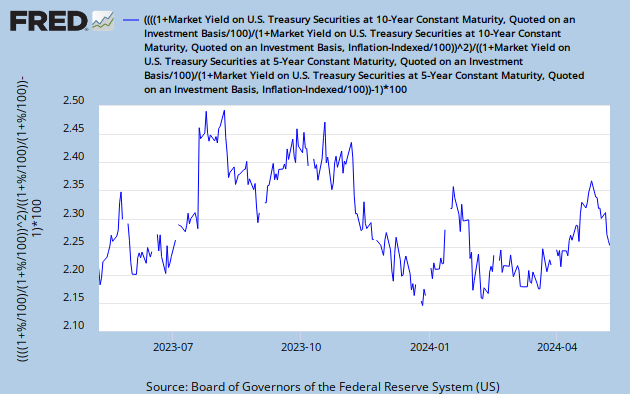
Inflation has moved somewhat closer to the Committee’s longer-run objective. Longer-term inflation expectations have remained stable. Inflation has been running below the Committee’s longer-run objective. Longer-term inflation expectations have remained stable. TIPS are showing slightly lower inflation expectations since the last meeting. 5y forward 5y inflation implied from TIPS is near 2.52%, down 0.08% from July.
Consistent with its statutory mandate, the Committee seeks to foster maximum employment and price stability. Consistent with its statutory mandate, the Committee seeks to foster maximum employment and price stability. No change. Any time they mention the “statutory mandate,” it is to excuse bad policy.
The Committee expects that, with appropriate policy accommodation, economic activity will expand at a moderate pace, with labor market indicators and inflation moving toward levels the Committee judges consistent with its dual mandate. The Committee expects that, with appropriate policy accommodation, economic activity will expand at a moderate pace, with labor market indicators and inflation moving toward levels the Committee judges consistent with its dual mandate. No change.  They can’t truly affect the labor markets in any effective way.
The Committee sees the risks to the outlook for economic activity and the labor market as nearly balanced and judges that the likelihood of inflation running persistently below 2 percent has diminished somewhat. The Committee sees the risks to the outlook for economic activity and the labor market as nearly balanced and judges that the likelihood of inflation running persistently below 2 percent has diminished somewhat since early this year. CPI is at 1.7% now, yoy.  They shade up their view down on inflation’s amount and persistence.
The Committee currently judges that there is sufficient underlying strength in the broader economy to support ongoing improvement in labor market conditions. The Committee currently judges that there is sufficient underlying strength in the broader economy to support ongoing improvement in labor market conditions. No change.
In light of the cumulative progress toward maximum employment and the improvement in the outlook for labor market conditions since the inception of the current asset purchase program, the Committee decided to make a further measured reduction in the pace of its asset purchases. Beginning in August, the Committee will add to its holdings of agency mortgage-backed securities at a pace of $10 billion per month rather than $15 billion per month, and will add to its holdings of longer-term Treasury securities at a pace of $15 billion per month rather than $20 billion per month. In light of the cumulative progress toward maximum employment and the improvement in the outlook for labor market conditions since the inception of the current asset purchase program, the Committee decided to make a further measured reduction in the pace of its asset purchases. Beginning in October, the Committee will add to its holdings of agency mortgage-backed securities at a pace of $5 billion per month rather than $10 billion per month, and will add to its holdings of longer-term Treasury securities at a pace of $10 billion per month rather than $15 billion per month. Reduces the purchase rate by $5 billion each on Treasuries and MBS.  No big deal.


The Committee is maintaining its existing policy of reinvesting principal payments from its holdings of agency debt and agency mortgage-backed securities in agency mortgage-backed securities and of rolling over maturing Treasury securities at auction. The Committee is maintaining its existing policy of reinvesting principal payments from its holdings of agency debt and agency mortgage-backed securities in agency mortgage-backed securities and of rolling over maturing Treasury securities at auction. No change
The Committee’s sizable and still-increasing holdings of longer-term securities should maintain downward pressure on longer-term interest rates, support mortgage markets, and help to make broader financial conditions more accommodative, which in turn should promote a stronger economic recovery and help to ensure that inflation, over time, is at the rate most consistent with the Committee’s dual mandate. The Committee’s sizable and still-increasing holdings of longer-term securities should maintain downward pressure on longer-term interest rates, support mortgage markets, and help to make broader financial conditions more accommodative, which in turn should promote a stronger economic recovery and help to ensure that inflation, over time, is at the rate most consistent with the Committee’s dual mandate. No change.  But it has almost no impact on interest rates on the long end, which are rallying into a weakening global economy.
The Committee will closely monitor incoming information on economic and financial developments in coming months and will continue its purchases of Treasury and agency mortgage-backed securities, and employ its other policy tools as appropriate, until the outlook for the labor market has improved substantially in a context of price stability. The Committee will closely monitor incoming information on economic and financial developments in coming months and will continue its purchases of Treasury and agency mortgage-backed securities, and employ its other policy tools as appropriate, until the outlook for the labor market has improved substantially in a context of price stability. No change. Useless paragraph.
If incoming information broadly supports the Committee’s expectation of ongoing improvement in labor market conditions and inflation moving back toward its longer-run objective, the Committee will likely reduce the pace of asset purchases in further measured steps at future meetings. If incoming information broadly supports the Committee’s expectation of ongoing improvement in labor market conditions and inflation moving back toward its longer-run objective, the Committee will end its current program of asset purchases at its next meeting. Finally the end of QE is in sight.  For now.
However, asset purchases are not on a preset course, and the Committee’s decisions about their pace will remain contingent on the Committee’s outlook for the labor market and inflation as well as its assessment of the likely efficacy and costs of such purchases. However, asset purchases are not on a preset course, and the Committee’s decisions about their pace will remain contingent on the Committee’s outlook for the labor market and inflation as well as its assessment of the likely efficacy and costs of such purchases. No change.
To support continued progress toward maximum employment and price stability, the Committee today reaffirmed its view that a highly accommodative stance of monetary policy remains appropriate. To support continued progress toward maximum employment and price stability, the Committee today reaffirmed its view that a highly accommodative stance of monetary policy remains appropriate. No change.
In determining how long to maintain the current 0 to 1/4 percent target range for the federal funds rate, the Committee will assess progress–both realized and expected–toward its objectives of maximum employment and 2 percent inflation. This assessment will take into account a wide range of information, including measures of labor market conditions, indicators of inflation pressures and inflation expectations, and readings on financial developments. In determining how long to maintain the current 0 to 1/4 percent target range for the federal funds rate, the Committee will assess progress–both realized and expected–toward its objectives of maximum employment and 2 percent inflation. This assessment will take into account a wide range of information, including measures of labor market conditions, indicators of inflation pressures and inflation expectations, and readings on financial developments. No change.  Monetary policy is like jazz; we make it up as we go.  Also note that progress can be expected progress – presumably that means looking at the change in forward expectations for inflation, etc.
The Committee continues to anticipate, based on its assessment of these factors, that it likely will be appropriate to maintain the current target range for the federal funds rate for a considerable time after the asset purchase program ends, especially if projected inflation continues to run below the Committee’s 2 percent longer-run goal, and provided that longer-term inflation expectations remain well anchored. The Committee continues to anticipate, based on its assessment of these factors, that it likely will be appropriate to maintain the current target range for the federal funds rate for a considerable time after the asset purchase program ends, especially if projected inflation continues to run below the Committee’s 2 percent longer-run goal, and provided that longer-term inflation expectations remain well anchored. No change.  Its standards for raising Fed funds are arbitrary.
When the Committee decides to begin to remove policy accommodation, it will take a balanced approach consistent with its longer-run goals of maximum employment and inflation of 2 percent. When the Committee decides to begin to remove policy accommodation, it will take a balanced approach consistent with its longer-run goals of maximum employment and inflation of 2 percent. No change.
The Committee currently anticipates that, even after employment and inflation are near mandate-consistent levels, economic conditions may, for some time, warrant keeping the target federal funds rate below levels the Committee views as normal in the longer run. The Committee currently anticipates that, even after employment and inflation are near mandate-consistent levels, economic conditions may, for some time, warrant keeping the target federal funds rate below levels the Committee views as normal in the longer run. No change.
Voting for the FOMC monetary policy action were: Janet L. Yellen, Chair; William C. Dudley, Vice Chairman; Lael Brainard; Stanley Fischer; Richard W. Fisher; Narayana Kocherlakota; Loretta J. Mester; Jerome H. Powell; and Daniel K. Tarullo. Voting for the FOMC monetary policy action were: Janet L. Yellen, Chair; William C. Dudley, Vice Chairman; Lael Brainard; Stanley Fischer; Narayana Kocherlakota; Loretta J. Mester; Jerome H. Powell; and Daniel K. Tarullo. Fisher and Plosser dissent.  Finally some with a little courage.
Voting against was Charles I. Plosser who objected to the guidance indicating that it likely will be appropriate to maintain the current target range for the federal funds rate for “a considerable time after the asset purchase program ends,” because such language is time dependent and does not reflect the considerable economic progress that has been made toward the Committee’s goals. Voting against the action were Richard W. Fisher and Charles I. Plosser. President Fisher believed that the continued strengthening of the real economy, improved outlook for labor utilization and for general price stability, and continued signs of financial market excess, will likely warrant an earlier reduction in monetary accommodation than is suggested by the Committee’s stated forward guidance. President Plosser objected to the guidance indicating that it likely will be appropriate to maintain the current target range for the federal funds rate for “a considerable time after the asset purchase program ends,” because such language is time dependent and does not reflect the considerable economic progress that has been made toward the Committee’s goals. Thank you, Messrs. Plosser and Fisher.  But what happens when the economy weakens?


Comments

  • Pretty much a nothing-burger. Few significant changes, if any.
  • Despite lower unemployment levels, labor market conditions are still pretty punk. Much of the unemployment rate improvement comes more from discouraged workers, and part-time workers.  Wage growth is weak also.
  • Small $10 B/month taper. Equities rise and long bonds fall.  Commodity prices are flat.  The FOMC says that any future change to policy is contingent on almost everything.
  • Don’t know they keep an optimistic view of GDP growth, especially amid falling monetary velocity.
  • The FOMC needs to chop the “dead wood” out of its statement. Brief communication is clear communication.  If a sentence doesn’t change often, remove it.
  • In the past I have said, “When [holding down longer-term rates on the highest-quality debt] doesn’t work, what will they do? I have to imagine that they are wondering whether QE works at all, given the recent rise and fall in long rates.  The Fed is playing with forces bigger than themselves, and it isn’t dawning on them yet.
  • The key variables on Fed Policy are capacity utilization, labor market indicators, inflation trends, and inflation expectations. As a result, the FOMC ain’t moving rates up, absent improvement in labor market indicators, much higher inflation, or a US Dollar crisis.
18 Sep 03:16

Italian workers were too productive for 20 years

by Antonio Fatas
The 2008 crisis has resulted in significant downward revisions of potential growth for most advanced economies. As output collapsed we revised down our expectations of what is feasible in the long-term. This has resulted in estimates of potential output that are much lower than the ones we had before the crisis. There are several interpretations of these revisions, some of which can be very depressing.

One interpretation is that we just realized that demographics and technology would not be as favorable as we thought going forward. The crisis might have raised awareness that demographic trends (aging) combined with weaker productivity growth will be unable to deliver the same growth rates as before. This is bad news but if this is what is going on, then we need to accept it or find ways to reverse those trends (increasing retirement age, finding levers for faster innovation,...).

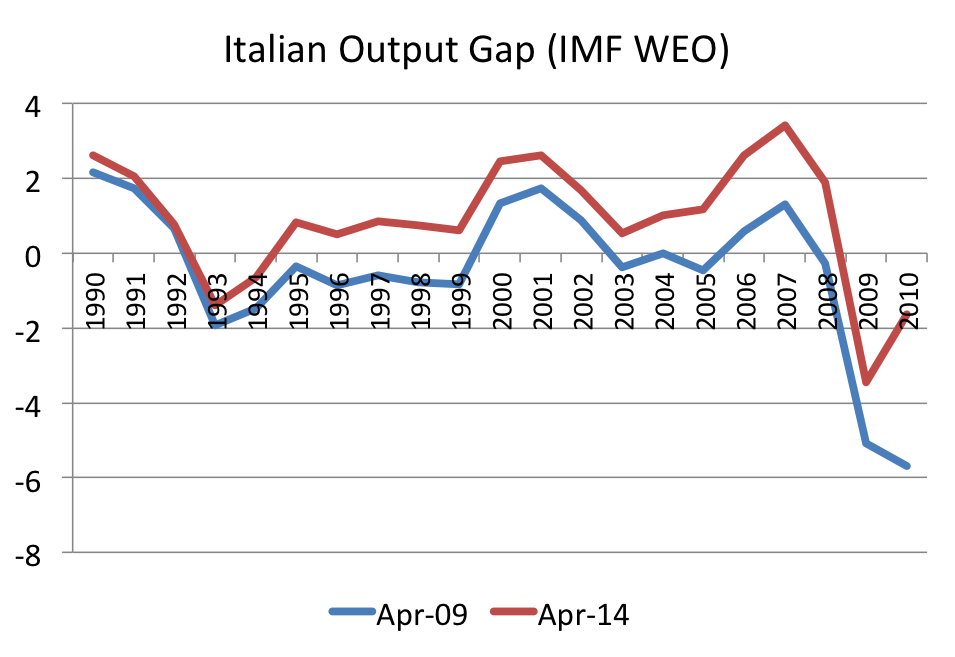
But this cannot be the main story behind the revisions of potential output given that most of the revisions are about the level of GDP, not so much about the growth rate going forward. As an illustration, I am plotting below the output gap for Italy as estimated by the IMF World Economic Outlook back in April 2009 and in its latest issue (April 2014). The output gap is the difference between actual GDP and potential GDP.


Since the crisis started not only we have changed our views about the future but we have also changed our views of the past. If you look at the blue line you can see that in 2009 we thought that the Italian economy had been growing at a rate similar to potential output for the previous 19 years (and remember that growth rates in Italy were already low during most of these years). But today we believe that Italy was producing "too much" during all those 19 years (with the exception of 1993). Every single year Italy was somehow employing too many workers or those workers where being too productive. Why that change? Because of the interpretation that some (most?) of the GDP fall during the crisis will be permanent and to make this consistent with what happened before the crisis we need to lower out estimates of potential output in those years as well. Let me me be clear, we have no theory and no direct evidence that potential output during those years was lower than what we thought before, we are simply finding a way to validate the current level of output that seems to be going nowhere. And because it GDP refuses to grow it must be permanent and structural.

The alternative (and much more depressing) interpretation is that a crisis, which is clearly global in its nature, this is not an Italian crisis, has resulted in a a very long period of low growth. This low growth has had an effect on potential output because long-term growth rates cannot be completely separated from cyclical conditions. Labor market conditions have an effect on long-term unemployment, discouraged workers and participation rates (what Blanchard and Summers called backed in 1986 hysteresis in labor markets).  But even more fundamentally, investment rates, technology adoption are slowed down by cyclical conditions and these are the forces that drive potential growth rates. So the longer is the recession, the bigger the impact on potential output (I was very interested in these dynamics back in the late 90s and wrote a couple of papers with supporting empirical evidence: here and here).

From a policy point of view the two interpretation lead to completely different recommendations. Under the first interpretation we have been living in a fictitious world for the last 20 years thinking that we were more productive. Finally we understand that we are not so it is the time to adjust and live within our means. As this working paper from Bundesbank puts it

Consequently, earlier growth paths are probably no longer achievable, particularly for some European countries. Substantial macroeconomic imbalances built up... and painful adjustment processes are now underway. Attempts to explain this merely through a major shortfall in aggregate demand are far from convincing.

Under the alternative scenario we are now learning that the costs of crises are a lot larger than what we thought. We are not just talking about transitory output losses but events that leave permanent scars on the level of GDP. So it is time to react and generate enough growth not just to go back to potential but to restore the mechanisms that drive its long-term growth.

Antonio Fatás

17 Sep 12:03

Google Launches Newsstand in India. Will Indians Buy (Anything) On Android?

by NextBigWhat

Google is on a roll in India. The company launched Android One in India, announced offline Youtube access on Android One devices and has also launched Newsstand in India (in partnership with 30 publishers including India Today/NDTV/Forbes India etc).

Google Newsstand in India

Google Newsstand in India

Will Indians buy (anything) on Android?

India is an Android nation, but unfortunately Indians do not buy on Android (1 year back, half of Android users didn’t even have data plan). Google is smartly bundling Newsstand free for one year for all customers who are on Android One – i.e. the company is trying to hook them up and eventually plans to show value to developers, who are mostly living well below the app poverty line.

App Developer Revenue : Not a Happy World

App Developer Revenue : Not a Happy World

So far, the Android story in India has mostly been about a ‘great looking smartphone’, but there has been very little monetization angle to Android.

Serious app developers and publishers prefer iOS when it comes to monetization.

Will this change with Android One? We don’t think so (unless there is operator billing integration enabling micro-payments).

The post Google Launches Newsstand in India. Will Indians Buy (Anything) On Android? appeared first on NextBigWhat.com

17 Sep 12:00

Making Systematic Risk Disappear, Not

by David Merkel

Yesterday I was at a conference for Registered Investment Advisors. There were about 11 of us in the room, and a variety of different parties pitched us on their services. Some of the pitches were harder, most were softer.

Two of the presentations I felt were deceptive, though I don’t believe the presenters intended to be deceptive. The idea was, you need to provide alternative investments to your clients, because clients can’t earn what they need to in stocks and bonds. Private equity investments and real estate outperform stocks, and we have new durable income vehicles that outperform bonds. What’s more, we can remove a lot of volatility from the portfolio.

Imagine for a moment that you’re investing in two private companies that after you buy them, you will have to own them for 10 years. The money is committed, and you have no way to get liquidity from the companies until the 10 years are up. One of the companies will leverage up a little bit, and invest in stocks. The other company will leverage up a great deal, and invest in bonds; it will behave like a shadow bank.

Now imagine on your brokerage statement, that your broker does not have to mark the positions to market.  After all, the corporations are not publicly traded and so the companies are valued at the amount of your investment until they dissolve and pay out their proceeds at the end of 10 years.

Does this method of investing limit volatility? It looks like it does, but it really doesn’t. Your investments are subject to all of the vicissitudes of the stock and bond markets, and then some, because the private companies took on some leverage. Though the values may be constant on the accounting statements, the volatility of the investing will be delivered in full at the end of the 10 years.

That’s the way some of these alternatives work, except they get applied not to public stocks and bonds, but private companies, real estate, mortgages, etc.  They are subject to the same economic forces as the public stocks and bonds, and once you strip out the effect of the additional leverage they perform about the same.

The story was told that this is the way that the wealthy got wealthy, by investing in private corporations, and investing in real estate. This is true as far as it goes except that the wealthy concentrated their investments in a few real estate projects and a few corporations that they themselves actively managed. Those offering alternative products investing in private equity and real estate are investing far more broadly in order to reduce risk. Even if the investments do well, you won’t get wealthy off them, though you might do well.

What is also not mentioned is that many more people who try to become wealthy by concentrating their investments fail. If this were easy, everyone would be doing it. The volatility is not eliminated; far from it, the volatility is amplified, and for those wealthy that succeed, that was the road to wealth for them.

As with public equity and bond investments, you will find that there are talented managers who can outperform the rest. Many of the talented managers in private investments limit the amount they manage, and money from new investors is not welcome.  The best managers of alternative investments are not open to the public, and not to these private investment middlemen as the conference.

The same logic applies to hedge funds. There are many different types of hedge funds, and performance data for them is dirty. Some managers are good, some are bad, and on average they’re about as good as markets they invest in. As for some of the data abnormalities, the good ones get into the databases before they’re actually taking money from outside clients which overstates the returns to clients. The bad ones exit the databases early, so the returns on their failure do not get reported.

Though some notable managers will do well, average managers will not outperform investments in public stocks and bonds. This is another case where the actual underlying investments matter more than the legal form that the investments take. Private and public investments exist in the same economy and get roughly the same returns. This should be no surprise.

The upshot of what I’m trying to say is that if you are not investing in alternatives, don’t feel bad because you’re not missing anything on average. Just beware slick marketing pitches designed to make you feel inferior because you’re not one of the “cool kids” investing in illiquid private securities.  After the next bear market, many “cool kids” will find that they lost a lot of money along with everyone else, if their alternatives mature in the bear market.

A Final Note — Fixed Income or Banking Income?

I also believe that income investors in some of these new approaches will be the most disappointed in the next bear market. When I was a portfolio manager managing mortgage bonds, we had a rule: don’t buy mortgages on operating properties like hotels, marinas, casinos, theaters, etc. When you do that, you cease to be a lender, because the underlying cash flows of the property are not stable enough to support a loan. If you do such a loan, you have a smaller loan that is real, and the rest is an equity investment.  In a bear market, that “equity investment” could prove worthless.

People will find out this same thing with durable income products, they will prove far more risky than ordinary fixed income investments in the next bear market because they are running a levered lending business. And in the few cases where the business is not levered, the riskiness of the investments is higher than what would commonly expect.

And thus my counsel is focus on the return of your money, rather than the return on your money. Play it safe with your fixed-income investments.

17 Sep 03:28

Basic HR tips for the IFA

by subra

Financial planning, selling mutual funds, life insurance, other financial products…all these are functions that an INDEPENDENT FINANCIAL AGENT does.

I have met many IFAs – and most of them are one man shows. Some of them of course are bigger and have between 2-10 employees. When you have a few employees, HR comes into play. No, you do not need a HR manager to handle a team size of 10, but good HR practices cannot be ignored.

Let us look at some of the challenges:

1. Most IFAs tell me ‘this is the best quality of people that I can get’ : the IFA himself is SURE that good people will not join him. They are sure that good people will either get better jobs or they will go for higher studies. This is not true – there are many kids who cannot afford higher studies and are looking for a career near their houses – so recheck your catchment area.

2. Make sure that the basic hygiene is in place – a clean loo, at least 2 women employees (get a family member in at least for some time if u have only a young girl working in your office), cleanliness of office – physical and mental, making sure that the staff use nice language – some girls can get terrified if they hear ‘gaalis’ from the boss, BE CAREFUL.

3. Have a nice atmosphere – celebrate birthdays, holidays,…whatever – keep the atmosphere friendly, DO NOT CRINGE ABOUT costs. Offer nice, free good advice to the kids in the office, give them good career guidance, academic and financial guidance. Make them feel wanted and relaxed. If you file IT returns do it FREE FOR THEM, their parents, etc. it helps.

4. Pay slightly more than the market, but obviously less than the organised sector – you cannot afford to compete with HDFC Bank, right? Spend lavish amounts of time in training them and teaching them. Get your friends to talk to them about subjects that they love – cricket, music, films, …does not matter what.

5. Take them out to lunch frequently and lavishly – remember no IFA closed down because he spent money on his staff eating well. You lose business because your employee spoke poorly.

What are the advantages of doing all this?

1. Employees will stay loyal to you : Remember your database is your ONLY asset. All employees carry a cell phone and a camera, so stealing data today is child’s play. One disgruntled employee can steal your efforts of the past 30 years. Caveat.

2. Happy employees talk to customers well, ask for reference, and do not ask clients for leads for jobs!! The whole atmosphere can be made friendly, happy, and successful….these kids will enjoy what they are doing only when they feel wanted…

3. I interact with many small businesses – and have had pleasure and pain. One hotel with good food and decent service left a poor after taste once at dinner…putting me off by about 6 months – before I visited them again.

4. A good enthusiastic employee will be proactive with clients – their enthusiasm will rub off on the client too. Once they know the values of the organisation, they will encourage longer SIPs, reduce withdrawals – have seen this happening in 2 IFA offices in Mumbai. Sadly I do not have too much interaction with the IFA offices so cannot generalize very easily.

5. By being different from the competition, your employees will also be proud that they are adding value to the whole chain! I know one IFA who has guaranteed all his staff’s Home Loan and provides LUNCH from a good source on a DAILY basis. His longest serving employee has been with him for the past 14 years. Business is about 16 years old…

…more to follow…

Post Footer automatically generated by Add Post Footer Plugin for wordpress.

16 Sep 03:14

Real Estate a Fantastic Investment?

by subra

Is real estate a fantastic Investment?

If yes, are the math tools available to prove that?

If no, are the math tools available to prove that point of view?

The jury is still out there to judge these questions and there are no clear answers. However I found an article in the Times of India (it is an old article, May 2014)..and am reproducing it here.

Read the article carefully – when it is considering the costs, the author has considered only 6% costs – in reality there is a 6% stamp duty, there are society entry fee, brokerage, if the paper work is done by a lawyer then the lawyer’s fees…in all practically the costs come to about 8% – and some times it can go higher to about 10%.

While considering the rentals, he has assumed A FULL OCCUPANCY with a clear annual increase – nice assumption, rarely holds true.

He has ignored society charges – assuming Rs. 1000 a month – that also changes the equation by a bit.

Instead of saving money in a bank fd, if the person were to keep it in an EQUITY mutual fund, the whole gain is TAX FREE….


http://timesofindia.indiatimes.com/business/india-business/Only-builders-banks-gain-when-you-take-loan-to-invest-in-realty/movie-review/34712813.cms

Post Footer automatically generated by Add Post Footer Plugin for wordpress.

15 Sep 03:05

Why maintain an Investment diary or a Private Investment blog

by subra

A lot of big investors are humble.

Do you know why this happens? Simply because they keep an investment diary. It is your investment diary and your real life kids who keep your ego in check.

If I go back and recollect why I bought certain shares, I feel it very funny. I am an incorrigible value seeker – and for me value HAS to come from cash compensation in the holding period. This normally means dividend, because my only asset class is equities. If my equities were to be taken away from me and my immediate family I would be devastated.

Let me tell you some of the mistakes and wrong calls.

1. Bought Cholamandalam at 65: Happy with the call timing (could have been far better, it was also available at 47). I thought it would be 5 bagger when I bought it a few years ago. Was compensated on the way by way of decent dividends (about 5% yield). However NOT SELLING NOW could be a mistake, only time will tell. However partially sold a few shares ….and I guess if it does become a 10 bagger, I hope to live to tell the tale.

2. Kajaria Ceramics: Have said this in the past: One of the worst things one can do is buy a small lot and sell on the up…and be left with 500 shares without the heart to buy at this price.

3. Bharti Airtel: First time bought it at 80 and sold it at 1200. Sadly a very small lot. Now hopefully will ride it from 257 to Rs. 500 at least – even if it takes 3 more years. Thankfully size is decent.

I could just go on and on. If you maintain a diary and you write down why you are buying (Subra told me, Subra’s barber, doctor, driver, reader – told me, whatever be the reason. When you maintain it in excel sheets you can also set targets, benchmarks, etc.

You write down the reason and go completely wrong. Whenever there is a BIG MISTAKE take action. I bought Crest Animation BECAUSE Vallabh Bhansali joined the board. Forgot to sell when he quit. So, so, so damn stupid.

Having a diary, writing a diary, seeing the DIARY REGULARLY for what action to take – all these are required.

I did not do it diligently, I wish I had.

Please listen to the rants of an old man…..


Post Footer automatically generated by Add Post Footer Plugin for wordpress.

15 Sep 03:04

ECB: QE or QT (Quantitative Tightening)?

by Antonio Fatas
Charles Wyplosz at VoxEU questions the potential effectiveness of quantitative easing (QE) as recently announced by the ECB. His main concern is that the ECB version of QE is supply driven, as opposed to the one implemented by the other central banks which is demand driven.

In the case of the US Federal Reserve or the Bank of England, the central bank buys securities and those securities permanently increase the size of the bank's balance sheet. Liquidity is provided regardless of the actions of commercial banks. In contrast, the ECB so far had always relied on the demand from commercial banks for liquidity. The ECB made loans available to commercial banks, and as long as commercial banks demanded those loans, the balance sheet of the central bank also increased (with the deposits of commercial banks being the liability that appears on the other side). But this means that in many ways commercial banks are driving QE. It is their desire to hold more liquidity the one that determines the expansion (or contraction) in the size of the ECB balance sheet.

To understand these dynamics, here are some charts from the ECB web site. First the total size of the balance sheet of the ECB.


We can see several steps after 2008 that increased the size of the ECB balance sheet to about 3 trillion Euros. But we can also see that since 2013, the balance sheet has decreased by more than 1 trillion euros (and no one noticed, by the way). What was he ECB doing? Not much. This is simply the outcome of commercial banks returning the loans that they have gotten earlier from the ECB. Here is the chart with those loans ("lending related to monetary policy operations").


And remember that these loans had to be sitting somewhere else on the liability side of the ECB, they appear as deposits of commercial banks (reserves). Here are the balances of the two accounts where these funds are held (current account and deposit facility).


The pattern of the four charts is very clear: the availability of liquidity by the ECB led to a very large amount of loans being demanded by commercial banks. This increased the size of the balance sheet and the deposits of commercial banks on the ECB. This liquidity had limited effect on lending to the private sector (although it probably protected the financial sector from an even-larger crisis). But as economic conditions stabilized or improved, commercial banks saw no need to hold such large amounts of liquidity so they simply paid back the loans to the central bank. The fact that interest rates on these deposits are now negative led to an acceleration of this trend. So the actions of the central banks (such as negative interest rates on banks' deposits) are not creating an incentive for commercial banks to lend, they are simply creating an incentive for the liquidity that the ECB created to decrease substantially (reverse QE!).

In the last months the ECB has tried to be more aggressive, first with the launch of targeted long term refinancing operations (TLTRO) back in June. But the details of this plan are still unclear (does anyone remember it?)  plus it relies once again on the willingness of commercial banks to lend to the private sector and finance this lending via the central bank. But we just saw commercial banks returning all the liquidity that they had previously borrowed from the ECB. Why will the ask for more?

In the last meeting, the ECB announced a change in strategy with the plan to purchase asset-backed securities. While in some sense this is the first time where the ECB will engage in supply-driven QE (no loans associated to these purchases), the wording of the plan has left many questions open about the extent to which this is a "permanent-enough" commitment to increase the ECB balance sheet and, in addition, the potential volume of these purchases could be small. Small enough that they will not be compensating the fall in the ECB balance sheet that we have witnessed in the last year.

Unfortunately, the ECB is likely to face soon the same question it has faced over the last years: what is next?

Antonio Fatás
14 Sep 16:02

Trial by ordeal: dipping hands in boiling oil – an ongoing Indian tradition

by Sanjeev Sabhlok

This is a placeholder for one of the most barbaric customs that still continues in India. I’ve tried to identify the source of this barbaric custom. Not clear whether it originates in any Hindu scripture, or just mythology. But it is still prevalent in India as the news reports of 2006, 2013 and 2014 show.

ORIGIN

1) Studies in Hindu Law and Dharmaśāstra by Ludo Rocher

2) Description of the Character, Manners, and Customs of the People of India by Jean-Antoine Dubois:

The small regard the Hindus have for an oath makes them seek, in difficult variety of tests and ordeals, by which they affect to try if a suspected person is really innocent or guilty. They admit nine or ten sorts of the ordeal; the most of which are the same as those anciently used in Europe, and elsewhere, under similar circumstances. Amongst the Hindus, the most frequent appeal is to fire; by compelling the suspected persons to walk bare-footed over burning coals, or to hold a bar of red hot iron a considerable while in their hands. Sometimes it was enjoined them to plunge their hands for a time in boiling oil. If the party under trial goes through the experiment of the fire, without wincing, or receiving hurt, he is declared innocent of the crime imputed to him; but if he receives injury from the test, he is held to be convicted on clear evidence, and receives the punishment applicable to the crime of which he has been thus found guilty.

INCIDENTS

1) Madhya Pradesh (2014)

MP: Minor boys suspected of theft made to dip hands in boiling oil

2) Gujarat, 2013

When 100 people ‘were forced to’ dip hands in boiling oil

3) Rajasthan, 2006

150 men forced to dip hands in burning oil over foodgrain theft

14 Sep 16:02

Fatter than your father?

by subra

How many guys over 30 years of age are now FATTER than their fathers?

Have you wondered why?

“I remember what my grandfather and father used to eat when they were my age, I SURELY EAT LESS than them, but I am fatter than what they were at my age” – said a friend. I said there is not much to think about. Blame it on your life style that is all..I said. So we set about looking at the problem in a different way.

I asked him a few questions..and he gave truthful answers:

What was your weight when at college?

He: Not sure but I guess it was in the mid to late 50s..say 57kgs.

Me: What is your weight now?                He: About 84 kgs.

Me: When did you leave college?              he said 1988

Me: Which means you have put on 27kgs in about 27 years…is that right?

He: Yes, yes I have put on about 1kg per year…

I told him the following:

Your father ate more at home, and less outside. As a family your mother bought more raw material and made things at home, but you tend to buy more things. Your consumption of MAIDA has gone up SUBSTANTIALLY because you not only eat samosa (which your father also did), you also eat noodles, bread, pizza and a host of other such products.

Your father went using public transport to go wherever he wanted. This meant he walked down the steps (your old building did not have a lift), he walked to the bank, he went shopping he WENT walking and took a rick only if the had to buy (and carry) a lot of things (that too on the way back).

Assume for a minute that all this took about 100 calories. Also assume that you drink one cup of extra tea a day. (about 100 calories a day). This means that you are consuming about 20o calories a day. The rough equivalence is about 8000 calories add up to one kilo. So in one year – you are consuming about 73000 calories MORE than your dad (365 * 200). This is about 9 kg a year is the weight that you are putting on every YEAR….you are lucky that you are doing something because of which your weight has gone up by ONLY ONE KILO per year…it should have been more.

Now get serious, keep a tab on what you are eating, how much,….etc…..and take care.

Post Footer automatically generated by Add Post Footer Plugin for wordpress.

14 Sep 03:36

What I told a Frustrated Guy in Job. At 37, He Retired few Months Back - Part 3

by Dev Ashish
This post was long due after I did Part 1 and 2 in April this year. Though the story of this guy was covered in first two parts, I wanted to do a follow up post highlighting some of the important points raised in comments of the post. Readers like Krish, Bharat and many others made some noteworthy points, which I feel need to be shared with a larger audience and hence this post. You can
14 Sep 03:36

A dramatic cost reduction for KYC using the e-KYC API of UIDAI

by Ajay Shah
by Suyash Rai, Smriti Sharma, Sanhita Sapatnekar.

The problem


On 2001-09-11, Mohammad Atta hijacked American Airlines Flight 11 and flew it into the North Tower of the World Trade Centre. Tracing flows of money led to the observation that a high ranking official within Pakistan's Inter-Services Intelligence (ISI) had allegedly ensured more than USD 100,000 was wired to Mohammad Atta, before the attack took place. Law enforcement authorities became quite keen to observe and block the `financing of terror'.

The Financial Action Task Force (FATF) develops and promotes policies that hinder money laundering, financing terrorism and financing weapons of mass destruction. One element of this requires financial institutions of member countries to implement `Customer Due Diligence' (CDD) for a variety of financial activities and circumstances. India is a member of FATF and Indian regulators are obliged to apply CDD. Regulators in India have applied CDD through excessive forms of `Know Your Customer' (KYC) requirements, which go well beyond the principles-based risk-sensitive requirements of CDD. As a result, financial firms in India face increased costs.

When an Indian financial service provider deals with a low value customer, the cost of performing the KYC that's required is often a substantial one when compared with the lifetime NPV of the customer. This has hampered financial inclusion by reducing the profitability of small value customers in the eyes of financial firms.

In 1999, Project OASIS (Old Age Social & Income Security) was established by the Ministry of Social Justice and Empowerment to make recommendations on how to develop old age income security. One of the key insights of Project OASIS was the importance of modern computer technology for the objective of serving small value customers. Paper- and human-intensive processes can even be viable for the rich, but when dealing with poor people, the only way to make ends meet is to push to the frontiers of technology.

A new attack upon the KYC problem


The Unique Identification Authority of India (UIDAI) has developed a novel technology that cuts the cost of opening an account by approximately 80%. The steps of this process are as follows:

  1. First, the customer has to have already enrolled in Aadhaar once. This involves supplying the name, identification, address details, and biometric data including the photograph. As there are many Aadhaar applications springing up in India, many individuals have ample incentive to undertake this cost of enrollment, once. Recent data shows that 670 million people in India have enrolled.
  2. Now let's focus on the account-opening process at a financial firm. The customer shows up with his Aadhaar number.
  3. The staff-person at the financial firm engages with the customer and takes the Aadhaar account number and captures fingerprints using a device.
  4. Aadhaar has provided an applications programming interface (API) through which the software at the financial firm now reaches into the Aadhaar database, presents (encrypted) credentials of a Aadhaar number and matching fingerprints, and requests a packet of information.
  5. This information is used to populate the form for the account-opening process. E.g. the photograph is brought from the Aadhaar database and placed into the account opening form. The entire process -- from fingerprint to completed form -- takes roughly 15 seconds.

e-KYC eliminates human effort in account opening, and allows residents to present their KYC information electronically and instantaneously, without needing any physical form of identity or address proof. e-KYC eliminates the movement and storage of verification papers, and therefore costs of document management. Error-free data is obtained from the Aadhaar database, at a much lower cost when compared with the costs of typing in and removing the errors in human-created data. e-KYC is a game changer when it comes to opening accounts for poor people.

An example


Invest India Micro Pension Services (IIMPS) enables low income informal sector workers to accumulate micro-savings for their old age. It has faced KYC challenges in the past, and is an early adopter of e-KYC. IIMPS's target population, i.e. the informal sector poor, cannot gain access to formal financial products as they have insufficient identity documentation (due to factors such as migration), or a complete lack thereof. As a result of this, and due to differences in KYC compliance across regulators, a host of interested low income workers are unable to join the integrated micro-pension program. This is only the first half of the problem. Lengthy KYC application and verification procedures cause significant cost and time overhead expenses for IIMPS while processing each micro-pension application. e-KYC has resolved both of these issues.

Watch a demo


Making it a reality


In the past, there has been doubts regarding the future of UIDAI's Aadhaar project. However, the BJP government has recently reaffirmed its interest in continuing with it. e-KYC is a valid document for all financial services, under the Prevention of Money Laundering Act Rules. e-KYC has also been accepted as valid proof of identification and address by five regulators in the financial sector, namely the Reserve Bank of India (RBI) ; the Securities and Exchange Board of India (SEBI) ; the Pension Fund Regulatory and Development Authority (PFRDA) ; the Insurance Regulatory and Development Authority (IRDA) ; and the Forward Markets Commission . It is also compliant with the Information Technology Act, 2000. This means the encryption and digital signatures ensure both end-points of the data transfer are secure, making e-KYC legally equivalent to KYC paper documents. e-KYC is up and running. However, most financial firms do not (at present) utilise it. They need to modify their software systems in order to utilise the API. As only 670 million people are enrolled in Aadhaar, financial firms have to have the ability to do the old-style KYC also. In the future, there could be situations where the entire process capability for conventional KYC is removed, which would further reduce costs.
14 Sep 03:28

Two short videos on what a government should (and should not) do. An updated SKC agenda for comment. And more.

by Sanjeev Sabhlok

Copy of my email circulated widely yesterday. Feel free to share this blog post widely.

====BEGIN EMAIL===

Dear Friends (I’m also addressing those bcc.d)

1) Videos:
I’ve recorded two short videos today – on what a government should do and what it should not. I’ll make around ten or so more videos, one each on major policy areas. Do provide feedback.

(7 minutes)


and (4 minutes)

2) SKC agenda:
I had sought comments on the draft Sone Ki Chidiya agenda by 30 September. I have received numerous comments which I’ve now reviewed and incorporated into the next draft [I am unable to share the tracked changes version on the blog]. The ‘clean’ Word and PDF versions can be downloaded from here: http://sonekichidiya.in/. If you haven’t sent your comments yet, please do so by 30 September, to allow me time to revise the document for printing.

3) Invitation to endorse the agenda
If you broadly endorse the agenda and are happy to have your name published as a supporter of the agenda, please write directly to me (sabhlok@gmail.com). We will print 1000 copies of the agenda for distribution to the media. Together we’ll make the agenda even better in the coming months/years.

4) In revising the agenda I reviewed Kumaraswamy’s recent book on governance reforms (see my review) and Prof. PV Indiresan’s policy reform book/ articles (see review here). I’m currently reviewing Madhav Godbole’s Good Governance: Never on India’s Radar, and will review Bibek Debroy’s Getting India Back on Track before the agenda is prepared for print. Do alert me to any other good book I should review.

I was happy that Prof. PV Indiresan promoted state funding of elections, school choice, shift to urbanisation, and many good things which are already part of the SKC agenda. He would surely have supported this work.

5) On a related note, I’m now developing RTI applications regarding Ramdev’s business empire. I had requested Ramdev to provide me relevant information, which he did not. Now it is time for RTI. Please volunteer to assist me if you have some time. For the good of the country one hopes Ramdev is an honest man, but given the information I’ve received from multiple sources, it is necessary for me to personally confirm this.

===END EMAIL===

13 Sep 09:54

Risks that worry and Risks that kill…

by subra

As human beings we do not understand risk much. Our brain gets excited when Tragedy is combined with Mystery. And we have no clue of what is tragedy. The Jury is still out on whether death is a tragedy!

We worry about ‘risks’ that hit us suddenly, in big numbers (air crash), mysterious (nuclear leakage), but not about things which could really impact us (road safety – drunken driving, dozing off while driving, not wearing a seat belt, poor car maintenance, over eating, lack of exercise etc.).

Take the American context – I would be worried if my daughter told me that she is going to a friends house if the friend’s father had a gun. Guns scare us. However 2 girls aged 15 could be in far greater danger of trying alcohol and drowing in a swimming pool.

Take the case of Investing. People worry too much about volatility in a portfolio, and not about the ABSOLUTE returns over a long period of time. If you do not have time or the inclination to invest in direct equities or managed funds, go and do a SIP in an index fund. YOU JUST CANNOT GO WRONG if you do a 10 year SIP. Over this period you will see the markets go up, go down, some funds beat the index, some under perform the index. As long as you promise YOURSELF that you will not worry about VOLATILITY, you will get awesome returns adjusted for inflation.

The catch phrase of course is “You should remain cool”.

Even when ET does an article like how you could have got only PPF returns over 20 years, you realize that it is either a stupid article or an article which has picked up the date PERFECTLY. The year 1993 was one in which equities gave 65% returns – it takes a couple of years to recoup such a sprint, does it not?

So such articles FEED on the risks that scare. The ET will not come out with an article showing the impact of inflation on wealth. Why? because it is far more difficult to do.

So here is a challenge – take 3 scenarios – assuming a nice portfolio (even Sensex is fine) see the impact of timing – one person who bought at the TOP every year from 1979 to 2014, one person who bought only at the bottom every year, one who did a flat investment every month….YOU WILL BE AMAZED TO SEE THE IMPORTANCE OF time (n) of the compounding formula. The impact of r is at best marginal.


Post Footer automatically generated by Add Post Footer Plugin for wordpress.

12 Sep 14:45

The Economic Advantages of an Independent Scotland

by Justin Fox

If its voters choose independence next week, Scotland will join the ranks of the world’s small, affluent countries. Over the past couple of decades, that’s been a good club to belong to. As Gideon Rachman put it in the FT in 2007:

This is the age of the small state. Look at almost any league table of national welfare and small countries dominate.

Things have gotten a little more complicated since then. (Rachman in 2009: “Big is beautiful again.”) Several small nations suffered brutally from the financial crisis and subsequent Euro mess: Greece, Iceland, Ireland, Portugal.

Still, several of the emerging bigs (Brazil, India, Russia) have since run into economic headwinds too. And small countries remain overrepresented near the top of lists of the world’s most affluent, most competitive, healthiest, and smartest nations.

So it’s not crazy to think that Scotland, which on its own would be a country of 5.3 million people with a GDP per capita ranking between Finland’s and Belgium’s (that’s counting offshore oil revenue), could be an economic success. But it’s not guaranteed, either.

What has made small countries so economically successful over the past few decades is less their smallness than the ways they’ve taken advantage of it. David Skilling, a former New Zealand government official and McKinsey consultant who now advises small-country governments and companies from a base in Singapore, has spent as much time thinking and writing about the strengths and weaknesses of small states as anybody. In a 2012 paper that should be required reading in Scotland, he lists two main characteristics of successful small states:

  1. They’re cohesive, and thus able to make policy decisions quickly and stick with them.
  2. They tend to make good policy decisions, in part because they’re very aware of the world around them and what it takes to compete in it.

In polls, Scotland appears evenly split on whether to leave the United Kingdom. That doesn’t look very cohesive. But one of the forces that’s been driving Scotland toward possible separation has been the divergence between Scottish political priorities and those of the rest of the UK. The ruling Conservatives hold only one of the 59 Scottish seats in the British parliament; two leftist parties, Labour and the Scottish National Party, dominate Scottish politics. If the question of independence were settled, it seems like the Scots would be able to find lots of other things to agree on.

Would they agree on the right things? A generous welfare state and economic success aren’t incompatible for small nations — there are several examples of this just across the North Sea from Scotland. But since a stretch of tough economic times in the early 1990s, Denmark, Sweden, and Finland have combined their generosity with remarkable efficiency and economic savvy (Norway, with its vast oil riches, hasn’t had to make quite as many hard choices). They and other successful small states tend to balance their budgets, export more than they import, and invest heavily and smartly in infrastructure and R&D. As Skilling tells it, they have designed their economies to be globally competitive.

“Being a small country offers a lot of in-principle upside, brings with it significant risks, and is what you make it — but it’s only for serious countries,” Skilling replied when I emailed him about Scotland.

So is Scotland serious? Skilling thinks it is, but the leaders of the “Yes” movement don’t seem to be quite there yet. They assume that they can continue in a currency union with London when officials in London say that won’t work, for one thing. What’s more, Scotland today has giant government deficits, a fast-aging population, and not much in the way of exports apart from oil, The Economist argued this summer. That, and it has spent the past three centuries becoming ever more economically intertwined with the rest of Britain. Set loose alone on the rough seas of the global economy, it seems likely to founder at first.

After that, the question is whether the small-state effect would kick in. Would the Scots be able to get their act together and rally around things like fiscal discipline and smart tax policies and R&D investment? This is the land that spawned such great economic thinkers as Adam Smith, David Hume, and — what the heck — John Law. Surely the Scots could figure it out eventually. And once they did, it is entirely possible that an independent Scotland with a clear economic identity would be a more vibrant, cosmopolitan, thriving land than the sometimes-neglected northern appendage of a populous country that it is now.

The big question — which neither I nor anybody else outside Scotland can really answer — is whether it would be worth the pain it will probably take to get there.

12 Sep 08:10

Asset Allocation is a full package…!

by subra

Many people do not know the word asset allocation. Recently I have been talking to reasonably successful people who have achieved fantastic financial success but with a breathtakingly risky portfolios.

This is like saying ‘I drove from Mumbai to Pune in 2 hours flat – I drove at a speed of 120 km per hr.’

Met a few people last week – and 2 SENIOR EXECUTIVES stood out dramatically in this group. Both were CEOs  and both had created net worth of Rs. 50 crores each for themselves. Sure they had very good salaries, they were investing aggressively and obviously were lucky!

However the routes chosen was very very different. The first person had bought a lot of real estate since the late 90s, flipped properties, leveraged to buy more, paid off the loans fast and every 3-4 years sold, took the profits and leveraged once more!

The second person had got a lot of ESOPs from 3 companies in which he worked – and ALL the 3 companies had done well. His net worth of Rs. 50 crores included Rs. 44 crores of one companies esop. He had leveraged, taken the esop, and held on.

What is wrong with such wealth creation? Well it is like the guy who traveled from Mumbai to Pune in 2 hours. Does it make sense NOW to continue with such dare devilry?

One important thing to note is that Big Wealth has been created using business acumen, concentrated bets, leverage, and some mind boggling risks.

HOWEVER, having created say Rs. 40 crores using such a strategy, CAN YOU AFFORD to lose it all?

The answer is NO.  You need to reduce risk (it may not improve your net-worth, but it will let you sleep better.

The concept of asset allocation is that your assets (what you own) should be split into a few asset classes so that you do not put all your eggs in one basket. The biggest asset that a 30 year old has is?

OBVIOUSLY HIS FUTURE EARNING POTENTIAL – over the next 30 years he will earn say Rs. 15 crores. All his other assets pale in significance compared to this asset. Now assuming he is in a private sector he could assume a reasonably rough  ride to become the CEO and earn much more. However if he is in the government he will get a smoother ride and an indexed pension. So really the sum total of the money adjusted for time value is really not very different. So if you have a high risk private sector job with a lot of incentive based payments, you should have a portfolio more in debt – sure, largely fixed, and secure. If you have a not very well paying government job without much cash, you should have a more variable portfolio. Thus over all balancing your risk – in the job and in the investment

So when you consider asset allocation consider the following as your assets:

Qualifications, Job, and Industry: A well qualified person in a growing industry is obviously better off. If you are working in a dying industry and you are 48 years of age, well your risk profile is lower.

Understanding and liking of assets: I understand Real Estate but do not like it as an asset class. Hey that is personal!

Know that diversification across debt classes is fine – provided you understand it – and you are happy staying saved instead of being invested.

IF I HAVE CONFUSED YOU ENOUGH, hey I have done my job….

Post Footer automatically generated by Add Post Footer Plugin for wordpress.

12 Sep 03:07

Why you should collect NOC (No Objection Certificate) once your loan is complete ?

by Manish Chauhan

Once you pay off your loan, a big responsibility is off your mind and you feel relaxed. Its a moment where you do not want any further run around and want to now move on to other things in life. And this is exactly why most of the loan customer do not collect a document called “NOC” or “No Objection Certificate” from their lender and it can get them into...

The post Why you should collect NOC (No Objection Certificate) once your loan is complete ? appeared first on Jagoinvestor - Personal Finance Blog.

11 Sep 03:32

PV Indiresan was firmly against Keynesian ‘pump-priming’

by Sanjeev Sabhlok

I’ve been reading a number of books simultaneously, including PV Indiresan’s Vision 2020. Indiresan, although not trained in economics, seems to have broadly understood a number of economic concepts. He does make a few errors here and there, but he is definitely not socialist, nor Keynesian. Not entirely classical liberal, his views are broadly consistent with classical liberalism.

In particular, he has some harsh words for Keynesians:

For four decades, the government went on a spree creating jobs whether they were needed or not. The prevailing view was that employing people was a good in itself – even if there was no work to do, or the work done was not commensurate with the wages paid.

Keynesians consider themselves expert in this area. Stung by the disastrous loss of competitiveness that resulted from their policies, they have been lying low for nearly ten years. Now, they are back at the centre-stage insisting that pumping money into the economy, and increasing fiscal deficit, is the only remedy for unemployment. Fiscal deficit puts all that money and patronage into the hands of politicians and officials. Neither of them is always wise or even honest.

Applied across the board, as Keynesians would do; pump-priming is like rain, it falls both where it is needed and where it is not, even where it may do much harm. So, the consequences of classical Keynesianism are problematic at best and disastrous at worst. [Vision 2020, p.93]

I’ll summarise his key points separately, but this section was good enough for me to scan, OCR and publish.

11 Sep 03:32

Merger of Hdfc Ltd and Hdfc bank?

by subra

Let me use this article to answer a few questions.

Will Hdfc Ltd. be merged into Hdfc Bank?

If yes, when?

Will the ratio be favoring the bank or will it be favoring the erstwhile parent.

A brief introduction: Hdfc Ltd. is a company formed in the 1970s – and its first public issue was in 1978 if I am not wrong (I am not even doing arm chair research or checking of dates please). It has been a super multi bagger and has been paying nice big dividends also. Apart from making money in housing finance Hdfc has promoted many businesses / funded many start ups and this has also added a lot of value to the shareholders. 3 of the prominent start ups are Hdfc bank, Hdfc asset management company (aka Hdfc Mutual Fund) and Hdfc Life Insurance. They also have a General Insurance business.

In 1994 Hdfc Ltd did an IPO of Hdfc Bank where the equity shares were issued at par, and the shareholders of Hdfc Ltd. were given 200 shares as a firm allotment. Many shareholders of Hdfc Ltd. may have still held on to the bank shares and hence benefited hugely from the surge in the prices of the parent company and the bank.

The group’s main strength today is the bank. The bank’s strength comes from the fantastic branch net work. This branch network brings in all the moolah – in form of deposits, casa balances, loans, and very importantly sales of life insurance and mutual fund products. In case of mutual fund products it is a case of open architecture – the bank sells all mutual funds (legally it can, practically it sells the most profitable), but in case of life insurance, it is a tied arrangement. This means for Hdfc bank there is NO CHOICE BUT to sell Hdfc Insurance. This means for Hdfc Insurance it is like having 50,000 feet on street – and they have a nice office from which to do their sales. Of course it should be a part of the group philosophy to sell more of the home grown mutual fund also.

The merger will release a lot of people – the bank will logically not need the Hdfc Ltd’s branch network – so that will release a lot of real estate, people, and other resources for more productive use. This should dramatically improve the profitability of the bank. The  only question to ask is will the current employees of the mortgage company, the mutual fund and the Life Insurance companies be able to take the heat of the hard task master Aditya Puri ? We might see a lot of attrition – this augurs well for the profitability of the new bank.

The cost of funds for the bank is lower than that of Hdfc Ltd (the money from individuals as FD will be repaid with lower cost CASA funds. Again good news.

All this means Hdfc bank shareholders should rejoice, while the shareholders of Hdfc Ltd. should do well to sell some of the parent and buy that of the kid.

Now coming back to the questions:

Will Hdfc Ltd be merged with Hdfc bank? It is not a question of whether, it is a question of when.  Will it be 2014, 2018, or 2022? Nobody in the aam junta is likely to know, but I guess it will be much sooner than you think. So sooner rather than later.

What will be the ratio? Cost of funds for the bank is lower (thanks to fantastic bank branch expansion especially into the smaller towns), so the bank has to be favored more. Both the companies have very strong shareholders, so there will be a very fair valuation by a reputed company and the valuation merger will be fair to both the shareholders.

These companies are reputed and as and when they decide in the Board within 20 minutes the Exchanges and the Media will know about it. That is exactly the time that yours truly will have the answer. Sigh.


Post Footer automatically generated by Add Post Footer Plugin for wordpress.

11 Sep 03:31

Outsourcing whistle blowers- and boards?

by T T Ram Mohan
Sebi's modified Clause 49 of the listing agreement, which takes effect from October 1, provides for the creation of a whistle-blower mechanism in companies. There are many issues that employees face in blowing the whistle unethical actions or violations of the law. Is it safe to report such things? If the MD is involved, whom do they report to? Will the complaint be acted upon?

A report in BS mentions the possibility of outsourcing whistle-blowing services. Then, perhaps, employees will face safer. Maybe. But who will the third party report to? The Compliance Officer, the MD or the Board? And who hires the third party? If the MD is unhappy with a hyper-active third party, what prevents him from terminating or not renewing the contract?

We are assuming here that all violations take place without the knowledge or consent of the MD. This may not be true in all cases. And if the MD himself is reported about or even a board member, should the third party not be bringing such cases to the attention of the regulator? In short, outsourcing of whistle-blowing needs to be carefully thought through with specifications of which matter should be taken to which authority.

In the Economist, Schumpeter raises the possibility of outsourcing the board itself.  The company would hire a professional services firm to provide board services. The professional firm would find the best directors. This eliminates the problem of self-dealing in companies, namely, management selecting board members convenient to itself. Competition among service providers of this kind would ensure that companies get the best service at competitive rates.

Sounds attractive but I can see several problems. Who will evaluate the performance of the board? The management, I guess. If management finds the board too inconvenient, it will simply not renew the contract. Secondly, if an outside firm is to provide such services, it may prove expensive relative to a company finding its own board members (although the fee should still be affordable for large companies). Thirdly, conflicts of interest could arise where an outside firm is providing boards to several companies.

If the idea is to distance board selection from the management, it would be simpler to just increase those involved in nominating members. Give large institutional investors, lenders, small investors and employees all the right to nominate one or two members each. Don't leave the selection entirely to management.

Incidentally, for public sector companies, such outsourcing already happens in a way. Board members are selected by the Bureau of Public Enterprises with inputs from the concerned ministries. Management at PSUs does not select board members. But here, it is the government as owner that is using its own agency to select the board. The job is outsourced so far as management is concerned but it is not outsourced where the principal investor is concerned. And the question of paying a commercial fee for board services does not arise.


11 Sep 03:30

The Euro crash?

by Antonio Fatas
As the US federal reserve might start soon raising interest rates and the ECB is about to being his quantitative easing plans, some see this divergence as a potential source of a large fall in the value of the Euro that might have already started over the last days.

Given that we have witnessed in the past similar episodes of divergence in monetary policy (or at least monetary policy moving at very different speeds), it is interesting to check what happened during those episodes.

Below is the evolution of the USD/EUR exchange rate since 1975 (click on the picture for a larger version). Of course, the Euro did not exist before 1999 but what I have done is to replace the Euro with the German Mark (converted at the Mark/Euro rate that was fixed at the time the Euro was launched). So the chart is really a combination  of the German/US exchange rate before 1999 and the Euro/US exchange rate post-1999. I will refer to the Euro even in the earlier years for simplicity.

The line drifts up mostly because inflation in Europe has consistently been below that of the US (we expect the currency with the higher inflation to depreciate over time). The effect is more pronounced in the early decades because that's when inflation differentials were the largest (between Germany and the US).

In addition to the trend we see two episodes where the dollar strengthened substantially relative to the Euro and then reversed in the opposite direction at a similar speed to go back towards its trend. The first episode was in the early 80s where a combination of tight monetary policy and large budget deficits in the US put upward pressure on interest rates and started a persistent swing upwards of the US dollar. The US dollar reached a value that was clearly above any reasonable estimate of fundamentals and led to the Plaza Accord in September 1985 where finance ministers from Europe, Japan and the US agreed to intervene to keep the dollar from continuing its appreciation. The reversal that followed was also very dramatic.

The second episode takes place in the mid to late 90s and coincides with very strong growth rates in the US that also attracted the interest of investors. Monetary policy itself was not that different but growth rates were. In addition the launch of the Euro in 1999 was viewed by some as a source of uncertainty and potential bad news for the Euro economy and its currency. This time, the appreciation of the US dollar was also stopped by a coordinated intervention of the US federal reserve and the ECB in November 2000.

In these two episodes we do see a pattern of divergence in economic conditions between Europe and the US that triggers an appreciation of the US currency although not always related to monetary policy (and in both cases the appreciation led to overvaluation and large volatility). Are we supposed to expect the same thing now? It is certainly a possibility but far from from guaranteed. Why? Because if we look carefully at some of the other years we will see that there are several other episodes during which US growth was also stronger than European growth and US interest rates were raising faster and the US dollar did not appreciate, in fact it depreciated significantly.

For example, in the period 2002-2003 Europe was in the middle of a recession with growth rates that were significantly lower than those of the US. Interest rates in Europe were coming down and remained at 2% until the fall of 2005. At the same time, US interest rates were climbing from a low 1% to 5.25% by the summer of 2006. In those years, the dollar not only did not appreciate but instead it depreciated relative to the Euro. In January 2002 the exchange rate was below 0.9 USD/EUR and by 2005 the Euro had climbed to 1.30 USD/EUR.

It is also interesting to notice that since the 2008 crisis started, the USD/EUR exchange rate has remained quite "stable" (compared to most other previous years). It has fluctuated between 1.25-1.40 despite the dramatic changes that we have seen on both sides of the Atlantic. The sovereign debt crisis in Europe was forecasted to have a large effect on the value of the Euro but the currency remained stable all through the crisis.

If economic conditions continue to diverge between the US and Europe and the Euro depreciates heavily relative to the US Dollar, no one will be surprised. It will clearly look like a great textbook illustration about how interest rates and capital flows move currencies. But history tells us that there is no guarantee that this will happen, exchange rates are a lot more volatile and unpredictable than what some theories make you believe. Regardless of the final change in the exchange rate, what is very likely is that we will witness a lot more volatility in exchange rates over the coming months and years, in contrast with the stability that we have enjoyed for the last years.


Antonio Fatás

11 Sep 03:23

If market timing was so easy!

by subra

I recently got an offer on email. Somebody was offering me a news letter which promised to double my money every 2 years. Got me interested in the model.

Here all I had to do was to put just Rs. 10 million into this scheme. In about 20 years time I would have about Rs. 1 billion – and if I waited for 2 more years would have about Rs. 2 billion. Not bad considering that the last 3-4 generations of our family would not have even thought of such a nice round sum. Why not convert the whole thing to US $?

Then the reality hit me. I actually liked the business model of the offer – there was an entry fee for the introductory seminar, fee for the annual newsletter, then there was even a free e-mail newsletter, then a full workshop.

The accountant that I am started wondering if I can convert my own Rs. 10 million to Rs. 1 billion, why not leverage – get a couple of billion $ to start with and in 20 years have enough money to fund Obama and Osama? Why create newsletters and write blogs for fun?

Then I heard my daughter wake me up from my dream…..so I went to have dinner.

This is the problem with market timing. If you cannot do it right every time and with every share you think you are a failure. I have met some seriously rich people who have made the ‘000 crores in the Indian equity markets. One of them told me about 20 years ago “I have NEVER been able to buy any share at its bottom AND sell it at its top”. He had found many tops and many bottoms, but not in a single share had he found both.

Another very big Investor (and was a big broker till recently) told me “I think the market will close about 200 points lower today – on a particular day” . At the end of the day it closed 85 points HIGHER. He said see – I got neither the quantum NOR the direction right. However I have seen him hold 2 shares from Rs. 1 crore to Rs. 1000 crore in his family portfolio. This is not easy. He is not a promoter – so the logic of the holding was purely from an investment angle.

So when I see articles in the main stream media or in blogs saying ‘how timing is very important to get good returns in equity markets’ i feel amused and disappointed with irresponsible journalism. I have time the market in the past, and done it successfully many times, but it is NOT something that I would EVER recommend in a blog. I need to be seeing the person, making sure his greed, anger, expectations, understanding, …etc. are all at levels when timing is possible. And needless to say you can rarely time the market – you can perhaps time a particular scrip at best. Recently I bought Gillette at a foolishly high price or Rs. 1700 and sold it to a greater fool at Rs. 2700 – 2690 to be precise. Does it mean Gillette will not go up again? NO. It means this was a nice trading transaction. Period.

Too many purists stick to one style and think other styles are wrong. However I tread the market as a speculator, trader, position trader, investor, real long term investor – and I can assure you you can do all this in a portion of YOUR portfolio also….be careful of the time spent, transaction costs, greed,….that is all. If you have some of these shares you can look at today’s prices and gulp, but I do not have the guts to buy Nestle, Colgate, PnG, Glaxo – Pharma or Food, …at these prices. That is my problem, not yours….

Post Footer automatically generated by Add Post Footer Plugin for wordpress.