Shared posts

10 Sep 04:34

Why Equities and Equity funds?

by subra

Many people ask me this question.

Subra why should we invest in equities and equity funds only?

My logic is simple. You save in post office instruments, bank fixed deposits, etc.

You invest in asset classes which fluctuate in annual returns. So when you put money in equities, gold or Real Estate you are investing. Along with investing comes risk. Now if you have invested in a HOUSE, you get rental yields regularly and hopefully the house will appreciate. If you invest in gold, chances are you will get some appreciation at the end of an ‘n’ period.

It is only in equities that you can handle Rs. 1000 crores – buying or selling in less than one minute. Imagine doing a transaction of that size in a information scarce market like Real Estate. It is impossible without letting half the world know that you need to do a transaction!

It is only in equities that you can get partial liquidity. If you have a house with a market value of say Rs. 3 crores – it is not possible to sell Rs. 40 lakhs out of that house. Either you sell in full or nothing. Of course you can borrow against the property – but to me that feels like paying interest on money that you have in another form! Very high and usurious rates make such a transaction difficult / expensive.

You can start small – as small as Rs. 500 per month as a SIP in a mutual fund. There is no such product available in Real Estate.

Real Estate calls for a huge LOAN COMMITMENT – upfront if you want to do a transaction. One should be worried about not having the cash flow to be able to pay the EMI. In case of a SIP if you do not have money you just stop the SIP with no penalties!

these articles are good to read too:

 http://www.sandipsabharwal.com/?p=1047

http://firstbiz.firstpost.com/economy/realty-prices-can-fall-25-nocs-fell-objection-objection-certificates-97875.html

Post Footer automatically generated by Add Post Footer Plugin for wordpress.

09 Sep 03:15

Will markets go up or down? Cheer leaders at it again….

by subra

this is a very old article….but still worth reading …nothing really changes, does it? this was written FIVE YEARS AGO…in 2009….


The cheer leaders are screaming once again – welcoming the 10,000 index.

Whether it is television, print, or the internet – all of them have headlined the great reclaiming of the 10k index. The typical middle class guy is happy, but of course skeptical.

The questions he is asking are the following:

Will this market rally last?

Does it have the strength to last?

Will it come down again?

Is it a dead cat bounce?

What do the chartists say?

The most honest answer is nobody has an accurate answer to any of these questions.

And when I say markets it is generic – US markets, Indian markets, all behave more or less similarly. However, one theory that investors / traders are willing to buy is ‘the worst is over’. Having been in the markets on the journey up to 21k, many believe that 7500 will be re-tested. People are skeptical (In US and in India) about the economy.

Are they right? Sure they are right. Lots of pain is left in the economy.

Let us look at the US economy first: ·

Jobs are still being lost ·

People find it difficult to believe that some banks can be profitable so quickly ·

Banking is in a mess – ask Warren Buffet! ·    Real estate is falling ‘less fast’ ·

Nobody is sure about what Maddox has done!

What about the Indian economy?

1.    Banking is slowing but is not in a mess

2.    Jobs are still being lost

3.    Some new jobs are being created

4.    Real estate is down by a mile in some places and up by a couple of miles in some places.

5.    Salaries, rent, interest rates are all headed south, but recruitment is happening at the bottom of  the pyramid.

How much of an IQ do you need to say things can get worse in the real economy? Not much I guess. It took me quite a long time to realize that there is no direct relation between the equity markets and the direction of the economy in the short run!

So, a family hobby of buying high and selling low has been now converted to a more serious calling – teaching and writing! The equity market goes up when all the pundits say it will tank and vice-versa! That is the reason why historians like us have learnt the greatest lesson from history – ‘you cannot learn from history’. Why did the equity market in India suddenly add a couple of ‘000 points to the Sensex?

That is about 23% jump! Or the Dow Jones spurt 20% in 18 days? Well here is a confession – I do not know!

However, if you agree that the market came down from 21k to 8k, surely there was some reason why it could also go up from 8k to 10k in a short term.

Is it a bear rally? Is it a dead cat bounce?

Remember when markets are down investors, traders, analysts, all of them look for reasons why it cannot go up – exactly reverse of how they behave in a boom. A couple of friends who give a classic signal – when they leave the market it is a great time to buy – have left the market. To me that is a fine signal. And all uncles and aunts say they will be out of the market for 2 years – in cash if need be – to me it is a great BUY signal. If I knew that the market will be lower – which means I am still expecting a capital loss – I would be in cash. The problem is I do not know.

The Equity market delivers! I have not asked my friends who shifted to cash recently – how it feels to see their next 4 years from debt markets already delivered by the market in the last fortnight! Sorry guys, I know it hurts. Some other friends are saying “I will want stronger signals – I will wait for the markets to stabilize”. I find that sad. Wait till when? 10,342? 11,673? 12,500?

I do not think they have an answer. And I keep asking myself – is that the smart thing to do? This is like waiting to buy AFTER the market has gone up. Why? And in a market with statistics to show that the best return is the steepest one? Do they forget investment guru John Templeton saying “I do not know anyone who knows anyone who can time the market?”

Other investors have been pushed to the limit. They say they’ve had it. They’re done with the stock market for good. This funny dialogue reminds me of a graveyard / a crematorium – where everybody says “what is life – it could have been you or me….” And then going home and continue doing what they have been doing. Less cruel examples is a hangover or the promises we make ourselves at the weighing scale. Aw come on, do not kid yourself. You will be here before long. Maybe when the sensex is at 16k – and perhaps on the way down again! Bluntly what is your choice?

If you are an investor who is investing towards some goals, do you have too much of a choice? ·    Will real estate give you inflation adjusted, post EMI return in double digits? You got to be kidding! ·    What about RBI bonds with real returns in the negative territory? ·    Or will you be tempted by Income funds – guaranteed to give you sub-RBI bond yields in the longer run also? ·    Or in gold – which has returned pathetic returns in the past 29 years – but has ridden the current metal boom?

Like it or lump it, but if you have long term goals – children’s education, own retirement, etc. you have to be in equities – directly if you know how to or through good fund managers. Cut all this. Your question is simple. “Should I buy?” The answer is simple. Yes. You should buy – stick to good fund houses, do good asset allocation. If you do a SIP remember you are putting only a small portion of your money on a monthly basis. http://www.subramoney.com

Post Footer automatically generated by Add Post Footer Plugin for wordpress.

09 Sep 03:13

The fiscal correction that India requires is feasible: Aadhaar and subsidy reform holds the key

by Ajay Shah

The size of the task


Last year (i.e. 2013-14 RE), the fiscal deficit was 4.6% of GDP. The fiscal deficit budgeted for 2014-15 is 4.1% of GDP. The budget speech has said that the target for 2015-16 is 3.6% and then the target for 2016-17 is 3% of GDP. For India to achieve macroeconomic stability, this fiscal contraction is extremely important.

How are we going to get this overall gain of 1.6 percentage points of GDP from 2013-14 till 2016-17? The international experience suggests that sustained fiscal corrections are dominated by reduced expenditure; attempts at increased tax revenues tend to peter out as the economy changes its behaviour in response to short-termist tax measures. Hence, we have to focus upon expenditure reductions.

How might we get an expenditure reduction of 1.6 percentage points? Will it be done by doing a little bit here and a little bit there? The trouble is: 1.6 percentage points of GDP is a full Rs.2,06,026 crore (i.e. Rs.2.06 trillion or $33 billion). Minor initiatives will not move the needle. Any one initiative which yields an impact of below Rs.10,000 crore is not a big element of this task. What this requires is the pursuit of qualitative change.

Aadhaar offers a stab at the task


In November 2012, we at the Macro/Finance Group of NIPFP had done a cost-benefit analysis of UIDAI. At the time, the key focus was on the question: Is the construction of UIDAI an NPV-positive project? The answer of this calculation was in the affirmative. The extremely conservative estimates made in that calculation are revealing about the far-reaching consequences of Aadhaar for improvements in numerous expenditure programs. A big area for focus is on better engineering, and reforming, subsidy programs. We should think about it in three parts:

  1. Superficial change: just add biometric authentication. The first and easy area for progress is the removal of duplicates (i.e. payment to the same person twice) and ghosts (i.e. payment to a non-existent person). This is low hanging fruit and only requires systems engineering of existing programs using UIDAI. At this stage, nothing changes on the working of the existing program. People continue to buy subsidised LPG through the existing subsidy program; there’s just a biometric check which establishes that the same person is not buying many cylinders. NREGA continues to operate; we just use Aadhaar to eliminate ghosts and duplicate payments.

  2. Deeper change: Commodity-specific subsidies continue, but transfers are in cash. The second stage is deeper changes in the design of the program. As an example, consider the LPG subsidy. Progress had begun with direct benefit transfer for LPG (“DBTL”). In 289 districts, consumers got cash of Rs.435 a month into their bank accounts when they purchased LPG at the market rate. This program was working; Rs.5,400 crore was transferred into 28 million accounts. Unfortunately, the UPA government lost nerve and on 30 January 2014, this initiative was shut down.

  3. Eliminating commodity linked and other subsidies, and doing income support. Once enough people are plugged into Aadhaar-enabled payments, it becomes possible to replace commodity-linked subsidies by a cash subsidy. This is more efficient as the government would not distort commodity markets or intrude on the preferences of households. Government would empower poor people with money and not get into decisions about whether consuming LPG is a good thing. The construction of such a cash-based subsidy involves its own design choices. This design work can start now, and one year from now, Aadhaar adoption will be on a scale large enough to support implementation.
All this was quite novel a few years ago, but by now these ideas are ripe for implementation. The policy analysis and workplan documents are ready on the fertiliser and fuel subsidy, use of Aadhaar for large-scale payments infrastructure, and restarting DBT for LPG.

 The low hanging fruit from Aadhaar adoption in the implementation of subsidies works out to around Rs.75,000 crore a year. While this does not take us all the way to the required Rs.2,06,026 crore, this is big enough to move the needle in a way that tinkering at the margins is not. Re-engineering subsidy programs using Aadhaar also sets the stage, and changes the political possibilities, for deeper subsidy reform (e.g. capping the number of cylinders per household, or kilograms of subsidised fertiliser per farmer) through which the remainder of the required reduction in expenditure can be obtained.

The early initiatives which can be easily rolled out are reviving the DBTL (that was done for LPG) and using the same framework for Kerosene, Fertiliser and Food. Alongside this, state governments can also use DBT for water and electricity subsidies, which will help free up fiscal resources at the state level. As with DBT for LPG: when the household pays a water or electricity bill, the subsidy would show up in the household’s bank account.

DBT can help in all government to person payments including : MNREGA, scholarships, salaries, pensions. It can help in delivering stipends and incentives to the 1-2 million contract workers associated with the government: SSA school teachers, anganwadi workers, ASHA workers etc. The WTO may require India to put an end to procurement from farmers; we can shift to delivering cash to farmers using DBT.

 It is important to remember that every time we shift from a price-based subsidy to an income support, this simultaneously yields an impact of GDP growth, as the distortions associated with price-based subsidies are removed. Hence, such an approach to reform simultaneously hits the numerator (fiscal deficit measured in rupees) and the denominator (GDP), and thus gives a bigger bang for the buck.

A few minor things or grand schemes?


To summarise, Aadhaar is the big idea around which we can take a stab at the required 1.6 percentage points of GDP of a reduction in expenditure by 2016-17. This generates cost savings right away, and sets the stage for deeper subsidy reform which will generate the remainder of the required fiscal correction. Aadhaar has been constructed and is ready to go. The BJP government has reaffirmed its interest in continuing with this program. What a difference a few years makes: Aadhaar was viewed as a complex, risky, new system, but now it’s a big working system:

  • 670 million Aadhaar numbers have been issued, and the system is at its point of inflection into near-complete coverage of the poor people who would be beneficiaries of subsidies.
  • A few thousand crore have been transferred through Aadhaar DBT.
  • Over 60 million bank accounts are linked to Aadhaar.
  • Several million authentications have been done so this is also a proven capability.
  • Jan Dhan Yojana will use Aadhaar e-KYC, which is a statement of the maturity of this capability.
  • Jan Dhan Yojana, as presently envisaged, has many problems: it is a continuation of 60 years of failed RBI thinking on financial inclusion. But this work could be channelled into a big push for getting a Aaadhar-linked mobile-based payments mechanism to every citizen of India, which would be a pretty good thing.

As with all important progress in India, what matters is obtaining execution on grand schemes, and not tinkering at the margin. Our present ways in public administration are broken: we need to think big, and implement new systems. The centrepiece of our journey is implementing five big transformational projects: Aadhaar, the Goods and Services Tax, the Indian Financial Code, the Direct Taxes Code, and the Delhi-Mumbai Industrial Corridor. These are the five initiatives where the analysis and thinking is complete, and we’re ripe for execution. They are big enough to move the needle for the Republic.

For many bureaucrats, it is far more comfortable living around little initiatives, and being fashionably cynical about grand schemes. The little stuff is, however, a bad use of top management time, and becomes irrelevant in a few years. A more intellectual perspective shows us, by looking back into 20 years, that it was only the grand schemes that mattered.
08 Sep 04:32

BFSI – misselling just happens!

by subra

When you have been sold a bad financial product, what should you do?

Complain, right? NO. People do not. They treat it as ‘bad luck’ or justify saying ‘Oh Subra it is only Rs. 55,000 per month premium’ ..I mean anything except ACCEPT THE FACT that they have been had. Many of them do not like me for finding out that they have been sold a lemon. Imagine Subra telling their wife / colleagues about him being such a duh…that he has bought a lemon. It insults them and hurts their ego. So in many cases they will not even talk about it Loudly. They will just stop taking my calls.

Unfortunately in India most customers crib, then when they get a pat on the back from a high ranking official, they withdraw their complaint. I am yet to see a court order a full repayment for mis-sold policy and heavy damages suits. One friend who was sold a lemon was convinced by the CEO of the selling company that the product is not so bad after all – damn Subra – he is a cynic. Worst thing is it worked.

There is no fear of God in ANY company. If you do bring up the issue of mis-selling to ANY  CxO in the industry he comes up with “Oh ‘A’ is doing more than us or ‘L’ is doing more than ‘M’.

So will mis selling stop on its own? No. People behave in a way that they have been rewarded in the past (or at least not punished). So in a country where :

– the customer is so damn indifferent that he does not even know he has been sold a lemon

– the courts take forever to award penalties for such ‘minor’ offences

– the regulator has made the process of getting justice difficult

WHY oh why will a guy NOT mis-sell?

Into this scenario a financial services company has come out with an incentive system which will pay a bonus to a sales guy if :

– he can get 5 leads from existing clients

– more bonus if he can SELL more to the same client (normally companies insist on no. of  new clients brought ..)

– get clients for a meeting with product heads / risk heads  once in a while to explain their portfolio.

Sounds utopian? They also have a good system for internal counsel meetings for reducing mis-selling by an informal whistling system.

Why do all this?

Parent country where they are located is cracking the whip on bad behavior.

Will it work?

Too early to say, but short term profitability could suffer. Fantastic opportunity for trainers. Hey trainers are you listening?

Trainers polish your English, give international examples, speak slowly….look east!!

Post Footer automatically generated by Add Post Footer Plugin for wordpress.

08 Sep 04:31

Whatever it takes to see helicopter Mario (Draghi)

by Antonio Fatas
Mario Draghi surprised markets last week with a further cut in interest rates and a QE plan to start purchases of assets to expand the ECB balance sheet. These two actions were welcome as well as the change in the content and tone of his comments that are finally make it clear the need for strong policy actions in Europe.

Unfortunately, the fear is that this is coming too late and might not be enough. While the ECB plan to buy assets could expand its balance sheet over the coming months, the reality is that this move might just take its size to where it was several months ago. It is true that purchases of certain assets could have a stronger impact than the previous rounds of bank lending, but this might not be enough.

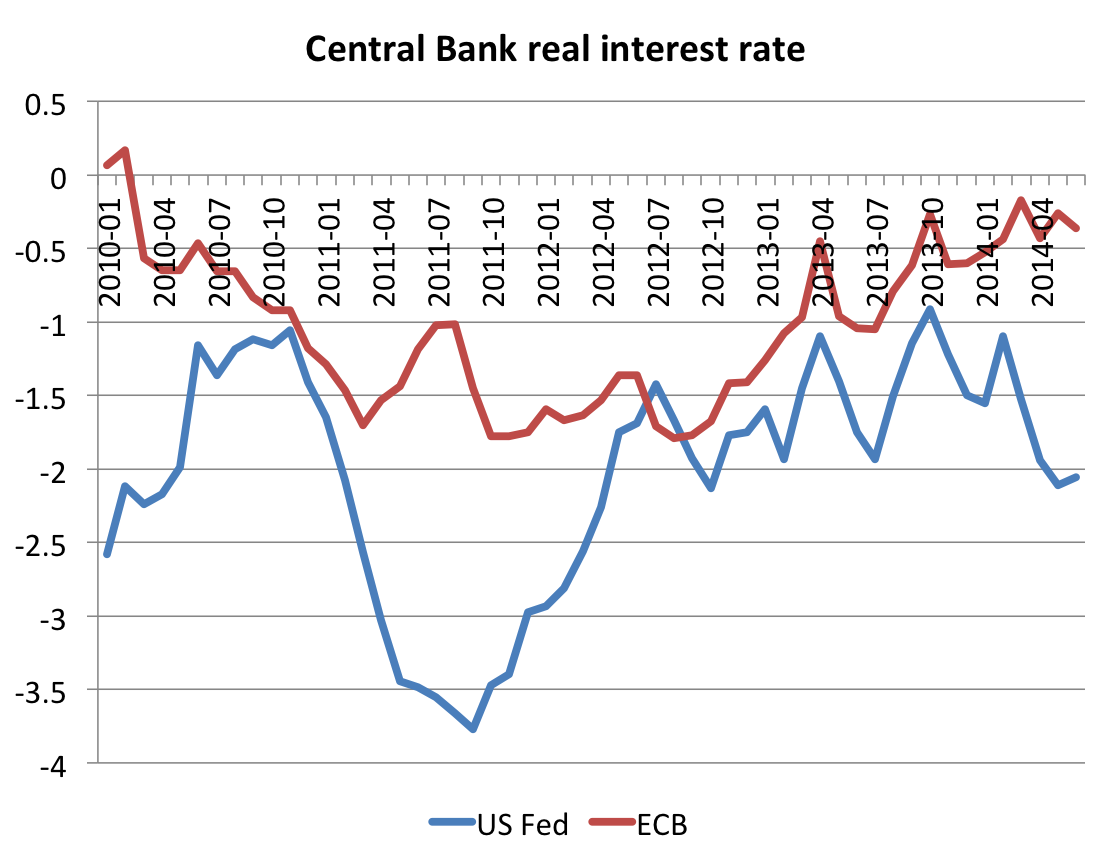
And when it comes to interest rates, while the ECB has finally reached zero, it took so long that in the last months the Euro area has seen a dangerous move towards very low inflation. And as inflation went down, real interest rates went up. Below is a chart that compares real interest rates in the Euro area and the US (real interest rates are calculated as the central bank interest rate minus the one-year inflation over the previous year).


First thing we noticed is that since the the summer of 2012 real interest rates have increased in Europe while they have remained broadly stable in the US. In the last two years, while real interest rates have increased by more than 1% in Europe, they have gone down by about 1% in the US. And this is all the result of the difference in behavior in inflation, which is possibly the result of the differences in policies we see during 2011 with much higher interest rates in the Euro area than in the US.

If the recent ECB actions are not enough, what else is to be done? Maybe European governments start listening to Mario Draghi and we see a reversal of fiscal policy, possibly in a coordinated fashion across Euro members. In the absence of this, the ECB has very few tools left at its disposal. It could try to increase inflation expectations, hoping that this would translate into increases in wages and prices. But raising inflation expectations would require very strong communications possibly making explicit that a temporary deviation of inflation above 2% would be welcome. Or even better, an explicit increase in the inflation target of the ECB (which could be temporary, for X years).

The only other alternative is "helicopter money", which implies a permanent increase in the monetary base/supply via either permanent purchases of assets or direct transfers to the governments or households (read Simon Wren-Lewis explain the difference between QE and helicopter money or Willem Buiter discuss why helicopter money always works).  There has been some recent talk among central bankers about this idea but it has always been ruled out because of legal or practical constraints, which are likely to be more binding in the case of the ECB.

The discussion around helicopter money in the US led to the expression "helicopter Ben" to refer to the former chairman of the federal reserve, Ben Bernanke. Maybe it is time to see "helicopter Mario" do whatever it takes to save the Euro area. And finding a picture to illustrate what this would look like is so much easy with Mario Draghi...


Antonio Fatás

08 Sep 04:30

Some more basic tips…

by subra

I have not been a blog very famous for its humility.  Let me also say that I try to concentrate on wealth creation and do not really write too much about live frugally, spend less, etc.

One of the kids I know (too lazy to search through the archives I guess) wanted some tips on get me rich quick kinda stuff. So here is an attempt at a post like this. The sad part is that many of these things are EASY to say. However not every one of you out there will be able to implement it. So here are a few tips…

1. Spend less than what you earn: Sounds easy? so very difficult to implement. Many people do not even know when things are going beyond control. The plastic card is addicting and most people do not know when they are going beyond the current month’s income. Add to this the stupidly bought big house, unnecessarily bigger car, etc. just keep piling on the misery.

2. START investing NOW: postponing of investments / savings is one the MEGA crimes of all generations. Procrastination is a disease. Over come it. Go download a form and start a SIP in a good fund. However if you are serious, stop reading this. NOW. Go and fill up a form for the same..

3. Earn More: You have no choice but to earn more. If you want to do a big SIP you need to make a lot of money. You cannot get rich by spending less. It just does not work. Oops, sorry.

4. Stop spending money to impress people: I know many kids in the 22-28 age group, they laugh at some of their colleagues if they try to impress them with their spending habits. Remember your friends know what you earn, what is your family, etc etc., so what are you trying to impress if you yourself..

5. Take a basic health and term insurance: Your health cover should include all those people whose medical bill you will pay. If you are supporting your dad’s sister, she too should be covered by a medical cover.

6. Track your expenses, and your investments: It is nice to watch where you are spending and what you are investing. Making a statement showing your earnings grow is amazingly satisfying. It keeps you focused on your goals.

7. Improve by 1% every week: on your ability to save, on your health, on your investments – strive for being the best. The process of trying to improve by a targeted number is a great picnic kind of an experience.

8. Write down what you have and make a semblance of a WILL: You never know when things could go wrong. Be careful.

9. Work towards your true passions: If you are a Musician at heart and are working as a clerk in a lawyer’s office, do not forget your passion. Describe yourself as a musician – and the bills are being paid by the clerk till the musician starts earning well.

10. Live life for YOURSELF, and your spouse: Stop worrying about what the world thinks about you. Seriously, it is none of your business….

Post Footer automatically generated by Add Post Footer Plugin for wordpress.

07 Sep 06:48

Offshore banking/ financial secrecy, tax havens/ evasion, asset protection, tax efficient corporate structure, illegal reinvoicing, fraud concealment, black money

by Sanjeev Sabhlok

I’ve started reading Treasure Islands: Tax Havens and the Men who Stole the World by Nicholas Shaxson. This continues an interest developed through an FTI member’s analysis of Switzerland as a tax haven.

I intend to sporadically make notes on this topic till I understand it properly. This post will evolve and grow. Please send me your thoughts/ links in the comments section.

What is a tax haven?

From Nicholas Shaxson:

 It is a place that seeks to attract money by offering politically stable facilities to help people or entities get around the rules, laws, and regulations of jurisdictions elsewhere.
A number of features help us spot tax havens.
First, all tax havens offer secrecy, in various forms.
Another common marker for tax havens is very low or zero taxes. People and corporations use them to escape tax, legally or illegally. Secrecy jurisdictions also have very large financial services industries in comparison to the size of the local economy.
Tax havens usually deny what they are and strenuously assert that they are clean.
But there is one feature of a secrecy jurisdiction that stands out above all: that local politics is captured by financial interests from elsewhere (sometimes these financial interests are criminal interests). Meaningful opposition to the offshore business model will have been neutered in a serious tax haven, so that such irritants as local politics cannot interrupt the business of making money. These zones of ultra-freedom for financial interests are so often repressive places, viciously intolerant of criticism.
It is, at heart, about artificially manipulating paper trails of money across borders.

The sum total of this underground economy is estimated at around a quarter of world GDP. It is absolutely massive.

Re: Switzerland, some notes from an internal discussion:

 Swiss Bankers helped the Nazis to loot and illegally store the wealth of Jews appropriated in Germany, Poland and other East European countries. And, they actively refused to repatriate this wealth back to the surviving relations of the murdered Jews – and fought pitched legal battles with Israeli and American Jews on the provenance of this wealth secreted away in their lockers. And, then they became the bankers of choice for African despots, looting their impoverished citizens, drug smugglers, and assorted alleged terrorists – until more salubrious nations came up with their own banking secrecy laws – and the more recent American attack on the major Swiss Banks and their secrecy laws.

The latest scam of the Swiss to help tax scamsters and other hoarders of ill-gotten wealth is to build large “bonded” warehouses at the airports in Geneva and Zurich – these are apparently “jurisdiction free” and for a “small fee” will store all your hard assets – diamonds and precious stones, bullion, currency notes (Swiss franc, preferably), art and what have you.

With the secrecy laws that Switzerland has till date, diluted only recently under US pressure  –  the entire system is a bad apple. The stalwarts like CS and UBS are paying massive fines in the US for SYSTEMATICALLY helping US Citizens to evade taxes. And, this is nothing compared with the private banks, which have not yet completely come under the scanner – because each bank itself is small, but in aggregate dwarf the private banking practices of CS and UBS. How many have heard the names of Sarasin, Pictet, Lombard Odier, there are multitudes of others. Secret Banking is a cottage industry in Switzerland.

The banks of Switzerland have over US$3.0 trillion in assets (Source: Swiss national bank, 2011 stats). Most of these should be repatriated them to their source countries.

Switzerland is the prime beneficiary of this largesse – the 3-month LIBOR for CHF is 0.02%, while  the 10-year bond yield is 1.03% currently – so, Swiss industry benefits from all the stolen wealth that is deposited in Swiss Banks. (Indian companies have to borrow at 12%+, and the RBI 10-year bond yield is currently c. 9.0%). What if the Swiss Industry was to pay “true costs” for their borrowings?

RELATED ARTICLES

Credit Suisse ‘helped US tax evaders

US senators rebuff Credit Suisse arguments over tax allegations

Switzerland pledges to lift the veil on secrecy

A Piketty Protégé’s Theory on Tax Havens   ["Mr. Zucman estimates — conservatively, in his view — that $7.6 trillion — 8 percent of the world’s personal financial wealth — is stashed in tax havens."]

 ALTERNATIVE VIEW

Why Tax Havens Are A Force For Good by Daniel J. Mitchell

07 Sep 06:47

The FSOC is Full of Hot Air

by David Merkel

I’ve written about this before, but if the FSOC wants to prove that they don’t know what they are doing, they should define a large life insurer to be a systemic threat.

It is rich, really rich, to look at the rantings of a bunch of bureaucrats and banking regulators who could not properly regulate banks for solvency from 2003-2008, and have them suggest solvency regulation for a class of businesses that they understand even less.

And, this is regarding an industry that posed little systemic threat during the financial crisis.  Yes, there were the life subsidiaries of AIG that were rescued by the Fed, and a few medium-large life insurers like Hartford and Lincoln National that took TARP money that they didn’t need.  Even if all of these companies failed, it would have had little impact on the industry as a whole, much less the financial sector of the US.

Life insurance companies have much longer liability structures than banks.  They don’t have to refresh their financing frequently to stay solvent.  It is difficult to have a “run on the company” during a time of financial weakness.  Existing solvency regulation done by actuaries and filed with the state regulators considers risks that the banks often do not do in their asset-liability analyses.

Systemic risk comes from short-dated financing of long-dated assets, which is often done by banks, but rarely by life insurers.  I’ve written about this many times, and here are two of the better ones:

MetLife and other insurers should not have to live with the folly of “Big == Systemic Risk.”  Rather, let the FSOC focus on all lending financials that borrow short and lend long, particularly those that use the repurchase markets, or fund their asset inventories via short-term lending agreements.  That is the threat — let them regulate banks and pseudo-banks right before they dare to regulate something they clearly do not understand.

07 Sep 06:46

Goes Down Double-Speed (Update 2)

by David Merkel

This is the third time I have written this article during this bull market.  Here are the other two times, with dates:

The first time, we had doubled since the bottom.  Second time, up 2.5x.  Now it is a triple since the bottom.  That doesn’t happen often, and this rally is getting increasingly unusual by historic standards.  That said, remember that every time a record gets broken, it shows that the prior maximum was not a limit.  If you think about that, after a bit you know that idea is obvious, but that isn’t the way that many people practically think about extreme statistics.

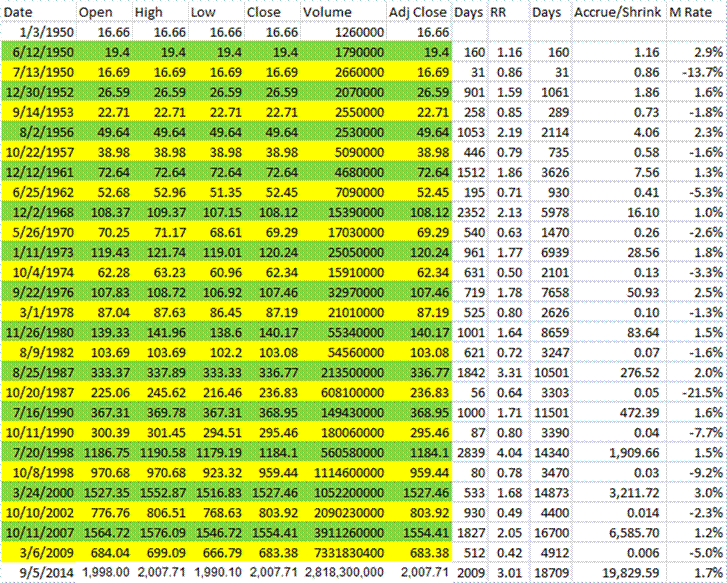
Let’s look at my table, which is the same as the last two times I published, except for the last line:

spx_31294_image002

Since the second piece, the gains have come slowly and steadily, though faster than between the first and second pieces.  As I said last time,

“In long recoveries, gains first come quickly, then slowly, then near the end they often come quickly again.  Things are coming quickly again now, but who can tell how long it might persist.”

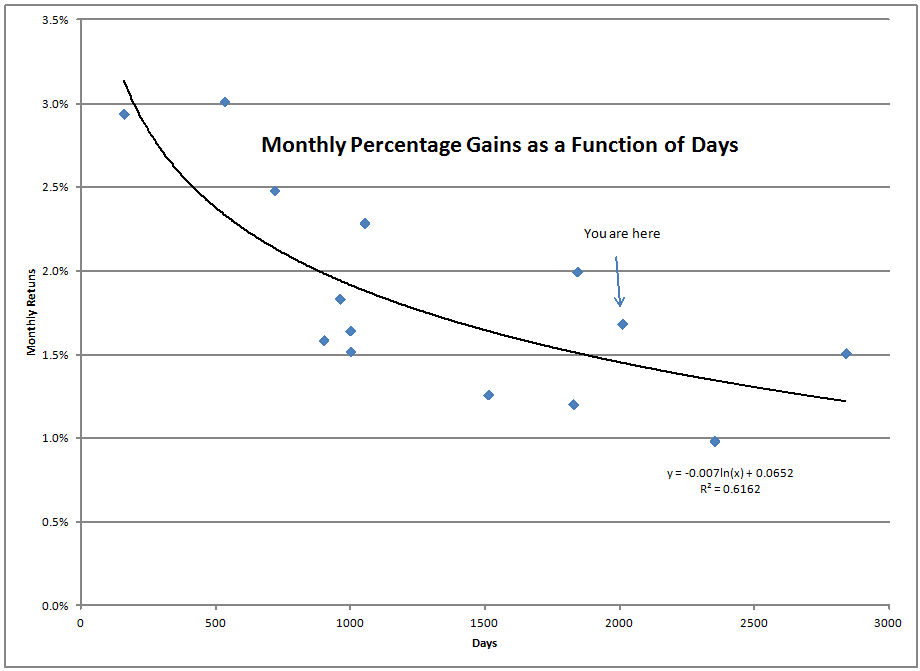
Indeed, and after the first piece, the market did nothing for about 16 months, after which the market started climbing again at a rate of about 1.5% per month for the last 27 months.  Though not as intense as the rally in the mid-’80s, this is now the third longest rally since 1950, and the third largest.  It is also the third most intense for rallies lasting 1000 calendar days or more.  This is a special rally.


spx_8180_image001

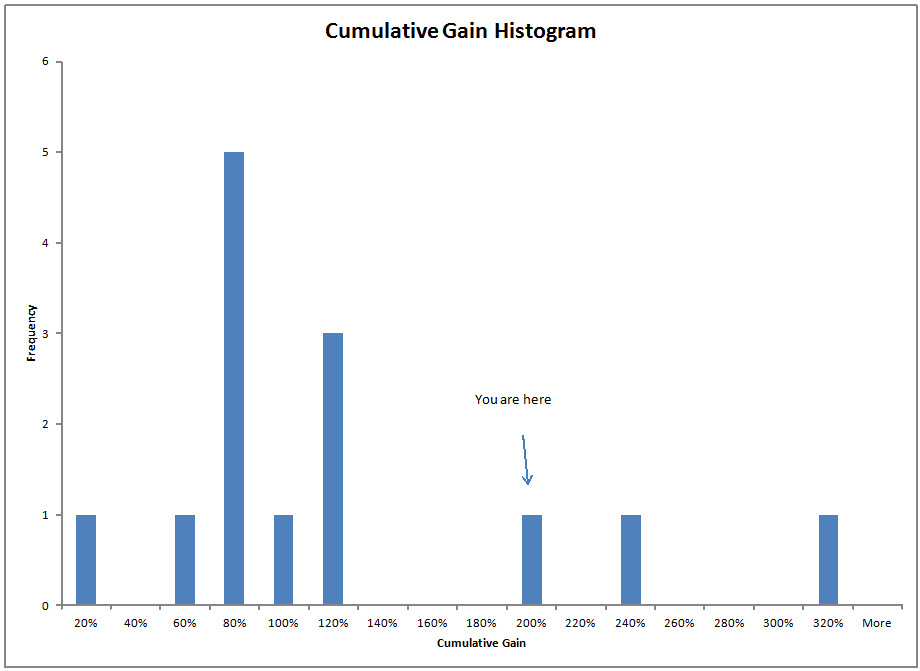
And now look at the cumulative gain:

spx_24509_image001


Does this special rally give us any clues to the future?  Sadly, no.  Or maybe, too much.  Let me spill my thoughts, and you can take them for what they are worth, because I encouraged caution the last two times, and that hasn’t been the winning idea so far.

  1. To top the rally of the ’90s for total size, we would have to see 2700 on the S&P 500.
  2. It is highly unlikely that this rally will top the intensity of that of the ’50s or ’80s.  Gains from here, if any, are likely to be below the 1.7%/month average so far.
  3. For this rally to set a length record, it would have to last until 12/14/16 (what a date).
  4. Record high profit margins should constrain further growth in the S&P 500, but that hasn’t worked so far.  As it is, there are very good reasons for profit margins to be high, because unskilled and semi-skilled labor in the capitalist world is not scarce.
  5. Rallies tend to persist longer when they go at gradual clips of between 1-2%/month.  Still, all of them eventually die.
  6. At present the market is priced to give 5.5%/year returns over the next 10 years.  That figure is roughly the 85th percentile of valuations.  Things are high now, but they have been higher, as in the dot-com bubble.  We are presently higher than the peak in 2007.
  7. On the negative side, it doesn’t look like the market is pricing in any war risk.
  8. On the positive side, I’m having a hard time finding too many industries that have over-borrowed.  Governments and US students show moderate credit risk, as do some industries in the finance and energy sectors.
  9. Finally, the most unusual aspect of this era is how little competition bonds are giving to stocks.  In my opinion, that idea is getting relied on too heavily for a relative value trade.  Instead, what we may find is that if bond yields rise, stocks, particularly dividend paying stocks, will get hit.  By relying on a relative yield judgment for stocks, it places them both subject to the same risks.

I still think that we are on borrowed time, but maybe you need to regard me as a stopped digital clock with a date field, which isn’t even right twice per day.  Historically, if the rally persists, stock prices should only appreciate at a 8-9% annual rate with the bull this old.

That’s all for now.  I’m not hedging my equity portfolio yet, but maybe my mind changes near 2300 on the S&P 500, should we get there.

PS — the title comes from the fact that markets move down twice as fast as they go up, so be ready for when the cycle turns.  The first article in the series focused on that.

07 Sep 05:59

I am very humble, I know

by subra

It took Shakespeare to say you can flatter a man by saying ‘You are so simple, you cannot be flattered’.

I am not so humble…and hence this post. I know, I know, I should not be putting it here, but hey not even a learned man like Ravana could conquer his ego. I am a mere mortal, am I not?

To Subra

on gratitude, opinion Dear Sir,

I read your post yesterday, and for the first time, in the really long time I have been reading your blog, you genuinely shocked me a little bit.

The post seemed a little out of sorts & and a little down to me. As if, you were really doubting your worth as a teacher

For a little bit, I was back in school, to when my teacher’s “Teacher” mask would slip a bit & I would get a glimpse of the person beneath.

You say, all learning is caught, but what drops of water will I catch, or run around under, if a fountain does not rain down on me?

I am a prime example of the student you speak of. I am a smart alec, autodidact. The teacher does not matter, since I can find everything online and I can teach my self vitually anything, I put my mind to.

Or can I?

And to me, Sir, the answer is No.
And that’s because I have been fortunate enough to have people in my life who have taught me so well, that I cannot imagine life without what they taught me.

  • Maria Barrot, taught me English & persistence.
  • Sunil Varma, taught me Digital Electronics & the importance of always being learning.
  • The two priciples, I do my consulting with, for making me worldly wise
  • Manish Chauhan, ostensibly taught me how to get out of debt, but was actually teaching me how to help people and how to be a more giving person.
    Goddammit Manish, put an ‘about us’ on your site. I hate linking to Linkedin! :P
  • My parents!

And finally an old guy called P V Subramanyam who says he makes smart people richer.

I found you because Manish kept linking to your articles.
I stayed because you tease, insult, joke, criticize, poke, but hey you also teach.
If it sounds like you said that, you did :)
But to me, the most important fact is that you stay real. You are yourself – honest, true, transparent with no agendas, save self improvement :)
You taught me money is not the end all and be all of life, but that improvement is holistic.
And most importantly, you goad me into thinking for myself and you taught me how to reflect.

So while, some might copy a few words here and there, they can never be you.
And while while I might learn something specific from somewhere, nothing can ever replace the love and attention and the wealth of knowledge, a good teacher can shower on you.

You are a teacher, not because you “teach”, but because it is just who you are.
You are not just my Dronacharya, you are also my quirky Mr. Chips :)

Stay the same, Sir! And thank you so much, for all that you do.

With the best of regards,

I remain,
your humble student.


Post Footer automatically generated by Add Post Footer Plugin for wordpress.

07 Sep 05:56

Some predictions: about the Future and the World

by subra

The easiest thing to do was to predict – in the 1980s and even in the 1990s. However now with the electronic media keeping tabs on your writings predicting has become difficult, if not downright risky.

Still I am willing to stick my neck out and say the following:

1. The US interest rates are now at 2.3% p.a. – and is surely headed NORTH. Now we could have said that at the beginning of the year too – when the interest rates were about 2.98%…but we were all wrong. What is happening? Foreign inflows are ensuring that interest rates in the US and in Germany are kept low. Amazing stuff…but but..when interest rates go up, who will buy the bonds? I know only the sellers. That is going to be fun.

2. US markets are up (equity) ..hey buy the locals are selling equity and buying a lot of debt. So when the bond holders are unable to sell their bonds, what impact will it have on their equity markets? Keep guessing. I do not have an answer either.

3. US equity and bond markets will see far more volatility in 2015 than it saw in 2013 and 2014

4. Emerging markets (including India) will see lots of cash flow – IN and OUT. So the Indian markets (Equity and Debt) may see more cash inflows, markets may go up, there will be many big IPOs, …and volatility will be high. Very good time for brainy investors – a blind random pick market may be dead….

5. Geopolitical risks may be up, but India is likely to attract some more money.

6. Namo has done well, but the jury is still out on his luck, track record, etc…..

Post Footer automatically generated by Add Post Footer Plugin for wordpress.

05 Sep 16:58

Do I really TEACH?

by subra

I am not sure whether I should have said

– do I really teach? or Can I really teach?

If I stand in front of a class and expect to ‘teach’ something, am I cheating myself. Why are cheating and teaching acronyms?

Seriously, I do not know whether I can teach anything to anybody. Or whether anybody can teach anything to anybody. Almost all the learning is ‘caught’ not sure what can be taught. Try telling your kid ‘do not tell lies’ and then in the next breath say ‘If somebody calls, say I have gone out’. No point in then wondering ‘why is my kid telling me a lie’ .

In my class (in a college) what are the kids learning? They are busy skimming the ppt (reading the books is a wrong term to use dude) and finding short cuts to ‘crack’ the exam. Google gives them enough ‘knowledge’ to do a presentation, and perhaps even crack a tough interview.

Once the MBA degree is in hand, a Rs. 10L job in a big 4 firm is in place, do kids want to go back to their basic MBA books and REALLY learn the subjects? Do enough of them go to www.coursera.com to learn? Do they visit Investopedia?

Tragically the answer is NO. They do visit these sites if they need to make a presentation. Do they take 1 hour off every day to ‘grow’ their learning? In most cases NO. When you are 26 you have lots of other things to do also.

So beyond class 3 does the teacher really teach? What can I teach about equity markets? What is there in my ppt which is not already available on Google? Or if you want to see how it is done on You Tube? Or if I want to plagiarize on Investopedia? Really, nothing.

Life has become tough for teachers at all levels. Children have access to the same resources as the teachers have. So if a teacher cannot take the content and understand it BEFORE he/she stands up in the class, the teacher is not really adding value.

When people ask for my ppt that I use – I happily give it away to them. It is like asking for my cue cards. Take it, I am far beyond my ppt.

God bless people who want to call themselves teachers. I only facilitate learning.

If you see me parked on the way or obstructing your road to learning, please call the towing van. I have no business being an impediment to your learning. Happy Teacher’s day…..

Post Footer automatically generated by Add Post Footer Plugin for wordpress.

05 Sep 16:55

Meet Your New Teacher. MOOC : The New Age Way of Learning Online.

by Sivaprasad Nair

It’s Teacher’s Day today – what better day to talk about studies and courses.

The education industry is changing and MOOCs are driving that change. Today, we have compiled a list of all the MOOCs that are available internationally. These websites have a variety of subjects to choose from and have very flexible learning schedules.

Online Learning : MOOC

Online Learning : MOOC

A massive open online course (MOOC) is an online course aimed at unlimited participation and open access via the web. In addition to traditional course materials such as videos, readings, and problem sets, MOOCs provide interactive user forums that help build a community for students, professors, and teaching assistants.

Take a look at list of MOOC courses available globally:

Openlearning.com
www.openlearning.com/courses/

OpenLearning was founded in Australia by computer science professor Richard Buckland and software engineer Adam Brimo from the University of New South Wales. OpenLearning has worked with the University of New South Wales and Taylor’s University to deliver the first MOOCs in Australia and Malaysia respectively. The website has a list of Public and private online courses from educators and individuals worldwide. The private educational portals on its platform are created on a cloud based software product launched in December 2013 by OpenLearning.

Apnacourse.com
https://www.apnacourse.com/allcourses

Apnacourse launched by SpearheadEduOnline.com is India’s ‘first of its kind’ e-tutoring platform for professional courses and certificate programs. Domains for Training include Financial Management Certifications like CFA, FRM, CFP et al., Project and Quality Management Certifications like PMI-ACP, PMP etc., IT Services and Security Management Certifications like ISTQB, CISA, CISM etc., and certifications like Business Analysis and more.

edX
https://www.edx.org/course-list

edX hosts more than 240 online university-level courses in a wide range of disciplines to a worldwide audience at no charge. It also conducts research into learning based on how people use its platform. EdX differs from other MOOC platforms as it is nonprofit and runs on an open-source software platform. Major contributors to the development of Open edX include Stanford University, Google, UC Berkeley, MIT, Harvard, University of Queensland etc.

Udacity
https://www.udacity.com/courses#!/all

Although the website started off with Computer Science courses, it now focuses more on vocational courses for professionals. The website also hosts many CS courses as part of collaboration with Google, Nvidia, Microsoft, Autodesk, Cadence Design Systems, and Wolfram Research. Programming classes use the Python language; programming assignments are graded by automated grading programs on the Udacity servers.

Coursera
https://www.coursera.org/courses

Coursera was founded by computer science professors Andrew Ng and Daphne Koller from Stanford University. Coursera is an education platform that partners with top universities and organizations worldwide, to offer courses in a variety of areas, including Humanities, Medicine, Biology, Social Sciences, Mathematics, Business, and Computer Science for free. Learners can watch short video lectures, take interactive quizzes, complete peer graded assessments and connect with teachers and classmates.

Udemy
https://www.udemy.com/

Udemy.com is a platform for online learning for experts of any kind to create courses which can be offered to the public, either at no charge or for a tuition fee. Udemy provides tools which enable users to create a course, promote it and earn money from student tuition charges. The website has more than 18000 courses available online and is compatible with any device for learners to learn at their own pace.

COL – Commonwealth of Learning
http://www.col.org/progServ/services/Pages/default.aspx

The Commonwealth of Learning (COL) is an intergovernmental organisation created by Commonwealth Heads of Government to encourage the development and sharing of open learning/distance education knowledge, resources and technologies. COL’s activities are grouped under two sectors: Education and Livelihoods & Health. COL provides fee-for-service distance education and open learning course delivery and training for international agencies, such as the United Nations High Commissioner for Refugees (UNHCR) and the World Health Organization (WHO).

OpenUpEd
http://www.openuped.eu/courses

OpenupEd is a supranational platform, founded with support of the European Union (EU). Around 40 courses that range from mathematics to economics, e-skills to e-commerce, climate change to cultural heritage, corporate social responsibility to the modern Middle East, and language learning to writing fiction, are available free of charge and in 12 different languages.

Course Hero
https://www.coursehero.com/

CourseHero’s educator portal is a micropublishing platform for educators to distribute their educational resources. Course Hero collects and organizes study materials like practice exams, problem sets, syllabi, flashcards, class notes and study guides from users who upload. Users either buy a subscription or upload documents in order to receive membership and access website material.

Saylor.org Academy
http://www.saylor.org/courses/

The Saylor Foundation is known for its emphasis on finding, vetting, and assembling openly available texts and resources into courses resembling those of a traditional brick and mortar institution which are then peer-reviewed before being published. The foundation offers 317 free, college-level courses, which are selected as typical courses in high enrollment majors at traditional U.S. colleges.

The Open University
http://www.open.ac.uk/courses

The Open University (OU) is a distance learning and research university founded by Royal Charter in the United Kingdom. The OU provides courses on a wide variety of subjects like Arts & Humanities, Business & Management, Computing & IT, Design, Education, Childhood & Youth, Engineering, Environment & Development, Health & Social Care, Health & Wellbeing, Languages, Law, Mathematics & Statistics, Medical Sciences, Nursing & Healthcare Practice, Psychology & Counselling, Science, Social Sciences and Technology.

Iversity
https://iversity.org/courses

iversity.org is based in Bernau bei Berlin, Germany. iversity specializes in providing online courses and lectures in higher education, specifically MOOCs (Massive Open Online Courses). Courses are free and open for anyone to enroll and participate. Courses consist of chapters, units and assessments. A MOOC is typically made up of 8 chapters. One chapter is released per week. Each chapter contains 6-10 units. These units provide video lectures, 3–8 minutes long, interspersed with interactive quizzes and homework. Should the instructor wish, there may be peer-to-peer reviews and group projects. There is normally an exam at the end of each course.

ALISON
http://alison.com/subjects/25/Diploma-Courses

ALISON (Advance Learning Interactive Systems Online) is an e-learning provider founded in Galway, Ireland in 2007. Its stated objective is to enable people to gain basic education and workplace skills. Contrary to other MOOC providers with close links to American third level institutions such as MIT and Stanford University, the majority of ALISON’s learners are located in the developing world with the fastest growing number of users in India. ALISON offers over 600 courses across certificate and diploma level in ten languages.

Edukart
http://www.edukart.com/

EduKart is an Indian distance learning cum online education company that provides Indian and international degrees such as MBA, Executive MBA, MCA, MSc IT, BBA, BCA and BSc IT through both distance learning and online mode of education. It also offers industry relevant certificate courses in areas of retail, finance, telecom, digital marketing, programming languages and project management.

Futurelearn
https://www.futurelearn.com/courses/upcoming

FutureLearn is a learning platform founded in December 2012 as a company wholly owned by the UK’s Open University in Milton Keynes, England. It is the first UK-led massive open online course learning platform, and as of June 2014 had 36 UK and international University partners  and – unlike similar platforms – includes four non-university partners: the British Museum, the British Council, the British Library and the National Film and Television School.  The first courses to be made available included “Web science: how the web is changing the world”, “Introduction to ecosystems”, “Improving your image: dental photography in practice”, “Causes of war”, “The discovery of the Higgs boson”, “Discover dentistry”, “Muslims in Britain: changes and challenges”, “Begin programming: build your first mobile game” and “England in the time of King Richard III”. The first course to launch was “The secret power of brands”, conducted by professor Robert Jones of the University of East Anglia.

Marginal Revolution University (MRUniversity)
http://mruniversity.com/economics-video-library

The website includes free-to-watch videos, interactive comments, and the option of actively enrolling and participating in courses. The videos and course materials are also accessible for those who do not enroll in a course or register on the site. The videos are structured as simple PowerPoint slide presentations with voice-overs by the speakers. The audio can also be downloaded separately. Those who formally register for a course and take the final examination can get a certificate of completion.

openSAP
https://open.sap.com/courses

openSAP is developed and provided by SAP in cooperation with the Hasso Plattner Institute. openSAP courses are conducted entirely online. All the material provided can be accessed from any device that is connected to the Internet. openSAP courses have a defined duration (usually between five and seven weeks) to which course participants need to adhere. openSAP courses are based on video units, supporting material (slide decks, handouts), and self-tests.  Course participants need to work on weekly assignments and keep to deadlines. The weekly assignment is graded and contributes to the points required to receive a record of achievement.  Course participants can discuss the course content in a discussion forum.  openSAP courses end with a final exam.  Upon successful completion of the weekly assignments and the final exam, participants receive a record of achievement.  openSAP courses are conducted in English.

NovoEd
https://novoed.com/courses

NovoEd is a for-profit educational technology company, founded by Stanford University professor Amin Saberi and PhD student Farnaz Ronaghi. Students view lecture videos online as individuals, but NovoEd’s unique selling point is that students converse in defined teams of 4-10 for group assignments. NovoEd covers subjects like Entrepreneurship, Finance, Business Strategy, Education, Design & Creativity, Math & Science, Humanities and more.


Recommended Read : The True Promise of Technology In (Indian) Higher Education [We Need To Think Beyond MOOC]

The post Meet Your New Teacher. MOOC : The New Age Way of Learning Online. appeared first on NextBigWhat.com
05 Sep 16:54

Geert Wilders: “War Has Been Declared against Us”

by Atanu Dey

Well, what do you know! Amazing things are happening around the world. One of the more positive developments has been that of the Islamic State (formerly known as the ISIS) showing up and demonstrating to the world what “peace” means in the “Religion of Peace.(™)” They are the poster boys of Islam, arguing against the left-lib-tards (that’s the short form for “leftist liberal retards”) who keep on insisting that Islam is a religion of peace.

(I read this somewhere: If someone declares that they love you, ask for proof; if someone says that they wish to kill you, believe them and get away quickly.)

In every case of Islamic terrorism, the perpetrators loudly proclaim Allahu-akbar and declare that they are following Islam’s dictates. But their claim is met with the leftlibtards’ denial “No, these are misunderstanders of Islam.” Quote chapter and verse from the Qur’an (Koran, Quran) or the Hadiths (Hadis) showing that the Islamic State is being faithful to the commands of Allah (the Islamic god) as recorded in the Quran by Muslims — and still the leftlibtards will continue with their denial. Perhaps the Islamic State has to go beyond video-taped beheading of foreign journalists to catch the attention of the retards that run the Western countries.

I say that IS is a positive development because the sooner the bloodthirsty religion of Islam is seen to be the evil it is, the better it will be for all — non-Muslims and Muslims alike. Once in grad school, a friend of mine told me that he likes the house parties (we used to live in a student housing co-op in Berkeley) early in the term. Why, I asked. He said, “With all the booze, many people get drunk. How they behave when they are drunk gives you a fairly accurate idea of what kind of people they are. Once you have identified the obnoxious ones, it is easy to avoid them.”

The British are helping the world in a big way. They imported the spawn of the evil ideology by the boatloads — from such Islamic paradises as Pakistan. When they gained sufficient numerical strength, they let the British society have it. In one recently reported case, around 1400 children have been raped by gangs of Religion of Peacers from Pakistan. This happened over a span of over a decade — but the authorities just turned a blind eye.

London does deserve the new name “Londonistan.” But the idiot leaders will not wake up, until I suppose one of their beloved Pakistani ROP-follower plants a dirty bomb there. One does not hope for such things to happen, but if it is to happen, I say let it happen sooner rather than later, because the sooner the civilized world crushes that evil ideology, the better for the whole world.

One Western leader has been indefatigable in his opposition to Islam — the Dutch politician Geert Wilders. I have been following his career for a while and I have mentioned him on this blog several times for over five years. (See these four posts.)

Here is Geert Wilders again. This is the English transcript of a speech he made in a debate at the Netherlands’ parliament a few days ago.

BTW, Wilders was denied entry into Londonistan in Feb 2009, as I reported it on this blog. Here’s an excerpt:

“Dutch populist politician and controversial anti-Islam campaigner Geert Wilders has been refused entry to the United Kingdom despite being invited to visit by a member of the House of Lords, the British parliament’s upper chamber. . . Geert Wilders, perhaps best known outside the Netherlands for having made the video Fitna, in which the religion Islam and its holy book the Koran are attacked as providing a basis for terrorist attacks and for the undermining of western democracy and values, had been invited to London for a showing of this film to members of the British parliament.”

I mention the above because Wilders refers to his Fitna movie in his recent speech. Here it is, for the record.

Madam Speaker, actually I was expecting flowers from you. I am celebrating an anniversary these days. Exactly ten years and two days ago, I left a party whose name I cannot immediately remember. During these ten years and two days. I have been much criticized. Most importantly for always saying the same thing

geert-wilders

My critics are right. Indeed, my message had been the same during all these years. And today, I will repeat the same message about Islam again. For the umpteenth time. As I have been doing for ten years and two days.

I have been vilified for my film Fitna. And not just vilified, but even prosecuted. Madam Speaker, while not so many years ago, everyone refused to broadcast my film Fitna, we can today watch Fitna 2, 3, 4 and 5 daily on our television screens. It is not a clash of civilizations that is going on, but a clash between barbarism and civilization.

The Netherlands has become the victim of Islam because the political elite looked away. Here, in these room, they are all present, here and also in the Cabinet, all these people who looked away. Every warning was ignored.

As a result, also in our country today, Christians are being told: “We want to murder you all.” Jews receive death threats. Swastika flags at demonstrations, stones go through windows, Molotov cocktails, Hitler salutes are being made, macabre black ISIS flags wave in the wind, we hear cries, such as “F-ck the Talmud,” on the central square in Amsterdam.

Indeed, Madam Speaker, this summer, Islam came to us.

In all naivety, Deputy Prime Minister Asscher states that there is an “urgent demand” from Muslims to “crack down” on this phenomenon. Last Friday, in its letter to Parliament, the Cabinet wrote that jihadists are hardly significant. They are called a “sect”, and a “small” group.

This is what those who look away wish, these deniers of the painful truth for ten years and two days, the ostrich brigade Rutte 2.

But the reality is different. According to a study, 73% of all Moroccans and Turks in the Netherlands are of the opinion that those who go to Syria to fight in the jihad are “heroes.” People whom they admire.

And this is not a new phenomenon. Thirteen years ago, 3,000 people died in the attacks of 9/11. We remember the images of burning people jumping from the twin towers. Then, also, three-quarters of the Muslims in the Netherlands condoned this atrocity. That is not a few Muslims, but hundreds of thousands of Muslims in the Netherlands condoning terrorism and saying jihadists are heroes. I do not make this up. It has been investigated. It is a ticking time bomb.

Madam Speaker, is it a coincidence that for centuries Muslims were involved in all these atrocities? No, it is not a coincidence. They simply act according to their ideology. According to Islam, Allah dictated the truth to Muhammad, “the perfect man.” Hence, whoever denies the Koran, denies Allah. And Allah leaves no ambiguity about what he wants. Here are a few quotes from the Quran:

Surah 8 verse 60: “Prepare to strike terror into the hearts of the enemies of Allah.”

Surah 47 verse 4: “Therefore, when ye meet the unbelievers, smite at their necks”. We see it every day in the news.

Another quote from Allah is Surah 4 verse 89: “So take not friends from the ranks of the unbelievers, seize them and kill them wherever ye find them.”

Madam Speaker, the Koran on the table before you is a handbook for terrorists. Blood drips from its pages. It calls for perpetual war against non-believers. That Koran before you is the hunting permit for millions of Muslims. A license to kill. That book is the Constitution of the Islamic State. What ISIS does is what Allah commands.

This bloodthirsty ideology was able to nestle in the Netherlands because our elites looked away. Neighborhoods such as Schilderswijk, Transvaal, Crooswijk, Slotervaart, Kanaleneiland, Huizen, you name it. There, the caliphate is under construction; there, the Islamic State is in preparation.

During the past ten years and two days , the ostrich Cabinets did nothing. It has nothing to do with Islam, they lied to the people. Imagine them having to tell the truth.

But the people have noticed. Two thirds of all Dutch say that the Islamic culture does not belong in the Netherlands. Including the majority of the electorate of the Labour Party, the majority of the voters of the VVD, the majority of the voters of the CDA, and all the voters of the PVV.

The voters demand that, after ten years and two days of slumber, measures are finally taken. The voters demand that something effective happen. No semi-soft palliatives. Allow me to make a few suggestions to the away-with-us mafia. Here are a few things which should happen starting today:

Recognize that Islam is the problem. Start the de-Islamization of the Netherlands. Less Islam.

Close our borders to immigrants from Islamic countries. Immediate border controls. Stop this “cultural enrichment”.

Close every Salafist mosque which receives even a penny from the Gulf countries. Deprive all jihadists of their passports, even if they only have a Dutch passport. Let them take an ISIS passport.

Do not prevent jihadists from leaving our country. Let them leave, with as many friends as possible. If it helps, I am even prepared to go to Schiphol [airport] to wave them goodbye. But let them never come back. That is the condition. Good riddance.

And, as far as I am concerned, anyone who expresses support for terror as a means to overthrow our constitutional democracy has to leave the country at once. If you are waving an ISIS flag you are waving an exit ticket. Leave! Get out of our country!

Madam Speaker, war has been declared against us. We have to strike back hard. Away with these people! Enough is enough!

(I will file this post under Islamic Terroris, Jihad, etc. More to come.)

04 Sep 03:36

Understanding Clubbing of Income & blunders people make

by Hemant Beniwal

Many times you transfer assets to a relative like parent or wife or buy assets for a relative especially non-earning family members in their name with your money. This is done either for emotional purposes, providing financial stability to the relative or to save some tax liability. In certain cases, when this asset earns income, you are liable to pay tax on it. This income is clubbed with your other sources of income. (Income Tax Section 60 to 64) Similarly if the asset incurs loss, the loss is also clubbed with your income to calculate your income tax.

clubbing of income Understanding Clubbing of Income & blunders people make

Let us look at the situations that are considered as clubbing of income as per the Income Tax Act -

  1. You are allowed to transfer an asset to your spouse. If this asset earns income, it will be clubbed to your income while computing income tax and you are liable to pay it.
  2. You can transfer an asset to your child (own legitimate child/ adopted child). You are liable to pay tax on income accrued on this asset. If the parents are divorced, then the income is clubbed with the income of the parent who has custody of the minor child.
  3. If you transfer an asset to your son’s wife, and there is income earned, that amount is required to be clubbed with your income and you should pay tax on it.
  4. You can invest in assets in your spouse’s name. For example, you can buy shares or invest in Mutual funds in your spouse’s name. The income earned from these assets needs to be clubbed with your income while filing Tax Returns.
  5. If you transfer income to another person, this income will be included in your income and be computed for tax liability.
  6. If you have property in your name and convert it to HUF (Hindu Undivided Family) property, then income earned from this property is to be clubbed with your income for tax computation.
cp Understanding Clubbing of Income & blunders people makeSource: www.ClearTax.in

Still looking for ways to save tax?

There are some other ways in which you can reduce your tax liability -

  • If you transfer an asset to your parents or siblings, the provision of clubbing income does not arise and you do not have tax liability on the income earned on this asset.
  • If you invest in instruments like PPF, life insurance for your spouse and/ or children, your income is eligible for tax deduction under Section 80 C and 80 D of Income Tax Act.
  • If you buy health insurance for your parents, you are eligible for tax deduction.
  • You can also invest in PPF and Senior Citizens’ Savings Scheme in your parents’ name. You will not be eligible for tax deduction but your money will earn tax-free interest.
  • You can gift money to your spouse, siblings or adult children who can invest in PPF. You will again not be eligible for tax deduction but your money will earn tax-free returns.
  • Gifts given before marriage to would-be spouse is not considered in clubbing of income.
  • Cross Gifts which means you give your brother’s children gifts and he gives your children gifts. Such transfer is also not included in the giver’s income. (this may be counted in tax evasion)

 If you would like to read this topic in detail – check this

Blunders people make: I have seen lot of people who invest in the name of spouse or kid but don’t show that in ITR – someday that may land them in tax scrutiny & penalties.

Have you considered clubbing your income provisions? Do ensure that you keep the above mentioned points in mind so that you do not break any laws of the Income Tax Act.

04 Sep 03:34

Why Indians do not like to invest in equities?

by subra

D0 you know what is the Wimbledon effect? Well it is the location – the Wimbledon is in UK, but no Englishman ever wins it !!

Similarly when the Indian stock markets go up, the participants are mostly White men in US or UK.

Why are Indians shy of investing in Equities? Well Sucheta Dalal and Ravi Narayan have their reasons about this..and I am giving mine…

1. The whole media right from the beginning keeps saying ‘Equities are Risky’ – of course most people in the media business do not understand the word risky. If media started saying ‘Adjusted to inflation and for volatility equities give real returns over long periods of time’ – in a way that the common man understood, it would make sense.

2. There is a conspiracy of the rich – if people have to be kept engaged from birth to death in acquiring a car, a house, education for children, a bigger house…the best way is to keep them away from wealth creating assets. The rich do this very well by controlling the banks (who make it cheaper to fund a new car), and make people chase vacations, etc…

3. People invest as per their greed and Risk-Return expectation. So people bought shares in Global Trust Bank (greed that it will become a big bank) and kept money in Fixed Deposits of GTB. When the bank failed the SHAREHOLDERS lost everything (price for greed) but the FD holders got THEIR FULL AMOUNT back (with those ridiculous rates of interest). So the message is – take risk on FDs, not on equity.

4. The government keeps coming out with a new regulation regularly – in the capital market.

5. If the bond markets, the national savings certificates, k v p, are dematerialised and opened to trade by the members of the stock exchange, brokers will penetrate the country much better…and increased market penetration will take equities also to the masses. This is unlikely to happen – the government will not want competition at the bottom of the pyramid – the cost of borrowings will shoot up dramatically. 

6. Share market movements look scary the way it is presented on tv. If a tv anchor can show the impact of inflation on savings, people would react better. You remember what you read earlier, right? The real rich control the media. 

7. As the government owns all the banks, banks do not fail. Regular bailing out of banks ensures that people do not worry about bank deposit failing. This means just all the money goes to banks…14 lakh crores….is not a small amount lying in banks..

8. Pathetic Corporate Governance – in the PSU and the private sector too. This dissuades the real long term investor.

9. People not bothering about who is going to feed them from age 55 to the rest of their lives. Longevity, Inflation, Old Age care, etc. do not seek to worry them when they are 22…


Post Footer automatically generated by Add Post Footer Plugin for wordpress.

03 Sep 03:27

Prof. PV Indiresan had arrived at one of the two key solutions to governance reforms in India

by Sanjeev Sabhlok

In June 2011 Prof. Indiresan wrote: "most politicians have no source of professional income; they are all officially quite poor. On top of it, election expenses are extraordinarily high. Therefore, they see every justification in collecting money — under the table. High cost of elections is the excuse and justification that politicians have for collecting money illegally. That excuse will vanish once the government reimburses in full all legitimate election expenses." [Source]

In August 2012: "If legislators are paid handsomely and the cost of elections is met by the government, a lot of political corruption will be taken care of. But Anna Hazare and Baba Ramdev seem to be pursuing less workable ideas.​" [Source]

In February 2013, shortly before his death, Prof. Indiresan wrote: "our legislators (even the runners-up) should be paid very well. Further, all legitimate election expenses of serious candidates should be met in full by the state"  [Source]

Note that I don't agree with the detailed system he has suggested. For that we need a very simple system of Rs.20 or Rs.50 per vote (whatever is determined based on proper calculations).

But at least he came to this point of understanding. 

Today I note that even Arun Srivastava of JD(U) has come to this broad understanding, but his detailed solution is also incorrect (I won't go into details).

However, it is good that there are at least SOME people in India who are now beginning to understand why they get CRIMINALS to rule over them.

02 Sep 12:13

Wage moderation: a recipe for growth?

by Antonio Fatas
In the economic policy debate in the Euro area it is common to hear a reference to the need for structural reforms in order to improve competitiveness, under the assumption that this is the recipe that Germany has followed so successfully over the  last years. To this logic it is common to add a recommendation for wage moderation. Low wage growth seems to be a necessity in Europe given the increased competition from emerging markets. While there can be some truth to this argument, let me show some evidence that questions some of the facts and then present some additional conceptual concerns with the way wage moderation and competitiveness are normally linked.

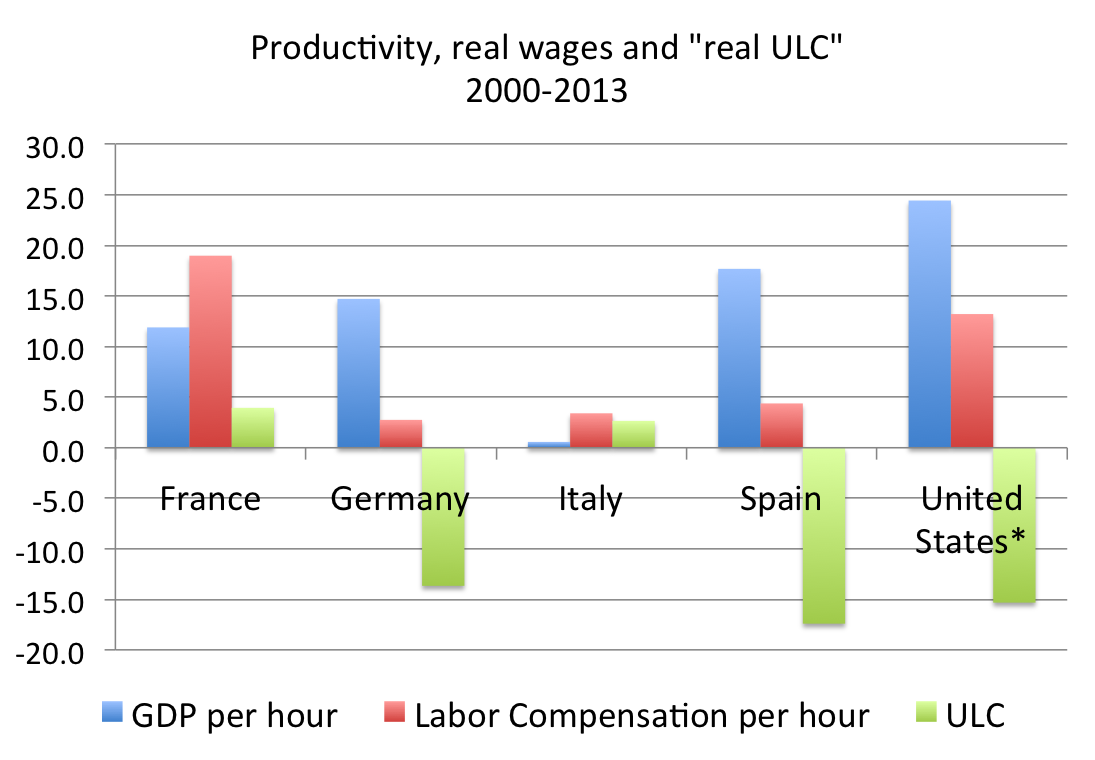
Below is a chart that summarizes data provided by the OECD on productivity, compensation and unit labor costs. I computed the accumulated change from 2000 to 2013 (except for the US where there was no data for 2013, so the period is 2000-2012).

The blue column (real GDP per hour) represents improvements in productivity. This is the ultimate source of sustainable improvements in living standards. What we see is a significant gap between the US and Europe (more so if we consider that the US is 'missing' one year). When we look inside Europe we see a big outlier: Italy, where GDP per hour has barely changed in the last 13 years. There are some interesting differences among the other countries with Spain seeing an 18% increase over the period compared to 15% in Germany and 12-13% in France and the UK. In this first column, there is no obvious German miracle during this 13 years.

The second number is labor compensation per hour. This is measured in nominal terms (i.e. current Euros or US dollars or UK pounds) as it should be when talking about competitiveness. One expects that increased productivity gets reflected in increased compensation (in real terms) and in addition we should see the effect of inflation. Here Germany stands out as the country with the lowest wage increase (per hour). To make sense out of this number we should compare it to the increase in productivity as measured by GDP per hour. This is what the third column, the unit labor cost (ULC) does, it is simply equal to the change in labor compensation per hour minus the change in output per hour.

When looking at ULC we see that Germany has seen the lowest increase in labor costs per unit of output but not because of the highest increase in productivity but because of wage moderation relative to productivity gains. Italy and the UK are the countries with the largest increase in ULC through a combination of zero (Italy) or average (UK) productivity gains combined with significant wage growth. This is the German "miracle", the ability to convince workers to get paid less (relative to productivity) than in other countries. This is good news for German firms.

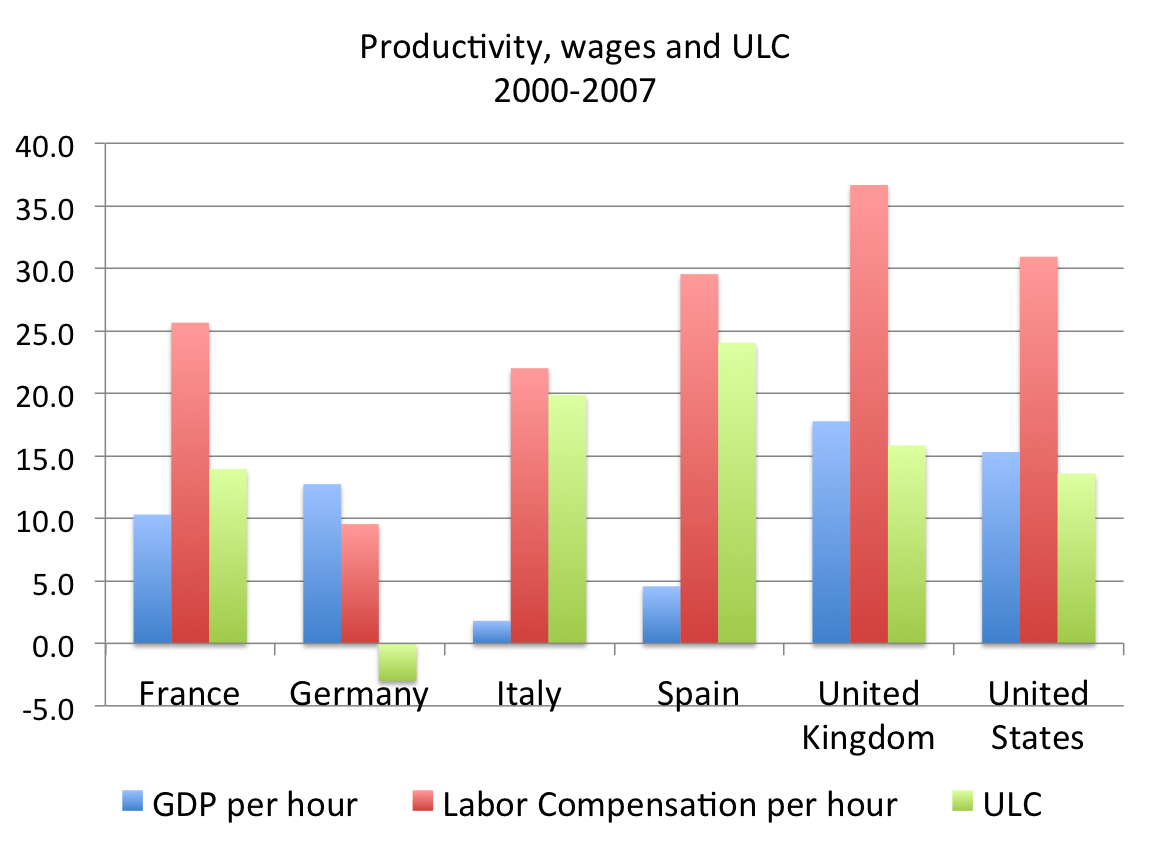
To make the "German miracle" look even stronger we can replicate the same analysis for the pre-crisis period (2000-2007).

Here we can see how Germany was even more of an outlier in terms of ULC. Once again we see wage moderation combined with good productivity growth. We also see that during those years Spain looks much worse than once we add the post-crisis period with lower productivity growth and much higher increase in ULC. Comparing the two charts we can see that there has been a significant adjustment in Spain after the crisis both when it comes to GDP per hour and ULC relative to Germany.

So can low wages be the solution for some of the Euro problems? If the goal is to improve living standards, the focus must be on improving GDP per hour, that is the only way to ensure sustained progress. Having said that, for a given increase in GDP per hour, wage growth has to be consistent with these improvements in productivity so that unit labor costs do not grow too fast, otherwise a country will be pricing itself out of the market (and we will see that in a decline in the number of hours, unemployment)

Finally, the connection between wages and prices is also not as straightforward as some would argue. The numbers for labor compensation above are all in nominal terms, which is the right way to compare labor costs across countries and its relationship to competitiveness in global markets (more so when we compare two Euro countries so we do not need to worry about exchange rates). But the evolution of nominal wages can be very different from the evolution of real wages. Below I reproduce the first chart (excluding the UK) where I adjust wages and ULC for domestic inflation (using CPI).


If we compare Germany to Italy or Spain now we see that real wages did not grow significantly faster in Italy or Spain than in Germany, and this is of their higher inflation. When compared with GDP per hour we could still argue that real wage is high in the case of Italy but it looks as low in Spain as it does in Germany. Notice that when real wages grow slower than GDP per hour it must be that we are seeing a decline in the labor share, so an increase in the capital share. In other words, prices are not only related to labor compensation but also to profits.

In summary, no doubt that wage growth can in occassions be excessive and generate increases in labor costs with negative consequences on labor market outcomes. But insisting on moderation in wage growth regardless of the circumstances as a recipe for growth is not right. First, sustained growth in living standards can only be the result of increases in productivity (otherwise, why don't we just make wages equal to zero to maximize our competitiveness?). Second, what matters for competitiveness is prices and those depend not only on labor costs but also on the pricing power and decisions of firms. Excessive wage growth might be a drag on competitiveness but so can an excessive increase in profits or other forms of rents.

Antonio Fatás


02 Sep 09:51

What to do with failed banks?

by T T Ram Mohan
Governments in the US and Europe have set their faces against bailouts of failed banks following the crisis of 2007- the Dodd FranK Act in the US prohibits such bailouts hereafter. Yet, as an article in the FT asks: what alternatives do we have?

A time tested-alternative, the author points out, was to merge a failed bank with a strong bank. Banks are now finding out that this can be costly for one reason or another. The huge fine that BofA has had to cough up has to do with the problems at Merrill Lynch and Country which it acquired in 2008 and these problems happened before the merger. This is going to deter future acquisitions and mergers because the amount of due diligence will take too long and will be too costly.

The other alternative, getting banks to prepare living wills  that will document an orderly winding up of a bank when it fails, is proving unworkable so far- in the US, the regulators have rejected living wills prepared by US and European banks. It's no use asking for banks to have contingent capital- this will be very costly and it may not suffice.

So, governments will have no recourse against bank failure other than bailouts. The only answer, which I have urged repeatedly, is to ensure that the problem is manageable when it happens and that is to limit bank size as a proportion of GDP. No policy maker or regulator is willing to touch this political hot potato.


02 Sep 03:33

10 smart actions every Indian Parents should take, once their baby is Born ?

by Manish Chauhan

When a new kid is born, your entire life changes. You are excited to enjoy the new phase of your life. Today we are going to touch upon some basic things you should watch out for and focus on after your new kid is born. These are few things which you will eventually complete, but if you are too late, you might end up waste your time and energy. So...

The post 10 smart actions every Indian Parents should take, once their baby is Born ? appeared first on Jagoinvestor - Personal Finance Blog.

02 Sep 03:31

What does algorithmic trading do to market quality?

by Ajay Shah
by Nidhi Aggarwal and Susan Thomas.

Electronics unsettled the world of organised financial markets when the trading floor and dealers became obsolete. In the late 1980s and early 1990s, this was the subject of great debate. `Program trading' and `portfolio insurance' were believed to have exacerbated the crash of October 1987. Many people believed that human market makers did things that computerised order matching could not. Millions of jobs were on the line.

When DTB won back the long bond contract from LIFFE by replacing the trading floor, the writing was on the wall. For some time, it was still claimed that electronic order matching exchanges are good for some things like equities and derivatives, but not for the bond market and the currency market. That claim has broken down in the last decade; electronic order matching on exchanges has become important in these areas also.

The debate of the day is now about high frequency trading (HFT) and algorithmic trading (AT). Once organised financial trading is done electronically, it becomes possible to setup a man-machine hybrid, where a human controls a computer program which does the actual work of looking at information and sending back orders. This man-machine hybrid is faster than a human, is less error-prone than a human, and costs less than a human. Once again, millions of jobs are on the line.

Several concerns have however been expressed on whether an HFT / AT world is socially desirable or not. Critics argue that high levels of HFT / AT does not do any good to the quality of the markets, exacerbates market volatility, and induces `flash crashes'. There are fears that liquidity provision in the AT world is transient: it is argued that in times of market stress, algorithms step away from this essential function, and instead become liquidity demanders, worsening the volatility in the markets and creating `liquidity black holes'. These are non-trivial concerns; many regulators have started exploring the extent to which the new AT/HFT world has new kinds of market failures, and the kinds of regulatory interventions that might be appropriate in that environment.

In the last five years, myriad papers have been written on the impact of HFT / AT for market quality. Most of these papers suffer from three flaws:
  1. In the US, the market structure is very fragmented across a large number of trading venues. Hence, observing HFT/AT activity at any one market venue gives an incomplete depiction of either the treatment (HFT/AT) or the outcome (market quality at the level of the whole country). The US is not a good laboratory to study AT/HFT.

  2. Most researchers do not observe a flag for each order or each trade about whether this was HFT/AT. A variety of proxies have been reconstructed by researchers, but all these are fairly imprecise.

  3. Algorithmic traders self-select themselves to be active in certain kinds of securities. This induces selection bias and hampers our ability to claim that AT/HFT has caused the observed changes. More generally, conventional regressions -- where a market quality measure is regressed on a bunch of explanatory variables -- are riddled with endogeneity bias and other statistical problems.

In a recent paper we make substantial progress on all three problems:

  1. We observe data from the Indian `National Stock Exchange' (NSE), which was the world #1 exchange by number of trades in 2013. NSE accounts for over 75% of trading, there is no OTC trading and there are no dark pools. This yields an ideal clean setting.

  2. NSE's data files precisely tag each order and the counterparties of each trade with an AT/HFT flag so there is no imprecision in identification.

  3. That leaves the problem of endogeneity bias. We utilise an exogenous event -- the launch of co-location at NSE in 2010. The effect of a treatment is best observed when the outcomes of the individuals who receive the treatment (called the `treated') are compared to the ones who are not treated (the `controls'). These two sets of individuals are required to be otherwise similar in all other characteristics. We follow this approach and use matching techniques to identify stocks that are otherwise similar, but one set of stocks saw a significant surge in the level of AT activity after the introduction of co-location, while the other did not. To ensure comparability of days in the period prior (2009) and post (2012-13) co-location due to differences in the macroeconomic conditions, we match dates based on the volatility of the market index (Nifty). The matching on the stocks along with the matching on the dates allows us to setup a matched difference-in-difference analysis through which we can measure the causal impact of AT.

We find that the adoption of AT was a gradual process. The community took nearly a year and a half after NSE started co-location before adopting it in a big way.

Evolution of AT intensity before and after co-location

Further, the adoption of AT was not uniform for all stocks. This animated visualisation shows the fraction of traded volume of a particular stock due to AT for all large securities traded on NSE between January 2009 to August 2013. Each circle is a security with the size capturing market capitalisation of the firm. Large market capitalisation firms all saw a high AT adoption from the start to the end of the period. But AT adoption is highly varied for the smaller market capitalisation securities: some got high levels of AT and some got low. This gives us the opportunity to compare `treatment' stocks (which got to high AT) against `controls' (similar stocks which got to low AT).

Our analysis yields the following results:

Market quality measure Estimated coefficient
Transactions costs
  Spread -0.35
  Impact cost -0.79
Depth
  Total depth 0.33
  Top 1 depth 0.16
  Top 5 depth 0.33
  Order imbalance                          -13.87
Liquidity risk
  IC volatility -0.02
Volatility
  Realised volatility -2.65
  Range -16.90
Efficiency
  Variance Ratio -0.03
Crash risk
  Price movements
  in excess of 5% -2.39

To summarise, our results suggest that higher AT has caused:
  • Transactions costs to drop.
  • Available liquidity to shift closer to the touch.
  • Total available depth increased.
  • Closer alignment of orders between the buy side and sell side.
  • Lower intra-day volatility of price.
  • Lower intra-day volatility of transaction costs.
  • Faster adjustment of intray-day prices.
  • Lower incidence of extreme prices outside the 5 percent band.
These results do not support the skeptical view about algorithmic trading. There is no evidence of more mini flash crashes, or of greater liquidity risk, or of a more jittery and volatile market. On the contrary, greater algorithmic trading improves market quality.

There is one class of concerns which is not addressed in this work: the problems of transacting large quantities. The evidence about transactions costs that is visible in the order book is limited to small transactions (i.e. impact cost). Big orders are dribbled out through complex algorithms. We do not know whether transactions costs got much worse for institutional investors, as some fear. 
01 Sep 03:48

Lessons from a downturn….lucky lessons should I say?

by subra


Till Taleb came along and said ‘Do not discount the role of luck in your life’ all of us considered ourselves smart. Very smart.  Warren Buffett, Bill Gates, etc. also have to consider themselves lucky with regard to their date (and place) of birth. If they were born as women in a backward district, at age 11 they would have been busy warding off the men, or looking after their younger siblings.

In my case too I consider it my luck that I was in Ghatkopar (Mumbai suburb) and not in Matunga (where my dad grew up). THAT is what brought me to the stock market. I now respect the stock market unlike many of my cousins who think of the stock market as a gambling den. So have been in the market since I was in class 12 and now can say that I have been in the markets since the 1970s! (how funny it was in 1979 that I did my first ‘sauda’ (trade)).

I must consider my self very, very lucky. During the Harshad Mehta Boom, I bought an office space for personal usage. When the index reached 21000 I had no reason to sell. However just luckily I decided to get out of some very high price earning stocks like Tata Power, L&T, Hdfc, and invest in lower p/e stocks.

Then Tata Motors, Cholamandalam, Hindustan Oil exploration, Tata Investment corporation, Hindalco, announced their rights issues. Just to be liquid for these right issues, I sold again. When the issue actually came, I was sitting on cash, but had no desire to fill the rights form. So again was sitting on cash. I think God protects people who do not know what they are doing.

Other than God I should also thank Ken Fisher for his book – “Only 3 things that Count”.

This book MADE me learn 2 things –

1) it is all right to be in equities during slow downs, but in fmcg and pharma rather than infrastructure and banking

2) Even if you do not believe in ‘timing’ if a portion of your portfolio can be save from the blood bath, your overall returns over long periods of time can be better than blind ‘time in the market game’.

However for all the readers I have a few lessons from 2008:

1. Like me, if you get lucky, do not argue against luck, protect your money.

2. Know the difference between skill and luck. I had luck so I sold enough shares to pay for the rights (and additional shares too!). If I had skill I would have sold much more, sold Kotak Bank, bought puts on Icici bank, sold Tata Steel and Hindalco.

3. Stock picking is tough – Bear Sterns, Lehman, Citibank, Morgan Stanley. Closer home Satyam, Cholamandalam, Dlf, etc.  have all shown us that

4. Diversification did not help! – Debt in Nagarjuna group was wiped out. If you put money in a real estate pms, you lost. In 2008 there was just no place to hide. Only a ‘put only’ portfolio would have been in the green.

5. Liquidity: when you need your money, if you do not get it, it is not there!

6. Leveraging which made you look smart in a bull run, can wipe you out in a bear phase.

7. Indexing works, indexing works, indexing works. Especially for people who do not think of investing as something scientific. It works best for long term investing by indifferent investors who are disciplined in investing.

Believing in ULIPs for wealth creation or Mutual fund investing based on Advisor’s skills and hoping to out performing the index is a nice fantasy like Santa Claus.

8. If your Advisor or fund manager has no transparency or you do not understand equity trading – you are better off in ppf.

9. Past performance is as useful as last year’s weather pattern on a particular day to carry an umbrella. If you get wet, do not blame the forecast. –

See more at: http://www.subramoney.com

Post Footer automatically generated by Add Post Footer Plugin for wordpress.

01 Sep 03:45

Markets are headed up!

by subra

This is a fantastic headline to catch people’s attention, that is all.

I have no clue whether the market will go up, go down, remain sideways,….NO CLUE at all. I mean it, really.

I was in a bank class when the index had reached 10,000 (year 2008 I think?).

One of the kids asked me ‘How long will it take for the market to touch 21000 again?’ Interesting question, I said. It took about 10 years for the equity market to regain Harshad Mehta’s peak – i.e. 1992 to 2002 for the market to decisively break the previous high.

I think after that they stopped troubling me – they had to learn a lot if the client stumped them with such accurate information! But, lekin, kintu, parantu, Alas!

As is fashionable and necessary there is a discussion on a leading channel about how the market will behave. Of course to quote Taleb “Sensible sound bytes is an oxymoron”.

So please listen to all the noise and come to your own conclusion. There is S who is predicting that the market might see 10,500 (when he says market can fall 50% from its previous top, I guess this is what he means), says we are in a bear market.

He says the bear market can last 2-3 years.

Then there is B who says market the market is in a correction mode – part of a bull market and this phase can last 12-18 months. Frankly all these experts are guessing – and they are looking into a teleprompter or a tv camera not a crystal ball.

Getting the market right means –

1.getting the direction right (from 26k, the market will GO DOWN), or that the market will go up (say 50k)

2.say by how much (say specifically, it will go to 14,000, or 50,000 – as your stand is),

3. how long it will be there (time that it will spend at say 14k or at 50k), and by implication

4. when will it start going up from 14k or down from 50k.


AND HAVE THE CONVICTION TO STAND BY IT.

Like John Templeton, I also do not know anybody who knows anybody who can get all the factors correct, all the time, every time.

So stop listening to sure fire timing success stories – it requires too much discipline to be successful with Technical skills.

FAR, FAR, FAR, more importantly you need not know what the market will do going forward on a  day to day basis. That is useless information, with which you can do nothing.

Do not underestimate the power of reading balance sheets, understanding asset allocation and investing regularly. It is damn powerful.


Post Footer automatically generated by Add Post Footer Plugin for wordpress.

01 Sep 03:29

Increase in PPF Investment Limit to Rs. 1.5 lakh Notified & Acceptable Now

by Shiv Kukreja

This post is written by Shiv Kukreja, who is a Certified Financial Planner and runs a financial planning firm, Ojas Capital in Delhi/NCR. He can be reached at skukreja@investitude.co.in

Starting today, I would like to remind my clients or those investors, who have the habit of depositing their hard earned money in their respective Public Provident Fund (PPF) accounts in the first week of April every year, that now onwards they can use the opportunity of topping up their PPF investments by an additional Rs. 50,000.

Announced in Budget 2014 by the Finance Minister Arun Jaitley, increase in the investment limit of PPF from Rs. 1 lakh to Rs. 1.50 lakh got notified by the Government of India on August 13 and the Reserve Bank of India (RBI) on August 22. Here are the links to their respective notifications:

Ministry of Finance Notification

RBI Notification

The same has now been brought to the notice of all the post offices as well as some of the nationalised/commercial banks which are authorised by the Government and the RBI to open PPF accounts and accept deposits in these accounts.

Nationalised or commercial banks, which have been notified and have started accepting the increased limit of deposits, include State Bank of India (SBI), Punjab National Bank (PNB), Bank of Baroda (BoB), ICICI Bank, Axis Bank, Canara Bank, Andhra Bank, Allahabad Bank, Bank of India (BoI), Oriental Bank of Commerce (OBC), Bank of Maharashtra (BoM), Central Bank of India, Corporation Bank, Dena Bank, Indian Bank, Indian Overseas Bank, Syndicate Bank, UCO Bank, Punjab & Sind Bank (PSB), Union Bank of India, United Bank of India, Vijaya Bank, IDBI Bank, State Bank of Patiala, State Bank of Bikaner & Jaipur (SBBJ), State Bank of Travancore (SBT), State Bank of Hyderabad and State Bank of Mysore.

Make PPF deposit between 1st & 5th of a month to earn maximum out of it

As most of the investors know, interest on our PPF deposits gets calculated on the minimum balance lying in the account between 5th day and the last day of a month, it is advisable for an investor to deposit cash in the account between 1st and 5th day of that month or if a cheque is deposited, then it gets cleared on or before 5th day of that month.

Features of Public Provident Fund (PPF)

For those investors, who are yet to open a PPF account, I would like to quickly highlight some important features of this most loved investment:

* A PPF account can be opened by a resident individual in his/her own name or on behalf of a minor of whom he/she is the guardian.

* A PPF account can be opened at a post office or some of the nationalised or commercial banks mentioned above.

* The minimum tenure of a PPF account is 15 years which can be further extended in blocks of 5 years each.

* Though the tenure is 15 years, investors are allowed to have premature withdrawals or avail the loan facility subject to certain terms and conditions.

* Interest Rate on PPF deposits is notified by the Government of India every year and the rate remains fixed for the whole of that financial year. For FY 2014-15, the rate stands at 8.70% per annum compounded annually.

* Investments made in a PPF account qualify for deduction under section 80C of the Income Tax Act, 1961.

* It is one of the only three investment schemes in India which still qualify as Exempt-Exempt-Exempt (EEE) from taxation point of view. The other two being the Employees’ Provident Fund (EPF) and Equity-Linked Savings Schemes (ELSS).

* Non-Resident Indians (NRIs) are not allowed to open a PPF account. Even Hindu Undivided Families (HUFs) are no longer allowed to open it.

With economic growth finally gaining some strength to touch 5.7% in the first quarter of the current financial year, inflation showing early signs of slowing down, global economies consolidating on their recovery path, the Modi government showing some early signs of taking action on its strategies laid down in the first 100 days and the Indian stock markets gaining strength steadily, would you still be investing in PPF or rather invest in ELSS this year to take part in the growth of Indian economy? Please share your views.

31 Aug 04:25

V.Kumaraswamy’s book on India: Some brilliant gems interspersed with forgettable bits

by Sanjeev Sabhlok

I’ve finished reading most of V.Kumaraswamy’s brand new book, Making Growth Happen in India: A Road Map for Policy Success [I bought the book from Flipkart]. The Kindle version should be out in a few weeks.

Overall, I’d rate the book as among the better books on Indian public policy that I've read. I'd give it 6 out of 10 (in comparison, Gurcharan Das’s books might rate around 8 out of 10, Nandan Nilakni's around 8.5 out of 10).

I have struggled to determine Kumaraswamy's worldview (i.e. his theory of the state or of the individual). He does not examine why we have a government in the first place. There is not one word I could find regarding individual freedom nor any discussion on basic governance reforms. He seems to prefer operating as a technician, not as an architect. 

This mode of operation can lead to fundamental contradictions. In some places Kumaraswamy comes out strongly against subsidies for the rich; in other places he seems to support them. In places he seems to follow Keynes (multipliers, see p.148), while elsewhere he believes markets work best. In some places he supports alternative technology (p.151: while forgetting that if jobs are to be an objective of building infrastructure, we should build roads with spoons). Although Kumaraswamy talks a lot about the need for price discovery, he seems comfortable with the continuation of many administered prices (there is no serious questioning of MSP for agricultural produce or the PDS system from first principles).

This absence of a coherent worldview flows through into the weak sequencing of topics. This is also perhaps because Kumaraswamy has strung together a number of themes from articles he published over 15 years in Business Line and Business Standard.

Despite these limitations, this book should form part of the toolkit or library of every Indian interested in public policy. It is bubbling with ideas (ranging from the bizzare to the really good). It adds value to policy debates in India.

Illustrative good bits and not-so-good bits, listed below:

EXCELLENT
1.  Suggestions regarding cost recovery (p.105 onwards, 113, 115). These are part of standard good governance toolkit across most of the developed world, but in India the rich are HEAVILY subsidised. That needs to go.
2. The need for proper analysis of infrastructure projects (p.200).
3. Some good ideas re: employment (e.g. forestry p.155, landscaping p.181)
4. Parking requirements in urban areas (p.158)
5. Good commentary re: incentives of the government as a regulator (p.180) [despite that he promotes continuous involvement of the government in a vast set of areas where it can perform better as a regulator than doer].
6. Hypocrisy of socialists (p.105)
7. Build private cities (p.104)
8. Free up interest rates and credit (p.84). On this he positively shines. Brilliant.

GOOD
1. Discussion re: incentives (p.207, etc.)
2. Position re: urbanisation – both good and poor.
3. Land acquisition (p.6)

QUESTIONABLE
1. Opposes state funding of elections without understanding alternative models (p.15, 123).
2. Suggestion to increase the bureaucracy (p. 159)
3. Thinks of the government as an entrepreneur (p.188).
4. Misplaced objection to gold (p.190-91).
5. Confusion re: the role of real estate (p.194-96)
6. Some ideas on employment are bizzare (p.146)
7. Solution re: PDS (p.179)
8. Recommendations against agricultural productivity (p.56)
9. Grossly underestimates returns to education (p.60)
10. Likes to use the stick against citizens (p.63) and brings a “planning” mindset to many discussions.
11. Poor analysis of corruption (p.12).

Overall, I plan to re-read some of the sections while I'm revising the SKC agenda. The book was money (and time) well spent.

31 Aug 04:23

How did Ramdev get so much agricultural land for commercial purposes?

by Sanjeev Sabhlok

In 2012 Tehelka reported a massive story with significant details regarding land theft by Ramdev/ related persons.

Later, in November 2013, the Uttarakhand government started investigations against land theft. 

The CM of Uttarakhand said that "Ramdev had grabbed large chunks of land belonging to villagers and the government. Several pieces of property held by the Patanjali Trust turned out to be benami transactions with no trace of the owners, he said."

I've not had time to look through each of these well-detailed allegations. What's happened with the Uttarakhand case? 

How does Ramdev buy so much land, anyway, given that black money is the typical mode of purchase of land in India? Is this black money? Does he pay in cash? Anyone knows the answer?

30 Aug 04:21

Should you invest in an Index fund?

by subra

Not sure whether I will be lynched for this article, but as usual I am not giving an answer. Let me put both the sides of the argument, and you can pull your hair over what you should do. Let me start with a caveat, if you are not allocating about 80% of your overall investible surplus to equities, your PORTFOLIO return will not be very much influenced by your asset allocation. If you have all the time in the world, the requisite skills, the data tools required, the brain to do it…you may not be able to spot funds/ schemes which will CONSISTENTLY beat the index.

CAVEAT: Personally I have no investment – or a put option in an index fund.

Also  the importance of investing regularly, not interrupting compounding, being clear that equity does not have a clear time frame, but can sometimes test your patience for very long periods of time – is a given.

Let us look at the  arguments AGAINST investing in an index fund:

1. Even internationally it is difficult for fund managers to beat a Russell kind of an index – because it is a broad based index. So beating a Sensex may be easier, but beating a BSE 100 maybe more difficult.

2. In India the Indices are poorly constructed (I do believe this) – this means many fund managers are able to beat the sensex. Let me rephrase it – many fund managers have been able to beat the index over the past 35 years that the index has been around.

3. I have been extremely lucky that I chose Franklin India Bluechip, Hdfc Top 200, Hdfc Equity, Prudence, I Pru Discovery, – and these funds have all beaten the indices over long periods of time. Attribute it to my luck.

4. Index manufacturers are like rating agencies, they react too late. Historically there can be an argument that the companies that they remove from the index TOO do well – in fact many a times they do better…

The Arguments in favor of Indexing:

1. Easy to understand – just pick the fund with the least tracking error. Tracking error takes cost, churn, waiting time – and is one good figure to judge the fund performance.

2. Too much attention is not required on a day to day basis about where to invest, when to switch, etc. As long as you want to be in equities you can be in one fund, and be done.

3. Today inexpensive index funds are available, and going forward the number of  funds that beat the index will only go down.

4. Fund managers which do well many a times are closet index funds which do just a little better – to nullify the asset mgt charges.

5. As bigger indices keep getting better managed and representative, the fund managers may find it difficult to keep pace with the index….


Post Footer automatically generated by Add Post Footer Plugin for wordpress.

30 Aug 04:20

Modi's Great Leap Forward

by T T Ram Mohan
It's a big bang reform alright but not quite what the reforms brigade has been clamouring for. The government's Jan Dhan Yojana, an ambitious plan for financial inclusion, has the potential to be a game-changer for the banking sector and the economy. It calls to mind Indira Gandhi's much-maligned bank nationalisation move which helped transform India's economic prospects over the decade of the seventies.

Bank nationalisation helped sweep small savings into the financial system and push up the savings rate from 10 per cent at the end of the seventies to over 20 per cent by the beginning of the eighties. That, in turn, caused the investment rate to double and helped lift India's trend rate of economic growth from 3.5 per cent to 5.5 per cent in the eighties. Bank nationalisation had its problems. The achievement on the lending side has not been as impressive as that on the liabilities side: small and marginal farmers and also small firms do not get the credit they need. The expansion of branches and balance sheets undermined viability in the banking system. But these problems could be dealt with over time as the basis for economic growth had been laid.

Jan Dhan Yojana holds out the promise of carrying forward the unfinished agenda of bank nationalisation. Sceptics again say it will add to the existing stresses in the banking system. The banking system will have crores of accounts that are inoperative.The overdraft of Rs5000 per accoun promised, if extended to the 10 crore accounts targeted, will create NPAs of Rs 50,000 crore.Banks may garner deposits but lending will remain an issue.And so on.

Yes, in the short run, there will be issues. Over the long run, however, the potential for transformation is enormous. The new accounts will not be idle for long. Large amounts of cash will flow in through the Direct Benefits Transfer. These could lead to large amounts of floats in the public sector (which is bearing the brunt of the initiative). Overdrafts will not be given overnight to all. Banks will watch the accounts for six months before doing so. Even if we assume that half the accounts get the overdraft and half of the overdrafts turn into NPAs, we are talking of  losses of Rs 12,500 crore over two or three years. That is bearable.

Once large numbers of people are brought into the financial system, banks will find opportunities and ways to lend. What has been the province of micro-finance institutions and Regional Rural Banks will move in a large way into the commercial banks. Banks already have made some headway with banking correspondents. Alliances with mobile operators should enable to them to leverage mobile banking as well. It is conceivable that Jan Dhan Yojana could just the shot in the arm that the public sector banks needed. Let me qualify this by saying that much depends on whether the moves under way in the finance ministry to strengthen both boards and management in the public sector bear fruit.

The goverrnment's initiative does undercut the RBI's attempts to pursue inclusion through new players such as payments banks and small banks. The RBI had taken the view that not much could be expected of the public sector and that private entrepreneurs were needed to infuse life into inclusion.The Modi government clearly has a different view. In a way, the entire locus of financial inclusion as well as bank governance has shifted from the RBI to the finance ministry. That could well be a comment on the present state of relations between the ministry and the RBI.

Above all, by unveiling an initiative that is quite different from what economists have pressed for urgently, Modi has shown his capacity for out-of-the box thinking- and his willingness to be guided by his grassroots understanding of what is required rather than the wisdom of experts.


30 Aug 04:18

98 Words That Can Make You Very Rich

by Dev Ashish
"Experience tends to confirm a long-held notion that being prepared, on a few occasions in a lifetime, to act promptly in scale, in doing some simple and logical thing, will often dramatically improve the financial results of that lifetime. A few major opportunities, clearly recognizable as such, will usually come to one who continuously searches and waits, with a curious mind that loves
29 Aug 04:53

The microeconomics of governance: the principal-agent-subagent problem

by Sanjeev Sabhlok

Most (perhaps 98 per cent) of the economists across the world have a blind spot: the economics of governance. And 100 per cent of Indian economists have that blind spot.

Have you ever seen someone who keeps their home clean and beautiful but makes a mess outside? This is the key to understanding the microeconomics of governance.​ 

Collective decisions regarding which public goods constitutes part of public choice theory. This discusses the design of the institutions of democracy and their many limitations. 

But there is an under-developed branch of public choice theory which assesses whether the individual actors in specific institutions of governance can deliver the goods we want, and why most such institutions in the developing world perform so poorly. Essentially, this is about understanding the incentives of individual players at the microscopic level. There is a huge difference between managing something in the private sector (which the discipline of management looks at) and managing public goods, which is the subject of public administration. 

Chapters 4 and 5 of Breaking Free of Nehru contain an elementary discussion on the microeconomics of the main governance institutions of India. The analysis involves examining the principal-agent-subagent problem and consideration of the costs and benefits for the parties involved (politicians/ bureaucrats). In these chapters I pick up key variables in the electoral system and bureaucratic system and analyse why these are poorly designed, and will lead to perverse outcomes.

My slides prepared for the 2013 governance reforms conference  should be seen as forming part of this branch of microeconomics. My talk at that conference summarises key aspects of the microeconomics of governance:

Much of Arthashastra by Chanakya contains the microeconomics of governance (although he tends to present the conclusions of his analysis, not the underlying argument).

There is also a considerable analysis of microeconomics of governance in the new public management literature, followed in countries like Australia and New Zealand. My article on the Victorian bureaucratic system highlights part of this analysis. The aim of this branch of microeconomics is to ensure that there are sufficient incentives to perform and deliver results. 

In brief, this branch of economics is about understanding how the citizen (principal) can get the bureaucrat (his sub-agent) to do what he wants through his agent (politician).

This involves similar principles to the standard principal-agent problem, but because of the vastly greater information gaps, uncertainty, measurability issues, etc. involved, this is a more difficult problem to resolve than the more simple principal-agent problem typically considered in the field of management. There is far more gaming, far greater moral hazard, far more costs of monitoring and enforcement, than in a simple private sector principal-agent problem.

There are also issues regarding the social contract (which I've addressed in Discovery of Freedom). – on which far more work has been done by economists in the recent past.

I must say that practitioners of public administration in the West have largely understood the basics of this branch of economics, as a result of which they have designed largely functional institutions. But perhaps Singapore outdoes all of them in the depth of understanding displayed. 

Time permitting, one day I'll write a text book on the microeconomics of governance. Without understanding it, no one can deliver public goods at an efficient cost.

ADDENDUM

My comment here:

I believe the key issue is never ownership per se, but the incentives at the micro level. Government owned organisations can perform wonderfully well, as demonstrated by Singapore (see section on Tamasek in my blog post, linked below):
http://www.sabhlokcity.com/2014/07/singapore-model-authoritarian-economic-liberalism-an-alternative-to-classical-liberalism/
I've been investigating the microeconomics of governance – a subject deeply neglected by economists – over the past 15 years. Many useful insights are obtained from operating at the micro-incentives level. http://www.sabhlokcity.com/2014/08/the-microeconomics-of-governance-the-principal-agent-subagent-problem/
If the incentives are right, then government ownership should NOT present a problem for then the citizen (principal) is directly able to achieve his/her goals at the lowest possible cost.
In most cases, however, the incentives are not right – mainly because politicians are ignorant and economists don't care about details. In those cases Friedman and Rothbard are right (even if they may exaggerate in a few cases). Those are the more common cases.
Economists are generally unwilling to examine real institutions (their incentives to publish are stacked against such detailed analysis). If they do so they'll need to examine employee contracts, funding models, etc. That's a lot of hard work. Much easier for lazy mathematicians to make wild assumptions and preach "ideology". That's an unscientific approach, however. It is time for economists to study real institutions in great detail.