Shared posts

08 Aug 02:33

What one should know about Term Insurance Plans

by Kirti

I won’t get anything back, if I take the term plan,” remarked my friend Sanjana as she was trying to find a way to save her tax this year and I suggested her buying Term plan.Term plan is the best form of insurance because it gives a very high cover at a low price. So along with Sanjana we would like to remind our readers about why buying Term Insurance plan is important?

Term life insurance is a policy that provides coverage at a fixed rate of payments, in event of the death of the insurer for a limited period of time. A term life insurance provides a large cover for a fixed period of time. There are several many benefits of term life insurance policy  as it helps secure the future of your loved ones. It ensures that even after your death; the financial security assistance provided by you keeps rolling in.  However, the nominee  would only receive the sum assured the benefits in case the insurer lost his life during the specified policy term. If one dies after the term expires, there’s no payout.

Following are 5 things that one needs to know about Term Insurance Plans

1.Term Policies are Available Online  There are many insurance companies offering term insurance policies online. Insurance companies have, now, made it easier by introducing e-term insurance policies. In this case, everything is managed online and for an individual who is comfortable using the internet, buying an e-term insurance policy will be the most feasible option. Fast, easy and secure!

2. Pure Term Plan (with Death Benefit ONLY) . You pay the premium for a specific period of time that is set in advance,  such as 20 or 30 years. Death benefit is only available if the life insured dies within the policy tenure. If death occurs after the expiry of the term, your loved ones will not be able to receive any benefits. No amount is payable to the policyholder if the life insured survives the policy tenure.

3. A Reliable Plan to Secure Your Family’s Future : Having a term insurance plan gives you the confidence that  in any case something happens to you, the plan will take care of your children’s education, housing needs and so on. A term life insurance gets you prepared for an unfortunate event like death and ensures that the financial needs of your dependents are fulfilled in your absence.

4. Low Premiums If you compare a term policy to a permanent policy, the former is definitely inexpensive. This is because a permanent policy will pay you a death benefit no matter when you die. Purchasing  insurance term policy is, therefore, a profitable proposal as it is one of the few financial products that gives a high cover at a low-priced premium. It is an affordable way to gain a noteworthy cover, which will help in securing your family’s future in your absence.

5.  Tax Benefits: Insurance premiums are eligible for tax exemption under section 80C and Section 10(10D) of Income Tax Act, 1961 subject to conditions as specified in those sections.

Related Articles:

As I have grown older and hopefully wiser, I have realised that simple ways are most effective.  I have bought a term plan, have you?

08 Aug 02:33

Some basics

by Muthu

1) Have an emergency fund of not less than 1 year of your expenses.

2) Insure: Term, medical, personal accident and fire insurance for your house.

3) Don’t use revolving credit on your credit cards.

4)Simplify: have two bank accounts, one credit card and one demat a/c.

5) Write a will.

6) Don’t borrow except for buying a house.

7) Ensure the value of the house is not more than 5 times your annual salary.

8) Create a corpus of not less than 30 times your annual expenses before considering retirement.

9) Spend less than you earn.

10) Try to save at least 30% of your salary.

11) Invest regularly.

12) Invest for long term; not less than 10 years, preferably 20 years or more.

13) Never stop your SIPs, especially in bear markets.

14) Never forget that all asset classes would always be cyclical.

15) Equity would provide the best return over long run than all other asset classes.

16) Follow portfolio diversification.

17) Follow asset allocation.

18) Have an advisor. The reward is worth the cost.

19) Check and review your portfolio only once a year.

20) More than your knowledge, it’s your behaviour which matters most for success in markets.

21) Come what may; always stay the course.


08 Aug 02:31

Buying The Next Hot Idea

by David Merkel

If you want to know what is the core problem of the average person approaching the market (though this applies more to males than females, women have more native caution on average), it is chasing a hot idea.  This can take a number of forms:

  • Getting tips from friends who have bought some stock that is currently popular in the market.
  • Doing the same thing with investors who talk or write about investing.  The best investment advice is not flashy, and does not make for good video.
  • Looking at charts and buying something that is rising rapidly, because popular media say this is “The Next Big Thing.”
  • Buying the mutual fund or other pooled vehicle of some manager who has done very well in the past, and seems to never fail.  (If you buy a mutual fund, don’t buy one that has had a lot of money pile into it recently… usually a bad sign.  Spend more time to see if the manager thinks in a businesslike way about assets that he buys.)
  • Going to a broker who is very well-dressed and confident, and talks really well, but who has no obligation to act in your best interests.  If you don’t know how he is earning his money from you, avoid him, because it usually means investments with high fees or hidden ways that you can lose, e.g. structured notes that offer a nice yield, but where possibilities to lose are more significant than you think.  At best, he will give you consensus ideas and managers that deliver him above average remuneration.
  • Buying the newsletter of some overly confident person who claims to know the secrets of the market, which he will share with you and 100,000 other close friends for a mere $299/year!  (Please read Mark Hulbert before buying a newsletter.)
  • Worse yet, giving into the fakery of those who try to bring you into a hidden opportunity.  It can be a Ponzi scheme, a promoted stock, but they suggest returns that are huge… or, like Madoff, decent but not exorbitant returns that are altogether too regular.

Many of these appeal to our desire to get something for nothing, which is endemic — we all have it to some degree, and marketers play off this regularly by offering us “free” this, and “free” that.  Earning returns from your investable assets is a business in its own right, and there are costs to doing it well.  You should not be surprised that doing well with it will take some time and effort.

You also have to avoid the impulse that there is some hidden knowledge, or group of insiders that have found an easy road to riches.  The markets aren’t rigged in any material way.  The principles of investing are well-known, but applying them takes creativity, time and effort.  There are no significant players with a new theory who make amazing money investing in secondary markets for stocks and bonds.

Most of the things that I listed above involve low-thought imitation of others.  There is little advantage in investing to mimicry.  Even if it worked for someone else, the prices are different now, and easy gains have been made.  You will do worse than the one you are trying to imitate with virtual certainty, and likely worse than average.  You need to plan to take an independent course, and learn enough such that if you do choose to use advice of any sort, that you can evaluate it rationally.  If you choose to do it yourself, you will need to learn more than that.  It takes effort, but that effort will pay off, if not in investing itself, but there are spillover effects in intelligent management of your finances, and in improving your abilities in the businesses that you serve.

In most areas of life, most things that pay off well take effort.  If people present you with easy or hidden ways to make above average money, be skeptical.  Doing it right takes discipline and effort.  (If you want the easy route while avoiding all the pitfalls see the postscript.  It is boring, but it works.)

Postscript

As an aside — you can always index, and beat most average investors over the long haul.  Buy broad funds that invest in a large fraction of all of the stocks that there are, and those that replicate the bond market as a whole.  Make sure they have low fees.  Buy them, hold them, and be done.  You will still face one hurdle: will you be able to maintain your strategy when everything is in a crisis, or when your friends tell you they are earning a lot more than you, and it is easy to do it?  Size the bond portion of your assets to the level where you can sleep soundly in all circumstances, and you will be fine.


08 Aug 02:27

Weekend Links: 7 August 2015

by Manshu

I really liked this explanation of death and life force by a Zen Master. On the topic of death, this news is old, but I really liked Jimmy Kemmel talking about Cecil the Lion.

Quite saddening to read about lion farms in South Africa on which lions are raised with the sole purpose of being hunted later on in their lives.

A lot of meat eating people (like me) are unable to make sense of the sadness they feel at news of whales or lions or dogs being killed but not giving it a second thought when we eat meat ourselves. A good read for us: Why eating chicken is morally worse than killing a lion?

Last link which is semi – related — every animal that became extinct in the last hundred years.

If Foxconn does indeed setup manufacturing operations in India, it would be great news for Indian manufacturing.

The Republican debates started yesterday, and the Economist presents a good summary. 

07 Aug 11:13

Simple retirement steps….

by subra

I speak for 2-4 hours on retirement, and I can tell you it is difficult to speak for 3 hours on retirement planning, because it is a simple topic and does not take so much time. Please understand being simple means – simple to understand. Not saying it is easy to do.

So Retirement Planning 101, let us say consists of the following things:

1. Knowing when you will retire.

2. Knowing how long you and your spouse will live.

3. Knowing how much you will spend in this period

4. Knowing how much your medical expenses will be.

5. Starting to save/ invest as soon as possible  (understanding, and so tapping Compounding)

6. Investing as much as possible, as quickly as possible, and not interrupting the compounding.

7. Understanding asset classes – equity, debt, cash and real estate

8. Understanding asset class returns, standard deviation, mean, and reversion to the mean.

9. Understanding Asset Allocation.

10. Knowing that Cost really matters, and one way of mitigating costs is through higher saving.


I hope that you realise that 1-4 is a joke – nobody can estimate these 4..so what you have to do is from 5 to 10 !!

Start of with a prayer on your lips, a white board, a nice calculator, and an adviser. Chances are in about 5 years you would have learnt why you do not need an adviser. If the adviser is good he would have delivered good results by now and you would do away with the doubt of whether you need an adviser.

So retirement which is the biggest asset that you will buy starts of by doing a SIP in a few mutual funds. I would suggest a combination of a large cap fund (for e.g. Franklin India Blue Chip fund or Icici Prudential Focused Blue Chip fund), one mid cap fund (Hdfc Midcap Opportunities fund?) and a balanced fund like Hdfc balanced fund.

How much should you save/ invest? The answer is simple – it does not matter. If the retirement calculator says you have to invest Rs. 32000/- and you are able to invest only Rs. 10,000, it does not matter. MAKE A START. That is important. Once you start and after a couple of years you make it 20,000 and then increase it to Rs. 45,000 you would have at least partly compensated for the delay.

You must not buy any plan from a life insurance company – forget what it is called!! Whether it is called ‘Endowment’ or ‘Moneyback’ or ‘Unit linked’ or it has the word Retirement or Pension…IGNORE products from a life insurance company.

The mutual funds also have retirement plans on offer, but no adviser sells it, so there is very little chance of it being offered to you. If you are a PPF fan continue your PPF, but a big portion should go into an ELSS – clearly have a vision that you will touch that ELSS only when you retire.

So discontinue your endowment plans, keep your PPF alive, keep your EPF from your company alive, start doing a couple of SIPs..and hey your retirement will be fine. Rather you will be on the right path!!

Post Footer automatically generated by Add Post Footer Plugin for wordpress.

07 Aug 11:11

The problem with 'best-practice' models

by noreply@blogger.com (Gulzar Natarajan)
This blog has consistently held that India's implementation deficit is largely a reflection of state capability weaknesses. This weakness is often amplified by the embrace of best practice models. As the cliche goes, "best becomes the enemy of the good" and to rephrase Dani Rodrik, scalable best-practices  are "second-best, at best". Ricardo Hausmann makes a reference to this in his most recent Project Syndicate article.

Consider the example of any regulation which provides the best-practice protections to consumers. In developing countries, many goods and services are offered without the full range of consumer satisfaction standards. They range from product development to safety to functional to servicing requirements. In fact, a significant portion of the value chain of the product or service is typically done in the informal sector. All this naturally lowers the cost of production and producers pass on atleast a share of the savings to consumers in the form of lower prices.

Accordingly, the plastic or steel vessels purchased at your local store, haircut from the 'barber shop', and driving lessons from the neighbourhood 'driving school' are cheap and affordable. Much the same applies to an apartment unit bought from the local developer. Alternatively, for the buyer, the transaction cost associated with the risk of buying a house without clear land title, construction quality assurance, and delivery time commitment is offset by the cheaper price of the housing unit. In an extremely price-sensitive market, such sub-par production, product/service-quality, consumer protection and servicing standards engenders a low-level equilibrium. I have blogged about similar low-level equilibriums in public service delivery here, here, and here

In this context, best practice regulation, which seeks to formalize and standardize processes and quality standards, can have unexpected consequences. One immediate impact is that the cost of production rises as the layers of processes and standards take effect. This in turn prices out a large share of the consumers, leaving a market for that product or service which is unaffordable for the vast majority of consumers.

Another effect is that it amplifies state capability weaknesses. Higher standards in an environment where even the lower standards are not effectively enforced is a recipe for more failures. Worse-still, since producers will struggle to comply with the increased requirements at their prevailing (or even slightly higher) price points, it increases the opportunities for harassment and rent-seeking by inspectors and other public officials concerned with monitoring the rule.

Finally, these best-practice models increase informality. As the cost of compliance increases, firms prefer to go informal so as to continue servicing their existing customers. Perversely enough, the quest for higher standards would end up lowering the informality threshold and increasing the share of the informal sector in the market for that product or service.

Such reform attempts fail because its proponents only ask, "what is the best strategy to improve the quality of a good or service?". Instead, the question should have been, "what is the best strategy to improve the quality of the good or service, conditional on the market constraints and enforcement capability of the public system?". We just can't wish away the real world! 
Add to Technorati Favorites
07 Aug 11:09

Financial Planning lecture…Ahmedabad and Bangalore..

by subra

from the emails, and FB requests…I decided to do 2 sessions – one in Ahmedabad and one in Bangalore…wait for further information.

will announce date, venue, price, etc…..it will be in October and the one in Ahmedabad no decision as of now

will need about 50 people to attend..or it does not make sense to travel…so people who wish to attend please say so on the comments…


thanks


Post Footer automatically generated by Add Post Footer Plugin for wordpress.

07 Aug 11:09

China urbanization fact of the day

by noreply@blogger.com (Gulzar Natarajan)
From a Brookings study (pdf here)of 100 largest metropolitan areas in the Asia Pacific region (East Asia, Oceania, western parts of North and South America), this factoid and graphic about China and rest of the world is simply staggering,
Chinese metro areas averaged 11.2 percent annual GDP per capita growth since 2000, compared to just 1.3 percent per year in the rest of the world’s major cities.
As this FT feature, which chronicles the downside of the Chinese urbanization, informs, urban area's share of population surged from about 20% in 1980 to over 50% now, and share of GDP has grown from nearly 70% to more than 90% in the same period.

China's much-discussed quarter century of economic growth in general has been spectacular, but in particular its less discussed urban growth has been unprecedented. The country's sustained and rapid urbanization, managed without much of the problems of unplanned sprawls and slum proliferation that characterize the same in countries like India, should count as arguably its biggest social and political achievement. Unorthodox, 'second-best', instruments like hukou permits, development of satellite townships etc have doubtless played an important role in managing the inevitable externalities and problems associated with rapid urbanization.
Add to Technorati Favorites
07 Aug 11:09

Reducing delays in litigation by reshaping the incentives of litigants

by Ajay Shah
by Shubho Roy.

Judicial delays are a major problem in India. There have been a number of attempts to solve these through introducing new legislation or tweaking existing laws. The tweaks usually involve putting ad-hoc numerical limits on the number of proceedings or delays. This approach has failed. A different approach is to create incentives for parties to not delay legal proceedings. This approach has been used worldwide with success. One example we show here, from the US, is Rule 68 of the Federal Rules of Procedure which sets up an interesting game to speed up litigation.

The problem


In enforcing contracts, India ranks 186 out of 189 countries. Judicial delays in criminal cases probably cause even more harm. To solve this problem the government has tried quite a few things. Amongst them are:

  1. The Arbitration Act and Conciliation Act, 1996 was made with the objective of providing litigating parties (mostly in commercial disputes) a system outside the court system through arbitrators, but within a legal system of the Arbitration Act. This law succeeded an older law of 1940 and was supposed to make India's law aligned with international law of arbitration.
  2. The Code of Civil Procedure which governs court proceedings in civil disputes was amended in 1999 (effective from 2002) requiring courts provide a maximum of three adjournments to a party in a case (times a party can delay a court proceeding for the day). This rule appears to be followed more in its breach. Similarly the costs imposed on parties for adjournments are puny compared to the actual costs in an adjournment. E.g.  Bombay caps costs for each days proceeding at Rs.100.

These attempts have not resulted in improved arbitration or reduced court delays. As a recent arbitration order against India in an arbitration under a bilateral investment treaty notes: An international investor could not enforce the arbitration award (i.e. legally collect the award) after winning the arbitration for a period of 8 years.

The government proposed an ordinance to amend the Arbitration Act, 1996 to speed up the process of arbitration. Amongst other changes, two key proposals are:

  1. A time of limit of 9 months for arbitrators to finish proceedings. If the time for proceedings exceeds the limit, the arbitrator will have to apply to the High Court to get an extension. The High Court may prevent arbitrators with long delays from taking up new proceedings.
  2. The government will cap total fees payable to an arbitrator.

These quantitative restrictions and price controls have three features:

  1. They are not new, and have been tried multiple number of times before.
  2. They have been a resounding failure in the past.
  3. They have many unintended consequences.

While speeding up arbitration is a step in the right direction, at the end if the losing party does not cooperate, the coercive power of the state has to be exercised. The Ease of Doing Business report notes that a contract enforcement in India involves 46 steps. Arbitration proceedings constitute only a fraction of those steps.

This award is symptomatic of what is wrong with squeezing the balloon in one place. We just create incentives for parties who want to litigate and delay to move their delaying tactics to other areas including:

  1. Appointment of arbitrators: When parties disagree whether an arbitration is required or who should be an arbitrator, the courts have to step in to start arbitration proceedings or appoint arbitrators. Parties unwilling to cooperate, will just use the same old delaying tactics in Indian courts to delay the appointment of arbitrators.
  2. Execution of arbitration awards: After winning an arbitration, the winning party still has to go to the court to force an unwilling losing party to pay up. Only a court order can block and transfer money out of a bank account or hold auction for a property of the loser. Again, this requires the winning party to go file an application before the court to get court official to assist in forcible takeover of properties, or get bank account records changed (usually called execution proceedings). The losing party can again use time tested delaying tactics in execution proceedings to lengthen out the suffering of the winning party.

Emphasising a single bad metric may have many bad unintended consequences. Arbitration proceedings should not be judged solely on the basis of time taken for the award. The quality of the award is also an important desirable feature of an arbitration. Arbitrary limits on time and fees work against the quality of the awards.

With the nine month deadline in the mind of arbitrators and a probable reduction of fees, the arbitrator will have the incentive to:

  1. Hurriedly finish arbitrations and push out a low quality award. Which will then be challenged in appeal before courts, thereby burdening the judiciary again.
  2. Take up more number of arbitrations to have the same level of income as before. This will have the same effect of pushing down the time and effort an arbitrator allocates to each case.

A single cost cap for arbitrator fees also ignores the complexity of modern arbitrations. Arbitrations today are not just limited to legal questions, complicated contracts in engineering, construction, high end services require specialist arbitrators with technical knowledge. Capping costs has a high risk of driving out competent and therefore expensive aribtrators outside India.

Reshaping incentives


In order to make progress, we should look deeper. We should understand the incentives of the parties to a litigation and then use policy interventions to modify these incentives. One useful example is from the US: Rule 68 of the Federal Rules of Civil Procedure. This is a more nuanced approach which discourages parties to litigate.

Rule 68: Winner beware


Rule 68 involves civil cases where the plaintiff (the suing party) is seeking monetary damages against the defendant (the party being sued). The rule has the following proposition:

At any time before the trial starts, the defendant can make an offer to the plaintiff to settle the case. Two copies of the offer terms are made. The plaintiff can accept or reject the offer. If the plaintiff accepts the offer, the cost of the trial is eliminated.

If the plaintiff rejects the offer, the judge is informed about the rejection but not the terms of the offer that was rejected (this is kept in a sealed copy with the court). If the plaintiff wins, there can be two scenarios at this point:

  1. The sum awarded in the judgment is higher than the sum offered by the defendant before the trial started.
  2. The sum awarded in the judgment is lower than the sum offered by the defendant before the trial started.

In the second case, the plaintiff has to bear the entire litigation costs incurred by the defendant from the date the offer was made by the defendant. The offer is not seen by the judge before the trial to prevent the judge's final determination from getting coloured by the offer of the defendant. The judge comes to the determination of judgment amount through the independent judicial process.

This rule is an elegant way to reduce litigation. At the beginning of a case, the judge has very little information about the merits of the case: In contrast, the parties know much more, having lived through the dispute. They are also in a better position to understand the true value of their economic loss. However, every plaintiff (who believes she will win) has an incentive to ask for more damages than actually suffered. Conversely, every defendant who knows that he has a weak case still has some incentive in drawing out a litigation, thereby delaying the eventual payout she has to make.

When an offer is made to settle, every plaintiff takes it as a signal about what the defendant thinks about the merits of her case. A high offer is interpreted by the plaintiff as that the defendant considers that the plaintiff is on strong legal grounds to win. This may push the plaintiff to continue with the trial, with the hope of getting a higher award in judgment rather than the settlement. However, by transferring the trial costs in case of a lower judgment value, a good counter incentive is created for the plaintiff. The plaintiff has to think hard about the offer and cannot reject it summarily.

Similarly, defendants have an incentive to offer lower settlement amounts because it may be used as a signal that the defendant has a good case. However, this rule gives an incentive to the defendant to make a fair and generous offer, knowing that if the court gives a lower amount the defendant will make significant savings in litigation costs.

The rule thus sets up an economic game where there is a strong incentive for both parties to avoid judicial systems without doing injustice and reducing the burden on the state.

Conclusion


Few problems are as important to India's emergence as a mature market economy and successful liberal democracy, as the problem of making courts work better. One element of this is a fresh approach to the administrative aspects of how courts work. The second element is to rethink rules in a way that is grounded in thinking about incentives. Compare and contrast the sophistication of Rule 68 with the 9 month and price capping rules that we are proposing in our arbitration law.
07 Aug 08:01

Mutual fund myths: some being removed

by subra

The mutual fund industry owes me some thanks for pushing a lot of people into investing! Surely the investors are happy and benefiting and hence enjoying the process. However when I speak to them I realize that there are too many mis-conceptions, let me clear some of them at least:

1. ‘Are mutual funds not risky':

Answer: Mutual funds are just investment vehicles with some underlying assets. So a mutual fund could represent equities, debt, commodities, real estate, etc. Largely mutual funds REDUCE risk of the individual asset class. Thus a bunch of equities is less risky than a single stock. Also in the Indian context about 70% of all assets are invested in debt instruments. This is surely not as volatile. I  will talk about risk in a different context.

2. All mutual funds invest in equities?

A: No. see answer number 1.

3. If I invest in EQUITY schemes I get tax benefit.

Answer: Partly right, partly wrong. Only and only if you invest in schemes called ‘ELSS” do you get a tax benefit under section 80C of the Income tax act. However, if you invest in any equity oriented mutual fund (i.e. a fund corpus having at least 65% in equities).

4. Do I not need a lumpsum, say, at least Rs. 100,000 to invest in a mutual fund?

A: Hell no!! You can start with an amount as small as Rs. 500 in most fund houses – and let the amount grow on a monthly basis, it slowly adds up over a long period of time. IN fact Icici Prudential and Hdfc mutual funds have a scheme by which you can increase the amount on an automatic basis. This brilliantly lets you accumulate a higher amount of corpus.

5. What happens if I start a SIP and am not able to pay for one month?

Ans: Literally nothing. Every month you are giving money to a fund manager to manage your money. Not giving in one particular month is not an offence. Largely this comes from the EMI cheque bouncing fear. You should not bounce any SIP cheque, but in a worst case scenario if it does bounce, you will end up paying some bank charges, nothing more than that. No penalties, no court case. Relax.

6. You keep saying mutual funds are for the long term, I have only a 3 year view!

Ans: Mutual funds are of many many types. In something called Liquid funds you keep large amounts of money in one shot for a short period of time. On the other hand in equity funds it makes sense to put small amounts of money over a very long period of time.

7. My adviser seems to be cheating me – he suggests only funds with high NAV, never cheap funds!

Ans: An adviser gets paid a %age of the money invested, so for him it should not matter in which fund you invest! It is a myth that funds with lower net asset value (the price that you pay for each unit) are cheaper. They are not cheap at all. The NaV should not bother you at all.

8. I am a businessman I cannot commit to a SIP:

Ans: Actually you can do a STP. Put all your money in a liquid fund and do a STP from that fund. Suppose you have Rs. 200,000 now. Put it in a liquid fund and do a STP of Rs. 2000 per month. When ever you have a surplus keep pumping it into that liquid fund. Thus at the end of one year that fund may have say Rs. 300,000 because – it grew in value and you added some amount. However 24,000 has gone into an equity fund. This can be painless for a businessman.


Alternatively you can start a small SIP of say Rs. 2000 per month and whenever you have extra money keep ADDING TO THE SAME ACCOUNT. Unlike a bank RD you can add some ad hoc amount into a SIP account.

There are more myths….but later…!!

Post Footer automatically generated by Add Post Footer Plugin for wordpress.

06 Aug 02:44

10 Richest People of All Time, Are Rich People Evil?

by Kirti

Who are the richest people? Who are the richest people of all time? Usually people associate rich being bad. But  are rich evil? There have been countless fortunes won and lost throughout history. People have built massive amounts of wealth a variety of ways: through inheritance, through the crown, savvy investing, or building incredibly powerful businesses. Lets look at Are Rich People bad? Is Money root of all evil and see 10 richest people of all time

Are Rich people bad?

The general conception is that rich are bad and poor are good.  But I have seen many rich yet down to earth people. On the contrary, poor have behave arrogantly. We have been seeing politicians and corporations leaving ordinary people behind — but that doesn’t that mean the rich people are evil and must have done something bad to attain their wealth.  Quoting from Is Money the root of all evil – Ayn Rand, Atlas Shrugged

So you think that money is the root of all evil?” said Francisco d’Aconia. “Have you ever asked what is the root of money? Money is a tool of exchange, which can’t exist unless there are goods produced and men able to produce them. Money is the material shape of the principle that men who wish to deal with one another must deal by trade and give value for value. Money is not the tool of the moochers, who claim your product by tears, or of the looters, who take it from you by force. Money is made possible only by the men who produce. Is this what you consider evil?

“But you say that money is made by the strong at the expense of the weak? What strength do you mean? It is not the strength of guns or muscles. Wealth is the product of man’s capacity to think. Then is money made by the man who invents a motor at the expense of those who did not invent it? Is money made by the intelligent at the expense of the fools? By the able at the expense of the incompetent? By the ambitious at the expense of the lazy? Money is MADE—before it can be looted or mooched—made by the effort of every honest man, each to the extent of his ability. An honest man is one who knows that he can’t consume more than he has produced.

“But money is only a tool. It will take you wherever you wish, but it will not replace you as the driver. It will give you the means for the satisfaction of your desires, but it will not provide you with desires. Money is the scourge of the men who attempt to reverse the law of causality—the men who seek to replace the mind by seizing the products of the mind.

I have tried to read about wealthy people, and what I realised is  they have gotten that way through extraordinarily hard work, taking advantage of where they were (Bill Gates) or Not (Steve Jobs), a clear understanding of what wealth means to them.

Think and Grow Rich is a 1937 personal development and self-help book by Napoleon Hill. The book was inspired by a suggestion from Scottish-American business magnate and philanthropist Andrew Carnegie . It is the result of more than twenty years of research based on Hill’s close association with a large number of individuals who achieved great wealth during their lifetimes. At Andrew Carnegie’s bidding, Hill studied the characteristics of these achievers and developed 16 “laws” of success meant to be applied by people to achieve success. Think and Grow Rich condenses these laws further and provides the reader with 13 principles in the form of a philosophy of personal achievement. The 13 “steps” listed in the book are:

1. Desire 2. Faith 3. Autosuggestion 4. Specialized Knowledge 5. Imagination 6. Organized Planning 7. Decision 8. Persistence 9. Power of the Master Mind 10. The Mystery of Sex Transmutation 11. The Subconscious Mind 12. The Brain 13. The Sixth Sense

Richest Man of All the Time

Time came out with the list of 10 Richest People of all time.  It has living legend Bill Gates and  an Indian Mughul Emperor Akbar. The methodology used to determine richest people of all time across a wide range of time periods and economic systems, is described at time.com.

S.no Name Year Country Wealth
1 Mansa Musa 1280–1337 Mali Richer than anyone could describe
2 Augustus Caesar 63 BC–14 AD Rome $4.6 trillion
3 Emperor Shenzong 1048–1085 China Ruled empire with 25% to 30% of global GDP
4 The Great Akbar 1542–1605 India Ruled empire with 25% of global GDP
5 Joseph Stalin 1878–1953 USSR Complete control of a nation with 9.6% of global GDP
6 Andrew Carnegie 1835–1919 United States $372 billion
7 John D. Rockefeller Sr. 1839–1937 United States $341 billion
8 Alan Rufus (a.k.a. Alan the Red) 1040–1093 England $194 billion
9 Bill Gates 1955-present United States $78.9 billion
10 Genghis Khan 1162-1227 Mongolian Empire Wealth: Lots of land, not much else

The image from Times of India gives more information about these richest people of all Time.

10 richest people of all time

10 richest people of all time

Related Articles:

Do you think that money is root of all evil? Do you think that Rich People are Wealthy? Which Rich Person do you admire and why? Do you get inspired from rich people? What do you say to 10 Richest people of all time?

06 Aug 02:32

Helicopter Money: What is it?

by Amol Agrawal
Superb post from Fergus Cumming of BoE. When Friedman famously conjured up images of banknotes fluttering from helicopters in 1969, perhaps he knew he was about to inspire decades of sky-bound puns and policies in the name of deflation avoidance.  Helicopter money goes beyond standard fiscal and monetary policy by boosting economic activity using money created […]
06 Aug 02:30

Silent SEBI vs. Raucous RBI

by Amol Agrawal
Let us start with a story. There were two children in an Indian household. One was “perceived” as this really brilliant type who was really liked by relatives & friends (both in India and abroad). The other was this silent type who was relatively ignored by one and all. As the first one was highly […]
05 Aug 08:54

Latticework of Mental Models: Tragedy Of Commons

by Anshul Khare

I have never been bitten by a dog (by an unfriendly dog to be precise). However, there were few friendly ones who would chase me for fun. Well it was fun for them but as a kid I didn’t particularly enjoy that kind of sport much.

So when I moved into my current apartment community, housing nearly two thousand flats, it felt nostalgic because the campus had multiple patches of large open areas which meant it was a boon for dog owners (and heaven for their dogs).

Few years back, it wasn’t uncommon to see few fitness conscious dogs taking regular morning and evening walks (along with their disinterested owners) inside the apartment campus. But as the resident population grew, the population of pets followed suit. Pretty soon, it became a common practice for dogs to relieve themselves anywhere in the campus.

The pet owners perhaps assumed that cleaning was a responsibility of maintenance staff which resulted in a campus littered with dog poop everywhere. It was ironical that the mess was equally disturbing for all residents (including those offending dog owners) but it was quite logical, in absence of any specific laws about pet poop mis-management, for people to keep their houses clean and compromise with the common area.

I couldn’t help but marvel at Aristotle’s insight about this issue. He said –

What is common to many is taken least care of, for all men have greater regard for what is their own than for what they possess in common with others.

Perhaps Aristotle’s neighbourhood had many pets too. Although, during his times people were probably more fascinated with horses than dogs. That reminds me of an interesting trivia

In late 1800s the primary mode of transport was horse carriage and in New York city alone there were more than 150,000 horses. This resulted in more than three million pounds of horse manure per day that somehow needed to be disposed of. Holy s**t!

Pardon me for all the crappy (and stinky) discussion so far. :) I think I digressed from the subject. Oh! I haven’t even introduced today’s subject yet. Sorry again!

My mind, like an unchained monkey, hops from one branch of thought to other. That’s what I call “google-ification” of human mind. A phenomenon where even before you are finished thinking about a word, the google(ish) mind starts regurgitating interesting trivia about it.

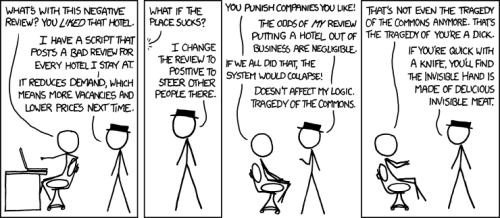
The mental model that we are going to look at today is called Tragedy of Commons, TOC in short. It’s an important idea from the field of economics and ecology.

Tragedy of Commons

TOC is a phenomenon, as we have seen in the case of dog owners above, that results from actions that benefit the individual (meaning single persons, households, villages, companies or nations) in the short term but often end up hurting the collective.

Mind you, it’s not a cognitive bias neither a result of irrational human behaviour. On the contrary, it’s the perfect rational behaviour that leads to the long-term ruin of the common resources.

This shows how individually good decisions lead to collectively bad outcomes.

Gregory Mankiw, in his book Principles of Economics, explains the idea using this simple parable –

Consider life in a small medieval town. Of the many economic activities that take place in the town, one of the most important is raising sheep. Many of the town’s families own flocks of sheep and support themselves by selling the sheep’s wool, which is used to make clothing.

…the sheep spend much of their time grazing on the land surrounding the town…No family owns the land. Instead, the town residents own the land collectively, and all the residents are allowed to graze their sheep on it. Collective ownership works well because land is plentiful.

[Very soon] With a growing number of sheep and a fixed amount of land, the land starts to lose its ability to replenish itself. Eventually, the land is grazed so heavily that it becomes barren. With no grass left, raising sheep is impossible, and the town’s once prosperous wool industry disappears. Many families lose their source of livelihood.

What causes the tragedy? Why do the shepherds allow the sheep population to grow so large that it destroys the Town Common? The reason is that social and private incentives differ. Avoiding the destruction of the grazing land depends on the collective action of the shepherds. If the shepherds acted together, they could reduce the sheep population to a size that the Town Common can support. Yet no single family has an incentive to reduce the size of its own flock because each flock represents only a small part of the problem.

In essence, the Tragedy of the Commons arises because of an externality. When one family’s flock grazes on the common land, it reduces the quality of the land available for other families. Because people neglect this negative externality when deciding how many sheep to own, the result is an excessive number of sheep.

The Tragedy of the Commons is a story with a general lesson: When one person uses a common resource, he or she diminishes other people’s enjoyment of it. Because of this negative externality, common resources tend to be used excessively.

This mental model was further made popular by an American ecologist Garret Hardin. Charlie Munger spoke about this in his 2003 talk at University of California –

…the tragedy of the commons model, popularized by my longtime friend, UCSB’s Garrett Hardin. Hardin caused the delightful introduction into economics – alongside Smith’s beneficent invisible hand – of Hardin’s wicked evildoing invisible foot. Well, I thought that the Hardin model made economics more complete, and I knew when Hardin introduced me to his model, the tragedy of the commons, that it would be in the economics textbooks eventually. And, lo and behold, it finally made it about twenty years later. And it’s right for Mankiw to reach out into other disciplines and grab Hardin’s model and anything else that works well.

TOC Is Everywhere

TOC isn’t limited to just dogs and sheep. It applies to ecosystems, rivers, oceans, organisms or mineral resources.

Even meetings in office! Claims this post

In a culture where anyone can call a meeting for any reason at any time, they will.

After getting familiar with this mental model, I started noticing it in many others places. In fact in my apartment complex (for that matter for any community living) I found few more TOC issues –

  1. The campus has designated car parking slots for each flat and if someone has multiple cars then they can rent one. However, the visitor parking area is free. A visitor parking area is supposed to be used as common resource. But TOC kicks in and what do you see? People start using the visitor parking for their extra cars. Not only that, people would even invite their friends’ and relatives’ to leave their cars in the visitor parking for many days.
  2. In apartment complexes you can still enforce rules but what about houses which don’t really belong to a closed community? In Bangalore, and perhaps in all big cities, it’s common for people to build their houses without making provision for garage. Why? The road is a common resource and free of cost. So you see most of the roads being used as permanent parking areas by most of the car owners. TOC again!

I found this interesting piece of observation on Farnam Street blog about TOC –

While walking my dog around Philadelphia during the blizzard aftermath, I couldn’t help but notice an interesting trend. Virtually all of the houses with a single occupant or family (as indicated by a single doorbell or knocker) were shoveled clean. Nearly every house with multiple occupants — and most businesses — were unshoveled. This seems like a TOTC in reverse: A common good that requires work to maintain is ignored if there is a diffusion of responsibility.
TOC

If you really think about it, a lot of social vices are aggravated as a result of TOC.

Everyone wants to get rid of corruption but when it comes to getting our work done at public office we don’t mind paying a small bribe, knowing very well that it’s a harmful practice for the society over long term.

Peter Bevelin, in his book Seeking Wisdom, writes –

Why do people abuse the health care and welfare system? Isn’t it natural that people use the system if they don’t have to pay anything? And if people don’t have to pay for a benefit, they often overuse it. The more people that benefit from misusing the system, the less likely it is that anyone will draw attention to what really happens. Individually they get a large benefit and it’s a small loss for society. Until everyone starts thinking the same.

Here is a nice illustration from the house of Khan Academy –

Limitations of TOC

Before I start sounding like a man with a new hammer (TOC), let me talk about the limitations of this mental model. With all the rules, policies, taxes, and regulations at place a lot of common resources around us have become less prone to fall for TOC.

Even Garret Hardin revised his theory of TOC a bit to account for this factor. He wrote –

To judge from the critical literature, the weightiest mistake in my synthesizing paper was the omission of the modifying adjective “unmanaged.” In correcting this omission, one can generalize the practical conclusion in this way: “A ‘managed commons’ describes either socialism or the privatism of free enterprise. Either one may work; either one may fail: ‘The devil is in the details.’ But with an unmanaged commons, you can forget about the devil: As overuse of resources reduces carrying capacity, ruin is inevitable.” With this modification firmly in place, “The Tragedy of the Commons” is well tailored for further interdisciplinary syntheses. (source: extensions of tragedy of commons)

The word “managed” is an important key in addressing the issue of TOC. Let’s see how.

How To Solve TOC

Before jumping on the answers let me state that there are no silver bullet like solutions for this problem, however there are few ways in which you can manage and minimize the impact.

Singapore is a great example of how to solve TOC issues especially in dealing with traffic problems. My friend Jana Vembunarayan has compiled a great post on TOC and you should read it.

Broadly there are two ways to contain the problem of TOC.

First, an enforcement body (like government) can use regulations or taxes to reduce consumption of the common resource. Mankiv suggests in his text –

If the tragedy had been foreseen, the town could have solved the problem in various ways. It could have regulated the number of sheep in each family’s flock, internalized the externality by taxing sheep, or auctioned off a limited number of sheep-grazing permits. That is, the medieval town could have dealt with the problem of overgrazing in the way that modern society deals with the problem of pollution.

This is how the management committee at my apartment complex addressed the issues. They came up with strict rules for pet owners to take the responsibility of cleaning the mess themselves. Of course they had to facilitate poop disposal waste bins which made the task easier. Similarly management had to come up stringent policies and parking violation fines to control the TOC tendency in car parking problem.

The idea of carbon credits and its trading is to contain the carbon emission (pollution). There are some interesting insights in this article about how social entrepreneurs are working with TOC.

Second way is to turn the common resource into a private good. Mankiv writes –

The town can divide the land among town families. Each family can enclose its parcel of land with a fence and then protect it from excessive grazing. In this way, the land becomes a private good rather than a common resource. This outcome in fact occurred during the enclosure movement in England in the 17th century.

Here is an interesting thought – the attached toilet in your bedroom? Isn’t it a private good? May be one day pet lovers might consider installing dog-loo inside their houses. I think that would be sign of a developed country. 😉

By the way here is an interesting piece of thought, although unrelated to the current topic of discussion but just can’t control the unchained monkey in my head, about characteristics of a developed country (or community) –

A developed country is not a place where the poor have cars. Its where the rich use public transportation.

I couldn’t find out who said this but if you know please tell me. Interestingly, Garret Hardin seems to be talking on the same lines in this video

Conclusion

Before writing this post I was vaguely aware about the idea of TOC. But in the process of researching I learned a lot of new stuff. And as I have said before, that’s the primary purpose for me to compile this Latticework series.

I hope my learning doesn’t stop here. I expect to gain more insights from other people especially you, the reader.

Do participate in the discussion. Without your participation this post would mostly lie here like a boring monologue. Don’t hesitate to share your insights and feedbacks. I am especially looking forward to the ones which challenge the ideas presented here.

And please forgive me if I have sounded insensitive towards dogs. I don’t hate dogs. I love them especially when they are chasing other people. :)

Take care and keep learning.

The post Latticework of Mental Models: Tragedy Of Commons appeared first on Safal Niveshak.

    
05 Aug 03:53

The Summary of the RBI Policy Today, In Which They Did Not Cut Rates

by Deepak Shenoy

RBI did not cut rates today, like we had expected them not to. There was no reason to cut, and in fact more reasons not to. What the RBI said was:

  • We’re not cutting rates
  • Banks should cut rates first
  • We did 0.75%, bank average cut is only 0.30%
  • Plus the monsoon started well but doesn’t seem to be all that great.
  • And stuff in China isn’t good either.
  • “Bond market sell-offs originating in Germany lifted bond yields across the world, including in EMEs”

The Gist

No one expected them to cut rates, and they did not. That sums it up.

Isn’t there more? Aren’t you supposed to analyze everything like his hand movements and all that?

Get over it. There isn’t anything big.

Except this.

Inflation’s been going up. Rajan said this today in the policy statement:

Headline consumer price index (CPI) inflation rose for the second successive month in June 2015 to a nine-month high on the back of a broad based increase in upside pressures, belying consensus expectations.

(Read On...)
05 Aug 03:53

Why Invest in a long bond?

by subra

‘Should you invest in a long bond? and or / Who should invest in a long bond?

The answer is simple. If you are say 65 years of age (or older) and there is a psu bond on offer and it is paying a coupon of say 8% (it is more likely to be 7.5%) and it is a 15 to 20 year term, just go and blindly buy it.

Look at the advantages:

– it is a fixed return for the next 15 years of your life (assuming no call option is available – put option you do not need)

-there is no default risk if it is a Psu (hopefully the sovereign guarantee will not be withdrawn)

– you know the exact date of interest

– you know the exact date of maturity

– it is listed and you have the flexibility of partial liquidity in case of an emergency

– if a cumulative option is available you can invest a small portion and differ the tax by 15 years (debatable about the option, but there is a way)

So at age 70 buy some options of PSU bonds – ask the people whom I forced (literally down their throat when they bought the PSU tax free bonds @ 9% yield) they are sitting on a 23% appreciation on their debentures!!

Then at age buy another product which ‘financial advisers’ do not sell. Well not too many people understand the importance of simplifying their portfolios. So at age 75 add an annuity. If you are already aged 75 go to LIC (for those who do not know, there is no choice). This product is likely to give you a 9% yield on a wasting corpus basis (ok it means if you die your heirs get nothing). This too is a good option for a small portion of your portfolio – or even a big portion of your portfolio.

Recently a client bought a Rs. 1 crores annuity – with the assurance that even in case he lives longer than anticipated he is assured of getting a monthly pension that takes care of his expenses at the old age home where he is staying.

There are not enough advisers who understand the importance of the long bond (no not the long bond fund) and annuity in a retiree’s portfolio. Be careful.


Post Footer automatically generated by Add Post Footer Plugin for wordpress.

04 Aug 02:44

Milton Friedman on Politics

by Greg Mankiw
From this collection of Milton Friedman quotations, here is one I had not heard before:

“I do not believe that the solution to our problem is simply to elect the right people. The important thing is to establish a political climate of opinion which will make it politically profitable for the wrong people to do the right thing. Unless it is politically profitable for the wrong people to do the right thing, the right people will not do the right thing either, or if they try, they will shortly be out of office.”
04 Aug 02:44

Crime Patrol and Investing

by subra

I watch 2 programs on television – both are ‘real episodes of crime’.  The lessons from that:

– do not take anything for granted. One woman (with her father’s help) and along with her new boy friend kills her husband. The kid is 17 years old and helpless.

Learning: make a will, and do not assume that all the money from the wife will automatically flow to the kids. NORMALLY it does, but in real life it could be different, be careful.

Most of the crimes relate to money. Even girls being kidnapped to be put into the flesh trade is about money, right?

teach delayed gratification, even if that is the only thing you teach your kid.

Most of the problems are not law and order, it is something that happens INSIDE THE HOUSE. Greed, lust, envy, anger, jealousy – all happen inside. Most of the crime is solved by the involved person, not by the police doing the investigation.

Learning: You need to manage your investing, do not expect the regulator to solve micro issues. THEY CANNOT. Use the resources that they provide.

Post Footer automatically generated by Add Post Footer Plugin for wordpress.

04 Aug 02:43

How Not to Pass a Carbon Tax

by Greg Mankiw
As long-time readers of this blog know, I have long advocated greater use of Pigovian taxes, such as taxes on carbon emissions. Such taxes can correct incentives by aligning private and social costs, and the revenue from such taxes can be used to reduce other, distortionary taxes.

Skeptics of Pigovian taxes on the right sometimes argue that such taxes are good in principle but in practice the left will co-opt them and, rather than using the revenue to reduce other taxes, will use it to fund ever larger government.

Sadly, that point of view is getting some support in Washington state.  The headline above from The Seattle Times reads 'Green' alliance opposes petition to tax carbon.  Why the opposition?  Because the ballot measure is revenue-neutral. Some environmentalists want to use the revenue from the proposed carbon tax to increase spending instead.

I believe that a carbon tax could someday win bipartisan support.  But before it does so, those on the left will need to convince those on the right that the tax would be a tax shift, not a tax increase.  The carbon tax needs to be evaluated on its own merits and should not be a stalking horse for a broader, big-government agenda.

Update: Responding to my post, John Whitehead writes, "The standard textbook treatment of a Pigouvian tax is agnostic on what happens to the revenue."

He is right, of course. So let me clarify. I was trying to make a point not about textbook economics but about practical politics.  Here are two propositions:

1. The tax system should be shifted in a Pigovian direction.
2. Government should be larger.

These are largely unrelated claims. Logically, one can believe both, neither, or only one of them.  In my view, it much easier to make the case to many voters, especially those on the right, for proposition 1 than for proposition 2.  As a result, if you strongly believe in proposition 1 and are trying to put together a coalition to make it happen, marrying it to proposition 2 is not the best move.
04 Aug 02:42

Chart: Nifty Company Results Show Abysmal Profit Growth Even as Banks and Auto Shine

by Deepak Shenoy

Out of the 50 Nifty companies, 33 have declared results and the status looks quite depressing. Aggregate profits of the Nifty companies are up just 2.5% (if you added them all up), and revenues are down.

image

The biggest performer, Vedanta (previously Sesa Sterlite) is up so much because of a 2,200 cr. book entry for depreciation adjustments in June last year. If you ignored that, Vedanta would show profits have fallen. And if you ignored Vedanta entirely, you get a 1.45% growth in overall profits.

Check out Capital Mind Premium!

Get In-Depth Macroeconomic Analysis, Market Metrics, Proprietary Capital Mind Indexes, a look into the CAPM Portfolio and More Actionable Insights, straight to your Inbox.

Take a 30-day Free Trial!

This is low but a few notes:

  • Cement companies have fallen off a cliff, apparently. Look at the results of ACC, Ambuja Cements and Ultratech
  • Banks are relatively okay, though Kotak had a hit due the ING Vysya Bank acquisition, and Punjab National Bank was just behaving like a Public Sector Bank
  • IT companies have only shown single digit profit growth.
(Read On...)
04 Aug 02:40

India excess capacity facts of the day

by noreply@blogger.com (Gulzar Natarajan)
I have blogged earlier about India's excess capacity problem and called it an investment demand constrained situation. From Livemint, about capacity over-hang in hotels market,
More than 100 planned hotel projects in India are in limbo, some stuck for as long as five years, as the sector suffers from overcapacity in an economic slowdown... According to JLL India data, around 30 projects planned by Hyatt Hotels are on hold, while 18 Marriott projects have failed to take off. Accor Hotels... has 17 stalled projects. Starwood... has 5 projects stuck... Hotel occupancy in India has steadily declined from about 75% in the last decade to about 60% between 2011 and 2014.
From a just released Knight Frank report on the weak demand in India's real estate sector,
Over 7 lakh housing units remain unsold in eight major cities and it will take more than three years to exhaust the inventories... Mumbai Metropolitan Region (MMR) has the maximum unsold inventories at 1.95 lakh units followed by Delhi-NCR 1.9 lakh homes as on June... Housing sales dropped by 19 per cent to 1,10,300 and new launches by 40 per cent to 95400 during January-June 2015 in eight cities compared with 1.6 lakh units the year-ago period. These cities are Delhi-NCR, Mumbai, Bengaluru, Pune, Kolkata, Chennai, Hyderabad and Ahmedabad.
And from the automobiles market, 
According to Siam data, Indian auto makers sold 3.22 million passenger vehicles in 2014-15 in the domestic and export markets, out of their annual capacity of 4.96 million, which is 65% of their overall capacity. However, this percentage worsens if one takes out Maruti Suzuki India Ltd, Hyundai Motor India Ltd and Honda Cars India Ltd, all of which utilize at least 80% of their capacity... Despite the low utilization, there is massive capacity expansion under way at Maruti, Honda and Mahindra and Mahindra Ltd. Once that happens in the next two-three years (see chart), the total installed capacity will reach 6.9 million units: a situation worrying enough for Kirloskar... According to forecasts from leading consultants... the Indian passenger vehicle market will see 4.44-5.3 million sales annually by 2020. That still leaves around two million in excess capacity, which the auto makers will look to utilize via exports. But experts believe that will be a mammoth task.
For an economy at the cusp of taking-off into the middle-income trajectory, this is a matter of serious concern. Given that production has been stagnant across sectors, one wonders how much the "missing middle class" contributes to the weakness in demand. 
Add to Technorati Favorites
03 Aug 09:33

Why the activity level keeps increasing!

by subra

In 1979 when I did my first trade, I had to walk to my broker’s house in the night and discuss what to buy and sell. Sure we both had phones at home (2 phones each actually) but most of the talk happened face to face. He would call around 5 pm or later to confirm that a transaction was done or not done.

If somebody dropped dead at 11am, I could do NOTHING to access him because he / his representative would be inside the ring of the BSE. And I thought I was trading too much – I would do small transactions – perhaps one a day. That was too damn high. There was a physical limitation of how many transactions got done.

Then came online brokerage. Your broker sat on a terminal and did the transactions – obviously volumes went up from Rs. 250 crores to about Rs. 25000 crores. Stunning, but yes, that was the kind of jump.

Today’s investor is bombarded with ‘data’ pretending to be information. He is inundated with data. Views. Opinions. Interviews.

Cost as the only consideration of choosing banks, fund managers, term insurance, distribution channels. So sudden switches, closures, re-starts. Again pointing towards activity.

Every day, week, month people open their computers, phones, or whatever to decide whether to buy or sell and what to buy or sell.

Every day the poor investor is bombarded on television, on the net, on his phone about what he should do NOW or face death!!

Every day a chartist calls him or pings him to sell him a newsletter.

Everyday some bank / brokerage house wants me to borrow money, invest, insure, switch loans, – again calling for action.

Actually I have no clue what would have happened if I had left my 1995 portfolio as it is and done NOTHING at all. It had 300 shares of Infosys!!

There is nothing wrong with information, but it is making lazy people lazier. They are happy to believe what they see in print. On investment forums. On blogs. In pink papers. In newsletters.

Do not do that. See if it is accurate. Learn to read the balance sheet. Many of these stories are written by the machine. Accurate and stupid. So go beyond the story. Go behind the numbers. As soon as Infosys posts one quarter of good results there are ‘strategic management articles’ saying how Sikka is a great strategist. Hey what is the hurry to judge? One quarter bad results from Ta Mo and people are willing to say “Ta Mo” is doomed and finished. Oops guys get curios.

Have a Great weekend.

Post Footer automatically generated by Add Post Footer Plugin for wordpress.

03 Aug 09:31

Volume Is Usually Low At Turning Points

by David Merkel

A few days ago, I was trying to buy a little bit of a defense company that I own for myself and clients.  It was relatively inexpensive, and had fallen out of favor.  Now, it’s not the most liquid beastie on the US market, so I put in an order to buy 2000 shares, while showing 100 shares, offering to buy at the current bid of $25.50 while allowing purchases at up to $25.57, while the ask was at $25.65.  I then shifted away from my trading application, and went to do other work.

After an hour, I went back to my trading screen, and saw that 1200 shares had executed between $25.50 and 25.57, but now the price was much higher, and by the end of the day, higher still.  It is even higher now.

At the time, I took a look, and lo and behold: I got the bottom tick — the lowest price on that stock ever (for now).  I also noted that I had almost all of the volume when it went down to the low price.  But 1200 shares is small compared to the total trading in the name, and $30,000 is also a small amount of money.  I concluded that it was a happy accident that I got the bottom tick.

I’ve had the same experience working at a hedge fund.  I would occasionally get the bottom tick when buying, or the top tick when selling, and most of the time I ended up saying that it had to happen to someone — it was us that day.  That said, the total amount of volume was almost always low near the top or bottom, so getting that versus a trade nearby was not worth that much.

To have a lot of volume near a top or bottom, you need two or more determined and anxious traders with large capacity to trade, a need for speed, and opposite opinions.  That happens sometimes, but in experience, not that often.  Near a peak, you would need a buyer anxious to buy a lot more NOW.  Near a trough, a seller wanting to sell it all NOW.

Most of the time, large institutional investors are cautious, and try to minimize their impact on market prices — being too aggressive will likely give them a worse result than being patient.  The exception would be someone who thinks he knows a lot more than the market, but feels that edge will erode soon, and therefore has to do the trade in full NOW.

That doesn’t happen often.  Practically, that means to not be so picky about levels in buying and selling.  If you are getting the trade off and there is decent volume at a price near where you want to do the trade, do the trade, and don’t worry much about the small amount of profit that you might be giving up.  Better to focus on ideas that you think have long term potential for profit, than to waste time trying to squeeze the last bit of profit out of a trade where incremental returns will be minuscule.

03 Aug 09:29

Modeling Financial Liquidity and Solvency

by David Merkel

Too often in debates regarding the recent financial crisis, the event was regarded as a surprise that no one could have anticipated, conveniently forgetting those who pointed out sloppy banking, lending and borrowing practices in advance of the crisis.  There is a need for a well-developed model of how a financial crisis works, so that the wrong cures are not applied to the financial system.

All that said, any correct cure will bring about a predictable response from the banks and other lending institutions.  They will argue that borrower choice is reduced, and that the flow of credit and liquidity to the financial system is also reduced.  That is not a big problem in the boom phase of the financial cycle, because those same measures help to avoid a loss of liquidity and credit availability in the bust phase of the cycle.  Too much liquidity and credit is what fuels eventual financial crises.

To get to a place where we could have a decent model of the state of overall financial credit, we would have to have models that work like this:

  1. The models would have to have both a cash flow and a balance sheet component to them — it’s not enough to look at present measures of creditworthiness only, particularly if loans do not fully amortize debts at the current interest rate.  Regulatory solvency tests should not automatically assume that borrowers will always be able to refinance.
  2. The models should try to go loan-by-loan, and forecast the ability of each loan to service debts.  Where updated financial data is available on borrowers, that should be included.
  3. The models should try to forecast the fair market prices of assets/collateral, off of estimated future lending conditions, so that at the end of the loan, estimates can be made as to whether loans would be refinanced, extended, or default.
  4. As asset prices rise, there has to be a feedback effect into lowered ability to finance new loans, unless purchasing power is increasing as much or more than asset prices.  It should be assumed that if loans are made at lower underwriting standards than a given threshold, there will be increasing levels of default.
  5. A close eye would have to look for situations where if the property were rented out, it would not earn enough to pay for normalized interest, taxes and maintenance.  When asset prices are that high, the system is out of whack, and invites future defaults.  The margin of implied rents over normalized interest, taxes and maintenance would be the key measure, and the regulators would have to have a function that attributes future losses off of the margin of that calculation.
  6. The cash flows from the loans/mortgages would have to feed through the securitization vehicles, if any, and then to the regulated financial institutions, after which, how they would fund their future liabilities would have to be estimated.
  7. The models would have to include the repo markets, because when the prices of collateral get too high, runs on the repo market can happen.  The same applies to portfolio margining agreements for derivatives, futures, and other types of wholesale lending.
  8. There should be scenarios for ordinary recessions.  There should also be some way of increasing the Ds at that time: death, disability, divorce, disaster, dis-employment, etc.  They mysteriously tend to increase in bad economic times.

What a monster.  I’ve worked with stripped-down versions of this that analyze the Commercial Mortgage Backed Securities [CMBS] market, but the demands of a model like this would be considerable, and probably impossible.  Getting the data, scrubbing it, running the cash flows, calculating the asset price functions, implied margin on borrowing, etc., would be pretty tough for angels to do, much less mere men.

Thus if I were watching over the banks, I would probably rely on analyzing:

  • what areas of credit have grown the quickest.
  • where have collateral prices risen the fastest.
  • where are underwriting standards declining.
  • what assets are being financed that do not fully amortize, including all repo markets, margin agreements, etc.

The one semi-practical thing i would strip out of this model would be for regulators to score loans using a model like point 5 suggests.  Even that would be tough, but even getting that approximately right could highlight lending institutions that are taking undue chances with underwriting.

On a slightly different note, I would be skeptical of models that don’t try to at least mimic the approach of a cash flow based model with some adjustments for market-like pricing of collateral and loans.  The degree of financing long assets with short liabilities is the key aspect of how financial crises develop.  If models don’t reflect that, they aren’t realistic, and somehow, I expect that non-realistic models of lending risk will eventually be the rule, because it helps financial institutions make loans in the short run.  After all, it is virtually impossible to fight loosening financial standards piece-by-piece, because the changes seem immaterial, and everyone favors a boom in the short-run.  So it goes.

03 Aug 06:40

Indian middle class is only 3%

by Muthu

Last week, we wrote about Pew Research Center and their classification of global population.

I subsequently read an article written specifically about India.

Based on PPP (Purchasing Power Parity), 1 USD= Rs.14.97 in 2011. This roughly means it takes Rs.14.97 in India to buy something which cost $1 in U.S.

Based on purchasing power parity, the classification of Indian population is as follows:

I’ve rounded off the decimal and taken 1 USD= Rs.15.

Poor: Less than Rs.30 a day

Low income: Rs.31 to Rs.150 a day

Middle income: Rs.151 to Rs.300 a day

Upper middle income: Rs.301 to Rs.750 a day

High Income: More than Rs.750 a day.

So for a four member family to be classified as middle income, their annual income needs to be in the range of Rs.2.20 lakhs to Rs.4.38 lakhs.

So the annual income classification of the above categories are as follows. Please note that this is for a family of four.

Poor: Less than Rs.43,800 per annum

Low income: Rs.45,260 to Rs.2,19,000 per annum

Middle Income: Rs.2,20,000 to Rs.4,38,000 per annum

Upper Middle Income: Rs.4,39,460 to Rs.10,95,000 per annum

High Income: More than Rs.10,95,000 per annum

Based on the analysis of Pew Research Center, the percentage of our population in each category are as follows:

Poor: 20%

Low income: 77%

Middle income: 3%

Upper middle income & Rich: 1%

The above findings of Pew Research Center more or less matches with NSSO ( National Sample Survey Organisation) statistics.

As per NSSO (coming under Ministry of Statistics), only 2.1% of the country earn above Rs.3,36,000 per annum and 72% of the country earn less than Rs.67,200 per annum. To my understanding, this is not for a family of four but based on per person.

If we convert it to family of four, 2.1% of households earn above Rs.13.44 lakhs per annum and 72% of the households earn less than Rs.2.68 lakhs per annum.

For a nation, to be identified as middle income, it has to have an annual per capita of USD 5000. That works out to Rs.3.2 lakhs per person per annum and Rs.12.8 lakhs per annum for a family of four.

There is a view that 20% or more of India would be middle income by 2030.

Let us hope many more families join our nation’s middle class in the years and decades to come.


03 Aug 06:39

The amount of salary disclosed in Income details/Part BTI is less than 90% of Salary reported in Schedule TDS1

by Kirti

I am filing ITR1 and filling the same salary mentioned in Form16(Income chargeable under the head Salaries(3-5)). But on submitting, I am getting error the amount of salary disclosed in Income details/Part BTI is less than 90% of Salary reported in Schedule TDS1

When we fill salary from the head Salary(#6 of form-16 which came after deduction of Sec 10) and the software is taking reference of the Salary as TDS1 which is ultimately creating the difference. Can we modify Salary Part in TDS1 accordingly after deducting Sec 10 amount as it seems like the root cause of the warning message.

In last week we have got several such messages. We were confused as to why people are getting this message. We tried various combinations in excel but could not reproduce it. Finally we restored to asking our readers to mail us the information to our email id. And one of our reader was kind enough to share. We then realised that Income mentioned in Form 26AS is not the income under the head salaries (Pt 6 in Form 16). Now question is why do we get the warning, how to fix the warning, do we change the income details and fix the warning and continue.

Short Ans:
It is just a warning you can  submit your ITR. This is because your employer reported your gross salary in the TDS section which is higher than what you have filled in the Income from Salaries  due to the bug that’s there in the sheet. To fix this error, just modify the TDS sheet column 4 and change the amount to what is there in the Income chargeable under the head salaries in Form 16(pt 6) .

Our reader Anubhav has a suggestion which also makes sense. Thanks Anubhav.

As per my understanding its not just a warning as its not allowing you to submit ITR. So this need to be rectify first before submission. Here is the way:

  • Chargeble Income should be filled in B1 from Entry#6 of form-16 (INCOME CHARGEABLE UNDER THE HEAD “SALARIES” (3-5))
  • Taxable Income should be filled in TDS1 from Entry#11 of form-16 (Total Income (8-10))

Income picked in Prefill from Form 26AS

When you use the prefill option then income picked up, Total Amount Credited and Total tax deducted , from Form 26AS as shown in image below. So using prefill option 692460 will be picked up as your income from Salary and Rs 55091 as TDS deducted. As we mentioned in our article What to Verify in Form 26AS?  PART A – Details of Tax Deducted at Source shows the TDS deducted from your salary / pension income and also TDS deducted by banks on your interest income. TDS deducted by each source is shown as a separate table. Clicking on + before the Name of deductor will show all the entries

Tax deducted and TDS in Form 26AS

Tax deducted and TDS in Form 26AS

  • Entries are in reverse chronological order that means entry with later date will appear first. So if you have entry for date 31-Jul-2014 31-Aug-2014, 30-Sep-2014 then they will appear as 30-Sep-2014 31-Aug-2014 31-Jul-2014. 
  • Details of deductor match your Form 16,Form 16A.
  • All entries for a deductor match the entries in your Form 16/16A. Check each entry for Section Under Which Deduction is made (192 for Salary, 193 for interest on Fixed Deposit from bank) , Date at which Transaction is made, Status of Booking.
  • Status of booking is F or FINAL which shows that payment details of TDS / TCS deposited in bank by deductors have matched with the payment details mentioned in the TDS / TCS statement filed by the deductors.
  • If Tax deducted by an employer is not reflecting in Form 26AS then employer should be approached to ensure filing of TDS statement with correct PAN.

Income reported in Form 16 Part B

As discussed in article How To Fill Salary Details in ITR2, ITR1  it is recommended to fill Salary as mentioned in Pt 6 Income under the Head Salary, shown in image below. This salary is arrived from Gross Salary(Pt 1 in Form 16) where employers  deduct allowance exempt under Section 10 such as HRA, Transport allowance and deductions usually Entertainment allowance and Tax on employment or Professional tax.

Form 16

Form 16

Now let’s look at the income and TDS submitted to government which is reported in Form 26AS and given to us as Part A of Form 16.

TDS in Form 16 part A

TDS in Form 16 part A

Please make sure that they match the details in Form 26AS as shown in image below

Match Form 16 TDS with that of Form 26AS

Match Form 16 TDS with that of Form 26AS


The amount of salary disclosed in Income details/Part BTI is less than 90% of Salary reported in Schedule TDS1

If you prefill from Form 26AS  then if the salary you entered using pt 6 in Form 16 is less than 90% of salary reported in TDS1 which gets prefilled then you get the error message. For example if your salary from Form 16 is 678688 but Gross Salary total (pt 1 (d) in Form 16) is 764320 then as 6,78,688/7,64,320 is 88.79%  you get the message that The amount of salary disclosed in Income details/Part BTI is less than 90% of Salary reported in Schedule TDS1

Tax details Prefilled from Form 26AS

Tax details Prefilled from Form 26AS

In the Schedule TDS1 you can change the Income under the Salary(3) . If you change it to salary in Income details you don’t get the message.

In calculation the income that it entered as Income from Salary is taken into account rounded off . For example 6,78,688 is rounded to 6,78,690. We have not included any deductions here.

Tax calculation is based on Income under head Salaries

Tax calculation is based on Income under head Salaries

Validation rules and Warning

Many companies are making Income tax filing software.There are a lot of errors and poor data quality in the software due to which returns are either rejected or wrongly generated.  Along with Excel,Java utility Income tax department also releases the rules,called Validation rules, that one needs to ensure in writing software for Income tax e filing.  Below is the communication regarding the Validation rules

The Income Tax Department has provided free return preparation software in the downloads page as well as facility for online ITR submission for ITR 1 & ITR 4S which are fully compliant with data quality requirements. However, there are commercially available software or websites that offer return preparation facilities as well. In order to improve the data quality received through in ITRs prepared through such commercially available software, various types of validation rules are being deployed in the e-Filing portal so that the data which is being uploaded can be validated to a large extent. Taxpayers are advised to review the same to ensure that the software that is used is compliant with these requirements to avoid rejection of return due to poor data quality or mistakes in the return. Software providers are strictly advised to adhere to these rules to avoid inconvenience to the taxpayers who may use their software

If you look at the Validation rules for ITR for example ITR 1 – Validation Rules for AY 2015-16 you will see the error/warning The amount of salary disclosed in Income details/Part BTI is less than 90% of Salary reported in Schedule TDS1  is in Category C.

ITR Validation Category C

ITR Validation Category C

And various categories are given below

ITR Validation Categories

ITR Validation Categories

Question is: why the salary in Form 16, Income chargeable under the Head salaries (3-5) does not match in Total Amount Credited in Form 26AS? For many of the readers and for us, it does. Is the workaround for that , editing the Income details in TDS1 section good enough? Or should employer re-file proper TDS details?  

Related Articles:

Note: There is a poll embedded within this post, please visit the site to participate in this post's poll.

We are trying to find more information. If you have faced similar error or have some feedback or input, please do share. If you can email the name of your company to bemoneyaware@gmail, we would appreciate it. We are thinking of collating information and informing the companies that there might have to relook at the income files in Form 26AS. Your name would not be shared.  Should we do it?

03 Aug 06:08

Weekend reading links

by noreply@blogger.com (Gulzar Natarajan)
1. Martin Ford, author of the Rise of Robots, has an oped in NYT where he says,
Midea, a leading manufacturer of home appliances in the heavily industrialized province of Guangdong, plans to replace 6,000 workers in its residential air-conditioning division, about a fifth of the work force, with automation by the end of the year. Foxconn, which makes consumer electronics for Apple and other companies, plans to automate about 70 percent of factory work within three years, and already has a fully robotic factory in Chengdu.
Even assuming some hype associated with the numbers, the pace of displacement is truly staggering. It assumes great significance for countries like India which have staked its economic growth and job creation fortunes behind manufacturing. While the initial trends in India are not alarming, the global experience does not lend much comfort.

2. Fascinating article on Phantom, the high-end audio speaker, developed by Devialet, the French acoustics engineering firm. This nugget about the Phantom was stunning,
There are only 10 separate parts inside the Phantom and not a single wire. 
3. Stephanie Flanders captures the dismal world trade scenario
The latest World Trade Monitor showed the volume of world trade falling in May by 1.2 per cent. It slid in four out of five months in 2015 and risen just 1.5 per cent in the past 12 months — less than the growth in global output and far below the long-term average of about 7 per cent a year... A recent study by the International Monetary Fund calculated that in the 1990s, every 1 per cent rise in global income generated a 2.5 per cent rise in global trade, much more than in the past... Since 2013, every 1 per cent of global growth has produced a trade bump of just 0.7 per cent.
This trend has to be the context to view India's new Foreign Trade Policy, 2015-20 which seeks to nearly double exports from $465.9 bn to $900 bn by 2019-20, an annual increase of about 12%!

4. At a time when the rapidly expanding share of Indigo Airlines, nearly 40% of the total domestic traffic, has raised concerns about monopoly in the Indian airline market, Economist points to an Associated Press study report that has some very interesting statistics about the US airline market,
At 40 of the 100 largest U.S. airports, a single airline controls a majority of the market, as measured by the number of seats for sale, up from 34 airports a decade earlier. At 93 of the top 100, one or two airlines control a majority of the seats, an increase from 78 airports... The four largest airlines control more than 80 percent of the U.S. market... 
In Indianapolis, the two leading airlines controlled just 37 percent of the seats a decade ago, and domestic fares were 9 percent below the national average. Then the city’s main airline, ATA, went bankrupt and was bought by Southwest, and its No. 2 carrier, Northwest, was absorbed by Delta. Now two airlines control 56 percent of the seats, and airfares are 6 percent above the national average. The Dayton, Ohio, airport was served by 10 airlines in 2005, and fares were 5 percent below average. Today, just four airlines fly there and prices are almost 10 percent above average. Big hub airports aren’t immune. In 2005, US Airways controlled nearly 66 percent of the seats in Philadelphia. Now that US Airways has merged with American, the combined airline has 77 percent of the seats. Airfare has gone from 4 percent below average to 10 percent above it. Delta’s hold on Atlanta, the world’s busiest airport, increased during that same period from 78 percent of seats to just over 80 percent. At the same time, low-cost AirTran merged into Southwest and reduced flights there. Domestic airfares at the airport went from nearly 6 percent below average to 11 percent above. Some cities are actually seeing lower fares than they did a decade ago. Prices in Denver were once 5.6 percent higher than the national average. Now that United’s market share there has dropped to 41 percent from 56 percent, fares are almost 15 percent lower than the rest of the country.
This market concentration is in some ways inherent in the conventional hub-and-spokes model of airline market. Even in the largest airports, it would not be competitive for more than an airline to operate hubs in one airport. Once a hub is established, the destinations in its vicinity are more likely to be competitively serviced by the hub airline.

5. In the context of the demand by big US airlines that the US Department of Justice revoke the rights of the three big Gulf carriers (Emirates, Etihad, and Qatar) to fly to US destinations on the grounds that they have benefited from $42 bn worth of government subsidies in the past decade, Edward Luce had this to write about the benefits enjoyed by the US carriers,
US airlines have benefited from the huge advantage of the Chapter 11 bankruptcy law. Starting with United in 2002, most of the big US carriers have gone bankrupt at some stage. US law has enabled them to restructure debts, slough off legacy pension costs and survive to fly another day. The industry-wide crisis has also prompted consolidation. The market has shrunk to just three big legacy airlines plus Southwest. A fifth, Virgin America, is nibbling at the edges. Nor are they strangers to direct government subsidy. At today’s prices, US airlines have benefited from $155bn of government help in the past half century, according to a US government report.
6. Why has leisure time declined even at the top-end of the income ladder even as today's top one percent earn a few times more than their peers from a century or earlier? Tim Harford offers this explanation,
The best educated and the highest earners, both men and women, had less free time than ever. Starting in the mid 1980s, this elite began to drop everything and work ­furiously... By pulling the longest hours and taking the least leave, we climb the corporate ladder. It may be no coincidence that the collapse in leisure time began in the 1980s, at a time when inequality at the top of that ladder was surging. The rewards for working hardest are large.
7. Finally, FT has this richly informative graphic from Rystad Energy that maps the price points at which the different oil sources become commercially viable.
In fact, as oil prices have plunged, it has been estimated that the oil majors have cut about $200 bn in projected investments. FT points to consultant Wood Mackenzie's report that 46 big oil and gas projects with 20 bn barrels of oil equivalent in reserves have been deferred, of which 5.6 bn barrels are in the tar sands of Canada.
Add to Technorati Favorites
03 Aug 03:53

Mint Mutual fund enclave Mumbai Sofitel

by subra

A few days ago I did a post profiling some of my readers. Let me tell you some more things. I have no clue how much of that money was made in a fair manner. I mean was it made with inside information? Was it front running?

I do not have an answer, but yes most of it was made in the equity markets. Most of them realized that RE can be good for one or 2 houses or offices but long term wealth creation is multi decade and multi generational.

Given this background I was pained at the Mint Mutual Fund conclave when in the CIO panel discussion there were some CIOs who were arguing for a 2-3 year close ended fund with dividend payouts. I fully agree with Prashant who said that there can be a marketing justification for such a scheme, not a fund management justification.

I am also worried about investing in other schemes of such fund houses. Matching of minds with the CIO is very useful if you want to sleep at peace.

PJ also said that there is just not enough evidence that close ended funds or smaller fund. Given our market capitalization our funds are too small. So if you are a large cap player being in a fund with say Rs. 10,000 crores should not worry you. At least you do not run the liquidity risk…

Santosh Kamath also said some very sensible things. If you misuse or overuse a privilege one day it will be taken away. You cannot create a quirk of a product like ‘Arbitrage fund’ – which has equity but OBVIOUSLY performs like a debt fund. Surely this fund will be taxed like a debt fund – and you should be damn lucky if it does not happen with retrospective effect. I think fund houses should stop playing around with the nice provisions of the law.


Post Footer automatically generated by Add Post Footer Plugin for wordpress.

03 Aug 03:34

The Internet Archive Wayback Machine

by Atanu Dey

One of the best ways to “capture a web page as it appears now for use as a trusted citation in the future” is the Internet Archive Wayback machine. It’s an awesome handy tool. You’ll be glad you know how to use it.

Publications sometimes change their minds and “unpublish” pieces. It is often under government pressure and sometimes under public pressure from special interest groups. When a publication retracts an article or an opinion piece, it is usually because the management (editors and owners) realize that they have published something that on second thoughts they should not have — the equivalent of “oops, did I say that aloud?” The way to do a hurried retraction is to delete the piece from the website. This happens quite frequently in the twitter world. But the incriminating evidence remains if some people do a screen-capture of the relevant tweet.

The Amazing Internet Archive Wayback Machine. There is an elegant way to take a snapshot of any page on the web and get an authentic time-stamp of it as it appeared at that time. It’s the amazing “Internet Archive Wayback Machine.” As the name implies, it archives the web. But you can use it to keep content that you believe may be taken down. Simply copy-paste the URL of the content you wish to preserve into the “Save Page Now” box on the WaybackMachine, and you are done.

For example, I created a sample post, “The Wayback Machine is Awesome.” After publishing the post, “saved the page as a trusted citation” in the Wayback machine. Then I deleted the post. So if you click on the previous link, you will get to the 404 Not Found page. But since I saved it, here’s proof that I did indeed publish the post: See the archived version here.

I am prompted to make this public service announcement because of this tweet:

If only someone had put that article on the Wayback Machine, we could read it even after it was deleted. Because the tweet references the page via a bit.ly link, the actual link gets preserved (http://www.firstpost.com/politics/land-bill-stuck-in-the-parliament-pm-modi-may-have-to-rethink-jaitley-as-fm-2351720.html), and so you get some part of the title of the deleted page: “Land bill stuck in the parliament; PM Modi may have to rethink Jaitley as PM”.

It may be that Jaitley did not like the tone of the article and had it taken down.

Anyway, so there you are. Save pages. Just remember “archive.org”. From there, you can get to the WaybackMachine.

03 Aug 03:32

Equity is a long term vehicle

by subra

Many people (sadly including CIOs of mutual funds and life insurance companies) think that 2-3 year schemes in equity makes sense. Hence a rash of close ended mutual fund schemes, and almost none doing well – except by a timing accident.

A few days ago I profiled a few of my HNI readers – very broadly of course. Let me give you a little of their back ground.

For most of them big time wealth has been created by their Equity holding.

Almost all of them can be said to be ‘To the Manor born’ . These were houses which were well off. Not fabulously rich, but surely upper middle class if not rich.

So when a kid was born a bank account was opened and a PPF account was opened when the kid was 1 year old. Quickly gifts received were converted to bank fixed deposits and equity shares. Which means by the time the kid was 5 years old he was receiving cheques from Tata Steel and Larsen & Toubro. All this made sense because dividends up to Rs. 7000 were tax free and taxation rates were high. Almost all of them would have a HUF – Hindu Undivided Family account to avail of the tax benefits too.

The kids 3rd birthday or the 5th birthday would have been the trigger to buy shares and by 15 he/she would have a brimming PPF account, a decent equity portfolio and an income far far more than that kids expenses. These families would have expenses of X per annum, cash flow income of 5x per annum and a portfolio appreciation of say 10x per annum.

They never had to bother about where their next vacation would be, but most of them would spend much less than their ‘affordability’. Many of them would have borrowed money from Hdfc to buy a house, but along with the house they would have picked up 100 shares too. In fact in many of the cases I have pushed them for a higher loan and using the balance to pick up equity shares of Hdfc. All of them have sought advice and at no point did they think that since they had a portfolio, they could do it themselves. Many of them have consulted me from time to time on things ranging from mending a damaged portfolio, a damaged education and a damaged marriage. This has nothing to do with their life skills, but an occasional touch here and there helped.

All these people would hold equity shares – forever. I know people who have held Tata Steel since the 1950s. So immaterial of the ‘r’ they got, the ‘n’ of the compounding formula may have created money. For most of them the un-booked profit of their equity portfolio would be a big multiple of their costs of building their portfolio. So if I commented ..’your equity portfolio is Rs. 22 crores’ – it would be met with ‘are we not lucky that our investing of Rs. 20 lakhs has become Rs. 22 crores?’ . They keep forgetting the trading profits, dividends reinvested, time spent in the market, and not interrupting the compounding. During this period they may have bought shares in the secondary market, primary market, done SIPs, met managements, sold shares after holding them for 20 years, done quick trades, done delivery based trading,  – it is very difficult to classify them as ‘Value’ investors or ‘Growth’ investors. They have worn various hats at various points in time. They have not paid too much attention to asset allocation, and understood that equity is about having a high tolerance for standard deviation. It they had listened to ‘advice’ they may have sold in 2004 because the index had doubled. Or at least in 2006. They did not.

Are these people lucky? I am sure they are, but they worked towards their luck. Many of them have Colgate, PnG, Nestle, Cadbury, Gsk, …still in their portfolio. All of this would have been first bought in 1977. Are they day traders? delivery based traders? value investors? growth investors? just buy and forget shareholders? Well in different parts of their portfolio they are different things.

Most of them would not have a written down goal plan. None of them started a ‘SIP’ to meet a goal. None of them worried too much about asset allocation – all of them would have 4-5 PPF accounts fully funded and extended beyond the first 15 years. Other than PPF they would have some bank deposits to keep their bankers happy but not as a serious asset allocation exercise. They would invest in good shares, in balanced funds, equity funds, etc. without worrying much about large cap, mid cap, micro cap, etc. Even their own portfolio would not be broken up. Most of their investments would be a bottom up approach.

Thus this is the background. You may or may not be able to copy what these people have done. You may want a quick fix. You may believe that doing a SIP of Rs. 15,000 from age 32 will put you in this league. Or you may believe that you can get wealthy because you are doing a SIP of Rs. 1,50,000 a month. Sadly whatever r you get and how much so ever your SIP amount, it is difficult to replace the power of n (theoretically possible, but not practical).

However, doing a SIP or not doing a SIP is not the question. The question is what are your expectations with which you are doing it, that is all. Keep your SIP going, use some kind of advice (enough people who espouse the direct method of investing seek advice personally but not professionally). And there are many people who give generic advice and think that is ‘personal advice’. God bless.

Post Footer automatically generated by Add Post Footer Plugin for wordpress.