Shared posts

01 Aug 05:07

Worst Investment / Retirement mistakes

by subra

Whenever I meet people close to retirement / retired people I ask them for their best investments and their worst investment mistakes..and generally I get to hear the following:

1. Poor asset allocation: Not having any equity or not having enough equity is a huge regret. Not that these people are worried about their day to day living, but they are not at all happy with the size of the corpus. Surprisingly NONE of them think of it as an asset allocation mistake. They almost uniformly think it is bad luck that they do not have equity in their portfolio. One thing they commonly tell me is “I wish I had met you earlier”. Not blowing my own trumpet, but I agree. I convert everybody to at least a little bit of equity.

2. I wish I had paid attention to my portfolio: People who had bought shares over a long period of time had good shares like Colgate, Larsen, Hdfc, Hdfc bank, etc. but, but, but, MANY of them had lots of nonsense too. Most of them regret not paying attention to the portfolio and not cutting losses. Orkay, Patheja forging, Shaan Interwell, Krishna Filament, …name the shit and they have it. Technically speaking a mutual fund NEVER goes to zero but there have been instances esp in tech funds, E-commerce funds, etc. where this has happened.

3. I wish I had not averaged: While investing it is very difficult to guess whether to invest or not to invest in a falling market. Sometimes when you buy a share from 1200 right down to Rs. 70 and the price goes back to Rs. 1200, you look very smart and smug. However if the prices go from Rs. 1200 to Rs. 6 and stay there – and go further down, averaging would have looked foolish. So when things go wrong we blame the process.

4. I held too long and I sold too soon: maybe twin sides of the same coin? People have tons of regrets on selling all the shares too early or too fast – Hdfc bank, Axis bank, Kotak bank, Asian Paints, Page Industries, Jubilant, Procter and Gamble, – the list is endless. Especially when they had no use for that money. Or worse when they sold Wipro and invested in Silverline or sold Infosys to invest in Reliance Power. Hind sight bias.

5. I bought buying without doing the research myself: Even when the person who is telling you is brilliant, it is necessary to have a look at the balance sheet, market strength, etc. as well as use some logic, and then buy. Far, far, more important is to keep validating the beliefs. If you do not understand what is happening on a Quarter on Quarter – at least sell partially and keep booking profits. Still could have better !!

6. Very rare, but 3 people had deep and huge regret that they had bought real estate. This was more to do with them not getting delivery, dealing with a bad builder, project delay, etc. Largely all these 3 men could be partly blamed..but their retirement corpus was surely hurt.

http://www.amazon.in/Retire-Rich-Invest-Rs-Day-ebook/dp/B00JOMDN04

Post Footer automatically generated by Add Post Footer Plugin for wordpress.

01 Aug 05:06

Bid Out Your Personal Insurance Policies!

by David Merkel
Photo Credit: Dana || They charge more for "Arrest me red" too!

Photo Credit: Dana || They charge more for “Arrest me red” too!

This should be a relatively quick note on personal lines insurance. I’m writing this after reading the piece in this month’s Consumer Reports on Auto Insurance.  I agree with most of it.  For those that are short on time, my basic advice is this: bid out your auto, home, umbrella and other personal lines property & casualty insurance policies once every three years, or after every significant event that changes your premium significantly.

Here are a few simple facts to consider:

  • Personal lines insurance — auto, home, umbrella, rental, etc. is a very competitive business, and the companies that offer it all want an underwriting formula that would give them the best estimate of expected losses from each person insured.
  • After that, they want to know how much “wiggle room” that they would have to build in some profit.  Where might the second place bid be?  How likely are consumers to shop around?
  • Most insurers use a mix of credit scores and claim history to calculate rates.  Together, they are effective at forecasting loss costs — more effective than either one separately.
  • Read my piece On Credit Scores.  They are very important, because they measure moral tendency.  People with low scores tend to have more claims than those with high scores on average.  People with high scores tend to be more careful in life.  This is a forward-looking aspect of a person’s underwriting profile.
  • It’s fair to use “credit scores” because they are positively and significantly correlated with loss costs.  The actuaries have tested this.  Note that it is legal in almost all states to use credit scores, or something like them, but not all of them.
  • As the Consumer Reports article points out, many insurance companies take advantage of insureds that stick with them year by year, because they don’t shop around.  Easy cure: bid out your policy every three years at minimum.  If enough people do this, the insurance companies that overcharge loyal customers will stop doing it.  (Note: when I was a buy side analyst analyzing insurance stocks, one company implicitly admitted to doing this, and I was insured by them.  Guess what I did next?  It was not to sell the stock, though eventually I did when I saw that their premium increases were no longer increasing profits.)
  • Also be willing to unbundle your home and auto policies — there may be a discount, or there may not as the Consumer Reports article states.  I’ve worked it both ways, and am unbundled at present.
  • If they have that much money for amusing advertising, it implies that the market isn’t that rational.  Bid it out.
  • But — it is important to realize that insurers don’t all have the same formulas for underwriting, and those formulas are not static over time.  Bidding out your insurance makes sure you benefit from changes that positively affect you.
  • Insurers tend to get more competitive as the surplus they have to deploy gets bigger, and vice-versa when it shrinks after a large disaster.  If your premium goes up after a disaster, bid the policies out.  If it drifts up slowly when there have been no significant disasters, or claims on your part, they are taking advantage of you.  Bid it out.

Bid it out.  Bid it out.  Bid it out.  What do you have to lose?  If loyalty means something to the insurer, they will likely win the bid.  If it doesn’t, they will likely lose.  Either way you will win.  If you have an agent, they will note that you are price-sensitive.  The agent will become more of an ally, even if it doesn’t seem that way.

I went through this several times.  Most people who have read me for a while know that I have a large family — I am going to start teaching number seven to drive now.  I bid it out when kids came onto my policy.  It produced a change.  When two of my kids had accidents in short succession, my premiums rose a lot.  They would not underwrite one kid.  I got most of it back when I bid it out.  Since that time, the two have been claim-free for 2.5 years.  Guess what I am going to do next March, when I am close to the renewal where premiums would shift?  You got it; I will bid it out.

There is one more reason to bid it out: it forces you to review your insurance needs.  You may need more or less coverage than you currently have. You might realize that you need an umbrella policy for additional protection.  You may decide to self-insure more by raising your deductibles.  The exercise is a good one.

You don’t need transparency, or more regulation.  You don’t get transparency in the pricing of many items.  You do need to bid out your business every now and then.  You are your own best defender in matters like this.  Take your opportunity and bid out your policies.

Make sure that you:

  • Choose a range of insurers — Large companies, smaller local companies, stock/mutual, and any that favor a group you belong to, if the group is known to be filled with good risks.
  • Give them a standardized request for insurance, giving all of the parameters for your coverage, and data on those insured.
  • Tell them they get one shot, so submit their best bid now… there will be no second looks.
  • Some companies argue more about paying claims.  (AIG once had a reputation that way.)  Limit your bidders to those with a reputation for fairness.  State insurance departments often keep lists of complaints for companies.  Take a look in your home state.  Talk with friends.  Google the company name with a few choice words (cheated, claim denied, etc.) to see complaints, realizing that complainers aren’t always right.
  • Limit yourself to the incumbent carrier and 4-6 others.  Seven is more than enough, given the work involved.

So, what are you waiting for?  Bid out your personal insurance business.

Full disclosure: long AIZ, ALL, BRK/B, TRV for myself and clients (I know the industry well)

01 Aug 04:41

Guru Purnima

by Atanu Dey

Of all the Sanskrit sholkas I know, the Guru Mantra resonates most with me. It says —

ॐ Guru Brahma, Guru Vishnu
Guru Devo Maheshwara
Guru Shakshat Parabrahma
Tasmai Shri Guruvey Namaha ॐ

Here it is in Devanagari:

guru-brahma

And my interpretation of the mantra follows.

The word guru means the one (ru) who helps in removing ignorance (gu). The guru mantra says that the guru is Bramha, the god who creates; the guru is Vishnu, the god who preserves creation; and the guru is the god Maheshwara (Shiva, the god who completes creation by annihilation). The guru is the personification of the Ultimate Brahma. I salute the guru.

Everyone and everything is potentially our guru because we can learn from them. It all depends on how evolved we are. The rocks can teach if we are sufficiently evolved. We can learn from the elements, from Brother Sun and Sister Moon. Whoever and whatever it may be, we can learn from on our path to enlightenment.

So here’s my favorite Beatles, George Harrison singing the guru mantra in the song, “My Sweet Lord”:

Guru Purnima greetings, everyone.

01 Aug 04:35

BNP Paribas buys Sharekhan!

by subra

You talk to the big brokerage firms and they keep wondering why are they still in the brokerage business. Some of the older players are now well established – like Kotak, Icici and of course Hdfc. However the role of the brokerage business in the success of banks like Axis, Standard Chartered, Hsbc, Idbi, is not clear. Even if they have a brokerage business is it profitable? Or even if it is not profitable is it adding clientele to the bank?

One big brokerage firm tells me that when markets go down volumes go down but when market goes up volumes do not go up fast. This is largely because there are too many small brokers who gobble up the volume. These are like family outfits working with very low overheads and can afford to cut rates. In this scenario why would BNP (remember the reverse of this PNB has enough NPA worries!!) buy a brokerage firm? Does it make any sense at all?

Well it makes some sense if the skill of Sharekhan is used for international operations. BNP operates all over Europe so if Sharekhan’s infra is used for learning and BNP can add on clients all over the world and deal in say 5 stock exchanges INCLUDING India, it would be a good move. Not otherwise.

This move to buy sharekhan is a good move for IDFC, and other shareholders of Sharekhan who were desperately looking for an exit. The market boom in brokerage was like a brilliant move to take the business off its shoulders. So IDFC which was tied down to just Sharekhan. IDFC’s move is a little perplexing too – as a bank they will want to be in demat business, in brokerage business, in insurance…so why an exit at this time? beats me. Like ILFS this company also seems to be a little confused.

By the way the million Euro question to ask is when will BNP get out of brokerage? and at what price?

See the history of BNP in India, and you will know what I mean …….

http://www.livemint.com/Companies/ry9D7iof9PPJCnST5ztcSO/BNP-Paribas-acquires-Sharekhan.html


Post Footer automatically generated by Add Post Footer Plugin for wordpress.

01 Aug 04:33

A thumb rule for financial independence

by Muthu

Getting rich is a never ending quest and it is fine as long we enjoy the journey instead of feeling feverish about the goal, which would always be a moving target.

Rich is relative. If you have Rs.10 crores and if your neighbour has Rs.100 crores, he is richer than you. There would always be many who would be richer than us. Of course, there would be lot more who would be poorer than us well.

Rich or poor is relative to whether we have more or less to someone whom we are comparing with. So what we should first aspire for in life is financial independence. Once we achieve it, there is no harm in aspiring to be rich, as much as our life circumstances, risk profile etc. allow it.

I’ll explain the thumb rule for financial independence with an example. If you are 50 years of age and expect to live till 80, you should have not less than 30 years (expected age minus current age) of annual expenses in financial assets in addition to having a primary residence and zero debt.

So financial independence for a 50 year old = Primary residence + zero debt + 30 times annual expenses in financial assets.

If the monthly expense is Rs.50,000; then the annual expense works out to Rs.6 lakhs. 30 times the annual expenses is Rs.1.8 crores.

This thumb rule is very conservative as it assumes you would get only returns (on your corpus) on par with inflation. In reality, in India, by investing in a right mix of debt and equity, we can even aim for 4% real return above inflation. In my opinion, this would be possible for at least next 2 to 3 decades.

In the example seen above, you are financially independent, if you have a house, no debt and Rs.1.8 crores in financial assets. When you are financially independent, your passive income would be able to meet your expenses and present life style for rest of your life.

Unlike getting rich, which is relative (you are always richer or poorer than someone); financial independence is absolute and measurable. Once you achieve financial independence, it does not matter where you stand in the rich hierarchy.

Financial independence does not mean you need to retire. It only means you can freely pursue what you want in life irrespective of the income it creates.

For example, if you take my case, I’m 42 and financially independent. I’ve no intention of retiring from what I’m doing now. God willing and health permitting, I want to work for next 28 years, till I turn 70. I thoroughly enjoy what I’m doing. I’ve a great work life balance and is grateful for finding out nearly a decade ago as to what I want to do for rest of my life. In future, even if I my income drop, I would only want to do this. I choose whom I want to work with and enjoy working with them to create and manage wealth.

So once you achieve financial independence, you are free to do anything you want, which would include what you are doing right now. More than change in your activities, financial independence would change your perspective. If you are no longer dependant on your active income to meet out your expenses, it completely changes the way you work and look at things. That freedom is worth aspiring and achieving.

So aim to achieve financial independence as early as possible. By proper planning, most of us can achieve it in 20 years of our career. So if you can do it by 40 or 45 years of age, the quality of your remaining life would improve drastically.

Like any thumb rule, this is only a broad indicator. Individual circumstances may vary. Your financial advisor would be able to guide you based on your individual life and financial situation.

Today is the beginning of August, the month in which our nation attained independence. So start today to plan for your financial independence.

All the best.


01 Aug 04:32

Mint Mutual fund enclave, 2015

by subra

I do attend mutual fund / life insurance meets and conclaves – but very rarely. So when I was accepting Mitra Joshi’s invite for the Mutual fund conclave, I was not sure whether I would go, but I did go yesterday. This was held at Softel Mumbai – the one at BKC.

Let me first tell you what all I liked at the conclave. I liked the CIO panel and the CEO panel for the group discussion. It does not get better than this.

I liked the fact that I met a lot of people – including one young girl whom I had met about 14 years ago. She is now a famous, and well known editor or Mint, Monica Halan. It was nice meeting her after such a long time. If Mitra had not called me I would have missed that.

When the CIOs were busy defending the 2 year close ended and the 3 year close ended funds, I like Prashant saying that Equity as a wealth creation takes much more time.

I have got tired telling people that equity creates wealth over decades or even generations. So I liked Prashant’s bluntness of saying “I may see some marketing sense…but not a fund management sense in the close ended 3 year equity fund.

Agree 1000%with Prashant Jain.

I liked Santosh Kamath saying ‘Arbitrage must end’ – makes sense right? by definition arbitrage should end. Also if you do a debt transaction but just call it equity, you are being wrong. I fully agree that if you break the spirit of the law you will get into trouble. When dividends became tax free we came with daily dividend plans. When FMP was launched and it took so much money from the banking system – that was made taxable for sub 3 years. Santosh led the team well.

I liked Nilesh Shah (the original Templeton guy who transited through Icici Pru and Axis) and is currently with Kotak.

Nilesh said ‘My employees will invest in my schemes – or how will he sell?

the whole ambience was nice, the room was nice, food was nice, arrangements were nice, panel was big and good …

More feedback tomorrow?

Post Footer automatically generated by Add Post Footer Plugin for wordpress.

31 Jul 03:14

Suckered: Castex Goes From 40 to 360, and Since Then, No Buyers.

by Deepak Shenoy

So there’s this stock called Castex Technologies.

Let me introduce you to this chart:

image


The stock rose from Rs. 40 to Rs. 360 and then, it’s been limit down (5% down per day) since. With next to no volume.

The company is in the auto component space, and used to be called Amtek India. It’s still promoted by Amtek Auto, which is a listed company but that share is not doing anywhere close to this kind of move.

Why did Castex Rise and Fall?

Castex has a large FCCB issue due for maturity in April and September 2017. This adds up to about $200 million. The FCCB converts to shares at Rs. 103.005 per share, and if the share price is lower, the FCCB holders will not convert and instead, demand their money back.

Instead, now, they’re converting to shares and then apparently attempting to dump shares on to the market.… (Read On...)

30 Jul 09:17

Doctor starting a practice

by subra

Is a doctor’s practice a service or a business? Frankly I find it very difficult to define it clearly. The costs involved are huge. Even if a doctor wants to do something ‘free’ he / she has to charge some amount to cover the costs and the effort. Forget the money involved, what are the questions that a doctor starting his practice has to answer…let us look at some:

1. Where to locate the practice? – should be in a rich locality / middle class locality / down market locality?

2. Should one practice solo or with a group of friends?

3. How many other health professionals should one employ / partner with?

4. What format to use – sole proprietor, partnership or a private limited company?

5. How will it be different from the other practices?

6. What will be the timing?

7. Will patients be seen ONLY by appointment or will there be walk ins allowed?

8. How will you attract patients?

9. What will be the ambience? Is there enough place for parking, sitting place for patients, etc?

10. Private practice vs. being employed in a big hospital – pros and cons?

11. Should I start afresh or should I buy into an existing practice?

12. Should equipment be bought, hired or leased?

13. What records should I keep?

14. How much to invest in technology? will I afford? will I understand?

15. Should I buy a house or stay in a rented house – the financial implications on practice?

16. Once I get married will my spouse be a part of my practice or will I marry a non medical person – planning perspective.

17. What licences, permissions, sanctions, insurance, do I require to start my practice?

18. Who should be my CA, lawyer, insurance consultant,  – all these are required BEFORE STARTING.

19. What will be the financial implications of all these actions / desires.

20. Will I find time to read www.subramoney.com every day ?


Post Footer automatically generated by Add Post Footer Plugin for wordpress.

30 Jul 04:08

Getting Things Done

by noreply@blogger.com (Saj Karsan)
Most of the books about productivity I have read recently have treated the symptoms of the wandering mind, rather than the cause. For example, meditation is said to give you better focus. But why is...

[[ Please visit site to read more ]]
30 Jul 04:02

What Economics can (and can’t) do?

by Amol Agrawal
Superb interview of Daniel Hausman, Prof of Philosophy at Univ of Notre Dame. He discusses variety of issues pertaining to field of economics. In the end he sums up: G.G.: How, in conclusion, would you sum up the prospects for using economics as a scientific basis for our discussions of public policy? D.H.: I am […]
30 Jul 04:00

Redacted Version of the July 2015 FOMC Statement

by David Merkel
Photo credit: jonesylife || Oh look, a dozen doves flying at the FOMC!

Photo credit: jonesylife || Oh look, a dozen doves flying at the FOMC!

June 2015 July 2015 Comments
Information received since the Federal Open Market Committee met in April suggests that economic activity has been expanding moderately after having changed little during the first quarter. Information received since the Federal Open Market Committee met in June indicates that economic activity has been expanding moderately in recent months. No real change.
Growth in household spending has been moderate and the housing sector has shown some improvement; however, business fixed investment and net exports stayed soft. Growth in household spending has been moderate and the housing sector has shown additional improvement; however, business fixed investment and net exports stayed soft. No real change. Swapped places with the following sentence.
The pace of job gains picked up while the unemployment rate remained steady. On balance, a range of labor market indicators suggests that underutilization of labor resources diminished somewhat. The labor market continued to improve, with solid job gains and declining unemployment. On balance, a range of labor market indicators suggests that underutilization of labor resources has diminished since early this year. No real change. Swapped places with the previous sentence.
Inflation continued to run below the Committee’s longer-run objective, partly reflecting earlier declines in energy prices and decreasing prices of non-energy imports; energy prices appear to have stabilized. Inflation continued to run below the Committee’s longer-run objective, partly reflecting earlier declines in energy prices and decreasing prices of non-energy imports. No real change.
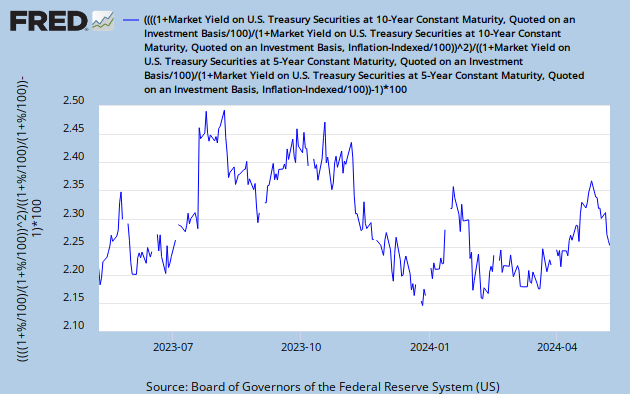
Market-based measures of inflation compensation remain low; survey-based measures of longer-term inflation expectations have remained stable. Market-based measures of inflation compensation remain low; survey‑based measures of longer-term inflation expectations have remained stable. No change.  TIPS are showing higher inflation expectations since the last meeting. 5y forward 5y inflation implied from TIPS is near 2.10%, up 0.07% from April.
Consistent with its statutory mandate, the Committee seeks to foster maximum employment and price stability. Consistent with its statutory mandate, the Committee seeks to foster maximum employment and price stability. No change. Any time they mention the “statutory mandate,” it is to excuse bad policy.
The Committee expects that, with appropriate policy accommodation, economic activity will expand at a moderate pace, with labor market indicators continuing to move toward levels the Committee judges consistent with its dual mandate. The Committee expects that, with appropriate policy accommodation, economic activity will expand at a moderate pace, with labor market indicators continuing to move toward levels the Committee judges consistent with its dual mandate No real change.
The Committee continues to see the risks to the outlook for economic activity and the labor market as nearly balanced. Inflation is anticipated to remain near its recent low level in the near term, but the Committee expects inflation to rise gradually toward 2 percent over the medium term as the labor market improves further and the transitory effects of earlier declines in energy and import prices dissipate. The Committee continues to monitor inflation developments closely. The Committee continues to see the risks to the outlook for economic activity and the labor market as nearly balanced. Inflation is anticipated to remain near its recent low level in the near term, but the Committee expects inflation to rise gradually toward 2 percent over the medium term as the labor market improves further and the transitory effects of earlier declines in energy and import prices dissipate. The Committee continues to monitor inflation developments closely. CPI is at +0.2% now, yoy.  No change in language.
To support continued progress toward maximum employment and price stability, the Committee today reaffirmed its view that the current 0 to 1/4 percent target range for the federal funds rate remains appropriate. In determining how long to maintain this target range, the Committee will assess progress–both realized and expected–toward its objectives of maximum employment and 2 percent inflation. This assessment will take into account a wide range of information, including measures of labor market conditions, indicators of inflation pressures and inflation expectations, and readings on financial and international developments. To support continued progress toward maximum employment and price stability, the Committee today reaffirmed its view that the current 0 to 1/4 percent target range for the federal funds rate remains appropriate. In determining how long to maintain this target range, the Committee will assess progress–both realized and expected–toward its objectives of maximum employment and 2 percent inflation. This assessment will take into account a wide range of information, including measures of labor market conditions, indicators of inflation pressures and inflation expectations, and readings on financial and international developments. No change.
The Committee anticipates that it will be appropriate to raise the target range for the federal funds rate when it has seen further improvement in the labor market and is reasonably confident that inflation will move back to its 2 percent objective over the medium term. The Committee anticipates that it will be appropriate to raise the target range for the federal funds rate when it has seen some further improvement in the labor market and is reasonably confident that inflation will move back to its 2 percent objective over the medium term. No real change.

No rules, just guesswork from academics and bureaucrats with bad theories on economics.

The Committee is maintaining its existing policy of reinvesting principal payments from its holdings of agency debt and agency mortgage-backed securities in agency mortgage-backed securities and of rolling over maturing Treasury securities at auction. This policy, by keeping the Committee’s holdings of longer-term securities at sizable levels, should help maintain accommodative financial conditions. The Committee is maintaining its existing policy of reinvesting principal payments from its holdings of agency debt and agency mortgage-backed securities in agency mortgage-backed securities and of rolling over maturing Treasury securities at auction. This policy, by keeping the Committee’s holdings of longer-term securities at sizable levels, should help maintain accommodative financial conditions. No change.  Changing that would be a cheap way to effect a tightening.
When the Committee decides to begin to remove policy accommodation, it will take a balanced approach consistent with its longer-run goals of maximum employment and inflation of 2 percent. The Committee currently anticipates that, even after employment and inflation are near mandate-consistent levels, economic conditions may, for some time, warrant keeping the target federal funds rate below levels the Committee views as normal in the longer run. When the Committee decides to begin to remove policy accommodation, it will take a balanced approach consistent with its longer-run goals of maximum employment and inflation of 2 percent. The Committee currently anticipates that, even after employment and inflation are near mandate-consistent levels, economic conditions may, for some time, warrant keeping the target federal funds rate below levels the Committee views as normal in the longer run. No Change.

“Balanced” means they don’t know what they will do, and want flexibility.

Voting for the FOMC monetary policy action were: Janet L. Yellen, Chair; William C. Dudley, Vice Chairman; Lael Brainard; Charles L. Evans; Stanley Fischer; Jeffrey M. Lacker; Dennis P. Lockhart; Jerome H. Powell; Daniel K. Tarullo; and John C. Williams. Voting for the FOMC monetary policy action were: Janet L. Yellen, Chair; William C. Dudley, Vice Chairman; Lael Brainard; Charles L. Evans; Stanley Fischer; Jeffrey M. Lacker; Dennis P. Lockhart; Jerome H. Powell; Daniel K. Tarullo; and John C. Williams. No change, sadly.

We need some people in the Fed and in the government who realize that balance sheets matter – for households, corporations, governments, and central banks.  Remove anyone who is a neoclassical economist – they missed the last crisis; they will miss the next one.

Comments

  • This FOMC statement was another great big nothing. No significant changes.
  • Don’t expect tightening in September. People should conclude that the FOMC has no idea of when the FOMC will tighten policy, if ever.  This is the sort of statement they issue when things are “steady as you go.”  There is no hint of imminent policy change.
  • Despite lower unemployment levels, labor market conditions are still pretty punk. Much of the unemployment rate improvement comes more from discouraged workers, and part-time workers.  Wage growth is weak also.
  • Equities and long bonds rise. Commodity prices and the dollar are flat.
  • The FOMC says that any future change to policy is contingent on almost everything.
  • Don’t know they keep an optimistic view of GDP growth, especially amid falling monetary velocity.
  • The key variables on Fed Policy are capacity utilization, labor market indicators, inflation trends, and inflation expectations. As a result, the FOMC ain’t moving rates up, absent improvement in labor market indicators, much higher inflation, or a US Dollar crisis.
  • We have a congress of doves for 2015 on the FOMC. Things will continue to be boring as far as dissents go.  We need some people in the Fed and in the government who realize that balance sheets matter – for households, corporations, governments, and central banks.  Remove anyone who is a neoclassical economist – they missed the last crisis; they will miss the next one.
30 Jul 03:59

London's 'Big Dig'

by noreply@blogger.com (Gulzar Natarajan)
London's 'Big Dig' is about to start, with contracts to be awarded over the coming weeks. The £4.2 bn super-sewer, being build under the Thames river and one of the most complex infrastructure projects in the world, has several unique contracting features. The construction work on the project being built by Thames Water, London's privately owned water utility, through its special purpose vehicle, Thames Tideway Tunnel, is set to start in 2016 and will take seven years to complete. Apart from its sheer size (it is spread over 42 sites), the project has several technical risks including potential threat to Big Ben's foundations and flooding of the London metro network. 

Given the size and risks involved, a novel off-balance sheet financing arrangement has been worked out. Thames Water will finance a third of the cost, through the SPV's balance sheet, and the remaining two-third of £2.8 bn will come from a consortium of financiers, Bazalgette Consortium, which includes Allianz, Swiss Life Capital, and Dalmore Capital. The consortium will own, finance, and manage the project for 125 years. In order to pay for the project, Ofwat, the water regulator, and the Government have estimated that Thames Water's 15 mn consumers may need to pay a surcharge on their water bills, of upto £80 every year almost in perpetuity. Interestingly, the surcharge will become operational from the date construction begins, and the investors will therefore receive income from the beginning. This, coupled with the high tariffs and the long, almost a perpetuity, contract tenure provide the project's financial risk mitigation. Further, construction risks are mitigated by a few government guarantees, including accidents at project sites, meeting the insurance costs not covered by markets and also any "exceptionally large cost over-run". 

As critics have pointed out, the cost of capital for the consortium is certain to be much higher than would have been the case if it were constructed with public borrowing. Given that construction problems cause mega projects to become "over-budget, over-time, over and over again", whether done with public or private financing, the final cost of the project once construction is completed is most certain to be much higher than its current estimates. Would that result in an increase in the surcharge?

Further, the case for public financing followed by contracting out long-term once the construction risks are off-loaded becomes even stronger given that the government is already assuming constructions risks thereby limiting the project developer's incentives for on-time delivery. If the construction contract is given out as an Engineering Procurement Construction (EPC) contract and once constructed given out on a long-term operation and maintenance concession, the private sector efficiency gains could just as well have been captured, and at a lower cost of capital. 
Add to Technorati Favorites
29 Jul 09:45

Scary Retirement Statistics

by subra

Look at it anyway the Retirement statistics coming from the USA are surely scary. We just do not have enough statistics about India, but if one were to collect the data, it would be just as scary. I keep getting data in some ad hoc manner and I have no clue whether that is the trend or that is the outlier in the data.

I met a person who thought he was very comfortably off in his retirement. However that was his view, not mine.

He is about 59 years of age and is likely to retire in 6 months. He of course has his provident fund, gratuity to receive when he retires. His wife is 54 years old and has been a housewife. They have paid for the education and marriages of their 2 children who are well settled now. This couple has fixed deposits, and the potential provident fund ..etc. adding up to Rs. 65 lakhs. Other than this they have a house that is given on rent and is fetching them a rent of Rs. 20,000 per month.

He has no exposure to equity, no mutual funds, not even post office or LIC products. Plain and simple fixed deposits in their joint names.

He thought he was very well off because their lifestyle was simple (true), and the fact that if they did indulge themselves once in a while (like a vacation that they are planning every year) they could afford it because they were rich. I guess this rich feeling comes from the Rs. 65 lakh savings figure. His logic was right too. He needed only Rs. 10-15,000 a month from his savings – and the balance of the household expenses was anyway coming from the rent.

He said ‘my rent goes up by 10% every year’ and the house is appreciating. He was sure that the 10% hike was perennial – or would happen for at least 10 more years. At that stage he would shift to that house (it was smaller) and sell off the current house in which he was living. So at the age of say 70 he would have one house (in which he was staying) and Rs. 2.25 crore (estimated sale value of his current house). Again good logic – and he felt that at stage if he got Rs. 2.25 cr. that amount kept in a bank fixed deposit could give him enough returns to last for another 10-15 years of his life.

My view:

Congrats, yes you have enough. Surely enough if you do not do anything way out of the ordinary. What I do not like is the inflation risk (longevity risk), and the amazingly high taxation (Imagine on a FD of Rs. 65 lakhs he has an income of Rs. 6 lakhs and ends up paying tax on that whole amount). I would have surely restructured this into some balanced funds (with more than 65% in equity), debt funds and bank fixed deposits. This would have brought the current income to say Rs. 100,000 per annum from fixed deposits and Rs. 240,000 from rent. If there was a gap that would have come from a withdrawal from a Mutual fund.

He also needs an annuity – she does not know how to handle investments…so simplification is an important part of the agenda..

I would still not be comfortable with such a balance sheet at age 60. I would have liked to have one house, and a million US $…

Post Footer automatically generated by Add Post Footer Plugin for wordpress.

29 Jul 09:44

The Passing of Former President Mr APJ Abdul Kalam

by Atanu Dey

MWSnap0442Former President of India, Mr APJ Abdul Kalam, passed away on 27th July, 2015. He was 83 years old. It is indeed a sad day for India and the millions of Indians who hold him in high regard and genuine affection. He is celebrated for his many professional accomplishments and admired for his character, his sincere dedication to improving India his beloved motherland. He perhaps deserved to be the head of state — a position he held from July 2002 through July 2007 — more than many others who have held or will hold that position. May his soul rest in peace.

A Sad Day

I got to know of Mr Kalam’s passing via twitter. I was saddened at his passing. I read the sentiments of those on my twitter time-line. Many were figuring out how to properly honor the memory of that remarkable man. I agreed with the sentiments of my friend Amit Malviya but also corrected him that the former president should not be addressed at “Dr APJ Abdul Kalam.”

Mr Kalam, I Presume

What was the need for me to stress that correction? This piece is by way of an explanation. It appears to be a churlish thing to do. I assure you that I am not motivated by meanness of spirit. I recognize that I am perhaps the only person who would at this time bring up something so frivolous as whether it is proper to address Mr Kalam as Dr Kalam. Here I explain that the matter is not as trivial as it appears because it has much larger implications for India. So let me begin by explaining why I object to the “Dr.”

These are the bare facts. First, Mr APJ Abdul Kalam was educated but his education did not extend to earning a doctorate in any branch of study. That is, he did not enroll in a program of study that led to the doctorate diploma, he did not sit for examinations, submit a thesis of original academic work, etc. In other words, he did not earn a Ph.D, for whatever that is worth.

Second, he was awarded several honorary (Honoris Causa) doctorate or Ph.D. degrees by universities in India and abroad: Doctor of Science (Edinburgh Univ, UK; Aligarh Muslim Univ.), Doctor of Law (Simon Fraser Univ), Doctor of Engineering (University of Waterloo; Nanyang Univr, Singapore), Honorary Doctorate (Oakland Univ.), Honorary Doctor of Science and Technology (Carnegie Mellon Univ.), and Honorary Doctor of Science (Univ of Wolverhampton).

Third, he received numerous honors, among them: Hoover Medal (ASME Foundation, USA), King Charles II Medal (Royal Society, UK), Ramanujan Award, and Veer Savarkar Award. He was awarded the highest civilian award of India, the Bharat Ratna, not to mention the lesser ones such as Padma Bhushan and the Padma Vibhushan.

Clearly, Mr Kalam was no stranger to awards, honors and felicitations. Very few get so well recognized as he. All those honors pale in significance to the honor of the position he attained as the President of the Republic of India. Only a handful occupied that exalted position, although some of the recent incumbents whom we don’t have to name have been persons of questionable character and accomplishments.

Protocol & Convention

Given the fact that he was widely recognized for his remarkable contributions, and his many honorary doctorates, one may ask why would anyone object to him being referred to as “Dr APJ Abdul Kalam”? There are two reasons. First, it is a matter of protocol and convention.

Honorary doctorates are honors, not earned degrees. Earned degrees conferred by universities have various requirements such as residence, study, original research, examinations, acceptance of theses, etc. It’s a tradition and comes as a package — if you decide to abide by that tradition, you implicitly agree to adhere by the accepted standards.

This whole business of universities awarding degrees at the bachelor’s, master’s, and doctorate level is a Western tradition that many other non-Western countries, such as India, have adopted. Having done that, it becomes incumbent to follow the rules.

The relevant rule here is that people who earn a Ph.D. get the privilege of using “Dr.” in their title if they so desire, and to be addressed by others as “Dr. So and so” on formal occasions. But if the degree is “for the sake of the honor” (honoris causa in Latin), then only in correspondence between the granting institution and the person is the title “Dr” appropriate. The honorary degree does not give leave to anyone else — including the recipient — to refer to the person as “Dr.”

(For more on honorary degrees, please read this short piece “How to Address Those With Honorary Degrees” by Robert Hickey. Everything you ever wanted to know about “honorary degrees” you will find on the wiki. Did you know that some prestigious American universities — MIT, Cornell, Stanford, Rice, etc — do not award honorary degrees as a matter of policy?)

I am not making up this rule or convention. It is what it is, and if we freely choose to use that convention, then we have to follow it all the way. It is like language. We are not required to use any specific language but if we do choose, we have to adhere to the conventions of that language. We don’t have to use the English convention of “Mr” and “Miss”. But if we do, then it would be silly to ditch the convention half-way and decide that we would randomly use “Mr” or “Miss” without regard to whether the person is a male or a female.

We have the freedom to follow or not follow the Western academic title convention. But having chosen to follow it, we are not free to disregard the convention. Mr Kalam, however else you may want to refer to him — Shri Kalam, Mr Kalam, Vaidya Kalam, Hakim Kalam, Pandit Kalam, Ustad Kalam, Monsieur Kalam, Herr Kalam, etc — you don’t have the freedom to refer to him as “Dr Kalam” because he did not earn a Ph.D.

Dignity & Pride

As I said above, my objection is based on two factors. I am done with the first: protocol and convention. You may say, “Convention be damned. He was a great man, and we must call him Dr Kalam.” My response to that objection is that it is a matter of dignity and pride.

Mr Kalam was the President of India. Even without that rare honor, his accomplishments were widely acknowledged. So pinning fake peacock feathers on him only makes him look ridiculous, not more respectable. The president of some failed banana republic may strut around calling himself “Dr Magobuto Idiam” but it is undignified for a person of Mr Kalam’s stature to use a fake title.

That the common person on the street does not know of this “Dr” convention is pardonable. What is unforgivable is the ignorance of those journalists who hold forth on radio, TV and newspapers. They just regurgitate falsehoods shamelessly. Message to them: Stop in the name of decency and dignity.

One can gain from faking something but only at the high cost of dignity and pride. It’s like petty thievery: it does not enrich oneself but only results in loss of dignity.

“Sincerely Yours, Richard P. Feynman”

To conclude this bit, let me tell you about my hero, Richard Feynman, and his attitude towards honorary degrees. Feynman was impatient with honors and awards and positions and titles and being a member of this or that high-sounding society. For nearly a decade in the 1960s he corresponded back and forth with the National Academy of Sciences (the preeminent organization that recognizes the best among scientists by electing them as members) to get them to drop his membership.

A few years ago, I read a collection of his letters. I cannot recommend it highly enough. It’s called “Perfectly Reasonable Deviations from the Beaten Track.” [2005]. One of the letters in that collection was in reply to a letter from Dr George Beadle of the University of Chicago offering him an honorary degree. This was following his 1965 Nobel Prize in Physics.

Dear George,

Yours is the first honorary degree that I have been offered, and I thank you for considering me for such an honor.

However, I remember the work I did to get a real degree at Princeton and the guys on the same platform receiving honorary degrees without work—and felt an “honorary degree” was a debasement of the idea of a “degree which confirms certain work has been accomplished.” It is like giving an “honorary electricians license.” I swore then that if by chance I was ever offered one I would not accept it.

Now at last (twenty-five years later) you have given me a chance to carry out my vow.

So thank you, but I do not wish to accept the honorary degree you offered.

Sincerely yours,
Richard P. Feynman

Feynman was one of the finest minds of the 20th century; he was also unabashedly plainspoken. His was not the mealymouthed bullshit we get from the so-called leaders of academia, politics and journalism.

Auntie Saggy

Talking of mealymouthed journalists spouting bullshit, I am reminded of Auntie Saggy. See these tweets (Reference):

MWSnap0439

MWSnap0440

Auntie Saggy is a weather vane, spewing crap all across the landscape, depending on the wind.

Dr Kermit, I Presume

MWSnap0441 But I don’t want to end on that dismal note. So here for your delectation is part of the acceptance speech that Kermit the Frog gave when he was awarded a honorary Ph.D. in “Amphibious Letters.”

First, of course, I want to thank you for bestowing upon me this Honorary Doctorate of Amphibious Letters. To tell you the truth, I never even knew there was such a thing as “Amphibious” Letters. After all those years on Sesame Street, you’d think I’d know my alphabet. It just goes to show that you can teach an old frog new tricks.
. . .
It’s great to have an honorary doctorate. I have spoken with my fellow honorees — Professor Merton, Ms. Meaker, Mr. Gambling — and as honorary doctors we promise to have regular office hours, put new magazines in our waiting room, and to make late night house calls regardless of your health plan coverage. On behalf of all of us, thank you sincerely.

Note that Kermit the Frog never called himself Dr Kermit, and neither did he start practicing medicine — although he did mention that he’d have regular office hours and make house calls.

Anyway, I have much to write about Mr Kalam but that will have to wait for another piece. It will be a more substantial topic — his vision and my take on it.

Be well, do good work and keep in touch.

29 Jul 09:41

Latticework of Mental Models: Thermodynamics

by Anshul Khare

The big idea that we are going to look at today is from the field of Physics and it’s called Thermodynamics. Before you get too scared of the big word let me assure you that we’re not going to be discussing any mind bending formulae here.

In fact, here a confession is in order.

The subject of Thermodynamics has fascinated me since my college days. And the fascination was mostly because it provoked more dread than excitement. Perhaps my bad karma from past life, call it Karma-dynamics, made sure that I barely got passing marks in any paper related to Thermodynamics.

So trust me, I won’t even make an attempt to go anywhere near complex equations.

The plan is to learn some basics and use that knowledge to gain useful insights that will help us make an educated guess about few interesting problems. What kind of problems? Here is one for starter –

Why is there disproportionate difference in size between the largest mammal on land (elephant) and the largest mammal in water (the blue whale)? In case you aren’t aware of the difference, here is a visual to give you some perspective. Click here for bigger image.

Latticework of Mental Models: Thermodynamics

Eye popping, isn’t it? Blue whale is an ultimate display of mother nature’s marvels.

So let’s start probing by thinking about a simpler question.

If you had an ice cube weighing 8 kgs, and if you had 8 smaller ice cubes each weighing 1 kgs, will there be any difference in melting time?

This is a question that Peter Bevelin asks in his book Seeking Wisdom.

I suggest you take a few moments and think about the problem before reading further.

To be able to solve this, you need to have some basic idea about surface areas and volumes of 3 dimensional bodies. This video will help you get some handle on the fundamentals.

In short, as the volume grows for any object, its surface area grows at a much slower rate and the ratio (volume) / (surface area) becomes increasingly bigger.

You still with me on this? Okay, once this concept is clear, let’s look at the first law of thermodynamics.

The Law of Conservation of Energy

First law encompasses several principles, one of which is the law of conservation of energy, which states that energy can be neither created nor destroyed. However, energy can change forms, and energy can flow from one place to another. The total energy of an isolated system does not change.

Which means that the total energy produced by metabolism (which results from the breakdown of food consumed) inside an animal’s body has to be expended in form of physical activity or heat produced or a combination of both.

Now let’s take Bevelin’s help in connecting above two concepts. He describes an interesting thought experiment in his book –

Assume we make a human 10 times larger than normal. This means he is now 10 times longer, 10 times wider, and 10 times higher…The giant has 1,000 times more meat on the body but only 100 times the skin to hold it …[which] means that his skin surface area is too small to remove the heat emitted from his huge body. He would suffer from overheating since the amount of heat his body produces is proportional to the cube of his length (1,000), while the amount of heat he dissipates through the skin is proportional to the square of his length (100).

If the difference between heat produced and heat released is large, it will raise the core temperature of the animal body which might lead to death if the temperature goes beyond a normal body temperature range.

So we know that heat loss becomes a hurdle for size of a land mammal. But what about animals in the water?

I remember when my grandmother wanted to cool down the hot milk, she would partially immerse the milk vessel in a bigger vessel containing cold water.

My grandmother didn’t know anything about Thermodynamics but when I read Thermo, it explained how the rate of heat loss in water is higher than rate of heat loss in air.

So, extending the logic, we conclude that water mammals can afford less surface area per unit of volume because of their ability to lose heat faster inside water.

Hence we can make a reasonable speculation as to why Blue Whale is so big. Now this may not be the only reason but it shows how multidisciplinary learning can help us construct approximately right answers and that’s what Charlie Munger suggests –

It’s better to be approximately right than precisely wrong.

So far so good, but what’s the use of learning all this Thermo-Shermo if you can’t use it for gaining insights about stocks market investing?

Let’s see.

Thermodynamics in Investing

Instead of trying to find an analogy myself, I would redirect you to a blog post written by Prof. Bakshi (in 2005) which takes the first law of thermodynamics and applies it to the idea of risk.

The law of conservation of risk states that the total inflow of risk in a system must equal the total outflow of risk from the system, plus the change in the risk contained within the system. In other words, risk can be converted from one form to another, but it cannot be created or destroyed.

Take the simple example of a hedging operation involving shorting index futures. The hedger who shorts the index futures is trying to protect herself from a market decline. Should the market decline, the value of her stock portfolio will also decline, but this decline is expected to be offset by the profit she will make on the short futures position. So far, so good. But, is it?

Is it really that simple? Has the risk to the hedger been reduced? Of course not. The risk of the decline in the price has merely been transferred to the buyer (counter-party) of the index futures. But that’s not the whole story. There is more to it.

By selling the index futures, the hedger has transferred the price risk to the buyer of the index futures but has assumed another risk. That risk is credit risk i.e. the risk that the counter-party may default.

While it’s true that with the presence of organized futures markets with margin requirements and other risk mitigation measures in place, credit risk is much lower at the individual level, this does not mean that the risk in the entire system has been reduced. At the individual level, risk may be reduced but not at the system level.

You must read the full article.

Apart from this, there are few interesting parallels between the capital markets and the laws of thermodynamics, as described in this post which I found in Capital Ideas Online blog. Here is an excerpt –

In considering energy in nature or markets, it is helpful to think of potential energy, on the one hand, and “working” transformations of energy, on the other. Active forms of energy include kinetic, chemical, electric, electromagnetic, elastic (as in a bouncing ball), nuclear, heat, and sound.

Money available to buy stocks may be thought of as a form of potential energy. When cash piles up in money-market accounts and investment in stocks dwindles, as it did in 2001 and 2002, the situation is similar to a pendulum pausing at the top of its arc. At that moment, the energy seems to have disappeared. In reality, it is there in potential form and quite likely to be converted into movement.

When movement beings, one possible route is into equity funds. At the beginning of 2002, the ratio of assets in equity funds relative to money market funds was 1.5, close to a four-year low of 1.4. A high of 2.6 occurred in the spring of 2000 just as the market was embarking on its terrible 18 month descent.

What about the other laws of Thermodynamics?

Well, the second law of thermodynamics, in simple terms, states that anytime work is done, some energy is used non-productively (not to do work) to simply increase the entropy (disorder, chaos) of the universe. So the entropy of the universe is constantly increasing.

For example, when you burn fuel to heat water, some part (a substantial) of the heat energy will be lost to the surroundings. When you ride a bicycle some part of your energy is lost in dealing with friction.

This entropy is somewhat similar to the transactional cost (brokerage, taxes etc.) that we incur in the stock market. The entropy of stock markets could be the brokers and no-skin-in-the-game money managers.

I am thinking out loud here about analogies between stock market and entropy. However, the problem is that it’s easy to win an argument in my own head. So I invite you to chip with your own interpretations and insights. Be the devil’s advocate and please use the Comments section to challenge my views.

Look at Birkshire Hathway, it may look huge like a one big monolithic cube but in reality it’s more of a collection of loose- coupled smaller cubes. So the heat loss is very efficient for this big organism.

As I have said earlier, it’s good to learn about an idea but it’s absolutely critical to know its limitations too. Let’s see where Thermodynamics doesn’t really explain things but continue to be used and abused.

Thermodynamics and Weight Loss

One of the areas where the law of conservation of energy (calorie) has been overused and misused is weight loss diets and fads.

Shane Parrish has compiled few interesting ideas from the book Why We Get Fat which questions the conventional wisdom about the calorie-in-calorie-out model –

The very notion that we get fat because we consume more calories than we expend would not exist without the misapplied belief that the laws of thermodynamics make it true. When experts write that obesity is a disorder of energy balance—a declaration that can be found in one form or another in much of the technical writing on the subject—it is shorthand for saying that the laws of thermodynamics dictate this to be true. And yet they don’t.

Nassim Taleb, in his masterpiece Antifragile, voices similar concerns about misplacing the idea of conservation of absolute calories and its limitations in weight loss –

…there is no clear evidence that sugar-free sweetened drinks make you lose weight in accordance with the calorie saved…Somehow those recommending these drinks [1 calorie diet coke] are under the impression, driven by the laws of physics (naive translation from thermodynamics), that the concept we gain weight from calories is sufficient for further analysis. This would be certainly true in thermodynamics, as in a simple machine responding to energy without feedback, say, a car that burns fuel. But the reasoning doesn’t hold in an informational dimension in which food is not just a source of energy; it conveys information about environment. The ingestion of food combined with one’s activity brings about hormonal cascades (or something similar that conveys information), causing cravings (hence consumption of other foods) or changes in the way your body burns the energy, whether it needs to conserve fat and burn muscle, or vice versa. Complex systems have feedback loops, so what you ‘burn’ depends on what you consume, and how you consume it.

Conclusion

The superfluity of communication and information today is drowning us in massive noise. Most of the things that we read, listen or watch is dimly understood unless we have the right tools to detangle the balderdash from the core ideas.

Mental models are tools to scaffold our thinking. While thinking about a problem, mental models provide you a map with which you can quickly course correct your line of inquiry.

Our world and life is full of opportunities, disguised as problems and challenges, which need to be either pursued or avoided. You don’t want to spend a disproportionate amount of time analysing a single problem. Instead the strategy should be to race through numerous problems and quickly identify the solvable ones.

Abraham Lincoln famously quipped  –

Give me six hours to chop down a tree and I will spend the first four sharpening the axe.

Spending a lot of time on a single problem is akin to struggling with a single tree with a blunt axe.

And Latticework of Mental Models is that sharp axe. So the idea is to spend more time constructing, overhauling, fine tuning and maintaining your Latticework. Building your own Latticework of mental models is a tremendously useful way to evaluate and upgrade the fabric of your worldview.

Let me wrap up with this thought – Anything that you read “rewires” a part of your brain.

The brain you had before you read this post? You don’t get that brain back. I’m sincerely hoping that the trade-off is worth it. :)

Compiling this Latticework series is turning out be enormously exciting activity for me. I hope you too are enjoying it.

Take care, don’t stop learning and keep your axe sharp.

The post Latticework of Mental Models: Thermodynamics appeared first on Safal Niveshak.

    
29 Jul 09:38

Pick a Valid Strategy, Stick With It

by David Merkel

I’m not going to argue for any particular strategy here. My main point is this: every valid strategy is going to have some periods of underperformance.  Don’t give up on your strategy because of that; you are likely to give up near the point of maximum pain, and miss the great returns in the bull phase of the strategy.

Here are three simple bits of advice that I hand out to average people regarding asset allocation:

  1. Figure out what the maximum loss is that you are willing to take in a year, and then size your allocation to risky assets such that the likelihood of exceeding that loss level is remote.
  2. If you have any doubts on bit of advice #1, reduce the amount of risky assets a bit more.  You’d be surprised how little you give up in performance from doing so.  The loss from not allocating to risky assets that return better on average is partly mitigated by a bigger payoff from rebalancing from risky assets to safe, and back again.
  3. Use additional money slated for investing to rebalance the portfolio.  Feed your losers.

The first rule is most important, because the most important thing here is avoiding panic, leading to selling risky assets when prices are depressed.  That is the number one cause of underperformance for average investors.  The second rule is important, because it is better to earn less and be able to avoid panic than to risk losing your nerve.  Rule three just makes it easier to maintain your portfolio; it may not be applicable if you follow a momentum strategy.

Now, about momentum strategies — if you’re going to pursue strategies where you are always buying the assets that are presently behaving strong, well, keep doing it.  Don’t give up during the periods where it doesn’t seem to work, or when it occasionally blows up.  The best time for any strategy typically come after a lot of marginal players give up because losses exceed their pain point.

That brings me back to rule #1 above — even for a momentum strategy, maybe it would be nice to have some safe assets on the side to turn down the total level of risk.  It would also give you some money to toss into the strategy after the bad times.

If you want to try a new strategy, consider doing it when your present strategy has been doing well for a while, and you see new players entering the strategy who think it is magic.  No strategy is magic; none work all the time.  But if you “harvest” your strategy when it is mature, that would be the time to do it.  It would be similar to a bond manager reducing exposure to risky bonds when the additional yield over safe bonds is thin, and waiting for a better opportunity to take risk.

But if you do things like that, be disciplined in how you do it.  I’ve seen people violate their strategies, and reinvest in the hot asset when the bull phase lasts too long, just in time for the cycle to turn.  Greed got the better of them.

Markets are perverse.  They deliver surprises to all, and you can be prepared to react to volatility by having some safe assets to tone things down, or, you can roll with the volatility fully invested and hopefully not panic.  When too many unprepared people are fully invested in risky assets, there’s a nasty tendency for the market to have a significant decline.  Similarly, when people swear off investing in risky assets, markets tend to perform really well.

It all looks like a conspiracy, and so you get a variety of wags in comment streams alleging that the markets are rigged.  The markets aren’t rigged.  If you are a soldier heading off for war, you have to mentally prepare for it.  The same applies to investors, because investing isn’t perfectly easy, but a lot of players say that it is easy.

We can make investing easier by restricting the choices that you have to make to a few key ones.  Index funds.  Allocation funds that use index funds that give people a single fund to buy that are continually rebalanced.  But you would still have to exercise discipline to avoid fear and greed — and thus my three example rules above.

If you need more confirmation on this, re-read my articles on dollar-weighted returns versus time-weighted returns.  Most trading that average people do loses money versus buying and holding.  As a result, the best thing to do with any strategy is to structure it so that you never take actions out of a sense of regret for past performance.

That’s easy to say, but hard to do.  I’m subject to the same difficulties that everyone else is, but I worked to create rules to limit my behavior during times of investment pain.

Your personality, your strategy may differ from mine, but the successful meta-strategy is that you should be disciplined in your investing, and not give into greed or panic.  Pursue that, whether you invest like me or not.

29 Jul 03:30

Asset Allocation, Portfolio Construction, and all that bull shit

by subra

Let us assume for a minute that you have only 2 asset classes – how much should be in equity and how much should be in debt.

THAT IS THE MILLION DOLLAR question, that we need to answer while wondering what is asset allocation. So let us look at that.

ULTIMATELY immaterial of what questionnaire that you use, what risk profiler you use, clients stick to an asset allocation that THEY are comfortable with. I know once civil servant (amazingly humble even while in office) who decided that all his money should be in bank fixed deposits. What about his wife? she was a banker – who knew NOTHING about investments. She actually said “let my husband handle my money” – both of them had a nice big corpus in bank fixed deposits.

Tried telling him about tax deferral, inflation risk, ….but he would not budge. Frankly it did not matter – between them they had a SIX figure (each one almost had that much). The children were abroad, he had retired she was about to.

Comfortably he could have been about 40% in equity. He was currently about 1% in equity. Nothing happened.

One person about 54 years of age…has about 18% of his investments in equity. This will really do nothing for his accumulation, but he has a combination of large cap, mid cap, small cap, balanced fund, child plan, pension plan, micro cap, …when he asked me I said “I have no ability to understand what you have done”. He also has about 5 debt fund, some FMPs, and of course the classic endowment. Overall over the past 15 years he has been consistently under-performing the INDEX and getting a negative return on the whole portfolio.

Look frankly when you are young and are investing small amounts of money you HAVE TO BE IN EQUITIES. As your corpus keeps getting bigger you will keep putting more into equity. Sometime when you are say 50 years of age you will have about 70% in equity. Now on going forward put MORE in debt, but as your equity keeps growing…the equity portion will remain reasonably high.

How much to invest in large cap, mid cap, multi cap is a NEVER ending answer.

So if you do not understand all this please be about 70+ percentage in LARGE CAP EQUITY. Then what you do with the balance 30% does not matter too much. If you are too worried about what to do put the money in a multi cap balanced fund. So just one fund – a balanced fund which has about 65% in equities….that is all.

Post Footer automatically generated by Add Post Footer Plugin for wordpress.

29 Jul 03:29

Books Everyone Should Read on Psychology and Behavioral Economics

by Shane Parrish

Psychology and Behavioral Economics Books

Earlier this year, a prominent friend of mine was tasked with coming up with a list of behavioral economics book recommendations for the military leaders of a G7 country and I was on the limited email list asking for input.

Yikes.

While I read a lot and I’ve offered up books to sports teams and fortune 100 management teams, I’ve never contributed to something as broad as educating a nation’s military leaders. While I have a huge behavorial economics reading list, this wasn’t where I started.

Not only did I want to contribute, but I wanted to choose books that these military leaders wouldn’t normally have come across in everyday life. Books they were unlikely to have read. Books that offered perspective.

Given that I couldn’t talk to them outright, I was really trying to answer the question ‘what would I like to communicate to military leaders through non-fiction books?’ There were no easy answers.

I needed to offer something timeless. Not so outside the box that they wouldn’t approach it, and not so hard to find that those purchasing the books would give up and move on to the next one on the list. And it can’t be so big they get intimidated by the commitment to read. On top of that, you need a book that starts strong because, in my experience of dealing with C-level executives, they stop paying attention after about 20 pages if it’s not relevant or challenging them in the right way.

In short there is no one-size-fits-all but to make the biggest impact you have to consider all of these factors.

While the justifications for why people chose the books below are confidential, I can tell you what books were on the final email that I saw. I left one book off the list, which I thought was a little too controversial to post.

These books have nothing to do with military per se, rather they deal with enduring concepts like ecology, intuition, game theory, strategy, biology, second order thinking, and behavioral psychology. In short these books would benefit most people who want to improve their ability to think, which is why I’m sharing them with you.

If you’re so inclined you can try to guess which ones I recommended in the comments. Read wisely.

In no order and with no attribution:

  1. Risk Savvy: How to Make Good Decisions by Gerd Gigerenzer
  2. The Righteous Mind: Why Good People Are Divided by Politics and Religion by Jonathan Haidt
  3. The Checklist Manifesto: How to Get Things Right by Atul Gawande
  4. The Darwin Economy: Liberty, Competition, and the Common Good by Robert H. Frank
  5. David and Goliath: Underdogs, Misfits, and the Art of Battling Giants by Malcolm Gladwell
  6. Predictably Irrational, Revised and Expanded Edition: The Hidden Forces That Shape Our Decisions by Dan Ariely
  7. Thinking, Fast and Slow by Daniel Kahneman
  8. The Folly of Fools: The Logic of Deceit and Self-Deception in Human Life by Robert Trivers
  9. The Hour Between Dog and Wolf: Risk Taking, Gut Feelings and the Biology of Boom and Bust by John Coates
  10. Adapt: Why Success Always Starts with Failure by Tim Harford
  11. The Lessons of History by Will & Ariel Durant
  12. Poor Charlie’s Almanack
  13. Passions Within Reason: The Strategic Role of the Emotions by Robert H. Frank
  14. The Signal and the Noise: Why So Many Predictions Fail–but Some Don’t by Nate Silver
  15. Sex at Dawn: How We Mate, Why We Stray, and What It Means for Modern Relationships by Christopher Ryan & Cacilda Jetha
  16. The Red Queen: Sex and the Evolution of Human Nature by Matt Ridley
  17. Introducing Evolutionary Psychology by Dylan Evans & Oscar Zarate
  18. Filters Against Folly: How To Survive Despite Economists, Ecologists, and the Merely Eloquent by Garrett Hardin
  19. Games of Strategy (Fourth Edition) by Avinash Dixit, Susan Skeath & David H. Reiley, Jr.
  20. The Theory of Political Coalitions by William H. Riker
  21. The Evolution of War and its Cognitive Foundations (PDF) by John Tooby & Leda Cosmides.
  22. Fight the Power: Lanchester’s Laws of Combat in Human Evolution by Dominic D.P. Johnson & Niall J. MacKay.

--
Sponsored By: Greenhaven Road Capital: You think differently - now invest differently.

29 Jul 03:26

Warren Buffett on Gold

by Muthu

We’ve been writing for many years as to how gold is not an investment and why it should only be bought for consumption.

Today I felt like sharing with you some thoughts by Warren Buffett on gold.

1) “Gold is a way of going long on fear, and it has been a pretty good way of going long on fear from time to time. But you really have to hope people become more afraid in a year or two years than they are now. And if they become more afraid you make money, if they become less afraid you lose money, but the gold itself doesn’t produce anything.”

2) “What motivates most gold purchasers is their belief that the ranks of the fearful will grow. During the past decade that belief has proved correct. Beyond that, the rising price has on its own generated additional buying enthusiasm, attracting purchasers who see the rise as validating an investment thesis. As ‘bandwagon’ investors join any party, they create their own truth – for a while.”

3) “I will say this about gold. If you took all the gold in the world, it would roughly make a cube 67 feet on a side…Now for that same cube of gold, it would be worth at today’s market prices about $7 trillion – that’s probably about a third of the value of all the stocks in the United States…For $7 trillion…you could have all the farmland in the United States, you could have about seven Exxon Mobils and you could have a trillion dollars of walking-around money…And if you offered me the choice of looking at some 67 foot cube of gold and looking at it all day, and you know me touching it and fondling it occasionally…Call me crazy, but I’ll take the farmland and the Exxon Mobils.”

4) “The problem with commodities is that you are betting on what someone else would pay for them in six months. The commodity itself isn’t going to do anything for you….it is an entirely different game to buy a lump of something and hope that somebody else pays you more for that lump two years from now than it is to buy something that you expect to produce income for you over time.”

5) “Gold gets dug out of the ground in Africa, or someplace. Then we melt it down, dig another hole, bury it again and pay people to stand around guarding it. It has no utility. Anyone watching from Mars would be scratching their head.”

6) “Gold, however, has two significant shortcomings, being neither of much use nor procreative. True, gold has some industrial and decorative utility, but the demand for these purposes is both limited and incapable of soaking up new production. Meanwhile, if you own one ounce of gold for an eternity, you will still own one ounce at its end.”

7) “I have no views as to where it will be, but the one thing I can tell you is it won’t do anything between now and then except look at you. Whereas, you know, Coca-Cola will be making money, and I think Wells Fargo will be making a lot of money and there will be a lot – and it’s a lot – it’s a lot better to have a goose that keeps laying eggs than a goose that just sits there and eats insurance and storage and a few things like that.”


29 Jul 03:18

Author: Nidhi Aggarwal

by Ajay Shah
29 Jul 03:18

Five Reasons Why Florida Might Be The Best State To Seek Out And Achieve Early Retirement

by Jason Fieber

beachsideI was working for a domestic car dealership just outside metro Detroit in early 2009. Couldn’t have picked a worse career at a worse time in a worse place.

I remember there were fears over the manufacturer possibly going out of business. People stopped buying cars. The service lane became a lot less busy. And people were getting fired. Including yours truly.

So a few months later, I packed my bags for greener (literally!) pastures and moved to Southwest Florida to start my life anew. That turned out to be one of the best decisions I’ve ever made.

But let’s back it up a bit.

Why Florida? I could have moved anywhere in the country at the time. I moved down here after finding a cheap room for rent on craigslist, but without a job in hand. So Florida was just as good as anywhere else. Right?

Well, maybe not.

I did a ton of research on different cities and states across the country and, after spending weeks with this, determined that Florida was the best place to start over, begin a new lifestyle, and flourish.

Now, some of the reasons I picked Southwest Florida are individualistic and qualitative. Where you live isn’t (and really shouldn’t be) all about money. If we all wanted to just live where it was cheapest, we’d all be living in Detroit or somewhere similar. But I’m going to do my best to narrow this down to five fairly objective reasons that anyone looking to chase after and achieve early retirement ought to at least consider Florida, and specifically Southwest Florida (my general experience and this article tilts toward the Tampa Bay area).

You’re Surrounded By People That Retired At A Normal Age

I hope this doesn’t come across as condescending, because that’s not my intention.

Florida is a popular retirement destination in general, largely due to the reasons I’m going to list in this article. And living in a county where, as of 2010, over 30% of the population is over the age of 65, I see a lot of people that retired at a more traditional age and are just now living life on their terms. But I also see a lot of people on an everyday basis that are physically and mentally in decline. This isn’t hyperbole. I write at a coffee shop within walking distance to our apartment and older people that have a hard time hearing/walking/communicating come in here frequently.

Well, I never wanted to be one of those people. I mean, look, we all become old one day, if we’re so fortunate enough to live a long, happy, healthy life. But who wants to wait until their capabilities are starting to dwindle to finally own their time, set their own schedule, and enjoy the best luxuries that are known to man?

I remember telling people when I first moved down here that I always wanted to spend more time around palm trees, beautiful sunsets, sandy beaches, and sunshine. Coming from Michigan, only some of those things were available, and certainly not in the quantity or quality that Florida offers. But I would also tell people that I didn’t want to wait until I was an old man to enjoy those things. Why suffer through 30 more years of brutal Michigan winters just to finally enjoy sunshine, palm trees, and beaches? Why wait? Why retire and move to Florida when I’m 60 or 70 years old? Why not enjoy my life now? Moreover, why wait so long to retire?

Well, I know of no better motivation than to see the alternative on a regular basis. I get to see firsthand what “real” retirement looks like – finally enjoying life when you’re used up and burned out. Sorry, but no. That’s not for me. Seeing what might happen if I don’t live below my means and invest intelligently so that I can buy my time about 30 years faster than most is all the motivation I need to keep going.

Fantastic Weather

Sure, it gets hot in the summertime down here. But Florida’s “brutal” summers are overrated, and this is coming from someone who has experienced both Midwest summers and the worst Florida has to offer. The truth of the matter is this: It’s hot everywhere in the summer. As I type this article, it’s 81 degrees here in Sarasota. It’s 80 degrees in Washington D.C. It’s 85 degrees in Chicago. It’s 85 degrees in St. Louis (with the same humidity there as we have here right now). Meanwhile, it’s 105 degrees in Phoenix.

And, yes, the humidity is high in the summer. But, according to The Weather Channel, it “feels like” 85 in Chicago right now and it “feels like” 86 here in Sarasota at the same exact time. Think that’s just today? It’s supposed to be 97 degrees in St. Louis tomorrow – about 13 degrees warmer than what we’re expecting down here in “brutal” Florida.

I can say from personal experience the biggest difference between summers down here and what I used to experience back in the Midwest are threefold: it’s consistently hot for about four months straight, it stays hot even at night, and it rains in the afternoon (although, it generally quickly stops) far more often. But that’s really about it.

However, we more than make up for that with about eight months of glorious weather. The difference between Florida and most of the rest of the country during the summer might be a few degrees of “feels like” weather. But the difference between Florida and the rest of the country in the middle of say, January, is quite stark. Like 30 or 40 degrees stark. Try weather in the mid-70s to the low 80s with little rain (and lower humidity) for about eight months straight (including in the middle of winter), more or less.

What does that mean for us freedom fighters? 

Well, it means you can live without a car fairly easily for the entire year. I’ve waited for the bus in the middle of an Ann Arbor, Michigan winter and that wasn’t fun. 20 degrees and snow up past my ankles. No, thanks.

Conversely, it’s a lot easier to wait for the bus when it’s sunny, the sky is blue, and it’s a comfortable temperature outside. Same goes for walking or biking. This makes it relatively painless to live without a car while simultaneously still maintaining your quality of life. I’ve also owned a few 49cc scooters down here as well. Easy and cheap to scoot around town, and you don’t need to garage it for six months per year.

And the weather also makes it easy to enjoy the outdoors all year long. One of the main advantages of being financially independent is that you own your own time, able to set your own schedule at will. You’re able to do what you want, when you want, and with whom you want. But that might not be such an advantage if it’s freezing outside and there’s six inches of snow on the ground (maybe you’re really into snowboarding, though). However, you can maximize an open schedule all year down here. Doesn’t matter if it’s January or July.

One last point is that we spend very little on utilities here. The most comfortable temperature for the human body is 72 degrees. Well, we spend a good portion of the year in that temperature range down here, minimizing the need for air conditioning (and we almost never turn on the furnace). A fan while you sleep is about as much you need for maybe five or six months, if that. We’ll use the air conditioning for a good four or five months per year, but even then it’s not pumping all the time. Not that difficult to cool it down to 77 degrees or so, even in the summer. Especially when living in an apartment where neighbors in adjoining units are keeping their apartments even cooler. Economies of scale, and I’m happy to suck up a little bit of their air conditioning.

No State Income Tax

This is a huge advantage to living here and one of the key reasons I moved here in the first place.

I pay zilch to the state of Florida in the form of state income tax. How amazing is that?

Well, imagine you’re earning $40,000 per year in dividend income. And let’s say you have a state that collects 6% of that (not totally uncommon). That’s $200 per month that you could otherwise use to pay for… well… anything. $200 per month is a lot of money. That currently covers my mobile phone, utilities, and even a few meals.

But here in Florida I keep everything I make from the perspective of state income tax. And I’ve already discussed before why dividend income is so attractive from the perspective of federal income taxation. Living in Florida means you might actually pay zero income tax on your dividend income, depending on your bracket. Death and taxes? Maybe we can knock one of the two out. I’ll see what I can come up with one on the other one.

Now, some like to point to state income tax and say there’s no free lunch – you’ll pay your fair share somehow. I’m not so sure about that.

For instance, I’ve always wanted to try out living in the Pacific Northwest, especially Portland (it was a place I considered back in 2009). Seems like an amazing city. Maybe I’ll even still live there one day. But Oregon has a state income tax that tops out at 9.9%. Even if you don’t earn a lot of money, you’ll still be sending in a hefty check since those making just a little more than $8,000 per year are already exposed to the 9% bracket.

Those who live over there are quick to point out there’s no sales tax in Oregon. Big whoop. If you’re living frugally enough to put yourself in this kind of a position in the first place, you’re likely not consuming much anyway. And I tend to find that groceries is always one of the biggest categories in my monthly budget that could possibly be exposed to sales tax, yet Florida doesn’t tax groceries.

Property taxes? I’ve never seen anything that shows that a piece of real estate in the Tampa Bay area of Florida has a higher property tax rate than that of similar real estate in a comparably large city in high-tax states like California, Oregon, or Hawaii. In fact, property in those states tends to be more expensive in general, so even a lower rate would still likely lead to a higher absolute bill, if we’re comparing apples to apples. But I don’t own, so property taxes is a moot point. However, I do find that rent here is similar (or less) to what I’d pay in comparable cities in states where income tax is present at all (along with a similar lifestyle), and certainly in states where the income tax is relatively high.

You can control your expenses to a degree. But if you owe the state a check, it is what it is. I find it preferable to live where I can rent an affordable apartment, not pay taxes on that which I consume the most, and not pay taxes on my income. If you can keep 100% of your dividend income and not have to pay the federal or state government a penny, that’s a pretty amazing position to be in.

I’ll quickly note, to be fair, that you might be able to land a job in a high-tax state that pays a high enough income to offset those higher taxes and expenses. But car dealerships didn’t pay a substantially higher income in other areas of the country (I looked), and definitely not enough to offset the higher expenses and taxes. The income didn’t scale well, so I took advantage of geographical arbitrage and moved to a place where I could create a large gap between income and expenses, and no state income tax helped dramatically toward that endeavor.

Nature’s Best

Mountains are beautiful. Don’t get me wrong. But I think there’s also something pretty magical about the coast. And you have access to the second-largest coastline in the US here in Florida, at over 1,300 miles.

Beautiful beaches like Siesta Key – it’s won numerous awards for “best beach” by various publications – dot the Southwestern coastline of Florida where you can literally walk right up to the beach, plop yourself down, and gaze out in amazement. Or play football. Or volleyball. Or sleep. Or jog. Or walk. Or do pretty much anything. Anything is better at the beach. I even sometimes think about rigging up a way to write out there occasionally. Wouldn’t that be something?

But what’s really fantastic about all the beaches and parks we have down here is that you can enjoy them for free and all year long. How frugally fantastic. It’s completely free to grab a towel and hit the beach for a few hours. Watch the sun set over the horizon and celebrate another day being alive. I can surely think of more expensive ways to spend an afternoon, and those more expensive ways probably won’t even be as much fun.

I remember when I first moved down here, I would spend hours at the beach. And I’d always tell people how amazing the beaches were. Imagine my surprise when they’d tell me that they rarely visited. They were too busy – surprise, surprise – working.

Affordable Cost Of Living

You think you’d have to pay a ton of money to live in a veritable paradise where the weather is gorgeous for eight months per year (and really not all that bad for the other four), you have access to beautiful beaches, there’s no state income tax, and the motivation to retire early is in your face all the time.

But it’s just not so.

We pay $925 per month for our two-bedroom condo. I haven’t looked at the specs in some time now, but it’s over 900 square feet. It’s a few miles away from the ocean. It’s located near multiple bus lines. We can walk to multiple stores, a grocery store, entertainment options, restaurants, and various businesses like the local veterinarian.

Groceries are similar to any other place. Gas as well. So is pretty much everything else. But you’ll be spending most of your money on housing, and I find housing (especially rent) in this area of Florida to be fairly cost effective for what you get in terms of actual housing and the lifestyle around that housing.

This lifestyle in many parts of the country is much more expensive. I know because I’ve looked. And it’s certainly more expensive in areas with comparable weather, like Southern California or Hawaii. I think the only other state that’s really comparable across the board is Texas. You’ve got no state income tax, pretty nice weather for much of the year (though, I understand it can get a lot hotter in the summer in many parts of the state), and comparable cost of living. But that state doesn’t have amazing beaches like we have here in Florida.

Conclusion

There are expensive areas of Florida, like Miami. However, those areas are easily avoided. Meanwhile, the Tampa Bay area of Florida offers a lot to like. You get a lot of the amenities that any other big city might offer, but at very affordable prices. The weather is absolutely amazing for most of the year, you’re not taxed by the state on any money you make, the beaches are nothing short of spectacular, and you’re encouraged to retire early by the very nature of the populace. If seeing someone in their 70s or 80s struggling to complete regular tasks like walking isn’t enough to motivate you to think about your future self, I don’t know what is.

If you’re looking to maximize your chances retiring early/becoming financially independent early in life, and then also maximize your life after you get there, the Tampa Bay area of Florida is one of the best options I know of.

I’m not saying Florida is the best state to live in. I’m not even saying I’ll always live here. But I think for intents and purposes of seeking out and achieving early retirement, Florida offers the right mix of benefits to make the journey and destination easier and more enjoyable, in my view.

And if I had to do 2009 all over again, there’s nowhere else I would have moved to. The income taxes I’ve saved over the last six years alone surely adds up to a tidy sum, and I’m very happy about that. More in my pocket and less in the state’s. In addition, I received a hefty pay raise (relative to what I was making in Michigan) once I landed a job down here. So I was saving money on my general cost of living as well as the 4%+ the state of Michigan charges for state income tax while simultaneously making more money and having more opportunities to save money. That growing delta between income and expenses helped get me to where I’m at now, and I’ll always be thankful for that.

What do you think? Is Florida a great place to seek out and achieve early retirement? Where do you think is best? 

Thanks for reading.

Photo Credit: samarttiw/FreeDigitalPhotos.net

28 Jul 09:07

Debt miracle: Why the country that borrowed the most industrialised first

by Amol Agrawal
Jaume Ventura and Hans-Joachim Voth say that it was the debt revolution in Britain which played a strong factor in its industrial revolution as well: Towering debts, rapidly rising taxes, constant and expensive wars, a debt burden surpassing 200% of GDP. What are the chances that a country with such characteristics would grow rapidly? Almost […]
28 Jul 09:07

Twenty Enduring Posts

by David Merkel

This morning, I looked at the fall in the Chinese stock market, and I said to myself, “It’s been a long journey since the last crash.” After that, I wrote a brief piece at RealMoney, and another at what was then the new Aleph Blog, which was republished and promoted at Seeking Alpha, and got featured at a few news outlets.  It gave my blog an early jolt of prominence. I was surprised at all of the early attention. That said, it encouraged me to keep going, and eventually led me away from RealMoney, and into my present work of managing money for upper middle class individuals and small institutions.

I try to write material that will last, even though this is only blogging.  Looking at the piece on the last China crash made me think… what pieces of the past (pre-2015) still get readers?  So, I stumbled across a way to answer that at wordpress.com, and thought that the array of articles still getting readers was interesting.  The tail is very long on my blog, with 2725 articles so far, with an average word length of around 800.  Anyway, have a look at the top 20 articles written before 2015 that are still getting read now:

20. Got Cash?

Though I write about personal finance, it’s not my strongest suit.  Nonetheless, when I wanted to write some articles about personal finance for average people, I realized I needed to limit myself mostly to cash management.  A few of the articles in the new series “The School of Money,” should be good in that regard.

19. Book Review: Best Practices for Equity Research Analysts

I write a lot of book reviews.  I have some coming up.  I was surprised that on this specialized got so many hits after four years.

18. On the Structure of Berkshire Hathaway, Part 2, the Harney Investment Trust

This is a controversial piece on the most secretive aspects of what Buffett does in investing.  I have tried to get people from the media to pick up this story, but no one wants to touch it.  I think I am one of the few admirers of Buffett willing to be critical… but so what?  Hasn’t worked on this story.

17. Learning from the Past, Part 1

This short series goes through my worst investing mistakes.  It’s almost finished.  I have one or two more articles to write on the topic.  This one covers my early days, where I made a lot of rookie errors.

16. On Trading Illiquid Stocks

I describe some of my trading techniques that I use to fight back against the high frequency traders.

15. De Minimus Laws

Here I do a post aiding all of my competitors, giving the relevant references to the de minimus laws for registered investment advisers in all 50 states, plus DC and Puerto Rico.  Note that I got my home state of Maryland wrong, and I corrected it later.

14. The Good ETF, Part 2 (sort of)

Reprises an article of mine explaining what makes for exchange-traded products that are good for investors.

13. On Bond Risks in the Short-Run

A piece giving advice on institutional bond management.  Kinda surprised this one still gets read…

12. Should Jim Cramer Sell TheStreet or Quit CNBC?

Cramer generates controversy, and thus pageviews as well.  As an aside, TheStreet.com is down another 20% since I wrote that.  Still, the piece had my insights from brief discussions that I had with Cramer, way back when.

11. An Internship at a Hedge Fund

Basic advice to a young man starting a new job at a hedge fund.

10. Q&A with Guy Spier of Aquamarine Capital

I have always enjoyed the times where I have had the opportunity to interact with the authors of the books that I have gotten to review.  Guy Spier was a particularly interesting and nice guy to interact with.

9. The Good ETF

This is the predecessor piece to the one rated #14 on this list.  Brief, but gets the points across on what the best exchange traded products are like.  It was written in 2009.

8. We Eat Dollar Weighted Returns — III

I’ve been banging this drum for some time, and the last one in this series was quite popular also.  This article highlighted how much average investors lose relative to buy-and-hold investors in the S&P 500 Spider [SPY].  Really kinda sad, underperforming by ~7%/year.

7. Portfolio Rule Seven

Now, why does my rebalancing trade rule get more play than any of my other rules?  I don’t know.

6. The US is not Japan, but there are some Similarities

I had forgotten that I had written this one in 2011.  Why does it still get hits?  In it I argue that the US will get out of its difficulties more easily than Japan.  (Maybe this gets read in Japan?)

5. Actuaries Versus Quants

My contention is that Actuaries are underrated relative to Quantitative Analysts, and have a lot to offer the financial markets, should the Actuaries ever get their act together.

4. Can the “Permanent Portfolio” Work Today?

Does it still make sense to split your portfolio into equal proportions of stocks, long Treasuries, T-bills, and gold?!  Maybe.

3. The Venn Diagram Method for Greatest Common Factors and Least Common Multiples

I was shocked at this one, written in 2008.  This post explains a math concept in simple visual terms for teachers to explain greatest common factors and least common multiples.

And now for the last three:

2. On Berkshire Hathaway and Asbestos

1. On the Structure of Berkshire Hathaway

0. Understanding Insurance Float (oops, miscounted when I started… so much for being good at math 😉 )

Should it be any surprise that the last three, the most popular, are on Buffett, Berkshire Hathaway and Insurance?  People go nuts over Buffett!

The one novel thing I bring to table here is my understanding of the insurance aspects of BRK.  Each of the three deal with that topic in a detailed way.  Aleph Blog is pretty unique on that topic; who else has written in detail about the insurance company-driven holding company structure?  Aside from that, many don’t get how critical BRK is to covering asbestos claims, and don’t get the economics of insurance float.  Many think float is magic, when it can lead to an amplification of losses, as well as an intensification of gains.

These last three pieces got really popular in March, around the time that BRK released its 2015 earnings, even though they were one year old.

Anyway, I hope you found this interesting… I was surprised at what gets read after time goes by.  One final note: for every time the most popular pre-2015 article was read, articles that would have been rated #22 and beyond got read 10 times… and thus the long tail.  It’s nice to write for the long term. :)

Full disclosure: long BRK/B for myself and clients

28 Jul 08:57

Book Review: Do Androids Dream of Electric Sheep?

by Manshu

I’ve recently finished reading Do Androids Dream of Electric Sheep by Philip K Dick, and it is quite a good science fiction novel. If you have ever seen Battlestar Gallactica then this book will remind you of that show a lot, although the movie Blade Runner is the one that’s actually based on this book. I’ve not seen Blade Runner and that is probably why my mind kept wandering back to Battlestar Gallactica.

The novel is about an earth that has almost been destroyed by a world war called World War Terminus, and there are only a very few people who now stay there, and animals are almost extinct.

Most people have been sent to Mars by the UN, and there are androids in this world that are so similar to humans that only a certain type of test can distinguish them.

This test is an empathy test; for some reason, unlike humans, androids aren’t able to empathize with others, and while they can fake their reaction to the test, there is a slight delay in eye movement that gives them away.

The story is about a bounty hunter named Rick Deckard who is tasked with killing androids on earth, and how he begins to empathize with the androids themselves. There is an interesting passage from the book where Rick is thinking about empathy in humans, animals and androids.

For one thing, the emphatic faculty probably required an unimpaired group instinct; a solitary organism, such as a spider, would have no use for it; in fact it would tend to abort a spider’s ability to survive. It would make him conscious of the desire to live on the part of his prey. Hence all predators, even highly developed mammals such as cats, would starve. Empathy, he once had decided, must be limited to herbivores or anyhow omnivores who could depart from a meat diet. Because, ultimately, the emphatic gift blurred the boundaries between hunter and victim, between the successful and the defeated.

Empathy is one of the central themes of the book, and I feel the central question of the novel is what it means to be human, and I really liked the part of the book where Rick is wondering whether androids dream, and concludes that they do dream. The androids that escaped from Mars escaped servitude, and in that sense they did dream of a better life.

This is interesting to think about because the book starts with Rick and his wife using a device that alters their mood in the sense that you can dial it for happiness or depression and the device will give you that, so you do feel that humans have acquired some machine like features.

The thing I liked most about the story was how you see-saw from liking the androids, to disliking them, and how the thought of absence of empathy can make such a lot of difference.

Do Androids Dream of Electric Sheep is a quick read, and I think you’d enjoy reading this on a plane or a lazy weekend.

Disclosure: The link to Flipkart is an affiliate link which means I’ll get a small commission if you buy the book from this link.

28 Jul 08:55

Syngene IPO: A Very Dull Analysis

by Deepak Shenoy

Syngene has an IPO coming up, here’s the detail:

  • Offer: 2.2 crore shares
  • Price: Rs. 240 to Rs. 250
  • Size: Around Rs. 500 cr.
  • From: 27th July to 29th July 2015
  • Lot: 60 shares (Rs. 15,000 approximately)

We make a very cursory analysis of the IPO, as we have realised in recent times, (paraphrasing Samir Arora):

If the IPO is bad you don’t want any shares. If it’s good, you wont’ get any shares (allocated).

So detailed analysis are largely useless and it’s better to consider buying after the company lists, usually. So this is going to be abrupt and boring.

Who gets the money?

Not Syngene. They don’t get a paisa from the IPO.

All the money goes to Biocon, the promoter of Syngene. This is bad for Syngene – typically it would have taken money from an IPO and expanded operations. But because it is a cash generating company it probably doesn’t want the dilution, and eventually they can dilute away through QIPs etc.… (Read On...)

28 Jul 04:00

Chart: Oh, We Are Still Overvalued, Says the CNX 500 P/E

by Deepak Shenoy

A note I’d recently spoken about in Premium shows us something very important. Even as we had a near 2% down day (nothing compared to China which had an 8.5% down day) we are, er, slightly overvalued.

Check out Capital Mind Premium!

Get In-Depth Macroeconomic Analysis, Market Metrics, Proprietary Capital Mind Indexes, a look into the CAPM Portfolio and More Actionable Insights, straight to your Inbox.

Take a 30-day Free Trial!

I plot the Price to Earnings ratio of the CNX 500, which is the broadest index we have in India. And in that way, I plot its earnings growth over the last year. And what you see is surprising:


image

We are at the highest P/E ratio levels since January 2008.

And we are at the lowest earnings growth levels in three years.

Whoa!

Markets go through phases of overvaluation and undervaluation. From Jan 2014 to Jan 2015, earnings growth for the broad index picked up, to reach 20% growth levels and since Jan 2015, results have been just disastrous.… (Read On...)

28 Jul 03:24

May I have a feed back please…Pune lecture Deccan Gymkhana…

by subra

I did a financial planning session at Pune (Deccan Gymkhana, courtesy of Prof Anil Agashe for the lovely location and the nice hall)…and it was well attended.

Some of the interesting observations / comments…

– almost all the people who were there were people who knew me because of www.subramoney.com

– many of the people were younger than 30 years of age, and that was impressive. I guess these may have been PUMBA students including friends of Ganesh Pardeshi – a young kid who did the organising, arranging the payment gateway, ..etc. Thanks Ganesh, maybe it was simple, but somebody has to do it, and you did it. Initiative without profit is really rare. Appreciate that.

– my knowledge of medical insurance is limited and it is a complicated topic. Please do enough research and then buy it.

– I was happy that I was able to handle all the queries…and there was an unofficial extension of about 45 minutes

– Manish Chauhan…came…and last time i saw a young boy MC..now I saw a man MC. I am sure his business is doing very well :-)

– When somebody says ‘I bought a second hand car instead of a new car’ – I realized that the minimalisation posts are working !!

– as usual the Real Estate calculation was an eye opener – it was in Ranchi on Tuesday, and eyeopener on Sunday in Pune

– please give a feed back on the face of the blog…and not on FB. If you give on fb I will do a cut paste….

Post Footer automatically generated by Add Post Footer Plugin for wordpress.

28 Jul 02:46

How you have been cheated by the government….

by subra

Assuming that you got about 8% interest in bank deposits over the past 10 years, and that you paid 30% tax on that. This means you got about 5.6% post tax from your bank EACH YEAR….

How much did you REALLY GET..well you got nominal return (5.6%) and the resultant inflation is here…so your real return is calculated as follows:

NOMINAL RETURN minus INFLATION….and here are the inflation figures…

CPI India 2015 6.25 %  (so negative return of 0.65%)


CPI India 2005 4.25 %


CPI India 2014 6.37 %


CPI India 2004 3.77 %


CPI India 2013 10.92 %   CPI India 2003 3.81 %   CPI India 2012 9.30 %


CPI India 2002 4.31 %   CPI India 2011 8.87 %   CPI India 2001 3.77 %   CPI India 2010 12.11 %


CPI India 2000 4.02 %   CPI India 2009 10.83 %   CPI India 1999 4.84 %   CPI India 2008 8.32 %


CPI India 1998 13.17 %   CPI India 2007 6.39 %     CPI India 1997 7.25 %       CPI India 2006 5.79  –


NOW CALCULATE THE INTEREST THAT YOU GOT ON YOUR INVESTMENT please.

Most debt instruments would have given you very small +ve return, or more likely you MUST have got a – ve return….


See more at: http://www.inflation.eu/inflation-rates/india/historic-inflation/cpi-inflation-india.aspx#sthash.nfFsPdHu.dpuf

Post Footer automatically generated by Add Post Footer Plugin for wordpress.

28 Jul 02:45

Adam Smith on the Division of Labor

by Atanu Dey

This is from An Inquiry into the Nature and Causes of the Wealth of Nations [1776] by Adam Smith (1723 – 1790), the great Scottish moral philosopher and the granddaddy of classical economics.

This division of labor, from which so many advantages are derived, is not originally the effect of any human wisdom, which foresees and intends that general opulence to which it gives occasion. It is the necessary, though very slow and gradual consequence of a certain propensity in human nature which has in view no such extensive utility: the propensity to truck, barter and exchange one thing for another.

The phrase “not originally the effect of any human wisdom” brings to mind the words of another Adam of the Scottish Enlightenment — Adam Ferguson. In his book An Essay on the History of Civil Society [1767], he wrote:

Every step and every movement of the multitude, even in what are termed enlightened ages, are made with equal blindness to the future; and nations stumble upon establishments, which are indeed the result of human action, but not the execution of any human design.

Engineering societies usually results in disaster because society is not some machine made of inanimate matter that can be designed and controlled. Society is a collective of individuals who act strategically for their own individual benefit. Order in such an organic system emerges spontaneously without anyone giving orders. Order without orders.

28 Jul 02:44

The structural headwinds facing the Indian economy

by noreply@blogger.com (Gulzar Natarajan)
Massive infrastructure requirements, alarming decline in private infrastructure investments, rapidly growing debt burden of infrastructure companies, rising debt-to-equity ratios for projects, and rising gross non-performing assets of banks. This, captured in the WSJ graphic below, constitutes the perfect storm that the Indian economy tries to weather in its attempt to regain the high economic growth trajectory.
Despite the optimism, the ingredients for the short to medium-term just do not look promising. In fact, even if growth recovers (forget the new series), it is unlikely to be sustained for beyond 2-3 years. Household savings are declining, widening the gap between supply and demand for investment resources. In the absence of massive recapitalization, and that may not be forthcoming, bank lending is unlikely to be anywhere near sufficient to finance high growth rates.  

For sustainable growth, India needs to get the ingredients right. It needs a broad enough platform of skilled labor, productive job creating industries, and consumption demand, none of which are easy to create, leave aside in a short duration. Consider each ingredient. Less than 5% of Indian workers receive some form of skill training, compared to 80% for Japan and 96% for S Korea. This compounded with the woeful school education standards means we have a 17 million strong semi-employable workforce entering the labour market each year. Less than 30% of women are employed, a distant last among any large economy. Supply of skilled labor is already a major constraint faced by businesses.  

Jobs get created and broad-based economic growth sustained by the growth of formal sector small firms into medium sized ones. But India's industrial landscape is characterized by the 'missing middle', a result of firms starting small and informal and remaining so. The ease of doing business should have as much to do with improving the business environment for domestic small and medium enterprises as with large and foreign manufacturers. The former requires that the mundane issues of getting land registered, building plans approved, utility services connected, and accessing credit should become hassle-free. Unfortunately, all these run into issues of state capability. 

Finally, India's consumption story too is characterized by yet another 'missing middle'. Contrary to the popular estimations of the 200-300 m strong middle class, recent domestic and foreign surveys points to a far smaller sized and not very rapidly growing middle-class. Further, rural demand, hitherto supported by the boost from various welfare programs, may no longer be able to provide the demand that supported the high growth rates of 2003-08.   

China's massive investments in infrastructure were complemented with policies that promoted hundreds of thousands of town and village enterprises, rising rural incomes, well educated and skilled workforce and strong female participation in labour markets. India has none of these in place and unfortunately, there are no quick-fixes for any of these deficiencies. They require long-drawn and relentless action at multiple dimensions, especially at the level of state governments. Acknowledging the same would be a good place to start. 
Add to Technorati Favorites