Shared posts

03 Nov 05:35

To Learn, Retrieve

by Farnam Street Team

Mike Ebersold is a neurosurgeon. In neurosurgery and indeed life there is an essential kind of learning that only comes from reflection on personal experience.

In the book Make It Stick: The Science of Successful Learning, the authors capture Ebersold’s description:

A lot of times something would come up in surgery that I had difficulty with, and then I’d go home that night thinking about what happened and what could I do, for example, to improve the way a suturing went. How can I take a bigger bite with my needle, or a smaller bite, or should the stitches be closer together? What if I modified it this way or that way? Then the next day back, I’d try that and see if it worked better. Or even if it wasn’t the next day, at least I’ve thought through this, and in so doing I’ve not only revisited things that I learned from lectures or from watching others performing surgery but also I’ve complemented that by adding something of my own to it that I missed during the teaching process.

“Reflection,” Ebersold says, “can involve several cognitive activities that lead to stronger learning: retrieving knowledge and earlier training from memory, connecting these to new experiences, and visualizing and mentally rehearsing what you might do differently next time.”

The authors of Make It Stick continue:

To make sure the new learning is available when it’s needed, Ebersold points out, “you memorize the list of things that you need to worry about in a given situation: steps A, B, C, and D,” and you drill on them. Then there comes a time when you get into a tight situation and it’s no longer a matter of thinking through the steps, it’s a matter of reflexively taking the correct action.

“Unless you keep recalling this maneuver,” Ebersold notes, “it will not become a reflex. Like a race car driver in a tight situation or a quarterback dodging a tackle, you’ve got to act out of reflex before you’ve even had time to think. Recalling it over and over, practicing it over and over. That’s just so important.”

The Testing Effect

The power of retrieval as a learning tool is known among psychologists as the testing effect. In its most common form, testing is used to measure learning and assign grades in school, but we’ve long known that the act of retrieving knowledge from memory has the effect of making that knowledge easier to call up again in the future.

Aristotle Exercise

Francis Bacon and William James also wrote about this phenomenon. Retrieval makes things stick better than re-exposure to the original material. This is the testing effect.

To be most effective, retrieval must be repeated again and again, in spaced out sessions so that the recall, rather than becoming a mindless recitation, requires some cognitive effort. Repeated recall appears to help memory consolidate into a cohesive representation in the brain and to strengthen and multiply the neural routes by which the knowledge can later be retrieved. In recent decades, studies have confirmed what Mike Ebersold and every seasoned quarterback, jet pilot, and teenaged texter knows from experience—that repeated retrieval can so embed knowledge and skills that they become reflexive: the brain acts before the mind has time to think.

Learning or Just Recalling Information?

In 2010 the New York Times reported on a scientific study that showed that students who read a passage of text and then took a test asking them to recall what they had read retained an astonishing 50 percent more of the information a week later than students who had not been tested.

This would seem like good news, but here’s how it was greeted in many online comments:

  • “Once again, another author confuses learning with recalling information.”
  • “I personally would like to avoid as many tests as possible, especially with my grade on the line. Trying to learn in a stressful environment is no way to help retain information.”
  • “Nobody should care whether memorization is enhanced by practice testing or not. Our children cannot do much of anything anymore.”

Forget memorization, many commenters argued; education should be about high-order skills. Hmmm. If memorization is irrelevant to complex problem solving, don’t tell your neurosurgeon. The frustration many people feel toward standardized, “dipstick” tests given for the sole purpose of measuring learning is understandable, but it steers us away from appreciating one of the most potent learning tools available to us. Pitting the learning of basic knowledge against the development of creative thinking is a false choice. Both need to be cultivated. The stronger one’s knowledge about the subject at hand, the more nuanced one’s creativity can be in addressing a new problem. Just as knowledge amounts to little without the exercise of ingenuity and imagination, creativity absent a sturdy foundation of knowledge builds a shaky house.

The Takeaway

Practice at retrieving new knowledge or skill from memory is a potent tool for learning and durable retention. This is true for anything the brain is asked to remember and call up again in the future—facts, complex concepts, problem-solving techniques, motor skills.

Effortful retrieval makes for stronger learning and retention. We’re easily seduced into believing that learning is better when it’s easier, but the research shows the opposite: when the mind has to work, learning sticks better. The greater the effort to retrieve learning, provided that you succeed, the more that learning is strengthened by retrieval. After an initial test, delaying subsequent retrieval practice is more potent for reinforcing retention than immediate practice, because delayed retrieval requires more effort.

Repeated retrieval not only makes memories more durable but produces knowledge that can be retrieved more readily, in more varied settings, and applied to a wider variety of problems.

While cramming can produce better scores on an immediate exam, the advantage quickly fades because there is much greater forgetting after rereading than after retrieval practice. The benefits of retrieval practice are long-term.

Simply including one test (retrieval practice) in a class yields a large improvement in final exam scores, and gains continue to increase as the frequency of classroom testing increases.

Testing doesn’t need to be initiated by the instructor. Students can practice retrieval anywhere; no quizzes in the classroom are necessary. Think flashcards—the way second graders learn the multiplication tables can work just as well for learners at any age to quiz themselves on anatomy, mathematics, or law. Self-testing may be unappealing because it takes more effort than rereading, but as noted already, the greater the effort at retrieval, the more will be retained.

Students who take practice tests have a better grasp of their progress than those who simply reread the material. Similarly, such testing enables an instructor to spot gaps and misconceptions and adapt instruction to correct them.

Giving students corrective feedback after tests keeps them from incorrectly retaining material they have misunderstood and produces better learning of the correct answers.

Students in classes that incorporate low-stakes quizzing come to embrace the practice. Students who are tested frequently rate their classes more favorably.

Make It Stick: The Science of Successful Learning is worth reading in its entirety.

--
Sponsored By: Greenhaven Road Capital: You think differently - now invest differently.

03 Nov 05:14

Network18 Takes a 380 Cr. Hit On The Shady Senior Professional Welfare Trust Loan, A Further Provision Is Likely

by Deepak Shenoy

Network 18 has finally realized that it’s “Senior Professional Welfare Trust” that owes it more than 550 cr. is mostly a dud borrower. After giving it that much money as a loan, the company has now had to write off Rs. 380 cr. as a provision because they are unlikely to recover money from it.

Let’s recap:

  • The Network18 Senior Professional Welfare Trust is an entity controlled by past Network18 promoter and CEO, Raghav Bahl, which was “supposed” to be for the benefit of senior management of the company.
  • In 2011, we noted that Network18 pledged its shareholding in subsidiaries so that this “trust” could borrow money, from financial entities, to the tune of 100s of crores. The trust used the money to buy shares of Network18 itself.
  • In 2012’s annual report, we noted that Network18 then loaned this trust more than Rs. 500 crores (which apparently used the money to repay the loans it had taken)
  • In 2013, Network18 continued that 500 cr.
(Read On...)
03 Nov 05:14

Macronomics: Nifty and CNX 500 P/E Beyond 22, As Earnings Growth Deep in Negative Territory

by Deepak Shenoy

Macronomics Header New

The Nifty Price to Earnings Ratio is calculated by using the Nifty members’ market capitalization divided by the total earnings of all members of the Nifty. We plot that along with the Earnings Per Share or EPS Growth.

The Nifty doesn’t have shares – it’s an index. So how does it have an EPS? Simply put, we assume it has shares, to calculate the earnings per unit of Nifty. So we divided the Nifty value by the P/E and we get the EPS. What we care about is how much is this earnings growing per year? Typically you would expect that if you pay a 20 P/E for an index, that you should be seeing growth at 20% plus. This is a thumb rule, but you typically won’t pay a high P/E for a slow growing company or index.

Or won’t you? Here’s how the situation is for the Nifty:


The rest of this content is only available to premium members.(Read On...)

03 Nov 03:30

The challenge with early restructuring of debts

by noreply@blogger.com (Gulzar Natarajan)
Indebtedness and deleveraging have been an important global economic concern in recent years. Several Eurozone countries, none more than Greece, suffer from massive debt burdens. The Chinese economy is struggling on the back of heavily indebted corporates and local governments. Closer home in India, the fate of "House of Debt" companies are just a more high-profile reflection of broader corporate indebtedness. In all three cases, creditors, primarily banks, are the obvious counterparties suffering the losses. 

There is little prospect of any satisfactory denouement to this problem. Worse still, the policies being followed do not appear to be doing much good. Currently, in all these cases and more, the strategy has been to reschedule loans in the hope that with time recovery will take hold and deleveraging will happen through growth. This assumes that the debt troubles are essentially a liquidity problem - either firms have illiquid assets or the asset revenue streams are further in time - and not one of solvency. 

But what if the latter were true? What if a large proportion of the underlying assets have negative values and the debts cannot be serviced under any circumstances? This assumes significance since it is now widely accepted that the Greek debt burden is just unsustainable and increasingly evident that the same is the case with Chinese local governments and many large infrastructure projects in India. In this case, rescheduling would not only be kicking the can down the road but also increasing the final tally of losses - interest, cost escalation, partial default provisioning etc. In the circumstance, the best approach would be to strip shareholders and have creditors take haircuts. 

Economists have accordingly advocated that the Eurozone debts should have been restructured with haircuts and forgiveness. In fact, economists like Ken Rogoff argue that the Great Recession should have been countered with not just quantitative easing but more importantly, policies that nudged governments into buying back risky debts and lenders into writing-off some part of their loans. The conventional wisdom is that this is an ideological battle between those advocating the wait-and-watch and restructuring strategies. 

Maybe, but for the political decision makers, there is another important consideration. Governments would find it difficult to offer taxpayer's money to bailout bad investments and their respective promoters, investors and lenders. The lurking feeling would be that these reckless and greedy stakeholders are being bailed out. Also baked into this dynamic is the moral hazard associated with bailing out bad investments. 

A bailout becomes possible only when the costs of the stand-off become egregiously damaging to the economy. A settlement, with losses imposed on the stakeholders, then becomes politically less unacceptable. 

Accordingly, though many of the stressed projects are insolvent and cannot be revived without haircuts and contract renegotiations (extend tenure or raise tariff or viability gap funding), it is unlikely to happen till something definitive happens. This includes the developer defaulting completely or going bankrupt, or creditors offering haircuts, or the cumulative drag of all the projects on the sector becomes unbearable. Till then, the promoters and creditors invariably hold out, in the expectation that things will improve or the government will blink. 
Not only would the total cost of a final settlement be much higher, the private benefits from the bailout would outweigh the private costs due to the delay for all the private stakeholders. Coupled with the taxpayer-financed bailout, everyone is left worse off,  similar to a game of Prisoner's dilemma with its inevitably sub-optimal outcome. This is the insurmountable transactional challenge with political and social bargaining in any such situations. 
Add to Technorati Favorites
03 Nov 03:23

Mini SparkPlug Report : Auto Sales for October, 2015

by Aakash

Today we bring you a mini version of our Monthly SparkPlug Report – a summary of the sales made during the month of October.

Data for April to September has been sourced from SIAM while the October numbers have been obtained from the Press Releases submitted to the stock exchange. Detailed SparkPlug Report will be available once the curated data is available from SIAM.

 Mini SparkPlug 2-11

This is how the numbers of the 9 entities stack up:

  • Royal Enfield: Breaking all records, Eicher Motors continues to dominate the <350cc category. Its total sales grew by +71%(YoY) – its highest during the current year. Total units sold stood at 44,522 units compared to the same month of the previous year at 26,039 units.  Though its Domestic Sales grew by +73.02% (YoY), Exports were not so great with a decline of -27.41% (YoY) – the worst during this year. It managed to Export only 384 units compared to 529 units during the same period last year.
(Read On...)
02 Nov 06:07

The Curse of a Bull Market

by Vishal Khandelwal

“Vishal, since the market is up so much over the past 3-4 years, and especially after the surge over the last few months, I’m looking for cheap stocks and sectors that have been left behind, even if they are average businesses,” a value investor friend Ravi told me this as we met for lunch last weekend.

“Why?” I asked.

“Because it’s almost impossible to find value among good quality companies…your so-called moat businesses. And I am a true blue ‘value’ investor you see.”

“Oh no,” I told Ravi. “That is a dangerous thing to do.”

I understood what Ravi was hoping to do. It also sounded logical i.e., to identify and buy stocks that remain cheap in a market where most businesses are quoting at high valuations.

But sensible investing doesn’t work that way.

“There is a big difference between ‘cheapness’ and ‘value’, Ravi.”

“Why do you say that, Vishal?”

“Think about stocks from the real estate and infrastructure sector as an example,” I said. “Since March of 2009, which was the bottom of last major stock market crash, shares of companies like DLF, Suzlon, GMR Infra, and JP Associates are down between 15% and 60%. Note that I am talking about these returns from the bottom of 2009, when almost everything was cheap.

And we all know what has happened to these stocks from the peak of January 2008. These are down anywhere between 90% and 96%.

“Now compare these with a few high quality businesses (as in 2008) like Asian Paints, Pidilite, and Titan. If you had owned them at the peak of January 2008 (note again, at the peak), and you held on to them till today, you would have earned CAGR of between 20% and 30%.

“And we all know what has happened to these stocks from the bottom of March 2009. These are up anywhere between CAGR of 40% and 50%.

“In short, if you had bought bad businesses in March 2009 when they were cheap, you would have been sitting on losses even six years later. On the other hand, if you had bought or held high quality businesses when then were seemingly expensive in January 2008, you would have still made big gains over the years.”

“So are you advising me to buy high quality businesses, even if they are expensively valued?” Ravi broke his silence.

“No, not at all Ravi. Far from that! Consider what Warren Buffett has said so often –

It’s far better to buy a wonderful company at a fair price than a fair company at a wonderful price.


“And why? Well, here is Buffett again –

Time is the friend of the wonderful company, the enemy of the mediocre.


“The message is simple, Ravi. Avoid the mistake of buying ordinary companies just because they are trading cheap and you have nothing to buy among high-quality businesses.

“Patience, as I understand, is required not just after you buy a stock, but also before you buy it.

“Look Ravi, what we have seen over the past few years has been an amazing bull run in stocks. If a stock did not rise in this run up, you must investigate why it has been so. Maybe something is wrong with the business. Maybe it is cheap now for a reason.”

Ravi was listening carefully, and so I continued.

“Most people, like I used to do earlier, think that it’s safer to buy a cheap stock – one that didn’t participate in the big run. They think that there’s some safety there. They think that it can’t fall as much as the ones that ran up, simply because it doesn’t have as far to fall.

But having been an investor in the markets for almost 14 years now, and seeing others investors who have done really well over the years, I know this isn’t how it works. Buying the previous underperformers that are trading cheap doesn’t provide you any protection against market crash, or a potential for reasonable return in the future.

“Some stocks that did not participate in the past run up may do well in the future, but it’s because their underlying businesses do well and not because these stocks were cheap at the start of their turnaround.

“Once the market has run up like it has, the temptation is to look for deals among ordinary companies. Resist that temptation, Ravi. Trust me, it doesn’t work.

“Learning this lesson was hard for me. I hurt myself a few times looking for cheap stocks after bull runs before I got it. But it doesn’t have to be a hard lesson for you. Now you know it. Don’t let yourself get burned by cheap stocks, too. Focus on business quality and then wait for the right valuations for them, even if you have to wait for some time.

“But how long should I wait Vishal?” Ravi asked.

Well, wait till you find high-quality stocks worthy of buying, Ravi. As Charlie Munger says –

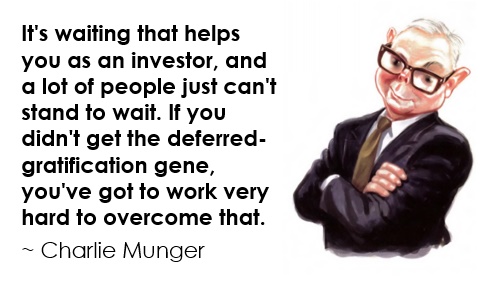
It’s waiting that helps you as an investor, and a lot of people just can’t stand to wait. If you didn’t get the deferred-gratification gene, you’ve got to work very hard to overcome that.


“It’s the curse of the bull market that leads people to give up on their sound investment philosophy and become impatient (especially because ‘others’ are making money fast). But take my word – this stuff doesn’t work in investing. It has never worked.

“Beware this curse of a bull market that makes you forget the risk of ‘losing’ money, and leads you to assume that making money in stocks is easy.

“And with that, let’s begin our lunch,” I told Ravi, “I am very hungry, so let’s talk of good food now and not investing.”

Note: This post was originally written in November 2015, but because the curse (of the bull market) is once again upon us, and because I could not write it better, I am sharing this again.

The post The Curse of a Bull Market appeared first on Safal Niveshak.

    
02 Nov 04:06

Open Thread: The Daylight Saving Time edition

by Atanu Dey

snap1784 The twice a year reminder that daylight saving time (DST) is a prime example of collective idiocy is here. This morning (Sunday Nov 1st), at 2 AM, clocks in North America were set back one hour to 1 AM. Today will be 25 hours long, and to reverse this gain of one hour, March 8th 2016 will be only 23 hours long. Oh the insanity!

This business of moving between regular and daylight saving time imposes huge economic losses. For instance, all Amtrak (a partially US government-funded American passenger railroad service that is operated as a non-for profit corporation) trains had to stop dead on their tracks at 2 AM and wait for an hour to resume service when the clock once again read 2 AM. On the other side, when the clocks in Spring skip an hour forward from 1 AM to 3 AM, all Amtrak trains fall behind schedule by an hour instantaneously — and have to somehow catch up, leading to all kinds of disruptions.

For now, I better go change several clocks — microwave, stove, living room clock, bathroom clock radio, the audio receiver, DVD player, tv, and the car — that need to be set back an hour manually. The mobile phone, laptop and PCs handle the change automatically.

Anyway, c’est la vie. One of these years, perhaps this insanity will end. What’s on your mind?

02 Nov 03:58

Hayek on Equality

by Atanu Dey

A brief excerpt from Friedrich Hayek’s essay, “Equality, Value and Merit.”

From the fact that people are very different it follows that, if we treat them equally, the result must be inequality in their actual position, and that the only way to place them in an equal position would be to treat them differently. Equality before the law and material equality are therefore not only different but are in conflict with each other; and we can achieve either the one or the other, but not both at the same time. The equality before the law which freedom requires leads to material inequality. Our argument will be that, though where the state must use coercion for other reasons, it should treat all people alike, the desire of making people more alike in their condition cannot be accepted in a free society as a justification for further and discriminatory coercion.

A careful reading of that essay (link above) is guaranteed to lead to profit and enlightenment. Read it a few times.

02 Nov 03:58

RIP Brijmohan Lal Mujnal, father of Indian motorcycle revolution

by Amol Agrawal
A sad day indeed. Mr Munjal passed away yesterday leaving behind a history  of Indian auto-mobiles which is likely to be unmatched. The manner in which his family migrated from Pakistan and created this Indian behemoth called Hero Honda Motors (and now Hero), is stuff of legends. He and his team were hardly ever in the news/media trying […]
01 Nov 05:04

One Dozen Thoughts on Dealing with Risk in Investing for Retirement

by David Merkel
Photo Credit: Ian Sane || Many ways to supplement retirement income...

Photo Credit: Ian Sane || One of many ways to supplement retirement income…

Investing is difficult. That said, it can be harder still. Let people with little to no training to try to do it for themselves. Sadly, many people get caught in the fear/greed cycle, and show up at the wrong time to buy and/or sell. They get there late, and then their emotions trick them into action. A rational investor would say, “Okay, I missed that move. Where are opportunities now, if there are any at all?”

Investing can be made even more difficult.  Investing reaches its most challenging level when one relies on his investing to meet an anticipated and repeated need for cash outflows.

Institutional investors will say that portfolio decisions are almost always easier when there is more cash flowing in than flowing out.  It means that there is one dominant mode of thought: where to invest new money?  Some attention will be given to managing existing assets — pruning away assets with less potential, but the need won’t be as pressing.

What’s tough is trying to meet a cash withdrawal rate that is materially higher than what can safely be achieved over time, and earning enough consistently to do so.  Doing so as an amateur managing a retirement portfolio is a particularly hard version of this problem.  Let me point out some of the areas where it will be hard:

1) The retiree doesn’t know how long he, his spouse, and anyone else relying on him will live.  Averages can be calculated, but particularly with two people, the odds are that at least one will outlive an average life expectancy.  Can they be conservative enough in their withdrawals that they won’t outlive their assets?

It’s tempting to overspend, and the temptation will get greater when bad events happen that break the budget, whether those are healthcare or other needs.  It is incredibly difficult to avoid paying for an immediate pressing need, when the soft cost is harming your future.  There is every incentive to say, “We’ll figure it out later.”  The odds on that being true will be low.

2) One conservative estimate of what the safe withdrawal rate is on a perpetuity is the yield on the 10-year Treasury Note plus around 1%.  That additional 1% can be higher after the market has gone through a bear market, and valuations are cheap, and as low as zero near the end of a bull market.

That said, most people people with discipline want a simple spending rule, and so those that are moderately conservative choose that they can spend 4%/year of their assets.  At present, if interest rates don’t go lower still, that will likely (60-80% likelihood) work.  But if income needs are greater than that, the odds of obtaining those yields over the long haul go down dramatically.

3) How does a retiree deal with bear markets, particularly ones that occur early in retirement?  Can he and will he reduce his expenses to reflect the losses?  On the other side, during bull markets, will he build up a buffer, and not get incautious during seemingly good times?

This is an easy prediction to make, but after the next bear market, look for a scad of “Our retirement is ruined articles.”  Look for there to be hearings in Congress that don’t amount to much — and if they do amount to much, watch them make things worse by creating R Bonds, or some similarly bad idea.

Academic risk models typically used by financial planners typically don’t do path-dependent analyses.  The odds of a ruinous situation is far higher than most models estimate because of the need for withdrawals and the autocorrelated nature of returns – good returns begets good, and bad returns beget bad in the intermediate term.  The odds of at least one large bad streak of returns on risky assets during retirement is high, and few retirees will build up a buffer of slack assets to prepare for that.

4) Retirees should avoid investing in too many income vehicles; the easiest temptation to give into is to stretch for yield — it is the oldest scam in the books.  This applies to dividend paying common stocks, and stock-like investments like REITs, MLPs, BDCs, etc.  They have no guaranteed return of principal.  On the plus side, they may give capital gains if bought at the right time, when they are out of favor, and reducing exposure when everyone is buying them.  Negatively, all junior debt tends to return worse on average than senior debts.  It is the same for equity-like investments used for income investing.

Another easy prediction to make is that junk bonds and non-bond income vehicles will be a large contributor to the shortfall in asset return in the next bear market, because many people are buying them as if they are magic.  The naive buyers think: all they do is provide a higher income, and there is no increased risk of capital loss.

5) Leaving retirement behind for a moment, consider the asset accumulation process.  Compounding is trickier than it may seem.  Assets must be selected that will grow their value including dividend payments over a reasonable time horizon, corresponding to a market cycle or so (4-8 years).  Growth in value should be in excess of that from expanding stock market multiples or falling interest rates, because you want to compound in the future, and low interest rates and high stock market multiples imply that future compounding opportunities are lower.

Thus, in one sense, there is no benefit much from a general rise in values from the stock or bond markets.  The value of a portfolio may have risen, but at the cost of lower future opportunities.  This is more ironclad in the bond market, where the cash flow streams are fixed.  With stocks and other risky investments, there may be some ways to do better.

Retirees should be aware that the actions taken by one member of a large cohort of retirees will be taken by many of them.  This makes risk control more difficult, because many of the assets and services that one would like to buy get bid up because they are scarce.  Often it may be that those that act earliest will do best, and those arriving last will do worst, but that is common to investing in many circumstances.  As Buffett has said, “What a wise man does in the beginning a fool does in the end.”

6) Retirement investors should avoid taking too much or too little risk. It’s psychologically difficult to buy risk assets when things seem horrible, or sell when everyone else is carefree.  If a person can do that successfully, he is rare.

What is achievable by many is to maintain a constant risk posture.  Don’t panic; don’t get greedy — stick to a moderate asset allocation through the cycles of the markets.

7) With asset allocation, retirees should overweight out-of-favor asset classes that offer above average cashflow yields.  Estimates on these can be found at GMO or Research Affiliates.  They should rebalance into new asset classes when they become cheap.

Another way retirees can succeed would be investing in growth at a reasonable price – stocks that offer capital growth opportunities at an inexpensive price and a margin of safety.  These companies or assets need to have large opportunities in front of them that they can reinvest their free cash flow into.  This is harder to do than it looks.  More companies look promising and do not perform well than those that do perform well.

Yet another way to enhance returns is value investing: find undervalued companies with a margin of safety that have potential to recover when conditions normalize, or find companies that can convert their resources to a better use that have the willingness to do that.  After the companies do well, reinvest in new possibilities that have better appreciation potential.


8 ) Many say that the first rule of markets is to avoid losses.  Here are some methods to remember:

  • Always seek a margin of safety.  Look for valuable assets well in excess of debts, governed by the rule of law, and purchased at a bargain price.
  • For assets that have fallen in price, don’t try to time the bottom — buy the asset when it rises above its 200-day moving average. This can limit risk, potentially buying when the worst is truly past.
  • Conservative investors avoid the areas where the hot money is buying and own assets being acquired by patient investors.

9) As assets shrink, what should be liquidated?  Asset allocation is more difficult than it is described in the textbooks, or in the syllabuses for the CFA Institute or for CFPs.  It is a blend of two things — when does the investor need the money, and what asset classes offer decent risk adjusted returns looking forward?  The best strategy is forward-looking, and liquidates what has the lowest risk-adjusted future return.  What is easy is selling assets off from everything proportionally, taking account of tax issues where needed.

Here’s another strategy that’s gotten a little attention lately: stocks are longer assets than bonds, so use bonds to pay for your spending in the early years of your retirement, and initially don’t sell the stocks.  Once the bonds run out, then start selling stocks if the dividend income isn’t enough to live on.

This idea is weak.  If a person followed this in 1997 with a 10-year horizon, their stocks would be worth less in 2008-9, even if they rocket back out to 2014.

Remember again:

You don’t benefit much from a general rise in values from the stock or bond markets.  The value of your portfolio may have risen, but at the cost of lower future opportunities.

That goes double in the distribution phase. The objective is to convert assets into a stream of income.  If interest rates are low, as they are now, safe income will be low.  The same applies to stocks (and things like them) trading at high multiples regardless of what dividends they pay.

Don’t look at current income.  Look instead at the underlying economics of the business, and how it grows value.  It is far better to have a growing income stream than a high income stream with low growth potential.

Deciding what to sell is an exercise in asset-liability management.  Keep the assets that offer the best return over the period that they are there to fund future expenses.

10) Will Social Security take a hit out around 2026?  One interpretation of the law says that once the trust fund gets down to one year’s worth of payments, future payments may get reduced to the level sustainable by expected future contributions, which is 73% of expected levels.  Expect a political firestorm if this becomes a live issue, say for the 2024 Presidential election.  There will be a bloc of voters to oppose leaving benefits unchanged by increasing Social Security taxes.

Even if benefits last at projected levels longer than 2026, the risk remains that there will be some compromise in the future that might reduce benefits because taxes will not be raised.  This is not as secure as a government bond.

11) Be wary of inflation, but don’t overdo it.  The retirement of so many people may be deflationary — after all, look at Japan and Europe so far.  Economies also work better when there is net growth in the number of workers.  It will be tempting for policymakers to shrink what liabilities they can shrink through inflation, but there will also be a bloc of voters to oppose that.

Also consider other risks, and how assets may fare.  Retirees should analyze what exposure they have to:

  • Deflation and a credit crisis
  • Expropriation
  • Regulatory change
  • Trade wars
  • Changes in taxes
  • Asset illiquidity
  • Reductions in reimbursement from government programs like Medicare, Medicaid, etc.
  • And more…

12) Retirees need a defender of two against slick guys who will try to cheat them when they are older.  Those who have assets are a prime target for scams.  Most of these come dressed in suits: brokers and other investment salesmen with plausible ways to make assets stretch further.  But there are other scams as well — retirees should run everything significant past a smart younger person who is skeptical, and knows how to say no when it is necessary.

Conclusion

Some will think this is unduly dour, but this is realistic.  There are not enough resources to give all of the Baby Boomers a lush retirement, without unduly harming younger age cohorts, and this is true over most of the developed world, not just the US.

Even with skilled advisers helping, retirees need to be ready for the hard choices that will come up. They should think through them earlier rather than later, and take some actions that will lower future risks.

The basic idea of retirement investing is how to convert present excess income into a robust income stream in retirement.  Managing a pile of assets for income to live off of is a challenge, and one that most people are not geared up for, because poor planning and emotional decisions lead to subpar results.

Retirees should aim for the best future investment opportunities with a margin of safety, and let the retirement income take care of itself.  After all, they can’t rely on the markets or the policymakers to make income opportunities easy.

31 Oct 08:42

Weekend reading links

by noreply@blogger.com (Gulzar Natarajan)
1. Polio is the new cross-border threat for India from Pakistan,
Experts warn that neighboring India, which succeeded in shedding its label as a polio-endemic nation three years ago, could face serious cross-border infection.
As immunization efforts flounder in Taliban-controlled northwest regions, the number of Polio cases reported have been growing, thereby raising the specter of cross-border infection. Yet another reason why India needs a stable and developing Pakistan.

2. Livemint has a graphic on judicial vacancies and case loads.

3. Arguably one of the most important macroeconomic debates in recent years has been over the relative superiority of fiscal austerity or expansion in combating economic weakness in developed economies. Two contrasting tales from both sides of the Atlantic.

In Spain, the Conservative Popular Party has pursued a vigorous austerity policy, slashing public spending in the middle of a recession and pushing through a series of labor reforms to improve external competitiveness. It has achieved internal devaluation through wage compression - wages have fallen in nine of the last fourteen quarters since the PP government assumed power. These measures appear to have succeeded, with output estimated to grow by 3% this year, Spanish exports have grown fastest rising from a share of 17% of GDP in 2007 to 23% in 2014, the number of Spanish companies selling abroad has risen 50% in the same period, and unemployment though still high has been declining. In contrast, in Canada, the center-left Liberal Party of Justin Trudeau recently won elections on an avowedly Keynesian platform.

4. Times points to this paper that evaluated the impact of seven cash transfer programs in Mexico, Morocco, Honduras, Nicaragua, Philippines, and Indonesia and found "no systematic evidence that cash transfer programs discourage work" and thereby promote lazy behaviors.

5. Business Standard points to another price transmission problem in India, in piped natural gas (PNG) distribution in cities. An 18% recent reduction in the regulated (by indexation) upstream price of natural gas (from $4.66 mBtu to $3.82 mBtu due to fall in global oil prices) translated to a mere 3% cut in the PNG price for consumers. As of June 2015, India had 2.8 PNG consumers in 11 states. 
The Indian Supreme Court had in July 2015 ruled that the Petroleum and Natural Gas Regulatory Board (PNGRB) had no powers to regulate transmission through CGD network and could only determine tariff for gas transmission through common or contract carrier pipelines. It, therefore, rejected PNGRB's claim to fix retail city gas prices. City gas distribution (CGD) firms are, therefore, currently monopolies and enjoy freedom from price regulation. They have marketing exclusivity for the first five years of their operations. Subsequently, the CGD network would be on "open-access", available to third parties to supply gas as a "common carrier", thereby ushering competition in the closed market. Once they become "common carriers", the PNGRB would have the regulatory powers to fix tariffs. However, the challenge then would, in all likelihood, be to get the incumbent network owners to not sabotage the open access arrangement. 

6. The digital traces left by mobile phones have emerged as one of the most exciting areas of studying human behavior in real-time, with the potential to frame public policy accordingly. Here are a few applications. 

LogAnalysis software developed by Emilio Ferrara and Co of Indiana University analyzes social networks developed from telephone calls (chiefs of gangs makes a few calls to trusted lieutenants who in turn disseminate the same widely and repeatedly) and compares them with crime data to identify (and pre-empt) criminals and crime locations. Adeline Decuyper and Co in Belgium monitored food consumption patterns by superposing an FAO household survey data with mobile phone calls data from Rwanda and found that airtime top ups correlated with purchases of high-value food items. Kevin Kung and Co at MIT used data from Ivory Coast, Portugal, and Boston and found that humans spent an hour daily commuting, independent of distance or mode of transport or the country, thereby validating the old Marchetti's constant (they assumed people's homes as where they made calls in the night and office as the location of calls during working days). Vasyl Palchykov and Co use the duration and frequency of telephone calls from a database of nearly 2 billion calls (age and sex of the callers were available) to tease out the changing patterns of relationships between men and women at different ages. Jameson Toole and Co use mobile data to study the economic and social impact of mass lay-offs by analyzing the changes in people's social networks. 

7. Andres Velasco points to the findings of Tulane University's Commitment to Equity Institute, which examined the impact of various fiscal policy instruments (direct taxes, indirect taxes, direct transfers, indirect subsidies like food and energy prices, and in-kind transfers like education and health care services) on inequality and poverty for Brazil, Chile, Colombia, Indonesia, Mexico, Peru, and South Africa,
The largest income redistributive effect is in South Africa and the smallest in Indonesia. Success in fiscal redistribution is driven primarily by redistributive effort (share of social spending to GDP in each country) and the extent to which transfers/subsidies are targeted to the poor and direct taxes targeted to the rich. .. South Africa’s result can be attributed to the combination of a large redistributive effort with transfers targeted to the poor and direct taxes targeted to the rich... While fiscal policy always reduces inequality, this is not the case with poverty. Fiscal policy increases poverty in Brazil and Colombia (over and above market income poverty)... meaning that a significant number of the market income poor (nonpoor) are made poorer (poor) by taxes and transfers. This startling result is primarily the consequence of high consumption taxes on basic goods... 
The marginal contribution of direct taxes, direct transfers, and in-kind transfers is always equalizing. The marginal effect of net indirect taxes is un-equalizing in Brazil, Colombia, Indonesia and South Africa. Total spending on education is pro-poor except for Indonesia, where it is neutral in absolute terms. Health spending is pro-poor in Brazil, Chile, Colombia and South Africa, roughly neutral in absolute terms in Mexico, and not pro-poor in Indonesia and Peru.
They calculate the marginal contribution of a tax or transfer (as the difference in inequality gini with and without the intervention) and the total redistributive effect (difference between market income gini and disposable or post-fiscal (disposable income plus indirect subsidies minus indirect taxes) incomes gini). 
Several counter-intuitive findings stand out - regressive taxes in Chile and South Africa are equalizing or neutral; the marginal contribution of contributory social security old-age pensions is un-equalizing in Chile, Mexico and Peru. 

Given this heterogeneity, to the question of whether direct taxes or indirect taxes and direct transfers or in-kind transfers are more effective at lowering inequality or reducing poverty, one can only say that "it depends" on its interaction with the other fiscal policy instruments already in operation. 
Add to Technorati Favorites
31 Oct 03:35

What to look for in a company…

by subra
Many a times I have been asked what to look for in a company before you decide to buy a share. Let me tell you what I was asked to do by an FII running an International Blue chip fund. Their definition of blue chip did change from market to market and the markets that […]
30 Oct 06:31

The missing lowflation revolution

by Antonio Fatas
It will soon be eight years since the US Federal Reserve decided to bring its interest rate down to 0%. Other central banks have spent similar number of years (or much longer in the case of Japan) stuck at the zero lower bound. In these eight years central banks have used all their available tools to increase inflation closer to their target and boost growth with limited success. GDP growth has been weak or anemic, and there is very little hope that economies will ever go back to their pre-crisis trends.

Some of these trends have challenged the traditional view of academic economists and policy makers about how an economy works. Some of the facts that very few would have anticipated:
- The idea that central banks cannot lift inflation rates closer to their targets over such a long horizon.
- The fact that a crisis can be so persistent and that cyclical conditions can have such large permanent effects on potential output.
- The slow (or inexistent) natural tendency of the economy to adjust by itself to a new equilibrium.

To be fair, some of these facts are not a complete surprise and correspond well with the description of depressed economies that have hit the zero lower bound level of interest rates because of deflation or "lowflation". We had been warned about this by those who had studied the Japanese experience: both Krugman and Bernanke, among others, had described these dynamics for the case of Japan. But my guess is that even those who agreed with this reading of the Japanese economy would have never thought that we would see the same thing happening in other advanced economies. Most thought that this was just a unique example of incompetence among Japanese policy makers.

Now we have learned that either all central bankers are as incompetent as the Bank of Japan in the 90s or that the phenomenon is a lot more natural, and likely to be repeated, in economies with low inflation, more so when the natural real interest rates is very low.

But if this scenario is more likely to happen going forward it might be time to rethink our economic policy framework. Some obvious proposals include raising the inflation target and considering "helicopter money" as a tool for central banks. But neither of these proposals is getting a lot of traction

My own sense is that the view among academics and policy makers is not changing fast enough and some are just assuming that this would be a one-time event that will not be repeated in the future (even if we are still not out of the current event!).

The comparison with the 70s when stagflation produced a large change in the way academic and policy makers thought about their models and about the framework for monetary policy is striking. During those year a high inflation and low growth environment created a revolution among academics (moving away from the simple Phillips Curve) and policy makers (switching to anti-inflationary and independent central banks). How many more years of zero interest rate will it take to witness a similar change in our economic analysis?

Antonio Fatás
29 Oct 10:29

Yes, Break Up AIG!

by David Merkel
Photo Credit: Insider Monkey || Carl never looked so good.

Picture Credit: Insider Monkey || Carl never looked so good.

I’ve written about this topic twice before:


Those were back in 2008, before the financial crisis.  I made similar comments at RealMoney earlier than that, but those are lost and gone forever, and I am dreadful sorry.

I’ve written a lot about AIG over the years, including my article that was cited by the Special Inspector General of the TARP in his report on AIG.  I’ve also written a lot about insurance investing.  I’d like to quote from the final part of my 7-part series summarizing the topic:

1) The first thing to realize is that diversification across insurance subindustries usually does not work.

Do not mix:

  • Life & P&C
  • Financial & Anything
  • Health & Anything

Maybe you can mix P&C, Mortgage & Title, after all Old Republic survived.  The main point is this.  Insurance is not uniform.  Coverages are sold and underwritten differently.  Generally, higher valuations will be obtained on “pure play” companies  Diversification is swamped by management inability.  These are reasons for AIG and Allstate to spin off their life operations.

2) Middle-sized companies tend to do best from a valuation standpoint: the large have nowhere to grow, and the small are always questionable on their viability.  With a few exceptions, I like sticking with focused mid-cap companies with my insurance names.

Both of these concepts augur in favor of a breakup of AIG — even without the additional capital needed for being a SIFI (which no insurance firm should be, they don’t collapse together, like banks do), large firms get a valuation discount, because they can’t grow quickly.

Synergies and diversification benefits between differing types of insurance tend to be limited as well.  Focus is worth a lot more in insurance than diversity, because managements are typically not good at multiple types of insurance.  They have different profit models, distribution systems, capital needs, and mindsets.  Think of it this way: if you can’t get personal lines agents to sell life insurance and annuities, why do you ever think there might be synergies?  They are very different businesses.

Now Carl Icahn is arguing the same thingsize and diversification are harming value at AIG, as well as a high cost structure.  I think his first argument is right, and a breakup should be pursued, but let me mention four complicating factors that he ought to consider:

1) Costs aren’t overly high at AIG, and there may not be a lot to cut.  Greenberg ran a tight ship, and I suspect those who followed tried to imitate that.  I would try to double-check cost levels.

2) ROEs are low at AIG likely because many life insurers have low embedded margins and those can’t be changed rapidly because of the long duration nature of the contracts.  The accounting for DAC [deferred acquisition cost] assets can be liberal at times — writedowns are not required until you are deferring losses.  I would analyze all intangible assets, and try to estimate what they returning.  I would also try to look at the valuation of life insurers comparable to those at AIG, which are high complexity beasties.  You might find that a breakup won’t release as much value as you think, at least initially.

3) Pure play mortgage insurers are fodder for the next financial crisis.  If one of those gets spun off, it won’t come at a high valuation, particularly if you give it enough capital to maintain its credit ratings.

4) There are a variety of cross-guarantees across AIG’s subsidiaries.  I’m assuming Icahn read about those when he looked through the statutory books of AIG.  That is, if he did do that.  They are mentioned in the 10K, but not in as much detail.  Those would probably be the most difficult part of a breakup of AIG, because you would have to replace guarantees with additional capital, which reduces the benefit of breaking the companies up.

Summary

Breaking up AIG would be difficult, but I believe that focused insurance companies with specialist management teams would eventually outperform AIG as it is currently configured.  Just don’t expect a quick or massive initial benefit from breaking AIG up.

One final note: it would pay Carl Icahn and all of the others who would be interested in breaking up AIG to hire some insurance expertise.  Insurance is a set of complex businesses, and few understand most of them, much less all of them.  It would be easy to naively overestimate the ability to improve profitability at AIG if you don’t know the business,  the accounting, and how free cash flow emerges, if it ever does.

They might also want to have a frank talk with Standard and Poors as to how they would structure a breakup if the operating subsidiaries were to maintain all of their current ratings.  Icahn and his friends might be surprised at how little value could initially be released, if any.


Full disclosure: long ALL


29 Oct 03:46

I Might Be Wrong

by Vishal Khandelwal

On the morning of the Battle of Waterloo in 1815, Napoleon Bonaparte smugly assured his generals – “I tell you Wellington is a bad general, the English are bad soldiers; we will settle this matter by lunchtime.”

Just before the Titanic was about to embark on its maiden journey in 1912, one passenger asked a ship’s agent for extra insurance on some valuables in her luggage. The agent replied, “Ridiculous. This boat’s unsinkable.”

Captain Smith himself was asked about the safety of the Titanic. He answered – “I cannot imagine any condition which would cause a ship to founder. I cannot conceive of any vital disaster happening to this vessel. Modern shipbuilding has gone beyond that.”

Then, after the ship had struck the iceberg, a passenger asked her employer if they should do something about it. He replied, “Go back to bed. This ship is unsinkable.”


The New “Unsinkables”
Cut to 2008. Fund managers in India who were betting big on infrastructure and realty stocks, when asked about the valuations at which they were buying such stocks, said, “Real estate and infra are the new gold and prices will continue to head north.”

Ask me. As an analyst in 2008, I asked my friends and relatives to hold on to “great stocks” expecting that these cannot fall more than 20-30%, whatever the markets did.

As a team at my ex-employer, we were asking clients to hold on to stocks, and “buy at every dip”, despite sensing a greater danger with every “breaking news” coming out of the financial system.

The rest, as they you know, isn’t history…but reality!

Anyways, if you have sensed by now, there is a common thread that binds all the above situations and events. If not, let me tell you that that common thread is of…

Arrogance!
If we’re repeatedly successful – like Napoleon, or fund managers and analysts prior to 2008 – we’re tempted to believe that we’ve found the formula for success and are no longer subject to human fallibility. This is devastating, especially in a world that is continually changing, and where every right idea is eventually the wrong one.

With an arrogant attitude, we cease paying attention to different points of view and information that contradicts our beliefs. Even if the world around us is expected to fall under its weight, we believe we’re not subject to the same constraints as others.

“I have done my homework,” I would tell myself after analysing a stock threadbare and finding its valuations attractive. “Now let me act on it!”

But I Might Be Wrong
Now, that’s something Napoleon didn’t tell himself before the Battle of Waterloo. That’s also what Captain Smith didn’t consider before sailing out with his “unsinkable” Titanic.

Here is what the legendary Seth Klarman wrote in his shareholder letter in 1996…

We regard investing as an arrogant act; an investor who buys is effectively saying that he or she knows more than the seller and the same or more than other prospective buyers.

This statement contains a big truth that I, as an investor, ignored all these years.

So I bought a stock because I thought my analysis was right. I thought my calculation of the stock’s intrinsic value was right. I thought my decision to buy the stock was right even when I always wondered what could be the reason someone else was selling the same stock.

All in all, my arrogance – of being right – made me buy several stocks over these years.

While I’m satisfied with my long term returns, I consider a large part of my performance a result of luck than my own aptitude of picking up the right stocks.

“Why do you say so?” you may ask.

Well, the reason is that in considering myself the most right (and thus the most arrogant) investor in the world, I often failed to tell myself the most important thing that an investor must tell himself before buying or selling a stock.

That thing is – “But I might be wrong!”

This statement now lies at every major decision point of my investing checklist…

  • After I’ve done my research on a company
  • After I’ve calculated a stock’s intrinsic value
  • Before I make the final decision to buy a stock

After providing for a numerical “margin of safety” to my intrinsic value estimates, this statement serves as an extra layer of margin of safety – a check on my arrogance…because it leads me to do a review of my analysis and assumptions before I go ahead with my final decision.

Here is what Klarman said in an interview with Charlie Rose in 2012…

You need to balance arrogance and humility…when you buy anything, it’s an arrogant act. You are saying the markets are gyrating and somebody wants to sell this to me and I know more than everybody else so I am going to stand here and buy it. I am going to pay 1/8th more than the next guy wants to pay and buy it. That’s arrogant. And you need the humility to say ‘but I might be wrong.’ And you have to do that on everything.

This is an interesting concept, and one that I, like most investors, did not fully consider when purchasing a stock (though I’ve now learnt my lessons).

Risk is Not in Our Stocks, But in Ourselves
Jason Zweig, in his commentary for Chapter 20 of Benjamin Graham’s The Intelligent Investor, wrote…

Risk exists in another dimension: inside you.

If you overestimate how well you really understand an investment, or overstate your ability to ride out a temporary plunge in prices, it doesn’t matter what you own or how the market does.

Ultimately, financial risk resides not in what kinds of investments you have, but in what kind of investor you are. If you want to know what risk really is, go to the nearest bathroom and step up to the mirror.

That’s risk, gazing back at you from the glass.

Staying humble with your analysis and forecasting powers will keep you from risking too much in a view of the future that may well turn out to be wrong. So, by all means you should lower your expectations – but take care not to depress your spirit.

For the intelligent investor, hope always springs eternal, because it should.

I’ve learned these important lessons by being an arrogant investor in the past. Now, I’m practicing to be humble…by telling myself this before making an investment decision – “But I might be wrong” – and double-checking my analysis and assumptions.

The post I Might Be Wrong appeared first on Safal Niveshak.

    
29 Oct 03:42

Axis Bank Sold 1820 cr. of Loans at 65% Loss to ARCs, Drags Down Stock 7%

by Deepak Shenoy

Axis Bank has fallen majorly today. It fell from 521 yesterday to 482 today, a fall of 7.5%. There’s a good reason: the worries about asset quality.

Axis

In their conference call, they mentioned that they sold loans to Asset Recovery Companies (ARCs). These are typically companies that buy bad assets from banks and then attempt to recover those loans.  

During the quarter, it has emerged from the Conference call and probably inadvertantly mentioned, that:

  • Two loans, worth Rs. 1820 cr. together, went ‘potentially bad’
  • They mentioned that these are loans to the same promoter group, and the name seems to be “Essar” which was mentioned in the conversation. (I could be wrong, but check out two snippets that I have uploaded) (Note: Apparently this was the Abhijeet Group, from comments below. The “SR” we hear is about security receipts from the ARC – which entitles them to a partial share of a recovery, is what we are told.)
  • And they were in the power sector. 
(Read On...)
29 Oct 03:39

Redacted Version of the October 2015 FOMC Statement

by David Merkel
Photo Credit: Day Donaldson

Photo Credit: Day Donaldson


September 2015 October 2015 Comments
Information received since the Federal Open Market Committee met in July suggests that economic activity is expanding at a moderate pace. Information received since the Federal Open Market Committee met in September suggests that economic activity has been expanding at a moderate pace. Shows less certainty about current GDP.
Household spending and business fixed investment have been increasing moderately, and the housing sector has improved further; however, net exports have been soft. Household spending and business fixed investment have been increasing at solid rates in recent months, and the housing sector has improved further; however, net exports have been soft. Shades up household spending.
The labor market continued to improve, with solid job gains and declining unemployment. On balance, labor market indicators show that underutilization of labor resources has diminished since early this year. The pace of job gains slowed and the unemployment rate held steady. Nonetheless, labor market indicators, on balance, show that underutilization of labor resources has diminished since early this year. Shades labor employment down a little.
Inflation has continued to run below the Committee’s longer-run objective, partly reflecting declines in energy prices and in prices of non-energy imports. Inflation has continued to run below the Committee’s longer-run objective, partly reflecting declines in energy prices and in prices of non-energy imports. No change.
Market-based measures of inflation compensation moved lower; survey-based measures of longer-term inflation expectations have remained stable. Market-based measures of inflation compensation moved slightly lower; survey-based measures of longer-term inflation expectations have remained stable. No change.  TIPS are showing lower inflation expectations since the last meeting. 5y forward 5y inflation implied from TIPS is near 1.79%, down 0.11% from September.
Consistent with its statutory mandate, the Committee seeks to foster maximum employment and price stability. Consistent with its statutory mandate, the Committee seeks to foster maximum employment and price stability. No change. Any time they mention the “statutory mandate,” it is to excuse bad policy.
Recent global economic and financial developments may restrain economic activity somewhat and are likely to put further downward pressure on inflation in the near term.   Well, that sentence lasted for one meeting.  Would that more got chopped out of the statement.
Nonetheless, the Committee expects that, with appropriate policy accommodation, economic activity will expand at a moderate pace, with labor market indicators continuing to move toward levels the Committee judges consistent with its dual mandate. The Committee expects that, with appropriate policy accommodation, economic activity will expand at a moderate pace, with labor market indicators continuing to move toward levels the Committee judges consistent with its dual mandate. No real change.
The Committee continues to see the risks to the outlook for economic activity and the labor market as nearly balanced but is monitoring developments abroad. Inflation is anticipated to remain near its recent low level in the near term but the Committee expects inflation to rise gradually toward 2 percent over the medium term as the labor market improves further and the transitory effects of declines in energy and import prices dissipate. The Committee continues to monitor inflation developments closely. The Committee continues to see the risks to the outlook for economic activity and the labor market as nearly balanced but is monitoring global economic and financial developments. Inflation is anticipated to remain near its recent low level in the near term but the Committee expects inflation to rise gradually toward 2 percent over the medium term as the labor market improves further and the transitory effects of declines in energy and import prices dissipate. The Committee continues to monitor inflation developments closely. CPI is at +0.0% now, yoy.  States that they have a global view of what they need to watch.  Good luck with that.
To support continued progress toward maximum employment and price stability, the Committee today reaffirmed its view that the current 0 to 1/4 percent target range for the federal funds rate remains appropriate. In determining how long to maintain this target range, the Committee will assess progress–both realized and expected–toward its objectives of maximum employment and 2 percent inflation. This assessment will take into account a wide range of information, including measures of labor market conditions, indicators of inflation pressures and inflation expectations, and readings on financial and international developments. To support continued progress toward maximum employment and price stability, the Committee today reaffirmed its view that the current 0 to 1/4 percent target range for the federal funds rate remains appropriate. In determining whether it will be appropriate to raise the target range at its next meeting, the Committee will assess progress–both realized and expected–toward its objectives of maximum employment and 2 percent inflation. This assessment will take into account a wide range of information, including measures of labor market conditions, indicators of inflation pressures and inflation expectations, and readings on financial and international developments. Gives the impression that a change might be coming at the next meeting, but the way the FOMC thinks about monetary policy is currently scattered, to say the least.

I wouldn’t make too much of this change.  The FOMC is big on their newfound flexibility, and isn’t going to be very predictable for some time.

The Committee anticipates that it will be appropriate to raise the target range for the federal funds rate when it has seen some further improvement in the labor market and is reasonably confident that inflation will move back to its 2 percent objective over the medium term. The Committee anticipates that it will be appropriate to raise the target range for the federal funds rate when it has seen some further improvement in the labor market and is reasonably confident that inflation will move back to its 2 percent objective over the medium term. No change.

No rules, just guesswork from academics and bureaucrats with bad theories on economics.

The Committee is maintaining its existing policy of reinvesting principal payments from its holdings of agency debt and agency mortgage-backed securities in agency mortgage-backed securities and of rolling over maturing Treasury securities at auction. This policy, by keeping the Committee’s holdings of longer-term securities at sizable levels, should help maintain accommodative financial conditions. The Committee is maintaining its existing policy of reinvesting principal payments from its holdings of agency debt and agency mortgage-backed securities in agency mortgage-backed securities and of rolling over maturing Treasury securities at auction. This policy, by keeping the Committee’s holdings of longer-term securities at sizable levels, should help maintain accommodative financial conditions. No change.  Changing that would be a cheap way to effect a tightening.
When the Committee decides to begin to remove policy accommodation, it will take a balanced approach consistent with its longer-run goals of maximum employment and inflation of 2 percent. The Committee currently anticipates that, even after employment and inflation are near mandate-consistent levels, economic conditions may, for some time, warrant keeping the target federal funds rate below levels the Committee views as normal in the longer run. When the Committee decides to begin to remove policy accommodation, it will take a balanced approach consistent with its longer-run goals of maximum employment and inflation of 2 percent. The Committee currently anticipates that, even after employment and inflation are near mandate-consistent levels, economic conditions may, for some time, warrant keeping the target federal funds rate below levels the Committee views as normal in the longer run. No Change.

“Balanced” means they don’t know what they will do, and want flexibility.

Voting for the FOMC monetary policy action were: Janet L. Yellen, Chair; William C. Dudley, Vice Chairman; Lael Brainard; Charles L. Evans; Stanley Fischer; Dennis P. Lockhart; Jerome H. Powell; Daniel K. Tarullo; and John C. Williams. Voting for the FOMC monetary policy action were: Janet L. Yellen, Chair; William C. Dudley, Vice Chairman; Lael Brainard; Charles L. Evans; Stanley Fischer; Dennis P. Lockhart; Jerome H. Powell; Daniel K. Tarullo; and John C. Williams. Still a majority of doves.

We need some people in the Fed and in the government who realize that balance sheets matter – for households, corporations, governments, and central banks.  Remove anyone who is a neoclassical economist – they missed the last crisis; they will miss the next one.

Voting against the action was Jeffrey M. Lacker, who preferred to raise the target range for the federal funds rate by 25 basis points at this meeting. Voting against the action was Jeffrey M. Lacker, who preferred to raise the target range for the federal funds rate by 25 basis points at this meeting. No change.  Lacker dissents, arguing policy has been too loose for too long.

Comments

  • This FOMC statement was yet another great big nothing. Only notable changes were shading household spending up, and employment and GDP down.
  • Don’t expect tightening in December. People should conclude that the FOMC has no idea of when the FOMC will tighten policy, if ever.  The FOMC says that any future change to policy is contingent on almost everything.
  • On the new phrase, “whether it will be appropriate to raise the target range at its next meeting,” I would not make much of it. It gives the impression that a change might be coming at the next meeting, but the way the FOMC thinks about monetary policy is currently scattered, to say the least.  I wouldn’t make too much of this change.  The FOMC is big on their newfound flexibility, and isn’t going to be very predictable for some time.
  • Despite lower unemployment levels, labor market conditions are still pretty punk. Much of the unemployment rate improvement comes more from discouraged workers, and part-time workers.  Wage growth is weak also.
  • Equities fall and bonds rise. Commodity prices fall and the dollar rises.  This is a sign that the markets anticipate more economic weakness.
  • The FOMC says that any future change to policy is contingent on almost everything.
  • Don’t know they keep an optimistic view of GDP growth, especially amid falling monetary velocity.
  • The key variables on Fed Policy are capacity utilization, labor market indicators, inflation trends, and inflation expectations. As a result, the FOMC ain’t moving rates up, absent improvement in labor market indicators, much higher inflation, or a US Dollar crisis.
  • We have a congress of doves for 2015 on the FOMC. Things will continue to be boring as far as dissents go.  We need some people in the Fed and in the government who realize that balance sheets matter – for households, corporations, governments, and central banks.  Remove anyone who is a neoclassical economist – they missed the last crisis; they will miss the next one.
29 Oct 03:38

Learning from Investing Experience

by subra
An early start in investing is really helpful. Not because of the power of compounding alone, it is also that you can implement the learning. I know, I know you will jump up and say ‘the past performance is not an indicator of future performance’. I agree, however having been in this ‘business’ since the […]
29 Oct 03:34

Quit Your 9-5 Faster: The Auxiliary Fund

by Jason Fieber

seeinglightPerhaps the biggest barrier to entry when it comes to the concept of achieving financial independence early in life is the very nature of the journey itself. Specifically, the length. It’s not like one can just have that epiphany and then go on to retire three or four years later. Not in most cases, anyway.

So there’s that long runway. You need to work really hard, live below your means, delay gratification, and save a high percentage of your net income for a decade or more in order to get to the promised land.

Although, I’d argue it’s really not all that bad. You’re going to work at a job anyway. And if you’re going to work at a soul-crushing grind to put food on the table, you may as well do what you can to get out of that situation as soon as possible.

And delaying gratification gets turned on its head when you realize that what’s really gratifying isn’t what’s in the present; it’s what you’re still striving for. Besides, what’s the bigger sacrifice: living below your means or working for most of your life?

That said, if we can shorten the journey a year or two, that’d be even better. Right?

Right.

I’ve come up with a few ideas over the years that I think can shorten the journey for me even more. And I’m pretty excited by that.

I thought all along that I’d be working my miserable day job down at the dealership until I was 40, not able to escape until my dividend income completely covered my expenses. But I was wrong about that, being able to “retire” from the auto industry at the ripe age of 32 years old.

Looking at where I’m at now, I’m ahead of pace. My overarching goal is to be financially independent by 40 years old. And I view financial independence as being in a situation where my expenses are covered by passive income, not having to work for any money any more (but knowing I could if I wanted to). As of now, I believe dividend income will exceed expenses sometime around 39 years old, assuming my expenses don’t dramatically increase and my investing trajectory stays similar to what it’s been over the last five or so years.

I’m going to discuss one of those ideas I’ve come up with to shorten things even more. It’s an “ace in the hole”, if you will. You don’t have to use it, but I think it would be easy to pull off if you had/wanted to. If you’re miserable at your job and the light just isn’t bright enough, I think this could speed things along by about a year, depending on your own situation.

Why Shorten The Journey?

First, I’ll note that I love writing for a living and doing all that that I do now. But I still crave financial independence almost as much as I did back when I first started the journey. It’s certainly become easier for me over time, especially with the fact that time has slowed for me a little bit.

But I’m the kind of person who craves new experiences because just about anything becomes routine for me over time. I want to be able to live new lifetimes with impunity. I want to wake up every single day knowing that whatever I end up doing that day, I’ll be doing it because, deep down inside, I want to do be doing it without any doubts. I never want to be in a situation where I’m doing something because I have to, just for the money.

Ultimately, I want to be free. It’s not technically binary where you’re either free or you’re not free. I do believe there’s a spectrum there, which is what the concept I’m going to discuss relates to. But while I love my station in life right now, I’m still not completely free. If I can move along that spectrum in a hurry, I will.

The Auxiliary Fund

This is where shortcuts come in. And I think the concept of an auxiliary fund could work out pretty wonderfully, if executed properly.

An auxiliary fund is a sum of cash you set aside to cover the spread between your passive income and your expenses until the passive income grows enough to take over and cover expenses completely.

Let’s use some numbers to illustrate the concept.

Say you’ve cut expenses to the bone and you can’t live on any less than $1,500 per month ($18,000 per year). And let’s then also assume that your dividend income is $1,300 per month ($15,600 per year). You’ve got a spread of $200 per month there.

Adding in some other assumptions, let’s say you’re saving 50% of your net income. So you’re netting $3,000 per month, investing the other $1,500. You can certainly play with the numbers for your own situation, but I think these are reasonable assumptions for a good number of folks out there.

Covering that spread could take a while in terms of how long it would take you to grow the dividend income to $1,500 per month. You’re investing $18,000 per year in this scenario. Assuming you’re achieving an overall yield on your dividend growth stock portfolio of 3.5%, you’re adding $630 to your annual dividend income after a year. I’m currently generating over 7% dividend growth on my portfolio, so that would add another $1,092 in annual dividend income after a year in this scenario. Adding the two together, you’re looking at $1,722 in additional annual dividend income after one year of saving, investing, and collecting dividend raises.

So that now puts you at $1,443 in monthly dividend income against $1,500 in monthly expenses. Close, but not quite there after another year of saving 50% and investing diligently. You could goose things a bit by chasing yield, but that adds risk. And you’d likely still fall short anyway.

But what if you could skip that entire additional year and quit that 9-5 even with the $200 delta?

That’s where the auxiliary fund comes into play.

Instead of directing your $1,500 per month in savings toward investments, you keep it in cash. This isn’t part of your emergency fund. This is used only to temporarily cover your spread between passive income and expenses.

Now, I’m a huge fan of passive and growing cash flow. A much bigger fan of that than cash. I didn’t get to the position I’m now in by preferring cash over cash flow. But I’m also a big fan of living on my terms, which is why we’re all doing what we’re doing here. All that saving and investing is a means to an end for me, even if the investing is a lot of fun in the meanwhile. If some great benefactor came into my life and offered to cover my expenses for life in exchange for never saving/investing another dime, you can bet your bottom dollar I’d take that offer in a heartbeat.

Moreover, with $1,300 per month in passive dividend income, you’re already in very rare company and likely a guaranteed millionaire. You’re already very successful, so try not to lose perspective as you continue to save and accumulate high-quality assets. Some people will never be able to find their enough. Try to not be one of those people.

Getting back to the example, you’re redirecting that $1,500 per month toward a short-term cash position instead of long-term dividend growth stock investments. After four months, you should have $6,000 in cash there (again, separate from your emergency fund). That $6,000 can then cover your shortfall for approximately years.

And guess what’s happening over that 2½ years?

You guessed it: dividend growth.

Your $15,600 per year in annual dividend income should become $16,692 in annual dividend income after a year, assuming 7% dividend growth. After another year, that compounds out to $17,860 in annual dividend income, which nearly covers your expenses. After another six months of compounding at 7%, you should be looking at right about $18,485 in annual dividend income.

Now, it’s probably safe to assume your expenses grew a little bit over this time frame as well, but the end result is still over $18,000 per year. And with inflation being so low right now, the odds are pretty strong that someone who’s frugal enough and good enough at controlling expenses for a long enough period of time to be in this position in the first place can keep running a pretty tight ship for another 2 or so years. In addition, the dividend growth is an ongoing and fluid process, meaning you’re spending a little less than $200 per month as you go and as the dividend income continues to rise, further bolstering the chances of success.

Of course, one could stay on the day job for another month, which would add another $1,500 to the pot, covering another six or seven months of expenses while the dividend income continues to grow and compound. In the end, you’re still looking at cutting the journey short by about a year.

Conclusion

This is just a concept. You don’t have to (and probably won’t) use it if you want that big margin of safety where your dividend income is covering your expenses by 110% or 120% or more. But just keep in mind that every additional day you’re working, saving, and investing is one less day you’re living on your terms. Money can always be made. Time cannot.

Personally, I’m strongly considering employing this strategy down the stretch. I think I’m probably about a year ahead of pace as things sit now. But this could potentially put me in a position where I quite literally don’t have to involuntarily work a minute of my life past 38 years old. And that’s even after quitting the full-time job a day after my 32nd birthday. How crazy would that be?

I just don’t think it’s necessary to have that big margin of safety where dividend income covers expenses by X% over 100%. In fact, I believe organic dividend growth would allow you to exit the workplace even if you are only ~90% there, assuming you have a solid auxiliary fund in place and firm control over your expenses. Besides, it’s highly, highly unlikely you’ll never earn another dime of active income for the rest of your life if you’re achieving financial independence relatively early in life. It’s almost impossible to be this incredibly creative and driven person (the kind of person that achieves financial independence early in life) and just never earn another dime for the value you could (and likely will) add to the world.

You’d have to play with the numbers a little bit, but I purposely used numbers that are pretty true to my own situation. My long-term goal has long been $1,500 per month ($18,000 per year) in dividend income, which I think will more or less free me. Expenses are somewhat of a moving target, especially looking a decade out. But I think it’s certainly a reasonable target for me assuming I’m able to pay off student loans by then and take subsidies for health insurance. In the end, it’s simply a matter of adjusting on the fly and taking a look at things as they go. Regardless, it’d be easy to save cash for 3-5 months toward the auxiliary fund and then go about my merry way. Likewise, it’d be easy for you to do the same. This is a concept that can be replicated by anyone following this strategy.

If you love what you do, then there’s probably no reason to consider this idea. But financial independence isn’t about hating your job. It’s about so much more. And if you want to sprint that last mile of the journey, I think this concept offers the chance for a late-stage burst of energy to cross over the finish line and step into the light.

What do you think? Would you consider using an auxiliary fund to speed things along? Why or why not?

Thanks for reading.

Photo Credit: adamr/FreeDigitalPhotos.net

29 Oct 02:42

FOMC Makes It Clear: December Hike Remains On The Cards

by Deepak Shenoy

The US Fed has decided not to raise rates today – they weren’t expected to. But they’ve made it fairly clear that a December Hike is still on the cards. Their statement:

Information received since the Federal Open Market Committee met in September suggests that economic activity has been expanding at a moderate pace. Household spending and business fixed investment have been increasing at solid rates in recent months, and the housing sector has improved further; however, net exports have been soft. The pace of job gains slowed and the unemployment rate held steady. Nonetheless, labor market indicators, on balance, show that underutilization of labor resources has diminished since early this year. Inflation has continued to run below the Committee’s longer-run objective, partly reflecting declines in energy prices and in prices of non-energy imports. Market-based measures of inflation compensation moved slightly lower; survey-based measures of longer-term inflation expectations have remained stable.

(Read On...)
29 Oct 02:42

More on India's GDP growth rates

by noreply@blogger.com (Gulzar Natarajan)
Much has been said about the last revision to the India's official economic growth statistics. To the extent that an economy's strength is reliably reflected in the underlying contributors, the graphic below raises more concerns about its veracity.
Clearly, since 2013, there is a distinct divergence in the trends between GDP growth and that of some of the important underlying contributors.  
Add to Technorati Favorites
28 Oct 09:50

Latticework of Mental Models: Status Quo Bias

by Anshul Khare

Do you own a smartphone? Chances are that you’re reading this on a smartphone or a tablet.

One of the most interesting thing about these smartphones is that they allows you to customize everything – data usage, app synchronisation, phone encryption, even how loud you want the camera shutter to sound.

How many of these customization settings have you used? In my case – almost none!

Although I’m not technically challenged, but do suffer from, just like most of the other human beings, a cognitive bias.

Earlier in the latticework series, I wrote about Do Something Bias. It’s a cognitive bias where people get an urge to take action or make unnecessary decisions when ‘not doing anything’ is required.

Now let’s turn the table, and talk about a bias which is exactly opposite of Do Something Bias. It’s called Status Quo Bias. The tendency of people where they don’t do anything and continue to maintain the current state of affairs.

If we could boil down this cognitive bias to a more fundamental body of knowledge, it would be Physics. I am sure you must have heard of Newton’s laws of motion. The third law of motion states –

An object either remains at rest or continues to move at a constant velocity, unless acted upon by an external force.

This characteristic, called inertia, is exhibited by all physical bodies. And when it comes to human behaviour, this tendency manifests in the form of Status Quo Bias.

Here is a very intriguing case study which Dan Ariely, author of wildly popular book Predictably Irrational, mentions in his blog post

This graph shows the percentage of people, across different European countries, who are willing to donate their organs after they pass away. When people see this plot and try to speculate about the cause for the differences between the countries that donate a lot (in blue) and the countries that donate little (in orange) they usually come up with “big” reasons such as religion, culture, etc.

But you will notice that pairs of similar countries have very different levels of organ donations. For example, take the following pairs of countries: Denmark and Sweden; the Netherlands and Belgium; Austria and Germany (and depending on your individual perspective France and the UK). These are countries that we usually think of as rather similar in terms of culture, religion, etc., yet their levels of organ donations are very different.

So, what could explain these differences? It turns out that it is the design of the form at the DMV. In countries where the form is set as “opt-in” (check this box if you want to participate in the organ donation program) people do not check the box and as a consequence they do not become a part of the program. In countries where the form is set as “opt-out” (check this box if you don’t want to participate in the organ donation program) people also do not check the box and are automatically enrolled in the program. In both cases large proportions of people simply adopt the default option.

This default effect caused by Status Quo Bias on human behaviour is so strong that a whole discipline of ‘choice architectures design’ has evolved around this idea of creating intelligent default options in different policy frameworks and various human interfacing systems.

If you really want to learn more about choice architecture, Nudge by Richard Thaler is an excellent book to read. Thaler writes …

People have a more general tendency to stick with their current situation… [It] has been demonstrated in numerous situations. Most teachers know that students tend to sit in the same seats in class, even without a seating chart. But status quo bias can occur even when the stakes are much larger, and it can get us into a lot of trouble.

…Those who are in charge of circulation [magazine subscriptions business] know that when renewal is automatic, and when people have to make a phone call to cancel, the likelihood of renewal is much higher than it is when people have to indicate that they actually want to continue to receive the magazine.

So next time when you apply for a new credit card and later figure out that you have been enrolled for couple of unnecessary “premium services” (which you of course don’t remember opting for), then don’t be surprised because the credit card application form probably had those options selected by default and you were actually required to specifically opt out of them.

An intelligent but manipulative practice. These very dubious tactics makes me feel that the credit card industry is largely evil.

In his awesome book Seeking Wisdom, Peter Bevelin writes…

We prefer to keep things the way they are. We resist change and prefer effort minimization. We favour routine behaviour over innovative behaviour.

The more emotional a decision is or the more choices we have, the more we prefer the status quo. This is why we stick with our old jobs, brand of car, etc. Even in cases where the costs of switching are very low.

…We are more bothered by harm that comes from action than harm that comes from inaction. We feel worse when we fail as a result of taking action than when we fail from doing nothing.

We prefer the default option, i.e., the alternative that is selected automatically unless we change it.

Of course people don’t blindly go with the current status. It’s only when they are either confused about the options or there is an uncertainty with a decision, that they choose to stick with the current state of affairs.

Shane Parrish, in his wonderful blog Farnam Street,  writes …

What happens when people are presented with difficult choices and no obvious right answer? We tend to prefer making not decision at all-that is, we choose the norm.

In high-stakes decisions many options are better than the status-quo and we must make trade-offs. Yet, when faced with decisions that involve life-and-death trade-offs, people frequently remark “I’d rather not think about it.”

In other words, when faced with a complex decision, people tend to accept the status quo, as reflected in the old adage, “When in doubt, do nothing.”

dilbert-statusQuo

What’s the reason behind this cognitive bias?

Behavioural scientists believe that Loss Aversion Bias could be the culprit here. Any kind of change in the status quo brings the possibility of disruption in your comfort zone.

“The present may stink, but I still don’t want to lose it,” This is how we comfort ourselves when we face a need to change.

In Investing

Several investors fall in love with their stocks in the garb of “buy and hold”. So they tend to protect the status quo by inventing new reasons to hold onto a dud investment. They will remain stuck in a status quo mode because they hate to admit they’ve lost money.

Talking about status quo bias in the context of making the most efficient use of capital, Warren Buffett writes …

We are free of historical biases created by lifelong association with a given industry and are not subject to pressures from colleagues having a vested interest in maintaining status quo. That’s important: If horses had controlled investment decisions, there would be no auto industry.

Benefits of Status Quo

I might have created a very negative picture about Status Quo Bias. It isn’t that bad either. It’s something which mother nature and evolution has ingrained in our psyche so it must have some purpose after all. There are some upsides to this bias too.

The noted psychologist, nobel laureate and the father of behaviour economics, Daniel Kahneman, writes in his book Thinking Fast and Slow

Loss aversion is a powerful conservative force that favours minimal changes from the status quo in the lives of both institutions and individuals. This conservatism helps keep us stable in our neighborhood, our marriage, and our job; it is the gravitational force that holds our life together near the reference point.

Nassim Taleb, in his book Antifragile, argues that Status Quo bias has been made to look unnecessarily bad and it can coexist with Do Somethings Bias. He writes …

Few understand that procrastination[possibly caused by Status Quo Bias] is our natural defence…I use procrastination as a message from my inner self and my deep evolutionary past to resist interventionism[do something bias] in my writing. Yet some psychologists and behavioural economists seem to think that procrastination is a disease to be remedied and cured.

Psychologists document the opposite of interventionism, calling it the status quo bias. But it seems that the two can co-exist, interventionism and procrastination, in one’s profession (where one is supposed to do something) and in one’s personal life (the opposite). It depends on domain. It is a sociological and economic problem, one linked to norms and incentives rather than mental property.

One of the ways in which Status Quo can be exploited for your benefit is to start an investment SIP. The reason SIP works is because once it’s setup people aren’t willing to take the pain of changing or stopping the SIP.

Don’t Let Status Quo Kill Your dreams

Status quo bias holds a lot of relevance in how we live our lives. Most of us born in a middle-class family, and with protective parents, must have heard and experienced endless stories of the dangers of being curious, standing up, standing out or breaking the tradition.

Believe it or not, this bias manifests in minor things like taking the same driving route, shopping from the same old store, using the same old brands coffee, soap, toothpastes and washing powder. Deliberately building habits and consciously creating routines is a nice hack to simplify life and focus on important things but please understand that following a set pattern unconsciously could ruin the possibility of a promising future.

Settling for the status quo is living for something less than God desires for us. It’s not the way you make your dreams come true. The defender of the status quo appeals to the known against the unknown, to the bird in the hand against the bird in the bush, to present possessions against future dreams, to established precedent and well-tried methods against all kinds of dangerous innovations.

“Dreamers have no respect for the status quo.” says Steve Jobs in this famous ad by Apple…

May be it’s the time to question your assumptions about career, work, money and relationships. I hope you’re not running your life on autopilot mode.

“Only one thing would be worse than the status quo. And that would be for the status quo to become the norm.” – Elizabeth Dole, 1999 campaign speech

Conclusion

Remember that deciding to do nothing is also a decision. And the cost of doing nothing could be greater than the cost of taking an action.

So how do you overcome Status Quo Bias?

One trick is to periodically revisit your processes and ask whether they are serving their purpose.

The 19th Century British biologist Thomas Henry Huxley said:

Perhaps the most valuable result of all education is the ability to make yourself do the thing you have to do when it ought to be done whether you like it or not. It is the first lesson that ought to be learned and however early a person’s training begins, it is probably the last lesson a person learns thoroughly.

Take care and keep learning.

The post Latticework of Mental Models: Status Quo Bias appeared first on Safal Niveshak.

    
28 Oct 03:38

Commissions Matter

by David Merkel

Before I start on this tonight, let me say that I never begrudge any salesman a fair commission.  When I was a bond manager, I made a point of never letting my brokers “cross bonds” to me, i.e., at no commission.  I would raise my purchase price a little to compensate them.  Had my client known that I did that, he might have objected, but it was in his best interests that I did it.  As a result of that and other things that I did, my brokers were very loyal to me, and worked to give my client excellent executions whether buying or selling.  They were also more frank with me about bonds they thought I should sell.  Fairness begets fairness under most conditions, and suspicion and tightness also have their way of breeding as well.  Consider that in all of your dealings.

My main reason for writing tonight is to remind investors to think about how the parties you transact with are compensated.

  • If they are compensated on transactions, expect to see a lot of buying and selling.
  • If they are compensated on asset-based fees, expect them to try to get business, and then retain it.
  • If they are compensated on profits, they will try to get profits.  Be wary of how much control they might have over the accounting, they will be incented to be liberal if they have any control.  They will also be incented toward volatility, because volatile assets offer the best possibility of a big score, even if the probability is moderate at best.

The greater the potential compensation, the greater the tendency to act along the incentives offered.  As a result, if a life insurance salesman has a product offering a high commission, and one offering a low commission, he may act in the following way:

  • Figure out if you are price-sensitive or not.
  • Figure out if you are willing to accept a product that has a long surrender charge.  Long surrender charges lock in business, and allow for high commissions to be paid.
  • Also analyze how much complexity you are willing to accept — more complex permanent policies and especially ancillary riders are far more profitable because even external actuaries would have a tough time analyzing them.
  • If you are price-sensitive, bring out the low commission policy that is more competitive.
  • If you are price-insensitive, bring out the high commission policy that is less competitive.

(Note: there are state laws in every state that constrain this behavior for life insurance agents, but it can never be eliminated in entire.)

Now, many agents will act in your interests in spite of their own interests, but some won’t, so be aware.  Always ask a question like, “This seems expensive.  Don’t you have another policy that is less expensive that accomplishes only the main goal that I am shooting for?”

You could always ask them what commission is that they will earn.  Most won’t answer that.  First, it’s kind of offensive, and second, they will argue that it is not material to your decision.

But it is material to your decision.  Here’s why:

  • The size of the commission directly affects the size of the premium that you pay.
  • It also directly affects the length and size of the surrender charge that you would pay if you terminate the policy early.
  • After all, the actuaries or other mathematical businessmen are trying to avoid the risk of paying a commission that they can’t recover under ALL circumstances.  They will get their fees from you to recoup the commission cost.  They will either get it from you coming or going, but they WILL get it from you, at least on average.

If the salesmen disagree with you after mentioning this (or showing them this), you can say to them that every actuary knows this is true, don’t argue with the actuaries, they know the math.  (And its why we tend to buy term and other simple policies.  Shhh.)

I’ve seen more than my share of ugly products in my time.  I’m happy I never designed any.  I did kill a few of them.  That said, one of the most unpleasant duties I ever had as a life actuary was about 18 years ago when I inherited a department to clean up, and I got the responsibility of talking to the clients that were the most irate, demanding to talk to the man in charge.  I never created those products, but I was nominally in charge of the division as I cleaned up the pricing, reinsurance, reserving, accounting, and asset-liability management.

I’ll tell you, it is no fun talking to people who conclude that they have been had.  It is even less fun to be the one who has been had.  Thus I would tell you to view all salesmen of financial with skepticism.  It is hard to assure a good result with intangible products that are hard to compare.  Thus aim for simplicity and lower surrender charge and commission products.

Now, I used life insurance as my example here because I know it best, and it excels in complexity.  But this applies to all financial products, especially illiquid ones.  Be wary of:

  • Brokers who make money off of commissions
  • Those who sell private REITs and structured notes
  • Any product where you have a limited ability to liquidate or sell it.
  • Any product that you can’t understand how the company and salesman are making money off it.
  • Any product where you can’t understand what the legal form of the investment is (Stock, bond, mutual fund, partnership, derivative, insurance, etc.)

Here are some final bits of advice:

  • Look for advisers who are fiduciaries, and are responsible to look out for your interests (but still be wary)
  • Look at the fee structures, and look for lower cost alternatives.
  • Seek competing products, salesmen and companies.
  • Negotiate lower compensation where possible.
  • Remember that higher yields are almost never free… what yields more typically has more risk.  Yield is the oldest scam in the books.

Remember, regardless of what laws exist, you are your own best defender when it comes to your own economic interests.  Be aware of the economic incentives of those who seek your business with financial products, and be reasonably skeptical.

28 Oct 03:34

The 11 Essential Attitudes for Meditation

by Shane Parrish

11 Essential Attitudes for Meditation

This comes courtesy of Mindfulness in Plain English, one of the best books on meditation and mindfulness that I’ve ever come across.

***

The very process of observation changes what we observe.

For example, an electron is an extremely tiny item. It cannot be viewed without instrumentation, and that apparatus dictates what the observer will see. If you look at an electron in one particular way, it appears to be a particle, a hard little ball that bounces around in nice straight paths. When you view it another way, an electron appears to be a wave form, glowing and wiggling all over the place, with nothing solid about it at all. An electron is an event more than a thing, and the observer participates in that event by the very act of his or her observation. There is no way to avoid this interaction.

Meditation is no different. What you are looking at responds to you looking at it.

Thus, the process of meditation is extremely delicate, and the result depends absolutely on the state of mind of the meditator.

Here are the essential attitudes to success in the practice of meditation.

1) Don’t expect anything. Just sit back and see what happens. Treat the whole thing as an experiment. Take an active interest in the test itself, but don’t get distracted by your expectations about the results. For that matter, don’t be anxious for any result whatsoever. Let the meditation move along at its own speed and in its own direction. Let the meditation teach you. Meditative awareness seeks to see reality exactly as it is. Whether that corresponds to our expectations or not, it does require a temporary suspension of all of our preconceptions and ideas. We must store our images, opinions, and interpretations out of the way for the duration of the session. Otherwise we will stumble over them.

2) Don’t strain. Don’t force anything or make grand, exaggerated efforts. Meditation is not aggressive. There is no place or need for violent striving. Just let your effort be relaxed and steady.

3) Don’t rush. There is no hurry, so take your time. Settle yourself on a cushion and sit as though you have the whole day. Anything really valuable takes time to develop. Patience, patience, patience.

4) Don’t cling to anything, and don’t reject anything. Let come what comes, and accommodate yourself to that, whatever it is. If good mental images arise, that is fine. If bad mental images arise, that is fine, too. Look on all of it as equal, and make yourself comfortable with whatever happens. Don’t fight with what you experience, just observe it all mindfully.

5) Let go. Learn to flow with all the changes that come up. Loosen up and relax.

6) Accept everything that arises. Accept your feelings, even the ones you wish you did not have. Accept your experiences, even the ones you hate. Don’t condemn yourself for having human flaws and failings. Learn to see all the phenomena in the mind as being perfectly natural and understandable. Try to exercise a disinterested acceptance at all times with respect to everything you experience.

7) Be gentle with yourself. Be kind to yourself. You may not be perfect, but you are all you’ve got to work with. The process of becoming who you will be begins first with the total acceptance of who you are.

8) Investigate yourself. Question everything. Take nothing for granted. Don’t believe anything because it sounds wise and pious and some holy man said it. See for yourself. That does not mean that you should be cynical, impudent, or irreverent. It means you should be empirical. Subject all statements to the actual test of your own experience, and let the results be your guide to truth. Insight meditation evolves out of an inner longing to wake up to what is real and to gain liberating insight into the true structure of existence. The entire practice hinges upon this desire to be awake to the truth. Without it, the practice is superficial.

9) View all problems as challenges. Look upon negativities that arise as opportunities to learn and to grow. Don’t run from them, condemn yourself, or bury your burden in saintly silence. You have a problem? Great. More grist for the mill. Rejoice, dive in, and investigate.

10) Don’t ponder. You don’t need to figure everything out. Discursive thinking won’t free you from the trap. In meditation, the mind is purified naturally by mindfulness, by wordless bare attention. Habitual deliberation is not necessary to eliminate those things that are keeping you in bondage. All that is necessary is a clear, nonconceptual perception of what they are and how they work. That alone is sufficient to dissolve them. Concepts and reasoning just get in the way. Don’t think. See.

11) Don’t dwell upon contrasts. Differences do exist between people, but dwelling upon them is a dangerous process. Unless carefully handled, this leads directly to egotism. Ordinary human thinking is full of greed, jealousy, and pride. A man seeing another man on the street may immediately think, “He is better looking than I am.” The instant result is envy or shame. A girl seeing another girl may think, “I am prettier than she is.” The instant result is pride. This sort of comparison is a mental habit, and it leads directly to ill feeling of one sort or another: greed, envy, pride, jealousy, or hatred. It is an unskillful mental state, but we do it all the time. We compare our looks with others, our success, accomplishments, wealth, possessions, or IQ, and all of this leads to the same state— estrangement, barriers between people, and ill feeling.

The meditator’s job is to cancel this unskillful habit by examining it thoroughly, and then replacing it with another. Rather than noticing the differences between oneself and others, the meditator trains him- or herself to notice the similarities. She centers her attention on those factors that are universal to all life, things that will move her closer to others. Then her comparisons, if any, lead to feelings of kinship rather than of estrangement.

Explore your breath.

All living things exchange gases with their environment in some way or other. This is one of the reasons that breathing has been chosen as a focus of meditation. The meditator is advised to explore the process of his or her own breathing as a vehicle for realizing our inherent connectedness with the rest of life. This does not mean that we shut our eyes to all the differences around us. Differences do exist. It means simply that we de-emphasize contrasts and emphasize the universal factors that we have in common.

The recommended procedure is as follows: When we as meditators perceive any sensory object, we are not to dwell upon it in the ordinary egoistic way. We should rather examine the very process of perception itself. We should watch what that object does to our senses and our perception. We should watch the feelings that arise and the mental activities that follow. We should note the changes that occur in our own consciousness as a result. In watching all these phenomena, we must be aware of the universality of what we are seeing. The initial perception will spark pleasant, unpleasant, or neutral feelings. That is a universal phenomenon, occurring in the minds of others just as it does in our own, and we should see that clearly. By following these feelings various reactions may arise. We may feel greed, lust, or jealousy. We may feel fear, worry, restlessness, or boredom. These reactions are also universal. We should simply note them and then generalize. We should realize that these reactions are normal human responses, and can arise in anybody.

If you’re interested in meditation, I highly recommend you pick up a copy of Mindfulness in Plain English.

--
Sponsored By: Greenhaven Road Capital: You think differently - now invest differently.
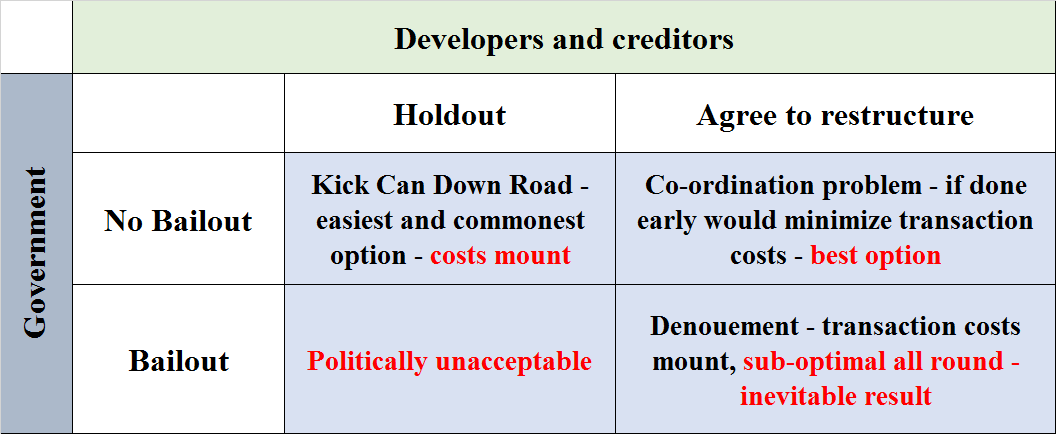
27 Oct 08:37

Shorts

by SK

So I’ve been trying to overcome my self-imposed taboos on online shopping, and trying to buy things online, especially brands and sizes that I already know and items that offline shops don’t stock much of.

As the title of this post might suggest to you I’m trying to buy shorts. I’ve had to decommission several pairs over the last couple of years for a number of reasons – some became too loose, some too tight, others wore out, more are fading away. And the lack of inventory of shorts in my wardrobe means that I end up wearing this one red pair pretty much everywhere.

While the beauty of online shopping is supposed to be that you get massive variety, and the long tail can get served, the problem is that the way sites are designed makes it hard to discover them. Here are two images, one each from Amazon and Jabong.

So I have two basic problems with the shorts that are available for sale online, based on these two sites.

  1. Too long: Check out the Jabong picture here. First of all, Jabong groups shorts and “3/4ths” (when did those abominations even become a thing) in the same category. But they are nice and allow you to specify length. I said “thigh length” and this is what they show me:
    Screen Shot 2015-10-27 at 6.25.31 AM
    I mean, shorts by definition are supposed to be short right? I grew up in an era when Pete Sampras was bossing Wimbledon and shorts of this length were classified as “bermudas”. If you look at the image above, save a couple of “sports shorts” (it’s sad that Jabong doesn’t even allow me to filter those out, since I’m not looking for them), they’re all knee length! Which is too long for a pair of shorts!
  2. Too narrow: Jabong refuses to admit that there is something called “relaxed fit” (even for cargos). Amazon has no fit filters for shorts. And the shorts all look like they’re just truncated pants rather than shorts. The difference between shorts and pants (apart from the extent of leg they cover of course) is that while the latter are narrow, shorts are more relaxed, and shouldn’t stick to your leg! And this is what Amazon shows me (while Amazon has a separate sportswear section, it continues to show sports shorts along with the regular shorts. They even showed boxers. There is no option to specify I want the button-zip-belt kind of “casual wear” shorts):

Screen Shot 2015-10-27 at 6.36.03 AM

All of them are way too narrow! Of the radius where they get stuck to the thigh when you sit down leaving you with the potential embarrassment of pulling them down when you get up.

I had ranted during an earlier attempt to buy online about the difficulty of sorting through inventories so I won’t go into that here.

All I have to say here is that it seems like “shorts” don’t mean what they used to, and I’m extremely unhappy about it.

27 Oct 03:23

REC 7.43% Tax-Free Bonds – October 2015 Issue

by Shiv Kukreja

This post is written by Shiv Kukreja, who is a Certified Financial Planner and runs a financial planning firm, Ojas Capital in Delhi/NCR. He can be reached at skukreja@investitude.co.in

Amid a mad rush and healthy listing gains for NTPC & PFC tax-free bonds, Rural Electrification Corporation (REC) will launch its issue of tax-free bonds from tomorrow i.e. October 27th. Like NTPC & PFC issues, this issue will also be of a smaller size i.e. only Rs. 700 crore. Though the issue is scheduled to close on November 4, given its smaller size, it is likely to get oversubscribed on the first day itself and get closed soon after that.

Since the RBI cut the Repo Rate by 50 basis points in its monetary policy last month, the 10-year benchmark G-Sec bond yield had fallen from 7.72% to 7.50% or so. But, for the past few days, it has remained steady in the range of 7.50% to 7.60%. Based on that, the coupon rate offered by REC has been fixed at 7.14% p.a. for the 10-year tenure option. After this issue, NHAI would launch its issue of tax-free bonds and I think it would carry interest rates which would fall more or less in this range only.

Before we take a decision to invest in this issue or not, let us first quickly check the salient features of this issue:

Size of the Issue – REC is authorized to raise Rs. 1,000 crore from tax free bonds this financial year, out of which the company has already raised Rs. 300 crore by issuing these bonds in private placement. The company will raise the remaining Rs. 700 crore from this issue.

Coupon Rates on Offer – Due to falling G-Sec rates, coupon rates for this issue have also fallen by 0.17% to 0.22%. REC will offer yearly rate of interest of 7.14% for its 10-year option, 7.34% for the 15-year option and 7.43% for the 20-year option to the retail investors investing less than or equal to Rs. 10 lakh.

Picture1

As always, these rates would be lower by 25 basis points (or 0.25%) for the non-retail investors.

Rating of the Issue – CRISIL, ICRA, CARE and India Ratings have assigned ‘AAA’ rating to the issue due to the fact that REC is a government company with reasonably decent fundamentals. Also, these bonds are ‘Secured’ in nature and in case of any default, the bondholders would carry a right to make claim on certain assets of the company.

NRI Investment Allowed – Non-Resident Indians (NRIs) are also eligible to invest in this issue, on a repatriation basis as well as non-repatriation basis.

QFI Investment – Qualified Foreign Investors (QFIs) are not allowed to invest in this issue.

Investor Categories & Allocation Ratio – The investors have been classified in the following four categories and each category will have certain percentage of the issue size reserved during the allocation process:

Category I – Qualified Institutional Bidders (QIBs) – 10% of the issue is reserved i.e. Rs. 70 crore

Category II – Non-Institutional Investors (NIIs) – 25% of the issue is reserved i.e. Rs. 175 crore

Category III – High Net Worth Individuals including HUFs & NRIs – 25% of the issue is reserved i.e. Rs. 175 crore

Category IV – Resident Indian Individuals including HUFs & NRIs – 40% of the issue is reserved i.e. Rs. 280 crore

Allotment on First Come First Served Basis – Subject to the allocation ratio, allotment will be made on a first come first serve (FCFS) basis in each of the investor categories, based on the date of upload of each application into the electronic system of the stock exchanges.

Listing & Allotment – REC has decided to get these bonds listed only on the Bombay Stock Exchange (BSE). The bonds will get allotted and listed within 12 working days from the closing date of the issue.

Demat/Physical Option – Like PFC issue, it is not mandatory to have a demat account to apply for these bonds. Investors will have the option to subscribe to them in physical or certificate form as well. Demat or physical form, interest payment will still get credited to the investors’ bank accounts through ECS.

Also, even if you get these bonds allotted in an electronic form, you have the option to rematerialize your holding in physical/certificate form if you decide to close your demat account in future.

No Lock-In Period – These tax-free bonds are freely tradable and do not carry any lock-in period. The investors may sell them at the market price whenever they want after these bonds get listed on the stock exchange.

Interest on Application Money & Refund – Successful allottees will earn interest at the applicable coupon rates on their application money, from the date of realization of application money up to one day prior to the deemed date of allotment. Unsuccessful allottees will get interest @ 5% per annum on their refund money.

Minimum & Maximum Investment – Investors are required to put in a minimum investment of Rs. 5,000 in this issue i.e. at least 5 bonds of face value Rs. 1,000 each. There is no upper limit for the investors to invest in this issue. However, an investor investing more than Rs. 10 lakhs will be categorized as a high networth individual (HNI) and will get a lower rate of interest as applicable.

Interest Payment Date – REC will make its first interest payment on December 28, 2015. However, next year onwards, interest will be paid on December 1 every year like it is done with its bonds issued in previous years.

Should you invest in this issue?

NHAI tax-free bonds issue is likely to hit markets within next 10 working days or so. Between REC and NHAI, I would personally opt for the NHAI bonds as I think interest rate for its bonds would be very close to the rates offered by REC in this issue. Moreover, NHAI’s issue size would be a big one as compared to this issue and therefore it would increase our chances of getting full allotment as against this issue, which I think will again get oversubscribed on the first day itself.

Fundamentally, I think both companies are financial stable and carry government backing in difficult times. So, I would give this issue a miss and prefer investing my money with NHAI.

Application Form for REC Tax Free Bonds

Note: As per SEBI guidelines, ‘Bidding’ is mandatory before banking the application form, else the application is liable to get rejected. For bidding of your application, any further info or to invest in REC tax-free bonds, you can contact me at +919811797407

26 Oct 03:39

The value of ‘overvalued’ stocks

by Rohit Chauhan
I recently tweeted the following


This tweet was prompted by the debate – online, and sometime offline between the different approaches to value investing. These debates appear like religious arguments with each side claiming their god is the superior one.

I have never quite understood the point of these debates.  There is obviously no single way of making money in the stock market. There are short term traders, buy and hold guys, debt specialists and all kinds of people in-between. Each approach has its strengths and weaknesses and no one can claim that a specific approach is inherently superior to the other, unless they are equally proficient in both.


I have come to realize that the most important factor to long term success is to understand which approach suits your temperament.

The value of learning


Some of you who have followed me on my blog, would have noticed that I try not be a dogmatic about any specific style. I have tried multiple approaches and continue to do so. I do have a dominant style which suits my temperament – buy decent quality companies and hold them for the long run, but I have tried deep value, arbitrage, options and all other types of investing.


Most of my experiments have been failures (see here and here) from a monetary perspective, but they have deepened my understanding on what works and does not work for me.

A valid question would be – why bother? Why not find an approach which works for you and then just stick with it (and maybe even publicly defend it as your faith :) )


Let’s consider an analogy – let’s say you are a sculptor who likes to make figures using wood, stone and other materials. Let’s assume you are exceptionally good at making stone sculptures, but not so great on wood. You go to an exhibition and see some great wood figures and happen to meet the artist. The artist tells you about his techniques and the tools he uses. Assuming you want to get better on wood, will you start laughing at this artist and belittle his tools?

In a similar fashion if you are a deep value investor, what should be your reaction to the success of investors who buy and hold seemingly overvalued stocks?


Durable success
I know what the first objection is to this line of thinking – The success of these investors is just dumb luck. These guys are not really practicing value investing, but a form of momentum investing. It is just that the momentum has lasted for 5 years in some of these cases, and sooner or later this bubble would burst.

My counter point – sure that is possible, but what if this bubble has lasted for 10-15 years in some cases. Will you still just wave away these anomalies and label them as flukes?


I prefer to take a different approach. There is no religious debate to this in my mind – if something has worked for 3+ years in the stock market, then it is worthy of investigation. A lot of bubbles and temporary fads usually get washed out in 2-3 years and so 3 years is good cutoff point.

Why not 5 years? Well now we are moving from the physical to the meta-physical :) and debating the nature of reality.


So what can one learn from this oddity where some companies manage to sell for seemingly high valuations for a very long time.

New business model or value capture


I think the first point to look for is whether there is a change occurring in the business model/ design, wherein due to changing customer needs and priorities, a new type of design is now more suited to meet them more profitably.


I would recommend reading the book – value migration, which goes over this concept in quite a bit of detail. The main point is that changing customer needs and priorities cause a change in the business design best suited to meet them. Companies which can identify and develop a business model to meet this new reality are able to accrue a lot of value for their shareholders.

For example, a rise in the income levels has caused the retail consumer to now value quality, brand image and convenience in addition to the price. As a result, companies which can meet this new set of needs have been able to create a lot of value.


It is easy to see this phenomenon around us – Bathroom fittings, automotive batteries, garments etc. Some of these products were commodities in the past, sold largely based on price. However increasing consumer purchasing power has meant that the priorities have shifted beyond price. Companies which have been able to adapt their business model to deliver on these new priorities of brand, quality and convenience in addition to price have delivered exceptional returns

Example: Cera sanitary ware, Amara raja batteries, Astral polytechnic etc


Opportunity size with durability

It is not sufficient to be able to meet the changing needs of the consumer, better than the competition. For starters, the opportunity size should be large so that the company can grow for a long time to come.


This is a major advantage of the Indian markets over almost all other foreign markets. Even niches in India have a market size running to millions of consumers and hence a company which can build a good business model can easily grow for years to come.

An additional point to keep in mind is the need for the company to develop a durable competitive advantage. Let’s take the case of the telecom industry in the early 2000s. The need for communication and mobile telephony was recognized by a few companies such as Airtel in the late 90s and these companies moved in quickly to satisfy the needs.


The market size was in the 100s of millions and most of the telecom companies were able to scale rapidly. However the edge or competitive advantage turned out to be transitory and as a result after a few years of high profitability, we soon had a lot of price based competition. As a result by 2007-08, most companies were losing money and did not create (actually destroyed) wealth.

In such cases seemingly overvalued companies were truly overvalued.


Kings of their domain

A productive area for finding multibaggers is in the microcap space, where the company operates in a niche and is growing rapidly as its business model is uniquely suited for that niche. In addition, the niche is large enough for the company to grow for a long time, yet not so big that it attracts large companies initially.


There are a few examples which come to my mind – Think of air coolers a few years back (symphony), CPVC pipes (Astral poly) or various niches in pharma and information technology.

A small company develops a unique set of skills for this specific segment and is able to dominate and grow within the segment for a long time. In addition as the niche is quite small, it does not attract much competition till it reaches a certain size.


However by the time the niche is big enough to catch the attention of larger companies in the overall space, it is too late as the specific company has established a dominant competitive position and cannot be dislodged.

A lot of these companies appear to be overpriced after they have started growing, but this ignores the possibility of above average growth and a dominant position for the company.


Capacity to suffer

This is a term used by Thomas Russo (see talk here) to describe companies which are capable and willing to make investments in the business for the long term, even though it penalizes the profits in the short term.


In most cases, due to market pressures, companies are not willing to hurt short term profitability to build the business for the long term and hence the few companies which are willing to do so, appear to be overvalued due to depressed profits.

Look at the example of Bajaj corp (an old holding which I have since exited). The company acquired no-marks brand in 2013 and started deducting the brand value on their P&L account. In reality the brand value is actually going up as the company continues to spend heavily on advertising (17% of sales) and hence the profits are understated.


The market did not like this short term penalty and punished the stock in 2013. The stock price has since recovered and we have a company which appears to overvalued due to the high investments in the business.

Platform Business


This is good note on what is a platform business


I do not have an example in the Indian markets, but will try to explain this using the example of a well know US company. Its 2004 and a well-known company called google decides to launch its IPO at a then PE of around 65. A cursory look shows the company to be grossly overvalued and as a result most of the value investors tend to give it a pass.

The company has since then delivered a return of around 26% p.a and I am sure this qualifies as a great return. So why did a company which appeared so overvalued turn out to be a 10 bagger.


My own understanding is that this result came about from multiple factors. To begin with, the company operates in a winner take all kind of a market where the no.1 company tends to dominate and capture almost all of its value. Once google had a 60%+ market share, the network effects kicked in and the company just kept getting more dominant in the search space.

Once this base was built, the company extended it to other platforms such as mobile where the next leg of growth has kicked in. These type of companies also have a very low marginal cost of production and hence any growth beyond a threshold, drops straight to the bottom line.


This however does not explain fully the reason behind its success – We have a management which in the words of Prof Bakshi in this note – are intelligent fanatics and also have the capacity to suffer (as referenced by Thomas Russo). As a result they have continuously invested in long term ideas (called as moonshots) even if it meant losses in the near term. You tube, android etc which are now bearing fruit were drains at one point of time.

Such companies have been referred as platform companies and usually appear highly overvalued in the early stages of growth. Another similar company seems to be Facebook.


A point of caution – For every successful platform company, there are atleast 10 pretenders which destroy value. So it is not easy to identify such companies ex-ante (atleast for me)

Rate of change matters


Let me introduce a new concept – business clock speed which I read here. This is the rate at which a business is changing. For example the rate of change in the social media business is high and conversely there are business such as paints or undergarments where the rate of change is low.


I think it is quite obvious that businesses with low rate of change can create a durable competitive advantage for the long term and hence a seemingly high price turns out to be cheap.

On the contrary very few high change businesses (google, Facebook being a few exceptions) turn out to justify their sky high valuations.It is difficult to establish a strong competitive position in an industry where the basis of competition keeps changing every few years – Just look at IBM which has had to re-invent itself almost every decade to stay in business and grow its value. For every IBM, there is DEC or Sun microsystems which did not make it.


It is quite rare

It is important to understand at this point that it is quite rare to find overvalued companies, which in hindsight turn out to be undervalued. A lot of overvalued companies, actually turn out to be just that and so it is important for a value minded investor to be cautious about such companies.


In addition it is not easy to identify such companies upfront (there are no simple screens for it) and one has to think deeply to develop the right insights to buy and hold such companies.

So why study ?


As I stated in the beginning of this note – If you want to be a successful investor, it is important to have as many mental models in your head. Investing in a cheap, low valuation companies is one such mental model. However this does not mean one should just wave away any company which is selling at a high price.


The advantage of understanding the drivers of success is that the next time when you are evaluating a company, it makes sense to check if this company fits into any of these models? One can ask some of these questions

-           Is the company overvalued simply because the management is investing in the business for the long term which has suppressed the near term profits?


-           Is the company developing a new business model which meets the changing requirements of the consumer much better than competition


-           Does the company have a durable advantage and a large opportunity space (the case for a lot of FMCG companies in India)


-           Does the company have network effects or is it a platform company run by an intelligent fanatic?


-           Has the company identified and developed a unique business model for a niche which it will dominate for a long time?


My post above does not cover all possible reasons why a seemingly overvalued company, will turn out to be cheap. There is no standard formulae or screen which will give you the answers. One has to study the company and the industry deeply to develop any useful insights (as fuzzy as they may be).

Inspite of the odds, if however if you do manage to get it right, it would be stupid to sell the company based on a PE ratio which appears higher than normal.
----------------
Stocks discussed in this post are for educational purpose only and not recommendations to buy or sell. Please contact a certified investment adviser for your investment decisions. Please read disclaimer towards the end of blog.  

26 Oct 03:32

Why Retirement Planning is difficult..?

by subra
It saddens me to see people trying to do their own financial planning while lacking the discipline / interest in understanding how it is to be done! If you are not diligent, thorough, clinical, and unbiased in your approach it is really difficult to build a nice portfolio! Let us take a look at the […]
26 Oct 03:25

Fast Food Enlightenment

by Atanu Dey

Markets work. That’s the “First Law” of the Extended Order of Social Interactions. I just made up that EOoSI bit but the ‘markets work’ bit is a genuine law in the sense that it expresses an observed regurality in human societies.

What does it mean? Among other things, it means that when the need (the demand) for something arises, the market spontaneously figures out a solution (the supply) without the need for some controlling authority passing orders to get that need met. Those who address the needs of people are sometimes referred to as entrepreneurs. These are the people who look around for unmet needs and figure out some way of meeting those needs.

The corner bicycle repair shop or the bakery is in a limited sense an entrepreneur. In these cases, the needs are quite evident and obvious, and so are the solutions. People need their bikes fixed and someone who knows how to fix them can go into the bike repair business. Nothing new has to be invented; just that the person has to be enterprising enough to get started and keep the customers satisfied at least as much the competitors do.

And then there are cutting-edge entrepreneurs. These respond to latent demand for some good or service. Latent demand refers to needs that are not even felt as a need until the supply occurs — and then the demand surfaces. There was really no demand for smart phones until smart phones started showing up in the marketplace; and then everyone and his mother couldn’t live without one. (Amazingly, I am the only person I know who does not use a smart phone.)

Did you ever feel the need to use a micro-blogging platform like twitter? Perhaps but only after twitter came into existence. Before that, no one really wanted one.

Markets work. When demand (latent or explicit) exists, markets figure out a solution. The solution consists of a set of suppliers, a range of goods, and a set of prices.

Who sets the prices? That depends on the market organization. If the market has only one supplier (a monopoly firm), the prices are set by the firm. But in markets which are served by a number of firms which compete with each other, the prices are set by no one and everyone. Let’s just say that Samsung cannot price there TVs without regard to what its competitors like LG and Sony are pricing their TVs. Burger King pays careful attention to what McDonalds’ prices are.

How much fast food of what kind (the range of goods) will be supplied, and by whom (the sellers) and at what prices — these the market discovers. The market discovers all these without any explicit order coming down from some central authority. There is no “Ministry of Fast Foods” where bureaucrats carefully monitor the population, do extensive surveys to figure out who wants how much fast food and of what kind, and give orders to their underlings who then herd fast food suppliers to cook up detailed list of fast food and sell them at prices determined by the “Pricing Section” of the Ministry of Fast Foods.

Order emerges without orders.

That is, firms enter or leave the business depending on their own calculations. Firms set their prices as they see fit. Customers decide what to buy and from whom. There’s freedom all around — firms can enter the market or leave, customers freely choose to buy or not buy, etc. In the long run, there are no shortages and there are no surpluses.

That’s the magic of markets.

What motivated this line of thinking? I came across an old email (from 2004) from a follower of Sri Sri Ravi Shankar, or SSRS as he is known around here. Like many others, she (AA for short) wrote that I should enroll in an “Art of Living” course because then I may realize how amazing SSRS is. The signature line in her email read:

~~ “Life is sacred.Celebrate life. care for others and share whatever you have with those less fortunate than you. Broaden your vision for the whole world belongs to you.”

-Sri Sri Ravi Shankar ~~

Here is my reply, for the record.

Dear AA:

I think you misread my opinion of SSRS. I do believe that he adds value to the lives of people as demonstrated by the fact that people willingly pay handsomely for what he has to offer. Commercial success is a fairly reliable indicator of value that a person or an institution adds.

As for my taking an AoL course, I will do so only after I am convinced that the course will offer me something that I value. As of now, I have only come across obvious platitudes and generic be-good admonitions that I myself can produce in astounding amounts if I were so motivated.

For instance, take the quote in your signature line. Is there anything there that is not obvious, hackneyed, trite, platitudinous — in short, is there something that a person of average intelligence and moral sense cannot have figured out by the age of 10?

Having said that, I am sure that there are people who need to be told what to me is basic plain common sense and are willing to pay to be told basic truths because they are perhaps too lazy to have pondered these matters themselves. It is what I would call “Fast Food Enlightenment”. You drive up, check out the menu, order “Happy Meal #4”, pay your money, are handed a prepackaged meal, and drive off with it effortlessly.

I don’t think that fast food vendors are evil. They add real value by providing meals for people who are either incapable of preparing a healthier meal or are unable to find the time to do it right. For myself, I like to take the time to cook a decent meal for myself. I have taken the time to consider the world and marvel at it and arrived at my own conclusions that I believe cannot be packaged into simple verities for mass consumption.

This post is a 2-for-1: a bit of beating my favorite drum — the market — and a bit of SSRS, our favorite new age guru. Enjoy.

26 Oct 03:20

Indians Begin To Maintain Their Relatives Abroad And Study Outside Suddenly in July, More Likely US Tax Avoidance

by Deepak Shenoy

The US has tightened up its tax collections through the FATCA process. And India’s a signatory. Which means people who have bank accounts in India but are US citizens, or permanent residents, will see the Indian banks notifying the US authorities with all information on debits and credits in India.

This must have spooked a number of people who are technically US residents (citizens, people with a green card or a work visa) and have income in India and haven’t declared it. This used to be standard practice, and in many cases, it was quite easy to:

  • send money from the US to India – properly earned, post taxes paid etc.
  • Use the money in India to buy property or set up bank accounts and buy shares etc.
  • Not declare this to the US because hey, how will they ever know

But a chink in their plans was FATCA. It’s an act that says every financial institution in the world must try to find US taxable entities (those with a green card or US citizens or residents) in their customer base, and report any transactions of such users to the US tax authorities.… (Read On...)