amogh.signupforstuff
Shared posts
Skin slime of Indian frog can kill flu virus

When we mistake the real for the ideal world

Another headwind for EMs - end of age of multinationals?
In 2016 multinationals’ cross-border investment probably fell by 10-15%. Impressive as the share of trade accounted for by cross-border supply chains is, it has stagnated since 2007 (see chart 2). The proportion of sales that Western firms make outside their home region has shrunk. Multinationals’ profits are falling and the flow of new multinational investment has been declining relative to GDP. The global firm is in retreat... In 2000 every billion dollars of the stock of worldwide foreign investment represented 7,000 jobs and $600m of annual exports. Today $1bn supports 3,000 jobs and $300m of exports.

That is because a 30-year window of arbitrage is closing. Firms’ tax bills have been massaged down as low as they can go; in China factory workers’ wages are rising. Local firms have become more sophisticated. They can steal, copy or displace global firms’ innovations without building costly offices and factories abroad. From America’s shale industry to Brazilian banking, from Chinese e-commerce to Indian telecoms, the companies at the cutting edge are local, not global. The changing political landscape is making things even harder for the giants.
Standardizing "citizen feedback services"
There are mayor’s mailboxes on the websites of every municipal government, usually indicated by a button next to a biography of the official with an exhortation to “write me a letter” (or, in practice, send an e-mail). The hotlines allow people to be put through to a local bureaucrat. The first one was set up in 1983. Since then they have proliferated, creating an unco-ordinated tangle. But the past few years have seen rounds of consolidation. Shanghai announced a single hotline in 2013. Guangzhou, in the south, did so in 2015. The unified ones all use the same number, 12345... A survey last year by Dataway Horizon, a consultancy in Beijing, found wide variations in the quality of service. In Beijing, Shanghai and Chongqing, which are among the richest cities, all hotline calls were put through right away. In Yunnan, Tibet, Shaanxi and Qinghai—less-developed provinces in the west—only a fifth of calls were even answered on the first attempt.
In recent months state media have been promoting what they call a model example—the 12345 hotline in Jinan, capital of the coastal province of Shandong. It was launched in 2008, has about 60 operators on duty and gets nearly 5,000 calls a day, rising to 20,000 on busy ones... Before it was set up, the city had 38 hotline numbers for contacting different departments. That was “chaos”, the administration said... In an attempt to improve widely varying levels of service, the central government recently laid down rules for running 12345 hotlines. Starting in July, calls must be answered within 15 seconds, at least one person on duty should be able to speak a language other than Mandarin and the line should be open 24 hours a day.
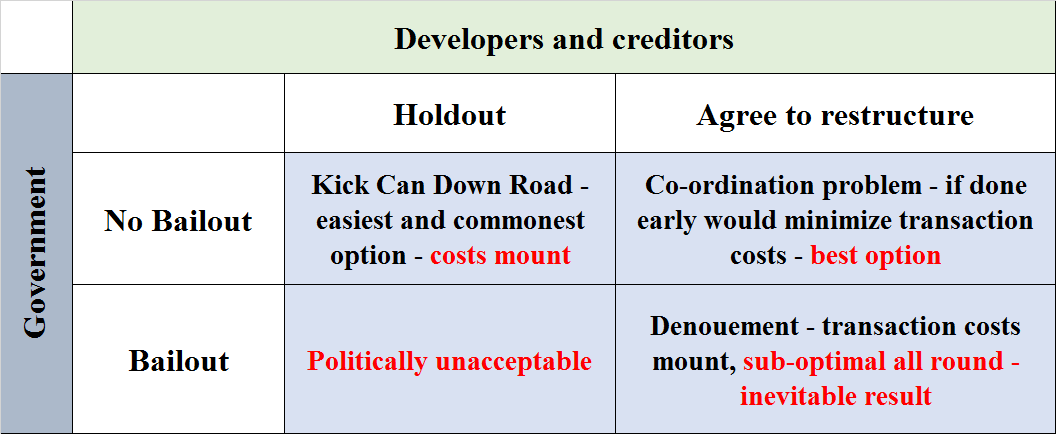
The challenge with early restructuring of debts
Interviews with App Developers: [dis]regard towards IPR vs. Patent Hype – Part II
Before one can identify the solution, one must first identify the problem. Yet, in order to understand the problem, we must first understand the individuals involved and the how the problem affects these individuals. We hope that the findings of this preliminary research initiative will provide sufficient groundwork to understand the problems that exist and the different ways of approaching them before determining the most suitable prospective option in changes at the policy level. In this case, the individuals under study are the key contributors to the mobile app space within India; and the problem, being those faced by them as they attempt to navigate an emerging and ambiguous ecosystem.
Previously, we looked at responses that were given across these mobile app developers interviewed which revealed how they orient notions of intellectual property within their practice and own products, specifically. Findings that were made included deductions that the majority of those interviewed developed mobile app products for clients, and in turn assigned ownership of their products to their clients. Just as well, they commonly shared an interest in leaving the services sector to create products of their own, with some of them already having made the transition within their business model.
Question 2: “How is your IP protected?”
Next, we asked how they go about protecting their intellectual property to get a feel of who is protecting their apps and who is not. In asking this question, we hoped to learn how they go about protecting their work via legal means. Across their various responses, we observed many patterns and contradictions which are conveyed here with reference to comments made across interviews. It is important to note, however, that no causal relations intend for be argued for, only suggested correlations.
How they responded
When asked, those interviewed responded with a variance in answers. Some simply stated that their work is not protected, while a few mentioned that they acquired trademark or intend to apply for trademark protection. One interviewee had a patent pending in India and the US, as well. In many of our conversations, developers mentioned that their code for their apps is under open source licenses, and a couple others entailed sharing that the content is under creative commons licenses, “individual licenses,” or joint copyright. Additionally, within one interview, one mentioned the use of encryption tools as a technical means of protection for their work.
Of the developers interviewed, many exhibited some sort of confusion or misunderstanding related to the protection of their works by means of intellectual property rights (IPR). Those interviewed seemed to either express an interest to acquire IPR in the future for their products in the forms of patent or trademark protection, or expressed their appreciation for openness source licensing—or both! Beneath these immediate responses, however, many repeated patterns, as well as contradictions, are revealed. Conversations that followed within these interviewed entailed the opportunity to hear from personal experiences and opinions on different areas within their practice intersecting IPR.
Reasons for IPR protection
If a startup or SME is bootstrapped with very little cash flow to begin with, what would provoke or inspire one to pursue the process of acquiring patent protection then? Aravind Krishnaswamy of startup, Levitum, considers “the concept of securing IP is relatively new within the Indian context.” So if this is the case, why did so many developers interviewed express an interest in IPR?
For those who did express interest in acquiring IPR as protection for their mobile app products, most seemed to express an interest in proving ownership over their work, or preventing problems in the future. One developer's commented on how the mobile app market is a “new and potentially volatile area for software development.” For this reason, it was imperative that he and his team attempted to avoid trouble in the future, and ensure that they going about mobile app development the right and moral way.
Within another interview, developer, John Paul of mobile app SME, Plackal, explains his motives for seeking to acquire patent protection, the application for which is currently pending in India and the US: "For us, applying for a patent is primarily defensive. And if it does get infringed upon, it would give us a good opportunity to generate revenue from it." For the company's trademark, they sought to be able to enforce their ownership over their product's brand: “As a precautionary, we've trademarked the app so that should there be a situation where the app is pirated, we can claim ownership for that app.”
Security not so easily attainable
However, for the startup especially, such protection does not come without a cost. For this reason, IPR is generally perceived as a gamble or tradeoff. It becomes a “question of priority between innovation and protection,” says Krishnaswamy. He continues in saying that, "I feel like even if it’s a great idea if someone else copies it, that’s some level of validation, but as a small company I’d rather be nimble in terms of how we build it up and get it to a certain point. We're trying to move fast and get something going, and then figure it out.” For Krishnaswamy and his team, securing a patent on an area where they feel they feel they have unique work is on their list of things to do, “It's something for us to revisit in the future.”
Paul explains that he and his team didn't always have IPR within reach: “To some extent, IPR law is only accessible after moving away from the startup phase.” So what discourages startups from acquiring IPR, or simply seeking it out?
Patent attorney and IP consultant, Arjun Bala explains that “there is a lot to figure out. One aspect is filling it out, the other is how you write it so that it is easily granted and gives you the right sort of patent protection you are looking for. It is a very complex process that requires a lot of technical and legal expertise.” But even if one successfully manoeuvres the IPR system, is protection guaranteed?
Business Financial Strategist of Out Sourced CFO & Business Advisory Services, Jayant Tewari, illustrates the lack of security for the SME in the patent system, specifically, in saying, “Since a patent becomes public domain on filing, it can be effectively infringed based on the filing, even before it is granted.” Tewari continues in stressing the irrelevance of patents for SMEs due to the difficulty of enforcement: “the infringement will be adjudicated after 2 years at an immense cost to the SME patent-holder, who will go commercially belly-up due to the infringement. The regime does not protect the SME at all.”
—Samuel Mani, Mani Chengappa & Mathur
Nevermind enforcement...
Not only did our interviews shed light on the difficulty for a startup developer to apply for and be granted protection for their intellectual property, but also for the enforcement of such. Partnering Lawyer, Samuel Mani, of technology-focused law firm, Mani Chengappa & Mathur, speaks to us about the extensive procedure required to prove one's ownership over their IP: “To demonstrate copyright infringement, it requires going into millions of lines of code—unless it is the interface that is copied, which is easily visible.” Mani continues on the enforcement of patent protection by saying, “For a patent, the scope is even wider. It is easy to say 'this is the method and no once can copy', but unless the look and feel is the same, it is very hard to demonstrate that you have been infringed on.”
Planting the initial seed
If there is arguably so much risk associated with applying for IPR protection, as well with enforcement, what specifically gets startups thinking about IPR initially within their practice? What experiences help them formulate their opinions on the matter, and which forms of IPR do they seek out?
Across interviews conducted, one particular observation entailed the tendency for developers to have worked in the past for corporate employers that have dealt with cases of infringement or have acquired IP protection. Almost half of those interviewed shared the fact that they worked for a corporate employer and became better familiar with different notions of intellectual property through that experience. It may not be too farfetched to suggest, then, that for the developer the idea of acquiring IPR protection is one that may be reinforced from previous employers or other successful development companies with IPR of their own.
Cofounder and developer for a medium-sized software development enterprise, Anoop[1] explained that it wasn't until after the success of his enterprise's first application with $1 million in sales, that they started thinking about intellectual property and began to understand the value of it. This newly attained understanding, however, had not been enough to sufficiently equip his team with the knowledge to properly secure protection. For them, going after patent protection turned out to be a pursuit in vain.
Loss of faith in patents for SMEs
Anoop shares his disappointing experience after attempting to secure a patent for one of their mobile apps:
“We burned our fingers with patents. We spent a lot of money for a game we invented about 3 years ago. We had a law firm in the US to help us. We applied for it, and it went through 3-4 revisions, costing us $25-30,000. We finally closed the file when we could not get it due to an existing patent. We were really surprised."
After much disappointment from not being successful in their attempts to acquire patent protection, however, Anoop came out of the experience with a new outlook on patents and their role for SMEs:
“They're meant for large companies as means to bully your competitor. Only big players with the capacity to file for a patent as soon as it takes off benefit. The existing system doesn’t really work for startup companies. In India and anywhere. It’s an expensive process. If you’re a startup who’s just bootstrapping, there’s no guarantee that you will get it. It’s going to take you years.”
Patent hype
Anoop is a prime example of developers in the startup space that fall victim to the promises of the patent system—only to be spat back out having exhausted their time and earnings. Already being aware of the probability for failure, Mani strongly discourages going after patent protection as a means of staying in the race. “With people spending millions on litigation, it is a recipe for disaster, especially considering the inherent delay of the Indian system.” For this reason, Mani stresses the importance of applying for the right protection.
Mani also suggests that the patent debate is driven by self-interest—people who simply make money off of application filing, regardless of whether or not the case succeeds. As a lawyer in the IT space, Mani claims to have turned away several prospective clients looking to patent their products when he insisted that such means of protection was not suitable for their product and interests...which brings us to an additional area of heated debate: the patentability of mobile apps.
Can mobile apps be patented?[2]
One concept that seemed to receive contested responses across interviews is that of the patentability of mobile apps in the first place. When asked if mobile apps could be patented, former lawyer and startup founder, Vivek Durai, of HumblePaper, put it blatantly in responding, “absolutely not.” Others offered explanations of the Indian Patent Law nuances regarding when a mobile app is patentable and when one is not.
While consulting a SME with their own patent application, Bala explains their approach to ensure the mobile app's eligibility for patent protection, while providing some insight into the Indian patent system:
“One approach that we've taken to getting a patent in India is it's not just a pure software, but a software plus a hardware—as in it requires a specific hardware to function. If [the software] makes the hardware perform better, then it has a technical effect... In which case, we have a better chance of getting a patent in India. If your software is agnostic to hardware, however, it is much more difficult to receive a patent in India.”
To patent or not to patent? (or any IPR for that matter)
To Tewari, on the other hand, the question of whether a mobile app can be patented is one entirely irrelevant. The question Tewari introduces into the developer's market strategy is not 'can I patent my app?' but instead, 'should I do so?' In response to which; he would predominantly reply: No.
“How [startup] mobile app developers regard IP laws—or better yet, disregard—is fine for their sake,” argues Tewari. Alternatively, he suggests developers learn how to maneuver the laws, to prevent themselves from arriving at any sticky situations after unknowingly using another's code. To his clients who have mobile apps of their own, he advises to use an open source equivalent of a piece of code if they do not have the rights to it. Doing so will help keep infringement upon others at a minimal and prevent litigation against oneself.
Not all developers interviewed, however, aspired to acquiring patent protection. In fact, some strongly opposed software patents, while expressing their appreciation for openness across the developer community. The other side to the IPR-Open Source dichotomy will be examined in the blog post to follow, after which, we will then look at accounts of infringement and threats of litigation across mobile app developers interviewed.
To recap
By looking closely at the individual experiences across mobile app developers interviewed, we hope to begin to map out the mobile app ecosystem and the ways in which industry players engage with each other regarding their IPR. We also hope to begin to shed light on the different attitudes towards the law within one's practice, and how they shape their decisions related to their work. Only after doing so, may we be able to sufficiently assess how India's current IP laws govern this landscape.
Stay tuned for the next in this blog series! We hope that you may benefit from our findings in your own practice as a mobile app industry player or enthusiast, as well.
Notes:
[1] Name changed to protect the interviewee's identity
[2] In conducting interviews, our goal was not to test the legitimacy of responses, but instead, to map them out across various industry stakeholders. For this reason, this blog series will not be able to sufficiently respond to legal question, such as whether or not mobile apps are patentable to begin with. We intend to, however, undergo legal analysis of the Indian IPR system at its intersection with the mobile app space in India at a later stage in this project.
For more details visit http://cis-india.org/a2k/blogs/interviews-with-app-developers-dis-regard-towards-ipr-vs-patent-hype-2013-part-ii
Interviews with App Developers: [dis]regard towards IPR vs. Patent Hype – Part II
Before one can identify the solution, one must first identify the problem. Yet, in order to understand the problem, we must first understand the individuals involved and the how the problem affects these individuals. We hope that the findings of this preliminary research initiative will provide sufficient groundwork to understand the problems that exist and the different ways of approaching them before determining the most suitable prospective option in changes at the policy level. In this case, the individuals under study are the key contributors to the mobile app space within India; and the problem, being those faced by them as they attempt to navigate an emerging and ambiguous ecosystem.
Previously, we looked at responses that were given across these mobile app developers interviewed which revealed how they orient notions of intellectual property within their practice and own products, specifically. Findings that were made included deductions that the majority of those interviewed developed mobile app products for clients, and in turn assigned ownership of their products to their clients. Just as well, they commonly shared an interest in leaving the services sector to create products of their own, with some of them already having made the transition within their business model.
Question 2: “How is your IP protected?”
Next, we asked how they go about protecting their intellectual property to get a feel of who is protecting their apps and who is not. In asking this question, we hoped to learn how they go about protecting their work via legal means. Across their various responses, we observed many patterns and contradictions which are conveyed here with reference to comments made across interviews. It is important to note, however, that no causal relations intend for be argued for, only suggested correlations.
How they responded
When asked, those interviewed responded with a variance in answers. Some simply stated that their work is not protected, while a few mentioned that they acquired trademark or intend to apply for trademark protection. One interviewee had a patent pending in India and the US, as well. In many of our conversations, developers mentioned that their code for their apps is under open source licenses, and a couple others entailed sharing that the content is under creative commons licenses, “individual licenses,” or joint copyright. Additionally, within one interview, one mentioned the use of encryption tools as a technical means of protection for their work.
Of the developers interviewed, many exhibited some sort of confusion or misunderstanding related to the protection of their works by means of intellectual property rights (IPR). Those interviewed seemed to either express an interest to acquire IPR in the future for their products in the forms of patent or trademark protection, or expressed their appreciation for openness source licensing—or both! Beneath these immediate responses, however, many repeated patterns, as well as contradictions, are revealed. Conversations that followed within these interviewed entailed the opportunity to hear from personal experiences and opinions on different areas within their practice intersecting IPR.
Reasons for IPR protection
If a startup or SME is bootstrapped with very little cash flow to begin with, what would provoke or inspire one to pursue the process of acquiring patent protection then? Aravind Krishnaswamy of startup, Levitum, considers “the concept of securing IP is relatively new within the Indian context.” So if this is the case, why did so many developers interviewed express an interest in IPR?
For those who did express interest in acquiring IPR as protection for their mobile app products, most seemed to express an interest in proving ownership over their work, or preventing problems in the future. One developer's commented on how the mobile app market is a “new and potentially volatile area for software development.” For this reason, it was imperative that he and his team attempted to avoid trouble in the future, and ensure that they going about mobile app development the right and moral way.
Within another interview, developer, John Paul of mobile app SME, Plackal, explains his motives for seeking to acquire patent protection, the application for which is currently pending in India and the US: "For us, applying for a patent is primarily defensive. And if it does get infringed upon, it would give us a good opportunity to generate revenue from it." For the company's trademark, they sought to be able to enforce their ownership over their product's brand: “As a precautionary, we've trademarked the app so that should there be a situation where the app is pirated, we can claim ownership for that app.”
Security not so easily attainable
However, for the startup especially, such protection does not come without a cost. For this reason, IPR is generally perceived as a gamble or tradeoff. It becomes a “question of priority between innovation and protection,” says Krishnaswamy. He continues in saying that, "I feel like even if it’s a great idea if someone else copies it, that’s some level of validation, but as a small company I’d rather be nimble in terms of how we build it up and get it to a certain point. We're trying to move fast and get something going, and then figure it out.” For Krishnaswamy and his team, securing a patent on an area where they feel they feel they have unique work is on their list of things to do, “It's something for us to revisit in the future.”
Paul explains that he and his team didn't always have IPR within reach: “To some extent, IPR law is only accessible after moving away from the startup phase.” So what discourages startups from acquiring IPR, or simply seeking it out?
Patent attorney and IP consultant, Arjun Bala explains that “there is a lot to figure out. One aspect is filling it out, the other is how you write it so that it is easily granted and gives you the right sort of patent protection you are looking for. It is a very complex process that requires a lot of technical and legal expertise.” But even if one successfully manoeuvres the IPR system, is protection guaranteed?
Business Financial Strategist of Out Sourced CFO & Business Advisory Services, Jayant Tewari, illustrates the lack of security for the SME in the patent system, specifically, in saying, “Since a patent becomes public domain on filing, it can be effectively infringed based on the filing, even before it is granted.” Tewari continues in stressing the irrelevance of patents for SMEs due to the difficulty of enforcement: “the infringement will be adjudicated after 2 years at an immense cost to the SME patent-holder, who will go commercially belly-up due to the infringement. The regime does not protect the SME at all.”
—Samuel Mani, Mani Chengappa & Mathur
Nevermind enforcement...
Not only did our interviews shed light on the difficulty for a startup developer to apply for and be granted protection for their intellectual property, but also for the enforcement of such. Partnering Lawyer, Samuel Mani, of technology-focused law firm, Mani Chengappa & Mathur, speaks to us about the extensive procedure required to prove one's ownership over their IP: “To demonstrate copyright infringement, it requires going into millions of lines of code—unless it is the interface that is copied, which is easily visible.” Mani continues on the enforcement of patent protection by saying, “For a patent, the scope is even wider. It is easy to say 'this is the method and no once can copy', but unless the look and feel is the same, it is very hard to demonstrate that you have been infringed on.”
Planting the initial seed
If there is arguably so much risk associated with applying for IPR protection, as well with enforcement, what specifically gets startups thinking about IPR initially within their practice? What experiences help them formulate their opinions on the matter, and which forms of IPR do they seek out?
Across interviews conducted, one particular observation entailed the tendency for developers to have worked in the past for corporate employers that have dealt with cases of infringement or have acquired IP protection. Almost half of those interviewed shared the fact that they worked for a corporate employer and became better familiar with different notions of intellectual property through that experience. It may not be too farfetched to suggest, then, that for the developer the idea of acquiring IPR protection is one that may be reinforced from previous employers or other successful development companies with IPR of their own.
Cofounder and developer for a medium-sized software development enterprise, Anoop[1] explained that it wasn't until after the success of his enterprise's first application with $1 million in sales, that they started thinking about intellectual property and began to understand the value of it. This newly attained understanding, however, had not been enough to sufficiently equip his team with the knowledge to properly secure protection. For them, going after patent protection turned out to be a pursuit in vain.
Loss of faith in patents for SMEs
Anoop shares his disappointing experience after attempting to secure a patent for one of their mobile apps:
“We burned our fingers with patents. We spent a lot of money for a game we invented about 3 years ago. We had a law firm in the US to help us. We applied for it, and it went through 3-4 revisions, costing us $25-30,000. We finally closed the file when we could not get it due to an existing patent. We were really surprised."
After much disappointment from not being successful in their attempts to acquire patent protection, however, Anoop came out of the experience with a new outlook on patents and their role for SMEs:
“They're meant for large companies as means to bully your competitor. Only big players with the capacity to file for a patent as soon as it takes off benefit. The existing system doesn’t really work for startup companies. In India and anywhere. It’s an expensive process. If you’re a startup who’s just bootstrapping, there’s no guarantee that you will get it. It’s going to take you years.”
Patent hype
Anoop is a prime example of developers in the startup space that fall victim to the promises of the patent system—only to be spat back out having exhausted their time and earnings. Already being aware of the probability for failure, Mani strongly discourages going after patent protection as a means of staying in the race. “With people spending millions on litigation, it is a recipe for disaster, especially considering the inherent delay of the Indian system.” For this reason, Mani stresses the importance of applying for the right protection.
Mani also suggests that the patent debate is driven by self-interest—people who simply make money off of application filing, regardless of whether or not the case succeeds. As a lawyer in the IT space, Mani claims to have turned away several prospective clients looking to patent their products when he insisted that such means of protection was not suitable for their product and interests...which brings us to an additional area of heated debate: the patentability of mobile apps.
Can mobile apps be patented?[2]
One concept that seemed to receive contested responses across interviews is that of the patentability of mobile apps in the first place. When asked if mobile apps could be patented, former lawyer and startup founder, Vivek Durai, of HumblePaper, put it blatantly in responding, “absolutely not.” Others offered explanations of the Indian Patent Law nuances regarding when a mobile app is patentable and when one is not.
While consulting a SME with their own patent application, Bala explains their approach to ensure the mobile app's eligibility for patent protection, while providing some insight into the Indian patent system:
“One approach that we've taken to getting a patent in India is it's not just a pure software, but a software plus a hardware—as in it requires a specific hardware to function. If [the software] makes the hardware perform better, then it has a technical effect... In which case, we have a better chance of getting a patent in India. If your software is agnostic to hardware, however, it is much more difficult to receive a patent in India.”
To patent or not to patent? (or any IPR for that matter)
To Tewari, on the other hand, the question of whether a mobile app can be patented is one entirely irrelevant. The question Tewari introduces into the developer's market strategy is not 'can I patent my app?' but instead, 'should I do so?' In response to which; he would predominantly reply: No.
“How [startup] mobile app developers regard IP laws—or better yet, disregard—is fine for their sake,” argues Tewari. Alternatively, he suggests developers learn how to maneuver the laws, to prevent themselves from arriving at any sticky situations after unknowingly using another's code. To his clients who have mobile apps of their own, he advises to use an open source equivalent of a piece of code if they do not have the rights to it. Doing so will help keep infringement upon others at a minimal and prevent litigation against oneself.
Not all developers interviewed, however, aspired to acquiring patent protection. In fact, some strongly opposed software patents, while expressing their appreciation for openness across the developer community. The other side to the IPR-Open Source dichotomy will be examined in the blog post to follow, after which, we will then look at accounts of infringement and threats of litigation across mobile app developers interviewed.
To recap
By looking closely at the individual experiences across mobile app developers interviewed, we hope to begin to map out the mobile app ecosystem and the ways in which industry players engage with each other regarding their IPR. We also hope to begin to shed light on the different attitudes towards the law within one's practice, and how they shape their decisions related to their work. Only after doing so, may we be able to sufficiently assess how India's current IP laws govern this landscape.
Stay tuned for the next in this blog series! We hope that you may benefit from our findings in your own practice as a mobile app industry player or enthusiast, as well.
Notes:
[1] Name changed to protect the interviewee's identity
[2] In conducting interviews, our goal was not to test the legitimacy of responses, but instead, to map them out across various industry stakeholders. For this reason, this blog series will not be able to sufficiently respond to legal question, such as whether or not mobile apps are patentable to begin with. We intend to, however, undergo legal analysis of the Indian IPR system at its intersection with the mobile app space in India at a later stage in this project.
For more details visit http://cis-india.org/a2k/blog/interviews-with-app-developers-dis-regard-towards-ipr-vs-patent-hype-2013-part-ii
How Keynes became a dirty word..

Mapping Workshop – Resources
My blog has shifted to http://ajantriks.net.
Please find this post here: http://ajantriks.net/mapping-workshop-resources/.
How Political booms lead to financial instability…(any lessons for India??)

Karnataka’s Amendments to the Goonda Act Violate Article 19(1)(a)
(A slightly modified version of this piece appeared on Outlook)
The Bangalore Mirror reports that “Karnataka has brought most offences under the Information Technology Act, 2000, and Indian Copyright Act, 1957, under the ambit of the Goonda Act.” The Goonda Act allows the Government to detain a person for upto one year “with a view to prevent him from acting in any manner prejudicial to the maintenance of public order.” “Acting in any manner prejudicial to the maintenance of public order” is, in turn, defined (for a “Goonda”) as “when he is engaged, or is making preparations for engaging, in any of his activities as a goonda which affect adversely or are likely to affect adversely the maintenance of public order.” Under the new amendments, actions contrary to S. 67 of the IT Act – which proscribes publishing “any material which is lascivious or appeal to the prurient interest” – have been brought within the ambit of this legislation.
Prior to the amendment, the Goonda Act already included speech-regulating provisions such as Ss. 153A (spreading disharmony between classes) and 295A (hurting religious sentiments) of the IPC. After the amendment, it includes more such provisions, such as S. 67 of the IT Act, and parts of the copyright law. To start with, it is difficult to see what relation S. 67 – or copyright violations – have with public order. Leaving that aside, in short: the Act allows the government to *preventively detain* persons who are only *making preparations for engaging* in a public-order related offence – and many of these offences have to do with the citizens’ right to freedom of speech and expression. Under free speech law, this is known as “prior restraint” – i.e., “government action that prohibits speech or other expression before it can take place.”
When this standard is applied to free speech, it is unconstitutional. There are two reasons for this. The first is that prior restraints are generally impermissible (unless exceptional circumstances obtain). This has been the uniform position in Anglo-American law since the 18th century. As early as 1765, the great English Jurist Blackstone wrote that “the liberty of the press… consists in laying no previous restraints upon publication.” The American Supreme Court has held repeatedly that “any prior restraint on expression comes to this Court with a `heavy presumption’ against its constitutional validity.”
There are many reasons why prior restraint is considered especially damaging to the freedom of speech and expression. It places the censorial power in the hands of an administrative or executive authority (as opposed to a Court). It makes it much easier for the government to censor material (than it would be if it had to take upon itself the burden to approach a Court and demonstrate to the judiciary why said material needs to be censored). And unlike in cases of subsequent punishment for speech – where the speech or expression in question is already circulating in the public sphere – prior restraints choke off access to the public sphere itself. In other words, it gives the government exclusive control over what material can or cannot be allowed to enter the marketplace of ideas.
For these reasons, the Indian Supreme Court has repeatedly held that prior restraints are unconstitutional. It did so very early on – in 1950 – in the cases of Romesh Thappar and Brij Bhushan. It did so more recently – in 1994 – in R. Rajagopal v. State of Tamil Nadu (which was, albeit, a defamation case), citing extensive American jurisprudence on prior restraints, before holding that “there is no law empowering the State or its officials to prohibit, or to impose a prior restraint upon the press/media.“
Apart from the general unconstitutionality of prior restraint, the Goonda Act is inconsistent with the Supreme Court’s understanding of the public order exception to the freedom of speech and expression. Under Article 19(2) of the Constitution, the State may – by law – impose “reasonable restrictions… in the interests of public order…” upon the 19(1)(a) right to freedom of speech and expression. In the 1950s, the Court interpreted the term “in the interests of” in a broad manner, allowing the government plenty of discretion in making speech-restricting laws that were – ostensible – about maintaining public order. There has, however, been a shift in that position. In Ram Manohar Lohia, for instance, the Supreme Court insisted that the link between the offending speech and public disorder must be “proximate” – and not remote or far-fetched. Subsequent judgments have clarified the meaning of proximity: S. Rangarajan likened the necessary connection between speech and consequence to a “spark in a powder keg”. Most recently, in Arup Bhuyan (2011), the Supreme Court has adopted the highly speech-protective “Brandenburg Test” for public order, which limits State interference with free speech to cases where there is an “incitement to imminent lawless action.”
These cases demonstrate that the Supreme Court requires the State to demonstrate a very high threshold before it can justify restricting speech on public order grounds. The reasons for this are very clear: ultimately, maintaining public order is the task of the State (via its police force). By preventing a citizen from speaking because public disorder will apparently result, the State not only curtails the exercise of constitutional rights, but also abdicates its own responsibility of maintaining public order, instead placing that burden upon the speaker. This is why public order restrictions are limited to cases where speakers are inciting already inflamed mobs to immediate violence (“spark in a powder keg”), because sometimes the extreme urgency of that kind of a situation might require the State to take immediate action against the speaker, both for his own and for general security.
The Goonda Act, with its wide-ranging preventive detention provisions for a whole host of offences (295A, 153A, 67 IT Act and so on) takes no account of the Supreme Court’s carefully crafted proximity requirement between speech and public order. Consequently, it is over-broad: i.e., it prohibits speech that it is entitled to prohibit (that bearing a proximate connection with public order), and that which it is not entitled to prohibit (all other kinds of speech). This makes it clearly unconstitutional. It is to be hoped that the Act will be swiftly challenged before the Courts, and struck down – or at least, the offending portions severed from the rest.


Fred Hoyle’s “The Black Cloud”
I am utterly fascinated by active scientists who also write fiction, particularly science fiction. There have been more of them than the average person realizes, including physicist Robert W. Wood, who co-wrote The Man Who Rocked the Earth (1915) and The Moon-Maker (1916), and astronomer Simon Newcomb, who wrote His Wisdom the Defender (1900). I would also add to this list millionaire inventor John Jacob Astor, who wrote A Journey in Other Worlds in 1894. The tradition continues to this day, as illustrated by my friends Blake Stacey, who wrote Until Earthset (2008), and Andrew David Thaler, who wrote Fleet (2013).
There are still more out there, I’m sure, that I have yet to come across. This was demonstrated to me recently, when I encountered astronomer Fred Hoyle’s 1957 novel The Black Cloud.

First edition cover of The Black Cloud, via Wikipedia.
I learned of this book through the always excellent Valancourt Books, who will be releasing a new edition in 2015.
Set in the year 1964, the novel focuses on the efforts of an international group of scientists as they try and save humanity from a massive black cloud that is approaching the solar system from interstellar space. You’ll notice that I say “save humanity” instead of “stop the cloud,” because there is no stopping the cloud: it is an object of planetary scale, and the best mankind can do is anticipate its behavior using the laws of physics and attempt to plan accordingly.
Fred Hoyle (1915-2001) was the perfect person to write such a novel. A very influential astronomer and theoretical astrophysicist, he spent most of his career at the Institute of Astronomy at Cambridge. His most significant research result was a full theory of stellar nucleosynthesis: the nuclear process by which heavier atomic elements are formed within stars. He is also mildly infamous for being an outspoken critic of the big bang theory for the origin of the universe; in fact, Hoyle coined the term “Big Bang” on BBC radio in 1949, during a discussion of competing theories for universe’s evolution. Hoyle considered the idea that the universe had a beginning to be pseudoscience rooted in religion, and he himself favored the “steady state” theory, which postulates a universe continuously expanding and creating new matter. Though the steady state model fell out of favor after the 1960s as observational evidence weighed in favor of the big bang, Hoyle never gave up his opinion.
Hoyle was also a prolific science popularizer, and would write nearly 20 textbooks and popular science books, as well as almost the same number of science fiction novels. The Black Cloud was his first, and evidently his most famous.
The novel begins at Mount Palomar observatory, where a routine observing run is disrupted by the discovery of a new, almost perfectly circular, dark patch in the starry sky. At nearly the same time, a meeting of the Royal Astronomical Society in London is disrupted by amateur observations that suggest that the outer planets of the solar system have deviated slightly in their paths, something only possible if a large gravitational mass is disrupting their orbits. Soon, the groups collaborate and confirm the existence of a dark cloud, speeding towards the Earth, due to arrive in slightly less than two years.
What follows is the hardest of hard science fiction, as the researchers combine resources and attempt to deduce the path of the cloud and the impact it will have on the Earth. At several points in the book, diagrams and calculations are provided to back up the speculations, including one detailed footnote that uses calculus!
This first half of the book is perhaps the most intriguing part, as it gives an accurate impression of how scientists work, think, and debate. It also gives insight into the work habits of scientists, as an early passage illustrates:
Astronomy is kind in its treatment of the beginner. There are many jobs to be done, jobs that can lead to important results but which do not require great experience. Jensen’s was one of these. He was searching for supernovae, stars that explode with uncanny violence. Within the next year he might reasonably hope to find one or two. Since there was no telling when an outburst might occur, nor where in the sky the exploding star might be situated, the only thing to do was to keep on photographing the whole sky, night after night, month after month. some day he would strike lucky.
In its pursuit of intellectual discovery, The Black Cloud reminds me somewhat of Arthur C. Clarke’s classic novel Rendezvous with Rama. Both books have scientists attempting to understand almost unfathomable phenomena, making flawed guesses along the way and coming to incredible revelations.
Hoyle’s book, however, is much darker. The surprises that come along with a massive object entering the solar system are all unpleasant ones. Hoyle does not shy away from the implications, and millions of people die on Earth in rather matter-of-fact descriptions that are quite chilling. This added a surprising amount of tension to the novel. In it, you see the smartest scientists on the planet more or less helpless to stop global catastrophe.
The latter part of the book is a little less spectacular, in my opinion. As a small spoiler alert, but not a huge one as the plot of the novel is given all over the internet, aliens come into the picture in the final third of the book. Even here, however, the opening of communications with the alien intelligence is grounded in some fascinating physics and really compelling scientific explanation.
Though he doesn’t broach the subject significantly, Hoyle couldn’t resist a small dig at the proponents of the “big bang” late in the novel. The aliens make one off-hand remark that prompts the following response from the human scientists:
McNeil did not understand this remark, but Kingsley and Marlowe exchanged a glance as if to say: “Oh-ho, there we go. That’s one in the eye for the exploding-universe boys.”
As you might expect, a global crisis that threatens all of humanity brings in politicians and, as in many science fiction novels, those politicians manage to make things worse at every turn. The problem is bluntly illustrated early on in a discussion between the Home Secretary of the United Kingdom and the main protagonist of the story, Dr. Kingsley:
When the Home Secretary talked, it was his aim to make those to whom he was talking to react according to some pre-arranged plan. It was irrelevant to him how he succeeded in this, so long as he succeeded. Anything was grist to the mill: flattery, the application of common-sense psychology, social pressure, the feeding of ambition, or even plain threats. For the most part like other administrators he found that arguments containing some deep-rooted emotional appeal, but couched in seemingly logical terms, were usually successful. For strict logic he had no use whatsoever. To Kingsley on the other hand strict logic was everything, or nearly everything.
Kingsley, in fact, takes active steps early in the novel to not only minimize the damage the politicians can cause, but to also secure his research lab a pivotal political role in the society to grow in the aftermath of the cloud.
This idea — that scientists can govern the world much better than the politicians — runs through many of these early scientist science fiction novels, and I find it quite fascinating. The same attitude can be found in The Man Who Rocked the Earth, in which a scientist threatens the world with destruction if peace is not achieved, and in His Wisdom the Defender, in which a scientist unilaterally disarms the armies of the Earth. It seems that many scientists of that era had internalized Plato’s vision of a “Philosopher King” that would be wise enough to rule with absolute power. I suspect that one can also see this attitude in the scientists who built the first atomic bombs and their naive belief that such weapons would lead to a permanent world peace.
Hoyle’s novel is currently out of print, though I have already noted that a new edition will be published in 2015 by Valancourt Books (I will blog about it when it is released). In the meantime, of course, used copies are available. Being fond of pretty books, I ordered a lovely leather bound 1986 collector’s edition published by Eaton Books, as shown below.

In summary: The Black Cloud is a fascinating science fiction novel, and one that gives a very accurate portrayal of how real scientists do their work. Though I found the characters to be a bit lacking, the book is a wealth of scientific ideas, and a fascinating and compelling story.


Asia in the Edges: A Narrative Account of the Inter-Asia Cultural Studies Summer School in Bangalore
This is the narrative account of the experiments and ideas that shaped the second Summer School, “The Asian Edge” which was hosted in Bangalore, India, in 2012. The peer reviewed article was published in Inter-Asia Cultural Studies Journal, Volume 15, Issue 2, on July 3, 2014. Click to download the file. (PDF, 95 Kb)
At the heart of the Inter-Asia Cultural Studies (IACS) project has been a pedagogic impulse that seeks to train young students and scholars in critical ways of thinking about questions of the contemporary. The ambition of developing an “Asian way of thinking” is not merely a response to the hegemony of North-Western theory in thought and research, especially in Social Sciences and Humanities. It is also a way by which new knowledge is developed and shared between different locations in Asia, to get a more embedded sense of the social, the political and the cultural in the region. Apart from building a widespread network of researchers, activists, academics and artists who have generated the most comprehensive and critical insights into developing ontological and teleological relationships with Asia, there have always been attempts made to integrate students into the network’s activities. From student pre-conferences that invited students to build intellectual dialogues, to subsidies and fellowships offered to allow students to travel from their different institutions across Asia, various initiatives have inspired and facilitated the first encounter with Asia for a number of young researchers who might have lived in Asian countries but not been trained to understand the context of what it means to be in Asia. Over time, through different structures, such as the institutionalisation of the Inter-Asia Cultural Studies Journal and the growth of the eponymous conference, the IACS has already expanded the scope of its activities, involving new interlocutors and locations in which to grow the environment of critical academic and research discourse.
Building upon the expertise and networks of scholarship developed for over a decade, the IACS Society initiated the biennial Inter-Asia Cultural Studies Summer School, in order to engage younger scholars and students with some of the key questions that have been discussed and contested in the cultural studies discourse in Asia. The IACS Summer School that began in 2010 in Seoul, is a travelling school that moves to different countries, drawing upon local energies, resources and debates to acquaint students with the critical discourse as well as the experience of difference that marks Asia as a continent. The summer school in 2012 was hosted jointly by the Centre for the Study of Culture and Society and the Centre for Internet and Society in Bangalore, India, in collaboration with the Centre for Contemporary Studies at the Indian Institute of Sciences.[1]
For a snapshot of the Summer School, see Table 1 below:
Table 1. The 2012 Inter-Asia cultural studies summer school: a snapshot
The Asian Edge
Core course: Methodologies for Cultural Studies in Asia (2–11 August, 2012)
Optional courses
The Digital Subject / Technology, Culture and the Body (13–16 August, 2012)
Language of Instruction: EnglishHomepage: http://culturalstudies.asia/?page_id=86
Organisers: Centre for the Study of Culture and Society, Bangalore; The Centre for Internet & Society, Bangalore
Host: Centre for Contemporary Studies, Indian Institute of Sciences, Bangalore
Co-organisers: Consortium of Inter-Asia Cultural Studies Consortium Institutions; Institute of East Asian Studies, Sungkonghoe University, Korea
Course Coordinators: Nitya Vasudevan & Nishant Shah
Number of Students: 35 students from 12 Asian countries
Number of Faculty: 17 from 5 Asian countries[2]
Plotting Edges: The Rationale
The second summer school, hosted in August 2012, with the support of the Inter Asia Cultural Studies Consortium and the Institute of East Asian Studies, was entitled “The Asian Edge.” We decided to stay with the metaphor of the Edge because it allowed us to experiment, both conceptually and in process, with new modes of engagement, interaction, knowledge production and pedagogy. The idea of an Asian Edge was interesting because it signalled a de-bordering of Asia. The Edge is also an inroad into that which might have remained invisible or inscrutable to those outside of it. The imagination of an Asian Edge brings in both the imaginations of geography as well as the notion of extensions, where Asia, especially in this hyper-real and geo-territorial age does not remain contained within the national boundaries. Within the Inter-Asia discourse, there has been a rich theorisation around what constitutes Asia and what are the ways in which we can reconstruct our Asianness that do not fall in the easy “Asian Studies” mode of being defined by the West as the ontological reference point. Chen Kuan-Hsing’s (2010) argument in Asia as Method, where he argues that Asia is a construct that emerged out of the Cold War and needs to be deconstructed and unpacked in order to understand the different instances and manifestations of India, have captured these dialogues quite comprehensively. Similarly, Ashish Rajadhyaksha’s (2009) landmark work Indian Cinema in the time of Celluloid marks how questions of nationalism, modernity, governance and technology have been peculiarly and particularly tied to cultural objects and industries such as cinema, not only in negotiations with the post-colonial encounters of India with its erstwhile colonial masters but also with the different locations and imaginations of India. Chua Beng-Huat (2000) in Consumption in Asia similarly points at the ways in which Asia works at different levels of materiality and symbolism, creating communities, connections and commerce in unprecedented ways, not only within Orientalist imagination but in Asia’s own imagination of itself. The Asian Edge was also a way of introducing new thematic interventions in the Inter-Asia Cultural Studies discourse. While the IACS project has invited and initiated some of the most diverse and rich conversations around cultural production—ranging from creative industries to cultural politics; from cultural objects to flows of consumption and distribution—we haven’t yet managed to shift the debates into the realm of the digital. The emergence of digital technologies has transformed a lot of our vocabulary and conceptual framework, but we haven’t been able to translate all our concerns into the fast-paced changes that the digital ICTs are ushering into Asia.
With this summer school, we wanted to introduce the digital and the technological as a central trope of understanding our existing and emerging research within inter-Asia cultural studies. And the edge, borrowing from the Network theories that have their grounds in Computing, Actor-Network modelling and ICT4D discourse, gives us another way of thinking about Asia. As the computing theorist Duncan Watts (1999) points out in his model of our universe as a “small world”, the edge, within networks is not merely the containing limit. It is not the boundary or the end but actually the space of interaction, communication and exchange. An edge is the route that traffic takes as it moves from one node to another. Edges are hence tenuous, they emerge and, with repetition, become stronger, but they also die and extend, morph and mutate, thus constantly changing the contours of the network. The ambition was to refuse the separation of technology from the Cultural Studies discourse, introducing what Tejaswini Niranjana in her work on Indian Language education and pedagogy calls “Integration” (Niranjana et al. 2010) rather than “interdisciplinarity”. It was also to provide a different historical trajectory to technology studies, what science and technology historians Kavita Philip, Lily Irani, and P. Dourish (2010) call “Postcolonial Computing.”
The Asian Edge then became a space where we could consolidate the knowledge and key insights from the Inter-Asia Cultural Studies discourse, but could also open it up to new research, new modes of engagement, and new questions that need the historicity and also the points of departure. These ambitions had a direct impact on both the structure of the Summer School as well as the processes that were subsequently designed
to implement it.
The core course: methodologies for cultural studies in Asia
The Inter-Asia Summer School in Bangalore thus had some distinct ambitions, which were reflected in its structure. While it wanted to reflect the rich heritage of scholarship that has been produced through the decade-long interventions, and give the participating students a chance to engage with these intellectual stalwarts of Asia, it also wanted to reflect some of the more cuttingedge and future-looking work that is also a part of the movement’s younger scholars. Hence, instead of going with the traditional model where the pedagogues teach their own text, explaining the nuances and intricacies of their work, we decided to stage a dialogue between the existing scholarship and emerging work. The curriculum for the summer school was designed by Dr Tejaswini Niranjana, Dr Wang Xiaoming and Nitya Vasudevan, to form the first Inter- Asia Cultural studies reader, reflecting the various trends and debates around different themes that have occurred in the movement. The reader, which served as a basic textbook for the summer school, and has plans to be bilingual (English and Mandarin Chinese), introduced historical thought, critical interventions and conceptual frameworks drawn from different locations within Asia. The reader not only incorporated the scholars whose work has shaped the Inter-Asia cultural studies movement but also the formative modern thought that has been central to the social, cultural and political theorisation in Asia.
However, instead of inviting the scholars whose work has been central to the Inter-Asia Cultural Studies thought, the instructors for the courses were younger critical scholars who are building upon, responding to and entering into a dialogue with the work prescribed in the curriculum. The pedagogy, hence, instead of becoming a “lecture” that synthesises earlier work, became a threeway dialogue, where the students and the instructors were responding to common texts, not only in trying to understand them but also in the context of their own work and interests. Moreover, each session was co-taught, by instructors from different disciplines, locations and geographies, to show how the same body of work can be approached through different entry points and pushed into different directions. The classroom hours, thus became a “workshop” space where the students and the faculty were engaging in a dialogue that sought to make the historical debates relevant to the discussions in the contemporary world. They also showed how the older questions persist across time and space, and that they need to be engaged with in order to make sense of the world around us.
Additionally, the Summer School classroom was designed as a space for collaborative pedagogy. The morning discussions around texts from the readers were followed by students presenting their work as a response to the texts prescribed for the day. Taking up a pecha-kucha format, it invited students to introduce themselves, their work, their context and their interventions and to open everything up for response and dialogue. The ambition was to build a community of intellectual support and interest, so that the students not only forge an affective bond but also a sense of collaboration and commonality in the work that they are already pushing in their existing research initiatives. The faculty for the day, along with some of the senior scholars also attended these presentations and helped tie in some of the earlier questions that might have emerged in the class, to the new material that was being introduced in the space.
While this dialogue around new research was fruitful, we also were aware that there is a huge value in getting the students to interact with some of the more formative scholars whose work was prescribed in the curriculum. Hence, alongside the classrooms, we also hosted three salons that brought some of the significant scholars from the Inter-Asia movement into a dialogue with each other, as well as into a conversation with local intellectuals and activists. The first salon, organised at the artist collaborator 1 Shanthi Road, saw Chen Kuan-Hsing and Tejaswini Niranjana, discussing the impulse of the Inter-Asia movement. Charting the history, the different trajectories and the ways in which it has grown, both through friendships and networks, and intellectual interventions and collaborations, the conversation gave an entrypoint to younger scholars in understanding the politics and the motivation of this thought journey. The second salon, organised at the Alternative Law Forum, had Ding Naifei (Taiwan) and Firdaus Azim (Bangladesh) in conversation with legal sexuality and human rights activists Siddharth Narrain and Arvind Narrain (India) to unpack the politics of rights, sexuality, modernity and identity in different parts of Asia. The third salon, hosted at the Centre for Internet & Society, saw Ashish Rajadhyaksha (India) in conversation with Stephen Chan (Hong Kong) looking at questions of infrastructure, sustainability and the new role that research has to play in non-university and non-academic spaces and networks. The salons were designed to be informal settings for conversations and socialising, giving the summer school students access to the senior faculty outside of the classroom setting.
The summer school also wanted to ensure that the students were introduced to the materiality and the texture of the local, to understand the different layers of modernity and habitation that the IT City of Bangalore has to offer. Hence a local tour, charting the growth of Bangalore from a sleepy education centre to the burgeoning IT City that it has become, guided by curator and artist Suresh Jairam, was included as a part of the teaching. The four-hour walking tour laid bare the different contestations and layers of an IT city in India, showing the liminal markets, local cultures of production, and the ways in which they need to be factored into our images and imaginations of modernity and the IT City. Along with these, there were student parties arranged in different local clubs and institutions of Bangalore, to offer informal spaces of socialising for the students but also to give them a glimpse of what public spaces and cultures of being social might look like in a city such as Bangalore.
The summer school found a new richness because two of the days were twinned with a workshop on Culture Industries, supported by the Japan Foundation, which became a pedagogic space for the summer school participants. The students had a new focus introduced to their work and a chance to meet other scholars and activists in the field from Asia, who presented their work as part of the Summer School. The creative industries workshop also afforded a chance for students to form new connections and collaborations with projects and research initiatives that were being discussed in that forum.
These different components were thus designed and put together as a part of the core course for the Inter-Asia Summer School in Bangalore. Each component had a specific vision and was designed to offer different spaces of learning, pedagogy and interaction for everybody included. The core course was an overview of the diversity and exchange that are parts of the Inter-Asia movement. The course ended with a “booksprint” model where the students, inspired by the conversations at the summer school, were given a day to submit written work that would capture their own learning and growth in the process. The submissions could take the form of an academic essay, a sketch towards a research essay, a blog entry summarising key events from a particular conversation, or a narrative summary of the key points in their own research and how it relates to the conversations at the Summer School. While the core course was compulsory for all the participants, the Summer School also offered two optional elective courses, which the students could opt for after the core course was concluded. The optional courses were designed to introduce students to work and debates that had not yet emerged centrally in the Inter-Asia debates, but were part of their current conversations.
New nodes: Optional courses: the digital subject/technology, culture and the body
The optional courses, which lasted for four days, were a way of introducing the students to some new core debates that are emerging in the Cultural Studies discourse. The courses were designed to specifically concentrate on how the older questions and frameworks are being reworked with the emergence of digital technologies, thus helping students to consolidate their own work and also engage with research initiatives across different parts of Asia.
The first optional course, entitled “The Digital Subject,” was coordinated by Nishant Shah and had lectures by Ashish Rajadhyaksha and Lawrence Liang. It proposed to account for the drastic changes in the relationships between the State, the Citizen and the Markets with the rise of digital technologies in the twenty-first century. The course proposed that as globalisation consolidates itself in Asia, we see changes in the patterns of governance, of state operation, of citizen engagement and civic action. We are in the midst of major revolutions in the Middle East and North Africa, powered by digital social change, some headed by cyber-utopians specialising in Web 2.0 and Social media. Phrases such as “Twitter Revolutions” and “Facebook Protests” have become very common.
Instead of concentrating only on the newness of technology-mediated change, there is a need to engage with the changing landscape of political subjectivity and engagement through a reintegration of science and technology studies with cultural studies and social sciences. The course thus posited certain questions that need to be addressed, within the domain of cultural studies, around the digital: what does a digital subject look like? What are the futures of existing socio-cultural rights based movements? How do digital technologies produce new interfaces for interaction and mobilisation? How do we develop integrated science-technologysociety approaches to understand our technology-mediated contemporary and futures?
Through a series of seminars, workshops, film screening, lectures, and fieldtrips, the course challenged the students not only to look at new objects of the digital but also to ask new questions of the old, inspired by the new methods and frameworks that the digital technologies are opening up for us.
The second optional course entitled “Technology, Culture and the Body” was coordinated by Nita Vasudevan and had Audrey Yue, Ding Naifei, Tejaswini Niranjana, Wing-Kwong Wong, and Hsing-Wen Chang as instructors. The course began with a hypothesis that, at this moment in history, we seem to be embedded in what Heidegger calls “the frenziedness of technology.” Hence, now more than ever, it is important that we try to understand how the gendered body relates to technology, and what this means for the domain of the cultural. For instance, what are the freedoms that technology is said to offer this body? What are these freedoms posed in opposition to? How do we understand technological practice contextually, both historically and in the contemporary? Is it possible to have a notion of the body that is outside technology, and a notion of technology that is outside cultural practice?
The course called for a move away from the idea of technology as a tool used by the human body, or the idea of technology as mere prosthesis or extension, to map the different ways of understanding the relationship
between culture, technology and the body, specifically in the Asian context. It will involve examining practices, cultural formations and understandings that have emerged within various locations in Asia. The course engaged the students in closereadings of key events and texts, hosted workshops to present and critique their own work, and think of collaborative pathways towards future distributed research and pedagogic initiatives that can emerge within the Inter-Asia space.
Both courses had additional assignments that included close-reading of texts, practical field work, critical reflection and collaborative projects completed during the span of the course.
Tying things up: key learnings
The Second Inter-Asia Cultural Studies Summer School was an ambitious structure, and while there were logistical hiccups in the implementation, there were some key learning aspects that need to be highlighted.
- Working with tensions. Asia is not a homogeneous unified entity. There are several geo-political tensions that mark the relationships between different countries in Asia. While the academic protocol and individual interest in learning more can help negotiate these tensions, these tensions do play out in different linguistic, cultural and emotional unintelligibility, which becomes part of the pedagogic moment in the Inter-Asia classroom. Orienting the instructors to these tensions, and trying to build a collaborative environment where the students appreciate these tensions and learn to communicate with each other and engage with the different contexts is extremely valuable. In the summer school, we had students helping each other with translation, providing new contexts and critiques for each other’s work, and learning how to engage with the palpable difference of somebody from a different country. These tensions can sometimes slow the content and discussions in the classrooms, but taking it up as a collective challenge (rather than just thinking of it as a logistical problem where students not fluent in English need to be given tools of translation) made for a productive and rich learning environment.
- Ownership of community structures. When young scholars from different parts of the world are thrown together for such an intense period of time, it is inevitable that there will be bonds of friendship and belonging that grow. We had debated about whether we should invest in doing online community building by creating platforms, discussion boards and other structures that accompany digital outreach and coordination. However, apart from the initial centralization for applications and programming, we eventually decided to make the participants owners of these activities.’ to give a better sense of the ‘digital structures of community building’. And it was fascinating to see how they formed social networks, blogs, Tumblrs and other spaces of conversation among themselves, making these spaces more vibrant and diverse, thus leading to conversations beyond the summer school.
- Infrastructure of participation. The Summer School was an extremely subsidised event thanks to the generous support of the Inter-Asia Cultural Studies Consortium, the Institute of East Asian Studies and the Indian Institute of Sciences, who helped in significantly reducing the costs of registration. The availability of travel fellowships, subsidies, scholarships, and an infrastructure of access cannot be emphasised enough in our experience. Owing to the subsidised costs, the living conditions and the logistics were not optimal. And while the students were extremely cooperative and accommodating with the glitches, we realised that better living conditions and amenities, especially for young students who are travelling to a different country for the first time, are as important as the classroom and the intellectual thought and design. Finding more resources to ease the conditions of travel and living will help build richer conversations inside and outside the classrooms. Sustained efforts to find more funding for a space for the IACS summer school need to be continued.
- Selection processes. It was wanted to promote the Inter-Asia movement and hence a first preference was given to students who applied for the summer school through an open call for application. The students were asked to have references from people who have been a part of the movement, and also to send in a brief essay describing their expectations from the summer school. We were scouting for students—given that the numbers we could accept were limited—who were involved in not only learning but also in contributing to the social and political thought of the Inter-Asia movement. We also encouraged students who might not have been a part of a formal education system but are considering further education. Instead of building a homogeneous student base, there was an attempt made to find different kinds of students, from different locations, at different places in their own research work, and with different disciplines and modes of engagement. Scholarships and travel aid were offered to students who we thought deserved to be a part of the summer school but did not have access to university resources for participation. The diversity helped bring a more comprehensive compendium of skills and methods to the table.
- Integration and relevance. Younger students often find it difficult to deal with historically formative texts from other contexts because they do not see how this responds to their context or is relevant to their work in contemporary times. Efforts at integrating the different cultures, showing the different trajectories of thought and research within Asia, and at locating the older texts in the context of modern-day research were hugely rewarding and more attempts need to be made to continue this process of making the historical archive of the Inter-Asia Cultural Studies Movement relevant and critical in new research.
- Planning the futures. The participants had all indicated that post the Summer School, they would be excited to see what future avenues for participation there could be. With this summer school, we hadn’t looked at modes of sustained engagement with the participants. While they did take the initiative to communicate with each other, the momentum that was generated because of these discussions could not be captured in its entirety because we did not have any formal structures and processes to continue the engagement. Especially if the IACS summer schools are some sort of an orientation into the IACS movement, then there should be more systemic thought given to how those interested in engaging with the questions can do so, through their own academic and institutional locations, but also through different kinds of support structures that continue the conversations and exchange that begin at the Summer School.
- Synergy with the local. For us, as well as for the students, the synergy with the local movements, activists, artists and research was fruitful and productive. One of the values of a travelling summer school is that every summer school can take up a particular theme that is locally relevant and weave it into the summer school. For Bangalore, it made logical sense for us to bring questions of Digital Technologies and Identity/Bodies into the course. Even within the core course, there was an effort to integrate these as key questions that open up new terrains of thought and research within Inter-Asia cultural studies. The optional courses, which were introduced for the first time, were exciting and generated a lot of interest and engagement from the participants. Attempts at creating these kinds of synergies need to be supported along with new and experimental modes of pedagogy and learning.
The Second Inter-Asia Cultural Studies Summer School was a great opportunity to harness the potentials of the incredibly rich and diverse network that the IACS movement has built up over more than a decade. For us, it also became a playground where, inspired by the hacker culture and DIY movements that dot the landscape of Bangalore, we experimented with different forms of learning and knowledge production. Involving the students as stakeholders in the process, engaging with them as peers, making them responsible for collaborative learning, and creating spaces of participation and socialisation helped us circumvent many of the problems of language and cultural diversity that might have otherwise crippled the entire process. Pushing these modes of interaction and integration, while also creating an environment of trust, reciprocity and goodwill, is probably even more important than the curriculum and teaching, because these interactions create new nodes and connections, with each student and his/her interaction creating new edges that will hopefully shape and contribute to the contours of critical thought and intervention in Asia.
References
- Chen, Kuan-Hsing. 2010. Asia as Method: Toward Deimperialization. Durham and London: Duke University Press.
- Chua, Beng-Huat, ed. 2000. Consumption in Asia: Lifestyle and Identities. London: Routledge.
- Philip, Kavita, Lily Irani, and P. Dourish. 2010. “Postcolonial Computing: A Tactical Survey.” Science Technology Human Values 37 (1): 3–29.
- Rajadhyaksha, Ashish. 2009. Indian Cinema in the time of Celluloid: From Bollywood to the Emergency. New Delhi: Combined Academic Publications.
- Niranjana, Tejaswini, et al. 2010. Strengthening Community Engagement of Higher Education Institutions. Bangalore: Centre for the Study of Culture and Society.
- Watts, Duncan. 1999. “Networks, Dynamics, and the Small-World Phenomenon.” AJS 105 (2): 493–527.
Author's Biography
Nishant Shah is the Director of Research at the Bangalore-based Centre for Internet & Society, an International Tandem Partner at the Hybrid Publishing Lab, Leuphana University, and a Knowledge Partner with Hivos, in The Hague. He is the editor of the four-volume anthology Digital AlterNatives with a Cause? and writes regularly for the Indian newspaper The Indian Express and for the Digital Media and Learning Hub at dmlcentral.net. His current areas of interest are Digital Humanities, Digital Activism and Digital Subjectivity.
[1]. A mammoth project such as the Inter-Asia Summer School requires resources, support and generosity from family, friends, and colleagues that can never be measured or cited in a note. However, there are a few people who need to be mentioned for their incredible spirits and the resources that they extended to us. Dr Raghavendra Gaddakar at the Centre for Contemporary Studies, Indian Institute of Sciences and his entire staff were patient and hospitable hosts, housing the entire summer school for over a fortnight. The faculty, students and staff at the Centre for the Study of Culture and Society (CSCS) Bangalore helped in designing courses, finding venues and organising events that added to the richness of the summer school. Raghu Tankayala and Radhika P, both at CSCS were our rocks through this process, taking up a lion’s share of logistical arrangements. The help of the entire staff at the Centre for Internet and Society, who were there every step, helping with every last detail, and the Executive Director Sunil Abraham who lent us infrastructure and financial support to organise various events and salons, is unparalleled and I know I would have found it impossible to work without the knowledge that they would always be there to watch my back. All the instructors who agreed to join the teaching crew made this summer school what it became (a full list can be found at http://cis-india.org/internet-governance/iacs-summer-school-2012). Both Nitya Vausdevan and I owe a huge amount of gratitude to the IACS society and the Consortium, as well as the stalwarts of the IACS movement who put faith in our vision, and pushed us, supported us, inspired us and helped us to carry out the different things we had planned. The local partners who make our life worth living—friends and colleagues at 1 Shanthi Road and The Alternative Law Forum—have been our rocks and we cannot thank them enough for their support and encouragement. A special thanks to Daniel Goh, who apart from being a faculty member, also helped us put together the website to manage the workflow for the entire project.
[2]. A full list of instructors and the prescribed curriculum can be found at http://cis-india.org/internet-overnance/iacs-summer-school-2012.
For more details visit http://cis-india.org/raw/digital-humanities/routledge-inter-asia-cultural-studies-volume-15-issue-2-nishant-shah-asia-in-the-edges
Downturn in shade-grown coffee putting forests, wildlife, people at risk
 |
A fine line: new program predicts when human impact becomes too much
 |
Scientists discover carnivorous water rat in Indonesia, good example of convergent evolution
 |