Shared posts

26 Oct 03:41

Should USP be part of MVP

by SK

First of all, my apologies for the jargon, but this is a way to get attention of those corporate types who I hope to sell to. The MVP here in question is the startup-wala MVP (minimum viable product) and not the sports-wala MVP (most valuable player). There is no ambiguity to USP.

So it’s an accepted mantra in the startup world that product development should follow the “agile model” rather than the “waterfall model” (borrowing from software engineering paradigms). It is recommended that you put out a “minimum viable product” (MVP) out early into the market and get continuous feedback as you continue to hone your product. This way, you don’t end up wasting too much time building stuff the market doesn’t want, and can pivot (change direction to another product/service) if necessary.

The question is how “minimum” the “minimum viable product” should be. Let’s say that your business isn’t something that creates a new market but something that improves upon an existing product or service. In other words, you are building a business around “a better way of doing X” (it doesn’t matter here what X is).

The temptation in this case is to copy X and release it as your minimum viable product. This is rather easy to do, since you can just reverse engineer X, and put out a product quickly. That’s the quickest way to get to the market.

The problem with this approach, however, is that your initial set of users who experience your MVP will fail to see what the big deal about your product is – while they might hear your promises that this is only a start and you intend to do X in a “new improved way”, the first version as they see it shows no indication of this promise.

Worse, when your product is branded as a “new improved X”, it automatically gets anchored in your users’ minds with respect to X. Irrespective of what your product looks or feels like, once you’ve branded as a “new improved X”, comparisons to X are inevitable. And when your MVP is not very different from X, people might lose interest.

On the other hand, if you need to build in your USP into your MVP, it results in a longer product development cycle. In such cases, if the market doesn’t really want your “new improved X”, a lot more effort would have been expended, leading to higher risk (of market not accepting product).

Yet, if your MVP is nothing like what your “real product” is, then you are not really getting feedback from the market on your “real product” – only feedback on your MVP. And the MVP should be something such that you can make use of any feedback you get on it in terms of superior product design.

26 Oct 03:40

Mind SIP

by Muthu

I always write about SIP for creating wealth. I would continue to write on the same.

My recent piece on ‘Health SIP’ was well received by you.

That motivated me to write this piece.

Anything done regularly, repeatedly in a disciplined manner is a systematic plan.

I read for few hours a day, almost every day. That’s a systematic plan for learning.

The key is regular, repetition and discipline.

As we’ve covered wealth and health, let me touch upon something for mind today.

Our mind is nothing but continuous stream of thoughts. Thoughts keep happening throughout the day and sometimes even during sleep.

There is need for some space in mind in addition to thoughts. A mind occupied nonstop by thoughts without any gap becomes very superficial and shallow. The depth and peace come to the mind only when there are gaps in additions to thoughts. Even if gaps are not possible, at least there should be slowing down of thoughts. Reduction in frequency of thoughts makes the mind deeper.

From my experience, I’ve found observing breath is the best way to slow down the thoughts or create gaps in the mind.

We know many good things but would not practice it. That was the case with physical exercise till last year. I’ve written in detail as to how only for last one year I’ve been regular in practicing exercise. Though I know the benefits of breath watching, I’ve never practised it regularly. To me, to label something as regular, one should have at least practiced it nonstop for a year.

I’ve also written about our achieving financial independence. Doing SIP for wealth, health, learning etc. have been happening regularly with discipline.

For those of you who read health SIP, I’m already on to treadmill for 20 minutes a day. It would be increased to 30 minutes in next one month.

Though there is nothing in life which makes me unhappy, I find that there is less or no space in mind. If your living room is full of furniture without space, it would be stuffy. My mind is presently like that.

Like I took a resolve for health last October, this October I’ve taken a resolve to practice breath awareness for next one year.

From my experience, I’m sure it would de-clutter and create some space in my living room; my mind. That is the whole purpose of this practice.

The actual practice is very simple. It is just watching your breath 3 to 5 times every one or two hours. This can be done while you are attending to some other activity. This can be done with eyes wide open. It would totally take 12 to 15 minutes a day.

The simplicity of this practice should not deceive us about its efficacy.

Those of you interested in knowing further on how to practice breath awareness can read “Peace is every step” by Thich Nhat Hanh. There are many books written by him. However if you read this book, especially only part one (this book is divided into 3 parts), it is more than sufficient. Being a monk, he would emphasise mindfulness on every activity. For ordinary mortals, who only want peace in everyday living, this limited practice would do.

For those of you, who want to go very deep, can enrol for Vipassana. I learnt and practised vipassana for a brief period and decided it is not for me.

Vipassana is for very serious seekers looking for self realisation.

Coming back to daily practise of breath awareness, I would like to end this piece with a small passage from ‘A New Earth’ by Eckhart Tolle:

“Discover inner space by creating gaps in the stream of thinking. Without those gaps, your thinking becomes repetitive, uninspired, devoid of any creative spark, which is how it is for most people on the planet. You don’t need to be concerned with the duration of those gaps. A few seconds is good enough. Gradually, they will lengthen by themselves, without any effort on your part. More important than their length is to bring them in frequently so that your daily activities and your stream of thinking interspersed with space.

Someone recently showed me the annual prospectus of a large spiritual organisation. When I looked through it I was impressed by the wide choice of interesting seminars and workshops. It reminded me of a smorgasbord, one of those Scandinavian buffets where you can take your pick from a huge variety of enticing dishes. The person asked me whether I could recommend one or two courses. “I don’t know”, I said. “They all look so interesting. But I do know this,” I added. “Be aware of your breathing as often as you are able, whenever you remember. Do that for one year, and it will be more powerfully transformative than attending all of these courses. And it’s free.”


25 Oct 07:41

Taking the easy way out

by SK

Taking the easy way out is a concept that is much frowned upon, especially in India (though I must confess I don’t have enough exposure to other cultures to have noticed this). When you take the easy way out on something, people assume that you’re cheating – like you’re using a cheat code in a computer game.

For example, purists believe that if one were to get the good karma that one deserves by going to Tirupati, it will accrue if and only if you were to walk up the hill on foot. People who take the easy way out by taking a cab or bus uphill apparently don’t get as much good karma.

During festivals such as Sankranti, people who buy the sugar candies and the eLL (sesame) mixture from a shop are again frowned upon, given they are taking the easy way out rather than preparing them at home. Employing a cook is similarly frowned upon, as is taking an auto rickshaw or a cab rather than a bus.

And to take an example that long-time readers of this blog might appreciate, fighters tend to view studs with derision since the latter seemingly get things done without putting in the same amount of effort as the former.

Ok I might have claimed in the past that my pieces are usually long on analysis and short on rhetoric, but as you can see, this is not one of those pieces. All I’ve done so far is to give examples of something that I don’t agree with.

And the reason I don’t agree with the view that taking the easy way out is wrong is because it is done if and only if it’s optimal. Notice that in all the above examples, there is no free lunch. Taking the easy way out comes at a cost, and reflects a set of trade offs. To take the car up Tirupati costs money, and the opportunity of experiencing the supposedly electric hillsides – and benefits are uncertain anyway in religious matters. Employing a cook or taking an auto are efficient if you value time and convenience, for example.

While I agree that there might be some cases where taking the easy way out might be short-termist (you might be ignoring “tail risks”, for example, which allows you to use an easy pricing model, or by using a calculator you may not develop your long-term arithmetic skills), in most cases it is considered decision.

In other words, there is no problem with taking the easy way out as long as you have fully understood the costs and benefits (including any tail risks) of the method that you’ve chosen to adopt. There is no absolute virtue attached to labour – labour is always a means to get to an end. Once you digest this, you will have no hesitation in taking the easy way out.

25 Oct 07:38

Cult of Personality

by Atanu Dey

People all across the world follow personalities. There’s something in the human psyche that makes this particular failing so prevalent. Perhaps it confers some selective survival advantage to groups that follow personalities instead of principles. Maybe principles-based thinking is hard for people and there are gains from “outsourcing” the thinking to some chosen person who is believed to be wiser. It shows up everywhere, from messiahs (Jesus is the prototypical example), to gurus (the Pope and other charlatans come to mind), to politicians (Mohandas Gandhi, Hitler, Stalin, etc are exemplars of this breed).

The cult of personality is ubiquitous because humans are susceptible to the superstitious worship of authority. What or who is imbued with authority differs from people to people, and changes with time. Old gods and leaders are replaced with some frequency but never entirely dispensed with by the majority.

However, there is always a tiny minority that doesn’t bow before the putative superiority of the chosen authority or cult figure because this minority has the intellectual and moral strength to do the heavy lifting of principles-based thinking and acting.

I have a particular abhorrence for personality cults. In my view, anyone who enjoys a cult status and is the object of the groveling adoration of the superstitious masses is immediately suspect, and his or her motives and methods must be most skeptically scrutinized.

Thus to me, all leaders and authority figures that are “elected” by the masses — politicians, religious leaders and movie stars — are, precisely because of their mass appeal, not very good or wise. The masses, as the followers of these personality cults, are pitiable. But because much of the misery they suffer flows from the stupidity of those leaders, they are ultimately responsible for it. As I say, “It’s all karma, neh?”

All this sounds dismal. But I am optimistic about the future. I believe that the average intelligence (broadly defined) is going up. All sorts of factors make that positive trend possible — better nutrition, better science and technology, better institutions, broader access to education and information, etc. Higher intelligence correlates with less superstition. That implies greater independence and therefore reduced reliance on leaders.

The signs are good. Already the voice of the discerning minority is being heard above the noise of the popular media, and that will lead to some weakening of the monopoly power of the personality cults. When the popular demand for personalities decreases, as I believe it will, the world will be a better place.

And now for something somewhat funny. I say somewhat funny because there is a nugget of truth in it that is not funny at all. It’s a Soviet-era joke.

Khrushchev is denouncing the cult of personality.

‘Atrocious crimes took place under Comrade Stalin,’ he says. ‘Many innocent people suffered. There were terrible breaches of socialist legality.’

‘And where were you when this was going on?’ comes a voice from the back.

‘Who said that?’ snaps Khrushchev. Dead silence. You could hear a pin drop.

Khrushchev nods. ‘That’s where I was,’ he says. [Source.]

Speak up. Because the evils of socialism will not go away by your silence.

25 Oct 07:27

Selective default on corporate bonds

by Ajay Shah
by Ajay Shah and Bhargavi Zaveri.

M. C. Govardhana Rangan and Satish John have an article in the Economic Times where they describe selective default by Amtek Auto to some bondholders but not to others. We have been aware of this problem for a while now: it appears that when a firm gets into trouble, it undertakes a `soft default' where powerful investors get paid while less powerful investors are not. Sometimes what firms seem to do is respond to stress by paying out different bond holders with different delays, which is also a form of default.

This undermines the very concept of the securities market


Securities markets are about arms-length investing. The investor looks at public domain information about the issuer, at the rules of the game as articulated in securities law, and makes the decision to buy or sell. The investor should need to have no human relationships into the game, or possess political power or influence.

When the cashflows that emanate from a security depend on who the investor is, this is not arms-length investing; it is not a securities market.

Selective default clouds our databases about default, and makes it more difficult to analyse credit risk in the future. In a well functioning financial system, we should observe a binary event of default or non-default associated with each date of cashflow for a bond. With selective default, the information set becomes enormously complicated: the information set of interest is the list of bondholders who were paid and the date on which the payment was made. None of this is visible in the public domain. Enormous energy is expended by market participants in obtaining gossip about these questions of fact. Ordinarily, bonds are a superior way for society to organise loans for borrowing above a certain size, but the productivity gains are lost when expensive finance practitioners waste their time on information gathering about default.

At a philosophical level, the equal treatment of every security is fundamental to the concept of a securities market, much like the concept of equal treatment in the eyes of the State is essential to liberal democracy (e.g. as is done by Art. 14 of the Constitution of India).

The approach of present law towards equal treatment


Under present Parliamentary law, there is no equal treatment clause which imposes the burden of fair play upon issuers of securities.

There is a complicated landscape of subordinate legislation which has scattered references to the principle of fair treatment of holders of a class of securities. However, it is not clear whether a selective default is a violation on account of unequal treatment of investors.

SEBI has recently come out with Listing Obligations and Disclosure Requirements Regulations, 2015, which explicitly have an equal treatment clause for shareholders. The regulation of listed debt instruments is now folded into this single regulation. Given that equitable treatment has been embodied as a general overarching principle in these Regulations, we hope the principle will be applied to a class of securityholders (and not be restricted to holders of equity).

Fixing the legal foundations


Under a sensible bankruptcy code, paying some bondholders would not help, as the bondholders that you have not paid would go to a court and trigger an efficient bankruptcy process. Hence, there is no incentive to undertake selective default.

Under the present law also, a bankruptcy process may be triggered by a creditor to whom it has become obvious that the company is going to default. However, given the costs associated with initiating and taking a bankruptcy petition through, it makes sense for a bond holder to await a settlement than to resort to a lengthy winding up process which guarantees little chance of recovery. Hence, the present institutional infrastructure for bankruptcy is a causal ingredient for the phenomenon of selective default.

Beyond bankruptcy, the issue of equitable treatment of security holders deserves to be treated under a securities law. Under a sensible securities law, issuers would be obliged to treat all security holders equally. This is a deep concept which goes beyond default into corporate governance. As an example, in version 1.1 of the Indian Financial Code, S.217 says:

(1) Every issuer making a public offering has an obligation to ... (c) have in place systems of governance and processes to ensure that the issuer does not discriminate between the owners of a class of securities of the issuer;

Once this legal foundation is laid, we would require a well functioning `debenture trustee' institution to represent the dispersed bondholders and vigilantly protect their rights, of which equal treatment is a core right.

Today, the SEBI (Debenture Trustee) Regulations allow debenture trustees to discriminate amongst their clients on ethical or commercial considerations. This virtually allows a debenture trustee to pick and choose amongst its beneficiaries and is contrary to the principles of fiduciary responsibility. This is low-hanging fruit which SEBI needs to revisit. The incentive structures for debenture trustees is another area which needs systematic reform.

One approach to constructing sound market infrastructure


The depositories have the full list of bondholders and the characteristics of the bonds that were promised. We can envision a regulation which mandates that issuers pay bond holders only through a an electronic system, that is operated by information utilities such as depositories. So, once a bond becomes redeemable as per its terms, the issuer is compelled to pay those who choose to redeem only through a single large electronic transfer of cash to the system, who would send out thousands of electronic payments to such bondholders. On one hand, this yields greater efficiency in the processing of payments. Objective data would come out into the public domain about the precise nature of default which took place, if any. This would help alert debenture trustees and help them do their job better.

The very presence of such an arrangement would constrain issuers to behave better.
24 Oct 11:26

Cyclists Touring Company Case 1906

by subra
Those who have studied law (even Second Year Bcom had this case) – LLB, CA, Company secretary, CWA – would be familiar with this company. This is a very famous company (it is still in existence) and was formed to help the cyclists. Fairly obvious its main aim was to protect the cyclists, lobby for […]
24 Oct 11:26

Indian economy reading links

by noreply@blogger.com (Gulzar Natarajan)
1. More confirmation that India's middle class may be much smaller than originally thought comes from the latest Credit Suisse Global Wealth Databook 2015. It finds a middle class of just 24 million adults, less than a fourth of China. This is confirmed by findings of recent Pew survey, the Government of India's own socio-economic and caste census, and by the income tax assessee base.
The report also finds disturbing trends on wealth dispersion, with the richest 1% and 10% Indians respectively owning 53% and 76.3% of the country's wealth, far more unequal than the US where the top 1% own 37.3% of the total wealth.
Highlighting the rapid widening of inequality, even as the national wealth rose by $2.284 trillion in the 2000-15 period, the richest 1% and 10% respectively claimed 61% and 81% of the increment.

2. More dismal news from Credit Suisse through the latest version of its status report on the debt levels of India's ten most indebted infrastructure firms. Their cumulative debt has risen seven-fold over the past eight years to reach 12% of all bank loans and 27% of all corporate loans, with debt levels rising for all the ten groups. Their interest cover dropped to 0.8 in 2014-15 from 0.9 in 2013-14, despite a significant share of interest being capitalized, and debt/EBITDA rose to 7. 
While the loans are standard in the bank books, 35-65% of the debt of four groups have been downgraded to default by rating agencies. In fact, the report points to auditor findings that 48% of the total debt, or $53 bn, was in some form of default, with $37 bn for 0-90 days and $16 bn for more than 90 days. It also estimates that 20-90% of the loans for some groups, aggregating to $48 bn or equivalent to declared banking sector gross NPAs, may be under severe stress. Taking all these into the count, the report estimates that the total NPA of India's banking system could be close to 17%.
Some of the groups have sold away their better-performing assets to raise capital, leaving them with an even greater struggle to repair their balance sheets. Faced with such levels of balance sheet problems, these firms have cut back on capital expenditure by 20-70%. Most worryingly, many projects have 20-70% cost over-runs, thereby pushing capital costs beyond their pre-loss replacement costs and leaving the projects unviable. 

It is most certain that many of these projects will have to be restructured with large haircuts and/or further equity infusions, maybe even public support. The aggressive traffic forecasts and tariff estimates that formed the basis of financial closure in road and power projects respectively may be impossible to realize. This coupled with the accumulated interest during construction and construction cost escalation may have made many projects insolvent. Any simple rescheduling of loans may be merely kicking the can down the road. 

3. Rajan Govil joins those questioning the GDP growth numbers based on underlying indicators. He points out that nearly three-quarters of August's 6.4% annual IIP growth are explained by four items - gems and jewelry, insulated rubber cables, heavy commercial vehicles, and electricity - whose out-sized growth rates are simply unsustainable. He also points to the unabated trend of declining credit growth - non-food credit growth was 8.4%, and that to industry and services was 5-6%. 

4. A new report by Bain and Co estimates private equity (PE) investments in India to touch $22.3 bn in 2015, exceeding the previous record of $17.1 in 2007. With this, PE would make up more than half the FDI into India.  
While this is an encouraging trend, its details need to be carefully parsed. Investments in consumer technology (e-commerce, aggregators, and other sharing economy firms), real estate, and financial services collectively made up 65% of all inflows and those into manufacturing is marginal. By its very nature, PE investors generally take positions in existing firms. A few large deals make up a disproportionate share of all PE investments - the top 25 deals made up 49% of 2014 PE investments. Finally, as the graphic below shows, the potential inflows from such sources is very small.
In any case, as I have blogged earlier, all such sources are a rounding error when compared to the country's credit needs, the overwhelming majority of which is met by the banking sector. 
Add to Technorati Favorites
24 Oct 04:29

Sudden death and the discount rate

by SK

It’s six years today since my mother passed away. She died in the early hours of Friday, 23rd October 2009 following a rather brief illness. The official death summary that the hospital issued reported the cause of her death as “sepsis”. She only officially died on the 23rd. As far as I’m concerned, I’d lost her two Mondays earlier, on 12th October 2009, when she complained of extreme breathing difficulty and was put on ventilator in the ICU.

Looking back (this year’s calendar is identical to that of 2009, so memories of that year have been coming back rather strongly this year), I realise that the suddenness with which it all happened have left me with a deep sense of paranoia, which can be described in financial terms as a “high discount rate”.

Having moved back from Gurgaon in June of that year, my mother and I had settled down in a rented house in Tata Silk Farm (she didn’t want to go back to our own house in Kathriguppe where we’d lived until 2008). She had settled well, and living not far from her sisters, had developed a nice routine. There were certain temples she would visit on certain days of the week, for example.

And then suddenly one day in September she complained of breathing trouble (she took thirty minutes to walk from our then house to my aunt’s house, which is only a ten minute walk away). Initial medical tests revealed nothing. More tests were prescribed, as her breathing got worse. There was no diagnosis yet.

She started seeing specialists – a pulmonologist and her cardiovascular surgeon (she had had trouble with some veins for a few years). More tests. Things getting worse. And before we knew it, she was in hospital – for a “routine three day admission” for an invasive test. The test got postponed, and the surgery finally done a week later. She got out of the ICU and remained there for hardly two days before she complained of insane breathing trouble and had to be put on ventilator – the only purpose the 12 days she spent on that served was to help me prepare for her impending death.

In all, it took less than a month end to end – from initially complaining of breathlessness to going on ventilator. What seemed to be a harmless problem leading to death.

I realise it’s caused insane paranoia in me which I’m yet to come out of. Every time I, or a relative or a friend, show minor signs of sickness, I start fearing the worst. I stop thinking about the symptoms in a Bayesian fashion – by looking at prior probabilities of the various illnesses that could be causing them – and overweight the more morbid causes of the symptoms. And that adds paranoia and anxiety to what I’m already suffering from.

Like two weeks back I had a little trouble breathing, but no apparent cold. It wasn’t something that happens to me normally. A quick Bayesian analysis would have revealed that the most probable cause is a sinus (which it was), but I spent half a day wondering what had become of me before I applied Vicks and quickly recovered. When my wife told me a week after she reached the US that she had got a high fever, I got paranoid again before realising that the most probable cause was a flu caused due to a change of seasons (which it was!).

Another consequence of my mother’s rather sudden death in 2009 (and my father’s death in 2007, though that was by no means sudden, as he had been diagnosed with cancer two years earlier) was that I suddenly stopped being able to make plans. I started overestimating the odds of something drastic happening, and planning didn’t make sense in such scenarios, I reasoned. As a consequence I became extremely short-term in my thinking, and couldn’t see beyond a few days away.

There have been several occasions where I’ve left a decision (such as booking tickets for something, for example) until it has been too late. There have been times when I’ve optimised for too short a term in some of my decisions, effectively jacking up my “discount rate”.

I’d written a while earlier about how in case of rare events, the probabilities we observe can be much higher than actual probabilities, and how that can lead to impaired decision-making. Thinking about it now, I’ve seen that playing out in my life over the last six years.  And it will take a considerable amount of effort to become more rational (i.e. use the “true” rather than “observed” probabilities) in these things.

23 Oct 06:02

Jason Zweig on Writing, Risk, and Why Historical Perspectives Matter

by Shane Parrish

Jason Zweig

This is the fourth episode of The Knowledge Project, my podcast aimed at acquiring wisdom through interviews with key luminaries from across the globe to gain insights into how they think, live, and connect ideas.

***

On this episode I have Jason Zweig.

Jason writes The Intelligent Investor column for the Wall Street Journal. He has also written books like Your Money and Your Brain, The Little Book of Safe Money, and taken part in revised editions of the cult classic The Intelligent Investor.

He’s got a new book coming out called The Devil’s Financial Dictionary, which we’ll talk about. Jason is an extraordinary person who offers historical perspectives on today’s seemingly important financial news.

In this episode we talk about a host of things, including what his day looks like; why he adds a philosophical and historical view to his columns; the relentless flow of news; his new book The Devil’s Financial Dictionary; and what the average investor should do.

If you enjoy the conversation, please let me know your feedback: I’m @farnamstreet on Twitter.

***

Listen

***

Show Notes

Transcript:

A complete transcript is available for members.

Books 

As you can tell Jason is a prolific reader. These books were mentioned in the interview.

Farnam Street links

--
Sponsored By: Greenhaven Road Capital: You think differently - now invest differently.

23 Oct 06:02

Fast Trains

by Atanu Dey

I find fast trains fascinating. Hence this little item caught my attention.

A Japanese magnetic levitation train has broken its own world speed record, hitting 603km/h (374mph) in a test run near Mount Fuji. The train beat the 590km/h speed it had set last week in another test.

Maglev trains use electrically charged magnets to lift and move carriages above the rail tracks.
Central Japan Railway (JR Central), which owns the trains, wants to introduce the service between Tokyo and the central city of Nagoya by 2027. The 280km journey would take only about 40 minutes, less than half the current time. [BBC. April 2015.]

fast trains

japan maglev

I find it interesting that the BBC did not explicitly mention the French TGV in the list of fast trains. The “Eurostar” category subsumes the TGV trains. Anyway, the TGV are the only fast trains I have had the pleasure of traveling in. Here are a few facts about the TGV:

  • The LGV opened to the public between Paris and Lyon on 27 September 1981.
  • The TGV holds the world speed record for conventional trains. On 3 April 2007 a modified TGV POS train reached 574.8 km/h (357.2 mph) under test conditions on the LGV Est between Paris and Strasbourg.
  • The TGV has carried over 1.6 billion passengers.
  • In almost three decades of high-speed operation, the TGV has not recorded a single fatality due to accident while running at high speed.
23 Oct 06:01

Advising Gen Y: Tips for IFAs

by subra
Gen X, Gen Y…nice terms but the definition keeps changing. If you have dealt with the baby boomers and their kids, let us accept one thing. These kids are different!! When I say Gen Y in terms of financial planning, I am using 1984 (George Orwell) as the cut off for their birth dates. They […]
23 Oct 05:51

Mid-week reading links

by noreply@blogger.com (Gulzar Natarajan)
1. The most popular criticism of cash transfers has been that recipients will squander it away on alcohol and other temptation goods and services. In this context, Tim Harford points to a World Bank paper which reviewed 19 field experiments and 11 surveys across the world on the impact of cash transfers on temptation goods and found,
Almost without exception, studies find either no significant impact or a significant negative impact of transfers on temptation goods. In the only (two, non-experimental) studies with positive significant impacts, the magnitude is small. This result is supported by data from Latin America, Africa, and Asia. A growing number of studies from a range of contexts therefore indicate that concerns about the use of cash transfers for alcohol and tobacco consumption are unfounded... Thus, it seems that the flypaper effect and the effect of women controlling more resources (the household bargaining effect) likely compensate for the income effect, leading to no significant net change in alcohol and tobacco consumption. We see no difference between conditional and unconditional cash transfer programs, so this does not seem to be a function of conditions.
2. Coming on the back of this study on the large productivity differential across manufacturing firms, Jason Furman and Peter Orszag find equally large differential among listed non-financial firms' returns on capital invested. Peter Orszag writes,
Among the top nonfinancial U.S. companies that are publicly traded, capital return has shown a stunning rise over the past three decades. Excluding goodwill, for example, the 90th percentile of such returns has risen roughly fivefold, from about 20 percent in the mid-1980s to an eye-popping 100 percent in 2014. In other words, the top 10 percent of publicly traded nonfinancial firms earned 20 percent or more on their invested capital in the 1980s, and 100 percent or more in 2014. Two features of these high-return companies stand out: They are disproportionately in health care and information technology -- from 2010 to 2014, two-thirds were in these sectors. And they are persistent. Among companies that, in 2003, had a return on invested capital in excess of 25 percent, only 15 percent had a return below that threshold in 2013. The vast majority remained in the 25-percent-plus bucket.
Interestingly, a comparison of individual and firm-level income dispersion reveals that virtually all of the dispersion is due to inter-firm dispersion than intra-firm (or wages).
Their conclusion, 
All this could help explain why Americans' earnings are becoming more unequal. Some companies in, say, the technology or financial sectors could generate consistently supernormal returns. Their employees would share the wealth by earning higher wages. Consistent with this possibility, other research suggests that the rise in wage inequality is driven more by a widening gap in the average earnings of workers in different companies than by a widening gap between paychecks inside individual businesses.
3. I have blogged on several occasions that finance loses its disciplining powers and lenders supply credit without due diligence when the markets are riding a wave. Solar power in India looks increasingly frothy. The assumptions that underpin the commercials of recent bids may be untenable. Even assuming the country gets the regulatory and demand-side challenges addressed, itself debatable, the grid management (balancing solar with conventional power which can alternatively be made operational and backed-down based on demand) and evacuation capacity constraints are certain to bind beyond a few gigawatts of capacity addition. And disturbingly, alleviating them, even in the best of circumstances, is likely to take many years. So brace yourselves for post-bubble clean-ups in the coming 4-8 years in solar sector.

4. Arguably the digital sharing economy's greatest contribution is in reducing market frictions and enabling the most efficient match between buyers and sellers. Michael Spence has two recent articles where he highlights how the internet enable more efficient utilization of under-utilized assets (Uber, AirBnb), creates new businesses (sharing clothes, selling part-time work etc), increases transaction efficiency and lowers their costs (network effect, rating systems), and so on.

5. MR points to this tweet from Ian Bremmer which has a stunning graphic on the creeping dispossession of the Palestinians.
6. Nice MRU video on China's economic prospects.
I'll tend to agree with most of what Tyler Cowen says. The risks from real estate and equity market bubbles, large municipal debt, excess manufacturing capacity, and capital flows are indeed very high and atleast some of them are certain to materialize. 

But I am more optimistic than Tyler and not just because the Chinese have invested heavily and very well on human capital development. While 48% investment rate is simply unsustainable, 35% consumption share of GDP can only go up significantly. If that starts to happen the excess capacity in many areas will start to look less a problem. The balance sheets of the central and provincial governments and consumers are healthy enough to sustain policies that can enable such structural transformation. 

The challenge, as I have blogged earlier, is not so much the economic strategy, but the political willingness to loosen control over the polity and society, so essential to transition to the next stage in the country's development trajectory. It is here that my concerns are greater. In this context, a government in Beijing that feels most secure about itself is more likely to have the stomach and political capital required to deregulate and liberalize, if only gradually, the political and social order. It is this transition that is likely to be of the greatest relevance for the prospects of the Chinese economy and the biggest test yet of the Chinese strategy of "crossing the river by feeling the stones".

7. I agree with Luigi Zingales' disturbing assessment of the state of capitalism today,
The form of capitalism prevailing in most of the world is very distant from the ideal competitive and meritocratic system we economists theorise in our analyses and most of us aspire to. It is a corrupt form, in which incumbents and special-interest groups shape the rules of the game to their advantage, at the expense of everybody else: it is crony capitalism. The reason why a competitive capitalism is so difficult to achieve is that it requires an impartial arbiter to set the rules and enforce them. Markets work well only when the rules of the game are specified beforehand and are designed to level the playing field... While everybody benefits from a competitive market system, nobody benefits enough to spend resources to lobby for it. Business has very powerful lobbies; competitive markets do not. The diffused constituency that is in favour of competitive markets has few incentives to mobilise in its defence.
He argues that media, with its role of gathering and distributing information on the cronyism, has the power to "create the demand for competitive capitalism". But I do not share his belief in the ability of media today, constrained as they are by the same forces, to recalibrate capitalism. 
Add to Technorati Favorites
23 Oct 04:25

Too Many Vultures, Too Little Carrion, Redux

by David Merkel
Photo Credit: TexasEagle || A: Do you see any prey? B: No, I don't. Do *you* see any prey?

Photo Credit: TexasEagle || A: Do you see any prey? B: No, I don’t. Do *you* see any prey?

I was surprised to find that I wrote another piece with the same title — 8.5 years ago, before the housing bubble crashed.  It was a short piece (with dead links).  Here it is:

I had a cc post over at RealMoney called Too Many Vultures, Too Little Carrion . The idea was that there’s too much money ready to rescue dud assets at present. Yesterday, Cramer had his own blog entry suggesting that the absorption of subprime assets at relatively high prices implied that the depositary financial sector is a sound place to invest. I disagree. In the early phases of any secular change, there are market players who snap up distressed assets, and later they find out that they could have gotten a better bargain had they waited.

The good sale prices for subprime portfolios is not a sign of strength, but a sign that there is a lot of vulture capital looking for deals. The true problems will surface when the vulture capital gets burned through or scared away.

That last paragraph is the “money shot.”  When there is too much vulture capital waiting to invest in distressed securities, marginal business concepts don’t get destroyed, clearing the way for a reduction in capacity, and healthy firms pick up the pieces.  At such a time, you have to wait until the distressed players get hosed, or get smart.

Today’s topic is the debt and equity of companies producing energy, or providing services to them, all of which get hurt by a lower oil price.  In the recent past, you have had marginal energy companies able to get financing amid decreasing opportunities for decent profits.  Thus the article at the Wall Street Journal talking about hedge funds losing money on recently placed bets on energy.

Aiding the financing of marginal companies can pay off if the companies will be profitable within a reasonable window of time, or, if you are trying to buy assets cheap for a reorganization.  But if there is too much capacity, and thus low prices for products, the profits after financing may never emerge, and the value of the assets may sag.

Let me talk about another group of oil companies on the global scene.  They are relatively high cost players with large-ish balance sheets that are presently pushing to recover market share.  Yes, I am talking about OPEC countries.  Not the national oil companies of those countries, but the countries themselves.

Think of the countries as the companies, because the companies themselves fund the government of these countries.  Consider this quotation from the Bloomberg article to which I linked, regarding one of the stronger OPEC countries, Saudi Arabia:

Saudi Arabia, the main architect of OPEC’s new strategy, will have a budget deficit of 20 percent of gross domestic product this year, the International Monetary Fund estimates. While the kingdom has been able to tap foreign currency reserves and curb spending to cope with the slump, financial assets may run out within five years if the government maintains current policies and prices stay low, the IMF said Wednesday.

Less wealthy OPEC members have even fewer options. The threat of political unrest is mounting in the “Fragile Five” of Algeria, Iraq, Libya, Nigeria and Venezuela, according to RBC Capital Markets LLC.

Think of the budget deficits that the OPEC countries have to fund in the same way you think about the debt service of a US E&P company.  The deposits of oil being produced may be low cost in and of themselves, but any profits go to cover debt service of the greater enterprise, and whatever is not covered, more will be borrowed, should the markets allow it.

What’s the longest that this game could be played?  Never say never, but I would be shocked if this could continue  to 2020.  That said, there are a lot of OPEC countries that won’t make it that far, and a lot of E&P and services businesses that won’t make it that far either.  Now, the countries could face severe political turbulence, but eventually, they will have to reduce what they borrow and spend.  That doesn’t mean the oil stops flowing, though a new government could decide to cut spending further, and save the patrimony (crude oil) for a better day.

The free market oil producers are another matter… they can go under, and production would likely stop.  The question is what side of the solvency line you end up on when enough production capacity is eliminated.  If you are still solvent, you will reap some reward for your fiscal rectitude as prices rise again, and the Saudis breathe a sigh of relief, congratulating themselves for winning a very expensive game of “chicken,” or, a Pyrrhic economic war.

As such, be careful playing in heavily indebted companies that benefit from higher energy prices.  That they are limping along should be no comfort, because those that they presently rely on for financing will eventually have to give up, much as those snatching up bargains in subprime had to give up when the financial crisis hit.

And for those watching the price of crude oil, this is yet another reason why Brent crude should remain near $50/bbl, for a few years.  It is the uneasy equilibrium where producers are both entering the market and giving up.  The Saudis don’t want it much lower — there are limits to the pain that they want to take, as well as impose on the rest of OPEC.

23 Oct 03:35

Peter Thiel: Zero To One

by Shane Parrish

Heraclitus

Peter Thiel’s book, Zero to One: Notes on Startups, or How to Build the Future, is about building companies that create new things. But more than that, there is a lot of wisdom in this book.

We look to models of success — be they companies, prescriptions, or people and we attempt to blindly copy them without understanding the role of skill versus luck, the ecosystem in which they thrive, or why they work.

We want the shortcut. We want someone to give us the map without understanding the terrain.

I can’t tell you the number of times I’ve seen companies attempt to solve innovation — as if it were a mathematical formula — with a version of Dragon’s Den or 20% innovation time.

It doesn’t work.

Zero to One

Every moment happens only once.

The next Bill Gates will not build an operating system. The next Larry Page or Sergey Brin won’t make a search engine. And the next Mark Zuckerberg won’t create a social network. If you are copying these guys, you aren’t learning from them.

So why do we copy?

[I]t’s easier to copy a model than to make something new. Doing what we already know how to do takes the world from 1 to n, adding more of something familiar. But every time we create something new, we go from 0 to 1. The act of creation is singular, as is the moment of creation, and the result is something fresh and strange.

We are unique. We are the only animals that build by creating something new.

Other animals are instinctively driven to build things like dams or honeycombs, but we are the only ones that can invent new things and better ways of making them. Humans don’t decide what to build by making choices from some cosmic catalog of options given in advance; instead, by creating new technologies, we rewrite the plan of the world. These are the kind of elementary truths we teach to second graders, but they are easy to forget in a world where so much of what we do is repeat what has been done before.

We are all searching for the elusive formula — the things that if only we’d do them we’d become successful. This is why we flock to the bookstore to learn about how Google innovates only to find that blindly applying the same prescription results in no more success than taking a polar bear and putting it in the desert. There simply is no formula for success. Giving up that notion might be the most helpful thing you can do today.

The paradox of teaching entrepreneurship is that such a formula necessarily cannot exist; because every innovation is new and unique, no authority can prescribe in concrete terms how to be innovative. Indeed, the single most powerful pattern I have noticed is that successful people find value in unexpected places, and they do this by thinking about business from first principles instead of formulas.

In his wonderful book of Fragments, Heraclitus writes: “No man ever steps in the same river twice, for it’s not the same river and he’s not the same man.”

If every moment happens only once, where does this leave us? These are the questions we must explore.

Zero to One: Notes on Startups, or How to Build the Future is worth reading in its entirety.

--
Sponsored By: Greenhaven Road Capital: You think differently - now invest differently.

23 Oct 03:14

Comparing urban footprints

by noreply@blogger.com (Gulzar Natarajan)
A fascinating graphic of city sizes, to scale, and their respective populations.
Another graphic compares the respective sizes of Atlanta and Barcelona, which both have the same populations. 
Note the comparison between the respective sizes of similarly populated cities like New York and New Delhi or even Tokyo and Dhaka. In this context, it is worth recollecting that both Delhi and Dhaka have stringent height restrictions, as reflected in their low floor area ratios (FARs), which are orders of magnitude lower than those in New York or Tokyo. This naturally translates into low per capita space availability for residents of these cities, which is reflected in their large shares of slum populations. 
Add to Technorati Favorites
21 Oct 08:56

India as a Triangle Power

by SK

In the course of a “thinktanki” discussion at the Takshashila office on Monday, I came up with the concept of the “triangle power”. As it might be intuitive to guess, the concept stems from Indian cinema, which has championed the cause of the “love triangle” plot formula.

The trigger for this post is this post by Takshashila scholar Kabir Taneja on India’s management of relationships with Africa, and specifically about India’s investments in Sudan. They key line in Taneja’s piece is this:

Even after the carving out of South Sudan from Sudan, New Delhi has managed to keep close relations with both Juba and Khartoum, even though the near war conditions between the two states do keep India’s Foreign Ministry on its toes.

Sudan and South Sudan don’t particularly see eye to eye with each other, since the latter broke away from the former following a protracted struggle. Yet, India maintains good relations with both of them. This has its own troubles, as Taneja’s piece mentions – South Sudan is seeking India’s help to bypass Sudan, but India is not too willing since that might anger Sudan. Despite these irritants, being a triangle power there puts India in a unique position.

India, in fact, has had a rich history of being a triangle power. The most prominent example is its continued maintenance of excellent relations with most countries in West Asia, which have had a strong history of mutual bickering. If we look at the current geopolitical theatre in Central and West Asia, India has great diplomatic and economic relationships with Iran, Iraq, Saudi Arabia, Israel, UAE, USA and Russia, to name a few. In other words, India helps complete many a triangle, with not too many other countries being in this position.

Yet, historically India has hesitated to use its position as a triangle power to further its national interest. For example, India was excellently placed to broker talks between the USA and Iran a few years ago, but that opportunity was passed on, and USA and Iran made up elsewhere (in Switzerland). India could also potentially help broker some inter-state conflicts in the gulf region, yet isn’t doing much on that front.

The great thing about India is that it has slowly and steadily built up a reputation of a triangle power in several theatres, but much needs to be done in order to utilise this to further national interest.

21 Oct 07:42

Why Companies SHOULD Offer Earnings Guidance

by David Merkel
Picture Credit: Insider Monkey

Picture Credit: Insider Monkey || Isn’t Jamie Dimon handsome?

Recently Jamie Dimon was interviewed by Bloomberg, and commented that companies should stop giving earnings guidance. This is out of character for me, but I will explain why companies should offer earnings guidance. (Why is it out of character? Previously I have said that I don’t personally care whether firms that I own give earnings guidance or not… that still remains true.)

From the interview:

JPMorgan Chase & Co. Chief Executive Officer Jamie Dimon said corporate leaders shouldn’t give earnings guidance because they can’t predict the future and should focus instead on long-term performance.

Some CEOs “start making promises they shouldn’t make,” Dimon, 59, said Monday in a Bloomberg Television interview with Stephanie Ruhle. “Don’t make earnings forecasts. You don’t know what’s going to happen every quarter. I don’t even care about quarterly earnings.”

<snip>

While many JPMorgan shareholders “completely appreciate” long-term investing, other market participants overreact to short-term results, Dimon said. The New York-based firm last week reported third-quarter profit that missed analysts’ estimates as a slump in trading and mortgage banking drove revenue lower from a year earlier.

Dimon is mostly right, as far as he goes, particularly when you think about a complex bank, where the accounting for profits over a short period is less than an exact science.

I’ve written at least two articles on earnings estimates:

In general, I think you have to have something like [adjusted non-GAAP (ANG)] earnings estimates in order for shareholders to have some measure of how corporations are tracking in their goals of building value.  That doesn’t mean that corporations have to facilitate that, because the sell side will do it themselves if the company is big enough, the shares trade enough, or it raises capital often enough.

Dimon and other CEOs can sit back and let the earnings estimates be their own little sideshow.  Still, there is a reason to give forward guidance.  It lowers your cost of capital on average.

Forward guidance gives investors (and sell side analysts comfort that there is a business model there that is predictable in building value.  I’m not talking about GAAP earnings, but ANG earnings because in principle they should reflect the true increase in the per share value of the firm after eliminating accounting entries that distort that effort.

Now don’t get me wrong.  Not all companies craft their ANG earnings so honestly — they may even adjust differently period to period to make things look good.  As with all things in the market, buyer beware.

But if companies can show that they have adequate control over their financial results such that they forecast future earnings and they honestly come to pass, investors will think the place is better managed than most, and reward it with a higher P/E multiple.

That is my simple argument.

21 Oct 07:40

Return to the PEG Ratio

by David Merkel
Photo Credit: Tony & Wayne || Do we PEG the growth of pretty flowers?

Photo Credit: Tony & Wayne || Do we PEG the growth of pretty flowers?

I was looking through an article to see if it had any decent stock ideas, and noted that most of the companies featured were growth stocks.  As such, my first pass for analysis is the PEG ratio, which is the ratio of the Price-Earnings ratio divided by the growth rate expressed as a percentage (e.g. 8% => 8 for this calculation.).

I’ve written about the PEG ratio a long time ago, and it is a classic article of mine.  The PEG ratio is a valid concept for “growth at a reasonable” price investors.  It does not work well for value investors or aggressive growth investors.  My rule for implementation comes to this: if the current P/E ratio is 12 or higher and the PEG ratio is lower than 1.5, that stock might be worth a look.  Better to find the PEG ratio below one, though.

I went through the article and concluded that maybe Becton Dickinson and Hanesbrands might be worth a look.  But then I thought, “What if I applied the formula to propose overvalued stocks?”

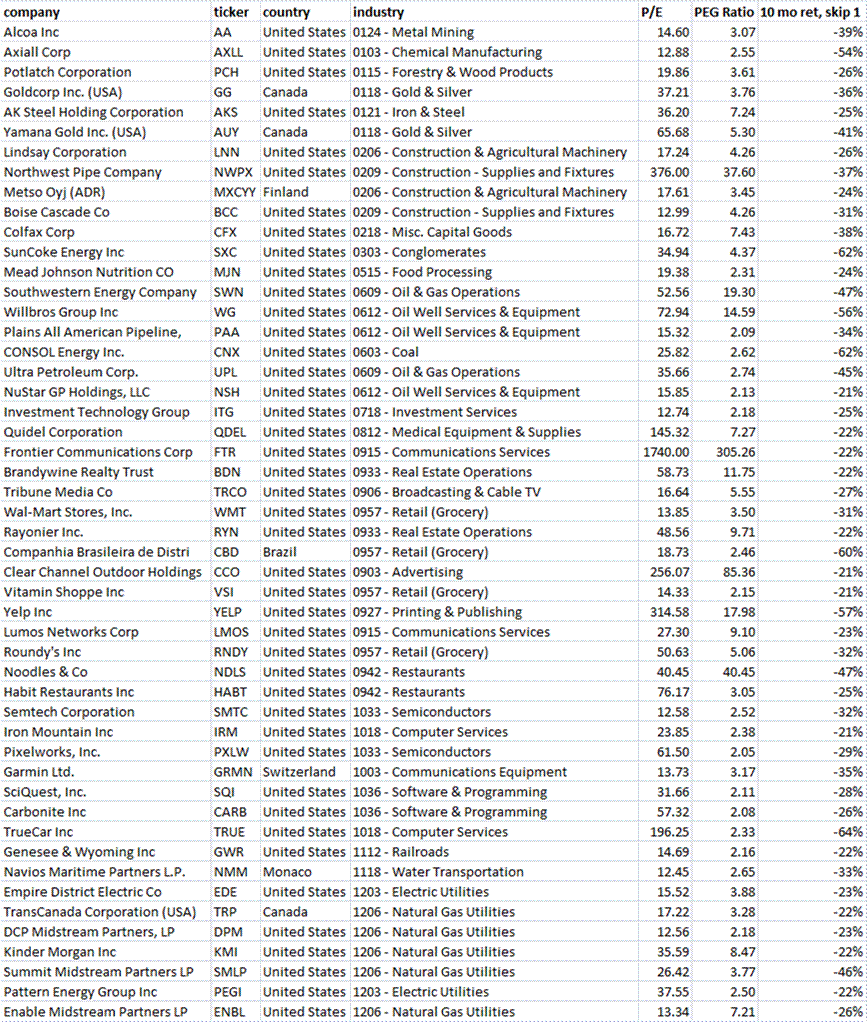
I set my screener for a 2016 PE higher than 12 and a PEG higher than 2.0x, with failing momentum, where the stock was down more than 20% in the nine months prior to the current month.  Here were the 50 stocks that resulted:

What I find fascinating here is the mix of hot companies, basic materials and energy names, and limited partnerships.

This is only a start for analysis, so don’t run out and short these.  Not that I am big on shorting, but high earnings valuations, and failing price momentum could be a good place to start.  I have no positions in any of these companies, and I rarely if ever short.  I just thought this would be an interesting exercise.

21 Oct 03:49

On Slack: Infy Results, Eros-PingTune, China Default, Mahindra Mojo, Big Billion Loss and more….

by Gautam Jagannathan

CapM Premium Header

The Slack Discussions

The Slack group at Capital Mind Premium has been extremely active and if you haven’t been there, pop us a note by replying to this email. (If you’re a trial member this probably sound like Greek to you; it will be available when you sign up!)

A brief summary of some of the interesting things discussed there in the last few days:

#stocks: Post Q2 results & guidance, foreign brokerages turn cautious on Infosys

The stock dropped 3.15 per cent on Tuesday, in addition to a 3.88 per cent fall in the previous session (6.9 per cent in two days), to hit a low of Rs 1,087.10 on BSE. The IT Company on Monday revised its FY16 dollar revenue guidance downward to 6.4-8.4 per cent from an earlier guidance of 7.2-9.2 per cent.

For the September quarter, the company reported a better-than-expected 6.9 per cent sequential growth in dollar revenue in constant currency terms, but maintained FY16 constant currency revenue growth guidance at 10-12 per cent, implying a weak compounded quarterly growth rate (CQGR) of -2.3 per cent to +0.15 per cent in the second half of FY16.… (Read On...)

21 Oct 03:18

Rules from Jesse Livermore

by Sudarshan Sukhani
Jesse Livermore is perhaps the most famous stock trader of all-time.
Back in the early part of the 20th century, Livermore made and lost millions shorting the market.
Following are some rules of Jesse Livermore which every trader needs to keep in mind:
  •  Money cannot consistently be made trading every day or every week during the year.
  • Don't trust your own opinion and back your judgment until the action of the market itself confirms your opinion.
  • Markets are never wrong - opinions often are.
  • As long as a stock is acting right, and the market is right, do not be in a hurry to take profits.
  • Never buy a stock because it has had a big decline from its previous high.
  • Never sell a stock because it seems high-priced.
  • I become a buyer as soon as a stock makes a new high on its movement after having had a normal reaction.
  • Never average losses.
  • Big movements take time to develop.
  • It is not good to be too curious about all the reasons behind price movements.
  • It is much easier to watch a few than many.
  • Do not become completely bearish or bullish on the whole market because one stock in some particular group has plainly reversed its course from the general trend.
To read full article click here
20 Oct 16:58

Counter Arguments On Uber Economics: What About The Cost of Owning a Car, And Other Deeply Insightful Questions

by Deepak Shenoy

In my last post on Uber, I spoke of Economics and we’ve had some extremely good arguments countering some of the economics. I’m always malleable, so if there’s a solid argument stating a case against me, I’m always open to change.

image

1. What About The Cost of Owning A Car?

I spoke of the price per kilomoter for taking an Uber versus taking your own car, and Uber’s costs came to 13Km + per kilometer. Using your own car, I said, uses up about Rs. 6 per kilometer – and if you added the rest up, you’d still pay less than an Uber. (About Rs. 0.5 per km as insurance, Rs. 1 per km as maintenance and so on).

But there’s a larger cost: the cost of the car itself. Which according to many people will be a whopping Rs. 10 per kilometer, if you assume a cost of Rs.… (Read On...)

20 Oct 08:43

Why would Indian educational institutions want to go abroad?

by T T Ram Mohan
Amity University plans to be in 50 countries in the next ten years, the Economist reports.  It has already set up shop in  America, Britain, China, the UAE, and Singapore.There are others such as BITS and Manipal University that have also spread their wings overseas.

Why would Indian institutions want to go abroad when there's a huge untapped market here? And surely, they can't expect to compete with foreign institutions for foreign students?

Well, here's the answer to the puzzle. These universities do not in general cater to the local market abroad. There are plenty of quality institutions overseas to take care of the local market. What the typical Indian institution does is cater to rich kids from India. These kids can't get into, say, Amity University in Delhi. But they can get into the same university in Dubai or Singapore. They are happy to cough up more than what they would pay in India and they either can't get into top schools abroad or don't want to pay the fees of foreign universities.

So, there's a perfect market segment arising from basically the Indian market. Why would Indian institutions not expand their institutions here and take in more students? Because that would dilute the quality of their products in India and affect placement and their brand image. Many do take in some via capitation fee or donations but, taken beyond a limit, this carries risks. Better to cater to Indian students who can't make it here by setting up operations abroad. Then you grow your revenues without compromising on quality in the domestic market.

I daresay this makes for a great case study in market segmentation and pricing.
20 Oct 03:27

The Four Types of Relationships and the Reputational Cue Ball

by Shane Parrish

There are four types of relationships with people.

  1. Win Win
  2. Win Lose
  3. Lose Win
  4. Lose Lose

Seneca says “Time discovers truth.”

Only one of those relationships is sustainable over the long-term. And longevity is the key to so many things.

Yet so many of us operate in the short term. Today. This week. This Month. This Quarter. We want to WIN even if that means the other person LOSES.

We rationalize this behaviour, arguing that, while it might not be fair today, we’ll make it right in the future.

Only this ignores all we know about game theory, biology (survival/evolution), physics (compounding), and psychology (reciprocation).

The most common strategy in life when you feel like someone is taking advantage of you is tit-for-tat. That is return what you get.

The person on the LOSING side of any relationship tends to coil like a spring, the latent energy building with time, frequency, and magnitude of slight. The more they perceive you taking advantage of them, the higher the odds they negatively become spring-loaded. This creates a negative leaping emergent effect. That’s human nature. Given the chance to punish someone that we feel wronged us, even at personal cost, we will often take it.

These outcomes are avoidable.

Biology has taught us that the key to evolving is to be sustainable over a long period of time. We must reproduce. A one-and-done species is not even a footnote in history.

While others attempt to win every lap around the track, it is crucial to remember that to succeed at investing, you have to be around at the finish.

And yet so few of us design systems that incorporate duration as an element. We make them short term. Designed to maximize the short run while ensuring we never get on a path of sustainability.

  • When you treat people badly they will respond (eventually) in kind.
  • When you rip your customers off they will (eventually) go elsewhere.
  • When you rip off your suppliers they will (eventually) stop doing business with you or return your behaviour in kind.

Anyone can come into an organization and start throwing their title around to get things done. We’ve all met this person. This works for a while but eventually fails. And who is interested in a tactic that only works for a short time?

Ideally, we want something that works for a long time. Taking advantage of relationships, while it may achieve the desired results in the short term, takes you off a path that involves time. And often it’s perception that matters here and that perception belongs to the other person.

The best results in the world are a function of time. The key component to compounding, which Einstein claimed was the most powerful force in the world, is time.

Peter Kaufman, who published Poor Charlie’s Almanack, describes this as the the Reputational Cue Ball

Non-Win/Win tactics are akin to playing a billiards tournament with a focus on sinking only the first shot or two. Billiards—or life—is a multi-shot game. When we fail to consider the future consequences of mistreating our counterparties in a current “deal”‘ or first phase, it can wind up leaving our “reputational cue ball” ill-positioned for the next shot—the next deal or phase to come down the pike.

--
Sponsored By: Greenhaven Road Capital: You think differently - now invest differently.

19 Oct 09:02

Maximizing Shareholder Value: A Dumb Idea?

by Vishal Khandelwal

Sometime in 2007, I called the Investor Relations head of a leading Indian power company. “I request for a meeting with your CFO,” I said.

“Where are you calling from?” she asked back.

“I work for an independent research company working for retail investors, and we are looking to initiate coverage on your stock,” I replied. “I had some questions before writing the report and thus wanted to meet your CFO.”

“Are you writing a Buy or Sell report on our stock?” she asked.

“How can I tell you that now?” I said “I need to finish my research and only then will I make a judgement on whether the stock is a buy or a sell.”

“Wait, you are from a retail research organization, right? She asked. “Sorry, we do not have a policy to meet companies focused on retail investors. We only meet the institutional guys because they can help up increase our market cap, not the retail guys. We want to maximize shareholders’ wealth, you see.”

I loved her honesty, but was shocked to hear such a response from a public company, which had a policy of maximizing shareholder wealth, and fast, and by excluding a large set of its shareholders.

What a Dumb Idea!
Peter Drucker said this in 1973 –

The only valid purpose of a firm is to create a customer.

Drucker’s perspective was that the goal of a firm isn’t fundamentally about creating profits or maximizing shareholder value. Profits and shareholder value are the results of adding value to customers, not the goal.

Even the legendary Jack Welch has come to see that maximizing shareholder value is “the dumbest idea in the world.

“On the face of it, shareholder value is the dumbest idea in the world,” Welch said, “Shareholder value is a result, not a strategy…your main constituencies are your employees, your customers and your products.”

Seth Godin wrote in a recent post –

The purpose of a company is to serve its customers. Its obligation is to not harm everyone else. And its opportunity is to enrich the lives of its employees.

Somewhere along the way, people got the idea that maximizing investor return was the point. It shouldn’t be. That’s not what democracies ought to seek in chartering corporations to participate in our society.

The great corporations of a generation ago, the ones that built key elements of our culture, were run by individuals who had more on their mind than driving the value of their options up.

Contrast this with what most companies and their managers do i.e., focus on short-term profits and stock price maximization, because this is an easy thing to do. Look at what the DCB Bank did recently.

Some days back, the management announced that the bank’s profits would take a knock as it tries to double its branch network in the next one year. On this news, the stock price crashed 30% in quick time. Shattered by this crash in the stock, the management revised its plan saying that, “after consultations with analysts and its chairman,” it would now not rush with the opening of new branches. Instead of setting up 150 branches over the next one year, it will do it over two years now.
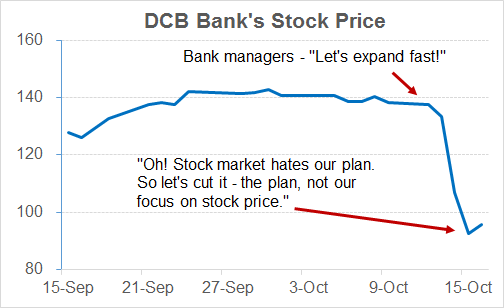

While I have no view on the bank or how this branch expansion would have helped or hurt it, the questions that arise are –
  • How can a management change its corporate plan while keeping an eye on the stock price?
  • How on earth can you consult stock market analysts on what you want to do as corporate managers?

The answer again seems to be – focus on short term profit and stock price maximization versus long term goals.

All CEOs and corporate managers appearing on business channels talking about their profits and next quarter’s or year’s performance are focused on just that – maximizing their stock prices in the short term.

Companies that never organized analyst meets or conference calls and become active there when their stock price is rising are also focused on that – further maximizing their stock prices in the short term.

Companies that pay dividends out of borrowed money are also doing that.

Steve Denning wrote this in his 2011 article on Forbes…

CEOs and their top managers have massive incentives to focus most of their attentions on the expectations market, rather than the real job of running the company producing real products and services.

The real market is the world in which factories are built, products are designed and produced, real products and services are bought and sold, revenues are earned, expenses are paid, and real dollars of profit show up on the bottom line. That is the world that executives control—at least to some extent.

The expectations market is the world in which shares in companies are traded between investors—in other words, the stock market. In this market, investors assess the real market activities of a company today and, on the basis of that assessment, form expectations as to how the company is likely to perform in the future. The consensus view of all investors and potential investors as to expectations of future performance shapes the stock price of the company.

Roger Martin wrote this in his book Fixing the Game –

What would lead [a CEO] to do the hard, long-term work of substantially improving real-market performance when she can choose to work on simply raising expectations instead? Even if she has a performance bonus tied to real-market metrics, the size of that bonus now typically pales in comparison with the size of her stock-based incentives. Expectations are where the money is. And of course, improving real-market performance is the hardest and slowest way to increase expectations from the existing level.

Invest with People Focused on Customers, Not Stock Prices
The problem with short-term stock price maximization is that it’s not particularly difficult. If a company has a big market share, or if it’s difficult for the customer to switch away from the company’s product, or if the customer lacks the knowledge of better options, it’s easy for the company to hurt its customers on the way to boosting what its shareholders say they want.

So, it’s not difficult for Nestle to be casual about what its super branded food products contain (thanks to its large market share), or for Indian Railways to provide sub-standard travel experience (customers don’t easily switch), or for financial services companies to mis-sell bad products (customers lack knowledge about good products). But just because it works doesn’t mean that they should be doing it to maximize short term profits, and in many cases their stock prices.

Contrast this with what Jeff Bezos and Larry Page are doing at Amazon and Google respectively – focusing only, and only, on the customer. The reason they have created so much wealth for their shareholders is because they never cared about shareholder value maximization, but only about customer satisfaction.

Consider the Purpose Statement of Procter & Gamble (emphasis mine) –

We will provide branded products and services of superior quality and value that improve the lives of the world’s consumers, now and for generations to come. As a result, consumers will reward us with leadership sales, profit and value creation, allowing our people, our shareholders and the communities in which we live and work to prosper.

For P&G, consumers come first and shareholder value naturally follows. As per the statement of purpose, if P&G gets things right for consumers, shareholders will be rewarded as a result.

This I am sure has also been the mantra of India’s biggest long-term wealth creators like HDFC, Asian Paints, Sun Pharma, Infosys, and Wipro. They have created tremendous shareholder wealth as a result of their focus on their customers and building their business for the long term, and not the other way round.

This is how you can also find a few of the future wealth creators – businesses where managements are not focused on shareholder wealth creation but treat it just as a byproduct of delighting its customers, employees, and the society at large.

Such are the businesses where you will find long-term sustainable moats. Every other moat – especially if it appears a lot on business television, is worshipped by everyone around, and where the management often touts its shareholder friendliness – is often fleeting.

“Mr. Market suffers from incurable emotional problems,” Ben Graham wrote while describing the daily madness of stock price movements.

Why would you want to partner with business managers who focus on managing these incurable problems of Mr. Market, than minding their business?


Also Read:
Clayton Christensen: Are Investors Bad For Business?
The Dumbest Idea In The World: Maximizing Shareholder Value

The post Maximizing Shareholder Value: A Dumb Idea? appeared first on Safal Niveshak.

    
19 Oct 07:22

Distrust and cross-check

I have piece in today’s Mint arguing that the Volkswagen emission scandal is a wake-up call for all financial regulators worldwide:


The implications of big firms such as Volkswagen using software to cheat their customers go far beyond a few million diesel cars

The Volkswagen emissions scandal challenges us to move beyond Ronald Reagan’s favourite Russian proverb “trust but verify” to a more sceptical attitude: “distrust and cross-check”.

A modern car is reported to contain a hundred million lines of code to deliver optimised performance. But we learned last month that all this software can also be used to cheat. Volkswagen had a cheating software in its diesel cars so that the car appeared to meet emission standards in the lab while switching off the emission controls to deliver fuel economy on the road.

The shocking thing about Volkswagen is that (unlike, say Enron), it is not perceived to be a significantly more unethical company than its peers. Perhaps, the interposition of software makes the cheating impersonal, and allows managers to psychologically distance themselves from the crime. Individuals who might hesitate to cheat personally might have less compunctions in authorizing the creation of software that cheats.

The implications of big corporations using software to cheat their customers go far beyond a few million diesel cars. We are forced to ask whether, after Volkswagen, any corporate software can be trusted. In this article, I explore the implications of distrusting the software used by big corporations in the financial sector:

Can you trust your bank’s software to calculate the interest on your checking account correctly? Or might the software be programmed to check your Facebook and LinkedIn profiles to deduce that you are not the kind of person who checks bank statements meticulously, and then switch on a module that computes the interest due to you at a lower rate?

Can you be sure that the stock exchange is implementing price-time priority rules correctly or might the software in the order matching engine be programmed to favour particular clients?

Can you trust your mutual funds’ software to calculate Net Asset Value (NAV) correctly? Or might the software be programmed to understate the NAV on days where there are lots of redemption (and the mutual fund is paying out the NAV) while overstating the NAV on days of large inflows when the mutual fund is receiving the NAV?

Can you be sure that your credit card issuer has not programmed the software to deliberately add surcharges to your purchases. Perhaps, if you complain, the surcharges will be promptly reversed, but the issuer makes a profit from those who do not complain.

Can you trust the financials of a large corporation? Or could the accounting software be smart enough to figure out that it is the auditor who has logged in, and accordingly display a set of numbers different from what the management sees?

After Volkswagen, these fears can no longer be dismissed as mere paranoia. The question today is how can we, as individuals, protect ourselves against software-enabled corporate cheating? The answer lies in open source software and open data. Computing is cheap, and these days each of us walks around with a computer in our pocket (though, we choose to call it a smartphone instead of a computer). Each individual can, therefore, well afford to cross-check every computation if (a) the requisite data is accessible in machine-readable form, and (b) the applicable rules of computation are available in the form of open source software.

Financial sector regulations today require both the data and the rules to be disclosed to the consumers. What the rules do not do is to require the disclosures to be computer friendly. I often receive PDF files from which it is very hard to extract data for further processing. Even where a bank allows me to download data as a text or CSV (comma-separated value) file, the column order and format changes often and the processing code needs to be modified every time this happens. This must change. It must be mandatory to provide data in a standard format or in an extensible format like XML. Since data anyway comes from a computer database, the bank or financial firm can provide machine-readable data to the consumer at negligible cost.

When it comes to rules, disclosure is in the form of several pages of fine print legalese. Since the financial firm anyway has to implement rules in computer code, there is little cost to requiring that computer code be freely made available to the consumer. It could be Python code as the US SEC proposed five years ago in the context of mortgage-backed securities (http://www.sec.gov/rules/proposed/2010/33-9117.pdf), or it could be in any other open source language that does not require the consumer to buy an expensive compiler to run the code.

In the battle between the consumer and the corporation, the computer is the consumer’s best friend. Of course, the big corporation has far more powerful computers than you and I do, but it needs to process data of millions of consumers in real time. You and I need to process only one person’s data and that too at some leisure and so the scales are roughly balanced if only the regulators mandate that corporate computers start talking to consumers’ computers.

Volkswagen is a wake-up call for all financial regulators worldwide. I hope they heed the call.

19 Oct 03:41

Why Are Dolly Khanna, Anil Kumar Goel, Nirmal Bang & Morgan Stanley Aggressively Buying This Small-Cap Stock?

by Arjun
Why Are Dolly Khanna, Anil Kumar Goel, Nirmal Bang & Morgan Stanley Aggressively Buying This Small-Cap Stock?
A congregation of big-ticket and super-savvy investors in a stock is usually a sure-fire indicator that mega gains are in the offing. Though the stock is already a mega-bagger, it is still quoting at a reasonable P/E. We need keep a hawk eye on the developments
19 Oct 03:36

Hayek: Liberty and Organization

by Atanu Dey

“The argument for liberty is not an argument against organization, which is one of the most powerful tools human reason can employ, but an argument against all exclusive, privileged, monopolistic organization, against the use of coercion to prevent others from doing better.” ~ F. A. Hayek

19 Oct 03:36

The TCS Results Debacle: Why Did the Share Price Drop 4.4% and Counting?

by Gautam Jagannathan

TCS released their results late Tuesday evening. (Here are the transcript of the call as well as the original video.) We present them in charts:

TCS Rev NI

Revenues have been constantly increasing as has Net Income. Operating margins too have been consistently hovering around the 27% mark. The blip seen in Net Income was due to the special employee rewards that TCS had announced in Q4 2015.

So far so good.

TCS - Rev NI Growths

The y-on-y growth in Revenues and Net Income has been quite positive too (apart from that outlier).

So why did they drop 4% right after they announced their results?!

Existing Issues

During the Earnings presentation, their CEO N. Chandrasekaran, emphasized quite strongly on looking at the growth figures in constant currency terms, as opposed to Dollar or Rupee terms. This might make sense, considering the massive depreciation seen in a lot of emerging market currencies, especially Latin America which accounts for nearly 2% of their revenues this year.… (Read On...)

19 Oct 03:32

Payment Banks - Airtel Bank in the making?

by Abhishek Basumallick
I have always been bullish on the Indian financial sector. My logic is simple. Any industry where there is a very large disconnect between demand and supply is bound to do well. India is a cash / credit starved nation and any business which provides credit to people and businesses will do well over a very very long time. 

The history of Indian banking is very interesting. Refer to Banking in India on wikipedia for a good overview. By now, most people are used to the ubiquitous ATM machines and do not consider private banks as fly-by-night operators who will take their money and run away. We are at the cusp of the third major wave in Indian banking (nationalisation in the 70s and privatisation in the 90s being the first two). With the 11 new licenses given out by RBI for new payment banks, the playing field has been (once again) forever changed. Ten years down the line, banking will not be the same as today. Brace yourself for a huge disruption in the coming years.

So what are payment banks? For simplicity's sake, it is a "technology driven bank", mainly mobile based which will cover most of the services provided by a regular bank except giving loans. They can take deposits of upto Rs 1 Lakh and pay interest on it, provide debit cards, transfer money from one account to another. 

The 11 players who have got the licenses include some very very prominent names - Airtel, Vodafone, Aditya Birla Nuvo, Reliance, Mahindra, India Post, Dilip Sanghvi (promoter of Sun Pharma), Paytm, Cholamandalam and NSDL. All of them are big players in their own fields. Three of them stand out distinctly - India Post, Airtel and Vodafone. Their reach and penetration is really unmatched. Just as an example, Vodafone m-pesa accounts for more than 50% of the GDP of Kenya on its platform. 

Already, we are seeing a beginning of "Uber"isation of services. Players like Vodafone & Airtel who are already there with you. It is so much more convenient if you can just use the mobile to pay for your kirana purchases or on public transport or at petrol pumps. 

Where does that leave the existing banks? The existing large players will push strongly on their apps (HDFC, ICICI, SBI etc). The brunt of the disruption in my opinion will be borne by the mid sized PSU banks and the smaller private banks. We already saw a DCB Bank being routed on the bourses because they accepted the increased competition from these new players. There will be more to come. The age of easy-CASA money may be behind us. The mid sized banks would now have to tie-up with some of these payment banks or invest heavily in their own app infrastructure. 

Let us keep an eye out for the trio - Airtel, Vodafone and India Post for the next leg of banking disruption.
19 Oct 03:29

The one graphic about India's learning outcomes that you should see

by noreply@blogger.com (Gulzar Natarajan)
The conventional wisdom on learning outcomes is that the country's state government public schools and low-end private schools are where the problem lies and their troubles have to do with poverty and other social issues. And that the remaining part of the country's education system is in good shape and those students can compete with the best in the world. This belief gets entrenched by the excellent performance of Indian students in international Math and Science competitions as well as the dominance of graduates from IITs etc in various professional fields.     

So, it comes as a surprise (HT:Lant Pritchett) when we examine the relative performance of Indian students at the top end of the achievement spectrum in the 2009 PISA tests which assessed a representative sample of students from the two best performing Indian states, Himachal Pradesh and Tamil Nadu. As can be seen, less than a percent of students in both states were above Level 4 (out of six levels) in the PISA test. The contrast with those countries that we aspire to match or even claim equivalence, atleast for the best and brightest among Indians, is staggering.
The comfort that we are better off comes from a cognitive bias. The immediacy of these kids engenders an availability bias, which makes people feel as though the schools where their children are going are as good as anything in the world. Sure, there are outliers, and they are the top 0.1% (or maybe 1%) or so of the schools. 
Add to Technorati Favorites