CenturyLink has taken on a new identity — Lumen Technologies — a name it says better highlights the company’s future direction and focus.
“Our people are dedicated to furthering human progress through technology. Lumen is all about enabling the amazing potential of our customers, by utilizing our technology platform, our people, and our relationships with customers and
partners,” said Lumen CEO Jeff Storey, in a statement on the name change.
Those around a while may remember Mountain Bell, the local phone company, which became US West in an anti-trust spin-off from AT&T. Qwest Communications International, an up and coming fiber-optic network, acquired the much larger US West, only to get into trouble with regulators, leaving it a vulnerable target for CenturyLink, a traditional phone provider out of Louisiana, after the tech and telecom boom went bust.
Now, another new name and logo will go up on the company’s buildings across the metro area. It isn’t because of one big acquisition, but rather a bunch of smaller ones. Outside of those name-changing transactions, the company has made dozens of other ones, small and big, such as Broomfield-based Level 3 Communications. Along with internal software innovations, they have given Lumen the ability to provide enterprise customers with a variety of services in a variety of areas.
Lumen is a measure of the brightness of light, and the company’s competitive advantage this century has come from its massive fiber network, stretching 450,000 route miles. That has helped CenturyLink survive even as consumers cut their home phone lines in favor of wireless providers and switched off DSL in favor of faster alternatives.
But transporting light signals can also be a commodity service. Lumen is now pushing to offer more higher-value applications and enterprise services directly to its customers, reflected in the company’s new motto: “The Platform for Amazing Things.”
Smart cities, retail and industrial robotics, real-time virtual collaboration and automated factories are some of the applications that Lumen believes it can help customers achieve in what it and others call the 4th Industrial Revolution. Steam power, electricity and then the computer chip all pushed economic progress, and now the melding of the digital and physical worlds that connectivity permits is doing the same, said Shaun Andrews, Lumen’s chief marketing officer.
That is the future direction, where the company sees the greatest potential for growth and new revenues. But Andrews emphasized that residential and small business consumers will still deal with CenturyLink, a brand executives believe still has value two decades into the new century. It is the name that will continue to show up on residential customers’ bills. CenturyLink Field in Seattle will retain its name.
Another new entity, Quantum Fiber, will handle the residential and small business transition to digital as the company rolls out more fiber-optic connections directly to homes and businesses. The company added capacity to reach about 300,000 homes and small businesses last year with gigabit service and plans to reach another 400,000 this year, according to Fierce Telecom.
Andrews said the name change won’t include a relocation to Denver of the corporate headquarters, which will remain in Monroe, La., home of the original CenturyLink. Of the company’s 40,000 employees globally, 5,800 are based in Colorado, and metro Denver remains an important hub of operations, especially the ones that Lumen will emphasize.
The company will change its ticker symbol from CTL to LUMN on Sept. 18 as part of the rebranding.
The GPU powerhouse ended rumors Sunday night with the announcement that it plans to acquire British chip designer Arm from Japanese owner SoftBank group in a deal that Nvidia CEO Jensen Huang says would create the ‘world’s premier computing company.’
It can be hard to tell a difference between AirPods and the many earbuds that resemble them, but checking the box is always a good start. US Customs and Border Protection tonight tweeted that its officers had “recently seized 2,000 counterfeit Apple AirPods from Hong Kong, valued at $398K had they been genuine.” There’s also this press release on the situation, which praises CBP officers for “protecting the American public from various dangers on a daily basis” and says that “the interception of these counterfeit earbuds is a direct reflection of the vigilance and commitment to mission success by our CBP officers daily.”
The only problem is, based on the agency’s own photos, the seized products appear to be legitimate OnePlus Buds —...
Like just about every airline, Delta is working to convince passengers that it's safe to fly during the coronavirus pandemic. It started off with the plane itself, blocking middle seats and spraying disinfectant on a regular basis.
Now, Delta is tackling the next part of the travel experience: the airport.
The Atlanta-based airline announced two new safety and sanitization initiatives at airports this week as airlines prepare for a stall in demand recovery between the summer and holiday travel seasons.
Delta said it would replace the air filtering systems on the jet bridges that passengers use to walk from the gate onto their planes, and announced new anti-microbial bins at security checkpoints at five of its hubs. The moves come as travel demand remains severely depressed over the same period in 2019. Airlines are desperate for demand to grow as they continue to bleed cash.
Although airplanes recirculate some cabin air, almost all aircraft are outfitted with High Efficiency Particulate Air, or "HEPA" filters, which are highly effective at removing the SARS-CoV-2 virus and other microbes from the air.
On the jet bridge, however, and on parked planes, air typically isn't filtered. Delta said that it would add MERV-14 filters to those air systems at 31 airports by mid-September, and at more airports in the coming months.
Although MERV-14 filters are not as effective as HEPA filters — they reduce air particles by 40%, according to Delta, instead of the 99.7% filtration that HEPA filters provide — it's still a significant improvement over having no filters at all. It was not immediately clear why Delta did not use HEPA filters, although those more effective products are in high demand as schools and universities reopen.
The airline also said it would offer the anti-microbial security bins at five airports: Atlanta, Minneapolis-St. Paul, Los Angeles, New York LaGuardia, and New York JFK. It has several hubs and focus cities (think mini-hubs) that did not make the list, and said that it "will evaluate opportunities for expansion to other markets following the launch in these cities."
The new bins, according to the airline, come with antimicrobial technology that "prevent[s] the growth of a broad spectrum of bacteria." While COVID-19 is a virus, not bacteria, the new bin design also "continuously minimizes the presence of microbes throughout the bin's lifecycle."
On its aircraft, Delta will continue to block middle seats on board flights and limit capacity — something shown to reduce COVID-19 infection risk by half — until at least January 2021. It has also introduced new cleaning procedures between flights. Other airlines, including Southwest and JetBlue, are also blocking middle seats, while United and American have introduced robust new cleaning procedures.
A Sinovac Biotech vaccine for Covid-19, one of three vaccines China has authorized under an emergency use program, on display at the China International Fair for Trade in Services in Beijing on September 6, 2020. | Noel Celis/AFP via Getty Images
Public health experts warn that the wide-reaching emergency use program poses risks.
China has taken a shortcut in the global sprint to develop and deliver vaccines for the novel coronavirus. Sinopharm, the state-owned company developing two of China’s leading vaccine candidates, told China National Radio on Monday that it has already vaccinated hundreds of thousands of Chinese citizens — even though the company’s phase 3 clinical trials have not yet concluded.
Individuals received one of two Sinopharm vaccines in development in an emergency use program launched by the Chinese government in late July, which also authorized a third vaccine, CoronaVac, developed by the privately owned drugmaker Sinovac Biotech. Under Chinese vaccine law, such authorization is allowed within a certain scope and time frame during a health emergency. China’s top vaccine official mentioned frontline medical workers and customs officials when he first announced the program, implying these high-risk groups had been prioritized to receive the still-experimental vaccines.
Phase 3 clinical trials, which look at the efficacy of a vaccine candidate at preventing a virus from spreading in a community, for the three Chinese vaccines had just begun overseas when they were approved for emergency use domestically. In July, Sinopharm initiated phase 3 trials for its two vaccine candidates in the United Arab Emirates; one of the vaccines also began trials in Morocco and Peru in August, according to the New York Times vaccine tracker. Sinovac launched CoronaVac’s phase 3 trials in July in Brazil, followed by Indonesia the following month. (The trials are being conducted outside of China because the vaccines’ protectiveness can be better evaluated in regions where Covid-19 transmission is high.)
China and Russia are the only countries that have provisionally greenlit vaccines that have yet to be deemed safe and effective through phase 3 trials.
In the US, the Centers for Disease Control and Prevention has told states to prepare to distribute vaccines to high-risk groups by the end of October or early November, stirring concerns that the vaccine approval process may be politicized ahead of the 2020 election. However, nine leading vaccine developers pledged to not submit their vaccines for approval until data from phase 3 trials shows that they meet predetermined safety and efficacy thresholds. No Chinese companies signed the pledge.
So far, China has not reported any serious issues with its emergency vaccine program. But vaccine experts told Vox that skipping or shortening phase 3 trials is risky and could subject citizens to an ineffective or unsafe vaccine. The risks are even higher in China, where vaccine producers have a history of scandals and the media is largely unable to play a watchdog role because of state control.
Although transmission has reportedly been very low in China since February, controlling local hot spots is still a priority for the government, said Yanzhong Huang, a professor of global health at Seton Hall and author of Toxic Politics, an examination of China’s environmental health crisis. “They have this strong incentive to develop vaccines to show Chinese high-tech capacity, and also [to] give people the sense of national pride,” Huang added.
Here’s what we know about how China’s emergency vaccine program is playing out so far.
China’s stealth emergency use vaccine program, explained
In the crowd of pharmaceutical companies that have jumped into the vaccine effort, Chinese companies got a swift and aggressive start. Of the 211 vaccines in development worldwide as of September 11, nine vaccines are in phase 3 trials, and four of the nine are from Chinese companies.
These trials allow scientists to determine the vaccines’ efficacy and identify side effects that may not have appeared in phase 1 or phase 2 trials.
But rather than waiting for trial results, the Chinese government started allowing certain workers to be vaccinated on a separate track.
The emergency program was only made public in late August during a carefully orchestrated segment on China’s vaccine development that aired on the country’s state-run television station CCTV. The program had been approved by the State Council on June 24 and was officially launched on July 22, Zheng Zhongwei, the leader of China’s vaccine program, explained on air.
Zheng said the program applies only to certain groups of people, pointing to medical workers treating Covid-19 and other illnesses, customs officials, food market workers, transportation workers, and some service industry personnel. The emergency use program is regulated through nine plans covering medical consent, the monitoring of side effects, and compensation, Zheng said.
The extent of the program had remained under wraps until early September, when new information revealed that participation had not been as limited as the government initially suggested. Sinopharm disclosed that hundreds of thousands of people have received their vaccines as part of the program. The CEO of Sinovac, the other vaccine maker involved, said 90 percent of the company’s employees and their family members — up to 3,000 people — have taken the vaccine voluntarily, Reuters reported. To justify the vaccine’s emergency use, the CEO explained it would help ensure the company’s workers could continue to produce vaccines.
The protocol for who, exactly, gets to receive the vaccine under the emergency program remains unclear. “That is still pretty much shrouded in mystery,” said Huang.
Outside of this official emergency program, the Chinese military in late June authorized the use of a vaccine candidate created by CanSino Biologics for military personnel. Separately, workers of state-owned companies traveling overseas were also allowed to take one of the two Sinopharm vaccines in June.
Shen Hong/Xinhua via Getty
A meeting commending leaders in China’s fight against Covid-19 on September 8, 2020, at the Great Hall of the People in Beijing.
The risks of circumventing phase 3 trials
After China’s initial outbreak peaked in February, the government swiftly brought the spread under control, reporting zero local cases by mid-March. Since then, new hot spots have emerged in regions such as Beijing and Xinjiang. In Xinjiang, where over a million Uighurs and other ethnic minorities have been put in detention over the past three years, the Chinese government has imposed a strict lockdown to rein in the spread, and some residents have reported being forced to drink Chinese traditional medicine.
Outside of these hot spots, transmission in China has remained very limited since March.
“The irony is that in China, at the moment infection rates are really very low,” said John Moore, an immunologist at Weill Cornell Medical College. “They are actually in a situation where they could afford to wait for the outcome of ongoing phase 3 trials, understand the safety and efficacy properly, without compromising their population.”
With occasional clusters of domestic transmission and imported cases, China still has an incentive to roll out a vaccine. However, introducing a vaccine prematurely comes with serious risks. Phase 3 trials require a large group of people, in part so that rarer side effects not discovered in earlier trials can be identified. Vaccinating hundreds of thousands of people before phase 3 trials conclude means those people could be harmed by any of these potential side effects. The World Health Organization recently emphasized that phase 3 trials are essential to evaluate the safety and efficacy of Covid-19 vaccine candidates.
“One needs to carefully conduct clinical trials of adequate size with adequate time for follow-up, look at both efficacy and safety, and those data have to be very carefully reviewed before you start giving the vaccine to people outside of a carefully designed clinical trial,” said Daniel Salmon, director of the Institute for Vaccine Safety at Johns Hopkins.
So far, Sinopharm reports that no one who has received its vaccines through the emergency program has experienced obvious adverse effects, and none have been infected with Covid-19. Interim results from the company’s phase 1 and 2 trials of the vaccine developed by subsidiary Wuhan Institute of Biological Products showed low rates of adverse effects. Sinopharm has yet to publish results from the phase 1 and 2 trials of its other vaccine, developed by the Beijing Institute of Biological Products.
Sinovac hasn’t published a peer-reviewed study of its phase 1 and 2 data, either, but it reported no severe side effects in those trials, and the company’s CEO told Reuters that the rate of adverse reaction has so far been very low across all the inoculated people.
When China first began allowing workers traveling overseas to get vaccinated, a couple of Chinese academics and a pharmaceutical executive expressed concerns about the practicality and ethics of the decision, as reported by the New York Times. But Huang said he hasn’t seen explicit criticism of the emergency use program from Chinese scientists.
Will Chinese vaccine makers be held accountable if safety issues with the Covid-19 vaccines arise?
The recent history of Sinopharm and Sinovac raises questions about their ability to produce safe vaccines. In 2018, the Wuhan Institute of Biological Products — the subsidiary company of Sinopharm Group that is developing one of its vaccines — was found to have sold more than 400,000 faulty diphtheria, whooping cough, and tetanus vaccines in two Chinese provinces.
The company was fined and nine employees were punished. Production at their factories restarted later that year following inspections, and China’s National Institutes for Food and Drug Control pledged to redouble supervision of the vaccine industry.
Sinovac also has a checkered past. The company was charged with bribing a Chinese official in charge of drug approval from 2002 to 2014, the New York Times reported.
Huang said this history does “not bode well for the quality of the Covid vaccines,” especially in the “rush to develop a vaccine without even following the typical protocols.”
China’s chokehold on the media may also inhibit accountability for any issues with the emergency use program. Huang pointed to the government’s strict media censorship, which could block reports about side effects or bad reactions to the vaccine.
China’s vaccine program is proceeding on two separate tracks
More Chinese people will likely be eligible for the emergency use program in the coming months, per Zheng Zhongwei’s CCTV interview. “In order to prevent the disease spread in the fall and winter, we are considering a moderate expansion in the program,” Zheng said. “The purpose would be to first build an immunity barrier among special groups in the population.”
Airline industry workers in China have already been notified that they will soon be given the vaccine on a voluntary basis, Reuters reported last week.
China’s vaccine development has been a source of national pride on social media, Seton Hall’s Huang said, and deals for Chinese vaccine shipments are already being offered to China’s allies. But if “there [are] reports suggesting that the vaccine is not effective, or could cause severe or adverse reactions,” Huang said, “that is going to tarnish the reputation of the Chinese vaccines.”
Lili Pike is a science, health, and environmental reporting (SHERP) master’s student at NYU and a freelance journalist with a focus on China.
Help keep Vox free for all
Millions turn to Vox each month to understand what’s happening in the news, from the coronavirus crisis to a racial reckoning to what is, quite possibly, the most consequential presidential election of our lifetimes. Our mission has never been more vital than it is in this moment: to empower you through understanding. But our distinctive brand of explanatory journalism takes resources. Even when the economy and the news advertising market recovers, your support will be a critical part of sustaining our resource-intensive work. If you have already contributed, thank you. If you haven’t, please consider helping everyone make sense of an increasingly chaotic world: Contribute today from as little as $3.
Leading business process services company, SYNNEX, recently announced a new agreement with the Five9 brand, to deliver cloud-based solutions for the contact centre to the Northern American IT channel. SYNNEX will now act as the Master Agent for Five9, as the companies partner to manage the convergence in the channel partner ecosystem around CCaaS, and a growing demand for intelligent offerings through the cloud.
According to SVP of Product Management for SYNNEX, TJ Trojan, the company is pleased to be extending its relationship with the team at Five9 to further support mutual partners and their clients’ migration into CCaaS offerings. The strategic partnership will broaden SYNNEX’s offering beyond the ability to leverage innovative CCaaS solutions and provide a differentiated service with SYNNEX GoldSeal.
Offering GoldSeal to Support Five9
SYNNEX is delivering GoldSeal as a solution to further support the Five9 solution, which helps resellers to provide rapid and seamless enablement as they migrate end-users to the cloud. End-users can take advantage of SYNNEX premier support solutions complete with 24/7 assistance, and next-day replacement of crucial equipment.
Andy Dignan
As the market continues to evolve, collaborations between companies like Five9 and SYNNEX are essential. Global Partner Services and International Sales expert for Five9, Andy Dignan, says that SYNNEX will be a massive growth engine for Five9 and the mutual partners of the brand.
To learn more about Five9 from the SYNNEX corporation, you can visit the SYNNEX or Five9 website. Going forward, the two companies are looking forward to working together more cohesively on a strategy for better contact centre solutions for everyone.
An online site for a Willy Wonka-like competition from the founder of Jelly Belly was overwhelmed by people trying to buy a $50 golden ticket shortly after it was announced.
David Klein, the original developer of The Jelly Belly brand who's sometimes referred to as "The Candyman," launched a nationwide treasure hunt before he officially retires from the business — with a candy factory as the grand prize.
The contest site, which was crashing due to high traffic, was functioning again on Wednesday.
The website for a competition reminiscent of the contest in the movie "Charlie and the Chocolate Factory" was overwhelmed by people looking to buy a $50 golden ticket. After crashing, the website was working again as of Wednesday.
The site, www.TheGoldTicket.com, ran into issues as those looking to participate in a Willy Wonka-style competition hosted by the founder of Jelly Belly tried to select and purchase a ticket for the contest in their particular state. ABC7 News in the Bay Area reported on Tuesday that "the site constantly crashes and people have had issues when they are trying to buy" their tickets.
The level of interest in the novel contest makes sense — it's an unusual and headline-grabbing concept that leans into people's nostalgia for "Charlie and the Chocolate Factory." It also takes place outside, offering those looking for a new activity something to do while many traditional entertainment options remain closed amid the coronavirus pandemic.
Jelly Belly founder David Klein, who's sometimes referred to as "The Candyman" and now runs a new candy company called Spectrum Confections, is launching a nationwide treasure hunt before he officially retires. Klein is no longer involved with Jelly Belly, which released a statement amid interest in the contest to highlight that it is not involved in the treasure hunt in any way, Fox 8 reported on Wednesday.
The winner is expected to receive an expense-paid trip to one of Klein's candy factories, an education to a candy-making university, and the grand prize: a factory "key."
"We're gonna have the ultimate treasure hunt where the winner will be receiving a key — a key to one of our candy factories," he said in a video.
Those who participate will get a riddle regarding the location of where "gold style tickets will be hidden in the form of necklaces," according to the contest's press release. Treasure hunts will be set up on a state-by-state basis, and first clue is set to be unveiled on September 30 in Georgia.
Each state is limited to 1,000 participants and has one golden ticket.
"With The Gold Ticket Treasure hunt, our goal is to get people out and about with their families. Grandma and Grandpa can even join with the kids and grandkids," Klein said.
Thanks to this tweet, I learned today how to change what font you see in Slack. And to be honest, I am more than happy to have discovered this on a Friday because I have spent the last hour trying out ridiculous fonts only to realize I didn’t know how to reset it.
If you want to try this yourself, you can by simply typing /slackfont followed by the name of a font you have locally. Yes, /slackfont Comic Sans MS works. So does /slackfont Wingdings. You need to make sure you’re typing how the font is named for you locally, so /slackfont Comic Sans won’t work; it has to be /slackfont Comic Sans MS. After some quick googling and frantic refreshing of the Twitter thread, I discovered that to reset the default font, you simply type in /...
Airlines have been inundated with refund requests during the coronavirus pandemic as travelers cancel preexisting plans due to border closures, quarantine requirements, or safety concerns.
The flaw, on the page that lets users check the status of refunds, was found by an IT researcher who estimates that 100,000 users' records were visible.
It was not immediately clear whether any sensitive information was exposed.
A security flaw in United Airlines' website may have exposed ticket information for customers who requested a refund, according to a new report from TechCrunch.
The bug caused the website to not validate a user's last name when checking their refund status. That made it possible to access other travelers' refund information simply by changing the ticket number, TechCrunch reported.
Like many airlines, United's website allows users to check their refund status by entering their ticket number and last name. It was not immediately clear whether another user's information could be viewed without knowing their full ticket number.
IT security expert Oliver Linow discovered the bug and told TechCrunch that the security hole allowed him to see traveler names, payment type, currency used, and the refund amount. It was not clear whether any more sensitive information was visible.
Linow said that he reported the bug to United in July, and that it took the airline more than a month to fix it. He tweeted that he estimates that 100,000 user records were visible, possibly more.
Companies doing business in the European Union are subject to steep fines for failing to protect user privacy — it was not clear whether the bug affected European versions of United's site, nor whether the bug was something that could subject United to penalties.
A spokesperson for United told Business Insider that the airline was looking into the report, but that he did not believe that any sensitive information was visible.
Airlines have been inundated with refund requests during the coronavirus pandemic as travelers cancel preexisting plans due to border closures, quarantine requirements, or safety concerns.
Last September, Amazon announced a voice assistant alliance ahead of its yearly fall event with the goal to ensure smart devices are compatible with multiple digital assistants concurrently. Nearly a year later, the coalition has over 70 companies pledging support, including Facebook, Garmin, and Xiaomi, which recently joined. Yet, Amazon’s biggest rivals in the voice assistant space — Apple, Google, and Samsung — have yet to join.
Amazon’s Voice Interoperability Initiative’s goal is to have companies create smart devices that support multiple voice assistants like Alexa or Cortana concurrently. But without Apple, Google, and Samsung’s voice assistants (Siri, Google Assistant, and Bixby), the biggest competitors to Alexa, the idea feels...
People are furious with Disney's newly released "Mulan" movie, and have called for a boycott of it.
The movie's credits thank government agencies in China's Xinjang region, where millions of Muslims have been detained, surveilled, and subjected to human-rights abuses for years.
Reports and watchdogs say people in the region — many of whom are known as Uighurs — are sterilized, made to work for little to no pay, and forced to adopt Chinese culture and deny their own.
There were already calls to boycott the movie over its star's public support of the Hong Kong police during pro-democracy protests last year.
Disney is facing backlash for filming its new "Mulan" remake in China's Xinjiang region, where authorities have built a 21st-century police state to surveil and detain millions of Muslims.
In the movie's final credits, "Mulan" gave "special thanks" to eight government entities in Xinjiang. These included the public security bureau in the city of Turpan, which is credited with running hundreds of detention camps, and the "publicity department" of the Chinese Communist Party's Xinjiang branch.
The credits were noted by social media users, who called for a boycott of the movie.
Former detainees of the camps have described dire conditions there, as well as physical and psychological torture. The BBC and The Globe and Mail recently published footage from a Uighur man who secretly filmed himself being chained to a bed while having to listen to Communist Party propaganda on speakers.
A perimeter fence constructed around what is officially known as a "vocational skills education center" in Dabancheng, Xinjiang, in September 2018.
And in an a recent interview with Architectural Digest, Grant Major, the film's production designer, said his team had spent months in and around Xinjiang.
The US put the Turpan Bureau of Public Security on an export-restrictions list in July, describing it as being implicated in "human rights violations and abuses in the implementation of China's campaign of repression, mass arbitrary detention, forced labor and high-technology surveillance against" Uighurs and other groups.
Disney has neither responded to Business Insider's requests for comment on the backlash, nor issued any public statement about it.
Leaked classified documents, published by the International Consortium of Investigative Journalists last year, also showed a concerted effort by regional officials to keep a close eye on Uighurs with foreign citizenship, wherever they are in the world.
Joshua Wong, a student and one of Hong Kong's leading pro-democracy activists, joined calls for a boycott of the movie on
He said a series of tweets: "While Disney has been completely remaining silent on the Uyghur issue, its cooperations with the officials responsible for brutal crackdowns on Uighur Muslim minority really sends an alarming signal to the world— what kind of values Disney advocates for, especially when the company's target market is the children worldwide." (Uyghur is an alternative spelling for "Uighur."
"It casts more doubts on whether Mulan is the propaganda masterpiece that Disney works hand in hand with the CCP government to whitewash the cultural genocide and human violations on ethnic minorities in the region."
Hollywood studios have in recent years grown heavily reliant on overseas box offices for revenue, with China being the most important market. China has in the past censored multiple Western movies for political reasons — from sex scenes to LGBT romance — and many Western movies have appeared to alter their content to appease those censors.
Wong added of "Mulan": "As the movie is widely considered as an attempt to spread propaganda & whitewash China's cultural genocide, I also urge Disney to suspend the screening of such a controversial movie and clarify its stance on human rights violations regarding re-education camps in the region."
The movie – a live-action adaptation of Disney's 1998 animated movie of the same name — was released this month on the Disney Plus streaming service.
Michael Cohen, President Donald Trump's longtime former lawyer and fixer, believes that Trump wanted to install a loyalist to head up the Manhattan US attorney's office so he could arrange to be federally indicted and then pardon himself in the event that he loses the November election.
"The reason behind that unprecedented and serpentine thinking was that Trump knows perfectly well that he's guilty of the same crimes that resulted in my conviction and incarceration," Cohen wrote.
Cohen elaborated on that belief during an interview with MSNBC's Rachel Maddow, saying, "Well, my theory is that if he loses, there's still the time between the election and the time that the next president would take office."
"And during that time, my suspicion is that he will resign as president, he will allow Mike Pence to take over, and he will then go ahead and have Mike Pence pardon him," he added.
The White House slammed Cohen's book and described him as a "disgraced felon" and liar who can't be trusted.
Michael Cohen, President Donald Trump's longtime former lawyer and fixer, believes that Trump tried to install a loyalist to head up the most powerful US attorney's office in the country so he could arrange to be federally indicted while in office, and then pardon himself if he loses the November general election.
Clayton, "not coincidentally, was a golf buddy of the President and almost completely inexperienced in criminal law," Cohen wrote.
He was "exactly what Trump and Barr wanted: a lackey," he added. Ultimately, Barr was forced to appoint Audrey Strauss, Berman's top deputy, as acting Manhattan US attorney after a public standoff with Berman. Berman eventually stepped down when Barr conceded and said Strauss would take over in an acting capacity until a permanent successor was confirmed by the Senate.
Cohen wrote that the reason Trump wanted to replace Berman, "I knew better than anyone, was so that while in office, he could arrange to be federally indicted. In the event he loses the election in November, he could then pardon himself, as he's long claimed to be his right."
"The reason behind that unprecedented and serpentine thinking was that Trump knows perfectly well that he's guilty of the same crimes that resulted in my conviction and incarceration," Cohen wrote.
Cohen pleaded guilty in August 2018 to eight counts of campaign finance violations, tax fraud and bank fraud as part of the Southern District of New York's investigation into illegal payments made during the 2016 election to the adult film star Stormy Daniels. Three months later, Cohen also pleaded guilty to one count of lying to Congress as part of the former special counsel Robert Mueller's investigation into Russian interference in the 2016 US election.
In his guilty plea, Cohen said that he acted at the direction of and for the benefit of Trump, who was named as "Individual-1" in the SDNY's charging document against Cohen. The president's former fixer also said he lied to Congress about the now defunct Trump Tower Moscow project to shield Trump from congressional or legal scrutiny.
In his book, Cohen wrote that Trump would try to preemptively pardon himself because "he also knows that I would be a star witness in that case, and my book a fundamental piece of evidence for his guilt. Without the immunity from prosecution granted to the president, Trump will also almost certainly face New York State criminal charges."
The president and his businesses have drawn intense scrutiny from both the New York state attorney general's office as well as the Manhattan district attorney's office. Trump is currently fighting a protracted legal battle with the latter to prevent Manhattan DA Cyrus Vance, Jr., from obtaining his long-concealed tax returns.
"He would likely be convicted on both the Federal and State charges and face serious prison time," Cohen wrote, though he did not elaborate. "That is Donald Trump's greatest fear in life, believe me, and if he fails to get reelected, that will be his fate — and he knows it — so silencing me was an essential part of his overall plan to evade the law and avoid that outcome."
MSNBC's Rachel Maddow asked Cohen about the excerpt when he appeared on her show Monday night.
"You say at the very end of the book that the president and Attorney General William Barr ousted the US attorney of New York and tried to install, effectively, the president's golfing buddy as the new US attorney there because the president, in your view, wanted to arrange for himself to be indicted while he's still in office because that would give him the opportunity to pardon himself after he lost the election," she said.
"Well, my theory is that if he loses, there's still the time between the election and the time that the next president would take office," Cohen said. "And during that time, my suspicion is that he will resign as president, he will allow Mike Pence to take over, and he will then go ahead and have Mike Pence pardon him."
"And it's a very, let's just say it's a very Nixon-type of event and it was probably discussed between Roger Stone and President Trump at some point," he added. "That this is certainly one way to avoid any potential prison time."
The White House slammed Cohen's book and described him as a convicted felon and liar who can't be trusted.
"Cohen is a disgraced felon and disbarred lawyer, who lied to Congress," White House press secretary Kayleigh McEnany said in a statement over the weekend. "He has lost all credibility, and it's unsurprising to see his latest attempt to profit off of lies."
One aspect of the 2020 presidential campaign that isn’t much discussed is the fact that both candidates want to end the internet as we know it. Both President Trump and Joe Biden have called for the end of Section 230 of the Communications Decency Act, which protects tech companies in most cases when their users post something illegal on their platforms.
Trump brought the subject up today when a Twitter account with fewer than 200 followers posted an obviously doctored image of Senate Majority Mitch McConnell dressed up in Soviety military garb, with the caption reading “Moscow Mitch.”
“Why does Twitter leave phony pictures like this up, but take down Republican/Conservative pictures and statements that are true?” the president wanted...
Yubico is announcing a new version of its USB-C equipped YubiKey 5 security key with NFC built in, which should theoretically be a convenient combo and compatible with many future devices moving forward.
Previously, YubiKey offered the YubiKey 5 series in your choice of USB-A; USB-A and NFC; USB-C; and USB-C and Lightning. But with the new YubiKey 5C NFC that’s being announced today, you no longer have to pick between being able to plug your key into a USB-C port or the convenience of NFC authentication, which lets you just tap your key on your device — you can now buy a key that offers both.
Hardware-based keys offer extra layer of account security
Hardware-based keys offer an extra layer of account security by requiring that you either...
With nearly all global companies having reported second-quarter figures, JPMorgan analyzed earnings to determine how hard the virus slammed profits and how long it may take to recover.
Global corporate profits tumbled 33% in the year through the second quarter, the bank's researchers said. The slump is less than half of the 70% drop JPMorgan projected in April.
The team still expects "an incomplete recovery that will prevent the return of profits to pre-pandemic levels anytime soon" as the pandemic's fallout lingers.
The tech and consumer staples sectors suffered the smallest earnings slumps, while energy and consumer discretionary firms endured the largest declines, according to the bank.
The coronavirus' impact on global second-quarter earnings has all but completely materialized, and JPMorgan found a handful of pros and cons in the data.
For one, researchers Joseph Lupton and Olya Borichevska expected a bigger plunge. Global earnings sank 33% in the year through the second quarter, according to the firm. The slump is on par with the trend seen during the financial crisis and hit certain sectors, such as travel and hospitality firms, far harder than others.
Yet JPMorgan forecasted a profit plunge of 70% over the same period in an April note. The smaller decline "owes in part to a remarkable level of policy support" that buttressed demand and helped keep businesses afloat through lockdowns, the team wrote. Profits are set to begin their bounce-back in the current quarter, but just because they fell less than expected doesn't mean the recovery will be easy.
"The picture remains grim and we still anticipate an incomplete recovery that will prevent the return of profits to pre-pandemic levels anytime soon," the researchers wrote in a note to clients.
Profit weakness is already weighing on lagging gauges of economic health. Global capital spending is on track for a 30% decline following the earnings slide, JPMorgan said. Even when earnings recover over the coming year, the firm doesn't expect capital spending to fully retrace its pandemic-sourced losses until the end of 2021.
Certain companies and countries will return to pre-pandemic profitability before others, the bank added. Tech sector earnings fared the best through the first half of 2020, only falling 0.1% on a non-annualized basis, according to the researchers. Health care and consumer staples firms followed with earnings declines of 4.7% and 5.5%, respectively.
Energy companies suffered the biggest plunge as profits contracted by 53.2% over the period. Consumer discretionary companies bore the second-largest hit, with earnings falling 43.9%.
By region, developed market earnings sank 45% year-over-year compared to emerging markets' 23% drop. US corporate earnings fell only 15% in the year through the second quarter. Only Taiwan, China, Sweden, Indonesia, and Turkey fared better, the researchers said.
In contrast, the eurozone's profits were hit the hardest. The UK's corporate earnings through the period tanked nearly 80%. Brazil, Norway, and Australia posted similarly dire declines.
Now read more markets coverage from Markets Insider and Business Insider:
A "closed" sign in a restaurant in New York on April 16.
Michael Nagle/Xinhua/Getty Images
Chris Wallace brought up the idea of a "K-shaped" economic recovery while moderating Tuesday's night's presidential debate between President Donald Trump and former Vice President Joe Biden.
The K shape suggests the wealthy are recovering and the lower-earning are not.
In the ongoing US recession, industries like technology, retail, and software services have largely recovered and begun rehiring, while travel, entertainment, hospitality, and food services have continued to decline past March levels.
The result is that low-wage jobs like restaurant staff, transportation workers, and cleaners are least likely to come back.
The economy made up a large portion of the first 2020 presidential debate Tuesday night, specifically whether the country is recovering from its current recession.
The debate's moderator, Chris Wallace, brought up the idea of so-called K- and V-shaped economic recoveries during the debate between President Donald Trump and former Vice President Joe Biden. In the past, Biden has referred to the "K-shaped" recovery, first coined by economists, where high-income Americans have seen jobs come back and income grow, while middle- and lower-class people have not.
"Millionaires and billionaires like him in the middle of the COVID crisis have done very well. Billionaires have made another $300 billion because of his profligate tax proposal, and he only focused on the market," Biden said during the debate. "But you folks at home, you folks living in Scranton and Claymont and all the small towns and working class towns in America, how well are you doing?"
Here's what the "K-shaped" recovery means and how that affects jobs and economic inequality.
What is a K-shaped recovery?
The US entered recession in February, per the National Bureau of Economic Research, ending a record 128-month economic expansion.
Since it became obvious the coronavirus pandemic would create a recession, economists have debated the "shape" it might take, with big implications for the future of the economy. Would it be a "V" shape, with a steep decline followed by a rapid recovery; a "U" shape, with a softer recovery; or the dreaded "L" shape, with no recovery at all?
A V-shaped recovery, for instance, is the most optimistic. A U shape is similar but suggests the period of unemployment and low economic activity will remain longer than in a V-shaped recovery.
L- and I-shaped recovery outlooks are much more dire, suggesting the high unemployment and low spending will have other ramifications, such as debt defaults and overwhelmed health systems.
A K-shaped recovery is somewhere between a V and an L — depending who you are. In the ongoing US recession, industries like technology, retail, and software services have recovered from the industry and begun rehiring, while the travel, entertainment, hospitality, and food-services industries have continued to decline past March levels.
"The pandemic's uneven economic impact on industries and workers has been stark," the US Chamber of Commerce's president, Suzanne Clark, wrote in a blog post on September 3 called "The K-Shaped Recovery and the Cost of Inaction."
What does a K-shaped recovery mean for jobs?
In the second half of March, after the rapid spread of the coronavirus prompted officials to shut down businesses and schools, nearly 10 million Americans filed new claims for unemployment insurance.
While the record job loss hit the travel and hospitality industries, some economists assumed the US would bounce back once businesses reopened. The result would have been a V-shaped recovery.
But the US has yet to control the virus to the point of a full reopening. The country has recorded the most infections of any country, with more than 7 million, and a resurgence of infections has been tied to hasty restaurant and business reopenings.
The stagnated recovery has meant the restaurant and travel industries have continued to decline, as more and more chains and restaurants have gone bankrupt. While job growth has picked back up slowly, the unemployment rate is still 8.4% nationally.
Clark wrote in her early-September blog post that the financial-services sector had already recovered 94% of its pre-pandemic employment, while the leisure and entertainment industries had brought back only 74% of their former workers. The result is that low-wage jobs like restaurant staff, transportation workers, and cleaners are least likely to recover.
Get a free 3-month subscription to Business Insider when you buy a ticket for the Business Insider Global Trends Festival, a virtual conference of ideas on October 19-23.
by afisher@businessinsider.com (Anthony L. Fisher)
Getty
Social media apps are designed using the same psychology as casino slot machines. They entice you with menial rewards to keep you coming back, even when you know it's doing you harm.
When I deleted social media apps from my phone, I found myself newly endowed with time, mental bandwidth, and imagination that would have been lost to mindless "doomscrolling."
You don't need to go cold turkey, just stop giving the parasitic social media sites so much of your lifeblood and get the apps off your phone.
This is an opinion column. The thoughts expressed are those of the author.
It's a parasite, its life force borne of your confessions, photos, memes, and soon-to-be-mortifying opinions. Perversely, it convinces you that feeding the social media beast is essential to your mental health and career by making you feel "connected."
Twitter, Facebook, Instagram, and the rest, aren't inherently evil websites. But they all operate as sociopaths would: always in their own interests, without conscience, at the expense of others.
They entice with promises of validation and reward. Your work is shared widely. Your cause is amplified. You get a dopamine fix from positive reactions, or even any reactions.
They're the online cousins of casino slot machines. They're even designed using the same psychology, where profits are maximized by actively enabling addiction.
And the only rule of casinos is that sooner or later, the house always wins.
If you don't want to delete your account, at least delete the app
Earlier this summer, I found my mental capacity was stretched thin. I'm hardly alone in this time of pandemic and social upheaval.
I've known for years that social media was a time suck. But lately, more than ever, I could feel myself growing anxious just a couple minutes into mindless "doomscrolling"
For all the personal and professional connections made, the worthwhile articles read, and the occasional laugh, it became evident that social media was not giving me anything close to the emotional value of what I was putting into it.
It was swallowing my time, which as a parent of three young kids, is spare. It was scrambling my once-decent attention span. And it was convincing me to care deeply about all kinds of ephemeral internet mush — things not worth caring about at all.
Even Instagram, generally a source of hi-fives for my cute kids' photos, started feeling toxic. Underneath the "living your best life" facade lurked a cycle of what I call "envy porn" — basically content meant to instill the most FOMO on a global scale. Even if its users (a.k.a. content creators) mean well, Instagram is a place for people — especially women — to feel worse about themselves.
One afternoon, while eating lunch and scrolling down a Twitter rabbit hole of QAnon content, I rashly decided to delete all social media apps from my phone. I didn't delete my accounts, I just made a de facto rule: no social media on the phone.
It's been over two months, my life is better for it.
To be sure, I didn't totally go cold turkey. Twitter still hums on my desktop, for work, of course. Popping in on the latest journalistic flame wars, the ritualistic dunkings, and the rare but appreciated article worth reading maintains the "connection," but it no longer feels like a limb.
There's been more book-reading, more music-listening, more goofing around with my kids. During all those simple but life-affirming experiences, a portion of my brain doesn't feel permanently tethered to the online matrix. I didn't even have to make a big show of "leaving social media." All it took was getting social media off my phone.
Nobody is so thirsty for digital hearts that they're going to walk around mindlessly scrolling on a laptop. And yet, vacantly staring at hot takes and shitposts is socially acceptable, as long as it's on a phone.
The phone makes social media too instantly available. It promises that you'll never be bored again anywhere — at the in-laws, at the supermarket, in an elevator. And that's just awful.
We need to be bored, at least in moderation. Mental health, creativity, and the ability to be entertained require brains to endure at least a little bit of empty space.
There was a moment a few years back, where after many years of "social smoking" at alcohol-soaked events, I decided once and for all that cigarettes were gross and not even worth the occasional "social" puff. This feels like that.
Last week, I tweeted a strong opinion. Can't remember what it was. But I did feel a familiar jones for the affirmation earned from sending very good non-ratioed takes. I had to walk away from my laptop after about a minute, and then I completely forgot about the tweet.
Reopening my computer a few hours later, there were a favorable amount of RTs and Faves, with a mere sprinkling of "Go fuck yourself" replies.
It was all there, the life story of that tweet. For about 20 minutes, a few hundred people cared enough to engage with it, and they mostly liked it. Then they forgot it, just like I already had.
The thrill is gone.
I don't reflexively reach for my phone anymore. After going from extremely online to just occasionally online, it's a lot easier to walk right past the dopamine dealer.
To misquote Nancy Reagan, "Just Say No to Social Media on Your Phone."
Elon Musk, founder and chief engineer of SpaceX speaks at the 2020 Satellite Conference and Exhibition March 9, 2020 in Washington, DC.
Win McNamee/Getty Images
Tesla's stock is overvalued, David Trainer the CEO of New Constructs told CNBC's "Trading Nation" Monday.
He said: "We think this is a big, big – one of the biggest of all time – houses of cards that's getting ready to fold."
Tesla's stock price is up by nearly 800% in the last year alone.
It was a volatile week for Tesla last week due to a number of events, including a broader tech-sell off, and its biggest shareholder trimming their stake.
Tesla's explosive share-price growth has made the luxury electric vehicle maker one of the hottest tech stories of the year, but its stock levels are "houses of cards" waiting to "fold", one Wall Street strategist says.
This is according to David Trainer, the CEO of investment research firm New Constructs.
He told CNBC's "Trading Nation" last week: "We think this is a big, big – one of the biggest of all time – houses of cards that's getting ready to fold."
"Whatever best-case scenario you want to paint for what Tesla's going to do – whether they're going to produce 30 million cars within the next 10 years, and get in the insurance business and have the same high margins as Toyota, the most efficient car company with scale of all-time," he said. "Even if you do believe all that is true, the stock price is still implying that profits are going to be even bigger than that."
At a current average selling price of $57,000 and assuming 10.9 million cars are sold by 2030, Tesla's market share is only 42%, Trainer said.
Tesla's stock is up nearly 800% in the last year alone and trades at an estimated 159 times forward earnings. Its shares were last trading down around 4% on the day at 327.45 euros ($387.54) a share in Frankfurt. US exchanges are closed on Monday for the Labor Day holiday.
Last week proved to be a volatile week for the company.
The stock closed 7% lower on Friday marking its fourth straight day of declines, including a 9% drop on Thursday in line with a brutal tech-sell off that led all three major Wall Street indices lower.
The company's shares had already fallen 6% on Wednesday, after Baillie Gifford, the company's largest shareholder, said it had trimmed its stake in the company because of internal rules constraining the weight of a single stock in client portfolios.
Trainer said Tesla's stock splits that took place last week are dangerous for new investors flocking to the stock.
"Honestly, I look at the stock split as a way to lure more unsuspecting, less sophisticated traders into just trying to chase this stock up and that is not a real strategy," he said.
While Trainer applauds Tesla's CEO, Elon Musk for turning electric vehicles more mainstream, the company's weak fundamentals means he wouldn't touch the stock.
Trainer said: "Tesla doesn't rank in the top 10 in market share, or car sales, in Europe for EVs and that's because the laws changed in Europe that have strongly incentivized the incumbent manufacturers to crank up hybrids and electric vehicles."
"The same is coming in the United States. I think realistically we're talking about something closer to $50, not $500, as a real value," he added.
The S&P 500 added three names to its index this month but did not add Tesla, even though it was widely expected that the world's most valuable carmaker would make the cut.
Samsung has pressed its 5G advantage over sanctions-hit Huawei by sealing a $6.64 billion deal with American telecommunications giant Verizon to set up 5G networks in the US.
Verizon will use the South Korean company's wireless telecoms equipment until the end of 2025.
Samsung, which announced the deal on Monday, has previously supplied 4G and 5G technology to US operators such as AT&T and Sprint. Fifth-generation wireless networks facilitate high-speed video and internet, and are considered vital to the rollout of future tech, such as self-driving vehicles.
The deal comes as the US government continues to impose sanctions on Chinese telecoms giant Huawei. The Trump administration banned the sale of chips using US software to the Chinese technology firm in August, restricting Huawei's 5G capabilities.
Senator Ted Cruz — who is a superfan of the movie — objected on Twitter to "Hollywood politics" ruining a "perfect movie."
Cruz has quoted the movie numerous times on the campaign trail himself.
Mandy Patinkin, who plays Inigo Montoya in one of the senator's favorite scenes, previously told him that he is missing the "heart of what that movie is all about."
Sen. Ted Cruz has reacted to news that the cast of his favorite movie, "The Princess Bride," are reuniting in a fundraiser for the Democratic Party.
The cast of the 1980s cult hit will gather for a table read of the movie and Q&A on September 13, which can be viewed on Zoom by making a donation to the Wisconsin Democratic Party.
"Anything you donate will be used to ensure that Trump loses Wisconsin, and thereby the White House," reads the event page.
Most of the major names from the cast, including Robin Wright, Cary Elwes, Mandy Patinkin, Billy Crystal, and Wallace Shawn, will take part in the read-through.
Sen.Ted Cruz at a hearing before the Senate Judiciary Committee on Capitol Hill in Washington.
Reuters
The situation has irked Cruz, whose love for the movie is well-known.
He even quoted from it in a tweet objecting to the read-through, where he talked about the "ultimate suffering" of seeing a "perfect movie" become politicized.
(The tweet adapts a line spoken by Inigo Montoya — played by Mandy Patinkin — to Fezzik, played by the late Andre the Giant.)
Cruz frequently does impressions from the movie in his own campaigning.
Appearing on a TV interview for Republican candidates in 2015, he acted out a scene in which one of the main characters, The Dread Pirate Roberts, is revived from being "mostly dead."
And in 2015, at an Iowa town hall event, he recounted one of the movie's most famous lines: "My name is Inigo Montoya. You killed my father. Prepare to die."
Inigo Montoya, played by Mandy Patinkin, in his infamous revenge scene.
The Princess Bride/YouTube
Patinkin, the actor who played Montoya, criticized the senator in a 2015 essay for Time for missing the spirit of the movie and — perhaps ironically — for using it "as a political tool."
Montoya's story arc, which ends with a message about the hollowness of revenge, was not suited to Cruz's politics, Patinkin suggested.
"This man is not putting forth ideas that are at the heart of what that movie is all about," USA Today reported Patinkin as saying. "I would love for Senator Cruz, and everyone creating fear mongering and hatred, to consider creating hope, optimism and love."
Following Cruz's tweet about the upcoming fundraiser, Cary Elwes, who played the hero Westley, responded to Cruz by suggesting he get out of the "fire swamp" — a deadly location in the movie.
Oracle was never fond of the JEDI cloud contract process, that massive $10 billion, decade-long Department of Defense cloud contract that went to a single vendor. It was forever arguing to anyone who would listen that that process was faulty and favored Amazon.
Yesterday it lost another round in court when the U.S. Court of Appeals rejected the database giant’s argument that the procurement process was flawed because it went to a single vendor. It also didn’t buy that there was a conflict of interest because a former Amazon employee was involved in writing the DoD’s request for proposal criteria.
On the latter point, the court wrote, “The court addressed the question whether the contracting officer had properly assessed the impact of the conflicts on the procurement and found that she had.”
Further, the court found that Oracle’s case didn’t have merit because in some instances it failed to meet certain basic contractual criteria. In others, it didn’t find that the DoD violated any specific procurement rules with this bidding process.
This represents the third time the company has tried to appeal the process in some way, four if you include direct executive intervention with the president. In fact, even before the RFP had been released in April 2018, CEO Safra Catz brought complaints to the president that the bid favored Amazon.
It’s worth noting that for all its complaints that the deal favored Amazon, Microsoft actually won the bid. Even with that determination, the deal remains tied up in litigation as Amazon has filed multiple complaints, alleging that the president interfered with the deal and that they should have won on merit.
As with all things related to this contract, the drama has never stopped.
By Dave Michels Catering to both consumer and enterprise customers and providing a simple to use video solution are just a couple of reasons why Zoom has pulled ahead.
On September 8th, CBS All Access is holding an all-day streaming event to commemorate the 54th anniversary of the premiere of the original Star Trek television show. I’ll admit I skimmed the email announcement until I found what I was looking for: yes, Patrick Stewart aka Captain Jean-Luc Picard will be part of the Star Trek panel discussions and will even reunite with Jonathan Frakes aka William Riker aka Number One aka Ensign Babyface.
You can tell I am a) respectful of Star Trek because I didn’t go with a cheap “boldly go” or “engage!” pun in my lede, and b) I have a somewhat limited scope of interest in the Star Trek universe. But I think that’s OK! Unlike that other space-related franchise, you can fully enjoy one aspect of the Star...
Today, we are proud to announce the general availability of the Lists app in Teams for all our commercial and GCC customers. As you might already know, Microsoft Lists, which we announced at Build 2020 is a Microsoft 365 app that helps you track information and organize your work. Lists are simple, smart, and flexible, so you can stay on top of what matters most to your team. Track patients, loans, issues, assets, routines, contacts, inventory and more using customizable views and smart rules and alerts to keep everyone in sync. With ready-made templates, you can quickly create lists from directly within Teams and access them on the Teams mobile app by accessing the Lists tab you added as a channel.
Introducing the Lists app in Teams
The vision of the Lists app in Teams is to bring all the collaboration and communication modalities to lists and list items, so it is easy to get work done.
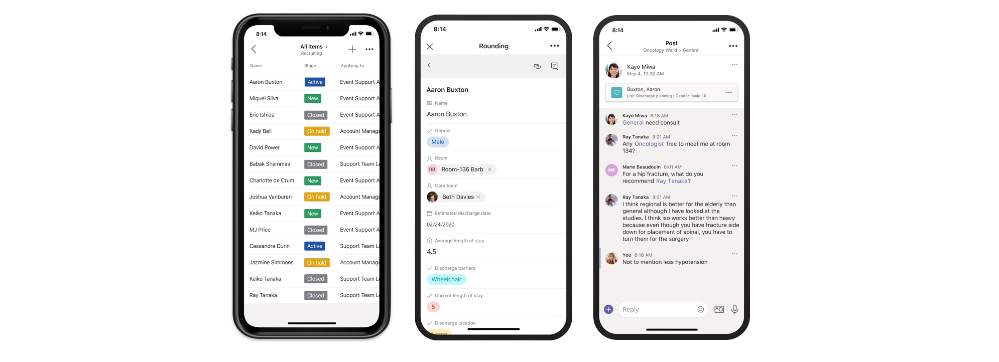
The new Lists app experience in Microsoft Teams, for mobile on the left and for Web and desktop on the right.
Lists in Teams is supported as a team based tab app built on top of the Microsoft Teams platform and supports the following features:
New list creation from scratch, from templates (8 standard templates and 3 industry specific ones: Patients, Loans, and Incidents), from Excel table data and from an existing list.
Importing existing team lists as new tabs.
All standard list features that you can access in SharePoint web: column types, view formatting, Quick Edit, exporting to Excel, sorting, filtering, etc.
The ability to have a channel conversation about a list item (see below for more details).
All user actions on the list are audited and available in the Security and compliance center audit logging.
How do I get started? To get started, simply go to any channel where you would like to start tracking a list and hit the “+” button to explore the tab gallery and select the Lists app. Once the tab is added you can either create a new list or bring in an existing list (from another team or an older SharePoint site, but not a personal list from Lists home) into the channel as a new tab.
Create a new list inside Teams with conversations side-by-side. The above shows using the Asset manager template.
The Lists app in Teams includes 3 new industry-specific templates – Patients, Loans and Incidents. Team members start managing and tracking these key entities. Here are some examples of how these templates can be leveraged.
Create a new list from within Microsoft Teams and choose from numerous ready-made templates, including the new industry-specific ones.
Healthcare organizations can use the Lists app in Teams to support patient rounding, multi-discplinary huddles and discharge planning. The Patients template is an easy way for all health teams to track patient progress and keep in touch with their peers. If you have questions about storage of PHI in Teams, Lists, or Office 365, please see more documentation here.
Government agencies can use the Lists app in Teams to track incidents and coordinated incident response. The Incidents template helps people quickly setup a list and get started.
Loan officers at a mortgage broker or bank can use the Lists app to track a set of loans and informally collaborate on advancing a them to approval. The Loans template helps them get started with plenty of scope for further customization.
How do I start a conversation alongside a list item?
Once you have configured the tab and have a list with list items, you can start a conversation about an individual list item. Go to the details view (or form) for the list item by clicking into the title field and then click on conversation to start a conversation about the list item on the channel. With this feature, you can collaborate with your team about the list item (your key business entities) and get work done, faster.
Since the conversation is a channel message in Teams, all the messaging features like @mentions, rich text, giphies, stickers, emojis, mentions, tagging, and attachments are available for use! The conversation shows up in the right rail for the list item and also on the channel for those who might not have viewed the list as yet.
You can chat side-by-side individual list items within Teams.
See more about getting started with the Lists app in Teams “Create a list in Microsoft Teams” click-thru demo. And do not forget to try the Lists app experience in the Teams mobile app to track your lists within Teams on the go. Just go to your Teams android or iOS mobile apps and go to the channel where you have added the Lists app and click on more and tap on the tab name to open up the list.
Learn more about the Lists app in Teams
If you are unable to see the Lists app in your channel, please contact your Teams Admin because applications in the Teams app store can be disabled or enabled by app permission policies. For more information, see the Manage the Lists app in Teams article. If you are looking for more resources and guidance, please review the help article here. For general help content and resources on Microsoft Lists, check out the Microsoft Lists resource center.
Note: Users of the existing SharePoint tab app in Teams that have pinned a list will see their experience inside the tab get upgraded to the latest Lists in Teams experience. This change will be rolling out today as well.
Millions of people use SharePoint lists and libraries every month in Microsoft 365 to track issues, manage inventory, report status, onboard new hires, build out event agendas, manage FAQs, and more. With flexible columns, forms, and views, you can build your own solution to meet your specific needs without knowing how to code. All these great capabilities now come to you inside the Lists app in Teams.
As always, thanks for taking the time to read about Lists in Teams! We’d love to hear any feedback or ideas you might have. Do submit suggestions on user voice. We are listening!
The internet policy world is headed for change, and the change that’s coming isn’t just a matter of more regulations but, rather, involves an evolution in how we think about communications technologies. The most successful businesses operating at what we have, up until now, called the internet’s “edge” are going to be treated like infrastructure more and more. What’s ahead is not exactly the “break them up” plan of the 2019 Presidential campaign of Senator Warren, but something a bit different. It’s a positive vision of government intervention to generate an evolution in our communications infrastructure to ensure a level playing field for competition; meaningful choices for end users; and responsibility, transparency, and accountability for the companies that provide economically and socially valuable platforms and services.
We’ve seen evolutions in our communications infrastructure a few times before: first, when the telephone network became infrastructure for the internet protocol stack; again when the internet protocol stack became infrastructure for the World Wide Web; and then again when the Web became infrastructure on which key “edge” services like search and social media were built. Now, these edge services themselves are becoming infrastructure. And as a consequence, they will increasingly be regulated.
Throughout its history, the “edge” of the internet sector has - for the most part - always enjoyed a light regulatory yoke, particularly in the United States. Many treated the lack of oversight as a matter of design, or even as necessarily inherent, given the differences between the timetables and processes of technology innovation and legislation. From John Perry Barlow’s infamous “Declaration of the Independence of Cyberspace” to Frank Easterbrook’s “Cyberspace and the Law of the Horse” to Larry Lessig’s “Code is law,” an entire generation of thinkers were inculcated in the belief that the internet was too complex to regulate directly (or too critical, too fragile, or, well, too “something”).
We didn’t need regulatory change to catalyze the prior iterations of the internet’s evolution. The phone network was already regulated as a common carrier service, creating ample opportunity for edge innovation. And the IP stack and the Web were built as fully open standards, structurally designed to prevent the emergence of vertical monopolies and gatekeeping behavior. In contrast, from the get-go, today’s “edge” services have been dominated by private sector companies, a formula that has arguably helped contribute to their steady innovation and growth. At the same time, limited government intervention results in limited opportunity to address the diverse harms facing internet users and competing businesses.
So, the internet didn’t turn out the way we hoped. Now what?
In our special Tech & Design issue, we ponder the internet’s future at a time when that future has never felt more unsettled. Read on: https://t.co/qszPhGOlwQ
As the cover of the November 17, 2019 New York Times magazine so well illustrated the internet of today is no utopia. I won’t try to summarize the challenges, but I’ll direct anyone interested in unpacking them to my former employer Mozilla’s Internet Health Report as a starting point. We are due for another evolution of the internet, but in contrast to prior iterations, the market isn't set up for change on its own - we need government action to force the issue.
I’m not alone in observing that the internet regulatory tide has turned. Governments are no longer bystanders. We are witnessing an inexorable rise in intervention. This is scary to many people: private companies operating in the sector worried about new costs and changes, academics and think tanks who celebrate the anti-regulatory approach we’ve had thus far, and human rights advocates concerned about future risks to speech and other freedoms. The internet has been an incredible socioeconomic engine, and continuing the benefits it brings requires preserving its fundamental good characteristics.
While new laws are not without risk of harm, further regulatory change today seems both necessary and inevitable. The open question is whether the effect will be, on balance, good or bad. If these imminent changes are done well, the power of government oversight will be harnessed to increase accountability and meaningful transparency, promote openness and interoperability, and center the future on user agency and empowerment to help make markets work to their fullest. If on the other hand these changes are done poorly, we risk, among other undesirable outcomes, reinforcing the status quo of centralized power, barriers to entry and growth, and business models that don’t empower users but instead subject them to ever-worsening garbage.
I’m an optimist; I think we’re on a course to make the internet better through good government intervention. From my perspective, we can already see the framework of the future comprehensive internet regulation that is to come, for better or for worse. Think of it as the Internet Communications Act of 2024, to use a U.S. naming convention; or the General Internet Sector Regulation, following the E.U. style. Advocates for a better internet can either sit on the sidelines as these developments continue, decrying the (legitimate) risks and concerns; or they can get into the mix, put forward some good ideas, and build strategies and coalitions to help shape the outcome so that it best serves the public’s interest.
Where are the key policy fights taking place? Geographically, over the past few years, we’ve seen the center of internet policy shift from Washington D.C. to Brussels, and that’s where we can see the future emerging most clearly today. The GDPR illustrates this shift, as despite its imperfections, it established a new paradigm for data protection that has been echoed in Kenya and California, with more to come.
This isn’t just a story about Europe, or about privacy, though. Competition reform is racing forward with major investigations and reports around the world; the United Kingdom has done perhaps the most work here, with its eye-opening Final Report of July 2020 (all 437 pages and 27 appendices of it!). Many countries are undertaking antitrust investigations of specific companies or reevaluating the modern day fitness of their competition legal frameworks.
Meanwhile social media companies and, more broadly, internet companies as intermediaries for user communications online, have come under fire all around the world, with Pakistan and India making some of the most aggressive moves so far. The European Union is advancing its own comprehensive regulatory vision for online content through the Digital Services Act, just as the United States is reevaluating its historical intermediary liability safe harbor, Section 230.
In the United States, we’re seeing a moment that bears many similarities to the late 1960s in the buildup to the Clean Air Act of 1970. That law had powerful bipartisan support, and commensurate industry opposition. Just as with those early climate political wars, advocates for reform are facing the weaponization of uncertainty as a tactic to resist government intervention, with the abuse of data and science and metrics to advocate for an outcome of inaction. As with climate change, inaction to address the harms presented by the internet ecosystem today is itself is a policy choice, and it’s the wrong one for the future health of the internet. I believe change will come though, and as with the Clean Air Act, eventually we'll look back and appreciate the sea change we made by intervening at a critical moment. (Sorry, that pun was mostly inadvertent - and, in fact, a bit unfortunate given the current state of play of climate politics and the climate crisis… but that’s a piece for another author, another day.)
Considering that the Clean Air Act established the Environmental Protection Agency, perhaps in the U.S. we need what Harold Feld and his colleagues at Public Knowledge have been calling for in the Digital Platform Act, establishing something akin to an Internet Protection Agency. Or perhaps, as I’ve supported in the past, we need a revamped Federal Trade Commission with greater authority, building on that agency’s success at integrating technologists into its consumer protection work. Increasingly, I’m inclined towards the idea that what we need is an expanded Federal Communications Commission, given that agency’s relatively broad authority (no matter how circumscribed by the current leadership) and the nature of this evolution as advancing what feels like modern day communications infrastructure. The United Kingdom has decided to go in this direction for content regulation, for example, appointing OFCOM to manage future “duty of care” obligations for online platforms. The technologies and businesses are very different between the traditional telecom sector and the internet ecosystem, though, and substantial evolution of the regulatory model would be necessary.
Regardless of where you situate the future policy making and enforcement function within the U.S. government, we’re still at the normative development stage on these policy issues. And frankly, the internet policy world needs some new ideas for what comes next. So, over the next few posts in this series, I’m going to share a few fresh thoughts that I’ve been mulling over. Stay tuned!
Others may now feel ready to board a plane again given the latest news. But just how safe is air travel during the pandemic? Is it safe to fly right now during COVID-19?
To break down the answers, we reached out to an array of experts, including an infectious disease doctor, an ER doctor, a pilot, a medical advisor for an aviation trade association, and frequent flyer founders of popular flight deal platforms.
Here's what they have to say about the risks of flying during COVID-19, encountering airplanes and airports, the precautions you should take to mitigate risk if you decide to fly, and whether or not they consider it safe to fly at all in this stage of the pandemic.
What are the risks of flying during COVID-19?
Remember that most air travel - with the exception of private flights, or public charters like JSX that fly through private terminals - requires not just the airplane flight itself, but also the full airport experience. As we all know, that means lots of lines and crowds.
We also know that the virus is generally transmitted directly between people. Therefore, people-to-people interactions pose the greatest risk among the factors present in airports.
"Airports have constant traffic going through them with travelers coming to and from various locations around the globe," said Dr. Neil Brown, an emergency medicine physician and K Health's chief diagnosis officer. "We cannot be sure everyone is using the same precautions as we are, nor if they have been advised to."
But you might be able to reasonably manage your risk of exposure to people in an airport. Dr. Thomas Russo, chief of the division of infectious disease at the University at Buffalo, said, "I would think that you could control spacing and time that you might be exposed to individuals who might be infectious unbeknownst to you more easily as you're entering the airport and during the boarding process, than when you're on the flight."
Airports are also trying various tactics to minimize contact between people and promote social distancing. For instance, Seattle-Tacoma International removed many of the seats at its gates. At Hartsfield-Jackson Atlanta International Airport, passengers can use facial recognition technology to bypass various points of human contact prior to boarding.
What are the risks of getting COVID-19 on an airplane?
Airplanes are known to filter air quickly and effectively.
In fact, airplane travel has many built-in safety features that are well suited to the age of the novel coronavirus, explains Dr. David Powell, a medical advisor for the International Air Transport Association (IATA), a trade group that represents most of the world's major passenger airlines and cargo carriers.
"Customers sit facing forward and not toward each other, seat backs provide a barrier, and the limited movement of passengers once seated adds to the onboard protection," he said. "Moreover, airflow is less conducive to droplet spread than other indoor environments: flow rates are high, directed in a controlled manner (from ceiling to floor), to limit mixing, and the use of High Efficiency Particulate Air filters ensures that the air supply is pure."
Pilot and aviation author Brett Manders explains that these filters are able to capture 99.9 percent of virus particles. "The other thing to note is aircraft air is replaced at a rapid rate," he says. "If you filled the aircraft with green smoke for demonstration purposes, it would be all 100-percent clear within two minutes."
But while these features may help reduce risk, they do not change the fact that commercial airplane travel means flying in a confined space with other people, and for more than a fleeting period of time.
Manders notes that while planes' airflow and filtration systems are effective, they can't do everything to prevent spread between passengers, even those who may be asymptomatic.
"COVID-19 transmits by droplets in the air and whilst the systems refresh cabin air at a rate of about 90 seconds, it isn't a linear flow from ceiling to floor," he said. "Unfortunately, air will mix and tumble and it only takes a droplet in the air from a passenger's cough, speech, or sneeze to your personal space."
PeopleImages/E+/Getty Images
Indeed, Dr. Russo underscores that airplanes' airflow systems may be good - but they're not magical. "The air handling in a plane is pretty good, but it's still a closed space. And depending on how long your flight is, you're going to be in proximity of a fixed number of people for a prolonged period," he says. "Once you're on the flight, you've been dealt a hand. Hopefully, everyone around you isn't infected, but you just don't know for sure. A longer flight is going to be a greater risk even though the air is handled pretty well because it's a close space, exposed to other individuals, and the time of exposure is longer."
Russo puts the risk of infection coming mainly from other passengers next to you or within a couple of rows. It's "a lot less likely [from passengers] 10 or 15 rows back."
What are tips to follow for flying during COVID-19?
As it is known that the virus spreads primarily through direct person-to-person contact, inanimate objects are much less of a concern, according to CDC guidance.
"It's really proximity to people," Dr. Russo said. "This would be a time to use your best masks. If you have an N95 mask, that's ideal," he says."Bring your own wipes if you want to be sure, and wipe down your tray tables, all your audio, TV remote knobs, and all that sort of stuff."
Dr. Brown also suggested sanitizing the seat, armrests, headrests, and sidewalls if you have a window seat. "If you are flying or planning to, I highly recommend everyone to take certain precautions to lower your risk of being exposed to the coronavirus such as making sure you are up to date with your routine vaccinations, wash your hands often or use an alcohol-based hand sanitizer, steer clear from people who are visibly sick, and avoid touching your eyes, nose, and mouth," he said.
Dr. Brown considers it "generally safe" to use the airplane's lavatory as long as you socially distance as much as possible from other passengers if waiting in line. "I would advise travelers to avoid directly touching the door, bathroom faucet, the slider to lock the lavatory, and the handle to flush the toilet."
Also, consider that eating and drinking on planes may be another possible transmission trigger. As airlines reintroduce food and drink service, proceed with caution and limit the amount of time your mask is off.
How are airlines dealing with COVID-19?
Airlines previously announced a patchwork of new policies designed to reduce the risk of virus transmission and reassure would-be travelers. The government also issued a national mask mandate earlier this year requiring face masks in airports and on planes.
Dr. Powell noted changes within airports that include airport staff and passengers wearing masks, provision of hand sanitizer dispensers, frequent and thorough disinfection of premises, and physical distancing measures where practicable.
Some airports, including London Heathrow and Puerto Rico's San Juan airport, also conducted passenger temperature checks using thermal cameras. Of course, much has been made of the novel coronavirus' ability to transmit through asymptomatic passengers, who would not be detected in such a screening.
On the planes themselves, airline policies vary widely. Delta was among those announcing it would cap seating capacity to guarantee distancing and block middle seats, but recently ended those policies, and was one of the last airlines to do so.
Additionally, Dr. Powell said, "We are seeing measures being introduced such as wearing of face masks and coverings by passengers and crew, simplified catering that reduces interactions between passenger and crew, reduced mobility on board, more frequent and deeper cabin cleaning, and new boarding procedures to eliminate crowding on the air bridge and in the cabin."
However, the policies are constantly changing. "There's been a bit of confusion," says Scott's Cheap Flights founder and flight expert Scott Keyes. "Some airlines are blocking middle seats, some are limiting the number of passengers on board, some are warning passengers ahead of time if it'll be a full flight, and some are doing none of that. It's difficult to keep straight which airline is taking which step, if any. Generally speaking, airlines are adhering to their stated policies, but those policies vary widely."
And not everyone is as convinced the airlines are faithfully doing what they promise. Alex Miller, the founder and CEO of UpgradedPoints.com, says they can only "sort of" be trusted. "Many airlines promised blocked seats, but later revealed that if flight loads dictated, they would release these seats for passengers. So, blocked seats really weren't blocked after all. This said, most airlines are implementing rigid cleaning procedures and most airlines are abiding by these new, strict standards."
Most airlines have already abandoned the policy entirely and opted to fill aircraft to capacity, citing US Department of Defense and Harvard School of Public Health studies that show the effectiveness of mask-wearing and high-efficiency particulate air filters in limiting the onboard spread of COVID-19.
MARK RALSTON/Getty Images
For his part, Dr. Russo is not convinced that seat-blocking policies are necessarily adequate to fully mitigate risk in all situations anyway. After all, a window seat is hardly six feet from the seat on the aisle, even if the middle seat is vacant.
Is flying safe if I've been vaccinated?
The first important factor here is that you've been fully vaccinated. Whether you receive one dose or two depends on which vaccine you get, but according to the CDC, you need to wait at least two weeks after receiving your final dose to be considered fully vaccinated.
Dr. Russo also agrees with the recommendation. "Though we're still learning about the vaccine, it offers an extraordinary degree of protection against developing symptomatic disease, and if it does develop, it will likely be a very mild case," he said. "Although the vaccines are very good at preventing transmission to others, there is still a small but finite chance you could be infectious even if vaccinated. If you had COVID-19, that offers a degree of protection, but it's even more robust protection if you've been vaccinated."
However, he also notes that you still need to wear a mask on planes and when in public areas like airports, even after getting vaccinated. "The vaccines are very good, but they're not perfect. While you're much less likely to transmit the disease or get it, there is still a chance," says Dr. Russo.
As for when we can all feel safe hopping on planes without masks again like pre-pandemic times, Dr. Russo says we are still at least a few months away, if not more, and notes that many areas still have high infection rates. "We would need to reach herd immunity levels and have cases be at, or very close to, zero," he says.
Bottom line: is it safe to fly?
The IATA's Powell reports encouraging data about the risk of virus transmission on flights. "The risk of transmission of COVID-19 from passenger-to-passenger onboard an aircraft appears already to be very low, based on our communications with a large number of major airlines during January through March 2020, and a more detailed IATA examination of contact tracing of 1,100 passengers [during the same period] who were confirmed for COVID-19 after air travel." He attributes this to the seating configuration, airflow and filtration systems, and those other traits unique to flying.
But according to medical experts unaffiliated with aviation, there continues to be an inherent risk in flying. "Safe is a relative term," Dr. Russo said. "Particularly for longer flights, even with good mask usage, you're getting into the more moderate risk zone as opposed to low risk" environments you might find with grocery store outings or jaunts to a local beach with social distancing.
"On a plane, all bets are off as far as likelihood of who could be infected," he said. "It could be different people from different parts of the world, and different prevalence of disease. So even if you're flying out of an area where everything looks good, you just don't quite know who's on that plane, where they've been, and what their state is. The mask affords a certain degree of protection, but there's no question there's going to be some risk with this situation, particularly the longer the flight is and the more crowded it is."
Dr. Brown puts it simply: "It is best to avoid any unnecessary travel at the moment."
Whether or not to fly remains an individual choice, best undertaken after serious considerations of the risk-versus-reward ratio until there is a vaccine. For his part, Dr. Russo said he would fly for a significant family event he deemed worthy of exposure to some amount of risk.
Keyes agreed. "I think it's safe enough that if I had an important trip like visiting a sick family member, I'd feel confident getting on board."
A sample of airlines' current COVID-19 policies
Air Canada: Mandatory masks for passengers. Issuing contact-free infrared temperature screenings. Passengers with elevated temperatures will be denied boarding.
Air France: Mandatory masks for passengers. Issuing contact-free infrared temperature screenings on some flights.
American Airlines: Seats are no longer blocked and flights may be filled to capacity. Mandatory masks, and reduced food and beverage service is continuing. If a flight is booking up, American may notify passengers and offer the option to change flights free of charge. No change to boarding process.
Allegiant: Flights may be filled to capacity and masks are mandatory.
Delta: Mandatory face masks, reduced food and beverage offerings, and new boarding by row procedure from back to front. Reducing the total number of passengers per flight depending on aircraft type.
Emirates: Mandatory masks, food offerings reimagined in bento-box style to reduce contact during service, and option to buy extra seats when at the airport for onboard distancing.
Frontier: First US airline to announce screening all passengers with temperature checks and denying boarding if found to be elevated. Mandatory masks, plexiglass partitions are being installed at ticket counters, all passengers checking in must accept a health acknowledgment. No food and drink service and no change to boarding process.
Hawaiian: Seats are no longer blocked and flights may be filled to capacity and masks are mandatory.
JetBlue: First airline to make masks mandatory for passengers and crew. Mandatory masks, plexiglass partitions are being installed at ticket counters, all passengers checking in must accept a health acknowledgment. Seats are no longer blocked and flights may be filled to capacity. Limited food and beverage service and back to front boarding.
Southwest: Mandatory masks for the crew, and airline-provided masks for passengers without them, limited food and beverage service of ice water and a snack mix. Seats are no longer blocked and flights may be filled to capacity. No change to boarding process.
Spirit: Flights may be filled to capacity and masks are mandatory. Food and drinks, including alcoholic beverages, are available for purchase.
Sun Country: Flights may be filled to capacity and masks are mandatory.
United: Seats are no longer blocked and flights may be filled to capacity, but United will allow passengers with full flights to make a change free of charge. Masks are mandatory and boarding is from back to front. Service is suspended on short flights, but on flights longer than 2 hours and 20 minutes, United will distribute amenity bags with a sanitizing wipe, water bottle, and snacks, and offer soft drinks.
More reporting on whether it's safe to travel right now
We've noted for a long time that telecom giants like Comcast and AT&T have been pushing (quite successfully) for massive deregulation of their own monopolies, while pushing for significant new regulation of the Silicon Valley giants whose ad revenues they've coveted for decades. As such, it wasn't surprising to see AT&T come out with a incredibly dumb blog post this week supporting Trump's legally dubious and hugely problematic executive order targeting social media giants. You know, the plan that not only isn't enforceable by the agencies supposedly tasked with enforcing it (the FCC), but that also risks creating a massive new censorship paradigm across the entire internet.
As Mike already noted, AT&T's post was a pile of bad faith nonsense, weirdly conflating net neutrality with the ham-fisted attack on Section 230. AT&T just got done deriding the FCC's relatively modest net neutrality rules as "government interference in the internet run amok." Yet here it is, advocating for a terrible plan that attempts to shovel the FCC into the role of regulating speech on social media, authority it simply doesn't have. For those that tracked the net neutrality fight, the intellectual calisthenics required here by folks like AT&T and its favorite FCC officials have been stunning, even for Trumpland:
Momentum continues to build for 230 reform:
“AT&T will join the growing consensus of voices concluding that online platforms should be more accountable for, & more transparent about, the decisions they control that fundamentally shape how we communicate”https://t.co/VEF5aQHJw5
By "momentum," Carr clearly means "intellectually-flimsy support by lobbyists employed by a telecom monopoly."
Folks like FCC boss Ajit Pai know damn well Trump's order is laughable and legally dubious, going against nearly every principle they spent the last decade claiming to stand for. But they're going through the motions anyway to avoid upsetting dear leader and derailing any future political prospects. As a result, the FCC is burning resources holding a public comment period on Trump's EO and the (equally laughable) petition from the NTIA.
Numerous folks have submitted their comments on the record (you can read Mike's here). That includes AT&T, which is apparently not only busy making intellectually inconsistent arguments, but is providing form letters to other organizations to try and get them to support Trump's crappy EO. Some folks digging through the comments noticed that a lot of these groups are submitting AT&T's form letters to the FCC... without bothering to proof read them first:
When you submit an astroturf comment to the FCC's #Section230 rulemaking, you should generally replace "XYZ GROUP" in the pre-written comment with your group name. pic.twitter.com/WRj5Lfzja7
This is a greasy lobbying tactic companies like AT&T have employed for years. In fact, we wrote a piece just about a decade ago busting AT&T for the exact same behavior. AT&T can routinely be found giving money to groups in exchange for support for problematic to downright terrible policies, be it be support for AT&T's latest merger, or the culling of any meaningful oversight of telecom monopolies. Often this includes the "co-opting" of even civil rights or consumer groups. Other times, it involves the creation of entirely bogus "consumer rights" or advocacy groups.
The goal is always the same: to create the illusion of broad support for what's almost always terrible tech policy that aids AT&T in some way.
This sort of "astroturfing" (fake grass roots) has been a problem nobody wants to fix. This being the Trump FCC, you shouldn't expect them to police this kind of gamesmanship with any sort of integrity. You'll recall that the FCC not only turned a blind eye as the telecom sector used dead, fake, or hijacked personalities to spam the FCC during the net neutrality repeal,
it actively blocked law enforcement inquiries into who was behind them.
This corporate co-opting of what's often the only chance the public has to express their thought on the record plagues numerous agencies, not just the FCC. And given AT&T's still busy doing this sort of thing nearly a decade after being busted for the exact same thing, you can clearly see how important protecting the integrity of public policy discourse is for U.S. leaders. Granted if your arguments are sound on their merits (which the Trump EO most certainly isn't), you wouldn't need to generate fake support from dead people or co-opted organizations in the first place.
Intel has officially announced its first 11th Gen Tiger Lake processors for laptops, which will feature the company’s new integrated Xe graphics, Thunderbolt 4 support, Wi-Fi 6, and a big leap in performance and battery life over the previous Ice Lake chips. The company claims that the new 11th Gen lineup offers the “best processor for thin-&-light” laptops.
Intel is launching nine new 11th Gen designs for both its U-series (which Intel is now referring to as UP3) and Y-series class chips (aka UP4), led by the Core i7-1185G7, which offer base speeds of 3.0GHz, a maximum single core turbo boost of up to 4.8GHz, and a maximum all-core boost of up to 4.3GHz. It also features the most powerful version of Intel’s Iris Xe integrated graphics,...
Fujifilm has announced a new 50mm X-series lens with an unprecedented f/1.0 aperture. The XF 50mmF1.0 R WR is the world’s first f/1 autofocus lens for mirrorless cameras, according to Fujifilm, and marks the 35th X-series lens the company has produced. Its field of view is about 75mm-equivalent on Fujifilm’s APS-C sensors.
Fujifilm’s previous fastest lens was the 56mm f/1.2, which is the aperture that companies like Canon and Nikon also tend to top out at when designing autofocus lenses. While Canon did make an autofocus 50mm f/1.0 for its DSLRs at one point, it was discontinued decades ago. Nikon and Leica have made f/0.95 lenses before, but they only worked with manual focus. Large apertures allow the user to achieve shallower depth of...
 Now, another new name and logo will go up on the company’s buildings across the metro area. It isn’t because of one big acquisition, but rather a bunch of smaller ones. Outside of those name-changing transactions, the company has made dozens of other ones, small and big, such as Broomfield-based Level 3 Communications. Along with internal software innovations, they have given Lumen the ability to provide enterprise customers with a variety of services in a variety of areas.


 A Sinovac Biotech vaccine for Covid-19, one of three vaccines China has authorized under an emergency use program, on display at the China International Fair for Trade in Services in Beijing on September 6, 2020. | Noel Celis/AFP via Getty Images
/cdn.vox-cdn.com/uploads/chorus_asset/file/21874760/GettyImages_1228416806.jpg) Shen Hong/Xinhua via Getty
Shen Hong/Xinhua via Getty

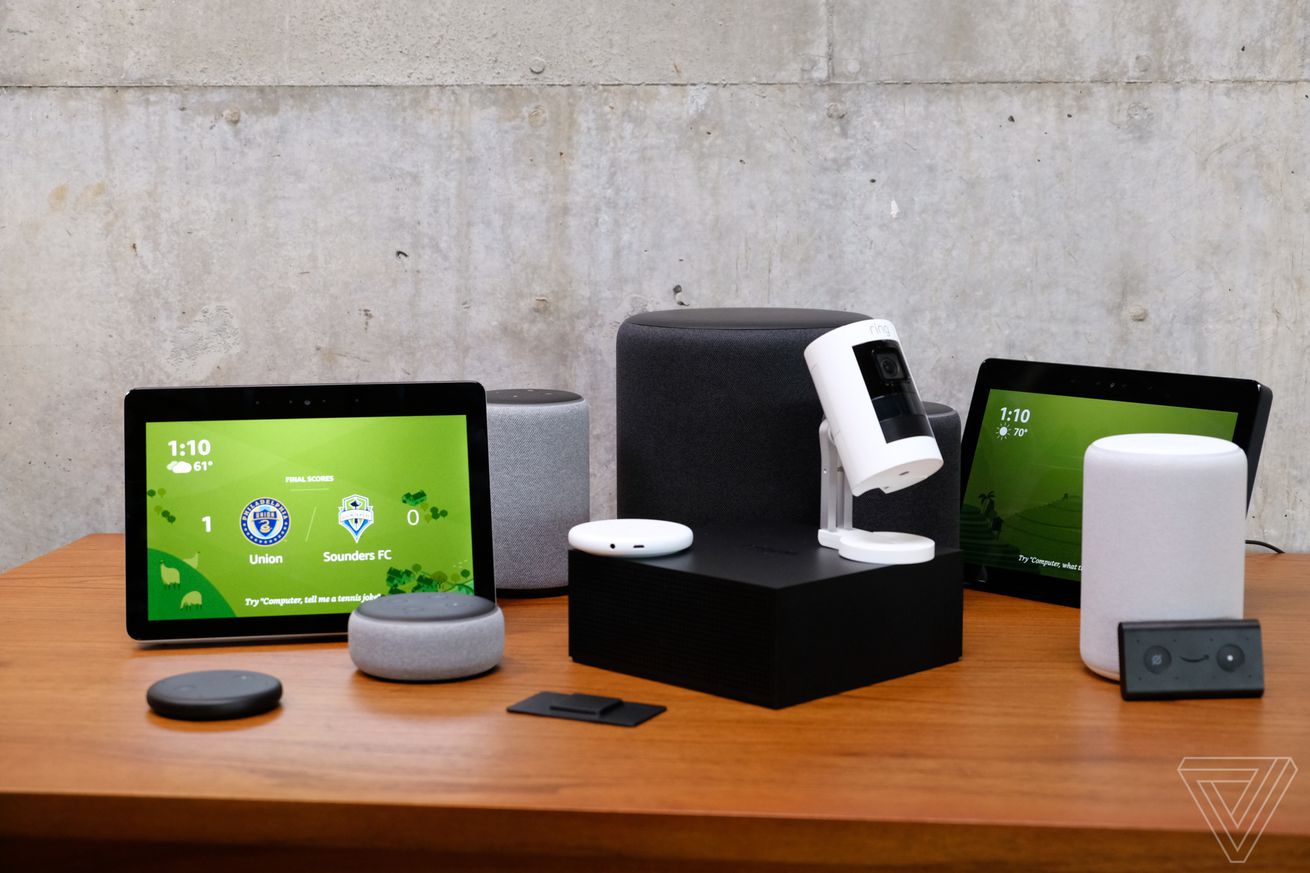 Photo by Dan Seifert / The Verge
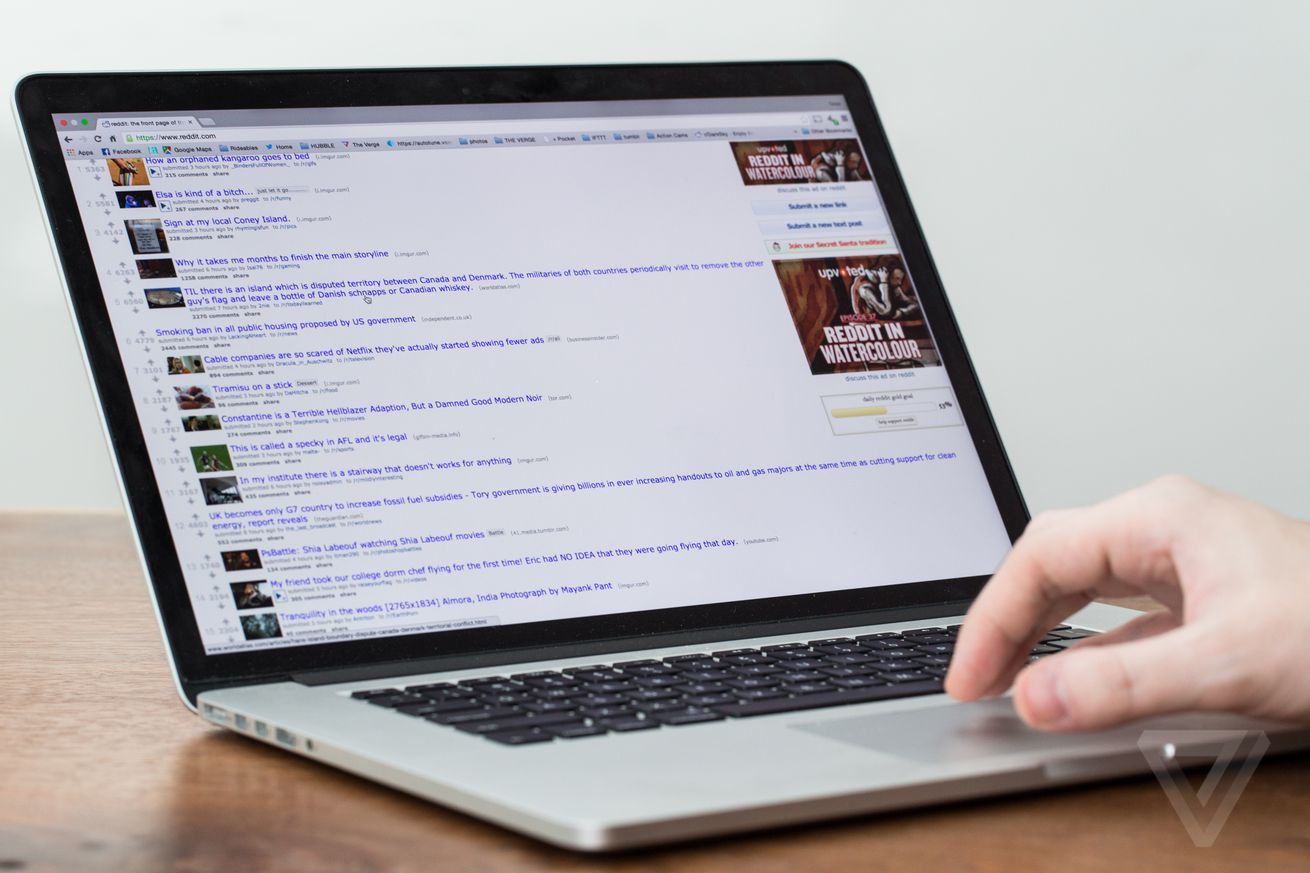
 Image: Yubico

 Image: CBS
 The new Lists app experience in Microsoft Teams, for mobile on the left and for Web and desktop on the right.
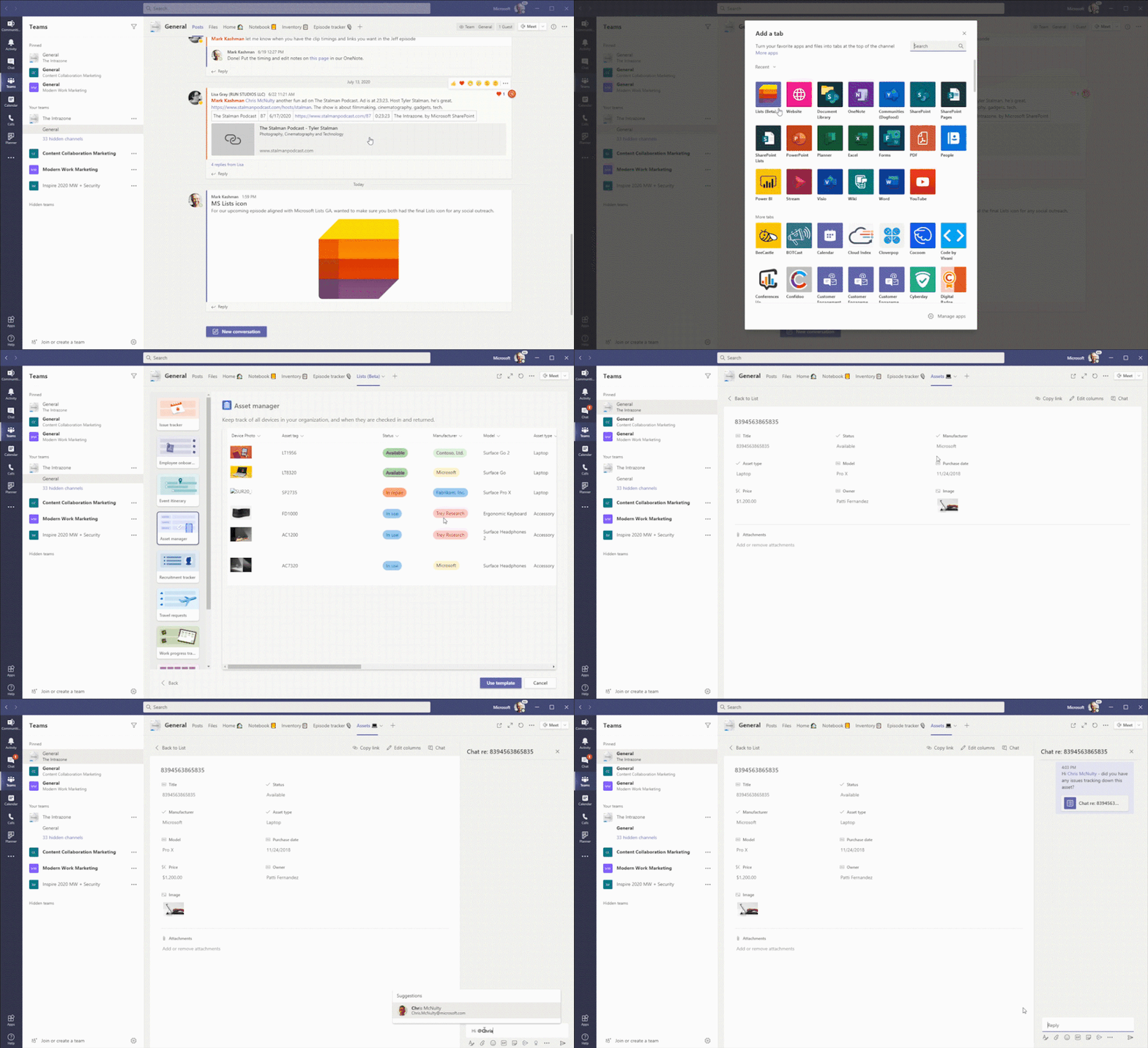 Create a new list inside Teams with conversations side-by-side. The above shows using the Asset manager template.
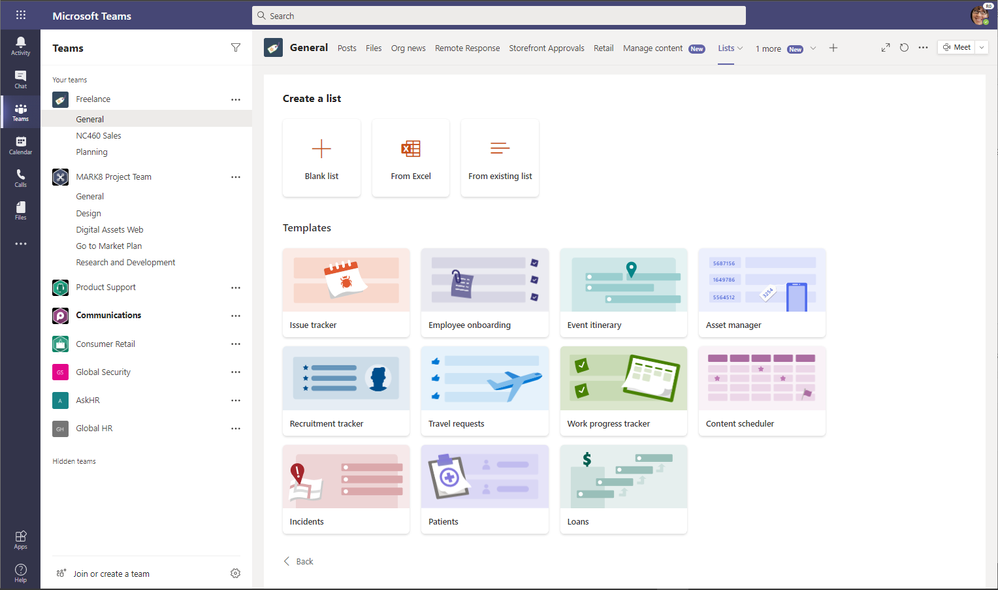 Create a new list from within Microsoft Teams and choose from numerous ready-made templates, including the new industry-specific ones.
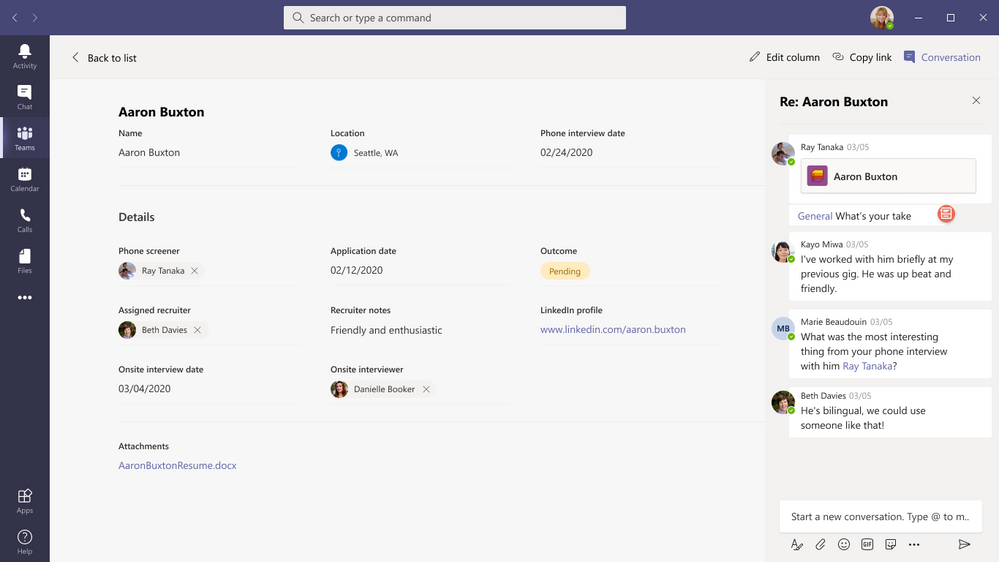 You can chat side-by-side individual list items within Teams.