Shared posts

13 Nov 15:42

Meet Zoo de Beauval’s Handsome New Tapir

by Andrew Bleiman

1_22713436_1781610201863918_5821360811058164021_o

Zoo de Beauval is pleased to announce the birth of a male Brazilian Tapir. The handsome three-week-old has been named Diego.

Attentive mother, Chiquita, has been protectively caring for her sweet, striped son. The new family, including dad Farrusco, is at home in the Zoo’s South American exhibit.

2_22791984_1781610255197246_4416364773959397786_o

3_22713235_1781610225197249_5875735016977931129_o

4_22769813_1781610285197243_4033519976349854851_oPhoto Credits: Zoo de Beauval

The South American or Brazilian Tapir (Tapirus terrestris) is one of five species in the Tapir family, including: the Mountain Tapir, the Malayan Tapir, the Baird's Tapir, and the Kabomani Tapir.

They are excellent swimmers and divers, but they can also move quickly on land and rugged, mountainous terrain. They have a life span of approximately 25 to 30 years. When frightened, they are known to run toward water to take cover.

Brazilian Tapirs are herbivores. Using their nose, they can feed on leaves, buds, shoots, and small branches torn from trees, fruit, grasses, and aquatic plants.

They generally mate in late Spring through early Summer. Females go through a gestation period of 13 months (390–395 days) and will typically have one offspring every two years. Newborns weigh about 15 pounds and are weaned at about six months of age.

The Brazilian Tapir is currently classified as “Vulnerable” on the IUCN Red List. Dwindling numbers are due to poaching for meat and hide, as well as habitat destruction. The United States Fish and Wildlife Service designated the species as “Endangered” on June 2, 1970.

08 Nov 15:42

Long-Awaited Anteater Pup at Nashville Zoo

by Andrew Bleiman

1_Praim's Baby Girl - 2017 - Margarita Colburn4

A Giant Anteater pup was recently born at the Nashville Zoo. The female arrived on October 22, and she is the first of her kind born at the Zoo since 2011.

The pup, named Isabel, has been under the careful attention of mom, Praim. According to sources, Isabel weighed-in at three pounds and was around 26 inches at birth.

2_Praim's Baby Girl - 2017 - Margarita Colburn3

3_Praim's Baby Girl - 2017 - Margarita Colburn2Photo Credits: Nashville Zoo / Margarita Woc Colburn, DVM

The Giant Anteater (Myrmecophaga tridactyla), also known as the ‘ant bear’, is a large insectivorous mammal native to Central and South America. It is classified with Sloths in the order Pilosa.

The species is mostly terrestrial and is the largest of its family. It is especially recognizable by its elongated snout, bushy tail, and long fore claws. Adults can grow to a total length of around 7 feet and a maximum weight of around 90 pounds.

The Giant Anteater can be found in grasslands and rainforests. It forages in open areas and rests in more forested habitats. It feeds primarily on ants and termites, using its fore claws to dig them up and its long, sticky tongue to collect them.

They are mostly solitary, except during mother-offspring relationships. Giant anteaters can mate throughout the year. Gestation lasts around 190 days and ends with the birth of a single pup, which typically weighs around 1.4 kg (3.1 lb). Females give birth standing upright.

Pups are born with eyes closed and begin to open them after six days. The mother carries its pup on its back for the first few months. The pup's black and white band aligns with its mother's, camouflaging it. The young communicate with their mothers with sharp whistles and use their tongues during nursing. After three months, the pup begins to eat solid food and is fully weaned by ten months. The mother grooms her offspring during rest periods lasting up to an hour. Grooming peaks during the first three months and declines as the young reaches nine months of age. Young Anteaters usually become independent by nine or ten months.

The Giant Anteater is currently listed as “Vulnerable” by the International Union for Conservation of Nature. It has been extirpated from many parts of its former range, including nearly all of Central America. Threats to its survival include: habitat destruction, fire, and poaching for fur and bush meat.

03 Nov 16:29

Rare Baby Wombat Emerges From the Pouch

by Chris Eastland
Leahgates

features boops

DSC_4562-(10-17)-wombat2

A baby Southern Hairy-nosed Wombat, born on February 4, 2017 at the Brookfield Zoo and one of only nine living in North America, is out of the pouch and exploring her surroundings along with her mom, 17-year-old Kambora. 

At birth, a Wombat joey (that’s what a baby marsupial, or pouched mammal, is called) is tiny and hairless, and is about the size of a bumblebee. It climbs into its mom’s pouch where it attaches to a teat and remains there for the first few months of life. While in the pouch the young joey sleeps and nurses, getting all the necessary nutrients it needs to fully develop. Though she was born in February, the joey didn't peek out of Kambora’s pouch until the end of August. Gradually, she went from poking her head for a few seconds to climbing completely out of the pouch. Now weighing just over 10 pounds, the joey is very inquisitive and becoming more independent.

22780663_10156005823044170_7832309798256986397_n
22688420_10156005823034170_3338021262524645997_nPhoto Credit: Brookfield Zoo

The not-yet-named joey is Kambora’s sixth offspring and the first for the sire, 5-year-old Darryl, who arrived at Brookfield Zoo in 2016 from Australia. Several years ago, Brookfield Zoo staff worked with the five other North American zoos that have southern hairy-nosed Wombats, along with Zoos South Australia and their government, to form and develop a breeding program to ensure a genetically sustainable population for the species in professional care.

In 1969, Brookfield Zoo received three Southern Hairy-nosed Wombats, and, in 1974, became the first zoo outside of Australia to successfully breed the species in professional care. Since then, there have been 21 Wombat births at Brookfield Zoo. There are only nine southern hairy-nosed Wombats in five North American institutions, including at Brookfield Zoo.

DSC_4565-(10-17)-wombat

DSC_4540-(10-17)

Southern Hairy-nosed Wombats, whose closest living relative is the Koala, are thick, heavy-bodied animals. They are native to central southern Australia, where they live in arid to semiarid savannah woodlands, grasslands, and low shrub plains. They are about the size of a medium-sized Dog, but are much more rounded and solidly built. The pouch opens to the rear, so that when they are digging, soil does not get into it.

Wombats have long claws, a stubby tail, a flattened head that looks too big for their body, and short, powerful legs. They use their long claws when digging warrens—complex, underground tunnel systems—that are the center of Wombat life. Each warren is made up of several separate burrows. Wombats never wander too far from their warrens. Several Wombats may have their warrens near each other, forming a cluster. However, they rarely interact with each other. Currently, the Wombat population in Australia is being threatened by habitat loss, drought, and agricultural practices.


Related articles
02 Nov 14:09

Rowdy Rhino Calf Joins 'Crash' at Cotswold

by Andrew Bleiman
Leahgates

First video features a critically important grumphop

1_Baby Alan (photo credit Jackie Thomas) (2f) (1)

Cotswold Wildlife Park is celebrating the birth of a White Rhino calf. The newborn male, named Alan, is the newest additions to the UK park’s “crash” (collective noun for a group of Rhinos) at their Burford collection.

It’s been a remarkable few years for the Rhino family at Cotswold. After almost forty years of hoping the Rhinos would breed, history was finally made in 2013 with the birth of Astrid, the Park’s first Rhino breeding success.

Since the arrival of Astrid, thanks to the dedication of the mammal keepers, the breeding programme has gone from strength to strength. The newest arrival, Alan, is the fourth White Rhino to be born at the Park.

2_Baby Alan (photo credit Jackie Thomas) (2g)

3_Baby Alan (photo credit Jackie Thomas) (2f) (2)

4_Rhino baby Alan (photo credit Jackie Thomas) (3c) (3)Photo Credits: Jackie Thomas /Cotswold Wildlife Park & Gardens

Alan is the second calf for parents, Ruby and Monty. At just one-week old, he weighed around eleven stone (154 lbs.), and he is proving to be a high-spirited and boisterous youngster. Ruby also continues to impress keepers with her skills as an exceptional and protective mother.

(Alan is named in honor of Cotswold Wildlife Park’s electrician who retires this year after twenty-three years of dedicated service.)

Managing Director of Cotswold Wildlife Park, Reggie Heyworth, said, “Everyone is over-joyed about the birth of another Rhino calf to Ruby, who is being such a good mother, for the second time. The calf looks like a strong lad already, and the rest of the Rhino ‘crash’ seem to be taking his arrival in their stride. With Rhinos facing such poaching pressures in the wild, every birth in captivity is a sign of hope for this wonderful species”.

Births in captivity are considered extremely rare, with only thirteen White Rhinos being born in European zoos in the last twelve months.

Females only reproduce every two-and-a-half to five years, so the window of opportunity for successful reproduction is limited. After a gestation period of sixteen to eighteen months, a single calf is born. This is one of the longest gestation periods of any land mammal, surpassed only by the twenty-two month gestation period of an Elephant. A newborn Rhino calf will stand up within one hour of birth and immediately attempt to suckle, although he or she may be a little unsteady on their feet for the first few days. It will remain under the watchful eye of the mother, suckling from her for approximately one year. Their bond is an intensely strong one, and the calf will remain with its mother for at least two years, benefiting from her protection. Females guard their offspring aggressively and are intimidating adversaries if challenged.

The White Rhino (Ceratotherium simum ssp. simum) is living proof of conservation success. They were once the rarest subspecies of any Rhino and were on the verge of extinction in the early 1900s, when it was believed only some fifty animals remained in their native South Africa. Thanks to excellent and sustained protection, they are now the most common of the five Rhino species, although poaching in the last five years has once again escalated to serious levels. Three of the five Rhino species – the Black, Javan and Sumatran – are critically endangered.

Poaching for their horns remains the biggest threat to these iconic animals. Recently HRH Prince William warned: “Rhinos face extinction in our lifetime as we struggle to correct lies about the supposed benefits of using its horn as a drug”. There is no evidence that horns, made of the same substance as human fingernails and hair, have any medicinal value. However, the false belief that Rhino horn can cure cancer and other life-threatening diseases has resulted in a population slaughter of one thousand and fifty four Rhinos in South Africa alone in 2016.

White Rhinos have always been an important species at the Wildlife Park. They were one of the first large mammals to join the collection, which was founded by Mr. John Heyworth in 1970.

Cotswold Wildlife Park is committed to the conservation of these iconic mammals. Each year the Park hosts Rhino Month to raise awareness and funds for Rhino conservation work in Africa. This year £1,000 was raised and donated to Save the Rhino International for their conservation work with the critically endangered Black Rhinos in Namibia.

Visitors to the Park can see the new calf daily in the large Rhino paddock and solar powered Rhino House.

More great pics of Alan, below the fold!

5_Calf Alan staring at camera (photo credit Jackie Thomas)

6_Rhino baby Alan (photo credit Jackie Thomas) (58)

7_Rhino baby Alan (photo credit Jackie Thomas) (59)

8_Rhino baby Alan 1st mudbath caught on camera (photo credit Jackie Thomas) (1)

9_Rhino baby Alan 1st mudbath caught on camera (photo credit Jackie Thomas) (3)

10_Calf Alan on the rocks (photo credit Jackie Thomas)

11_Rhino baby Alan various  (photo credit Jackie Thomas) (46)

12_Rhino baby Alan running around paddock (photo credit Jackie Thomas) (3a)

13_Rhino baby Alan various (photo credit Jackie Thomas) (11)

14_Rhino baby Alan various (photo credit Jackie Thomas) (12)

31 Oct 17:49

Houston Zoo's Elephant Brings 'Joy' to the World

by Chris Eastland
Leahgates

elephants are the only other animals with chins

1_Baby Elephant Joy Outside-0010-7098

After a two-year pregnancy, the wait is over for the Houston Zoo’s Asian Elephant, Shanti. On July 12, the 26-year-old gave birth to a 305-pound female.

The calf has been named Joy by the zoo team that has dedicated their lives to the care, wellbeing, and conservation of these incredible animals.

Baby elephants are quite wobbly when they’re first born, so the harness seen on the images and video of Joy assists the elephant team to help her stand-steady while she’s nursing.

Shanti gave birth in the Houston Zoo’s McNair Asian Elephant Habitat cow barn under the supervision of keepers and veterinary staff. She and her calf underwent post-natal exams and are now spending several days bonding behind the scenes. During this important bonding period, the elephant team is watching for the pair to share key moments like communication and hitting weight goals.

“Our animal team is thrilled that the birth has gone smoothly,” said Lisa Marie Avendano, Vice President of Animal Operations at the Houston Zoo. “We look forward to continuing to watch Joy and Shanti bond, and introducing her to Houston.”

2_Baby Elephant Joy Outside-0003-6833

3_Baby Elephant Joy Outside-0004-6921

4_Baby Elephant Joy Outside-0006-7012Photo Credits: Stephanie Adams/ Houston Zoo

The Asian Elephant (Elephas maximus) is the only living species of the genus Elephas and is native to Southeast Asia from India and Nepal in the west to Borneo in the east.

Since 1986, the species has been listed as “Endangered” by the International Union for Conservation of Nature (IUCN). The population has declined by at least 50 percent over the last three generations. Primary threats are degradation, fragmentation, loss of habitat, and poaching.

*By visiting the Houston Zoo, guests help save baby elephants and their families in the wild. A portion of each zoo admission and membership goes straight to protecting an estimated 200-250 wild elephants in Asia.

Since the Houston Zoo started its work in Borneo in 2007, there has been a doubling of the elephant population on the island. The Houston Zoo also provides funds for elephant conservationist, Nurzhafarina “Farina” Othman and her team in Asia, to put tracking collars on wild elephants. This group uses collars to follow wild elephants, conducting valuable research that aids in protecting the elephants as they travel through the forests. Farina also spends time working with farmers that grow and produce palm oil, offering her guidance in responsible cultivation practices that are wildlife-friendly.

Palm oil is an ingredient in many foods and cosmetics, typically grown in areas that were previously home to animals like wild elephants. Converting pristine forests into oil palm plantations has caused extensive deforestation across Southeast Asia. Luckily, a growing number of producers are working to protect these areas and the animals that live there.

The Houston Zoo encourages people to protect elephants in the wild by supporting companies that use responsibly sourced palm oil, increasing demand for palm oil that is grown and produced without destroying the forested homes of elephants.

5_Baby Elephant Joy Outside-0007-7042

6_Baby Elephant Joy Outside-0008-7061

7_Baby Elephant Joy-0001-6296

8_Baby Elephant Joy-0002-6313

9_Baby Elephant Joy-0003-6322

10_Baby Elephant Joy-0004-6356

11_Baby Elephant Joy-0006-6395

31 Oct 14:11

Red Panda Brothers Debut at Philadelphia Zoo

by Andrew Bleiman

1_RedPandaCubs_YerenAnd#56B42

The Philadelphia Zoo’s two new adorable Red Panda cubs recently made their public debut.

Brothers, Yeren and Ping Jing, were born to mom, Spark, and dad, Khumbie, in June. This is the second successful Red Panda litter at Philadelphia Zoo. Twins, Benjamin and Betsey, were born in June of 2015.

Spark is a wonderful mom and is doing a great job caring for her new babies, and the Zoo says all are doing very well.

2_RedPanda_CubYeren_5675

3_RedPanda_CubPingjing_5622Photo Credits: Philadelphia Zoo

The birth of this litter is important, as Red Pandas are classified as “Endangered” by the IUCN. The main threats to the species in the wild are habitat destruction, poaching and climate change.

Known for their cinnamon colored fur and bushy, ringed-tail, the Red Panda (Ailurus fulgens) is native to the mountains of Central China, Nepal and northern Myanmar (Burma).

Yeren and Ping Jing are now on exhibit with their mom Spark each day at Philadelphia Zoo.

Related articles
30 Oct 17:09

Digital Resource Lifespan

Leahgates

extremely real in ways that seriously impact my life

I spent a long time thinking about how to design a system for long-term organization and storage of subject-specific informational resources without needing ongoing work from the experts who created them, only to realized I'd just reinvented libraries.
30 Oct 15:20

Rare Four-Eyed Turtles Hatch at Tennessee Aquarium

by Chris Eastland

1_Four-eyed Turtle and Beal's Four-eyed Turtle hatchlings

The Tennessee Aquarium recently celebrated the successful hatching of four endangered turtles.

When it comes to breeding some turtles, making even small changes to their environment can be like trying to introduce new foods to an especially picky eater.

“You don’t want to go changing a lot of stuff, or you may unsettle them and have to wait until next year to try again,” says Tennessee Aquarium Senior Herpetologist Bill Hughes. “With some turtle species, it doesn’t matter. With others, you move them to a different space, and they don’t lay eggs for five years. It throws them off track.”

Because of their fickleness and tendency to be slow to reproduce, every successful turtle-breeding season is significant, especially for imperiled species. At the Aquarium, Hughes recently celebrated the successful hatching of a pair each of endangered Four-eyed Turtles (Sacalia quadriocellata) and critically endangered Beal’s Four-eyed Turtles (Sacalia bealei).

The hatchlings emerged from their shells in the Tennessee Aquarium’s rooftop turtle nursery on June 13 (Four-eyed) and July 2-3 (Beal’s) from eggs that had been incubating at 82 degrees since being laid in April.

2_Four-eyed Turtle and Beal's Four-eyed Turtle hatchlings 2

3_Four-eyed Turtle (Sacalia quadriocellata) hatchlings

4_Beal's Four-eyed Turtle (Sacalia bealei) hatchlingsPhoto Credits: Tennessee Aquarium

The Aquarium is home to the largest collection of freshwater turtles in North America. In 2007, it received national attention as the first North American zoo or aquarium to successfully hatch a Beal’s Four-eyed Turtle.

In the last decade, the Aquarium has had continued success in hatching these “four-eyed” species, which are native to Southeast Asia and named due to eye-like markings on the top of their heads. Including the most recent babies, the Aquarium has successfully hatched 15 Beal’s Four-eyed and 37 Four-eyed Turtles since 2007.

In all, just 47 Four-eyed and 24 Beal’s Four-eyed are housed in North American facilities accredited by the Association of Zoos and Aquariums (AZA). Hatchlings raised at the Tennessee Aquarium have been shared with other caretakers in an effort to shore up their captive population. In 2015, a trio of Beal’s Four-eyed were sent to the Knoxville Zoo — the only other AZA institution to house them — and Four-eyed hatchlings have been shipped to facilities as far as New York, Texas and California.

In light of these turtles’ limited numbers, both in the wild and in captivity, Hughes says he’s largely opted to avoid tampering with his breeding setup for fear of derailing programs that are helping to significantly bolster their overall populations.

“The only thing I’ve really changed is cooling them off more in winter and incubating them a degree or two warmer,” he explains. “They’re all still in their same space they’ve been in for years, which is helping.”

Like many Southeast Asian species, both the Beal’s Four-eyed and Four-eyed Turtle wild populations have been in free fall in recent decades. This decline is thanks to a combination of human-induced threats, including habitat destruction and capture for use as a food source or to supply the pet trade.

According to a 2014 study by the International Union for Conservation of Nature, 50-60 percent of the 335 modern turtle and tortoise species are either extinct or threatened with extinction. That gives them the dubious distinction as the most imperiled major group of vertebrates on the planet.

The Aquarium’s successful rearing of Beal’s Four-eyed and Four-eyed Turtles is crucial to their survivability. Hughes serves as the coordinator of the Species Survival Plan (SSP) for the Four-eyed Turtle since that plan became active in 2012. This year, the Beal’s Four-eyed Turtle became a candidate for the program, and Hughes says the turtle’s conservation status puts it on the fast track to achieving full SSP status in the future.

Even after years of success in raising them, Hughes never tires of seeing new turtles emerge from their eggs. And as you would expect from such dogged creatures of habit, they tend to arrive almost like clockwork, he says.

“They lay at the same time or year, and the eggs hatch at the same time of year, so it’s like a floating holiday that doesn’t float that much. You know when it’s coming,” Hughes says. “It’s still a thrill to see them.”

Photo below by Todd Stailey, Tennessee Aquarium photographer, showing the ocelli, "false eyes", of the Four-eyed Turtle5_FOUREYEDTURTLE

28 Oct 15:20

Warthog Piglets Debut at Zoo Miami

by Chris Eastland
Leahgates

tbh sharing for the family stache display in this pic http://www.zooborns.com/.a/6a010535647bf3970b01bb09b52b81970d-800wi

1

Four Warthog piglets, born June 20 at Zoo Miami, made their exhibit debut this week alongside their parents. At six weeks old, the piglets (one female and three males) explored the exhibit, rooted around in the soil, and tasted fresh vegetation under the watchful eyes of mom and dad.

4
2
9Photo Credit: Ron Magill/Zoo Miami

Three-year-old mother Erica came from the Indianapolis Zoo and three-year-old father Beebop is from the San Diego Zoo Safari Park. This litter of piglets is the first for both parents and the second successful birth of Warthogs at Zoo Miami.

Warthogs are found through much of sub-Saharan Africa and skyrocketed to fame following the release of “The Lion King,” which starred a lovable Warthog named Pumba.

Warthogs use their large, powerful tusks to dig for roots, tubers, and grubs to eat. Males develop larger tusks than females and use their tusks in combat to establish dominance. The tusks also offer protection: Warthogs enter their burrows rear-first, allowing the tusks to face outward at the burrow entrance to deter predators.

The large facial bumps or “warts” are not warts at all. Instead, they are fatty growths which protect Warthogs’ faces from the tusks of other Warthogs during skirmishes.

Warthogs are fairly numerous across their range. They are not currently threatened, but some localized extinctions have been recorded due to overhunting or drought.

See more photos of the piglets below!

3
5
6
7
8

Related articles
28 Oct 15:19

Downtown Aquarium-Denver Welcomes Baby Alejandro

by Andrew Bleiman
Leahgates

pokemon

1_20264800_10155541340960148_8699893262200612860_n

The Downtown Aquarium at Denver welcomed a new Three Banded Armadillo on July 15.

The new guy, who has been named Alejandro, was born to first-time parents Lady Gaga and Howard Caruso. At his first weigh-in, Alejandro was 62g (2.2 oz.) and 1.5 inches long.

2_20265093_10155541340930148_1042219681278425895_n

3_20264888_10155541341050148_5892821731272283078_n

4_20229122_10155541341000148_6662293227210638679_nPhoto Credits: Downtown Aquarium-Denver

The Three Banded Armadillo can roll completely into a ball to protect itself from predators and thorny vegetation. The yellow-brown sides of the carapace extend beyond the skin, giving the armadillo a space to retreat its head, legs, and tail when curling up. The armor plating that covers the body is divided into two domed shells, with three armored bands in between, joined by flexible bands of skin.

Three Banded Armadillos reach a length of about 9 to 13 inches and weigh a max of about 3 to 3.5lbs.

They are found throughout the central region of South America: Southern Brazil, Bolivia, Paraguay, and Northern Argentina. They prefer mountain, tropical and temperate grasslands, as well as rainforest, tropical dry forest and swamps.

In the wild, they eat primarily insects, which includes: beetle larvae, ants, and termites. They are also known to consume plants, and other small animals.

In zoos, they are primarily fed cooked sweet potatoes, bananas, wax worms, crickets, and mealworms.

The gestation period is about 120 days. The female will typically give birth to a single young (pup). Pups are about the size of a golf ball at birth. The young will nurse for 10 weeks.

5_20245697_10155541340975148_2948724981072654672_n

28 Oct 15:17

Banded Palm Civets Born at Nashville Zoo

by Andrew Bleiman
Leahgates

severely boopable

1_Banded Palm Civet - 2007 - Heather Robertson (6)

Nashville Zoo recently welcomed the birth of two Banded Palm Civets. The brother and sister were born on June 29.

At their first well check, the male measured 19 cm (7.5 in) with a weight of 105g (3.7 oz). The female’s body length was 20.5cm (8 in) with a weight of 100g (3.5 oz).

2_Banded Palm Civet - 2007 - Heather Robertson (4)

3_Banded Palm Civet - 2007 - Heather Robertson (3)

Photo Credits: Dr. Heather Robertson/Nashville Zoo

For the past decade, this is only the second successful birth in an Association of Zoos and Aquariums (AZA) institution for the species. The first Banded Palm Civet birth was also at Nashville Zoo in September 2015.

Nashville Zoo is the only AZA accredited facility breeding this species. There are now a total of 11 Banded Palm Civets in the AZA’s collection, with ten being at Nashville Zoo and one at Cincinnati Zoo.

Nashville Zoo is heading a breeding research project to determine if Banded Palm Civets are seasonal breeders, as well as discovering other factors for fecundity.

The Banded Palm Civet (Hemigalus derbyanus), also called the Banded Civet, is rare species found in tropical forests across Myanmar, Malaysia, Thailand and on the Indonesian islands of Sipura, Sumatra and Borneo.

Roughly the size of a domestic cat, adults of the species measure from 41 to 51 cm (1.3 to 1.7 ft) in total length, and can weigh between 1 to 3 kg (2.2 to 6.6 lbs).

The Banded Palm Civet is carnivorous, and like other species of civet, it survives on a meat-based diet, supplemented by the plants or fruits.

After a gestation period that lasts for a couple of months, a female can give birth to up to four young.

The Banded Pam Civet is currently listed as “Near Threatened” on the IUCN Red List. It is under threat from deforestation and the loss of much of its natural habitat. Extensive deforestation in their habitat is a result of logging or to clear the land to make way for palm oil plantations.

Nashville Zoo currently does not have plans to place the Banded Palm Civet siblings on exhibit.

24 Oct 16:24

Making Progress

Leahgates

me during fulbright season when I fruitlessly try to stay on top of draft edits with increasingly complex color coding

I started off with countless problems. But now I know, thanks to COUNT(), that I have "#REF! ERROR: Circular dependency detected" problems.
23 Oct 16:39

The different media spheres of the right and the left — and how they’re throwing elections to the Republicans

by Lisa Wade, PhD

A new study tackles the media landscape building up to the election. The lead investigator, Rob Faris, runs a center at Harvard that specializes in the internet and society. He and his co-authors asked what role partisanship and disinformation might have played in the 2016 U.S. election. The study looked at links between internet news sites and also the behavior of Twitter and Facebook users, so it paints a picture of how news and opinion is being produced by media conglomerates and also how individuals are using and sharing this information.

They found severe ideological polarization, something we’ve known for some time, but also asymmetry in how media production and consumption works on either side. That is, journalists and readers on the left are behaving differently from those on the right.

The right is more insular and more partisan than the left: conservatives consume less neutral and “other side” news than liberals do and their outlets are more aggressively partisan. Breitbart News now sits neatly at the center. Measured by inlinks, it’s as influential as FOX News and, on social media, substantially more. Here’s the  network map for Twitter:

Breitbart’s centrality on the right is a symptom of how extreme the Republican base has become. Breitbart’s Executive Chairman, Steve Bannon — former White House Chief Strategist — calls it “home of the alt-right,” a group that shows “extreme” bias against racial minorities and other out-groups. 

The insularity and lack of interest in balanced reporting made right-leaning readers susceptible to fake stories. Faris and his colleagues write:

The more insulated right-wing media ecosystem was susceptible to sustained network propaganda and disinformation, particularly misleading negative claims about Hillary Clinton. Traditional media accountability mechanisms — for example, fact-checking sites, media watchdog groups, and cross-media criticism — appear to have wielded little influence on the insular conservative media sphere.

There is insularity and partisanship on the left as well, but it is mediated by commitments to traditional journalistic norms — e.g., covering “both sides” — and so, on the whole, the left got more balance in their media diet and less “fake news” because they were more friendly to fact checkers.

The interest in balance, however, perhaps wasn’t entirely good. Faris and his co-authors found that the right exploited the left’s journalistic principles, pushing left-leaning and neutral media outlets to cover negative stories about Clinton by claiming that not doing so was biased. Centrist media outlets responded with coverage, but didn’t ask the same of the right (it is possible this shaming tactic wouldn’t have worked the other way).

The take home message is: During the 2016 election season, right-leaning media consumers got rabid, un-fact checked, and sometimes false anti-Clinton and pro-Trump material and little else, while left-leaning media consumers got relatively balanced coverage of Clinton: both good stories and bad ones, but more bad ones than they would have gotten (for better or worse) if the right hadn’t been yanking their chain about being “fair.”

We should be worried about how polarization, “fake news,” horse-race journalism, and infotainment are influencing the ability of voters to gather meaningful information with which to make voting decisions, but the asymmetry between the left and the right media sphere — particularly how it makes the right vulnerable to propagandists and the left vulnerable to ideological bullying by the right — should leave us even more worried. These are powerful forces, held up both by the institutions and the individuals, that are dramatically skewing election coverage, undermining democracy, and throwing elections, and governance itself, to the right.

Lisa Wade, PhD is a professor at Occidental College. She is the author of American Hookup, a book about college sexual culture, and a textbook about gender. You can follow her on Twitter, Facebook, and Instagram.

(View original at https://thesocietypages.org/socimages)

23 Oct 14:52

A Bipartisan Pay Gap in Presidential Administrations

by Evan Stewart

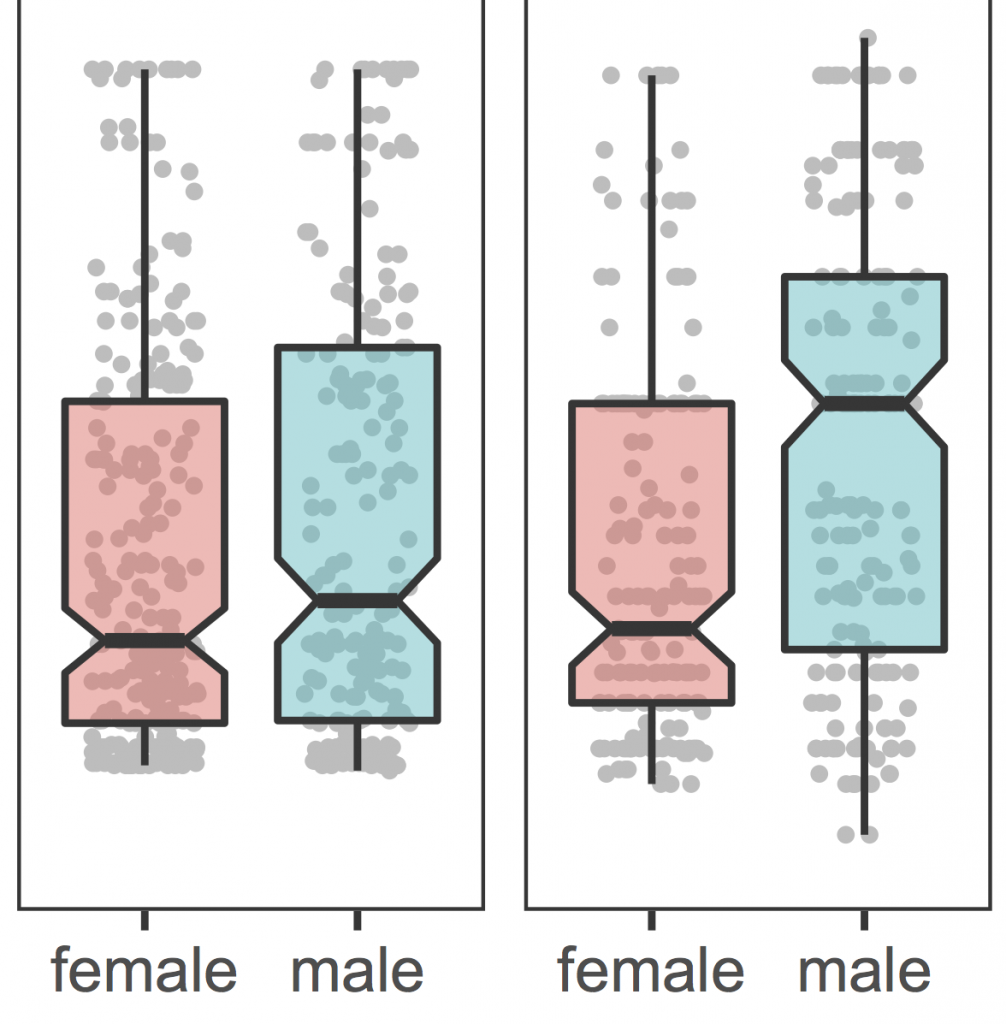
On the Data is Beautiful subreddit, a user going by the name fencelizard recently took a look at gender differences in full-time staff salaries in the last four U.S. Presidential administrations. This is only a quick descriptive picture (notes on the methodology below), but it highlights an important point about organizations: inequality doesn’t always neatly align with ideology.

Both the wide and the narrow median pay gaps are bipartisan. While the Clinton and the early Trump administrations have the widest gaps in median earnings, the George W. Bush and Obama administrations were the closest to gender parity (the gap was not statistically significant in the Obama years).

Of course, these gaps mean different things in different administrations. The parity among Bush staffers looks like it came from pay cuts on both sides, with more men remaining in a higher salary range, while the Obama administration had a much more even distribution across men and women. Part of the pattern for the Trump administration could be due to understaffing in general.

Nevertheless, it is interesting to see how the salary distribution for women staffers has remained relatively consistent and lower than fluctuating salaries for men. Sociologists know that inequality can be embedded in the day-to-day operations of institutions like schools, prisons, and government offices. Bias certainly can and does play a role in this process, but the ideological support that we often associate with such biases—like political preferences—doesn’t always have to be the deciding factor for whether inequality happens.

Some background on the analysis from fencelizard:

Salary data was sourced from white house press releases for Trump (PDF tables; FML) and Obama (UTF-8 csv’s; thanks Obama), and from the Washington Post for Bush (http://www.washingtonpost.com/wp-srv/politics/administration/whbriefing/2004stafflistb.html) and Clinton (https://www.washingtonpost.com/archive/politics/1993/11/01/salaries-at-clintons-white-house/9c96f5b6-02c5-4888-87ee-dc547d8d93f0/?utm_term=.aa70a4af1649). Supposedly full salary data for Bush I exists too, but I couldn’t find it anywhere online.
I cleaned up the data in R, used the ‘gender’ package to guess staffers’ gender from their first names, and made the plots with ggplot2 and gridExtra. I used a Wilcox test to compare the distribution of salaries across genders for each president. Asterisks in the figure above indicate significantly different distributions.

Evan Stewart is a Ph.D. candidate in sociology at the University of Minnesota. You can follow him on Twitter.

(View original at https://thesocietypages.org/socimages)

21 Oct 23:15

Two Litters of Endangered Tasmanian Devils Born

by Andrew Bleiman
Leahgates

they're already mad

1 - Tasmanian Devil Joeys

Taronga Western Plains Zoo is pleased to announce the arrival of two healthy litters of Tasmanian Devil joeys! According to keepers, this is one of the most successful years to date for the Zoo’s Tasmanian Devil conservation breeding program.

The first litter of three joeys arrived on March 19 to mother Lana. Keepers were recently able to take a close look at each joey and confirm their sex (two males and one female). Another female, Pooki, birthed four joeys more recently on June 19, which are yet to emerge from the pouch.

“We’re very pleased to see nurturing, maternal instincts from both Lana and Pooki, who are both two-year-old females and first-time mothers,” Taronga Western Plains Zoo Senior Keeper Steve Kleinig said.

“The three joeys born in March…are now weaned (meaning they have left mother Lana’s pouch) but they still remain close by her side. They are now playing with each other and exploring independently outside the den.”

“The four joeys born in June are starting to open their eyes and become more aware of their surroundings. While they are still attached to their mother's teats, we’re expecting they will begin to leave their mother’s pouch in the coming weeks,” Steve said.

2 - Tasmanian Devil Joeys

3 - TWPZ Keepers Hayley Brooks  Karen James and Rachel Schildkraut with Tasmanian Devil JoeysPhoto Credits: Taronga Western Plains Zoo (Image 3: Keepers Hayley Brooks, Karen James, and Rachel Schildkraut)

Taronga Western Plains Zoo is part of a national insurance population program designed to help save the Tasmanian Devil from becoming extinct as a result of the Devil Facial Tumour Disease*.

The Zoo’s breeding success this year is the result of a more targeted approach, and has benefited from favorable breeding recommendations. These are based on the unique characteristics and genetics of a breeding pair and, combined with their compatibility upon meeting, can determine breeding success.

“We are continuing to collaborate with other breeding institutions to improve the long-term viability of our program, such as Devil Ark in the Barrington Tops, where Lana and Pooki came from, and Tasmania’s Trowunna Wildlife Park, where the father originated,” Steve said.

Taronga Western Plains Zoo has two breeding facilities for the Tasmanian Devil located behind the scenes. The Zoo has bred 31 healthy Tasmanian Devil joeys so far - a significant boost to the regional zoo-based insurance population of this endangered species.

With Tasmanian Devil numbers in the wild currently dwindling to between 15,000 and 50,000 individuals, every birth is significant. The mainland breeding program of which the Zoo is a part could play an important role in helping to re-establish healthy wild populations of the species in Tasmania if needed in future.

The Tasmanian Devil (Sarcophilus harrisii) is a carnivorous marsupial of the family Dasyuridae. It was once native to mainland Australia, but it is now found only in the wild on the island state of Tasmania, including tiny east coast Maria Island where there is a conservation project with disease-free animals.

The Tasmanian Devil is the size of a small dog and became the largest carnivorous marsupial in the world following the extinction of the Thylacine in 1936. It is related to Quolls and distantly related to the Thylacine.

It is characterized by its stocky and muscular build, black fur, pungent odor, extremely loud and disturbing screech, keen sense of smell, and ferocity when feeding. The Tasmanian Devil's large head and neck allow it to generate among the strongest bites per unit body mass of any extant mammal land predator, and it hunts prey and scavenges carrion as well as eating household products if humans are living nearby.

A breeding Tasmanian Devil female can produce up to 50 young that are about the size of a grain of rice. Competition for survival is fierce, and only the first four joeys are able to latch onto the mother’s teats.

In 2008, the Tasmanian Devil was assessed and classified as “Endangered” by the IUCN. In 2009, the Australian Government also listed the species as “Endangered”, under national environmental law.

*Devil Facial Tumour Disease (DFTD) is an infectious cancer that only affects Tasmanian Devils, and is transmitted through biting, fighting and mating. Since the first official case of DFTD in Australia in 1996, there has been a decline of up to 50-70 per cent of the Tasmanian Devil population across the majority of Tasmania.

21 Oct 23:15

Endangered Aye-Aye Born at Duke Lemur Center

by Andrew Bleiman

1_agatha-small-version-675x540_c

The Duke Lemur Center recently welcomed an endangered baby Aye-aye. The female is the first Aye-aye born at the Duke Lemur Center in six years, and she is one of only 24 of her kind in the United States.

Third-time mom, Medusa, gave birth on June 7, and the infant has been named “Agatha” after prolific mystery writer, Agatha Christie.

Mother and baby have been kept behind the scenes, giving Agatha a chance to gain strength. Born weighing a mere 74 grams, Agatha was only two thirds the typical birth weight for her species so early care was given round-the-clock.

Cathy Williams (Veterinarian at the Duke Lemur Center for 21 years) stated in a Duke Lemur Center article: “Agatha was a unique case. She required intervention by the veterinary staff to provide supplemental warmth and formula until she gained enough strength that she could return to her mom full time.”

Between feedings, veterinary staff used a “baby cam” to monitor interactions between Agatha and Medusa. The staff reports that the big-eared infant, now three months old, is thriving. According to Steve Coombs, Agatha’s primary technician, “She’s tapping branches. She sleeps with Medusa in the nest box, and the interaction I see is mostly nursing. She’s calm, and Medusa is back to her easygoing self.”

2_DSC2488EDSHP_dm-7279-agatha-675x540_c

3_DSC2486EDSHP_dm-7279-agatha-675x540_c

4_DSC2756EDSHP2_Dm-7279-agatha-675x540_cPhoto Credits: Duke Lemur Center / David Haring

The Aye-aye (Daubentonia madagascariensis) is a lemur that is native to Madagascar. It combines rodent-like teeth that perpetually grow and a special thin middle finger.

It is known as the world's largest nocturnal primate, and is characterized by its unusual method of finding food. The Aye-aye taps on trees to find grubs, then gnaws holes in the wood using its forward slanting incisors to create a small hole in which it inserts its narrow middle finger to pull the grubs out. This foraging method is called “percussive foraging.” The only other animal species known to find food in this way is the Striped Possum.

The Aye-aye is currently classified as Endangered on the IUCN Red List of Threatened Species. Logging, slash-and-burn agriculture, and hunting are suspected to have cut their numbers in half in recent decades.

Some villagers in Madagascar believe these lemurs are evil omens and can curse a person by pointing their middle fingers at them; hence many Aye-ayes in their native territory are killed on sight. According to Cathy Williams from Duke Lemur Center, “They’re not at all aggressive, they’re extremely curious and energetic and they’re very intelligent. They learn very quickly.”

The Association of Zoos and Aquariums’ (AZA) Species Survival Plan (SSP) deemed Agatha’s parents, Medusa and Poe, a good genetic match.

Poe arrived at the Duke Lemur Center from Madagascar in 1987. He was one of the first Aye-ayes ever imported to the United States. At the time, Poe and seven additional animals imported by Duke between 1987 and 1991 represented the only Aye-ayes in the world under human care.

Today, all but one of the Aye-ayes in North America (as well as others overseas in London, Frankfurt, Bristol and the Jersey Channel Islands) are descendants of these eight founders.

Agatha is the third Aye-aye born in North America in the last two years. Her birth is a welcome development for the Duke Lemur Center, which tragically lost four adults last year to poisoning from a natural toxin found in avocados, not previously recognized as a threat to lemurs.

Agatha will stay with her mother for two to three years while she learns how to forage for food, build a nest, and other Aye-aye survival skills.

Visitors won’t be able to see baby Agatha yet, but they can see two of the Center’s other Aye-ayes, Endora and Ozma.

5_Agatha-3-Months-David-Haring-675x540_c

6_DSC9376EDSHP_Dm-7279-agatha-675x540_c

7_DSC9378EDSHP-8x10_Dm-7279-agatha-675x540_c

Related articles
20 Oct 03:07

Snow Leopard Cub Takes It Outside

by Chris Eastland

2017_09_19 Aibek snow leopard 900-10wm

When Woodland Park Zoo keepers opened the door allowing Aibek, a 2-month-old Snow Leopard, to leave the maternity den for the first time, the cub zipped outside so fast that he beat his mom into the outdoor habitat.

2017_09_19 Aibek snow leopard 900-5wm
2017_09_19 Aibek snow leopard 900-1wmPhoto Credit: Jeremy Dwyer-Lindgren/Woodland Park Zoo

Aibek immediately began pouncing, climbing, and stealthily sneaking around the enclosure amid a light drizzling rain. He climbed to the top of the habitat’s rocky hill and promptly found a spot that was nearly out of sight to the crowd that had gathered to greet him – typical of Snow Leopards, which are elusive in the wild, too.

You first met Aibek, who was born July 6, on ZooBorns when he was just a few weeks old. Like all wild Snow Leopards, he spent the first two months of his life snuggled in a cozy den with his mother, feeding exclusively on her milk. While mom Helen and her cub were bonding in the den, keepers were able to conduct occasional wellness checks and observed that Helen was providing excellent care for her cub. Now a healthy 10 pounds, Aibek has started eating meat but still nurses from his mom.

Aibek is the first single cub to be born at the zoo. Snow Leopards typically have litters of two or three cubs, so keepers expected Aibek to be rather timid since he had no siblings to wrestle and play with. But so far, Aibek has demonstrated confidence as he explores the outdoors, and Helen is an experienced mother who knows how to keep her cub safe.

Snow Leopards are listed as a Vulnerable species by the International Union for Conservation of Nature. These cats live in the high mountain ranges of Russia and several Central Asian nations, including in Afghanistan, China, India, Kyrgyzstan, Mongolia, Nepal and Pakistan. According to the Snow Leopard Trust, the wild population of Snow Leopards is estimated to be between 3,920 and 6,390 individuals.

More photos and info below!


Woodland Park Zoo has long been a conservation partner with the Snow Leopard Trust (SLT). The two organizations work with Kyrgyzstan's State Agency for Environment Protection and Forestry to protect Snow Leopards in the Tian Shan Mountains. Motion-activated cameras in the Sarychat Ertash reserve allow researchers to monitor the area's Snow Leopard population, which they estimate to be around 18 cats. Through innovative programs, effective partnerships, and the latest science, the SLT is saving these vulnerable cats and improving the lives of people who live in countries where Snow Leopards are present.

2017_09_19 Aibek snow leopard 900-3wm
2017_09_19 Aibek snow leopard 900-7wm
2017_09_19 Aibek snow leopard 900-8wm
2017_09_19 Aibek snow leopard 900-2wm


Related articles
20 Oct 03:06

Denver Zoo Announces Birth of Red Panda Brothers

by Andrew Bleiman

1_6Z7A1549

The Denver Zoo welcomed the birth of two, male Red Panda cubs on August 27. The brothers, who don't have names yet, have been quietly spending time behind the scenes with their mother, Faith, in a nest box.

Keepers say the cubs are doing well and growing fast; they currently each weigh just over one pound. They won't, however, be visible to the public for another few weeks, when they'll be more developed and ready to join their father, Hamlet, in the Zoo's Red Panda enclosure.

Denver Zoo animal care staff and veterinarians are keeping a close eye on the cubs, performing regular exams to check their weight, temperature and overall wellness. In their first days of life, the cubs received some supplemental feedings. However, keepers say the cubs and mother are thriving, and that the brothers are pretty feisty when they wrestle each other.

2_6Z7A1552

3_6Z7A1518Photo Credits: Denver Zoo

This is both parents' second litter. Faith was born in June 2014 at Toronto Zoo; Hamlet was born in July 2013 at Lee Richardson Zoo in Kansas. The Association of Zoos and Aquariums Species Survival Plan (SSP) brought the two to Denver Zoo, Faith from Trevor Park Zoo in New York and Hamlet from Toronto Zoo, in 2015 under a breeding recommendation, which ensures healthy populations and genetic diversity among zoo animals. The couple’s first litter of cubs, Lali and Masu, was born at Denver Zoo in June 2016. By recommendation of the SSP, Lali moved to Scovill Zoo in Illinois, and Masu was moved to Norfolk Zoo in Virgina in April of this year.

Red Pandas (Ailurus fulgens) are native to Asia and are most commonly found in Nepal, India, Bhutan, Myanmar and China. As their name suggests, the animals are red and have off-white markings, large puffy tails and pointed ears. Red Pandas, like Giant Pandas, have very specialized diet requirements and eat a large amount of bamboo daily.

The International Union for Conservation of Nature (IUCN) classifies Red Pandas as “Endangered”. According to the IUCN, their biggest threats come from habitat loss and fragmentation, habitat degradation and physical threats. Red Pandas are part of the Global Species Management Plan (GSMP) in zoos around the world. GSMP is allied with field conservation efforts for animals around the world.

Related articles
20 Oct 03:05

Black Jaguar Cubs Learn to Stalk at ARTIS

by Andrew Bleiman

1_jaguarwelpen_buiten_nieuwsbericht_2017_3_1920x1328.jpg__1920x0_q85_subsampling-2

The two Jaguar cubs born at ARTIS Zoo on June 28 recently explored their outdoor exhibit. Zoo visitors can now see the male and female on a regular basis, putting to practice their natural stalking abilities and big-cat skills.

The cubs are unique in their appearance. Both cubs have what is known as “color morphism” and are black in color (their father is also black). Color morphism is known to occur in the Jaguar species. Jaguars with melanism appear almost entirely black, although their spots are still visible on closer examination.

Melanistic Jaguars (or “black” jaguars) occur primarily in South America, and are virtually unknown in wild populations residing regions of North America. They are informally known as “Black Panthers”, but they do not form a separate species.

Extremely rare albino individuals, sometimes called “White Panthers”, also occur among Jaguars.

2_jaguarwelpen_buiten_nieuwsbericht_2017_1_1920x1247.jpg__1920x1247_q85_crop_subsampling-2_upscale

3_jaguarwelpen_buiten_2017_nieuwsbericht_2_1920x1080.jpg__1920x1080_q85_crop_subsampling-2_upscale

4_jaguarwelpen_buiten_nieuwsbericht_7_1920x1080.jpg__1920x1430_q85_crop_subsampling-2_upscale (1)Photo Credits: ARTIS/Joke Kok

The Jaguar (Panthera onca) is a big cat and is the only extant Panthera species native to the Americas. The Jaguar is the third-largest feline species after the Tiger and the Lion, and the largest in the Americas.

The Jaguar's present range extends from Southwestern United States and Mexico across much of Central America and south to Paraguay and northern Argentina. The species has largely been extirpated from the United States since the early 20th century.

This spotted cat most closely resembles the Leopard physically, although it is usually larger and of sturdier build and its behavioral and habitat characteristics are closer to those of the Tiger.

Dense rainforest is its preferred habitat, but it will range across a variety of forested and open terrains. Its preferred habitats are usually swamps and wooded regions, but Jaguars also live in scrublands and deserts. It is notable, along with the Tiger, as a feline that enjoys swimming.

The Jaguar is largely solitary, opportunistic, and a stalk-and-ambush predator at the top of the food chain. It is a keystone species, playing an important role in stabilizing ecosystems and regulating the populations of the animals it hunts. The Jaguar has an exceptionally powerful bite, even relative to the other big cats. This allows it to pierce the shells of armored reptiles and to employ an unusual killing method: it bites directly through the skull of prey between the ears to deliver a fatal bite to the brain.

The Jaguar is classified as “Near Threatened” on the IUCN Red List of Threatened Species and its numbers are declining. Threats include loss and fragmentation of habitat. While international trade in Jaguars or their parts is prohibited, the cat is still frequently killed by humans, particularly in conflicts with ranchers and farmers in South America.

ARTIS is part of the European Breeding Program for Jaguars. As a result, the black male and spotted female met at the end of last year, and several coverings were observed. Once pregnant, the two Jaguars were separated again. A female has a gestation period of about three to four months. The female raised the cubs on her own, and after one-and-a-half to two years, the young cubs become independent of their mother’s care.

5_jaguarwelpen_buiten_nieuwsbericht_1920x1080_8.jpg__1920x1080_q85_crop_subsampling-2_upscale

20 Oct 03:05

Important White Rhino Birth at The Wilds

by Andrew Bleiman

1_Rhino Calf 2488 - Grahm S. Jones  Columbus Zoo and Aquarium

The Wilds welcomed a female Southern White Rhinoceros calf born in the pasture during the afternoon of October 5. The calf is the second fifth-generation White Rhino to be born outside of Africa (both fifth-generation calves were born at The Wilds).

The new calf was born to second-time mother, Anan, and first-time father, Roscoe. Anan’s first calf, a male named Letterman (born at The Wilds in 2014), was the first fifth-generation White Rhino to be born outside of Africa.

Anan had a notable birth herself, as she was the first fourth-generation Rhino to be born outside of Africa, and she, too, was born at The Wilds. Anan’s mother, Zen, was the very first Rhino born at The Wilds in 2004 and is still a part of the conservation center’s breeding herd.

The Wilds animal management team members have observed that the new calf is strong and is nursing in the pasture. This is the 17th White Rhino born at The Wilds; the conservation center has also produced seven Asian One-horned Rhinos.

2_Rhino Calf 2539 - Grahm S. Jones  Columbus Zoo and Aquarium

3_Rhino Calf 2665 - Grahm S. Jones  Columbus Zoo and Aquarium

4_Rhino Calf 2753 - Grahm S. Jones  Columbus Zoo and AquariumPhoto Credits: Grahm S. Jones / Columbus Zoo and Aquarium

The breeding recommendations are part of the Association of Zoos and Aquariums’ (AZA) Species Survival Plan® (SSP) to enhance conservation of these species in their native range and to maintain a sustainable population of rhinos in human care.

“Every birth at The Wilds is significant, but this one is particularly special to us. With each new generation of Rhinos born, it is a testament to the success of the breeding program at The Wilds but more importantly a success for this species as a whole. The Wilds is proud to be a part of the conservation initiatives ensuring the survival of this species,” said Dr. Jan Ramer, vice president of The Wilds.

The White Rhino population had dwindled to perhaps only 50-200 at the beginning of the 20th century, but through conservation efforts, the population of White Rhinos in their native African range has rebounded to about 20,400 animals. However, even with the increase in numbers, the species remains classified as “Near Threatened” by the International Union for Conservation of Nature (IUCN). All five remaining Rhino species in Africa and Asia (White Rhinoceros, Black Rhinoceros, Greater One-horned Rhinoceros, Javan Rhinoceros, and Sumatran Rhinoceros) are persecuted by poachers who sell the horns for ornamental or traditional medicinal purposes, even though there are no scientifically proven health benefits for its use. The horns are made of keratin—the same substance that makes up fingernails and hair. The International Rhino Foundation, which receives support from The Wilds, estimates that one Rhino is killed every eight hours for its horn.

The Southern White Rhinoceros or Southern Square-lipped Rhinoceros (Ceratotherium simum simum) is one of the two subspecies of the White Rhinoceros (the other being the Northern White Rhinoceros). It is the most common and widespread subspecies of Rhino.

White Rhino calves are born after a gestation of 16 months and they can grow to be 4,000 pounds and six feet tall at their shoulder. Their natural habitats are plains or woodlands, interspersed with grassy openings. Through reintroduction efforts, their current range in the wild is in southern and eastern African countries.

Their physical characteristics are two pointed horns and a wide mouth suitable for grazing. The name White Rhinoceros originated from the Afrikaans word describing the animal’s mouth: wyd, meaning “wide.” Early English settlers in South Africa misinterpreted the word wyd for “white.”

To further protect the future of Rhinos, The Wilds and the Columbus Zoo has provided more than $196,000 in the last five years in support of conservation projects benefiting Rhinos in their native ranges, such as monitoring Black and White Rhinos in Zimbabwe’s Lowveld region through the International Rhino Foundation and protecting Black Rhinos in the Ngulia Rhino Sanctuary in Kenya through the African Wildlife Foundation.

5_Rhino Calf 2705 - Grahm S. Jones  Columbus Zoo and Aquarium

6_Rhino Calf 2552 - Grahm S. Jones  Columbus Zoo and Aquarium

7_Rhino Calf 2696 - Grahm S. Jones  Columbus Zoo and Aquarium

20 Oct 03:04

Tiny Trio of Otter Pups Born at Santa Barbara Zoo

by Andrew Bleiman

1_SB Zoo Otters Born 2

A pair of Asian Small-clawed Otters at the Santa Barbara Zoo produced their first litter of pups. Three healthy offspring were born in a nesting box in their holding area on October 7.

As in the wild, Otter parents prefer to keep their pups safely tucked in a den. The Zoo’s newborn Otters will not leave the behind the scenes holding area until they are old enough to safely swim and have grown the teeth needed to eat solid foods.

Depending on how their development progresses, keepers estimate the pups could go on exhibit as early as mid-December.

Animal Care staff had recently confirmed that new mom, Gail, was pregnant and estimated that she was due any day. When keepers arrived the morning of October 7, Gail and the father, Peeta, remained in the nesting box.

“The parents didn’t come out to greet us, and then we heard squeaks,” said the Zoo’s Curator of Mammals Michele Green. “That’s how we knew Gail had given birth.”

Gestation is 68 days, and after birthing, the female stays in the nesting box with the pups. Otter moms are given some relief, however, when new dads take over care for short periods of time.

2_SB Zoo Otters Born 3

3_SB Zoo Otters Born 1Photo Credits: Santa Barbara Zoo

Both of the adult Otters are first-time parents. According to keepers, the pair is showing excellent parenting skills toward the two females and one male.

“Gail only arrived in March and it’s been fun to watch them bond, and now become parents,” says Green. “She’s a young mom, but doing very well. Peeta is attentive and diligent.”

Peeta was born at the National Zoo in Washington, D.C. in 2008. Gail was born at the Greensboro Science Center in North Carolina in 2013. The two were paired as part of a cooperative breeding program of the Association of Zoos and Aquariums (AZA). The names (inspired by characters in the popular “Hunger Games” books and movies) were given by their Santa Barbara Zoo sponsors, Peter and Pieter Crawford-van Meeuwen.

Another female, Katniss, was first paired with Peeta, but they did not breed. She passed away in December 2016 from a kidney ailment.

The last time Asian Small-clawed Otters were born at the Zoo was in May 2011 when six pups were born to a pair named Jillian and Bob. That pair also produced five young in August 2010, the first of the species to be born at the Zoo in more than 20 years. The entire family group later moved to the National Zoo, where they live today.

Keepers predict that by January, the pups should be proficient swimmers, and will be on-exhibit at that time. Information on the progress of the Otter pups will be made available at the Zoo’s website: www.sbzoo.org .

Although the Asian Small-clawed Otter (Aonyx cinerea syn. Amblonyx cinereus) is only listed as “Vulnerable” by the IUCN, the species is seriously threatened by rapid habitat destruction for palm oil farming and by hunting and pollution. They are considered an “indicator species,” meaning their population indicates the general health of their habitat and of other species.

The species is the smallest Otter in the world and lives in freshwater wetlands and mangrove swamps throughout Southeast Asia, including southern India and China, Indonesia, the Philippines, Borneo, and the Malay Peninsula. They prefer quiet pools and sluggish streams for fishing and swimming.

Unlike Sea Otters, they spend more time on land than in water, but they are skillful, agile swimmers and divers, with great endurance. They can stay submerged for six to eight minutes.

Asian small-clawed otters are about two feet long and weigh less than ten pounds (half the size of North American River Otters). Their claws do not protrude beyond the ends of the digital pads, thus their names, and their feet do not have fully developed webbing and look very much like human hands.

They are one of the few species of Otter that live in social groups. The bond between mated pairs of Asian Small-clawed Otters is very strong. Both the male and female raise the young and are devoted parents. In the wild, Asian Small-clawed Otters live in extended family groups of up to 12 individuals. The entire family helps raise the young, which are among the most active and playful of baby animals.

Related articles
05 Oct 17:11

‘Pitter-Patter' of Tapir Hooves at Edinburgh Zoo

by Andrew Bleiman

RZSS Tapir calf

RZSS Edinburgh Zoo keepers are hearing the “pitter-patter” of tiny hooves with the birth of an endangered Malayan Tapir calf.

The female calf, born on September 18, has been named Maya. The new arrival was welcomed by mother, Sayang, and father, Mowgli, and is being well cared for by her experienced mum.

Karen Stiven, Senior Hoofstock Keeper at RZSS Edinburgh Zoo, said, “Currently, Maya is staying very close to mum and she is doing well. She has the signature brown fur and white markings that all baby Tapirs are born with, which helps to provide camouflage in the forest. She will begin to get her adult coloration at around three months old. Sayang is a great mum with lots of practice under her belt now and she really knows the ropes. Tapirs are pregnant for around 13 months so it is great to finally see another healthy calf being born.”

“Maya will go on to play an important role in the conservation of her species as part of the wider European Endangered Species Breeding Programme. The programme has a high demand for female Tapirs to help create a diverse safety-net population to ensure that the species does not go extinct in the wild.”

RZSS Tapir calf 3

RZSS Tapir calf 2

RZSS Tapir calf 4Photo Credits: RZSS/Siân Addison

Listed as “Endangered” on the IUCN Red List, the species is increasingly threatened, with population numbers continuing to decline as a result of habitat loss and fragmentation as well as increasing hunting pressure.

The Malayan Tapir (Acrocodia indica), also known as the Asian Tapir, is the largest of four Tapir species and is the only Old World Tapir. Native to the rainforests of Burma, Malaysia, Sumatra and Thailand, Tapirs’ noses and upper lips are extended to form a prehensile proboscis, which they use to grab leaves. Female Tapirs have a long gestation period of 13 months before giving birth to a single calf.

05 Oct 17:10

Punk Rock Resisting Islamophobia

by Neeraj Rajasekar

Originally posted at Discoveries

Punk rock has a long history of anti-racism, and now a new wave of punk bands are turning it up to eleven to combat Islamophobia. For a recent research article, sociologist Amy D. McDowell  immersed herself into the “Taqwacore” scene — a genre of punk rock that derives its name from the Arabic word “Taqwa.” While inspired by the Muslim faith, this genre of punk is not strictly religious — Taqwacore captures the experience of the “brown kids,” Muslims and non-Muslims alike who experience racism and prejudice in the post-9/11 era. This music calls out racism and challenges stereotypes.

Through a combination of interviews and many hours of participant observation at Taqwacore events, McDowell brings together testimony from musicians and fans, describes the scene, and analyzes materials from Taqwacore forums and websites. Many participants, Muslim and non-Muslim alike, describe processes of discrimination where anti-Muslim sentiments and stereotypes have affected them. Her research shows how Taqwacore is a multicultural musical form for a collective, panethnic “brown” identity that spans multiple nationalities and backgrounds. Pushing back against the idea that Islam and punk music are incompatible, Taqwacore artists draw on the essence of punk to create music to that empowers marginalized youth.

Neeraj Rajasekar is a Ph.D. student in sociology at the University of Minnesota.

(View original at https://thesocietypages.org/socimages)

04 Oct 01:55

Rhino Calf 'Pesters' Mum at Chester Zoo

by Andrew Bleiman
Leahgates

This rhino is every mom on the bus with a toddler

1_A two-month-old baby rhino  named Ike  tries to get the attention of his mum Zuri in the most adorable way at Chester Zoo (22)

A two-month-old Eastern Black Rhino calf was filmed trying to get the attention of his mum in the most adorable way at Chester Zoo recently.

The footage of baby Ike playfully jumping on mum, Zuri, was released just ahead of “World Rhino Day” on September 22.

Ike is one of two critically endangered Eastern Black Rhino calves that was born just weeks apart at Chester Zoo earlier in the year. (See our article from earlier in the summer: "Two Rhinos Born Days Apart at Chester Zoo")

2_A two-month-old baby rhino  named Ike  tries to get the attention of his mum Zuri in the most adorable way at Chester Zoo (4)

3_A two-month-old baby rhino  named Ike  tries to get the attention of his mum Zuri in the most adorable way at Chester Zoo (32)

4_A two-month-old baby rhino  named Ike  tries to get the attention of his mum Zuri in the most adorable way at Chester Zoo (31)Photo Credits: Chester Zoo

The arrival of the precious pair of Rhinos was hailed as remarkable by conservationists. According to the International Union for the Conservation of Nature (IUCN), there are less than 650 of the sub-species across Africa.

In the wild, a huge surge in illegal poaching, driven by a global increase in demand for Rhino horn to supply the traditional Asian medicine market, has resulted in around 95% of all Rhinos being wiped out in the last century.

The issue is being driven by the street value of Rhino horn, which is currently changing hands for more per gram than gold, diamonds and cocaine. However, modern science has proven that Rhino horns are made primarily of keratin, the protein found in hair, fingernails and animal hooves.

Stuart Nixon, Chester Zoo’s Africa Field Programmes Coordinator, said, “You’re likely to get exactly the same health benefits by chewing your own fingernails as you are taking powdered Rhino horn. Yet in South African alone, more than 500 rhinos have been killed so far this year.”

“The IUCN estimates that, on average, almost two Rhinos have been killed every day in Africa for nine straight years and they could be extinct in as little 10 years. Rhinos need protecting, not poaching.”

Chester Zoo is currently home to 10 critically endangered Eastern Black Rhinos (Diceros bicornis michaeli) and two Greater One-horned Rhinos.

Through its Act For Wildlife conservation movement, the zoo has also recently provided support for Rhino protection to its partners the Big Life Foundation in Chyulu Hills National Park in Kenya and the George Adamson Wildlife Preservation Trust in Mkomazi National Park in Tanzania.

More great photos below the fold!

5_A two-month-old baby rhino  named Ike  tries to get the attention of his mum Zuri in the most adorable way at Chester Zoo (27)

6_A two-month-old baby rhino  named Ike  tries to get the attention of his mum Zuri in the most adorable way at Chester Zoo (29)

7_A two-month-old baby rhino  named Ike  tries to get the attention of his mum Zuri in the most adorable way at Chester Zoo (25)

8_A two-month-old baby rhino  named Ike  tries to get the attention of his mum Zuri in the most adorable way at Chester Zoo (36)

9_Adorable two-month-old rhino calf  Ike  at Chester Zoo (8)

10_Adorable two-month-old rhino calf  Ike  at Chester Zoo (1)

11_New eastern black rhino mum Zuri at Chester Zoo

04 Oct 01:54

Screaming Hairy Armadillo Pups Are a First For National Zoo

by Andrew Bleiman

CROPPED screaming_hairy_armadillo_pup-10
The Smithsonian’s National Zoo welcomed two Screaming Hairy Armadillo pups on August 11. The pups are the first ever born at the zoo.

CROPPED screaming_hairy_armadillo_pup-2
Screaming_hairy_armadillo_pup-9
Screaming_hairy_armadillo_pup-6
The two little ones spend all of their time in the nest, and their eyes have not yet opened. However, the bony, armor-like plates that cover their bodies are already visible, and are covered with very fine hairs. At their last weigh-in, the pups weighed between five and six ounces each. It is still too early to determine if they are male or female.

The pups’ parents, Amber and Dylan Walter, were recommended to breed by the Association of Zoos and Aquariums’ Screaming Hairy Armadillo Species Survival Plan. These are the first pups for both parents. Visitors will be able to see the pups at the zoo after they have grown larger and have acclimated to their enclosure.

Screaming Hairy Armadillos are native to South America and are listed as a species of “least concern” by the International Union for Conservation of Nature (IUCN). They get their name from the squealing noise they emit if they are threatened and the greater amount of hair they have compared to other Armadillo species. At less than two pounds fully grown, Screaming Hairy Armadillos are the smallest of the three species of Hairy Armadillos.


Related articles
02 Oct 00:17

Critically Endangered Skinks Hatch at Chester Zoo

by Andrew Bleiman

1_World first as rare Bermudian skinks hatch at Chester Zoo as part of bid to save species (10)

Two clutches of critically endangered Bermudian Skinks have hatched at Chester Zoo. This is the first time conservationists have bred the species outside their homeland.

Known as ‘rock lizards’, the small Bermudian skinks are a much-loved cultural icon in the British Overseas Territory of Bermuda and are an important part of the ecosystem.

The species is on the brink of extinction in the wild, as habitat destruction and introduced predators have almost wiped them out. In a last gasp attempt to prevent the species being lost forever, the Bermudian government called on experts at Chester Zoo to help breed the species in the UK. Now, after years of work by conservationists and 43 days of incubation, seven Skinks have hatched.

2_World first as rare Bermudian skinks hatch at Chester Zoo as part of bid to save species (7)

3_IN BERMUDA_Coloration study on wild Bermudian skinks (2)

4_World first as rare Bermudian skinks hatch at Chester Zoo as part of bid to save species (1)Photo Credits: Chester Zoo

The major success at Chester Zoo is a dramatic breakthrough in the fight to save the Skink: a flagship animal in Bermuda’s species recovery programme.

It is possible that individuals bred at Chester Zoo will be reintroduced to the wild in Bermuda, whilst the zoo’s experts will also travel to the island to set up in-country breeding facilities.

In parallel with the breeding project, a team from the zoo is also working in collaboration with the Department of Environment and Natural Resources of Bermuda on an intensive ecological study following the last remaining populations of the Skinks on both the main and offshore islands.

Dr. Gerardo Garcia, Curator of Lower Vertebrates and Invertebrates at Chester Zoo, said, “The world’s biodiversity is under threat and we must protect our living world. Conservation is critical and breeding these skinks is a momentous event. Not only is it providing us with vital new data which will help to inform future decisions in terms of protecting the species, it will engage future generations with these fascinating animals too.”

“It has taken years of work, both out in Bermuda and here in our zoo breeding facilities, but to finally hatch these clutches of Bermudian Skinks is magnificent news.”

The Bermuda Skink has been listed as “Critically Endangered” by the International Union for the Conservation of Nature.

Mike Jordan, Collections Director at Chester Zoo, said, “We are working hard to prevent the extinction of this unique species, found nowhere else but Bermuda – and with so few endemic vertebrates – they are incredibly important to the country. This breeding breakthrough, in tandem with our extensive work out in the field alongside the Bermudian government, is a hugely significant boost for their long term survival hopes.”

Dr. Mark Outerbridge, Wildlife Ecologist for the Bermuda Government and the zoo’s partner in Bermuda, added, “I was thrilled to hear of the recent breeding success at Chester Zoo. Skinks have been living on Bermuda for over 400,000 years, and I believe we need to do all that we can to ensure their continued survival. The captive breeding is a critical step in this process and I am very grateful to all the staff there.”

The first Bermudian Skink (Plestiodon longirostris) hatched at Chester Zoo on June 7th from an egg that was laid on May 9th. The zoo’s reptile experts were able to photograph the moment the first skink popped its head out of its egg. Two clutches, one of four and one of three, have hatched at the zoo, with seven individual new Skinks in total.

Chester Zoo’s Curator of Lower Vertebrates and Invertebrates, and PhD student, Helena Turner, are currently in Bermuda collecting vital data from the last remaining wild skink populations.

More great pics below the fold!

5_IN BERMUDA_Bermudian skink is given a health check

6_IN BERMUDA_Bermudian skink is given a health check (2)

7_IN BERMUDA_Castle Island

8_World first as rare Bermudian skinks hatch at Chester Zoo as part of bid to save species (4)

9_World first as rare Bermudian skinks hatch at Chester Zoo as part of bid to save species (12)

10_World first as rare Bermudian skinks hatch at Chester Zoo as part of bid to save species (13)

11_World first as rare Bermudian skinks hatch at Chester Zoo as part of bid to save species (14)

12_World first as rare Bermudian skinks hatch at Chester Zoo as part of bid to save species (15)

Related articles
30 Sep 22:01

Life Is Going Swimmingly for New Hippo Calf

by Andrew Bleiman

1_SDZ Hippo calf

The San Diego Zoo welcomed a newborn Hippopotamus calf to its Lost Forest habitat on September 22.

The curious baby is reported to be healthy and is staying close to mother, Funani. This is the 12th calf born to Funani and father, Otis. Keepers will give the calf a name when they are able to confirm the sex. For now, guests of the San Diego Zoo can hope to catch a glimpse of the baby with Funani during normal operating hours.

2_SDZ Hippo calf

3_SDZ Hippo calfPhoto Credits: San Diego Zoo

The Common Hippopotamus (Hippopotamus amphibius), or Hippo, is a large, mostly herbivorous and aggressive mammal native to sub-Saharan Africa. It is one of only two extant species in the family Hippopotamidae, the other being the Pygmy Hippopotamus (Choeropsis liberiensis or Hexaprotodon liberiensis).

Although the Hippo is currently only classified as “Vulnerable” on the IUCN Red List, their habitat has been greatly reduced over the last 200 years. Even more devastating to Hippo populations is the current trade in illegal ivory. Following the 1989 ban on Elephant ivory, demand for Hippo ivory has sharply increased. The large canines that Hippos use to protect themselves are made of the same material as Elephants’ tusks. In fact, they are slightly softer and easier to carve than Elephant ivory, making them even more appealing to ivory buyers. As a result, Hippo numbers are rapidly decreasing.

According to the Zoo, if Hippos were to disappear completely, the effect on their habitat would be catastrophic. The large amount of waste that Hippos produce provides important nutrients for their African ecosystem. In addition, many species of fish eat the dung and feed on the small parasites that live on the Hippos’ skin.

24 Sep 20:13

Americans At Work: Not A Pretty Picture

by Marty Hart-Landsberg, PhD
Leahgates

needs more dogs

Originally posted at Reports from the Economic Front.

What is work like for Americans?  The results of the Rand Corporation’s American Working Conditions Survey (AWCS) paint a troubling picture. As the authors write in their summary:

The AWCS findings indicate that the American workplace is very physically and emotionally taxing, both for workers themselves and their families.

The authors do note more positive findings.  These include:

that workers appear to have a certain degree of autonomy, most feel confident about their skill set, and many receive social support on the job.

Despite the importance of work to our emotional and physical well-being, social relations, and the development of our capacities to shape our world, little has been published about our experience of work. Here, then, is a more detailed look at some of the Survey’s findings:

The Hazardous Workplace

An overwhelming fraction of Americans engage in intense physical exertion on the job. In addition to physical demands, more than one-half of American workers (55 percent) are exposed to unpleasant or potentially dangerous working conditions.

The Pressures of Work

Approximately two-thirds of Americans have jobs that involve working at very high speed at least half the time; the same fraction works to tight deadlines at least half the time.

The Long Work Day

While presence at the work place during business hours is required for most Americans, many take work home. About one-half of American workers do some work in their free time to meet work demands. Approximately one in ten workers report working in their free time “nearly every day” over the last month, two in ten workers report working in their free time “once or twice a week,” and two in ten workers report working in their free time “once or twice a month.” 

The Work Environment

Nearly one in five American workers were subjected to some form of verbal abuse, unwanted sexual attention, threats, or humiliating behavior at work in the past month or to physical violence, bullying or harassment, or sexual harassment at work in the past 12 months. 

At the same time, it is also true that:

While the workplace is a source of hostile social experiences for an important fraction of American workers, it is a source of supportive social experiences for many others. More than one-half of American workers agreed with the statement “I have very good friends at work,” with women more likely to report having very good friends at work than men (61 and 53 percent, respectively).

In sum, the survey’s results make clear that work in the United States is physically and emotionally demanding and dangerous for many workers. And with the government weakening many of the labor and employment regulations designed to protect worker rights and safety, it is likely that workplace conditions will worsen.

Worker organizing and workplace struggles for change need to be encouraged and supported. A recent Pew Research Center survey showed growing support for unions, especially among younger workers.  It is not hard to understand why.

(View original at https://thesocietypages.org/socimages)

15 Sep 03:17

Halls Gap Zoo Successfully Breeds Spotted-tail Quolls

by Andrew Bleiman
Leahgates

good news

there's a tiny spotted mammal called a quoll

21317922_1429132437124032_2496782924603917369_n

Halls Gap Zoo recently announced the breeding success of beautiful Spotted-tailed Quolls (or Tiger Quolls). Two healthy joeys, male and female, were born at the Australian facility.

The Zoo credits their dedicated and passionate staff for the successful breeding. The Zoo shared that the team at Halls Gap Zoo works hard to care for many threatened species, whilst sharing their passion for conserving many of the animals Australians are lucky to share their backyards with.

21432863_1429132400457369_3361255776147948867_n

21314870_1429132360457373_3450014820914595854_nPhoto Credits: Halls Gap Zoo

The Tiger Quoll (Dasyurus maculatus) is also known as the Spotted-tailed Quoll. It is a carnivorous marsupial of the Quoll genus Dasyurus and is native to Australia. With males and females weighing around 3.5 and 1.8 kg (7.7 and 4 lbs), respectively, it is mainland Australia's largest carnivorous marsupial, and the world's longest extant carnivorous marsupial (the biggest is the Tasmanian devil). They are found in wet forests of southeastern Australia and Tasmania.

The species is classified as “Near Threatened” on the IUCN Red List of Threatened Species. The Australian Department of the Environment and Heritage considers the northern subspecies, D. m. gracilis, as “endangered”.

This species is vulnerable to decline because it requires certain climates and habitats, it tends to live in low densities, it is likely to compete with introduced predators and requires lots of space. The biggest threat to the Quoll is habitat destruction. Humans may also directly contribute to Quoll deaths though persecution, motor collisions, and poisoning.

13 Sep 21:34

Perth Zoo is Saving Numbats and Dibblers From Extinction

by Andrew Bleiman
Leahgates

More good news

Numbat and Dibbler are their actual names

AlexAsbury_numbatjoey_1WEB

In 1936, Australia said farewell to the very last Tasmanian Tiger, also known as the Thylacine. The Perth Zoo is committed to preventing the endangered Numbat and Dibbler, two marsupials found only in Australia, from facing the same fate.

AlexAsburyDibblers_6254WEB
AlexAsbury_numbatjoey_5999WEBPhoto Credit: Alex Asbury

Perth Zoo’s Native Species Breeding Program (NSBP), in partnership with other organizations, has bred and released more than 220 Numbats and more than 800 Dibblers into the wild. This spring there has been a flurry of furry activity from 22 Numbat joeys, and 53 Dibbler joeys!

In June this year, three Dibbler mothers, with 21 pouch young between them, were released. The NSBP’s goal is to repopulate these species in their natural habitats. Perth Zoo is the only zoo in the world breeding both of these rare species.

The Numbat, a striped, bushy-tailed relative of the extinct Tasmanian Tiger, is so rare that there are less than 1,000 of them remaining in the wild.

Dibblers, tiny mouse-like carnivorous marsupials, were thought to be extinct for more than 50 years until a chance rediscovery in 1967.

As keepers prepare to release the joeys, they must first wean the Dibbler young from their mothers and prepare enough termite custard to meet the Numbats’ appetite for 20,000 termites a day.

The main threats facing both animals in the wild include habitat loss and introduced predators such as feral cats and foxes. Australia’s zoos, including the Perth Zoo, government agencies, and private groups are determined to protect Australia’s unique wild heritage.

See more photos below.

AlexAsbury_Dibbler_6193WEB
AlexAsbury_numbatjoey_6031Web

Related articles