16 Oct 14:54
Dalton Trans., 2014, Advance Article
DOI: 10.1039/C4DT02277G, Frontier
Heather L. Buckley, John Arnold
This article presents a brief review of recent developments in metallocorrole chemistry, with a focus on species with significant displacement of the metal from the N4 plane of the corrole ring.
To cite this article before page numbers are assigned, use the DOI form of citation above.
The content of this RSS Feed (c) The Royal Society of Chemistry

15 Oct 09:10
by Carlos A. Jiménez-Hoyos, R. Rodríguez-Guzmán and Gustavo E. Scuseria

The Journal of Physical Chemistry A
DOI: 10.1021/jp508383z

14 Oct 11:31
by Jian Li, Hua Chen, Ilya K. Drozdov, A. Yazdani, B. Andrei Bernevig, A.H. MacDonald
Recent experiments have provided evidence that one-dimensional (1D)
topological superconductivity can be realized experimentally by placing
transition metal atoms that form a ferromagnetic chain on a superconducting
substrate. We address some properties of this type of systems by using a
Slater-Koster tight-binding model. We predict that topological
superconductivity is nearly universal when ferromagnetic transition metal
chains form straight lines on superconducting substrates and that it is
possible for more complex chain structures. The proximity induced
superconducting gap is $\sim \Delta E_{so} / J$ where $\Delta$ is the $s$-wave
pair-potential on the chain, $E_{so}$ is the spin-orbit splitting energy
induced in the normal chain state bands by hybridization with the
superconducting substrate, and $J$ is the exchange-splitting of the
ferromagnetic chain $d$-bands. Because of the topological character of the 1D
superconducting state, Majorana end modes appear within the gaps of finite
length chains. We find, in agreement with experiment, that when the chain and
substrate orbitals are strongly hybridized, Majorana end modes are
substantially reduced in amplitude when separated from the chain end by less
than the coherence length defined by the $p$-wave superconducting gap. We
conclude that Pb is a particularly favorable substrate material for
ferromagnetic chain topological superconductivity because it provides both
strong $s-$wave pairing and strong Rashba spin-orbit coupling, but that there
is an opportunity to optimize properties by varying the atomic composition and
structure of the chain. Finally, we note that in the absence of disorder a new
chain magnetic symmetry, one that is also present in the crystalline
topological insulators, can stabilize multiple Majorana modes at the end of a
single chain.
14 Oct 11:31
by Eufemio Moreno Pineda
Article
Modelling magnetic data for lanthanide clusters is challenging due to spin–orbit coupling and crystal field effects. Here, the authors use multi-frequency electron paramagnetic resonance spectroscopy to measure directly the interaction between two dysprosium(III) ions in a dimeric system.
Nature Communications doi: 10.1038/ncomms6243
Authors: Eufemio Moreno Pineda, Nicholas F. Chilton, Raphael Marx, María Dörfel, Daniel O. Sells, Petr Neugebauer, Shang-Da Jiang, David Collison, Joris van Slageren, Eric J.L. McInnes, Richard E.P. Winpenny

13 Oct 17:19
by Alberto Hinojosa, Rafael M. Fernandes, and Andrey V. Chubukov
Author(s): Alberto Hinojosa, Rafael M. Fernandes, and Andrey V. Chubukov
We argue that superconductivity in the coexistence region with spin-density-wave (SDW) order in weakly doped Fe pnictides erdiffers qualitatively from the ordinary s+- state outside the coexistence region as it develops an additional gap component which is a mixture of intrapocket singlet (s++) and ...
[Phys. Rev. Lett. 113, 167001] Published Mon Oct 13, 2014
13 Oct 15:39
by P. Berggren, J. Fransson
Recent experimental conductance measurements performed on paramagnetic
molecular adsorbates on a superconducting surface, using superconducting
scanning tunneling microscopy techniques, are theoretically investigated. For
low temperatures, we demonstrate that tunneling current assisted excitations of
the local magnetic moment cannot occur for voltage biases smaller than the
superconducting gap of the scanning tunneling microscope. The magnetic moment
is only excited for voltages corresponding to the sum of the superconducting
gap and the spin excitation energies. In excellent agreement with experiment,
we show that pumping into higher excitations give additional current signatures
by accumulation of density in the lower ones. Using external magnetic fields,
we Zeeman split possible degeneracy and thereby resolve all excitations
comprised in the magnetic moment.
13 Oct 15:29
by Stevan Nadj-Perge, Ilya K. Drozdov, Jian Li, Hua Chen, Sangjun Jeon, Jungpil Seo, Allan H. MacDonald, B. Andrei Bernevig, Ali Yazdani
Majorana fermions are predicted to localize at the edge of a topological
superconductor, a state of matter that can form when a ferromagnetic system is
placed in proximity to a conventional superconductor with strong spin-orbit
interaction. With the goal of realizing a one-dimensional topological
superconductor, we have fabricated ferromagnetic iron (Fe) atomic chains on the
surface of superconducting lead (Pb). Using high-resolution spectroscopic
imaging techniques, we show that the onset of superconductivity, which gaps the
electronic density of states in the bulk of the Fe chains, is accompanied by
the appearance of zero energy end states. This spatially resolved signature
provides strong evidence, corroborated by other observations, for the formation
of a topological phase and edge-bound Majorana fermions in our atomic chains.
09 Oct 17:25
by Xiaopeng Duan, Yuriy G. Semenov, and Ki Wook Kim
Author(s): Xiaopeng Duan, Yuriy G. Semenov, and Ki Wook Kim
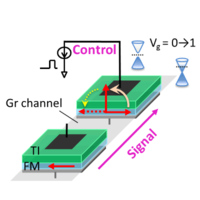
Exotic properties of topological insulators (TIs) and graphene have captivated many condensed matter physicists, but are practical outcomes actually within reach? The authors propose an efficient, beyond-CMOS spin logic platform exploiting the strong exchange coupling between a ferromagnet and the Dirac fermion states of a TI and of graphene. A detailed theoretical analysis illustrates the desired ultralow-power performance under realistic conditions, leading to predictions for practical devices to be controlled by signals as small as atto- (10−18) Joules!
[Phys. Rev. Applied 2, 044003] Published Thu Oct 09, 2014
09 Oct 17:21
by Chih-Pin Lu, Guohong Li, K. Watanabe, T. Taniguchi, and Eva Y. Andrei
Author(s): Chih-Pin Lu, Guohong Li, K. Watanabe, T. Taniguchi, and Eva Y. Andrei
 Molybdenum disulfide may provide an ideal substrate for supporting graphene.
[Phys. Rev. Lett. 113, 156804] Published Thu Oct 09, 2014
09 Oct 07:39
by Sampsa K. Hämäläinen, Nadine van der Heijden, Joost van der Lit, Stephan den Hartog, Peter Liljeroth, Ingmar Swart
Intermolecular features in atomic force microscopy (AFM) images of organic
molecules have been ascribed to intermolecular bonds. A recent theoretical
study [P. Hapala et al., Phys. Rev. B 90, 085421 (2014)] showed that these
features can also be explained by the flexibility of molecule terminated tips.
We probe this effect by carrying out AFM experiments on a model system that
contains regions where intermolecular bonds should and should not exist between
close-by molecules. Intermolecular features are observed in both regions,
demonstrating that intermolecular contrast cannot be directly interpreted as
intermolecular bonds.
08 Oct 16:54
by Mengxi Liu, Yuanchang Li, Pengcheng Chen, Jingyu Sun, Donglin Ma, Qiucheng Li, Teng Gao, Yabo Gao, Zhihai Cheng, Xiaohui Qiu, Ying Fang, Yanfeng Zhang and Zhongfan Liu

Nano Letters
DOI: 10.1021/nl502780u

08 Oct 16:40
by A. Eich, M. Michiardi, G. Bihlmayer, X.-G. Zhu, J.-L. Mi, Bo B. Iversen, R. Wiesendanger, Ph. Hofmann, A. A. Khajetoorians, and J. Wiebe
Author(s): A. Eich, M. Michiardi, G. Bihlmayer, X.-G. Zhu, J.-L. Mi, Bo B. Iversen, R. Wiesendanger, Ph. Hofmann, A. A. Khajetoorians, and J. Wiebe
The band structure and intra- and interband scattering processes of the electrons at the surface of a bismuth bilayer on Bi2Se3 have been experimentally investigated by low-temperature Fourier-transform scanning tunneling spectroscopy. The observed complex quasiparticle interference patterns are com...
[Phys. Rev. B 90, 155414] Published Wed Oct 08, 2014
07 Oct 05:54
by Nozomi Shirato, Marvin Cummings, Heath Kersell, Yang Li, Benjamin Stripe, Daniel Rosenmann, Saw-Wai Hla and Volker Rose

Nano Letters
DOI: 10.1021/nl5030613

02 Oct 13:49
by Tetsuya Kambe, Ryota Sakamoto, Tetsuro Kusamoto, Tigmansu Pal, Naoya Fukui, Ken Hoshiko, Takahiro Shimojima, Zhengfei Wang, Toru Hirahara, Kyoko Ishizaka, Shuji Hasegawa, Feng Liu and Hiroshi Nishihara

Journal of the American Chemical Society
DOI: 10.1021/ja507619d

02 Oct 13:43
by Nikolaj Moll, Bruno Schuler, Shigeki Kawai, Feng Xu, Lifen Peng, Akihiro Orita, Junzo Otera, Alessandro Curioni, Mathias Neu, Jascha Repp, Gerhard Meyer and Leo Gross

Nano Letters
DOI: 10.1021/nl502113z

02 Oct 13:31
by C. Zu
Experimental realization of universal geometric quantum gates with solid-state spins
Nature 514, 7520 (2014). doi:10.1038/nature13729
Authors: C. Zu, W.-B. Wang, L. He, W.-G. Zhang, C.-Y. Dai, F. Wang & L.-M. Duan
Experimental realization of a universal set of quantum logic gates is the central requirement for the implementation of a quantum computer. In an ‘all-geometric’ approach to quantum computation, the quantum gates are implemented using Berry phases and their non-Abelian extensions, holonomies, from geometric transformation of quantum states in the Hilbert space. Apart from its fundamental interest and rich mathematical structure, the geometric approach has some built-in noise-resilience features. On the experimental side, geometric phases and holonomies have been observed in thermal ensembles of liquid molecules using nuclear magnetic resonance; however, such systems are known to be non-scalable for the purposes of quantum computing. There are proposals to implement geometric quantum computation in scalable experimental platforms such as trapped ions, superconducting quantum bits and quantum dots, and a recent experiment has realized geometric single-bit gates in a superconducting system. Here we report the experimental realization of a universal set of geometric quantum gates using the solid-state spins of diamond nitrogen–vacancy centres. These diamond defects provide a scalable experimental platform with the potential for room-temperature quantum computing, which has attracted strong interest in recent years. Our experiment shows that all-geometric and potentially robust quantum computation can be realized with solid-state spin quantum bits, making use of recent advances in the coherent control of this system.

30 Sep 09:18
by S. Just, S. Zimmermann, V. Kataev, B. Büchner, M. Pratzer, and M. Morgenstern
Author(s): S. Just, S. Zimmermann, V. Kataev, B. Büchner, M. Pratzer, and M. Morgenstern
Monolayer graphene grown by chemical vapor deposition and transferred to SiO2 is used to introduce vacancies by Ar+ ion bombardment at a kinetic energy of 50 eV. The density of defects visible in scanning tunneling microscopy is considerably lower than the ion fluence, implying that most of the defe...
[Phys. Rev. B 90, 125449] Published Mon Sep 29, 2014
28 Sep 10:56
by Ying-Shuang Fu
Nature Physics.
doi:10.1038/nphys3084
Authors: Ying-Shuang Fu, M. Kawamura, K. Igarashi, H. Takagi, T. Hanaguri & T. Sasagawa
Massless Dirac electrons in condensed matter are, unlike conventional electrons, described by two-component wavefunctions associated with the spin degrees of freedom in the surface state of topological insulators. Hence, the ability to observe the two-component wavefunction is useful for exploring novel spin phenomena. Here we show that the two-component nature is manifest in Landau levels, the degeneracy of which is lifted by a Coulomb potential. Using spectroscopic-imaging scanning tunnelling microscopy, we visualize energy and spatial structures of Landau levels in Bi2Se3, a prototypical topological insulator. The observed Landau-level splitting and internal structures of Landau orbits are distinct from those in a conventional electron system and are well reproduced by a two-component model Dirac Hamiltonian. Our model further predicts energy-dependent spin-magnetization textures in a potential variation and provides a way for manipulating spins in the topological surface state.

28 Sep 10:35
by Zechao Yang, Martina Corso, Roberto Robles, Christian Lotze, Roland Fitzner, Elena Mena-Osteritz, Peter Bäuerle, Katharina J. Franke and Jose I. Pascual

ACS Nano
DOI: 10.1021/nn504431e

26 Sep 10:18
by Christoph Hübner, Benjamin Baxevanis, Alexander Ako Khajetoorians, Daniela Pfannkuche
Highly symmetric magnetic environments have been suggested to stabilize the
magnetic information stored in magnetic adatoms on a surface. Utilized as
memory devices such systems are subjected to electron tunneling and external
magnetic fields. We analyze theoretically how such perturbations affect the
switching probability of a single quantum spin for two characteristic
symmetries encountered in recent experiments and suggest a third one that
exhibits robust protection against surface induced spin flips. Further we
illuminate how the switching of an adatom spin exhibits characteristic behavior
with respect to low energy excitations from which the symmetry of the system
can be inferred.
25 Sep 14:46
How to draw perfect figures
Nature 513, 7519 (2014). doi:10.1038/513463e
Jumbled charts and misleading graphs — illustrations in a paper can go wrong in many ways. Now, a treatise that attempts to rescue science from bad figures has been getting rave reviews on social media (N. P. Rougier et al. PLoS Comput. Biol.10,

23 Sep 09:57
by Fabian Bebensee, Katrine Svane, Christian Bombis, Federico Masini, Svetlana Klyatskaya, Flemming Besenbacher, Mario Ruben, Bjørk Hammer, Trolle R. Linderoth
Abstract
Surface coordination networks formed by co-adsorption of metal atoms and organic ligands have interesting properties, for example regarding catalysis and data storage. Surface coordination networks studied to date have typically been based on single metal atom centers. The formation of a novel surface coordination network is now demonstrated that is based on network nodes in the form of clusters consisting of three Cu adatoms. The network forms by deposition of tetrahydroxybenzene (THB) on Cu(111) under UHV conditions. As shown from a combination of scanning tunneling microscopy, X-ray photoelectron spectroscopy, and density functional theory calculations, all four hydroxy groups of THB dehydrogenate upon thermal activation at 440 K. This highly reactive ligand binds to Cu adatom trimers, which are resolved by high-resolution STM. The network creates an ordered array of mono-dispersed metal clusters constituting a two-dimensional analogue of metal–organic frameworks.

Cu-trimer nodes: Using scanning tunneling microscopy and X-ray photoelectron spectroscopy, tetrahydroxybenzene (THB) is shown to dehydrogenate when adsorbed on a Cu(111) surface and form a highly reactive ligand. Density functional calculations confirm that the ligand stabilizes copper adatom trimers and creates a surface coordination network that is a two-dimensional analogue of metal–organic frameworks.
23 Sep 09:53
by L. Zhang, A. Bagrets, D. Xenioti, R. Korytar, M. Schackert, T. Miyamachi, F. Schramm, O. Fuhr, R. Chandrasekar, M. Alouani, M. Ruben, W. Wulfhekel, F. Evers
We report a combined experimental and theoretical study of the Kondo effect
in a series of binuclear metal-organic complexes of the form
[(Me(hfacac)_2)_2(bpym)]^0, with Me = Nickel (II), Manganese(II), Zinc (II);
hfacac = hexafluoroacetylacetonate, and bpym = bipyrimidine, adsorbed on
Cu(100) surface. While Kondo-features did not appear in the scanning tunneling
spectroscopy spectra of non-magnetic Zn_2, a zero bias resonance was resolved
in magnetic Mn_2 and Ni_2 complexes. The case of Ni_2 is particularly
interesting as the experiments indicate two adsorption geometries with very
different properties. For Ni_2-complexes we have employed density functional
theory to further elucidate the situation. Our simulations show that one
geometry with relatively large Kondo temperatures T_K ~ 10K can be attributed
to distorted Ni_2 complexes, which are chemically bound to the surface via the
bipyrimidine unit. The second geometry, we assign to molecular fragmentation:
we suggest that the original binuclear molecule decomposes into two pieces,
including Ni(hexafluoroacetylacetonate)_2, when brought into contact with the
Cu-substrate. For both geometries our calculations support a picture of the
(S=1)-type Kondo effect emerging due to open 3d shells of the individual
Ni^{2+} ions.
22 Sep 11:09
by Albert P. H. J. Schenning

John Wiley and Sons, Hoboken, 2013. 486 pp., hardcover, € 152.00.—ISBN 978-1118452004
22 Sep 08:13
by Matthias Germann
Nature Physics.
doi:10.1038/nphys3085
Authors: Matthias Germann, Xin Tong & Stefan Willitsch
Spectroscopic transitions in atoms and molecules that are not allowed within the electric-dipole approximation, but occur because of higher-order terms in the interaction between matter and radiation, are termed dipole-forbidden. These transitions are extremely weak and therefore exhibit very small natural linewidths. Dipole-forbidden optical transitions in atoms form the basis of next-generation atomic clocks and of high-fidelity qubits used in quantum information processors and quantum simulators. In molecules, however, such transitions are much less characterized, reflecting the considerable challenges to address them. Here, we report direct observation of dipole-forbidden, electric-quadrupole-allowed infrared (IR) transitions in a molecular ion. Their detection was enabled by the very long interrogation times of several minutes afforded by the sympathetic cooling of individual quantum-state-selected molecular ions into the nearly perturbation-free environment of a Coulomb crystal. The present work paves the way for new mid-IR frequency standards and precision spectroscopic measurements on single molecules in the IR domain.

19 Sep 13:56
by Rached Jaafar, Carlo A. Pignedoli, Giovanni Bussi, Kamel Aït-Mansour, Oliver Groening, Toru Amaya, Toshikazu Hirao, Roman Fasel and Pascal Ruffieux

Journal of the American Chemical Society
DOI: 10.1021/ja504126z

19 Sep 13:47
by Zhihuai Zhu
Condensed-matter physics: Catching relativistic electrons
Nature 513, 7518 (2014). doi:10.1038/513319a
Authors: Zhihuai Zhu & Jennifer E. Hoffman
Low-energy electrons have been found to mimic relativistic high-energy particles in cadmium arsenide. This defines the first stable '3D Dirac semimetal', which holds promise for fundamental-physics exploration and practical applications.

19 Sep 13:39
by H. Malissa
Magnetic resonance spectroscopy enables detection and manipulation of subtle spin interactions in organic semiconductors. [Also see Perspective by Bobbert]
Authors: H. Malissa, M. Kavand, D. P. Waters, K. J. van Schooten, P. L. Burn, Z. V. Vardeny, B. Saam, J. M. Lupton, C. Boehme
19 Sep 13:36
by Peter A. Bobbert
Probing the interplay between the electronic and nuclear spins in organic semiconductors [Also see Report by Malissa et al.]
Author: Peter A. Bobbert
19 Sep 13:35
by Marcia McNutt
On 3 July 1880, “a weekly journal of scientific progress” published its first research articles under the banner Science. From that original print medium, the inaugural set of papers has been reprinted, photocopied, posted online, converted to PDF, and even etched in glass blocks to serve as special gifts. Being part of the vanguard is indeed a privilege, and opportunities to be one of the first are rare. For that reason, I proudly announce that Science Advances, a new open-access journal for all of the sciences, officially joins the Science family of journals (Science, Science Translational Medicine, and Science Signaling) and is now accepting submissions (go to www.scienceadvances.org). In February 2015, the inaugural papers will be released, heralding the start of something big in scope, reach, and influence.
Author: Marcia McNutt


