Nature, Published online: 24 May 2019; doi:10.1038/s41586-019-1253-9
Author Correction: A CRISPR/Cas system mediates bacterial innate immune evasion and virulenceManuel Steinbrecher
Shared posts
28 May 21:15

Author Correction: A CRISPR/Cas system mediates bacterial innate immune evasion and virulence
by Timothy R. Sampson
26 Oct 08:39
Hyperfine interaction of individual atoms on a surface
by Willke, P., Bae, Y., Yang, K., Lado, J. L., Ferron, A., Choi, T., Ardavan, A., Fernandez-Rossier, J., Heinrich, A. J., Lutz, C. P.
Taking advantage of nuclear spins for electronic structure analysis, magnetic resonance imaging, and quantum devices hinges on knowledge and control of the surrounding atomic-scale environment. We measured and manipulated the hyperfine interaction of individual iron and titanium atoms placed on a magnesium oxide surface by using spin-polarized scanning tunneling microscopy in combination with single-atom electron spin resonance. Using atom manipulation to move single atoms, we found that the hyperfine interaction strongly depended on the binding configuration of the atom. We could extract atom- and position-dependent information about the electronic ground state, the state mixing with neighboring atoms, and properties of the nuclear spin. Thus, the hyperfine spectrum becomes a powerful probe of the chemical environment of individual atoms and nanostructures.
10 Oct 15:52
Upgrade of a low-temperature scanning tunneling microscope for electron-spin resonance. (arXiv:1810.03887v1 [physics.ins-det])
by Fabian D. Natterer, François Patthey, Tobias Bilgeri, Patrick R. Forrester, Nicolas Weiss, Harald Brune
Electron spin resonance with a scanning tunneling microscope (ESR-STM) combines the high energy resolution of spin resonance spectroscopy with the atomic scale control and spatial resolution of STM. Here we describe the upgrade of a helium-3 STM with a 2D vector-field magnet ($B_z$ = 8.0 T, $B_x$ = 0.8 T) to an ESR-STM. The system is capable of delivering RF power to the tunnel junction at frequencies up to 30 GHz. We demonstrate magnetic field sweep ESR for the model system TiH/MgO/Ag(100) and find a magnetic moment of $(1.004 \pm 0.001)$ $\mu_B$. Our upgrade enables to toggle between a DC mode, where the STM is operated with the regular control electronics, and an ultrafast-pulsed mode that uses an arbitrary waveform generator for pump-probe spectroscopy or reading of spin-states. Both modes allow for simultaneous radiofrequency excitation, which we add via a resistive pick-off tee to the bias voltage path. The RF cabling from room temperature to the 350 mK stage has an average attenuation of 18 dB between 5 and 25 GHz. The cable segment between the 350 mK stage and the STM tip presently attenuates an additional $34_{-3}^{+5}$ dB from 10 to 26 GHz and $38_{-2}^{+3}$ dB between 20 and 30 GHz. We discuss our transmission losses and indicate ways to reduce this attenuation. We finally demonstrate how to synchronize the arrival times of RF and DC pulses coming from different paths to the STM junction, a prerequisite for future pulsed ESR experiments.
Manuel Steinbrecher likes this
24 Sep 12:51
Yu-Shiba-Rusinov bound states versus topological edge states in Pb/Si(111). (arXiv:1809.03947v1 [cond-mat.supr-con])
by Gerbold C. Ménard, Christophe Brun, Raphaël Leriche, Mircea Trif, François Debontridder, Dominique Demaille, Dimitri Roditchev, Pascal Simon, Tristan Cren
There is presently a tremendous activity around the field of topological superconductivity and Majorana fermions. Among the many questions raised, it has become increasingly important to establish the topological or non-topological origin of features associated with Majorana fermions such as zero-bias peaks. Here, we compare in-gap features associated either with isolated magnetic impurities or with magnetic clusters strongly coupled to the atomically thin superconductor Pb/Si(111). We study this system by means of scanning tunneling microscopy and spectroscopy (STM/STS). We take advantage of the fact that the Pb/Si(111) monolayer can exist either in a crystal-ordered phase or in an incommensurate disordered phase to compare the observed spectroscopic features in both phases. This allows us to demonstrate that the strongly resolved in-gap states we found around the magnetic clusters in the disordered phase of Pb have a clear topological origin.
04 Sep 14:15

Radical open-access plan could spell end to journal subscriptions
by Holly Else
Radical open-access plan could spell end to journal subscriptions
Radical open-access plan could spell end to journal subscriptions, Published online: 04 September 2018; doi:10.1038/d41586-018-06178-7
Eleven research funders in Europe announce ‘Plan S’ to make all scientific works free to read as soon as they are published.
03 Sep 20:58
Majorana Corner Modes in a High-Temperature Platform
by Zhongbo Yan, Fei Song, and Zhong Wang
Author(s): Zhongbo Yan, Fei Song, and Zhong Wang
We introduce two-dimensional topological insulators in proximity to high-temperature cuprate or iron-based superconductors as high-temperature platforms of Majorana Kramers pairs of zero modes. The proximity-induced pairing at the helical edge state of the topological insulator serves as a Dirac mas...
[Phys. Rev. Lett. 121, 096803] Published Thu Aug 30, 2018
03 Sep 20:56

Imaging orbital-selective quasiparticles in the Hund’s metal state of FeSe
by A. Kostin
Imaging orbital-selective quasiparticles in the Hund’s metal state of FeSe
Imaging orbital-selective quasiparticles in the Hund’s metal state of FeSe, Published online: 03 September 2018; doi:10.1038/s41563-018-0151-0
Orbital-selective quasiparticle interference is imaged in the Hund’s metal parent state of iron-based superconductivity.
03 Sep 20:50
Majorana bound state localization and energy oscillations for magnetic impurity chains on conventional superconductors. (arXiv:1808.10061v3 [cond-mat.supr-con] UPDATED)
by Andreas Theiler, Kristofer Björnson, Annica M. Black-Schaffer
We study a chain of magnetic impurities on a conventional superconductor with spin-orbit coupling, treating the superconducting order fully self-consistently. We find and quantify strong hybridization between the topological edge Majorana bound states (MBSs) and in-gap Yu-Shiba-Rusinov (YSR) states, which causes increasing energy oscillations as a function of magnetic impurity strength, even when the direct MBS overlap is negligible. By treating the MBS as a topological boundary state, dependent only on the effective mass gap, we arrive at a fully parameter-free functional form of the its localization which decreases with magnetic impurity strength, opposite to the behavior of the superconducting coherence length.
28 Aug 08:28

Engineering the spin couplings in atomically crafted spin chains on an elemental superconductor
by A. Kamlapure
Engineering the spin couplings in atomically crafted spin chains on an elemental superconductor
Engineering the spin couplings in atomically crafted spin chains on an elemental superconductor, Published online: 14 August 2018; doi:10.1038/s41467-018-05701-8
Magnetic atomic chains assembled on the surface of superconductors are a potential platform for engineering topological superconducting phases. Here the authors step towards this by manipulating magnetic atoms at interstitial sites to tune interatomic interactions and control the Yu-Shiba-Rusinov states that form.
Manuel Steinbrecher, Samira likes this
23 Jul 09:09

Non-collinear spin states in bottom-up fabricated atomic chains
by Manuel Steinbrecher
Non-collinear spin states in bottom-up fabricated atomic chains
Non-collinear spin states in bottom-up fabricated atomic chains, Published online: 20 July 2018; doi:10.1038/s41467-018-05364-5
Scanning tunnelling microscopes can be used to accurately position atoms and measure emergent behaviour arising from interatomic couplings. Here, the authors fabricate a model spin chain and show the formation of a tunable spiral state due to competing Heisenberg and Dzyaloshinskii-Moriya interactions
Manuel Steinbrecher, Sonny Rhim likes this
13 Jul 08:34

Measuring the Hubble Constant with Neutron Star Black Hole Mergers
by Salvatore Vitale and Hsin-Yu Chen
Author(s): Salvatore Vitale and Hsin-Yu Chen
Among gravitational-wave sources, the merger of a neutron star and a black hole may provide the most precise way to measure how fast the Universe is expanding.
[Phys. Rev. Lett. 121, 021303] Published Thu Jul 12, 2018
Manuel Steinbrecher likes this
12 Jul 13:59
Thermal and Magnetic-Field Stability of Holmium Single-Atom Magnets
by Fabian Donat Natterer, Fabio Donati, François Patthey, and Harald Brune
Author(s): Fabian Donat Natterer, Fabio Donati, François Patthey, and Harald Brune
We use spin-polarized scanning tunneling microscopy to demonstrate that Ho atoms on magnesium oxide exhibit a coercive field of more than 8 T and magnetic bistability for many minutes, both at 35 K. The first spontaneous magnetization reversal events are recorded at 45 K, for which the metastable st...
[Phys. Rev. Lett. 121, 027201] Published Tue Jul 10, 2018
Manuel Steinbrecher likes this
05 Jul 08:35
An orbitally derived single-atom magnetic memory. (arXiv:1807.01668v1 [cond-mat.mes-hall])
by Brian Kiraly, Alexander N. Rudenko, Werner M.J. van Weerdenburg, Daniel Wegner, Mikhail I. Katsnelson, Alexander A. Khajetoorians
A single magnetic atom on a surface epitomizes the scaling limit for magnetic information storage. Indeed, recent work has shown that individual atomic spins can exhibit magnetic remanence and be read out with spin-based methods, demonstrating the fundamental requirements for magnetic memory. However, atomic spin memory has been only realized on thin insulating surfaces to date, removing potential tunability via electronic gating or distance-dependent exchange-driven magnetic coupling. Here, we show a novel mechanism for single-atom magnetic information storage based on bistability in the orbital population, or so-called valency, of an individual Co atom on semiconducting black phosphorus (BP). Distance-dependent screening from the BP surface stabilizes the two distinct valencies and enables us to electronically manipulate the relative orbital population, total magnetic moment and spatial charge density of an individual magnetic atom without a spin-dependent readout mechanism. Furthermore, we show that the strongly anisotropic wavefunction can be used to locally tailor the switching dynamics between the two valencies. This orbital memory derives stability from the energetic barrier to atomic relaxation and demonstrates the potential for high-temperature single-atom information storage.
05 Jul 08:27
Tuning the coupling of an individual magnetic impurity to a superconductor: quantum phase transition and transport. (arXiv:1807.01344v2 [cond-mat.mes-hall] UPDATED)
by Laëtitia Farinacci, Gelavizh Ahmadi, Gaël Reecht, Michael Ruby, Nils Bogdanoff, Olof Peters, Benjamin W. Heinrich, Felix von Oppen, Katharina J. Franke
The exchange scattering at magnetic adsorbates on superconductors gives rise to Yu-Shiba-Rusinov (YSR) bound states. Depending on the strength of the exchange coupling, the magnetic moment perturbs the Cooper pair condensate only weakly, resulting in a free-spin ground state, or binds a quasiparticle in its vicinity, leading to a (partially) screened spin state. Here, we use the flexibility of Fe-porphin molecules adsorbed on a Pb(111) surface to reversibly and continuously tune between these distinct ground states. We find that the FeP moment is screened in the pristine adsorption state. Approaching the tip of a scanning tunneling microscope, we exert a sufficiently strong attractive force to tune the molecule through the quantum phase transition into the free-spin state. We ascertain and characterize the transition by investigating the transport processes as function of tip-molecule distance, exciting the YSR states by single-electron tunneling as well as (multiple) Andreev reflections.
03 Jul 10:12
Mapping of Yu-Shiba-Rusinov states from an extended scatterer. (arXiv:1807.00646v1 [cond-mat.supr-con])
by Markus Etzkorn, Matthias Eltschka, Berthold Jäck, Christian R. Ast, Klaus Kern
We investigate the spatial evolution of Yu-Shiba-Rusinov (YSR) states resulting from the interaction between Copper phthalocyanine molecules and a superconducting Vanadium (100) surface with submolecular resolution. Each molecule creates several YSR states at different energies showing distinctly different spatial intensity patterns. Surprisingly, on the molecules the largest YSR intensities are found not at the metal center, but close to one of the pyrrolic N-atoms, demonstrating strong molecular substrate interactions via the organic ligands. Energy resolved YSR maps reveal that the different YSR states originate from different molecular orbitals. We also follow the YSR states well-beyond the extent of the molecules and find clear oscillations of the YSR intensities without strong particle hole scattering phase differences. This is in contrast to expectations from a point scattering model and recent experimental findings on atomic impurities on superconductors. Our results can be explained by treating the molecular system as extended scatterer. Our findings provide new insights that are crucial to interpret the effects of a variety of magnetic systems on superconductors, in particular also those discussed in the context of Majorana bound states, which because of their size can not be considered point like as well.
03 Jul 10:05
Antiferromagnetic MnNi tips for spin-polarized scanning probe microscopy. (arXiv:1807.00364v1 [physics.app-ph])
by P. R. Forrester, T. Bilgeri, F. Patthey, H. Brune, F. D. Natterer
Spin-polarized scanning tunneling microscopy (SP-STM) measures tunnel magnetoresistance (TMR) with atomic resolution. While various methods for achieving SP probes have been developed, each is limited with respect to fabrication, performance, and allowed operating conditions. In this study, we present the fabrication and use of SP-STM tips made from commercially available antiferromagnetic $\rm{Mn_{88}Ni_{12}}$ foil. The tips are intrinsically SP, which is attractive for exploring magnetic phenomena in the zero field limit. The tip material is relatively ductile and straightforward to etch. We benchmark the conventional STM and spectroscopic performance of our tips and demonstrate their spin sensitivity by measuring the two-state switching of holmium single atom magnets on MgO/Ag(100).
Manuel Steinbrecher likes this
02 Jul 18:44

Electric-field control of magnetism in a few-layered van der Waals ferromagnetic semiconductor
by Zhi Wang
Electric-field control of magnetism in a few-layered van der Waals ferromagnetic semiconductor
Electric-field control of magnetism in a few-layered van der Waals ferromagnetic semiconductor, Published online: 02 July 2018; doi:10.1038/s41565-018-0186-z
Few-layer semiconducting Cr2Ge2Te6 shows bipolar gate-tuned magnetism below its ferromagnetic Curie temperature.
02 Jul 14:13
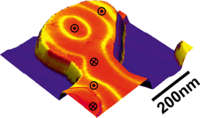
Large tunneling anisotropic magnetoresistance mediated by surface states
by Marie Hervé, Timofey Balashov, Arthur Ernst, and Wulf Wulfhekel
Author(s): Marie Hervé, Timofey Balashov, Arthur Ernst, and Wulf Wulfhekel
The tunneling anisotropic magnetoresistance (TAMR) effect, which is caused by a change in the tunneling density of state of a magnetic layer with change of magnetization direction, has great potential in application in magnetic data storage devices as it only requires one of the electrodes of a tunneling junction to be magnetic. Unfortunately, experimental TAMR values are currently limited to about 10%, requiring improvement for practical use. Here, the authors show that the TAMR in hcp Co can be boosted to 30% by magnetization-dependent hybridization of surface and bulk states. This effect is a general property of hcp Co and can be used in structures suitable for applications.
[Phys. Rev. B 97, 220406(R)] Published Wed Jun 27, 2018
02 Jul 13:36
Stability and magnetic properties of Fe double-layers on Ir (111). (arXiv:1806.11339v1 [cond-mat.mtrl-sci])
by Melanie Dupé, Stefan Heinze, Jairo Sinova, Bertrand Dupé
We investigate the interplay between the structural reconstruction and the magnetic properties of Fe doublelayers on Ir (111)-substrate using first-principles calculations based on density functional theory and mapping of the total energies on an atomistic spin model. We show that, if a second Fe monolayer is deposited on Fe/Ir (111), the stacking may change from hexagonal close-packed to bcc (110)-like accompanied by a reduction of symmetry from trigonal to centered rectangular. Although the bcc-like surface has a lower coordination, we find that this is the structural ground state. This reconstruction has a major impact on the magnetic structure. We investigate in detail the changes in the magnetic exchange interaction, the magnetocrystalline anisotropy, and the Dzyaloshinskii Moriya interaction depending on the stacking sequence of the Fe double-layer. Based on our findings, we suggest a new technique to engineer Dzyaloshinskii Moriya interactions in multilayer systems employing symmetry considerations. The resulting anisotropic Dzyaloshinskii-Moriya interactions may stabilize higher-order skyrmions or antiskyrmions.
02 Jul 13:29
Charge transport properties of the Majorana zero mode induced noncollinear spin selective Andreev reflection. (arXiv:1806.11138v2 [cond-mat.supr-con] UPDATED)
by Xin Shang, Haiwen Liu, Ke Xia
We study the charge transport of the spin-selective Andreev reflection(SSAR) effect between a spin polarized scanning tunneling microscope(STM) tip and a Majorana zero mode(MZM). Considering both the MZM and the excited states, we calculate the conductance and the shot noise power of the noncollinear SSAR using scattering theory. We find the influence of first excited states cannot be avoided when the spin polarization direction of the STM tip and the MZM are not collinear. In this case, the first excited states give rise to inside peaks and change the conductance peak value at zero energy. Moreover, we numerically calculate the shot noise power and the Fano factor of the SSAR effect. Our calculation shows that the shot noise power and the Fano factor are related to the angle between the spin polarization direction of the STM tip and that of the MZM. These transport properties of the SSAR effect provide additional characteristics to detect the MZM via SSAR.
29 Jun 14:13
What makes magnetic skyrmions different from magnetic bubbles ?. (arXiv:1711.07317v3 [cond-mat.mes-hall] UPDATED)
by Andrei B. Bogatyrëv, Konstantin L. Metlov
A large enough piece of ferromagnet is usually not magnetized uniformly, but develops a magnetization texture. In thin films these textures can be doubly-periodic. Such are the well known magnetic bubble domains and the recently observed "skyrmion" magnetization textures in MnSi. In this paper we develop a theory of periodic magnetization textures, based on complex calculus to answer the question -- is there a difference between those two textures even if they seem to carry the same topological winding number (or topological charge) ? We find that such difference exists, facilitated by a different role played by the magnetization vector's in-plane phase. We separate classical-like and quantum-like features of magnetization textures and highlight the role of magnetic anisotropy in favouring either of these cases.
27 Jun 09:16
Vibration-induced modulation of magnetic anisotropy in a magnetic molecule
by Ahmed Kenawy, Janine Splettstoesser, and Maciej Misiorny
Author(s): Ahmed Kenawy, Janine Splettstoesser, and Maciej Misiorny
We theoretically analyze the spectrum of a magnetic molecule when its charge and spin can couple to the molecular vibrations. More specifically, we show that the interplay between charge-vibron and spin-vibron coupling leads to a renormalization of the magnetic anisotropy parameters of the molecule....
[Phys. Rev. B 97, 235441] Published Tue Jun 26, 2018
27 Jun 09:16
Quantifying the leading role of the surface state in the Kondo effect of Co/Ag(111)
by M. Moro-Lagares, J. Fernández, P. Roura-Bas, M. R. Ibarra, A. A. Aligia, and D. Serrate
Author(s): M. Moro-Lagares, J. Fernández, P. Roura-Bas, M. R. Ibarra, A. A. Aligia, and D. Serrate
Using a combination of scanning tunneling spectroscopy and atomic lateral manipulation, we obtained a systematic variation of the Kondo temperature TK of Co atoms on Ag(111) as a function of the surface-state contribution to the total density of states at the atom adsorption site ρs. By sampling the...
[Phys. Rev. B 97, 235442] Published Tue Jun 26, 2018
Manuel Steinbrecher likes this
25 Jun 15:37
Online Search Tool for Graphical Patterns in Electronic Band Structures. (arXiv:1710.11611v2 [cond-mat.mtrl-sci] UPDATED)
by Stanislav S. Borysov, Bart Olsthoorn, M. Berk Gedik, R. Matthias Geilhufe, Alexander V. Balatsky
We present an online graphical pattern search tool for electronic band structure data contained within the Organic Materials Database (OMDB) available at https://omdb.diracmaterials.org/search/pattern. The tool is capable of finding user-specified graphical patterns in the collection of thousands of band structures from high-throughput ab initio calculations in the online regime. Using this tool, it only takes a few seconds to find an arbitrary graphical pattern within the ten electronic bands near the Fermi level for 26,739 organic crystals. The tool can be used to find realizations of functional materials characterized by a specific pattern in their electronic structure, for example, Dirac materials, characterized by a linear crossing of bands; topological insulators, characterized by a "Mexican hat" pattern or an effectively free electron gas, characterized by a parabolic dispersion. The source code of the developed tool is freely available at https://github.com/OrganicMaterialsDatabase/EBS-search and can be transferred to any other electronic band structure database. The approach allows for an automatic online analysis of a large collection of band structures where the amount of data makes its manual inspection impracticable.
Manuel Steinbrecher likes this
27 Nov 16:32
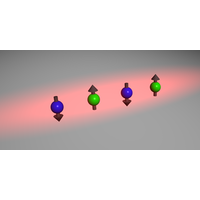
Antiferromagnetic Heisenberg Spin Chain of a Few Cold Atoms in a One-Dimensional Trap
by S. Murmann, F. Deuretzbacher, G. Zürn, J. Bjerlin, S. M. Reimann, L. Santos, T. Lompe, and S. Jochim
Author(s): S. Murmann, F. Deuretzbacher, G. Zürn, J. Bjerlin, S. M. Reimann, L. Santos, T. Lompe, and S. Jochim
Quantum magnetism that goes beyond nearest-neighbor correlations has been observed in a string of four ultracold fermions.
[Phys. Rev. Lett. 115, 215301] Published Thu Nov 19, 2015
06 Oct 15:41
Chiral spin liquids on the kagome lattice
by Krishna Kumar, Kai Sun, and Eduardo Fradkin
Author(s): Krishna Kumar, Kai Sun, and Eduardo Fradkin
We study the nearest-neighbor XXZ Heisenberg quantum antiferromagnet on the kagome lattice. Here we consider the effects of several perturbations: (a) a chirality term, (b) a Dzyaloshinski-Moriya term, and (c) a ring-exchange type term on the bowties of the kagome lattice, and inquire if they can su…
[Phys. Rev. B 92, 094433] Published Fri Sep 18, 2015
06 Oct 15:39
Quantum anomalous Hall effect in graphene coupled to skyrmions
by J. L. Lado and J. Fernández-Rossier
Author(s): J. L. Lado and J. Fernández-Rossier
Skyrmions are topologically protected spin textures, characterized by a topological winding number N, that occur spontaneously in some magnetic materials. Recent experiments have demonstrated the capability to grow graphene on top Fe/Ir, a system that exhibits a two-dimensional skyrmion lattice. Her…
[Phys. Rev. B 92, 115433] Published Mon Sep 21, 2015
06 Oct 15:35
Dzyaloshinskii-Moriya interaction mediated by spin-polarized band with Rashba spin-orbit coupling
by A. Kundu and S. Zhang
Author(s): A. Kundu and S. Zhang
Dzyaloshinskii-Moriya interaction (DMI) plays a central role in breaking chiral symmetry of magnetic domain wall structure. The recently observed chiral dependence of domain wall structures in ultrathin magnetic films with perpendicular anisotropy indicates the presence of a strong DMI. We calculate…
[Phys. Rev. B 92, 094434] Published Mon Sep 21, 2015
06 Oct 15:28
Atomic structure, alloying behavior, and magnetism in small Fe-Pt clusters
by Bheema Lingam Chittari and Vijay Kumar
Author(s): Bheema Lingam Chittari and Vijay Kumar
We report results of the atomic structure, alloying behavior, and magnetism in FemPtn(m+n=2–10) clusters using projector augmented wave (PAW) pseudopotential method and spin-polarized generalized gradient approximation (GGA) for the exchange-correlation energy. These results are compared with those …
[Phys. Rev. B 92, 125442] Published Wed Sep 30, 2015
22 Sep 11:36
Orbital signatures of Fano-Kondo line shapes in STM adatom spectroscopy. (arXiv:1509.03560v3 [cond-mat.str-el] UPDATED)
by Sebastian Frank, David Jacob
We investigate the orbital origin of the Fano-Kondo line shapes measured in STM spectroscopy of magnetic adatoms on metal substrates. To this end we calculate the low-bias tunnel spectra of a Co adatom on the (001) and (111) Cu surfaces with our density functional theory-based ab initio transport scheme augmented by local correlations. In order to associate different $d$-orbitals with different Fano line shapes we only correlate individual $3d$-orbitals instead of the full Co $3d$-shell. We find that Kondo peaks arising in different $d$-levels indeed give rise to different Fano features in the conductance spectra. Hence the shape of measured Fano features allows to draw some conclusions about the orbital responsible for the Kondo resonance, although the actual shape is also influenced by temperature, effective interaction and charge fluctuations. Comparison with a simplified model shows that line shapes are mostly the result of interference between tunneling paths through the correlated $d$-orbital and the $sp$-type orbitals on the Co atom. Very importantly, the amplitudes of the Fano features vary strongly among orbitals, with the $3z^2$-orbital featuring by far the largest amplitude due to its strong direct coupling to the $s$-type conduction electrons.