Dr.jens.brede
Shared posts
[Report] Subatomic resolution force microscopy reveals internal structure and adsorption sites of small iron clusters
Precursor Adsorption on Copper Surfaces as the First Step during the Deposition of Copper: A Density Functional Study with van der Waals Correction

Efficient light emission from inorganic and organic semiconductor hybrid structures by energy-level tuning
Article
Hybrid inorganic-organic structures can overcome the limits of inorganic semiconductor light emitting devices but the energy level offset is an obstacle. Here, Schlesinger et al. lower the ZnO work function with an organometallic donor monolayer and enhance the radiative emission of the hybrid structure.
Nature Communications doi: 10.1038/ncomms7754
Authors: R. Schlesinger, F. Bianchi, S. Blumstengel, C. Christodoulou, R. Ovsyannikov, B. Kobin, K. Moudgil, S. Barlow, S. Hecht, S.R. Marder, F. Henneberger, N. Koch
Influence of the Local Atom Configuration on a Hexagonal Skyrmion Lattice

Experimental Demonstration of a Two-Band Superconducting State for Lead Using Scanning Tunneling Spectroscopy
Author(s): Michael Ruby, Benjamin W. Heinrich, Jose I. Pascual, and Katharina J. Franke
The type I superconductor lead (Pb) has been theoretically predicted to be a two-band superconductor. We use scanning tunneling spectroscopy (STS) to resolve two superconducting gaps with an energy difference of 150 μeV. Tunneling into Pb(111), Pb(110), and Pb(100) crystals reveals a strong depende...
[Phys. Rev. Lett. 114, 157001] Published Tue Apr 14, 2015
Temperature-triggered chemical switching growth of in-plane and vertically stacked graphene-boron nitride heterostructures
Article
Targeted synthesis of vertically stacked graphene (G) and hexagonal boron nitride (h-BN) heterostructures remains a challenge. Here, the authors achieve the selective, CVD growth of h-BN-G and G/h-BN through a temperature-triggered switching reaction.
Nature Communications doi: 10.1038/ncomms7835
Authors: Teng Gao, Xiuju Song, Huiwen Du, Yufeng Nie, Yubin Chen, Qingqing Ji, Jingyu Sun, Yanlian Yang, Yanfeng Zhang, Zhongfan Liu
Magnetic Interaction Between a Radical Spin and a Single-Molecule Magnet in a Molecular Spin-Valve

Surface band structure of Bi_{1−x}Sb_{x}(111)
Author(s): Hadj M. Benia, Carola Straßer, Klaus Kern, and Christian R. Ast
The much debated topology of Bi1-xSbx has been resolved in this very careful and thorough experiment. The authors optimized the Bi1-xSbx growth method and minimized surface imperfections. They performed direct measurements of the surface band structure and followed its evolution within a large window of Sb concentration. They did not detect a third surface band seen in previous experiments. Thus, they conclude that the experimental surface band structure of B1-xSbx in the topologically insulating regime now agrees well with the theoretical predictions.
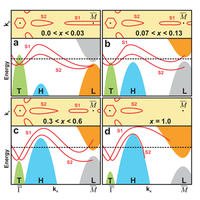
[Phys. Rev. B 91, 161406(R)] Published Mon Apr 13, 2015
Restoring the Co Magnetic Moments at Interfacial Co-Porphyrin Arrays by Site-Selective Uptake of Iron

Local Density of States at Metal-Semiconductor Interfaces: An Atomic Scale Study
Author(s): T. Iffländer, S. Rolf-Pissarczyk, L. Winking, R. G. Ulbrich, A. Al-Zubi, S. Blügel, and M. Wenderoth
The electronic charge distribution at the iron/gallium interface is imaged directly with high spatial and energetic resolution. The metal-semiconductor electronic barrier properties are found to be dependent on both the charge distribution and chemical bonds between the metal and semiconductor atoms.
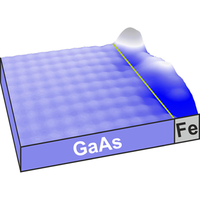
[Phys. Rev. Lett. 114, 146804] Published Thu Apr 09, 2015
Slow Magnetic Relaxation in Uranium(III) and Neodymium(III) Cyclooctatetraenyl Complexes

Field-Dependent Size and Shape of Single Magnetic Skyrmions. (arXiv:1504.01573v1 [cond-mat.mes-hall])
The atomic-scale spin structure of individual isolated skyrmions in an ultrathin film is investigated in real space by spin-polarized scanning tunneling microscopy. Their axial symmetry as well as their unique rotational sense is revealed by using both out-of-plane and in-plane sensitive tips. The size and shape of skyrmions change as a function of magnetic field. An analytical expression for the description of skyrmions is proposed and applied to connect the experimental data to the original theoretical model describing chiral skyrmions. Thereby, the relevant material parameters responsible for skyrmion formation can be obtained.
Long- versus Short-Range Scattering in Doped Epitaxial Graphene

Ultrafast electron dynamics in epitaxial graphene investigated with time- and angle-resolved photoemission spectroscopy
Orthogonal Insertion of Lanthanide and Transition-Metal Atoms in Metal–Organic Networks on Surfaces
Abstract
The orthogonal coordinative properties of tetrapyrrole macrocycles and nitrile ligands have been used in a multistep procedure towards interfacial d-f hetero-bimetallic nanoarchitectures based on a free-base porphyrin derivative functionalized with meso-cyanobiphenylene substituents. Molecular-level scanning tunneling microscopy studies reveal that the porphyrin module alone self-assembles on Ag(111) in a close-packed layer with a square unit cell. Upon co-deposition of Gd atoms, a square-planar motif is formed that reflects the fourfold coordination of CN ligands to the rare-earth centers. The resulting nanoporous network morphology is retained following exposure to a beam of Co atoms, which induces selective porphyrin metalation and ultimately yields a gridlike 2D metallosupramolecular architecture.

Surface-confined d–f bimetallic 2D coordination nanosystems have been achieved by using a three-step procedure that exploits orthogonal coordination interactions of CN-functionalized free-base porphyrin linkers with rare-earth and transition-metal centers. By systematic STM investigations the assembly process was established and the resulting nanoarchitectures characterized at the molecular level.
Chen's derivative rule revisited: Role of tip-orbital interference in STM. (arXiv:1503.09189v1 [cond-mat.mtrl-sci])
On the occasion of its 25th anniversary, we revise Chen's derivative rule for electron tunneling [C.J. Chen, Phys. Rev. B 42, 8841 (1990)] for the purpose of computationally efficient simulations of scanning tunneling microscopy (STM) based on first principles electronic structure data. The revised model allows the weighting of tunneling matrix elements of different tip orbital characters by an arbitrary energy independent choice or based on energy dependent weighting coefficients obtained by an expansion of the tip single electron wavefunctions/density of states projected onto the tip apex atom. Tip-orbital interference in the STM junction is included in the model by construction and can be analyzed quantitatively. As a further advantage, arbitrary tip geometrical orientations are included in the revised model by rotating the coordinate system of the tip apex using Euler angles and redefining the weighting coefficients of the tunneling matrix elements. We demonstrate the reliability of the model by applying it to two functionalized surfaces of recent interest where quantum interference effects play an important role in the STM imaging process: N-doped graphene and a magnetic Mn2H complex on the Ag(111) surface. We find that the proposed tunneling model is 25 times faster than the Bardeen method concerning computational time, while maintaining good agreement. Our results show that the electronic structure of the tip has a considerable effect on STM images, and the Tersoff-Hamann model does not always provide sufficient results in view of quantum interference effects. For both studied surfaces we highlight the importance of interference between s and pz tip orbitals that can cause a significant contrast change in the STM images.
Giant tunnel-electron injection in nitrogen-doped graphene
Author(s): Jérôme Lagoute, Frédéric Joucken, Vincent Repain, Yann Tison, Cyril Chacon, Amandine Bellec, Yann Girard, Robert Sporken, Edward H. Conrad, François Ducastelle, Mattias Palsgaard, Nick Papior Andersen, Mads Brandbyge, and Sylvie Rousset
Scanning tunneling microscopy experiments have been performed to measure the local electron injection in nitrogen-doped graphene on SiC(0001¯) and were successfully compared to ab initio calculations. In graphene, a gaplike feature is measured around the Fermi level due to a phonon-mediated tunnelin...
[Phys. Rev. B 91, 125442] Published Tue Mar 31, 2015
Conductance signatures of electron confinement induced by strained nanobubbles in graphene. (arXiv:1503.08488v2 [cond-mat.mes-hall] UPDATED)
We investigate the impact of strained nanobubbles on the conductance characteristics of graphene nanoribbons using a combined molecular dynamics - tight-binding simulation scheme. We describe in detail how the conductance, density of states, and current density of zigzag or armchair graphene nanoribbons are modified by the presence of a nanobubble. In particular, we establish that low-energy electrons can be confined in the vicinity or within the nanobubbles by the delicate interplay between the pseudomagnetic field pattern created by the shape of the bubble, mode mixing, and substrate interaction. The coupling between confined evanescent states and propagating modes can be enhanced under different clamping conditions, which translates into Fano resonances in the conductance traces.
Magnetic-field-assisted electron confinement and valley splitting in strained graphene. (arXiv:1503.08392v1 [cond-mat.mtrl-sci])
Spatially varying strained graphene can acquire interesting electronic properties because of the strain-induced valley-dependent gauge (pseudomagnetic) fields1,2. Here we report the realization of strained graphene regions located close to the step edges of Cu(111), obtained by using thermal strain engineering3,4. We study these strained structures with sub-nanometre-resolved scanning tunnelling microscopy and spectroscopy and identify their spatially modulated Dirac points, demonstrating the effect of overlap of Cu and graphene wave functions on the charge transfer between them5. By applying a magnetic field of 8 Tesla, electron confinement, as revealed by regularly spaced sharp resonances6,7, is observed in the strained graphene. In some regions of the strained graphene, repetitive pairs of resonance peaks appear in the tunnelling spectra. This provides direct and compelling evidence for lifting of valley degeneracy due to the coexistence of both the magnetic field and the pseudomagnetic field.
Nanoscale determination of the mass enhancement factor in the lightly doped bulk insulator lead selenide
Article
Electron–phonon coupling influences the thermal and electronic properties of many solid materials. Zeljkovic et al . now combine Landau level spectroscopy and scanning tunnelling microscopy to extract quantitative information on electron–phonon coupling in the insulator lead selenide.
Nature Communications doi: 10.1038/ncomms7559
Authors: Ilija Zeljkovic, Kane L. Scipioni, Daniel Walkup, Yoshinori Okada, Wenwen Zhou, R Sankar, Guoqing Chang, Yung Jui Wang, Hsin Lin, Arun Bansil, Fangcheng Chou, Ziqiang Wang, Vidya Madhavan
Structural and Electronic Properties of Pb- Intercalated Graphene on Ru(0001)

Synthesis of Surface Covalent Organic Frameworks via Dimerization and Cyclotrimerization of Acetyls

Scanning Quantum Dot Microscopy. (arXiv:1503.07738v1 [cond-mat.mes-hall])
Interactions between atomic and molecular objects are to a large extent defined by the nanoscale electrostatic potentials which these objects produce. We introduce a scanning probe technique that enables three-dimensional imaging of local electrostatic potential fields with sub-nanometer resolution. Registering single electron charging events of a molecular quantum dot attached to the tip of a (qPlus tuning fork) atomic force microscope operated at 5 K, we quantitatively measure the quadrupole field of a single molecule and the dipole field of a single metal adatom, both adsorbed on a clean metal surface. Because of its high sensitivity, the technique can record electrostatic potentials at large distances from their sources, which above all will help to image complex samples with increased surface roughness.
Resonant interaction of trapped cold atoms with a magnetic cantilever tip. (arXiv:1503.07825v1 [quant-ph])
Magnetic resonance in an ensemble of laser-cooled trapped Rb atoms is excited using a micro- cantilever with a magnetic tip. The cantilever is mounted on a multi-layer chip designed to capture, cool, and magnetically transport cold atoms. The coupling is observed by measuring the loss from a magnetic trap as the oscillating cantilever induces Zeeman state transitions in the atoms. Interfacing cold atoms with mechanical devices could enable probing and manipulating atomic spins with nanometer spatial resolution and single-spin sensitivity, leading to new capabilities in quantum computation, quantum simulation, or precision sensing.
Densely Packed Perylene Layers on the Rutile TiO2(110)-(1 × 1) Surface

Controlling the Spin of Co Atoms on Pt(111) by Hydrogen Adsorption
Dr.jens.bredeOuch... There goes the next one...
Author(s): Q. Dubout, F. Donati, C. Wäckerlin, F. Calleja, M. Etzkorn, A. Lehnert, L. Claude, P. Gambardella, and H. Brune
 Cobalt atoms exposed to hydrogen gas have higher spins, an effect that could be used to build magnetic nanostructures and lattices.
[Phys. Rev. Lett. 114, 106807] Published Wed Mar 11, 2015
Square ice in graphene nanocapillaries
Square ice in graphene nanocapillaries
Nature 519, 7544 (2015). doi:10.1038/nature14295
Authors: G. Algara-Siller, O. Lehtinen, F. C. Wang, R. R. Nair, U. Kaiser, H. A. Wu, A. K. Geim & I. V. Grigorieva
Bulk water exists in many forms, including liquid, vapour and numerous crystalline and amorphous phases of ice, with hexagonal ice being responsible for the fascinating variety of snowflakes. Much less noticeable but equally ubiquitous is water adsorbed at interfaces and confined in microscopic pores. Such low-dimensional water determines aspects of various phenomena in materials science, geology, biology, tribology and nanotechnology. Theory suggests many possible phases for adsorbed and confined water, but it has proved challenging to assess its crystal structure experimentally. Here we report high-resolution electron microscopy imaging of water locked between two graphene sheets, an archetypal example of hydrophobic confinement. The observations show that the nanoconfined water at room temperature forms ‘square ice’—a phase having symmetry qualitatively different from the conventional tetrahedral geometry of hydrogen bonding between water molecules. Square ice has a high packing density with a lattice constant of 2.83 Å and can assemble in bilayer and trilayer crystallites. Molecular dynamics simulations indicate that square ice should be present inside hydrophobic nanochannels independently of their exact atomic nature.
Chemically functionalized magnetic exchange interactions of hybrid organic-ferromagnetic metal interfaces
Author(s): Rico Friedrich, Vasile Caciuc, Nikolai S. Kiselev, Nicolae Atodiresei, and Stefan Blügel
We theoretically explore through systematic multiscale ab initio and Monte Carlo calculations how the surface magnetism of a ferromagnetic surface can be fine-tuned by nonmagnetic organic molecules containing a single π bond. We demonstrate that a magnetic hardening or softening can be induced depen...
[Phys. Rev. B 91, 115432] Published Wed Mar 25, 2015
Supramolecular nesting of cyclic polymers

Nature Chemistry 7, 317 (2015). doi:10.1038/nchem.2182
Authors: Dmitry V. Kondratuk, Luís M. A. Perdigão, Ayad M. S. Esmail, James N. O'Shea, Peter H. Beton & Harry L. Anderson
Biopolymers adopt functional tertiary structures through folding and multiplex formation. Synthetic molecules with protein-like dimensions — monodisperse cyclic porphyrin polymers with diameters of 13–21 nm — have now been shown to exhibit biomimetic self-organization by forming nested structures on a gold surface. These assemblies are formed both under vacuum and during deposition from solution.
Unlocking Bloch-type chirality in ultrathin magnets through uniaxial strain
Article
Magnetic domain walls can exhibit a variety of different spin textures. Chen et al . show that it is possible to switch these textures between left handed, right handed, cycloidal, helical and mixed domain wall structures by controlling uniaxial strain in iron/nickel bilayer thin films on tungsten.
Nature Communications doi: 10.1038/ncomms7598
Authors: Gong Chen, Alpha T. N’Diaye, Sang Pyo Kang, Hee Young Kwon, Changyeon Won, Yizheng Wu, Z. Q. Qiu, Andreas K. Schmid