
Journal of the American Chemical Society
DOI: 10.1021/jacs.5b03114

The possibility to design novel functional materials with desired and controlled characteristics demands a thorough understanding of the electronic structure of the building molecules and of the derived molecular materials. Phthalocyanines are versatile molecules, suitable for a variety of technological applications. For example, FePc capability to activate oxygen makes it successfully used in biomimetic catalysis. Since the activation of oxygen seems to take place at the metal center of the molecules, causing a change of the metal ionic state, it is of particular interest to characterize the ionic state of the central metal atom under working/activation conditions. The study carried out by Bidermane et al. (pp. 1259–1265) addresses the issue of identifying the influence of external factors on the electronic structure of the molecules in novel functional materials. The comparison between the electronic properties of gas phase and thick films on surfaces are analyzed by means of XPS and multiplet calculations. These kinds of studies are fundamental for enlightening the purely molecular electronic ‘fingerprint’ and the modification induced by different working conditions of such molecular films when employed in technological application.
Nature Nanotechnology 10, 534 (2015). doi:10.1038/nnano.2015.70
Authors: Xu Cui, Gwan-Hyoung Lee, Young Duck Kim, Ghidewon Arefe, Pinshane Y. Huang, Chul-Ho Lee, Daniel A. Chenet, Xian Zhang, Lei Wang, Fan Ye, Filippo Pizzocchero, Bjarke S. Jessen, Kenji Watanabe, Takashi Taniguchi, David A. Muller, Tony Low, Philip Kim & James Hone
Dr.jens.brede...
Nature Nanotechnology 10, 507 (2015). doi:10.1038/nnano.2015.79
Authors: Chitraleema Chakraborty, Laura Kinnischtzke, Kenneth M. Goodfellow, Ryan Beams & A. Nick Vamivakas
Although semiconductor defects can often be detrimental to device performance, they are also responsible for the breadth of functionality exhibited by modern optoelectronic devices. Artificially engineered defects (so-called quantum dots) or naturally occurring defects in solids are currently being investigated for applications ranging from quantum information science and optoelectronics to high-resolution metrology. In parallel, the quantum confinement exhibited by atomically thin materials (semi-metals, semiconductors and insulators) has ushered in an era of flatland optoelectronics whose full potential is still being articulated. In this Letter we demonstrate the possibility of leveraging the atomically thin semiconductor tungsten diselenide (WSe2) as a host for quantum dot-like defects. We report that this previously unexplored solid-state quantum emitter in WSe2 generates single photons with emission properties that can be controlled via the application of external d.c. electric and magnetic fields. These new optically active quantum dots exhibit excited-state lifetimes on the order of 1 ns and remarkably large excitonic g-factors of 10. It is anticipated that WSe2 quantum dots will provide a novel platform for integrated solid-state quantum photonics and quantum information processing, as well as a rich condensed-matter physics playground with which to explore the coupling of quantum dots and atomically thin semiconductors.
Dr.jens.bredeand...
Nature Nanotechnology 10, 491 (2015). doi:10.1038/nnano.2015.60
Authors: Ajit Srivastava, Meinrad Sidler, Adrien V. Allain, Dominik S. Lembke, Andras Kis & A. Imamoğlu
Semiconductor quantum dots have emerged as promising candidates for the implementation of quantum information processing, because they allow for a quantum interface between stationary spin qubits and propagating single photons. In the meantime, transition-metal dichalcogenide monolayers have moved to the forefront of solid-state research due to their unique band structure featuring a large bandgap with degenerate valleys and non-zero Berry curvature. Here, we report the observation of zero-dimensional anharmonic quantum emitters, which we refer to as quantum dots, in monolayer tungsten diselenide, with an energy that is 20–100 meV lower than that of two-dimensional excitons. Photon antibunching in second-order photon correlations unequivocally demonstrates the zero-dimensional anharmonic nature of these quantum emitters. The strong anisotropic magnetic response of the spatially localized emission peaks strongly indicates that radiative recombination stems from localized excitons that inherit their electronic properties from the host transition-metal dichalcogenide. The large ∼1 meV zero-field splitting shows that the quantum dots have singlet ground states and an anisotropic confinement that is most probably induced by impurities or defects. The possibility of achieving electrical control in van der Waals heterostructures and to exploit the spin–valley degree of freedom renders transition-metal-dichalcogenide quantum dots interesting for quantum information processing.
Dr.jens.bredeand this.
Nature Nanotechnology 10, 497 (2015). doi:10.1038/nnano.2015.75
Authors: Yu-Ming He, Genevieve Clark, John R. Schaibley, Yu He, Ming-Cheng Chen, Yu-Jia Wei, Xing Ding, Qiang Zhang, Wang Yao, Xiaodong Xu, Chao-Yang Lu & Jian-Wei Pan
Single quantum emitters (SQEs) are at the heart of quantum optics and photonic quantum-information technologies. To date, all the demonstrated solid-state single-photon sources are confined to one-dimensional (1D; ref. 3) or 3D materials. Here, we report a new class of SQEs based on excitons that are spatially localized by defects in 2D tungsten-diselenide (WSe2) monolayers. The optical emission from these SQEs shows narrow linewidths of ∼130 μeV, about two orders of magnitude smaller than those of delocalized valley excitons. Second-order correlation measurements revealed a strong photon antibunching, which unambiguously established the single-photon nature of the emission. The SQE emission shows two non-degenerate transitions, which are cross-linearly polarized. We assign this fine structure to two excitonic eigenmodes whose degeneracy is lifted by a large ∼0.71 meV coupling, probably because of the electron–hole exchange interaction in the presence of anisotropy. Magneto-optical measurements also reveal an exciton g factor of ∼8.7, several times larger than those of delocalized valley excitons. In addition to their fundamental importance, establishing new SQEs in 2D quantum materials could give rise to practical advantages in quantum-information processing, such as an efficient photon extraction and a high integratability and scalability.
Dr.jens.bredeCan someone forward this to me?
Nature Nanotechnology 10, 503 (2015). doi:10.1038/nnano.2015.67
Authors: M. Koperski, K. Nogajewski, A. Arora, V. Cherkez, P. Mallet, J.-Y. Veuillen, J. Marcus, P. Kossacki & M. Potemski
Crystal structure imperfections in solids often act as efficient carrier trapping centres, which, when suitably isolated, act as sources of single photon emission. The best known examples of such attractive imperfections are well-width or composition fluctuations in semiconductor heterostructures (resulting in the formation of quantum dots) and coloured centres in wide-bandgap materials such as diamond. In the recently investigated thin films of layered compounds, the crystal imperfections may logically be expected to appear at the edges of commonly investigated few-layer flakes of these materials exfoliated on alien substrates. Here, we report comprehensive optical micro-spectroscopy studies of thin layers of tungsten diselenide (WSe2), a representative semiconducting dichalcogenide with a bandgap in the visible spectral range. At the edges of WSe2 flakes (transferred onto Si/SiO2 substrates) we discover centres that, at low temperatures, give rise to sharp emission lines (100 μeV linewidth). These narrow emission lines reveal the effect of photon antibunching, the unambiguous attribute of single photon emitters. The optical response of these emitters is inherently linked to the two-dimensional properties of the WSe2 monolayer, as they both give rise to luminescence in the same energy range, have nearly identical excitation spectra and have very similar, characteristically large Zeeman effects. With advances in the structural control of edge imperfections, thin films of WSe2 may provide added functionalities that are relevant for the domain of quantum optoelectronics.
Nature Nanotechnology 10, 541 (2015). doi:10.1038/nnano.2015.74
Authors: Luka Trifunovic, Fabio L. Pedrocchi, Silas Hoffman, Patrick Maletinsky, Amir Yacoby & Daniel Loss
Nature Materials. doi:10.1038/nmat4302
Authors: Y. Miyata, K. Nakayama, K. Sugawara, T. Sato & T. Takahashi
The recent discovery of possible high-temperature (Tc) superconductivity over 65 K in a monolayer FeSe film on SrTiO3 (refs , , , , , ) triggered a fierce debate on how superconductivity evolves from bulk to film, because bulk FeSe crystal exhibits a Tc of no higher than 10 K (ref. ). However, the difficulty in controlling the carrier density and the number of FeSe layers has hindered elucidation of this problem. Here, we demonstrate that deposition of potassium onto FeSe films markedly expands the accessible doping range towards the heavily electron-doped region. Intriguingly, we have succeeded in converting non-superconducting films with various thicknesses into superconductors with Tc as high as 48 K. We also found a marked increase in the magnitude of the superconducting gap on decreasing the FeSe film thickness, indicating that the interface plays a crucial role in realizing the high-temperature superconductivity. The results presented provide a new strategy to enhance and optimize Tc in ultrathin films of iron-based superconductors.
Quantum anomalous Hall (QAH) effect, with potential applications in low-power-consumption electronics, is predicted in the heterostructure of graphene on the (001) surface of a real antiferromagnetic insulator RbMnCl3, based on density-functional theory and Wannier function methods. Due to the interactions from the substrate, a much large exchange field (about 280 meV) and an enhanced Rashba spin-orbit coupling are induced in graphene, leading to a topologically nontrivial QAH gap opened in the system. The avenues of enhancing the nontrivial gap are also proposed, from which nearly a gap one order large is achieved. Our work demonstrates that this graphene-based heterostructure is an appropriate candidate to be employed to experimentally observe the QAH effect and explore the promising applications.
Scientific Reports 5 doi: 10.1038/srep10629
Author(s): S. Meierott, N. Néel, and J. Kröger
Single Co atoms adsorbed to missing-row reconstructed Au(110) exhibit a zero-bias peak in spectra of the differential conductance acquired with a low-temperature scanning tunneling microscope. This peak is assigned to the Abrikosov-Suhl resonance, which arises due to the Kondo effect. The surface re...
[Phys. Rev. B 91, 201111(R)] Published Thu May 28, 2015
Author(s): A. Kreisel, Peayush Choubey, T. Berlijn, W. Ku, B. M. Andersen, and P. J. Hirschfeld
We apply a recently developed method combining first principles based Wannier functions with solutions to the Bogoliubov–de Gennes equations to the problem of interpreting STM data in cuprate superconductors. We show that the observed images of Zn on the surface of Bi2Sr2CaCu2O8 can only be understo…
[Phys. Rev. Lett. 114, 217002] Published Wed May 27, 2015

We report a first-principle study on electronic structure and simulation of the spin-polarized scanning tunneling microscopy graphic of a benzene/Fe4N interface. Fe4N is a compound ferromagnet suitable for many spintronic applications. We found that, depending on the particular termination schemes and interface configurations, the spin polarization on the benzene surface shows a rich variety of properties ranging from cosine-type oscillation to polarization inversion. Spin-polarization inversion above benzene is resulting from the hybridizations between C pz and the out-of-plane d orbitals of Fe atom.
Scientific Reports 5 doi: 10.1038/srep10602
The synthesis of a hexa-peri-hexabenzocoronene (HBC) with a central borazine core is described. The solid-state structure of this BN-doped HBC (BN-HBC) is isotypic with that of the parent HBC. Scanning tunneling microscopy shows that BN-HBC lies flat on Au(111) in a two-dimensional pattern.

A change of heart: The borazine derivative of hexa-peri-hexabenzocoronene was produced in a high-temperature reaction through multiple dehydrogenation of a borazine. The solid-state structure of this BN-doped HBC (BN-HBC) is isotypic with that of the parent HBC. Scanning tunneling microscopy shows that BN-HBC lies flat on Au(111) in a two-dimensional pattern.
Author(s): Jeannette Kemmer, Stefan Wilfert, Jens Kügel, Tobias Mauerer, Pin-Jui Hsu, and Matthias Bode
The growth and magnetic domain structure of ultrathin Fe films epitaxially grown on face-centered cubic (fcc) Rh(001) is investigated by spin-polarized scanning tunneling microscopy (SP-STM) at low temperatures (T=5.5K). Our results indicate that the cleaning procedure applied to the Rh(001) substra...
[Phys. Rev. B 91, 184412] Published Wed May 20, 2015
Article
Quantum spin Hall edge states are protected by time-reversal symmetry and are expected to disappear in a strong magnetic field. Here, the authors use microwave impedance microscopy and find, surprisingly, edge conduction in mercury telluride quantum wells that survives up to 9 T with little change.
Nature Communications doi: 10.1038/ncomms8252
Authors: Eric Yue Ma, M. Reyes Calvo, Jing Wang, Biao Lian, Mathias Mühlbauer, Christoph Brüne, Yong-Tao Cui, Keji Lai, Worasom Kundhikanjana, Yongliang Yang, Matthias Baenninger, Markus König, Christopher Ames, Hartmut Buhmann, Philipp Leubner, Laurens W. Molenkamp, Shou-Cheng Zhang, David Goldhaber-Gordon, Michael A. Kelly, Zhi-Xun Shen
Author(s): Roozbeh Shokri, Holger L. Meyerheim, Sumalay Roy, Katayoon Mohseni, A. Ernst, M. M. Otrokov, E. V. Chulkov, and J. Kirschner
A bilayer of bismuth is recognized as a prototype two-dimensional topological insulator. Here we present a simple and well reproducible top-down approach to prepare a flat and well ordered bismuth bilayer with a lateral size of several hundred nanometers on Bi2Se3(0001). Using scanning tunneling mic...
[Phys. Rev. B 91, 205430] Published Thu May 21, 2015
Author(s): Q. D. Gibson, L. M. Schoop, L. Muechler, L. S. Xie, M. Hirschberger, N. P. Ong, R. Car, and R. J. Cava
Design principles and predictions of new three-dimensional (3D) Dirac semimetals are presented and placed in the context of currently known materials. Three different design principles are presented (cases I, II, and III), each of which yields predictions for new candidates. For case I, 3D Dirac sem...
[Phys. Rev. B 91, 205128] Published Fri May 22, 2015
Dr.jens.bredeLot's of math, that I can't follow right away... Can't say much more than that.
Author(s): Howon Kim and Yukio Hasegawa
A highly stable scanning tunneling microscope measures the electrical properties of a metal on a scale smaller than individual atoms.
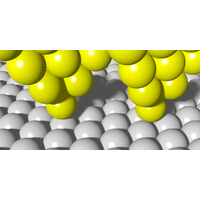
[Phys. Rev. Lett. 114, 206801] Published Fri May 22, 2015

Motivated by the striking promise of quantum computation, Majorana bound states (MBSs) in solid-state systems have attracted wide attention in recent years. In particular, the wavefunction localization of MBSs is a key feature and crucial for their future implementation as qubits. Here, we investigate the spatial and electronic characteristics of topological superconducting chains of iron atoms on the surface of Pb(110) by combining scanning tunneling microscopy (STM) and atomic force microscopy (AFM). We demonstrate that the Fe chains are mono-atomic, structured in a linear fashion, and exhibit zero-bias conductance peaks at their ends which we interprete as signature for a Majorana bound state. Spatially resolved conductance maps of the atomic chains reveal that the MBSs are well localized at the chain ends (below 25 nm), with two localization lengths as predicted by theory. Our observation lends strong support to use MBSs in Fe chains as qubits for quantum computing devices.
Nature Physics. doi:10.1038/nphys3342
Authors: David J. van Woerkom, Attila Geresdi & Leo P. Kouwenhoven
The parity modulation of the ground state of a superconducting island is a direct consequence of the presence of the Cooper-pair condensate preferring an even number of charge carriers. The addition energy of an odd, unpaired quasiparticle equals the superconducting gap, Δ, suppressing single-electron hopping in the low-temperature limit, kBT ≪ Δ. Controlling the quasiparticle occupation is of fundamental importance for superconducting qubits as single-electron tunnelling results in decoherence. In particular, topological quantum computation relies on the parity control and readout of Majorana bound states. Here we present the first parity modulation of a niobium titanite nitride (NbTiN) Cooper-pair transistor coupled to aluminium (Al) leads. We show that this circuit is compatible with the magnetic field requirement B ∼ 100 mT of inducing topological superconductivity in spin–orbit-coupled nanowires. Our observed parity lifetime exceeding 1 min is several orders of magnitude higher than the required gate time for flux-controlled braiding of Majorana states.


