Dr.jens.brede
Shared posts
Nanoscale patterning, macroscopic reconstruction, and enhanced surface stress by organic adsorption on vicinal surfaces
Direct imaging of electron transfer and its influence on superconducting pairing at FeSe/SrTiO3 interface. (arXiv:1701.03678v1 [cond-mat.supr-con])
The exact mechanism responsible for the tenfold enhancement of superconducting transition temperature (Tc) in a monolayer iron selenide (FeSe) on SrTiO3(STO) substrate over that of bulk FeSe, is an open issue. We present here a coordinated study of electrical transport and low temperature electron energy-loss spectroscopy (EELS) measurements on FeSe/STO films of various thicknesses. Our EELS mapping across the FeSe/STO interface shows direct evidence of band-bending caused by electrons transferred from STO to FeSe layer. The transferred electrons were found to accumulate only within the first two atomic layers of FeSe films near the STO substrate. Our transport results found a positive backgate applied from STO is particularly effective in enhancing Tc of the films while minimally changing the carrier density. We suggest that the positive backgate tends to 'pull' the transferred electrons in FeSe films closer to the interface and thus further enhances both their coupling to interfacial phonons and the electron-electron interaction within FeSe films, thus leading to a huge enhancement of Tc in FeSe films.
Probing Magnetic Excitations and Correlations in Single and Coupled Spin Systems with Scanning Tunneling Spectroscopy. (arXiv:1701.03587v1 [cond-mat.mes-hall])
Spectroscopic measurements with low-temperature scanning tunneling microscopes have been used very successfully for studying not only individual atomic or molecular spins on surfaces but also complexly designed coupled systems. The symmetry breaking of the supporting surface induces magnetic anisotropy which lead to characteristic fingerprints in the spectrum of the differential conductance and can be well understood with simple model Hamiltonians. Furthermore, correlated many-particle states can emerge due to the interaction with itinerant electrons of the electrodes, making these systems ideal prototypical quantum systems. In this manuscript more complex bipartite and spin-chains will be discussed additionally. Their spectra enable to determine precisely the nature of the interactions between the spins which can lead to the formation of new quantum states which emerge by interatomic entanglement.
FePc Adsorption on the Moiré Superstructure of Graphene Intercalated with a Cobalt Layer

Probing the Nodal Structure of Landau Level Wave Functions in Real Space
Author(s): J. R. Bindel, J. Ulrich, M. Liebmann, and M. Morgenstern
The inversion layer of p−InSb(110) obtained by Cs adsorption of 1.8% of a monolayer is used to probe the Landau level wave functions within smooth potential valleys by scanning tunneling spectroscopy at 14 T. The nodal structure becomes apparent as a double peak structure of each spin polarized firs…
[Phys. Rev. Lett. 118, 016803] Published Thu Jan 05, 2017
Colloquium: Persistent spin textures in semiconductor nanostructures
Author(s): John Schliemann
Spintronics continues to be a field of fast evolution where new concepts and devices are continuously being developed. One of the limiting factors in spintronics is the decoherence time in the materials used. This Colloquium reviews the current situation in the understanding of decoherence in some important semiconductors which are being considered in applications.

[Rev. Mod. Phys. 89, 011001] Published Thu Jan 05, 2017
Single-Molecule Vibrational Spectroscopy of H2O on Anatase TiO2(101)

Ordering of Zn-centered porphyrin and phthalocyanine on TiO2(011): STM studies
Abstract
Zn(II)phthalocyanine molecules (ZnPc) were thermally deposited on a rutile TiO2(011) surface and on Zn(II)meso-tetraphenylporphyrin (ZnTPP) wetting layers at room temperature and after elevated temperature thermal processing. The molecular homo- and heterostructures were characterized by high-resolution scanning tunneling microscopy (STM) at room temperature and their geometrical arrangement and degree of ordering are compared with the previously studied copper phthalocyanine (CuPc) and ZnTPP heterostructures. It was found that the central metal atom may play some role in ordering and growth of phthalocyanine/ZnTPP heterostructures, causing differences in stability of upright standing ZnPc versus CuPc molecular chains at given thermal annealing conditions.
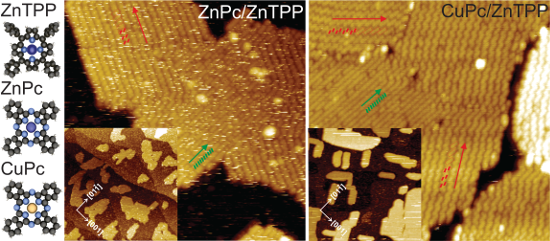
Beilstein J. Nanotechnol. 2017, 8, 99–107. doi:10.3762/bjnano.8.11
Coherent spin-exchange via a quantum mediator
Nature Nanotechnology 12, 26 (2017). doi:10.1038/nnano.2016.188
Authors: Timothy Alexander Baart, Takafumi Fujita, Christian Reichl, Werner Wegscheider & Lieven Mark Koenraad Vandersypen
Coherent interactions at a distance provide a powerful tool for quantum simulation and computation. The most common approach to realize an effective long-distance coupling ‘on-chip’ is to use a quantum mediator, as has been demonstrated for superconducting qubits and trapped ions. For quantum dot arrays, which combine a high degree of tunability with extremely long coherence times, the experimental demonstration of the time evolution of coherent spin–spin coupling via an intermediary system remains an important outstanding goal. Here, we use a linear triple-quantum-dot array to demonstrate a coherent time evolution of two interacting distant spins via a quantum mediator. The two outer dots are occupied with a single electron spin each, and the spins experience a superexchange interaction through the empty middle dot, which acts as mediator. Using single-shot spin readout, we measure the coherent time evolution of the spin states on the outer dots and observe a characteristic dependence of the exchange frequency as a function of the detuning between the middle and outer dots. This approach may provide a new route for scaling up spin qubit circuits using quantum dots, and aid in the simulation of materials and molecules with non-nearest-neighbour couplings such as MnO (ref. 27), high-temperature superconductors and DNA. The same superexchange concept can also be applied in cold atom experiments.
A dressed spin qubit in silicon
Nature Nanotechnology 12, 61 (2017). doi:10.1038/nnano.2016.178
Authors: Arne Laucht, Rachpon Kalra, Stephanie Simmons, Juan P. Dehollain, Juha T. Muhonen, Fahd A. Mohiyaddin, Solomon Freer, Fay E. Hudson, Kohei M. Itoh, David N. Jamieson, Jeffrey C. McCallum, Andrew S. Dzurak & A. Morello
Spin–Orbit Coupling Induced Gap in Graphene on Pt(111) with Intercalated Pb Monolayer

Optical determination of the Néel vector in a CuMnAs thin-film antiferromagnet
Nature Photonics. doi:10.1038/nphoton.2016.255
Authors: V. Saidl, P. Němec, P. Wadley, V. Hills, R. P. Campion, V. Novák, K. W. Edmonds, F. Maccherozzi, S. S. Dhesi, B. L. Gallagher, F. Trojánek, J. Kuneš, J. Železný, P. Malý & T. Jungwirth
Recent breakthroughs in the electrical detection and manipulation of antiferromagnets have opened a new avenue in the research of non-volatile spintronic devices. Antiparallel spin sublattices in antiferromagnets, producing zero dipolar fields, lead to insensitivity to magnetic field perturbations, multi-level stability, ultrafast spin dynamics and other favourable characteristics, and may find utility in fields ranging from magnetic memories to optical signal processing. However, the absence of a net magnetic moment and ultrashort magnetization dynamics timescales make antiferromagnets notoriously difficult to study using common magnetometers or magnetic resonance techniques. Here, we demonstrate the experimental determination of the Néel vector in a thin film of antiferromagnetic CuMnAs (refs 9,10), a prominent material used in the first realization of antiferromagnetic memory chips. We use a table-top femtosecond pump–probe magneto-optical experiment that is considerably more accessible than the traditionally employed large-scale-facility techniques such as neutron diffraction and X-ray magnetic dichroism measurements.
Spin Analogues of Superconductivity and the Integer Quantum Hall Effect in an Array of Spin Chains. (arXiv:1701.01509v1 [cond-mat.mes-hall])
Motivated by the successful idea of using weakly-coupled quantum electronic wires to realize the quantum Hall effects and the quantum spin Hall effects, we theoretically construct two systems composed of weakly-coupled quantum spin chains, which can exhibit spin analogues of superconductivity and the integer quantum Hall effect. Specifically, a certain bilayer of two arrays of interacting spin chains is mapped, via the Jordan-Wigner transformation, to a negative-$U$ Hubbard model that exhibits superconductivity. In addition, an array of spin-orbit-coupled spin chains in the presence of an suitable external magnetic field is transformed to an array of quantum wires that exhibits the integer quantum Hall effect. The resultant spin superconductivity and spin integer quantum Hall effect can be characterized by their ability to transport spin without any resistance.
Spin Orientation of Two-Dimensional Electrons Driven by Temperature-Tunable Competition of Spin–Orbit and Exchange–Magnetic Interactions

[Research Article] Majorana bound state in a coupled quantum-dot hybrid-nanowire system
Step-Edge Assisted Direct Linear Alkane Coupling
Abstract
Direct coupling of alkanes via C−H activation of terminal methyl groups has acquired tremendous interests both scientifically and technically. Herein we present the results of linear alkane-coupling at the step edges of Cu surfaces at modulated temperatures. Combining the observations of scanning tunneling microscopy (STM) with density functional theory plus dispersion (DFT-D) calculations, we elucidate the mechanism of the reaction and demonstrate that the low activation barrier relies on heterogeneous catalysis at the upper step edges, where low-coordinated surface atoms are present. We further reveal the generality of the reaction, so that it can be applied on the step edges of different facets of surfaces.

Direct coupling of alkanes via C−H activation of terminal methyl groups has been achieved at the step edges of Cu surfaces at modulated temperatures. The mechanism of the reaction has been elucidated and demonstrated that the low activation barrier relies on heterogeneous catalysis at the upper step edges, where low-coordinated surface atoms are present.
Fusing tetrapyrroles to graphene edges by surface-assisted covalent coupling

Nature Chemistry 9, 33 (2017). doi:10.1038/nchem.2600
Authors: Yuanqin He, Manuela Garnica, Felix Bischoff, Jacob Ducke, Marie-Laure Bocquet, Matthias Batzill, Willi Auwärter & Johannes V. Barth
Lateral anchoring of heteromolecules to graphene paves the way for the creation of hybrid materials with tunable properties. Now, following a surface-assisted dehydrogenative coupling reaction, the edges of graphene on silver have been functionalized with porphines. This enables the assembly of well-defined multifunctional graphene-based nanostructures.
Homochiral polymerization-driven selective growth of graphene nanoribbons

Nature Chemistry 9, 57 (2017). doi:10.1038/nchem.2614
Authors: Hiroshi Sakaguchi, Shaotang Song, Takahiro Kojima & Takahiro Nakae
Metal surfaces have been believed to be catalytic, but the mechanism of catalysis is unknown. Now, graphene nanoribbons (GNRs) can be grown on Au(111) from a ‘Z-bar-linkage' precursor through a conformation-controlled mechanism. Chemical vapour deposition of precursors adopting a chiral conformation produced homochiral polymers, which are dehydrogenated to form GNRs.
Aromatic and antiaromatic ring currents in a molecular nanoring
Nature advance online publication 19 December 2016. doi:10.1038/nature20798
Authors: Martin D. Peeks, Timothy D. W. Claridge & Harry L. Anderson
Aromatic and antiaromatic molecules—which have delocalized circuits of [4n + 2] or [4n] electrons, respectively—exhibit ring currents around their perimeters. The direction of the ring current in an aromatic molecule is such as to generate a magnetic field that opposes the external field inside the ring (a ‘diatropic’ current), while the ring current in an antiaromatic molecule flows in the reverse direction (‘paratropic’). Similar persistent currents occur in metal or semiconductor rings, when the phase coherence of the electronic wavefunction is preserved around the ring. Persistent currents in non-molecular rings switch direction as a function of the magnetic flux passing through the ring, so that they can be changed from diatropic (‘aromatic’) to paratropic (‘antiaromatic’) simply by changing the external magnetic field. As in molecular systems, the direction of the persistent current also depends on the number of electrons. The relationship between ring currents in molecular and non-molecular rings is poorly understood, partly because they are studied in different size regimes: the largest aromatic molecules have diameters of about one nanometre, whereas persistent currents are observed in microfabricated rings with diameters of 20–1,000 nanometres. Understanding the connection between aromaticity and quantum-coherence effects in mesoscopic rings provides a motivation for investigating ring currents in molecules of an intermediate size. Here we show, using nuclear magnetic resonance spectroscopy and density functional theory, that a six-porphyrin nanoring template complex, with a diameter of 2.4 nanometres, is antiaromatic in its 4+ oxidation state (80 π electrons) and aromatic in its 6+ oxidation state (78 π electrons). The antiaromatic state has a huge paramagnetic susceptibility, despite having no unpaired electrons. This work demonstrates that a global ring current can be promoted in a macrocycle by adjusting its oxidation state to suppress the local ring currents of its components.The discovery of ring currents around a molecule with a circumference of 7.5 nanometres, at room temperature, shows that quantum coherence can persist in surprisingly large molecular frameworks.
Hubbard band versus oxygen vacancy states in the correlated electron metal SrVO_{3}
Author(s): S. Backes, T. C. Rödel, F. Fortuna, E. Frantzeskakis, P. Le Fèvre, F. Bertran, M. Kobayashi, R. Yukawa, T. Mitsuhashi, M. Kitamura, K. Horiba, H. Kumigashira, R. Saint-Martin, A. Fouchet, B. Berini, Y. Dumont, A. J. Kim, F. Lechermann, H. O. Jeschke, M. J. Rozenberg, R. Valentí, and A. F. Santander-Syro
Strong electron correlations in solids are at the heart of fascinating phenomena such as high temperature superconductivity, whose understanding remains a prominent open problem in Physics. A central prediction of dynamical mean field theory (DMFT) is the breaking of Landau’s Fermi liquid, which describes extremely well simple metals like copper, into itinerant heavy quasiparticles and localized Mott-Hubbard states. To test it, electronic structure calculations based on DMFT are usually benchmarked against the photoemission spectra of SrVO3, a cubic perovskite with one d electron per unit cell that is considered the gold standard in this field. However, the present study shows that the UV synchrotron radiation used in the photoemission experiments creates oxygen vacancies, resulting in a strong peak of defect states essentially on top of the SrVO3 Hubbard band. As recent works found that the same peak of vacancy states occurs in noncorrelated wide-gap d0insulators, such as SrTiO3, an unavoidable worry emerges. What if the putative Hubbard bands observed in SrVO3 were just a mirage? What if this strongly correlated effect, a hallmark prediction of DMFT for the past 25 years was just not there? This study thoroughly explores those crucial issues both experimentally and theoretically.
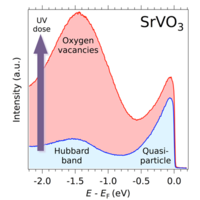
[Phys. Rev. B 94, 241110(R)] Published Mon Dec 19, 2016
Hidden Rashba spin-split states in a quasi-one-dimensional Au atomic chain on ferromagnetic Ni(110)
Author(s): Takuya Warashina, Munisa Nurmamat, Koji Miyamoto, Tatsuya Shishidou, Masaki Taniguchi, Akio Kimura, and Taichi Okuda
An electronic structure of a Au atomic chain on Ni(110), which was investigated decades ago, has been reinvestigated by high-resolution spin- and angle-resolved photoemission spectroscopy. Clear evidence of a Rashba spin split, i.e., spin-polarization reversal between positive and negative wave vect…
[Phys. Rev. B 94, 241109(R)] Published Thu Dec 15, 2016
Potential Energy Driven Spin Manipulation via a Controllable Hydrogen Ligand. (arXiv:1609.00612v2 [cond-mat.mes-hall] UPDATED)
Spin-bearing molecules can be stabilized on surfaces and in junctions with desirable properties such as a net spin that can be adjusted by external stimuli. Using scanning probes, initial and final spin states can be deduced from topographic or spectroscopic data, but how the system transitioned between these states is largely unknown. Here we address this question by manipulating the total spin of magnetic cobalt hydride complexes on a corrugated boron nitride surface with a hydrogen- functionalized scanning probe tip by simultaneously tracking force and conductance. When the additional hydrogen ligand is brought close to the cobalt monohydride, switching between a corre- lated S = 1 /2 Kondo state, where host electrons screen the magnetic moment, and a S = 1 state with magnetocrystalline anisotropy is observed. We show that the total spin changes when the system is transferred onto a new potential energy surface defined by the position of the hydrogen in the junction. These results show how and why chemically functionalized tips are an effective tool to manipulate adatoms and molecules, and a promising new method to selectively tune spin systems.
Atomic-scale visualization of quasiparticle interference on a type-II Weyl semimetal surface. (arXiv:1612.05208v1 [cond-mat.mes-hall])
We combine quasiparticle interference simulation (theory) and atomic resolution scanning tunneling spectro-microscopy (experiment) to visualize the interference patterns on a type-II Weyl semimetal Mo$_{x}$W$_{1-x}$Te$_2$ for the first time. Our simulation based on first-principles band topology theoretically reveals the surface electron scattering behavior. We identify the topological Fermi arc states and reveal the scattering properties of the surface states in Mo$_{0.66}$W$_{0.34}$Te$_2$. In addition, our result reveals an experimental signature of the topology via the interconnectivity of bulk and surface states, which is essential for understanding the unusual nature of this material.
Electrically-driven vibronic spectroscopy with sub-molecular resolution. (arXiv:1612.04653v1 [cond-mat.mes-hall])
A scanning tunneling microscope is used to generate the electroluminescence of phthalocyanine molecules deposited on NaCl/Ag(111). Photon spectra reveal an intense emission line at 1.9 eV that corresponds to the fluorescence of the molecules, and a series of weaker red-shifted lines. Based on a comparison with Raman spectra acquired on macroscopic molecular crystals, these spectroscopic features can be associated to the vibrational modes of the molecules and provide a detailed chemical fingerprint of the probed species. Maps of the vibronic features reveal sub- molecularly-resolved structures whose patterns are related to the symmetry of the probed vibrational modes.
Solution-Synthesized Chevron Graphene Nanoribbons Exfoliated onto H:Si(100)

Mechanistic Picture and Kinetic Analysis of Surface-Confined Ullmann Polymerization

Fermi Surface Manipulation by External Magnetic Field Demonstrated for a Prototypical Ferromagnet
Author(s): E. Młyńczak, M. Eschbach, S. Borek, J. Minár, J. Braun, I. Aguilera, G. Bihlmayer, S. Döring, M. Gehlmann, P. Gospodarič, S. Suga, L. Plucinski, S. Blügel, H. Ebert, and C. M. Schneider
The functionality of today’s technology in magnetic hard disks or memories relies on tiny relativistic effects in electron behavior that were previously believed to be too small to be directly observed. Researchers visualize these effects, for the first time, by showing how the electronic structure of iron responds to the direction of a magnetic field.
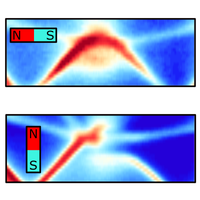
[Phys. Rev. X 6, 041048] Published Fri Dec 09, 2016
Current-induced switching of magnetic molecules on topological insulator surfaces. (arXiv:1612.02711v1 [cond-mat.mes-hall])
Electrical currents at the surface or edge of a topological insulator are intrinsically spin-polarized. We show that such surface/edge currents can be used to switch the orientation of a molecular magnet weakly coupled to the surface or edge of a topological insulator. For the edge of a two-dimensional topological insulator as well as for the surface of a three-dimensional topological insulator the application of a well-chosen surface/edge current can lead to a complete polarization of the molecule if the molecule's magnetic anisotropy axis is appropriately aligned with the current direction. For a generic orientation of the molecule a nonzero but incomplete polarization is obtained. We calculate the probability distribution of the magnetic states and the switching rates as a function of the applied current.
[Report] Robust spin-polarized midgap states at step edges of topological crystalline insulators
Quantum Dots Embedded in Graphene Nanoribbons by Chemical Substitution
